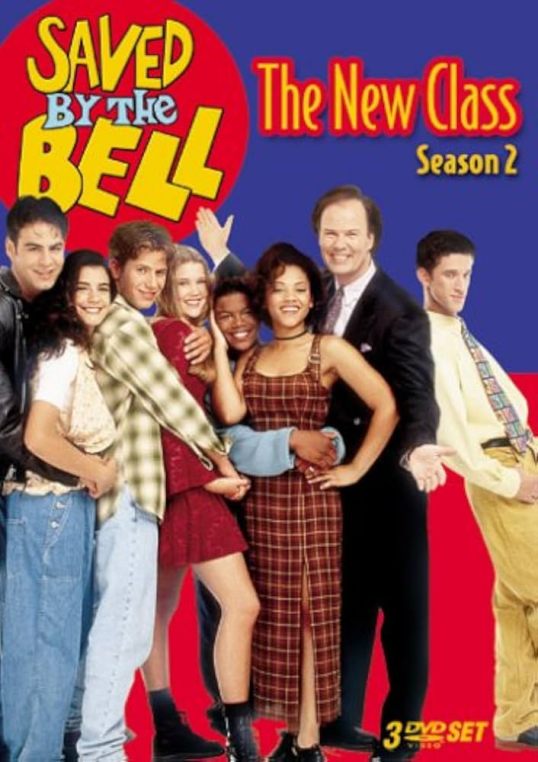
Retro Television Review: Saved By The Bell: The New Class 2.16 “Back At The Ranch”


Welcome to Retro Television Reviews, a feature where we review some of our favorite and least favorite shows of the past!  On Tuesdays, I will be reviewing Saved By The Bell: The New Class, which ran on NBC from 1993 to 2o00.  The show is currently on Prime.

It’s the summer that will never end!

Episode 2.16 “Back at the Ranch”

(Dir by Don Barnhart, originally aired on October 29th, 1994)

Mr. Belding had so much fun working with the Gang at Palisades Country Club that he decides to take them on a week-long trip to a real-life, functioning “dude ranch” that is owned by Screech’s uncle, Lester (Lewis Arquette).

Uhmmm …. okay.  Sure, that makes sense.  Whatever.

Actually, it makes no sense.  Do these kids not have families?  It’s the summer so they all get jobs working for their principal and now they’re going to a ranch with him?  And apparently, they’re going to be working as ranch hands or something?  I mean, what the Hell?  TAKE A REAL VACATION, KIDS!

Plus, since when has Screech had an Uncle Lester who owned a dude ranch?  This has never been mentioned before.  Screech apparently grew up around horses.  Really?  We’re talking about Screech here.

Anyway, Screech is excited to be at the ranch until he sees his cousin, Clint (Bart Johnson).  Clint used to bully Screech when he was a kid and Clint still acts like he knows more about horse-riding and gold-prospecting than Screech.  While Uncle Lester and Mr. Belding drive into town, Clint takes the Gang to search for gold in the hills.  Screech stays at the ranch and has a dream where he’s in an old-timey western.  Oh look!  The townspeople are all played by members of the Gang!  Tommy’s the blacksmith.  Wow.

Screech wakes up and sees that the horses have returned but the gang hasn’t.  That’s because Tommy didn’t adequately tie up the horses at the gold mine and they all ran off.  Clint was heading back to the ranch when he got thrown from his horse.  Now, he’s got a sprained ankle and there’s a rattlesnake nearby.  It’s a good thing that Screech has got his bicycle so he can ride up into the hills and save everyone!

This was one of the stupidest things that I’ve ever seen in my life.  And seriously, that’s all I’m going to say about it.

Late Night Retro Television Review: CHiPs 6.6 “Something Special”


Welcome to Late Night Retro Television Reviews, a feature where we review some of our favorite and least favorite shows of the past!  On Mondays, I will be reviewing CHiPs, which ran on NBC from 1977 to 1983.  The entire show is currently streaming on Prime!

This week, a man rides a motorcycle and jumps over a plane.  Also, God bless Eunice Kennedy Shriver.

Episode 6.6 “Something Special”

(Dir by Charles Bail, originally aired November 21st, 1982)

Ponch is working with the Special Olympics and is upset to discover that Mr. Grieve (Bert Kramer) isn’t even planning on coming out to see his son, Nicky (Ricky Wittman), compete. Ponch does some research and discovers that, in his youth, Mr. Grieve was an Olympic runner. Ponch tells Mr. Grieve that his son is an athlete too, just in his own way. Personally, I think Ponch should have beaten the hell out of Mr. Grieve and then arranged to adopt Nicky himself, but that’s just me.

Yes, this was yet another story where Ponch was the all-knowing wise man who knew how to fix everything. As I’ve said before, CHiPs eventually became The Ponch Show, and Ponch could do no wrong. Sometimes that could get annoying. In this case, though, I’m fully on Ponch’s side. I should mention that this has more to do with the Special Olympics than with any sudden affinity for Ponch as a character. The Special Olympics are one of the few good things that the Kennedy family has given us, and they always make me tear up. That was certainly the case with this episode.

This episode also featured a motorcycle daredevil! Now, I have to admit that I have a weakness for motorcycle daredevils. My inner country girl loves watching men risk their lives by jumping over wrecked cars and through rings of fire. In this episode, Shake Patterson (Robbie Knievel) wants to jump over a moving airplane, and his old friends Bobby and Bruce Nelson agree to work as his pit crew. There wasn’t much to this story, but I still got a little excited when Shake managed to clear the plane.

With Ponch coaching the Special Olympics and the Nelson brothers helping Shake risk his life, you may wonder if anyone actually did any police work in this episode. Klane (Charles Napier) has recently been laid off from his job at an auto factory. Now he is seeking revenge by vandalizing Japanese and German cars. Eventually, the Highway Patrol tracks him down to a warehouse. Klane has a bottle labeled “Nitroglycerin,” and he’s threatening to break it. Fortunately, Kathy Linahan (Tina Gayle) is able to convince him to give her the bottle and surrender.

Poor Klane! As played by Charles Napier, you couldn’t help but feel a little sorry for the guy. He wasn’t evil. He was someone who had lost his job and now felt like he didn’t have anything left to contribute to the world. He lost the one thing that gave his life meaning.

You know what? Considering that this is a final-season episode of a show that was definitely showing its age, “Something Special” is actually pretty good! (You thought I was going to say it was something special, didn’t you? I was tempted, but I decided that was too easy.) This was a throwback to what CHiPs did best. There was a daredevil stunt. There were plenty of chases. There was a lot of California scenery. And finally, there was that last title card, thanking the athletes of the Special Olympics.

The was a good episode.

Retro Television Review: Crime Story 1.17 “The Battle of Las Vegas”


Welcome to Retro Television Reviews, a feature where we review some of our favorite and least favorite shows of the past!  On Mondays, I will be reviewing Crime Story, which ran on NBC from 1986 to 1988.  The entire show can be found on Tubi!

This week, Frank Homan returns.

Episode 1.17 “The Battle of Las Vegas”

(Dir by Aaron Lipstadt, originally aired on February 6th, 1987)

The hotel and resort workers of Las Vegas are going on strike, and when union leader Slim Mahoney (Frederick Coffin) tells Luca that the unions have no interest in working with the mob (ha!), Luca responds by having Pauli use a big truck to run Slim over.

With Slim dead, Luca tries to maneuver a mob stooge named Sam Taylor (Lee Ving) into the presidency of the union. When Mahoney’s protégé, Roger Jankowski (Anthony Heald), argues that the union cannot sell out to the mob, Abrams and Torello show up at a union meeting to reveal that Sam is crooked and to lead everyone in a pro-union chant. Really?

Okay, the union stuff was a little bit too on-the-nose and silly. That said, at least Stanley Tucci showed up as a bombmaker who was recruited to make trouble for the striking workers. Unfortunately, for those hoping to see him in future episodes, he ended up getting arrested and apparently hanged himself in his cell.

The highlight of this episode wasn’t any of the union stuff. It was the return of Frank Holman (Ted Levine). When we last saw Holman, he was testifying that Luca was a crime boss (true) and that Torello was on the take (false). When Luca and Pauli come across Holman performing with a rock-and-roll band in Vegas, they have a surprising reaction. They drive Holman out to the middle of the desert and .… forgive him. Of course, Holman does make the claim that the only reason he lied about Torello was so that the case against Luca would fall apart. Could Holman be telling the truth? I doubt it. Holman doesn’t seem to be that smart. But Luca decides that he doesn’t care one way or the other, and he welcomes Holman back into his organization.

Why is Luca so forgiving? My personal theory is that Holman, like Pauli, is a symbol of everything that Luca gave up to become a power in Las Vegas. Luca was probably at his happiest when he was breaking into houses with Pauli and Holman. Now that he’s the boss, he doesn’t get to do the dirty work anymore. And yet, it’s obvious that Luca misses it. He’s a born criminal. For that reason, he’s willing to keep Holman and Pauli around, regardless of how much they screw up. In his way, Luca is the most sentimental character on the show.

Of course, Luca isn’t one to let sentiment get in the way of making money. Some things just take precedence.

Late Night Retro Television Review: Degrassi: The Next Generation 3.8 “Whisper to a Scream”


Welcome to Late Night Retro Television Reviews, a feature where we review some of our favorite and least favorite shows of the past!  On Sunday, I will be reviewing the Canadian series, Degrassi: The Next Generation, which aired from 2001 to 2015!  The series can be streamed on YouTube and Tubi.

This week is Degrassi at its best and most important.

Episode 3.8 “Whisper to a Scream”

(Dir. Philip Earnshaw; originally aired November 12th, 2003)

Ellie is dealing with more than any teenager should have to.

Her father, Colonel Nash (Daniel Lévesque), is deployed overseas, leaving her to take care of her self-centered, alcoholic mother (Kirsten Kieferle). Ellie is up for an internship with Caitlin Ryan, but to get it she’ll have to beat out none other than Paige. Despite the fact that Paige starts wearing glasses to look smarter and “accidentally” spills a drink on Ellie’s shirt, Ellie still manages to get the internship. “I guess she really did feel sorry for you,” Paige says.

The internship is Ellie’s dream job, but now she has to balance it with school and taking care of her mom. Her grades struggle. The ladies in the front office start giving her nasty looks whenever she comes in for a late slip. Whenever the stress gets to be too much, Ellie cuts herself.

This episode is difficult for me to watch. For a time, Degrassi was advertised as the show that “goes there,” and this episode has always hit close to home for me. When I was much younger and blaming myself for my parents’ divorce and the fact that my mom usually had to work more than one job to support me and my sisters, I used to manage my stress in much the same way Ellie did, though I was usually too afraid of scars to actually break the skin. Cutting is a sensitive subject, and not one that is easy for other people to understand or for people who cut to really explain. This episode approaches the subject with intelligence and sensitivity, and Stacey Farber gives a commendable performance.

To the show’s credit, Ellie does not magically get over being a cutter in just 20 minutes. Even after her former rival, Paige, sees the scars on Ellie’s arms and encourages her to talk to the school counselor, Ellie isn’t suddenly better. In a future episode, Ellie will admit, “I’ll always be a cutter,” regardless of whether she’s actually cutting or not. It’s one of those honest moments that sets Degrassi apart from most other teen shows.

I should admit that when Ellie cuts herself, she does so with a drawing compass, and it’s obvious that the point is very dull. This was apparently done on purpose to keep the episode from becoming a “how-to” video. I can understand that. Degrassi shows the dangers of cutting, but it doesn’t shy away from admitting that it also provides an outlet for Ellie’s stress.

This episode’s B-plot is important as well. Someone has been leaving flowers at Terri’s locker. Terri fears that her secret admirer is Toby, and Toby doesn’t help things by saying stuff like, “I don’t know, am I?” Fortunately, it turns out that Toby is not her secret admirer and is just acting weird because he’s trying to test whether or not she has ESP. Instead, Terri’s secret admirer is cute, shy Rick Murray (Ephraim Ellis).

Considering Rick’s ultimate legacy as a Degrassi student, it’s always a bit surprising to be reminded that, in his first appearance, he just came across as a sweet romantic. “Awwww! He left her a poem!” When you already know that Rick is destined to (1) put Terri in a coma and (2) shoot Jimmy in the back, it completely changes how you react to Rick’s courtship of Terri.

Next week, Emma’s back and she’s trying to move on from Sean. Yeah, good luck with that!

Retro Television Review: Homicide: Life On The Street 6.1 “Blood Ties, Part One”


Welcome to Retro Television Reviews, a feature where we review some of our favorite and least favorite shows of the past!  On Sundays, I will be reviewing Homicide: Life On The Street, which aired from 1993 to 1999, on NBC!  It  can be viewed on Peacock.

This week, we start season 6.

Episode 6.1 “Blood Ties: Part 1”

(Dir by Alan Taylor, originally aired on October 17th, 1997)

It’s a new season of Homicide and, while Pembleton and Bayliss have been off working in the robbery division, some changes have occurred.  Sgt. Howard has left Homicide to work in another division.  Brodie’s documentary won an Emmy and he’s moved to Los Angeles.  Melissa Leo and Max Perlich are no longer a part of the cast.

Instead, we have three new detectives.  Gharty and Falsone (ugh!) are now full-time members of the squad.  Joining them is Laura Ballard (Callie Thorne), a recent transfer from Seattle.  When Pembleton and Bayliss return to Homicide, the first that they see is Ballard and Gharty being given a commendation for solving “the Rico case.”  Meanwhile, Falsone is walking around the squad room like he owns the place.  Giardello praises the new detectives and basically acts as if Pembelton and Bayliss are useless.

And listen, as much as I dislike Falsone and Jon Seda’s mumbling performance in the role, I do think that Peter Gerety is well-cast as Gharty.  And Callie Thorne seems like she’ll do a good job as Ballard, even if this episode does spend a bit too much time trying to convince us that she’s the greatest detective since Frank Pembleton.  But, when it comes to Homicide, I want to follow detectives like Munch, Lewis, Pembleton, and Bayliss.  I want to watch as Kellerman battles his demons and Giardello battles his superiors.  My point is that I don’t care about these new people.  I don’t care that Ballard is a hotshot detective.  I don’t care that Gharty is a blue-collar guy who is looking to prove himself.  I can’t stand Falsone.  I don’t want any of these people to be the new lead characters on the show.  I want Melissa Leo with her weird accent.  What are we even doing here, Homicide?

This episode, however, seemed to be determined to force the new characters on me.  For instance, Georgia Mahoney (Hazel Goodman) is in town, looking to get revenge for the death of her brother Luther.  She’s got people shooting at Lewis, Kellerman, and Terri Stivers.  Needless to see, Lewis and Kellerman get involved in tracking down and arresting not only Georgia but also Junior Bunk (Mekhi Phifer), Luther’s incompetent nephew.  However, Falsone gets involved too.  This means that we have to sit through an entire scene of Falsone attempting to interrogate Kellerman about the Mahoney shooting and the inconsistencies in the statements given by Lewis, Stivers, and Kellerman..  Hey, Falsone — YOU’RE THE NEW GUY!  WE LIKE KELLERMAN!  LEAVE HIM ALONE, YOU MUMBLING DOUCHEBAG!

Meanwhile, at a banquet honoring distinguished businessman and civil right activist Felix Wilson (James Earl Jones), a young Haitian woman is found beaten to death in the men’s room.  Her name is Melia and she worked for the Wilsons.  Now, in this case, Pembleton and Bayliss are the primaries but Ballard and Gharty still come along to provide support and soon, Ballard and Pembleton are arguing about the best way to handle the investigation.  Ballard thinks that Pembleton is going easy on Felix Wilson because of Wilson’s standing in the black community.  Pembleton thinks that Ballard should remember who the primary investigator is.  And myself, I’m wondering why Pembleton and Ballard are having the type of conversations that Pembleton used to have with Bayliss.  Whenever Pembleton and Bayliss debate prejudice, it works because we know who Pembleton is and we know how Bayliss is.  We don’t know enough about Ballard for her debate with Pembleton to really mean anything.

Apparently, Homicide was nearly cancelled after the end of season 5.  When it was renewed, it was done on the condition that had to improve its rating and win its time slot.  This episode feature a lot of action.  A man on a motorcycle fires at Falsone and Lewis.  A sniper hits Kellerman in the arm.  The cops stop Georgia’s private plane from taking off and arrest her.  Visually, this episode is brightly lit and there’s none of the odd camera angles that dominated the previous few seasons.  Comparing this episode to the episodes that came before it creates a tonal whiplash that can only be compared to going from the Steve Carell-led Office to the Ed Helms version.  It’s not necessarily bad but it just doesn’t feel right.

This episode ends with Georgia in jail and Pembleton still investigating the death of Melia.  Season 6 is off to a start and I’m not really happy about how it’s going so far but we’ll see what happens.

Late Night Retro Television Review: Saved By The Bell 3.3 “The Glee Club”


Welcome to Late Night Retro Television Reviews, a feature where we review some of our favorite and least favorite shows of the past!  On Saturdays, I will be reviewing Saved By The Bell, which ran on NBC from 1989 to 1993.  The entire show is currently streaming on Tubi!

This week, the gang joins the Glee Club!

Episode 3.3 “The Glee Club”

(Dir by Don Barnhart, originally aired on December 23rd, 1990)

When Zack learns that the winners of a nationwide glee competition will get a trip to Hawaii, he demands that all of his friends join the Bayside Glee Club. The only problem is that Jessie is the only one who can sing, and she refuses to take off her face mask because she thinks she’ll catch COVID Lisa’s cold.

Luckily, Screech’s girlfriend Violet (Tori Spelling) can sing, but she can only do it if Screech is present and supporting her. After Screech acts like an idiot meeting her parents (he mentions that Violet’s mother looks like Arnold Schwarzenegger), Violet is told she’s no longer allowed to spend time around him. Violet will have to quit the Glee Club. Good thing Jessie can sing! Oh no! Jessie took off her face mask and caught Lisa’s cold.

This episode firmly established that Zack is not only a liar but a terrible liar, one who succeeds only because of the exaggerated stupidity of everyone around him. When Mr. Belding demands that Mr. Tuttle whip the Glee Club into shape, Zack’s solution is to tape another glee club’s performance and have Bayside lip-sync to it. Somehow, neither Belding nor Tuttle notices. Later, when the Glee Club performs at the competition, Zack plays the tape again. This time it gets screwed up. At first everyone is singing too fast, then too slow. “That was our impression of a glee club tuning up!” Zack says, and everyone buys it. You can call Zack’s behavior borderline sociopathic and you’ll have a point. But seriously: how dumb is every adult in Zack’s life?

Violet does eventually sing. Screech steps up to support her when she falters. Bayside wins the competition, even though they really should have been disqualified for all of that “tuning up” nonsense. Violet’s parents are so impressed by Screech’s support that they decide he can date their daughter. If I remember correctly, Violet disappeared after one more episode.

This episode does have one truly funny moment. When Jessie says she caught Lisa’s cold, everyone glares at Lisa. “Sorry,” Lisa says, in a tone that suggests she’s not that sorry. Lark Voorhies delivers the line perfectly. Otherwise the episode suffers because it revolves around two of the worst actors to ever grace the halls of Bayside. Any episode that features Screech’s love life is destined for cringe.

Retro Television Review: Baywatch 2.17 “The Chamber”


Welcome to Retro Television Reviews, a feature where we review some of our favorite and least favorite shows of the past!  On Saturdays, I will be reviewing Baywatch, which ran on NBC and then in syndication from 1989 to 2001.  The entire show can be viewed on Tubi.

This week, Mitch gets the bends (snicker)!

Episode 2.17 “The Chamber”

(Dir by Gregory J. Bonann, originally aired on March 2nd, 1992)

Mitch has a lot to think about. Summer is nearly over, and Gayle wants Hobie to return to Ohio for school. Craig, now living in Connecticut, sends Mitch a letter offering to help him get a job as a salesman. It would mean more money, but also a lot of traveling — and no more lifeguarding.

Mitch takes to the ocean in a kayak to clear his head. When he comes across a panicked boy on a boat, he learns that the boy’s father was scuba diving and is trapped 90 feet underwater. Mitch free-dives to free the father. Both men reach the surface, but they’ve both got …. THE BENDS!

The bends may have a silly name, but it’s a real condition, and it can be fatal. Because the father is in worse shape, he goes into the decompression chamber first. Mitch isn’t doing well either, so Baywatch rushes him back to the mainland and puts him in their own chamber. Then everyone waits for Mitch to recover.

And Mitch has flashbacks. Flashback after flashback. That’s right: this is a clip show. This is Baywatch at its cheapest. This is Baywatch showing clips that featured a totally different actor playing Hobie. Eventually, once the show runs out of clips, Mitch has a brief out-of-body experience — and then he wakes up.

This is Baywatch at its silliest, but it’s also David Hasselhoff at his most earnest. Say what you will about the show, Hasselhoff always seemed to take it very seriously. Or at least he did until Baywatch Hawaii. Luckily, that’s several seasons away.

Clip shows always feel like a wasted episode, but they’re also incredibly easy to review. This episode has that going for it.

Late Night Retro Television Review: Sledge Hammer! 1.3 “Witless”


Welcome to Late Night Retro Television Reviews, a feature where we review some of our favorite and least favorite shows of the past! On Fridays, I will be reviewing SLEDGE HAMMER!, a cop comedy which ran on ABC from 1986 to 1988. The entire series can be found on Prime!

This week, Sledge meets the Maninotes.

Episode 1.3 “Witless”

(Dir by Jackie Cooper, originally aired on October 3rd, 1986)

Upset that crime has fallen in the city due to the insanity of just one cop, Don Phillip Souza (Al Ruscio) announces that he will pay a million dollars to anyone who can bring him Sledge Hammer in a box. When his accountant (Basil Hoffman) points out that a million dollars is a lot of money, Souza explains that he’s running a weekly special.

Fortunately for Sledge, it turns out that the city’s assassins are even dumber than he is. On his way to work, he has several close calls that he fails to notice. A knife is tossed at him but is blocked by his newspaper (which is extra thick because of the addition of several new Zodiac signs). Two hitmen accidentally shoot each other when he leans forward. Sledge spills his poisoned coffee before he can drink it. It’s not until he arrives at work and ends up juggling a lit stick of dynamite in Captain Trunk’s office that he realizes someone is after him.

Captain Trunk orders Hammer to hide out in the country. Unfortunately, the cop driving him explains that he has 12 kids and needs the money both to pay for their school and for a vasectomy. A struggle ends with Hammer getting tossed out of the car. He lands in a field, where he is discovered by farmer Jacob (Lewis Arquette) and his daughter, Isadora (Ann Ryerson).

Jacob and Isadora may ride in a buggy and eschew modern technology, but they’re not Amish. They’re not Mennonites either. Instead, they are Maninotes. Isadora insists that Hammer stay in their farmhouse until he recovers. Jacob insists that he do chores. Sledge milks a cow. Sledge tosses hay. Sledge tries and fails to build a barn.

As you probably already guessed, “Witless” is a parody of the 1985 film Witness. It’s definitely an affectionate parody. It doesn’t make fun of the movie so much as it imagines what would have happened if Harrison Ford’s sensitive and intelligent detective had been replaced by a trigger-happy lunatic. Sledge may be attracted to Isadora, but in the end his true love remains his gun. And when the assassins (led by the Don’s accountant) arrive at the farm, Jacob and Isadora appear with machine guns. When Hammer points out that Maninotes are supposed to be against violence, Jacob shrugs. “It’s the ’80s,” he says.

Eventually, Sledge gets in a box and has himself delivered to the Don so that he can collect the money. When Officer Doreau tells Sledge that he can’t take the money because it’s evidence, Sledge laughs and says that he won’t be pressing charges. Instead, he takes the money and gives it to Jacob and Isadora. Jacob says that he’s going to repair the barn and then buy a Porsche.

This is a hilarious episode, from the sight gags at the start to Sledge’s efforts to help out around the farm. The humor is cheerfully absurd. (At one point, when the accountant is slowly creeping up on Sledge, one of the other assassins walks up and takes his place so the accountant can take a break.) David Rasche plays Sledge with just the right amount of clueless enthusiasm. I laughed throughout. Sledge Hammer may be witless, but he’s also very funny.

Retro Television Review: St. Elsewhere 4.8 “Watch The Skies”


Welcome to Retro Television Reviews, a feature where we review some of our favorite and least favorite shows of the past! On Fridays, I will be reviewing St. Elsewhere, a medical show which ran on NBC from 1982 to 1988.  The show can be found on Daily Motion.

This week, the hospital becomes a very sad place.

Episode 4.8 “Watch the Skies”

(Dir by Bethany Rooney, originally aired on November 27, 1985)

Mr. Zapata (Frank Ramirez) comes to the ER complaining of stomach pains. He tells Dr. Fiscus that he doesn’t have time for an examination. He just needs something for the pain so he can go back to his job on the loading docks. Fiscus calls in Dr. Westphall, the most depressing man on the planet, for a consult. When Zapata faints, Westphall diagnoses him as suffering from malnutrition. Zapata is an immigrant from El Salvador, and all of his money goes to paying for food for his kids and younger siblings. When he’s given food at the hospital, he insists that his sister, Morena (Edith Diaz), be allowed to take it home for the family.

It’s a sad story. Of course, Westphall makes it all about himself and his struggle to get the Hospital Board to approve his social outreach programs. For the thousandth time this season, he tells Auschlander that he thought people would automatically agree to all of his ideas. Westphall is the only character I know who can meet a man who is starving and turn it into a pity party for himself.

Speaking of sad stories, Colonel Cochrane (David Ackroyd) is informed that, even if he does regain the ability to walk, he will probably never be allowed to ride in another space shuttle. NASA feels that Cochrane’s religious fervor would make people nervous. (Really?) Cochrane’s wife gets frustrated with him always talking about God and leaves him. Cochrane has yet another vision of himself floating in space. He falls out of his hospital bed and nearly breaks his neck. Dr. Morrison tells Cochrane that God would not want him to destroy himself.

Poor Dr. Morrison. He spends this entire episode getting physically ill because he’s so worried about taking his third remedial exam. It’s actually kind of amazing that Morrison is being allowed to treat high-profile patients (like the astronaut) when he really shouldn’t even be allowed to practice medicine in the first place. (Last season, in case you forgot, Morrison confessed to getting his medical degree from a fly-by-night medical school in South America.)

When Dr. Turner’s ex-husband (Charles Weldon) comes to the hospital and asks her to consider returning to her hometown in Mississippi and serving as the town’s doctor, Chandler gets jealous. Turner informs Chandler that he’ll never be a good doctor unless he learns how to care about other people. Then she dumps him.

At the insistence of Bobby Caldwell, Ehrlich is kicked out of his plastic surgery rotation and assigned to gynecology. Meanwhile, Bobby continues to be a sleaze who hits on every woman in the hospital while obsessing over his new facial scar.

Nurse Rosenthal gets into an argument with abrasive Nurse Lucy Papandrao (Jennifer Savidge). Rosenthal accuses Lucy of being “autocratic.” Lucy accuses Rosenthal of being a suck-up who brings all of her personal problems into the hospital and whose “bratty kids are calling up here all the time.” Rosenthal slaps Lucy. Somehow, Rosenthal does not lose her job, which kind of supports Lucy’s claim that Rosenthal gets special treatment.

Seriously, is no one happy at St. Eligius?

Well, there is one happy couple, and their identity might surprise you. When Dr. Craig comes into work, he finds Gene Galecki (Ramon Bieri) waiting for him with Dr. Craig’s infant granddaughter, Barbara. Gene explains that Yvonne seems to be reacting well but that she still has a long way to go in her recovery. Gene says that he and his wife are going to have to devote all of their time to taking care of Yvonne. He asks Dr. Craig to look after Barbara. Dr. Craig agrees. When he calls Ellen and gives her the news, she’s overjoyed. For that matter, so is Dr. Craig.

So Mark and Ellen Craig end this episode happy. Who would have guessed? Personally, I’m happy for them. Watching this show, it’s easy to get used to the idea of Dr. Craig as always being sarcastic and prickly. This episode reminds us that Dr. Craig is just as compelling when he’s in a good mood.

In the end, there’s a lot of sadness in this episode. Fortunately, there’s some happiness too. That’s a lesson for us all.


Late Night Retro Television Review: Hunter 1.18 “Fire Man”


Welcome to Late Night Retro Television Reviews, a feature where we review some of our favorite and least favorite shows of the past!  On Thursdays, I will be reviewing Hunter, which aired on NBC from 1984 to 1991.  The entire show is currently streaming on Tubi and several other services!

This week, things are getting hot!

Episode 1.18: “Fire Man”

(Dir Tony Mordente, originally aired May 11th, 1985)

Somebody in Los Angeles has got a military-grade flamethrower and is using it to set fires all over the city.

When a homeless man perishes in a burning warehouse, Hunter and McCall get involved. Their first suspect is a nervous man named Jack Lachman (William Russ, giving a better performance than the material probably deserved), who always seems to show up in the crowds that gather to watch the flames. Jack swears he’s innocent and that the arsonist is instead a former Special Forces operative with whom he served in Vietnam.  Jack also claims that the arsons are connected to a war crime that Jack and his fellow soldiers covered up.

Also getting involved is Matt Gold (Mark Schneider), a reporter determined to get the story and unconcerned about whether he messes up the investigation in the process. At first, McCall thinks Matt is harmless. Hunter does not. Not surprisingly, Hunter turns out to be right: the media gets in the way of solving and preventing crimes.

This episode was all about visual style. The plot wasn’t terribly complicated, but the shots of the arsonist setting his fires were disturbing, as were the images of the flames quickly consuming anything they touched. The scene in which the arsonist takes out a witness was disturbingly violent, even by Hunter’s standards. At the same time, the song that seemed to play whenever the arsonist appeared quickly got old.

As violent as the episode got, there was something reassuring about Hunter and McCall once again stopping the bad guy and saving the city—and doing it while trading quips. It’s a scary world out there, this episode seemed to be saying, but luckily we’ve got Hunter and McCall to take out the trash.