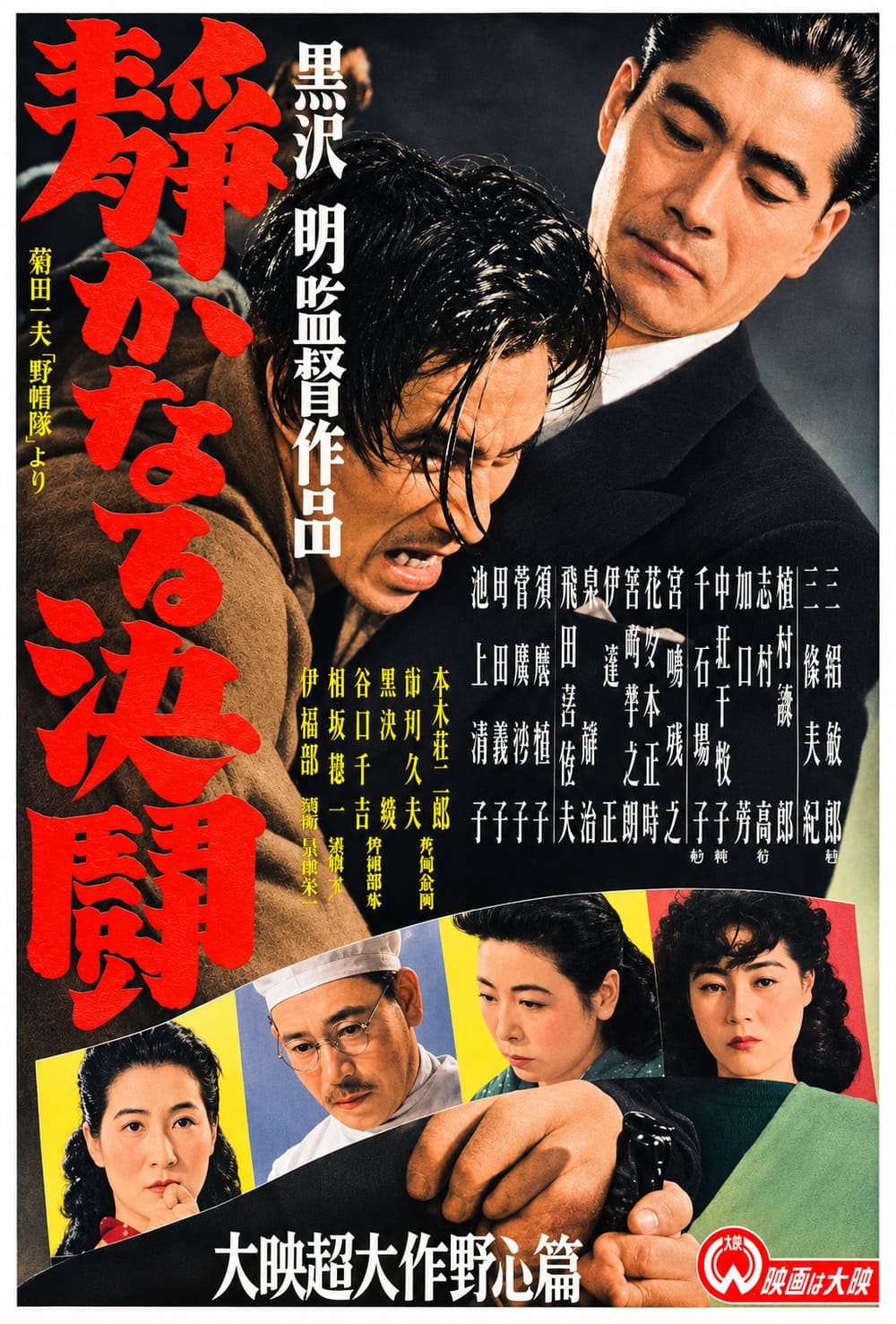
“I’m fighting desperately now to curb my desires.” — Dr. Kyoji Fujisaki
The most painful thing in The Quiet Duel is not the illness at the center of its story. It is the distance between what people feel and what they allow themselves to say. Akira Kurosawa’s 1949 drama keeps returning to that gap, watching a young doctor turn emotional restraint into something close to a second profession. The result can be moving, frustrating, and occasionally a little too pleased with its own nobility. But there is something compelling about a film that makes silence feel this crowded. Beneath its respectable surface, practically everyone is struggling to get a word in.
Toshiro Mifune plays Kyoji Fujisaki, a surgeon who contracts syphilis after cutting himself during an operation at a wartime field hospital. When he returns home, he joins his father’s medical practice and quietly begins treating himself. He also breaks off his engagement to Misao, refusing to explain his diagnosis because he believes she would insist on waiting for him. From his perspective, withholding the truth is an act of love. From hers, it is an inexplicable rejection. That difference is the film’s dramatic engine, although Kurosawa is sometimes more willing to admire Kyoji’s intentions than examine the damage his decisions cause.
The film also continues the Kurosawa–Mifune collaboration that began with Drunken Angel (1948), and the change in Mifune’s role is striking. In that earlier film, he played a tubercular gangster opposite Takashi Shimura’s alcoholic doctor. Here, Mifune becomes the doctor himself, with Shimura playing his physician father. Disease again brings questions of responsibility into focus, but the emotional balance has shifted. The unruly patient has given way to an almost painfully conscientious caregiver. Seen together, the films suggest how quickly Kurosawa recognized that Mifune’s intensity could work through resistance and repression, not just outward aggression.
That distinction matters because Kyoji could easily become a rather bloodless monument to goodness. Mifune keeps him from settling into that shape. His composure feels maintained rather than natural, as though every polite exchange requires a small act of self-discipline. Beneath it sit frustration, sexual desire, and an entirely understandable wish for an ordinary future. When those feelings break through, they do not seem imported for a big acting scene. They feel like the release of pressure the performance has been accumulating all along. Kurosawa’s direction gives that contrast room to register, letting the restrained exterior make the eventual outburst more uncomfortable.
The wartime opening establishes the stakes with an immediacy the rest of the film cannot always match. Rain, fatigue, and cramped operating conditions make the hospital feel barely held together. Kurosawa uses the setting as more than atmospheric decoration: the physical strain of the work helps explain how a momentary accident can change a life. Kyoji does not suffer because he is reckless or selfish. He suffers while doing something necessary. Before the screenplay develops its more insistent moral contrasts, the direction offers something simpler and harder to dismiss. There is no dependable relationship between the goodness of an action and the consequences awaiting the person who performs it.
Once the action moves to the family hospital, Kurosawa exchanges that immediate physical pressure for a more enclosed emotional tension. People share rooms while remaining separated by information they cannot, or will not, communicate. The audience knows what Misao does not, making their conversations painfully uneven. Every pause carries a meaning she cannot access. This is effective melodramatic construction, drawing us close to Kyoji while leaving her outside his confidence. Yet the same arrangement creates a problem: because we understand his reasons, the film can seem to assume that we should also accept them. Sympathy begins doing the work that scrutiny might have done.
Misao is where that problem becomes hardest to ignore. Miki Sanjo gives her hurt a directness that cuts through Kyoji’s elaborate reasoning. She does not need to know his secret for her confusion to be legitimate. His decision supposedly protects her freedom while denying her the information needed to exercise it. That contradiction deserves more attention than the film gives it. An honest conversation would not cure the illness or settle their future, but it would acknowledge that the future belongs to both of them. Instead, her pain too often becomes another way of measuring how much he is prepared to sacrifice.
Kurosawa’s handling of the supporting cast provides a welcome alternative to this tightly wound romantic impasse. Shimura brings patience and practical understanding to the father, making care seem less like heroic renunciation and more like sustained attention. His scenes with Mifune allow warmth into a film that can otherwise become airless. The nurse Minegishi also introduces concerns beyond Kyoji’s broken engagement, helping the hospital feel like a workplace occupied by several lives rather than a chamber built around one man’s suffering. These relationships give the director opportunities to observe ordinary companionship, and the film benefits whenever he allows those quieter connections to carry the scene.
Still, the direction does not entirely overcome the material’s theatrical weight. The contained settings can make repression tangible, but extended speeches sometimes explain emotions that the actors have already communicated. At those points, the film seems reluctant to trust its own images. Kyoji’s distress becomes less powerful when it arrives with an accompanying statement of what we should learn from it. The return of the soldier who infected him creates a similar difficulty. His irresponsibility supplies a forceful contrast, but it also makes the ethical arrangement too convenient. Responsibility and selfishness become opposing examples rather than qualities that might uneasily coexist within the same person.
What keeps the film from becoming merely a lecture is its sense that war continues inside ordinary life. Kyoji has returned home, but returning is not the same as recovering. The hospital offers meaningful work without restoring everything he has lost. Here, the connection to Drunken Angel becomes especially useful: both films place damaged bodies alongside the difficult business of caring for other people. What changes is Mifune’s position within that relationship. Kurosawa turns the actor’s force inward, testing how much agitation can exist beneath professional composure. The result is less immediately combustible than their first collaboration, but revealing in a different way.
By the end, the title feels less like a description of one man’s struggle with illness than a description of the film arguing with itself. Is silence an expression of love, or a way of keeping control? Is sacrifice still generous when someone else has no say in it? The Quiet Duel does not pursue those questions as far as it might, but it cannot entirely silence them either. Kurosawa’s direction is most persuasive when it leaves room for that discomfort, and Mifune makes it visible. Together, they leave us with a good man trying so hard to do right that he sometimes forgets to let anyone stand beside him.

