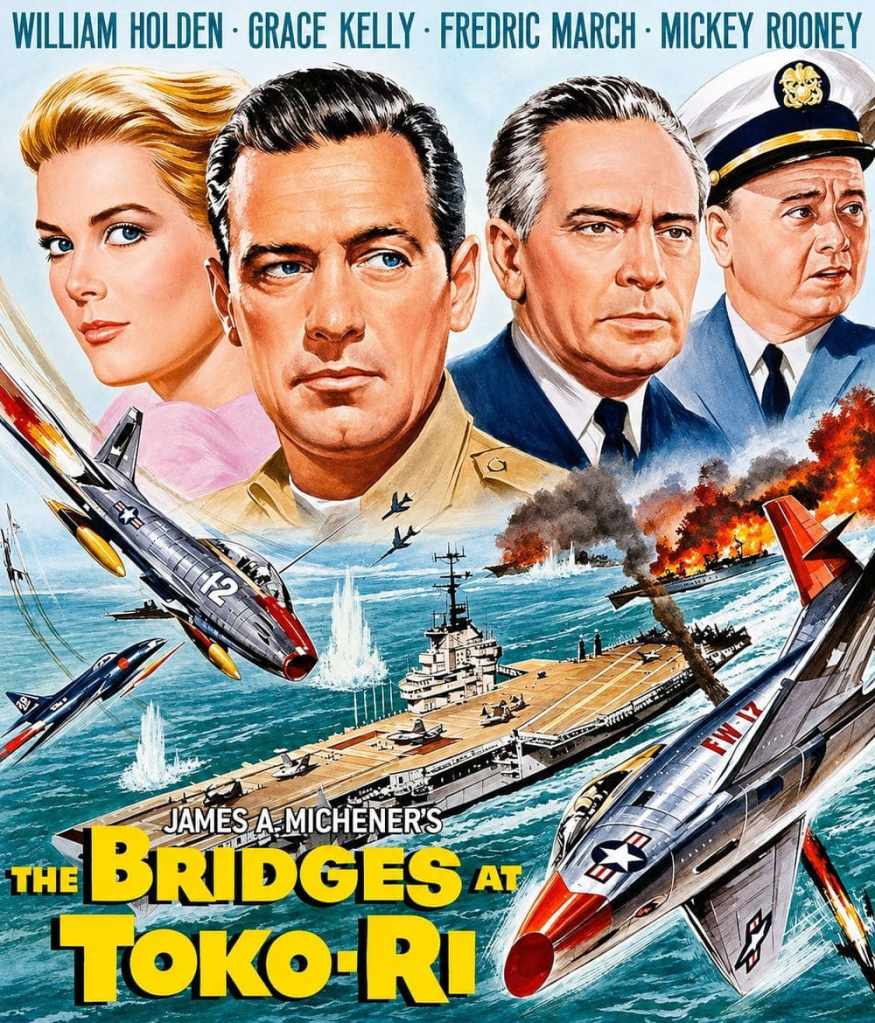
“All through history, men have had to fight the wrong war in the wrong place, but that’s the one they’re stuck with.” — Rear Admiral George Tarrant
Mark Robson’s The Bridges at Toko-Ri looks like a straightforward military tribute, but it leaves a much more uncomfortable impression. There are aircraft carriers, daring pilots, and impressive combat sequences, yet the strongest feeling is how badly its central character wants to go home. This is a war movie about courage that never makes courage look easy or especially rewarding. Adapted from James A. Michener’s story, it balances admiration for servicemen with serious doubts about what their service costs. That ambivalence makes it more interesting than a simple flag-waving adventure.
William Holden plays Lieutenant Harry Brubaker, a Navy reservist recalled to combat during the Korean War after already serving in World War II. Back home, he has a law practice, a wife, and two daughters. He isn’t looking for another chance to prove himself. He feels he has already done his share, and his resentment gives the movie its emotional center. His assignment to help destroy heavily defended bridges becomes more than a dangerous mission: it represents the military’s claim on a life he thought belonged to him again.
Holden is a strong fit because he can make frustration feel contained rather than theatrical. Brubaker doesn’t need constant speeches to communicate exhaustion; his reluctance comes through in his guarded manner and conversations with Rear Admiral George Tarrant, played by Fredric March. Tarrant sees an excellent aviator and potential career officer, while Brubaker sees a civilian whose future keeps getting interrupted. Their disagreement gives the film a useful tension. Neither man is presented as a fool, but they clearly aren’t measuring the value of military service in quite the same way.
Grace Kelly’s Nancy Brubaker gives that tension a domestic dimension. The family’s reunion in Japan shows what Harry stands to lose, making the danger personal rather than abstract. Nancy initially wants distance from the frightening details of his work, but eventually insists that he tell her about the bridges and the risks involved. That shift matters: she becomes someone trying to face reality alongside him rather than simply a comforting image of home. The family interlude slows the action, but it also gives the action consequences. Without it, Harry would be another pilot in trouble.
The supporting material is less consistently effective. Mickey Rooney brings energy to helicopter rescue pilot Mike Forney, whose green hat and romantic troubles provide a broad change of pace. Some of that business feels like a detour from the more compelling drama, especially when the comedy leans heavily on his unruly personality. Still, the humor serves a purpose beyond filling time. It gives the military setting a sense of everyday life, reminding us that these men have interests and problems that exist outside their assignments. Rooney’s liveliness also provides a useful contrast to Holden’s tightly controlled anxiety.
Robson gets considerable mileage out of the physical business of naval aviation. Launching, landing, and keeping men and aircraft moving become sources of suspense before the major attack even begins. The Navy’s cooperation gave the production access to real carrier operations, and that material lends weight to the spectacle. The machinery looks impressive, but it also makes the men seem vulnerable: a damaged plane or a failed landing can turn routine procedure into disaster. The film’s Academy Award for special effects feels appropriate, although the technical achievement works best when it supports that vulnerability.
What makes The Bridges at Toko-Ri especially interesting is its willingness to accommodate anti-war feelings within a patriotic framework. It emerged during the Red Scare, when Hollywood blacklisting made suspected Communist associations professionally devastating and political dissent could invite accusations of disloyalty. It would be too sweeping to say every anti-war sentiment was automatically considered un-American, but the atmosphere certainly discouraged challenges to Cold War orthodoxy. Against that background, allowing a capable American serviceman to question why he must fight in Korea gives the film a striking edge. His unhappiness is not simply treated as cowardice.
That doesn’t make the movie an outright rejection of the war, though. Tarrant explicitly argues that America must resist Communism, and the production opens with a tribute to the Navy. Its unusual quality lies in the friction between that official justification and the emotional experience it depicts. The admiral can explain why the mission matters without making Brubaker’s predicament feel fair. For me, this is where the film’s anti-war undertones are strongest: not in a declaration that all fighting is pointless, but in its refusal to let strategic necessity erase individual suffering.
As the bridge assignment approaches, the film draws its strongest suspense from the gap between professional competence and private fear. Brubaker knows how to do his job; that doesn’t mean he can switch off his awareness of everything riding on it. Robson makes that distinction count without needing to turn every conversation into a debate. There are dated comic passages and occasional stretches of stiff dialogue, but the central conflict remains compelling. The Bridges at Toko-Ri can admire military skill and still question the demands placed on the people who possess it. That tension gives its action an emotional weight that outlasts the spectacle.

