Welcome to Late Night Retro Television Reviews, a feature where we review some of our favorite and least favorite shows of the past! On Sunday, I will be reviewing the Canadian series, Degrassi: The Next Generation, which aired from 2001 to 2015! The series can be streamed on YouTube and Tubi.
This week, it’s Downtown Sasquatch vs Hell Hath No Fury at the Degrassi Battle of the Bands. Ashley writes a killer song but Craig writes an even more killer song. Meanwhile, Jimmy and Spinner rap.
Episode 3.18 “Rock and Roll High School”
(Dir by Stefan Scaini, originally aired on March 8th, 2004)
It’s time for the school’s Battle of the Bands! The winner will win free studio recording time. At first, it seems like Downtown Sasquatch will be the clear frontrunner. With Craig singing, Jimmy playing guitar, Marco on bass, and Spinner pounding away on the drums, they’re the ultimate Degrassi band. However, Ashley has formed a band of her own. Hell Hath No Fury features Ashley on vocals, Ellie on drums, Hazel on keyboard, and Paige on guitar. After Craig hears Ashley’s song “Mr. Nice Guy” and realizes that she’s attacking him for cheating on her with Manny, he gets hit with a serious case of writer’s block.
Can he conquer the block and come up with lyrics before the competition?
Of course, he does! Actually, he comes up with them right before the band plays. Amazingly, Jimmy, Marco, and Spinner are able to perform perfectly despite having never heard the lyrics before. I mean, they are incredibly good for a high school band. It’s almost as if the actors are lip-synching to a pre-recorded track.
This episode somehow manages to be Degrassi at both its best and its silliest. On the one hand, Ashley’s band actually wears t-shirts that feature an image of Craig burning in Hell. On the other hand, Craig’s song is really good. On the one hand, Ashley is amazingly quick to forgive Craig for cheating on her just because he wrote an apology song. On the other hand, I’d probably forgive Craig too because the song was really good.
This episode features two standout scenes. First, there’s this scene in which the future Drake raps. This may actually be the first time Drake was ever featured performing on a show.
And then there’s Craig’s performance of “Dust.”
This is an important episode. Not only is this the episode that leads to Ashley and Craig getting back together, but it also sets up one of the storylines that will dominate the show’s fourth season. This episode also establishes that Spinner and Jimmy are Sasquatch-obsessed. Remember Squatch Wear? We’ll get to that …. well, probably sometime in 2028. We’ve got quite a ways to go before we reach that episode. Good lord, am I still going to be writing about Degrassi in 2028? Actually, I probably will. It’ll provide a diversion from the 2028 Presidential election.
For now, the main thing is that Craig got in touch with his emotions and won the Battle of the Bands.
Welcome to Retro Television Reviews, a feature where we review some of our favorite and least favorite shows of the past! On Sundays, I will be reviewing Homicide: Life On The Street, which aired from 1993 to 1999, on NBC!
This week, the tyranny of the new detectives continues.
Episode 6.11 “Shaggy Dog, City Goat”
(Dir by Kyle Secor, originally aired on January 16th, 1998)
If Homicide were currently airing, this is the type of episode that I would refuse to review. This is the type of episode that would force me to take a stand and announce, “NBC, what the hell are you doing!?” However, since Homicide has been off the air for nearly 30 years, there’s nothing to be gained by boycotting.
Neither Pembleton nor Bayliss is in this episode. Now, in all fairness, I should mention that Kyle Secor directed this episode, so it makes sense that Bayliss wouldn’t be a part of the main action. And who knows? Maybe Andre Braugher was doing a movie or something. In the past, the show could have survived an episode without Pembleton and Bayliss. Some of the Lewis/Kellerman episodes are my favorites of seasons 4 and 5. Munch and Howard were always a good combination as well. But this is season 6. Kay Howard is gone. Lewis and Kellerman are barely speaking. And we’ve got new detectives to deal with!
Ballard and Gharty, for instance, investigate the death of a drug dealer from Appalachia. Apparently, in Baltimore, hillbillies are known as city goats. Gharty is familiar with them. Ballard, being from Seattle, is not. Personally, I like Ballard and Gharty as partners. I appreciate the fact that Gharty is a deeply flawed man who still tries to do a good job and who wants to be a better person. (That makes him more interesting than a certain other new Homicide detective.) But the whole City Goat thing just fell flat. This is the type of loose storyline that Lewis and Kellerman could have done wonders with because both of them are firmly established characters with their own unique rhythm. I like Ballard and Gharty, but they still haven’t reached that point.
Meanwhile, Falsone is preparing to go to court to get custody of his children and… you know what? I don’t care about Falsone and his kids. We already went through this storyline with Beau Felton, and it wasn’t that interesting the first time.
Georgia Rae Mahoney files a wrongful death lawsuit against the Homicide Department. WHO CARES!? Seriously, this Mahoney stuff is so boring. Lewis confronts Georgia and makes the mistake of striking her. Georgia laughs and laughs. It’s so cartoonish that I felt embarrassed for everyone involved. Lewis gets suspended. Well, great. I guess that will mean cases for Falsone to mumble his way through.
Finally, Dr. Cox told her fellow MEs a story about a man who jumped off a roof and then got shot as he passed his parents’ window. Now, I did enjoy this part of the episode, even if the whole storyline was just a retelling of a familiar urban legend. Kellerman and Munch worked the suicide-that-might-be-a-homicide. Steve Allen and Jayne Meadows both overacted as the parents of the deceased, but at least they didn’t break into Georgia Mahoney-style mad laughter. But Munch, Kellerman, and Cox made for a good team.
I’m really not sure what NBC was thinking sidelining the most popular characters on the show in favor of Jon Seda’s Falsone. From what I’ve read, Falsone was supposed to be the cool, sexy cop who would bring in younger viewers, but the character is so boring and Seda’s performance is so bland that my mind starts to wander whenever he shows up in an episode. The sixth season has felt like the Falsone show, and it annoys me that I can’t write to NBC to complain.
“That’s strange, Jim. I never even thought of failing.” — Commander Richardson
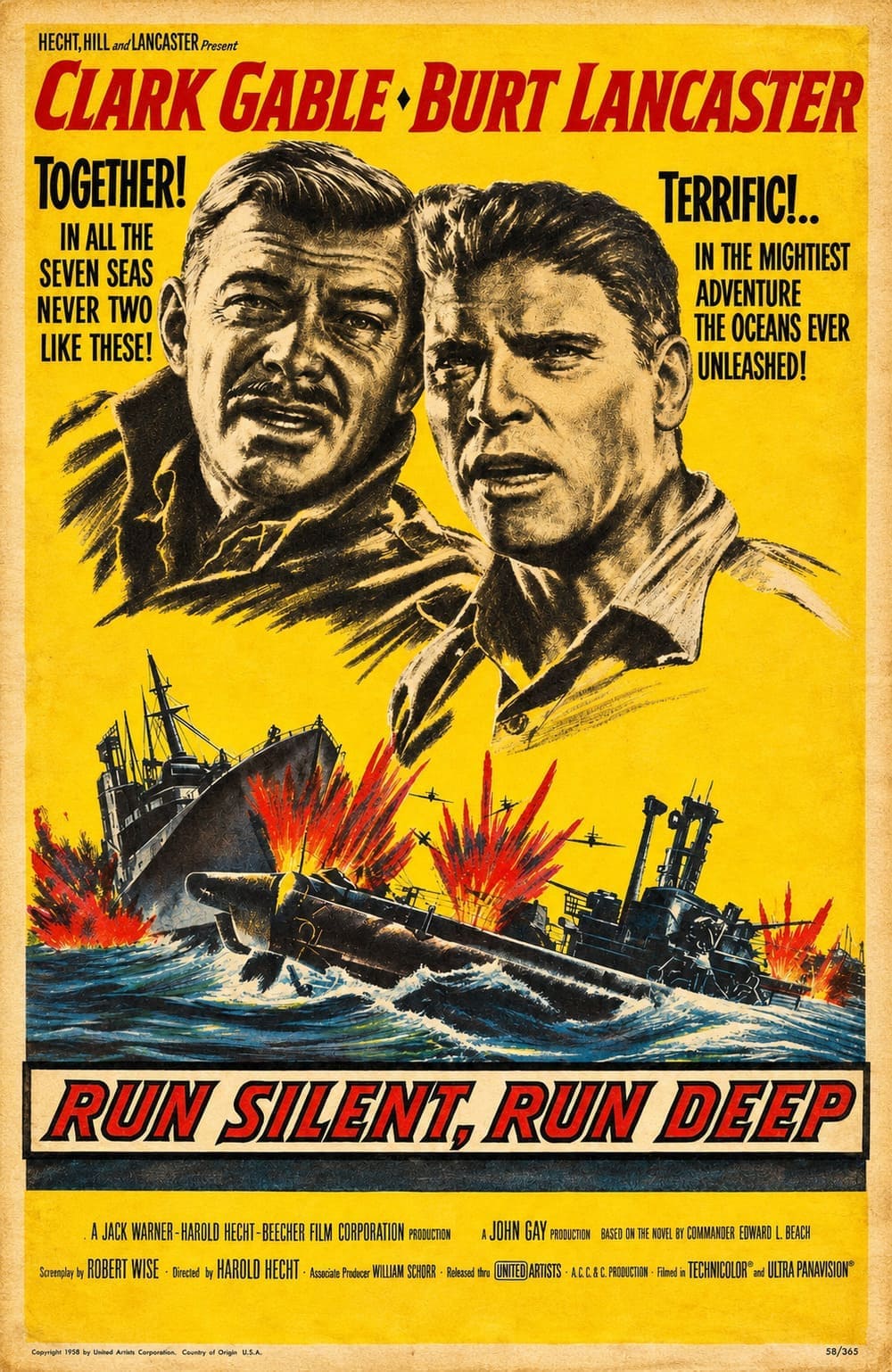
There’s barely enough room to turn around aboard the submarine in Run Silent, Run Deep, but two enormous egos manage to squeeze inside. Robert Wise’s 1958 war film puts Clark Gable and Burt Lancaster in close quarters and lets their competing ideas about leadership drive the action. Enemy ships supply the immediate danger, but the real hook is watching two capable officers work together when neither fully trusts the other. It’s a gripping movie about control, especially what happens when a captain’s personal ambitions start steering a military mission. The confined setting gives their disagreement an edge: nobody can walk away.
Gable plays Commander Richardson, who returns to sea after losing his previous submarine to a Japanese destroyer. His new command, the USS Nerka, comes with a complication: executive officer Jim Bledsoe, played by Lancaster, expected the promotion himself. Bledsoe knows the crew and has their confidence; Richardson brings seniority and unfinished business. The captain orders exhausting drills while keeping his intentions to himself. Before long, Bledsoe suspects that Richardson is preparing not simply for combat but for another encounter with the enemy responsible for his earlier defeat. What looks like demanding leadership begins to resemble a personal campaign.
Richardson works as a character because he isn’t an obvious fool. Gable gives him authority and convincing tactical confidence, making it easy to understand why the crew would follow him. That competence also makes his obsession harder to challenge. His troubling decisions come wrapped in the assurance of a man who usually knows what he’s doing. Gable communicates the danger through impatience, secrecy, and stubbornness rather than theatrical outbursts. Richardson doesn’t suddenly become incapable of command. Instead, he starts confusing what he wants with what his command needs, and the distinction becomes harder for everyone around him to ignore.
Lancaster makes Bledsoe an effective counterweight without turning him into an uncomplicated voice of reason. His concerns are legitimate, but his disappointment over losing command complicates every objection. Is he protecting the crew, defending his pride, or doing both? Lancaster allows those motives to overlap without making Bledsoe seem petty. He remains dependable, yet his frustration gives that professionalism an edge. You can feel the effort involved in showing respect to a superior whose decisions he distrusts. He also understands that challenging Richardson could damage the discipline he wants to preserve.
The scenes between them work because neither actor needs to dominate every exchange. Gable can make an order sound final while Lancaster’s reaction quietly keeps the argument alive. Their different kinds of authority are part of the appeal: Richardson expects obedience because he holds command, while Bledsoe draws strength from his connection to the crew. Those positions aren’t necessarily incompatible, but wounded pride makes cooperation difficult. The movie gives both men enough credibility that their disagreement remains uncomfortable. It’s much more interesting than watching an obviously reckless captain get corrected by an obviously sensible subordinate.
Wise folds that conflict into the submarine’s daily work. Drills, preparations, and clipped orders show how leadership becomes action: Richardson makes a decision, and everyone else must execute it. The procedural detail does more than establish a naval setting. It shows how completely these men depend on one another, making their divided loyalties dangerous. Some exercises become repetitive, but that repetition has a purpose. Richardson wants coordinated movement to become instinctive, and the film makes us appreciate how little margin for error the crew has. When combat tests that preparation, the earlier emphasis on timing pays off.
The black-and-white photography strengthens the enclosed atmosphere. Narrow passages and crowded equipment leave little room for privacy, much less escape from a strained relationship. Wise doesn’t need to make every shot claustrophobic; the arrangement of bodies within the boat already suggests how closely everyone lives and works. A disagreement between officers can affect men who aren’t participating in it but still have to carry out the consequences. The submarine becomes more than a backdrop. It’s a shared space where uncertainty spreads quickly and even a small loss of confidence can become difficult to contain.
Outside the hull, the enemy remains difficult to locate and anticipate. Wise builds suspense around decisions—when to move, when to wait, when to attack—rather than relying entirely on destruction. Faces listening for information can be as compelling as weapons firing. There’s a tension between the crew’s disciplined movements and how little they can know about what awaits them. The action is exciting because it tests judgment as much as nerve. Richardson’s determination might produce a tactical advantage, but that doesn’t automatically settle whether pursuing it was responsible. Success and sound leadership aren’t quite the same thing.
Later submarine films would revisit that captain-and-executive-officer friction. Crimson Tide (1995) turns it into a showdown between Gene Hackman and Denzel Washington over a nuclear launch, while U-571 (2000) echoes Bledsoe’s frustration through Matthew McConaughey’s resentment of a captain who questions his readiness for command. Neither relationship duplicates Gable and Lancaster’s, but all three films draw suspense from the divide between obedience and independent judgment. They also recognize that ambition can complicate a legitimate objection: wanting command doesn’t make a subordinate wrong, but it can make his motives harder to trust. Danger outside the hull becomes more frightening when authority inside it is unsettled.
Wise’s film has limitations. The supporting sailors register mostly through quick impressions, and some dialogue carries the familiar snap of an older Hollywood service picture. Its focus on the two officers leaves less room for the crew as individuals. Still, Gable and Lancaster give the central conflict enough weight to make that narrow focus worthwhile. Command emerges as a burden, not merely a promotion, and confidence alone doesn’t justify the decisions made in its name. The submarine warfare delivers, but the lasting suspense comes from a harder question: when does loyalty require an officer to stop following and push back?
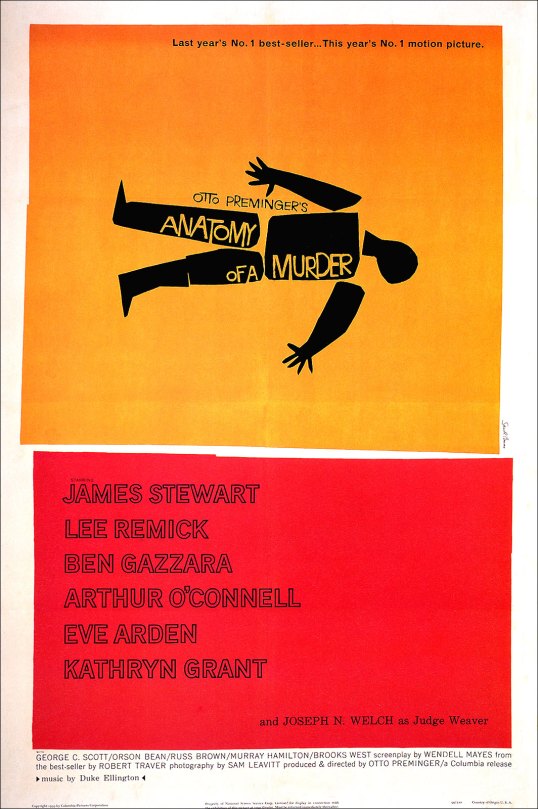
Today’s scene that I love comes from one of my favorite movies, 1959’s Anatomyofa Murder.
In this scene, an attorney played by James Stewart explains to his client (played by Ben Gazzara) that there are four ways that he can defend a murder charge. The contrast between Stewart’s classic style of acting and Gazzara’s intense method style makes for an intense scene between two very talented and unique performers.
4 Shots from 4 Films is just what it says it is, 4 shots from 4 of our favorite films. As opposed to the reviews and recaps that we usually post, 4 Shots from 4 Films lets the visuals do the talking!
Today, we celebrate cinematic pop art.
4 Shot From 4 Films
The Creation of the Humanoids (1962, dir by Wesley Barry)
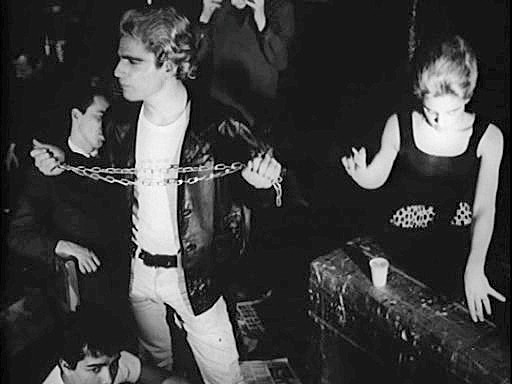
Award Presentation to Andy Warhol (1964, dir by Jonas Mekas)
I’ve often felt like Avril Lavigne in this video, searching and kicking open doors while my band plays in the background. Actually, I don’t have a band but, if I did, they would be standing on a street corner playing. Their name would be the Bowmanaires, by the way.
This is a video that I obsessed on when I was much younger.
“Our job is to lay down that sacrifice. That’s what we were trained for, and that’s what we’ll do.” — Admiral Blackwell
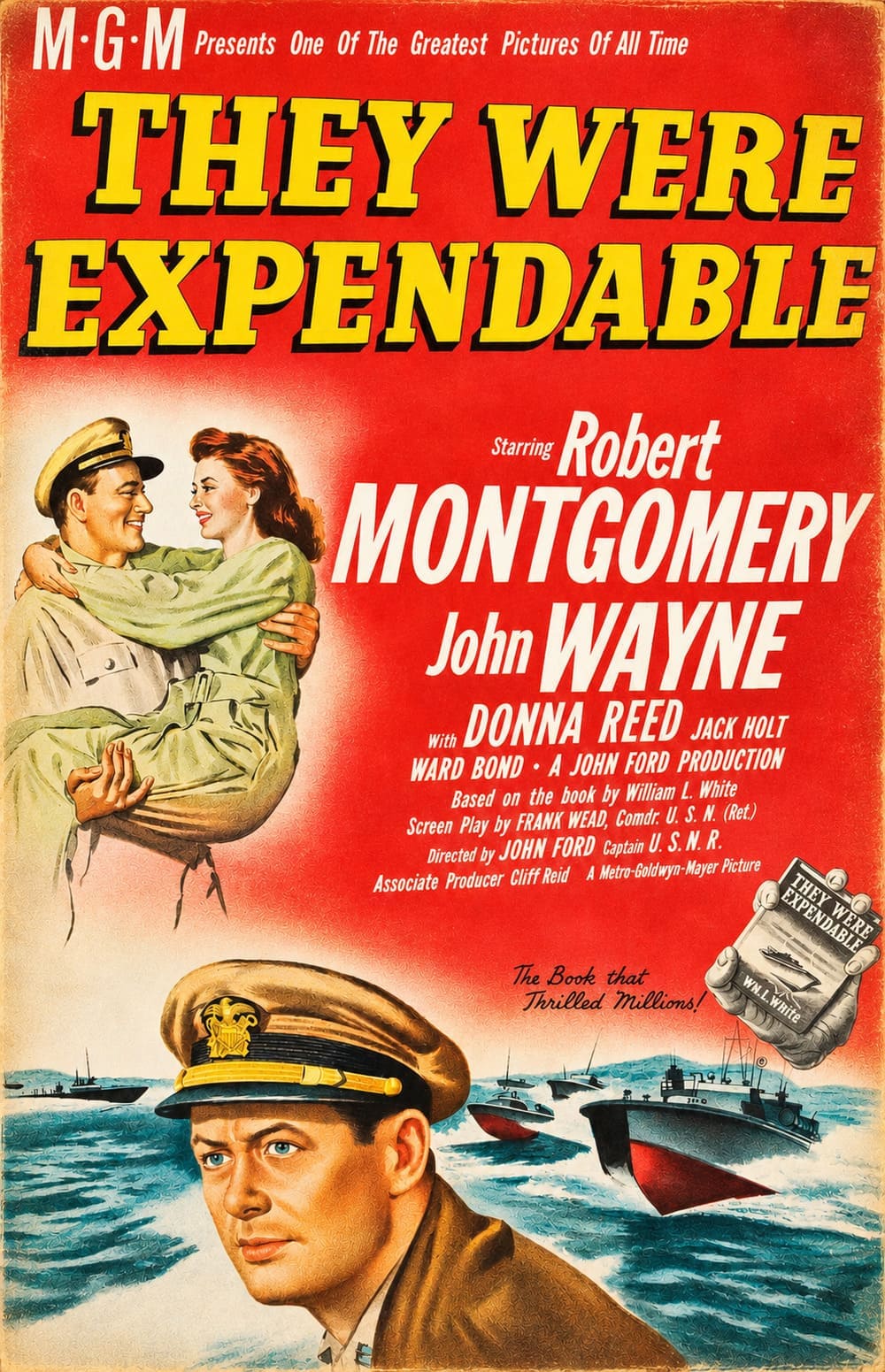
For a movie full of fast boats and urgent orders, They Were Expendable (1945) leaves a surprisingly quiet impression. The battles are exciting, but they are not what gives John Ford’s film its staying power. What lingers is the exhaustion between them, the effort to maintain ordinary manners, and the uncomfortable knowledge that capable people can do their jobs well and still lose ground. Ford makes room for all of that without draining the movie of energy. Instead, he turns a wartime adventure into something more personal: a story about people trying to hold themselves together as their circumstances steadily come apart.
The setting is the Philippines during the early months of America’s involvement in World War II. Lieutenant John “Brick” Brickley, played by Robert Montgomery, commands a patrol torpedo boat squadron whose usefulness has yet to be fully appreciated. His subordinate, Lieutenant “Rusty” Ryan, played by John Wayne, would prefer an assignment with better prospects. Their disagreement gives the opening stretch an easy dramatic hook. Brickley believes in the work already in front of them, while Ryan wants a chance to prove himself elsewhere. Once the fighting begins, those ambitions become tangled with more immediate questions of survival.
Montgomery gives the film a remarkably steady center. Brickley is authoritative without constantly announcing his authority, and Montgomery makes listening seem as important as giving orders. His calm never suggests that he knows everything will turn out fine. It feels like something he maintains because the men around him need it. As the situation worsens, small changes in his manner carry increasing weight. He has to absorb disappointment and then decide how to communicate it. That makes his leadership feel practical and human rather than an idealized quality the screenplay simply assigns him.
Wayne supplies the friction that keeps that steadiness from becoming monotonous. Ryan is impatient, proud, and eager to be somewhere his abilities will count. His frustration is understandable, but Ford does not automatically endorse it. Part of the pleasure is watching Wayne’s forceful screen presence meet circumstances that refuse to yield. Ryan cannot solve every problem by being tougher or more determined. The role gives Wayne room to suggest uncertainty beneath his confidence, especially when action gives way to waiting. He remains recognizably Wayne, but the movie makes that familiar strength look less secure.
Ford’s wartime experience provides an important context for this view of military life. A Navy officer who headed the Field Photographic Branch of the Office of Strategic Services, or OSS, he had also personally filmed combat at Midway while his position came under fire. He knew warfare as something witnessed through a camera under dangerous, uncontrollable conditions. That does not make every choice in They Were Expendable a direct reflection of his service, but it helps explain the film’s attention to exposure, confusion, and the disciplined behavior required to function when events stop making reassuring sense.
You can see that awareness in how Ford and cinematographer Joseph H. August place people within their surroundings. The boats, shorelines, open water, and crews remain important parts of the compositions. The stars belong to those spaces rather than seeming protected from them. Although the images are carefully arranged, they convey a convincing relationship between the men and the hazards around them. To my eye, Ford’s experience photographing real combat shows less in an imitation of documentary camerawork than in his respect for physical circumstances. Where someone stands, what protection exists, and how a group works together all matter.
The PT boats are a good example. Their speed makes them exciting to watch, but their size also makes them look vulnerable. Ford lets you admire their movement without suggesting they can outrun every consequence. The action has momentum because the boats seem capable, not invincible. Just as importantly, he connects their missions to the labor surrounding them. Preparation, waiting, medical treatment, and keeping equipment usable are not disposable scenes between the exciting bits. They establish how much effort goes into making action possible and how much more work follows when it is over.
Donna Reed’s Sandy Davyss, a nurse who develops a connection with Ryan, brings a different rhythm to the film. Their relationship offers a glimpse of companionship rather than a promise that romance can overcome the war. The dinner sequence is particularly touching because its pleasures are so modest. People make an effort, observe little courtesies, and try to enjoy an evening together. Ford gives those gestures time to register. Reed’s warmth helps the scene avoid feeling merely symbolic, while Wayne’s softer manner reveals a side of Ryan that his professional frustrations tend to conceal.
That interest in ordinary behavior extends across the squadron. Meals, jokes, instructions, and small acts of consideration make the men feel like people accustomed to living together. Ford understands that a community becomes convincing through shared habits, not just declarations of loyalty. As their situation deteriorates, those details acquire emotional weight. We know something about the life being disrupted. The film’s sadness grows from that familiarity, which is more effective than repeatedly telling us how much everyone has sacrificed.
The approach occasionally tests your patience. The episodic structure can feel loose, and a few sentimental touches seem more arranged than the quieter moments around them. Anyone expecting a tightly accelerating combat movie may find the pacing uneven. Still, most of the pauses earn their place. They allow fatigue to become visible and give the characters time to exist beyond their immediate military function. Tightening everything into a brisker adventure might improve the momentum while weakening the attachment that makes its losses matter.
What finally makes They Were Expendable so affecting is the way it changes the scale of a war movie. Large events determine the characters’ futures, but Ford keeps bringing us back to things within their reach: a job completed, a meal shared, a difficult order carried out. Montgomery, Wayne, and Reed give those moments enough feeling that the restraint never becomes cold. The film offers excitement, but its deeper achievement is making ordinary conduct under pressure worth watching. Ford leaves us with people whose circumstances grow smaller while the significance of their actions grows larger.