Retro Television Review: St. Elsewhere 4.17 and 4.18 “Time Heals”


Welcome to Retro Television Reviews, a feature where we review some of our favorite and least favorite shows of the past! On Fridays, I will be reviewing St. Elsewhere, a medical show which ran on NBC from 1982 to 1988.  The show can be found on Daily Motion.
In this special two-part episode, 50 years of St. Elsewhere are documented in just two hours.

Episodes 4.17 and 4.18 “Time Heals”

(Dir by Mark Tinker, originally aired on February 19th and February 20th, 1986)

Aired over two nights, “Time Heals” uses St. Eligius’s 50th anniversary to give us 50 years of history. While the staff prepares to observe half a century of serving Boston, the episode skips back and forth in time.

In 1935, a young and enthusiastic priest named Joseph McCabe (Edward Herrmann) prepares for the opening of a hospital that he hopes will serve the downtrodden and forgotten of Boston. Monsignor Senti (Norman Burton) views McCabe as a troublemaker. Meanwhile, a young Donald Westphall watches as his father helps bring a wounded man named Patrick O’Casey (William Russ) to the hospital. Later, Westphall’s sister and mother are killed in a house fire.

In 1945, a young liver specialist named Daniel Auschlander (James Stephens) is brought on staff and meets an angry teenage Donald Westphall (Michael Sharrett). Donald shines shoes in the hospital lobby. When Donald is caught stealing, Father McCabe takes him to the hospital’s gym and gives him a boxing lesson. As for Auschlander, he allows a returning serviceman named Patrick O’Casey to see his young daughter, who is suffering from polio and has been placed in an isolation ward.

In 1955, the Archdiocese sells the hospital to the city and Father McCabe is fired. McCabe gets drunk. Auschlander says that he intends to resign in protest. McCabe replies that that would be a mistake—Auschlander is the man McCabe has recommended as his replacement. Meanwhile, Patrick O’Casey’s daughter dies after spending ten years in an iron lung, and a cocky intern named Mark Craig (William Daniels, sans mustache) has a panic attack while performing his first operation. The demanding Dr. David Domedion (Jackie Cooper) orders Craig back into the operating room. Later, Craig tells another resident, Donald Westphall (Ed Flanders, his hair dyed black but still looking quite middle-aged), that he’s been offered a position at Boston General and will never return to St. Eligius.

In 1965, Dr. Craig returns to St. Eligius, bitter that he was passed over for chief of surgery at Boston General. While a young Luther Hawkins sits in the waiting room, a newly arrived nurse named Helen Eisenberg helps Dr. Westphall deal with Terence O’Casey (Brian Kerwin), a young man having a bad acid trip. “Get a haircut, hippie,” Dr. Craig says at one point.

In 1975, Terence O’Casey is back in the hospital, waiting as Dr. Craig performs open-heart surgery on his father, Patrick. Donald Westphall is appointed hospital administrator. The same night, his wife, Maureen (Anita Gillette), is in an auto accident that leaves her brain-dead. Westphall is the one who has to decide to remove her breathing tube and allow her to pass on.

In 1985, high school principal Terence O’Casey is brought to the hospital with sudden paralysis. His doctor, Jack Morrison, struggles to diagnose Terence’s condition until he goes down to the basement, looks through the earliest hospital records, and reads about Terence’s sister, who died in an iron lung. Jack diagnoses Terence with Guillain-Barré syndrome, a paralyzing condition that can resemble polio.

Meanwhile, Jack’s son, Pete, is apparently abducted by a man at the hospital. I say “apparently” because the plotline feels a bit underdeveloped. The episode ends with the police returning Pete to Jack during St. Eligius’s anniversary party. Pete seems to be physically unharmed, and we’re not really given any details as to who abducted him or how the police tracked him down.

The subplot featuring Morrison’s son being abducted is oddly undeveloped, but that’s really the only flaw to be found in “Time Heals.” This is not only a great episode of St. Elsewhere; it’s also one of the greatest episodes of television I’ve ever seen. That said, it isn’t just a great episode of television. It’s a great work of art, period, from the excellent performances to the way the episode seamlessly mixes the flashbacks so that they come together to tell one epic story of the 20th century. Featuring both the story of the hospital and the story of the O’Caseys, “Time Heals” is a portrait of how times change and how they remain the same.

A few random notes:

For those who think Dr. Craig is too hard on his residents, this episode shows that Craig’s mentor was equally hard on him, and that it helped turn Craig into the surgeon he is today. That said, it’s also amusing to see that young Mark Craig was just as obnoxious as Victor Ehrlich.

I’ve often complained about how depressed Westphall always seems to be. This episode shows that Westphall has a lot of reasons to be depressed. The man’s life has been one tragedy after another.

One cannot overlook the importance of the O’Caseys to this episode’s power. The O’Caseys represent the community St. Eligius is meant to serve. The hospital is part of the family’s life. History repeats itself throughout the O’Casey storyline. In 1935, Patrick O’Casey is injured and nearly killed in a fight. By 1945, he’s married and a member of the U.S. Army. In 1965, Patrick’s son, Terence, is a drug-abusing member of the counterculture. By 1985, he’s a conservative high school principal who has an estranged relationship with his gay son, Kevin (John Scott Clough). All of the male O’Caseys have more in common than they realize.

Each decade is shot in a different visual style, which helps us keep track of things. The 1935 scenes are shot in black and white. The 1945 scenes feature muted colors. As we move through time, the colors become clearer and more vibrant until we finally find ourselves in 1985.

“Time Heals” is touching, powerful, and even funny. It’s a true work of art.
Retro Television Review: St. Elsewhere 4.15 “Family Feud”


Welcome to Retro Television Reviews, a feature where we review some of our favorite and least favorite shows of the past! On Fridays, I will be reviewing St. Elsewhere, a medical show which ran on NBC from 1982 to 1988.  The show can be found on Daily Motion.

This week, Bobby Caldwell returns.

Episode 4.15 “Family Feud”

(Dir by Mark Tinker, originally aired on January 29th, 1986)

After being gone for the last few episodes, Bobby Caldwell (Mark Harmon) returns to St. Eligius. As he explains it, he’s spent the last month or so with his family in Baltimore. He worked on his family’s farm and got in touch with what actually matters in life. Westphall is so happy to hear this that he immediately starts talking about the time he spent volunteering in Ethiopia.

Caldwell is ready to get his facial scar taken care of. He meets with an old colleague from medical school, Dr. Duncan Harper (Kip Gilman). Harper says that the operation should be simple and quick and then Caldwell will be ready to hit the bars again. As a precaution, Caldwell gives blood, just in case it’s needed during the surgery.

Later, a shaken Harper comes to St. Eligius and meets privately with Caldwell. Harper says that the lab did some standard tests on Caldwell’s blood and that it appears that Caldwell might have AIDS. Caldwell says there has to be some sort of mistake, but Harper shakes his head. Harper retested the blood himself. He asks if Caldwell has any lesions. Caldwell looks down at a spot on his hand and says, “I thought it was just an infection.”

Caldwell tells Westphall about his diagnosis. Westphall tells Caldwell not to give up hope, that a cure might be right around the corner. Caldwell replies that he’s probably got 15 months to live and he’s not going to stop working. After Caldwell leaves, Westphall meets with Auschlander and they both agree that they have no idea what to do.

Meanwhile, it’s Jack Morrison’s birthday! Clancy arranges for him to have a birthday party in the doctor’s lounge. She also continues to flirt with Fiscus. You might expect Morrison to be upset about that, but Morrison is too busy flirting with Mona, Fiscus’s ex! Yeah, we’ll see how that works out….

Finally, Augusta Endicott previously told Dr. Craig that she didn’t want to have a bypass, even if it meant that she would die otherwise. However, when the entire Endicott family comes to visit her, she changes her mind. (During the operation, Dr. Wade comments that Dr. Craig must really be looking forward to the next Endicott presidential campaign. Craig snorts and says that the Endicotts are a bunch of bleeding-heart liberals and he wouldn’t vote for them in a million years.  I love Dr. Craig.) Sen. Gordon Endicott (Charles Cioffi) goes to the chapel to pray and ends up getting shot by a lone gunman.

Gee, who saw that coming?

The Endicotts continue to bore me. They’re just not that interesting as either characters or as thinly-veiled stand-ins for the Kennedy family. On the other hand, Bobby Caldwell’s storyline was powerful and Mark Harmon gave an especially good performance. (I just wish the show had made it clear that AIDS wasn’t meant to be some sort of narrative punishment for Caldwell’s previous bad behavior.) It will be interesting to see how the hospital deals with Caldwell’s diagnosis. Will he actually be allowed to continue to do his job? We’ll find out next week.

Retro Television Review: The Love Boat 4.18 “Aquaphobiac/Humpty Dumpty/The Starmaker”


Welcome to Retro Television Reviews, a feature where we review some of our favorite and least favorite shows of the past!  On Wednesdays, I will be reviewing the original Love Boat, which aired on ABC from 1977 to 1986!  The series can be streamed on Paramount Plus!

This week …. it’s one of the best episodes of The Love Boat ever!

Episode 4.18 “Aquaphobiac/Humpty Dumpty/The Starmaker”

(Dir by Roger Duchowny, originally aired on February 7th, 1981)

David Hasselhoff boards The Love Boat, for the second time!

This time around, the Hoff is playing Brian Kiley.  Brian and Julie went to college together.  Brian was the star quarterback and, as he explains it, he and Julie were a pretty serious couple at the time.  But, in the end, Brian ended up marrying Julie’s roommate and his own playing days came to a premature end when he broke his arm.  Now, he’s on the Love Boat and he wants to not only get back together with Julie but he also wants to make a comeback in the NFL!

Julie is tempted.  How couldn’t she be tempted by the Hoff?  But watching Brian talk about his glory days on the football field, she realizes that he’s living in the past and, to an extent, so is she.  Brian is, at first, upset by Julie’s feelings but then he realizes that she’s right.  He makes peace with his years as a famous quarterback and he leaves the boat not as Julie’s lover but as her good friend….

MY GOD, JULIE — IT’S THE HOFF IN HIS GLORY DAYS!  WHO CARES IF HE TALKS ABOUT FOOTBALL!?  CHASE AFTER HIM!

The Pointer Sisters also board the ship, this time as employees of the cruise.  Isaac want to impress a talent agent (Jeff Cooper) so he recruits the sisters to serve as his backing vocalists.  After seeing them perform, the talent agent is impressed but only by the sisters.  They get a recording contract while Isaac …. well, Isaac goes back to pouring drinks.  POOR ISAAC!  But give credit to Ted Lange, who brought a lot of sincere feeling to what could have been a throwaway storyline.

Finally, Glenn Dobson (Louis Nye) and his fiancée, Vanessa (Audra Lindley), board the boat so that they can get to know each other before the wedding.  Glenn has severe aquaphobia and cannot bring himself to take off his inflatable life jacket.  Vanessa tries to help him conquer his fear but nothing helps.  Glenn fears all the other passengers are laughing at him.  So, the crew and the passengers all put on their own life jackets to show Glenn that he has nothing to be ashamed of.

“Tonight,” Stubing announces, “we are truly a boat of love.”

Awwwwww!  Seriously, who would have guessed that The Love Boat would make me cry?  This was such a sweet story and both Louis Nye and Audra Lindley really seemed to be invested in their characters.  When Glenn finally removed his life vest and took a few stumbling steps into the pool, I wanted to cheer.

What a great cruise this turned out to be!

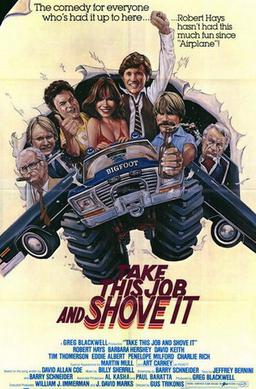
A Movie A Day #259: Take This Job And Shove It (1981, directed by Gus Trikonis)


Originally from a small town in Iowa, Frank Macklin (Robert Hays) is a hotshot young executive with The Ellison Group.  When Frank is assigned to manage and revitalize a failing brewery in his hometown, it is a chance for Frank to rediscover his roots.  His childhood friends (played by actors like David Keith, Tim Thomerson, and Art Carney) may no longer trust him now that Frank wears a tie but it only takes a few monster truck rallies and a football game in a bar for Frank to show that he is still one of them.  However, Frank discovers that the only reason that he was sent to make the brewery profitable was so that his bosses could sell it to a buffoonish millionaire who doesn’t know the first thing about how to run a business.  Will Frank stand by while his bosses screw over the hardworking men and women of the heartland?  Or will he say, “You can take this job and shove it?”

Named after a country music song and taking place almost entirely in places stocked with beer, Take This Job And Shove It is a celebration of all things redneck.  This movie is so redneck in nature that a major subplot involves monster trucks.  Bigfoot, one of the first monster trucks, gets plenty of screen time and, in some advertisements, was given higher billing than Art Carney.

A mix of low comedy and sentimental drama, Take This Job And Shove It is better than it sounds.  In some ways, it is a prescient movie: the working class frustrations and the anger at being forgotten in a “booming economy” is the same anger that, 35 years later, would be on display during the election of 2016.  Take This Job And Shove It also has an interesting and talented cast, most of whom rise above the thinly written dialogue.  Along with Hays, Keith, Thomerson, Bigfoot, and Carney, keep an eye out for: Eddie Albert, Royal Dano, James Karen, Penelope Milford, Virgil Frye, George “Goober” Lindsey, and Barbara Hershey (who, as usual, is a hundred times better than the material she has to work with).

One final note: Martin Mull plays Hays’s corporate rival.  His character is named Dick Ebersol.  Was that meant to be an inside joke at the expense of the real Dick Ebersol, who has the executive producer of Saturday Night Live when Take This Job and Shove It was filmed and who later became the president of NBC Sports?