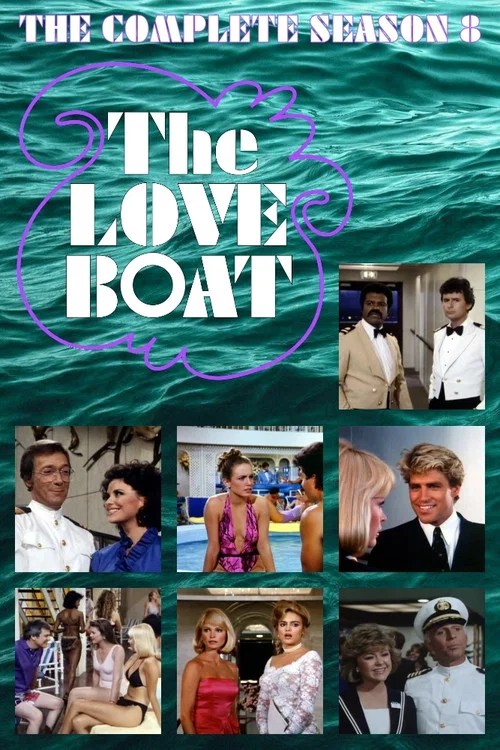
Welcome to Retro Television Reviews, a feature where we review some of our favorite and least favorite shows of the past! On Wednesdays, I will be reviewing the original Love Boat, which aired on ABC from 1977 to 1986! The series can be streamed on Paramount Plus!
This week, we set sail for some very minor adventure.
Episode 8.21 “Ace Takes a Holiday/The Runaway/Courier”
(Dir by Kim Friedman, originally aired on February 9th, 1985)
Irene Patton (Florence Henderson) boards the boat with her husband Frank (Peter Mark Richman) and her stepdaughter, Sandy (Tracy Nelson). Irene doesn’t understand why Sandy doesn’t like Frank. For us viewers, it’s easy to guess that Frank is up to no good because he’s played by Peter Mark Richman and we all remember how mean he was in the Friday the 13th movie where Jason went to Manhattan. Anyway, Frank hits on every woman that he sees, including Sandy and cruise director Judy McCoy. (If Julie was still cruise director, she probably would have ended up having an affair with Frank, but Judy is a bit less impulsive.) Eventually, Irene overhears Frank being a cad. So much for that marriage!
Courier Arnold Devlin (Michael Spound) likes passenger Ellen (Charlene Tilton). It’s too bad that Arnold has a big bulky briefcase handcuffed to his wrist! Arnold attempts to romance Ellen but he can’t let the briefcase out of his sight. Seriously, that’s the storyline.
Finally, Ace injures his ankle. Kim takes over as ship’s photographer and keeps accidentally taking pictures of herself. Passenger Lisa Baxter (Marla Heasley) is more than willing to nurse Ace through his injury, but good luck getting any alone time when all the other members of the crew keep coming by the cabin to check on him. I’ve sprained and broken my ankle enough times that I cringed every time I saw Ace hopping across his cabin to open the door. LET HIM REST! Seriously, if you don’t let your ankle heal properly, you’ll end up with crazy arthritis when you’re older. That’s something that they don’t tell you when you’re a klutzy 12-year-old aspiring ballerina.
This episode was strangely insubstantial. I guess one might be tempted to say the same of this review, but there’s really not much to say about this one. It’s a bit of a throwaway episode. After eight seasons, episodes like this are going to happen to any show. The storyline with Florence Henderson and her husband would seem to indicate that the show’s writers were getting a little bit cynical about finding love on the high seas. They could have called this episode The Divorce Boat.
“The value of Pork Chop is that it’s worth nothing.” — Lieutenant Joe Clemons
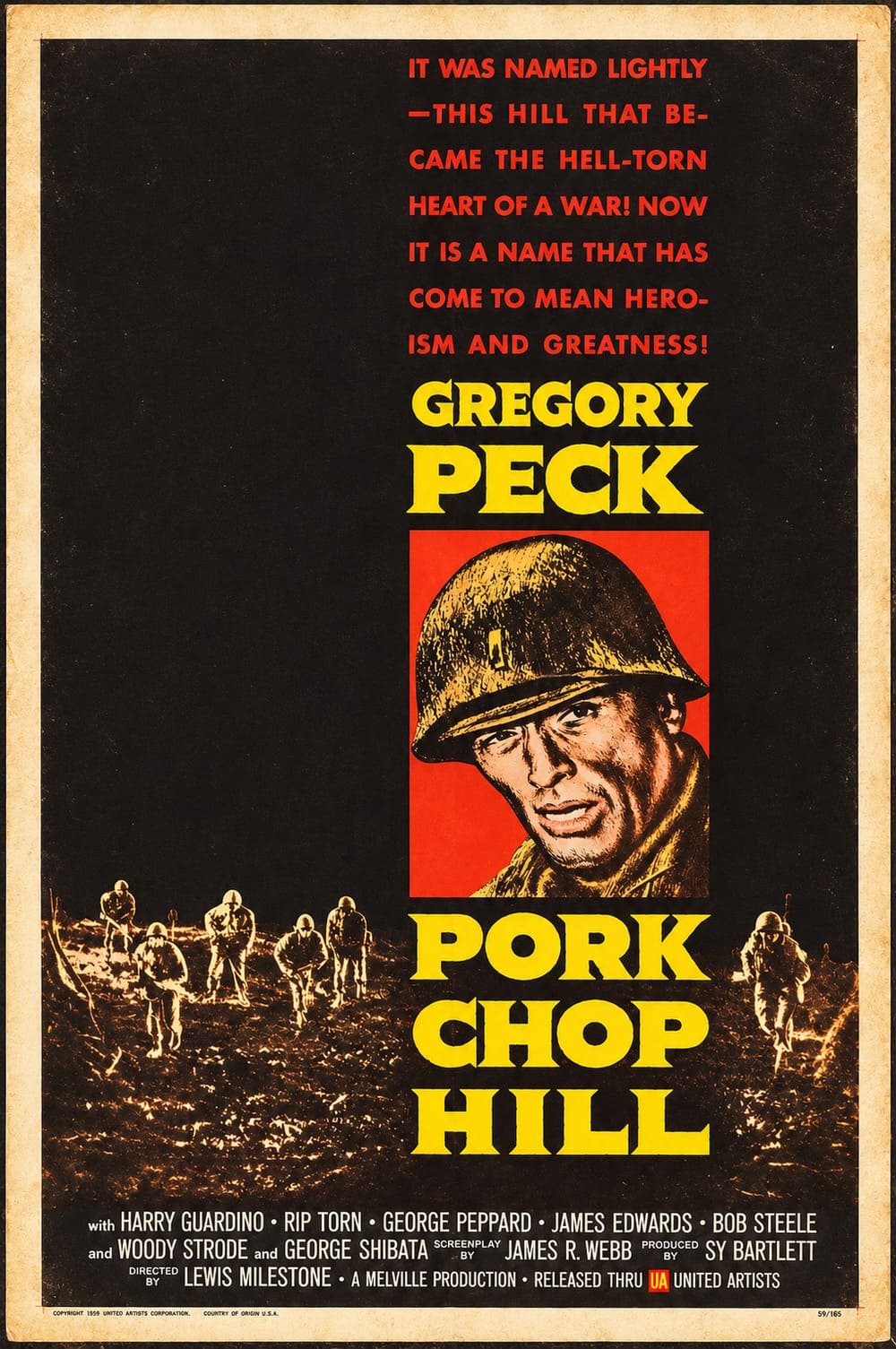
Lewis Milestone’s Pork Chop Hill (1959) is the kind of war movie that makes taking an objective look a lot less impressive than surviving it. There is no beautiful prize waiting at the summit, just torn-up ground, exhausted soldiers, and the possibility of another attack. Starring Gregory Peck as Lieutenant Joe Clemons, the film follows an American company ordered to retake a Korean hill while armistice negotiations grind along elsewhere. Its central question is uncomfortable: what happens when military courage gets put to work defending something that matters mostly because neither side wants to admit it doesn’t?
What makes the movie stick is its refusal to separate the soldiers’ bravery from the futility of their situation. These men can perform extraordinary acts without making the larger operation seem sensible. Milestone doesn’t treat that contradiction as something a stirring speech can clear up. Instead, it hangs over the fighting, making every bit of progress feel provisional. You can admire the men struggling up the slope while wondering why anyone should have to climb it. That tension gives Pork Chop Hill its bite: respect for the people doing the fighting never requires unquestioning respect for the decisions keeping them there.
Peck is a strong choice for Clemons because his authority feels practical rather than flashy. He gives the film a steady center without turning the lieutenant into a superhero who can personally fix a collapsing operation. Clemons has to keep people moving, work out what is happening, and hold together a force being steadily worn down. The performance works best as a portrait of leadership reduced to immediate responsibilities. Grand strategy is somebody else’s department; keeping the next position from being overrun is his. Peck’s restraint fits a film interested less in heroic posing than in the exhausting work behind survival.
Woody Strode provides an especially valuable counterweight as Private Franklin, a soldier who has no interest in dying to prove a point about Korea. Strode gives Franklin’s resistance an angry, defensive edge that makes him more interesting than a stock soldier who loses his nerve. His physical presence makes the contrast striking: looking powerful does not mean feeling willing to sacrifice yourself. When Franklin confronts Clemons, the clash brings the movie’s larger questions down to a painfully personal level. Why should this particular man give his life for this particular hill? Strode makes that question feel urgent rather than abstract.
Franklin’s bitterness also carries a racial dimension. His reference to the conditions he lives in back home complicates any easy appeal to patriotism: he is being asked to risk everything for a country whose treatment of him gives him reasons to feel alienated. The film ultimately steers him toward solidarity with the other soldiers, and Clemons answers his objections by emphasizing their shared danger and hardship. That resolution is not entirely satisfying, since it moves past Franklin’s specific grievances rather quickly. Still, Strode gives the character enough wounded pride and frustration that his objections remain worth considering even after the story pushes him back into the fight.
Milestone’s handling of combat has a nuts-and-bolts quality. Movement, communication, reinforcement, and relief become matters of life and death rather than background details. Orders do not automatically produce results, and information moving away from the battlefield does not necessarily describe what is actually happening there. The film makes the gap between the front line and higher command feel dangerous in itself. A position can look secure to someone elsewhere while the men occupying it know they are barely hanging on. That disconnect is more unsettling than a straightforward story about one obviously foolish officer making one obviously disastrous decision.
Most importantly, Pork Chop Hill doesn’t flinch from the meat grinder. Its violence matters through accumulation: men disappear from the fighting strength, exhaustion builds, and holding the same battered ground becomes harder. This isn’t simply a matter of whether an older film shows enough blood for modern tastes. The horror comes from the sense that human beings are being fed into an argument that has no natural stopping point. The enemy loudspeaker adds another ugly layer, reminding the Americans that they may die for a position being debated by people safely removed from it. Psychological pressure becomes part of the battlefield’s machinery.
The trap extends to both sides, even though the film’s emotional viewpoint stays firmly with the Americans. Chinese troops are also being committed to a struggle whose importance comes from what possession supposedly proves. That distinction matters. The movie does not offer an equally intimate portrait of both armies, but its political framework suggests a shared predicament: soldiers must keep paying because their leaders cannot afford to look unwilling to pay. The hill becomes a test of determination, and every sacrifice helps create the justification for another. It is a brutal circular argument, carried out with artillery and infantry instead of words.
The ceasefire negotiations make that argument especially bitter. Rather than presenting the fighting and diplomacy as separate activities, the film shows how closely they are connected. Leaders understand that the hill’s importance is not really in the ground itself. What matters is whether surrendering it might weaken their position at the negotiating table or suggest that their willingness to fight has run out. Neither side wants to blink. Peace is being discussed while men are being asked to demonstrate that the war could continue, which gives the battle an almost unbearable absurdity. The prospect of an agreement does not stop the killing; it helps explain its immediate purpose.
There is an important historical qualification here. The film dramatizes the April 1953 fighting, not the later July battle that ended with American withdrawal. The battles became controversial because of the casualties incurred over terrain widely described as having little or no strategic or tactical value. Still, “worthless” needs a little unpacking: the hill could lack meaningful military value while acquiring symbolic importance in negotiations. That does not make the losses easier to justify. It explains how commanders could recognize the ground’s limited usefulness and nevertheless insist that abandoning it would carry consequences beyond the battlefield.
As a movie, Pork Chop Hill is strongest when it lets that contradiction emerge through the soldiers’ immediate problems. Its matter-of-fact approach can feel emotionally spare, and viewers looking for extensive personal histories may find its concentration on the operation limiting. But that narrowness also has force. The men’s lives have been compressed into getting forward, finding support, maintaining contact, and lasting long enough to be relieved. Strode’s scenes puncture that operational focus just enough to remind us that each soldier brings his own reasons for resisting or accepting what is demanded of him. These are people, not simply a dwindling number on a commander’s report.
For all its toughness, Pork Chop Hill never makes toughness look like much of a reward. What stays with you is the sheer effort required to get through another stretch of fighting, followed by the realization that surviving it may simply mean being available for the next attack. Peck’s grounded authority, Strode’s simmering resistance, and Milestone’s stripped-down approach make that experience compelling without making it inviting. It’s a gripping war film, but not a comfortable one to cheer along with. By the time it is over, who holds the hill feels less important than how many men have been used up proving that neither side will let it go.
Welcome to Retro Television Reviews, a feature where we review some of our favorite and least favorite shows of the past! On Wednesdays, I will be reviewing the original Love Boat, which aired on ABC from 1977 to 1986! The series can be streamed on Paramount Plus!
This week, we’ve got a special two-hour episode of The Love Boat!
Episodes 8.19 and 8.20 “Scandinavia Cruise: Girl of the Midnight Sun/There’ll Be Some Changes Made/Too Many Isaacs/Mr. Smith Goes to Stockholm”
(Dir by Robert Scheerer, originally aired on February 2nd, 1985)
The Love Boat is going to Oslo and Stockholm!
This is another one of those two-hour episodes that largely served as a travelogue. Let’s just say that there are a lot of scenes of the crew members wandering around Oslo and Stockholm and pointing out all of the historic buildings. That said, there is the usual collection of guest stars.
Jack Klugman plays a man who wants to reduce the size of his nose. He meets and falls for Susannah York. In one of those mix-ups that could only happen on a sitcom, she gets it into her head that he’s going to Sweden to get a sex-change operation, and she makes it her mission to change his mind.
John Davidson plays the vice president of a suntan lotion company who has been tasked with finding a Scandinavian model to pose for the company’s ads. He thinks that he’s found the perfect candidate in Greta (Christopher Norris). How will he react when he discovers that Greta is actually just an American pretending to be Swedish? Do you think they’ll fall in love?
Priscilla Barnes plays a Swedish actress who appears to be fascinated with Gopher. Gopher briefly resigns from the cruise to join her father’s company. Don’t worry, he comes back.
Here’s the thing, though. While all of this is going on, Telly Savalas is playing a mad scientist who has built a robot that looks exactly like Isaac. He has hired Janet Jackson to distract the real Isaac so that the robot Isaac can commit a daring daylight robbery. His plan is for the real Isaac to be arrested. He almost succeeds until the robot Isaac malfunctions in a hallway. “That’s not Isaac!” Doc Bricker says.
Remarkably, Isaac is amazingly untraumatized by all of this. He even pretends to act like a robot after Savalas and Janet Jackson are arrested. The entire crew laughs. It really seems like this story should have left everyone feeling a bit more uneasy than it did.
Still, the Scandinavian countries were lovely to look at, and watching this old episode of The Love Boat on Wednesday helped to distract me from the fact that a political party that doesn’t have the guts to condemn anti-Semitism swept the midterms. That’s really the best thing that a show like this can do. That’s why I love The Love Boat.
Welcome to Retro Television Reviews, a feature where we review some of our favorite and least favorite shows of the past! On Wednesdays, I will be reviewing the original Love Boat, which aired on ABC from 1977 to 1986! The series can be streamed on Paramount Plus!
And love won’t hurt anymore …. unless your nickname is Gopher.
Episode 8.18 “Love on the Line/Don’t Call Me Gopher/Her Honor, the Mayor”
(Dir by Richard A. Wells, originally aired on January 26th, 1985)
Poor Gopher.
All he wants is for the crew to not call him by his nickname for one cruise. His friend Janet (Katherine Moffat) is going to be on the boat and she only knows him as Burl. Burl, to put it simply, wants to get laid. He suspects that he’ll have a better chance of getting laid if Janet doesn’t know that his nickname is Gopher. He’s probably correct about that, though Burl isn’t much of an improvement.
For some reason, the crew takes it personally. They act as if Burl is being arrogant by not wanting to be called by a nickname that brings to mind a hairy and destructive rodent. Eventually, Janet does discover that “Gopher” is Burl’s nickname and, just as Burl suspected, she finds it impossible to kiss him without laughing.
And yet, somehow, Burl is the one who ends up apologizing to the crew and accepting that he will always be known as Gopher. Listen, if the guy wants to be known by his actual legal name, that’s his right. Of course, Gopher does get laid after he accepts his nickname so maybe the crew had a point. Who knows?
Meanwhile, newly-elected Mayor Frances Hardy (Shelley Fabares) boards the boat with her campaign manager, Barry Singer (David Hedison). Barry is in love with Frances and wants to marry her. However, Frances ends up falling in love with the man she defeated in the election, Phil Haines (Robert Fuller). It’s nice to see that political differences don’t have to stand in the way of love. Imagine how different the country would be today if Hillary and Donald would just admit that they’re in love with each other.
Finally, businessman John Stockton (Cesar Romero) meets a mysterious woman named Marcy (Jane Wyatt). Mary encourages John to shake off his old routine and learn to love life. How will John react when he discovers that Marcy actually works in his office? If you guessed that John will fall in love with her, you’re right. This is the Love Boat!
This wasn’t a bad episode. The guest stars were likable. The stories were pleasant in that way that the Love Boat usually is. That said, I do feel bad for Gopher. All he wanted was a better nickname.
Welcome to Retro Television Reviews, a feature where we review some of our favorite and least favorite shows of the past! On Wednesdays, I will be reviewing the original Love Boat, which aired on ABC from 1977 to 1986! The series can be streamed on Paramount Plus!
This week, it’s love and fraud all aroud.
Episode 8.17 “Ace Takes the Test/The Counterfeit Couple/The Odd Triple”
(Dir by Nell Cox, originally aired on January 12th, 1985)
Ace’s friend Donna (Teresa Ganzel) boards the ship with her macho husband, Gus (Christopher Mayer). Gus owns a moving company. The first thing he does is crush Ace’s hand while shaking it. Gus then beats Ace in an arm-wrestling contest. He then asks Ace to solve a riddle, requests that Ace read the bottom line on a menu, and he asks about Ace’s hearing. Is Gus jealous?
Actually, Gus is testing Ace because he and Donna want to have a baby but Gus appears to be shooting blanks. Gus explains that all of his brothers have at least six kids. Gus just wants to have one. Would Ace consider donating his sperm?
Ace does consider it but ultimately, he decides that he can’t. Fortunately, Donna later faints and, when Doc Bricker examines her, he discovers that she’s pregnant. Gus’s boys can swim after all!
Meanwhile, Susie Epshaw (Crystal Bernard) has a crush on Gopher but Gopher falls in love with Susie’s mom, Annette (Mary Ann Mobley). Susie is okay with it and good for her. Gopher was a little bit old for her. That said, Gopher falls in love several times a season so neither Susie nor her mother should get too excited.
Two strangers (Richard Gilliand and Erin Moran) both buy tickets from scalpers, just to find themselves booked in the Honeymoon Suite together. (Apparently, the couple that originally bought the tickets broke up before the marriage.) “Barbara” and “Lyle” pretend to be married and then they fall in love for real. They admit the truth to the crew and everyone is just fine with the fraud. As long as the tickets were paid for, the Captain doesn’t really care who stays in the Honeymoon Suite. That’s a good attitude. I was a little surprised to discover that the Honeymoon Suite was just a normal cabin.
This cruise was another example of the eighth season’s tendency to be, in general, pleasant but predictable. I laughed a few times at Ace being tested by Donna and Gus, just because of the contrast between super smooth Ted McGinley and the rough-hewn Christopher Mayer. Otherwise, this was a cruise that wasn’t bad but also wasn’t particularly memorable.
Welcome to Retro Television Reviews, a feature where we review some of our favorite and least favorite shows of the past! On Wednesdays, I will be reviewing the original Love Boat, which aired on ABC from 1977 to 1986! The series can be streamed on Paramount Plus!
This week, Janet Leigh boards the boat and probably ends up wishing she hadn’t.
Episode 8.16 “Instinct/Unmade for Each Other/BOS”
(Dir by Richard Kinon, originally aired on January 5th, 1985)
Leslie (Vic Tayback) pays money to a computer dating service and is told to meet his date Shelley in the lobby of the Pacific Princess.
Shelley (Conrad Bain) also pay money to the same computer dating service and he is also told to meet his date on the Pacific Princess. The name of his date? Leslie.
Uh-oh! There’s been a mistake! At first, the plain-spoken Leslie and the fussy Shelley just laugh it off and agree to enjoy the cruise. But then they both fall for Joan Phillipps (Janet Leigh). Joan tells both men that she loves them because she’s enjoying the attention. Eventually, Leslie learns that Joan has been making fun of him behind his back and Shelley discover that Joan has been doing the same thing to him. Leslie and Shelley agree to be friends and hit the New Yok singles scene together.
Uhmm …. okay, then. The main problem with this storyline was that it asked us to believe that Janet Leigh couldn’t do better than Vic Tayback and Conrad Bain.
Meanwhile, Emelyne Namackere (a very annoying Irlene Mandrell) boards the ship with the expectation that her long-distance boyfriend will be waiting for her. Instead, Neil Bonhoff (Bruce Penhall) shows up and introduces himself as a friend of Emelyne’s boyfriend. Neil explains that Emelyne’s boyfriend has gotten married and that he sent Neil in his place. Emelyne is upset but eventually she falls for Neil. She sleeps with Neil and then announces that she knows Neil is going to dump her because men don’t marry women who they don’t respect. (Yikes!) Neil responds by asking Emelyne to marry him. Emelyne says yes and then she discovers that Neil was lying about her boyfriend getting married. Sneaky Neil! But, as is so often the case on The Love Boat, Emelyne is eventually willing to overlook a history of sociopathic deception in the name of love.
Those stories were both pretty bad. Fortunately, the third story is a bit better. Isaac falls for Lynda Miles (Berlinda Tolbert), who is member of a New Age self-help movement called BOS. At first, Isaac just pretends to be into BOS to get Lynda to talk to him but soon, he becomes a believer. His new openness with his emotions makes his co-workers uncomfortable. It’s a very simple story but Ted Lange sells it. As for BOS itself, it sounds like a cult so I’m glad Isaac appears to be over it by the end of the episode.
This episode was pretty forgettable. Irlene Mandrell and Bruce Penhall had an amazing lack of chemistry and their story was almost painful to watch as a result. Janet Leigh deserved better.
Welcome to Retro Television Reviews, a feature where we review some of our favorite and least favorite shows of the past! On Wednesdays, I will be reviewing the original Love Boat, which aired on ABC from 1977 to 1986! The series can be streamed on Paramount Plus!
Merry Christmas!
Episode 8.15 “Santa, Santa, Santa/Another Dog Gone Christmas/Noel’s Christmas Carol”
(Dir by Richard Kinon, originally aired on December 15th, 1984)
It’s time for the Christmas voyage!
Assigned to hire a Santa Claus for the trip, Judy McCoy has finally managed to find one in the surprisingly thin form of Max Phelps (Ray Waltson). Uh-oh! Apparently, Gopher didn’t get the memo and he hired a Santa Claus of his own, Patrick Turney (Avery Schreiber). Well, this is awkward but surely …. wait a minute, who is that with Isaac? Isaac also hired a Santa Claus, in this case Shakespearean actor Malcolm (Scatman Crothers)!
How did this happen and I mean that sincerely. I guess I can understand Gopher having the power to hire a Santa Claus because he is the ship’s pursuer. But why is Isaac hiring people? How does the Captain not know who is and who isn’t being hired for his ship? And why didn’t either Gopher or Isaac tell Judy that they hired a Santa Claus?
These are legitimate questions but they really don’t matter. The three Santa Clauses are all wonderful in their roles and watching them try to outdo each other is actually pretty entertaining. This is a storyline that worked better than it had any right to, largely because there wasn’t a hint of cynicism to be found on The Love Boat. Most modern sitcoms would have made the Santa Clauses angry or bitter. But, on The Love Boat, three Santas are always better than one!
As for the other stories, Carol Kelsey (Kim Lankford) lies to her mother (Anne Francis) and tells her that Ace is her fiancé. Carol is just trying to get her mother off of her back. But when Carol falls for Ace’s friend, Noel Kane (Shea Farrell), Carol’s mother fears that her daughter is cheating on Ace. No worries! What can go wrong when you fall in love with someone named Noel on Christmas? Again, this is another episode that worked specifically because of The Love Boat’s utter and complete earnestness. It was goofy and it was perfect for a Christmas voyage.
Finally, Vicki is sailing with her dog, Tundra (played by the adorable Tundra The Wonder Dog). Because Vicki’s aunt and uncle can no longer look after Tundra and a boat is no place for a dog to live, she gives Tundra to a down-on-his luck stand-up comedian (Howard Morris). This was such a sweet story that it brought tears to my eyes. Tundra was adorable and he brought a lot of cheer to the entire boat.
Wow, Christmas in October! Happy holidays everyone!
Welcome to Retro Television Reviews, a feature where we review some of our favorite and least favorite shows of the past! On Wednesdays, I will be reviewing the original Love Boat, which aired on ABC from 1977 to 1986! The series can be streamed on Paramount Plus!
This week, Adam’s old fraternity brother takes a cruise. He’s got a secret!
Episode 8.14 “Country Blues/A Matter of Taste/Frat Brothers Forever”
(Dir by Jerome Courtland, originally aired on December 8th, 1984)
Simon (Farley Granger) and Valerie (Terry Moore) used to be lovers but now, they’re rival interior designers. They are competing for the chance to redesign that ship’s cabins and, of course, they both end up sabotaging each other. The Captain grows so frustrated that he decides that the cabins are fine just the way they are and I agree. The cabins are functional and bland and they encourage the passengers to spend most of their time in either the lounge or at the pool. As for Simon and Valerie, they realize that they’re still in love. It’s a win-win-win for everyone.
Country singer Billy Bodine (Matt McCoy) falls in love with Arlene Cort (Leah Ayres), little realizing that she’s been bribed by his manager, Cappy (Claude Akins), to break his heart. Billy writes his most popular songs when he’s depressed. After she lies to him about having another lover, Arlene feels terrible, especially after she learns that she’s inspired Billy to write not just one but two songs about how heartbroken he is. Arlene wants to come lean but, if Arlene confesses, she’ll lose her chance to be on the big Kenny Rogers television special. Of course, Arlene does confesse. Love is more important than Kenny. Billy fires Cappy. Cappy doesn’t care. Cappy announces that he’s going to go into the pickle-selling business and make a million dollars. Arlene finds love but she does lose her chance to be a big TV star. So, this one is a win-lose-win.
Finally, Adam’s old frat brother, Buzz (Roy Thinnes), boards the ship with Jim Dolan (Michael McGrady). Buzz says that Jim is his cousin. Adam promises to find dates for both Buzz and Jim. Uhmm, Adam, I don’t think Buzz and Jim are interested in the same dates that you are.
This was the first and only episode of The Love Boat to feature a gay couple and, to my surprise, their story was actually handled with a good deal of sensitivity. Buzz fears that Adam won’t accept that he’s gay but he also doesn’t want to spend the entire cruise living a lie. (Adam keeps trying to set Buzz and Jim up with every single woman on the cruise.) When Buzz does come out to Adam, Adam is surprised but accepting. I appreciated that this episode allowed Adam to have a realistic reaction to Buzz coming out as opposed to turning Adam into some sort of idealized perfect best friend. Instead, Adam has the reaction that you would expect a good-hearted but old-fashioned boomer to have. He’s surprised and, briefly, at a loss for words. The fact that Adam does then accept Buzz for who he is and apologizes for his earlier surprise shows that people can continue to grow and learn, regardless of how old they may be.
Two of the stories were silly but the third one made up for them. This wasn’t a bad cruise.
Welcome to Retro Television Reviews, a feature where we review some of our favorite and least favorite shows of the past! On Wednesdays, I will be reviewing the original Love Boat, which aired on ABC from 1977 to 1986! The series can be streamed on Paramount Plus!
Welcome aboard! We’re expecting you….
Episode 8.13 “Paying the Piper/Baby Sister/Help Wanted”
(Dir by Richard Kinon, originally aired on December 1st, 1984)
Cheryl Enicker (Rue McClanahan) is sick of her husband, button manufacturer Harold (Donald O’Connor), taking her for granted. When she gives him a watch that cost $1,200, Harold points out that, since she gets all of her money from him, he basically bought the watch himself. Cheryl gets upset and hands Harold an invoice, listing everything that she’s done as a wife and mother for 25 years and demanding that Harold pay her half a million dollars. That’ll show him! After the episode, I was kind of of curious as to why the invoice was only for half a million dollars. It seems like it should have been more. I did some calculations and discovered that $520,00 in 1980 was the equivalent of $2,000,000 today. Wow!
Recent high school graduate Patty Springer (Dana Plato) can’t understand why her much older sister, Eleanor (Jaime Lynn Bauer), is freaking out about Patty hanging out with Peter Barkan (Christopher Knight). Eleanor goes as far as to kiss Peter in order to make Patty think that Peter is cheating on her. Patty’s mother, Eve (Vera Miles), suggests that Eleanor should tell Patty the truth. Eleanor isn’t actually Patty’s sister. Eleanor is …. Patty’s mother! And Eve is actually Patty’s grandmother. Needless to say, Patty is shaken by this news but she accepts it by the time the cruise ends. The Love Boat was only an hour show so most cases of generational trauma had to be resolved fairly quickly.
Kim Carlisle (Michelle Johnson) is the niece of a friend of Captain Stubing’s. Kim shows up, saying that her uncle said Stubing would find something for her to do on the ship. Kim goes from department-to-department, screwing things up. She removes all of the labels from the wine bottles so she can wash them. She snaps a picture of a man cheating on his wife. However, when she starts doing aerobics, several passengers join her. Kim is hired to be the new recreation director and — WAIT A MINUTE! I thought that was Charo’s job! Well, apparently, Charo is out and Kim is in.
This cruise was pleasant but forgettable, which seems to be becoming the norm for season 8. It didn’t take me long to guess the big twist about Eleanor being Patty’s mother. Poor Dana Plato. Knowing what I now know about her life and what the future had in store for her adds a definite melancholy feel to this episode.
Welcome to Retro Television Reviews, a feature where we review some of our favorite and least favorite shows of the past! On Wednesdays, I will be reviewing the original Love Boat, which aired on ABC from 1977 to 1986! The series can be streamed on Paramount Plus!
Is your mind on a new romance? Are you ready to set sail for adventure?
Episode 8.11 “My Mother, My Chaperone/The Present/The Death and Life of Sir Albert Demerest/Welcome Aboard”
(Dir by Richard Kinon, originally aired on November 24th, 1984)
Your Love Boat crew is sailing to London!
This is another one of those two-hour episodes that was shot on location. I always enjoy these episodes, even if they are mostly just extended travelogues. This one actually has a few good storylines to go along with the scenes of the crew walking around London and France.
For instance, Marc Singer plays John Neary, Judy’s ex-husband who boards the cruise in an attempt to win her back. This was the first storyline to really feature Judy as someone other than just the perky replacement for Julie. We saw how happy she was at the prospect of getting together with John but we also saw how John consumed her life to the extent that she started screwing up at work. When John suggested that Judy’s job really wasn’t that important to begin with, we saw why their marriage failed in the first place. This was the first episode in which Judy really felt like a member of the group.
Colleen Dewhurst played Maud Correll (Colleen Dewhurst), a former actress who is sailing to London with her son, Byron (Peter Barton). On the cruise, Maud tells Byron that his father is actually the distinguished actor, Sir Albert Demerest (Trevor Howard). In London, Maud and Sir Albert meet and, in a wonderfully acted scene, Sir Albert says he isn’t sure that he wants to meet the son that he previously didn’t know he had. “It’s been 20, 21 years,” Sir Albert says, “it’s too late.” Still, Byron wants to be an actor and he visits Sir Albert at work. Albert is filming a commercial and he keeps flubbing his lines. At first, Byron is upset that his father would sell out his talents but eventually, he comes to understand that, sometimes, an actor doesn’t have a choice. The bills have to be paid.
This story was surprisingly good. Dewhurst, Howard, and Barton all gave heartfelt performances. Howard was obviously not in the best of health when he appeared on The Love Boat but his fragile appearance only adds to the poignance of the story.
Speaking of good performances, the great German actress Lili Palmer plays novelist Lily Marlowe. Lily is a cynic about love and she’s concerned when she sees that her virginal daughter, Samantha (Anna-Alicia), is falling for Roger Wembly (Morgan Stewart). And when Samantha runs into Roger’s wife in London, it appears that Lily is right. However, Roger then takes over Speakers’ Corner and gives a speech about how much he loves Samantha and how he and his wife are getting divorced. He wins over both Samantha and Lily. While the story might have been a standard Love Boat melodrama (and how convenient was that divorce?), the scenes of Lily, Samantha, and Roger in London were nice to look at. (Rainy, misty London was lovely.) And the use of Speakers’ Corner was a reminder of what the UK used to be.
Finally, Kathy Ross (Loretta Swit) decides to test the fidelity of her husband, Leonard (Dennis Holahan), by hiring a prostitute to seduce him. The prostitute, Monika (Catherine Oxenberg), hopes to get her hands on Leonard’s money by lying and breaking up his marriage with Kathy. But, after seeing how terrible Leonard feels after Kathy leaves him, Monika has a change of heart and tells the truth. This was the weakest of the episode’s stories but Catherine Oxenberg did have a few funny lines.
All in all, this was a great cruise! London brought out the best of The Love Boat.