Welcome to Retro Television Reviews, a feature where we review some of our favorite and least favorite shows of the past! On Fridays, I will be reviewing St. Elsewhere, a medical show which ran on NBC from 1982 to 1988. The show can be found on Daily Motion.
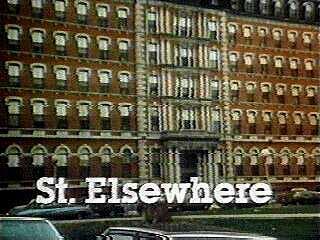
In this special two-part episode, 50 years of St. Elsewhere are documented in just two hours.
Episodes 4.17 and 4.18 “Time Heals”
(Dir by Mark Tinker, originally aired on February 19th and February 20th, 1986)
Aired over two nights, “Time Heals” uses St. Eligius’s 50th anniversary to give us 50 years of history. While the staff prepares to observe half a century of serving Boston, the episode skips back and forth in time.
In 1935, a young and enthusiastic priest named Joseph McCabe (Edward Herrmann) prepares for the opening of a hospital that he hopes will serve the downtrodden and forgotten of Boston. Monsignor Senti (Norman Burton) views McCabe as a troublemaker. Meanwhile, a young Donald Westphall watches as his father helps bring a wounded man named Patrick O’Casey (William Russ) to the hospital. Later, Westphall’s sister and mother are killed in a house fire.
In 1945, a young liver specialist named Daniel Auschlander (James Stephens) is brought on staff and meets an angry teenage Donald Westphall (Michael Sharrett). Donald shines shoes in the hospital lobby. When Donald is caught stealing, Father McCabe takes him to the hospital’s gym and gives him a boxing lesson. As for Auschlander, he allows a returning serviceman named Patrick O’Casey to see his young daughter, who is suffering from polio and has been placed in an isolation ward.
In 1955, the Archdiocese sells the hospital to the city and Father McCabe is fired. McCabe gets drunk. Auschlander says that he intends to resign in protest. McCabe replies that that would be a mistake—Auschlander is the man McCabe has recommended as his replacement. Meanwhile, Patrick O’Casey’s daughter dies after spending ten years in an iron lung, and a cocky intern named Mark Craig (William Daniels, sans mustache) has a panic attack while performing his first operation. The demanding Dr. David Domedion (Jackie Cooper) orders Craig back into the operating room. Later, Craig tells another resident, Donald Westphall (Ed Flanders, his hair dyed black but still looking quite middle-aged), that he’s been offered a position at Boston General and will never return to St. Eligius.
In 1965, Dr. Craig returns to St. Eligius, bitter that he was passed over for chief of surgery at Boston General. While a young Luther Hawkins sits in the waiting room, a newly arrived nurse named Helen Eisenberg helps Dr. Westphall deal with Terence O’Casey (Brian Kerwin), a young man having a bad acid trip. “Get a haircut, hippie,” Dr. Craig says at one point.
In 1975, Terence O’Casey is back in the hospital, waiting as Dr. Craig performs open-heart surgery on his father, Patrick. Donald Westphall is appointed hospital administrator. The same night, his wife, Maureen (Anita Gillette), is in an auto accident that leaves her brain-dead. Westphall is the one who has to decide to remove her breathing tube and allow her to pass on.
In 1985, high school principal Terence O’Casey is brought to the hospital with sudden paralysis. His doctor, Jack Morrison, struggles to diagnose Terence’s condition until he goes down to the basement, looks through the earliest hospital records, and reads about Terence’s sister, who died in an iron lung. Jack diagnoses Terence with Guillain-Barré syndrome, a paralyzing condition that can resemble polio.
Meanwhile, Jack’s son, Pete, is apparently abducted by a man at the hospital. I say “apparently” because the plotline feels a bit underdeveloped. The episode ends with the police returning Pete to Jack during St. Eligius’s anniversary party. Pete seems to be physically unharmed, and we’re not really given any details as to who abducted him or how the police tracked him down.
The subplot featuring Morrison’s son being abducted is oddly undeveloped, but that’s really the only flaw to be found in “Time Heals.” This is not only a great episode of St. Elsewhere; it’s also one of the greatest episodes of television I’ve ever seen. That said, it isn’t just a great episode of television. It’s a great work of art, period, from the excellent performances to the way the episode seamlessly mixes the flashbacks so that they come together to tell one epic story of the 20th century. Featuring both the story of the hospital and the story of the O’Caseys, “Time Heals” is a portrait of how times change and how they remain the same.
A few random notes:
For those who think Dr. Craig is too hard on his residents, this episode shows that Craig’s mentor was equally hard on him, and that it helped turn Craig into the surgeon he is today. That said, it’s also amusing to see that young Mark Craig was just as obnoxious as Victor Ehrlich.
I’ve often complained about how depressed Westphall always seems to be. This episode shows that Westphall has a lot of reasons to be depressed. The man’s life has been one tragedy after another.
One cannot overlook the importance of the O’Caseys to this episode’s power. The O’Caseys represent the community St. Eligius is meant to serve. The hospital is part of the family’s life. History repeats itself throughout the O’Casey storyline. In 1935, Patrick O’Casey is injured and nearly killed in a fight. By 1945, he’s married and a member of the U.S. Army. In 1965, Patrick’s son, Terence, is a drug-abusing member of the counterculture. By 1985, he’s a conservative high school principal who has an estranged relationship with his gay son, Kevin (John Scott Clough). All of the male O’Caseys have more in common than they realize.
Each decade is shot in a different visual style, which helps us keep track of things. The 1935 scenes are shot in black and white. The 1945 scenes feature muted colors. As we move through time, the colors become clearer and more vibrant until we finally find ourselves in 1985.
“Time Heals” is touching, powerful, and even funny. It’s a true work of art.

