Retro Television Review: St. Elsewhere 4.17 and 4.18 “Time Heals”


Welcome to Retro Television Reviews, a feature where we review some of our favorite and least favorite shows of the past! On Fridays, I will be reviewing St. Elsewhere, a medical show which ran on NBC from 1982 to 1988.  The show can be found on Daily Motion.
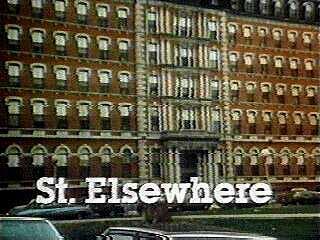
In this special two-part episode, 50 years of St. Elsewhere are documented in just two hours.

Episodes 4.17 and 4.18 “Time Heals”

(Dir by Mark Tinker, originally aired on February 19th and February 20th, 1986)

Aired over two nights, “Time Heals” uses St. Eligius’s 50th anniversary to give us 50 years of history. While the staff prepares to observe half a century of serving Boston, the episode skips back and forth in time.

In 1935, a young and enthusiastic priest named Joseph McCabe (Edward Herrmann) prepares for the opening of a hospital that he hopes will serve the downtrodden and forgotten of Boston. Monsignor Senti (Norman Burton) views McCabe as a troublemaker. Meanwhile, a young Donald Westphall watches as his father helps bring a wounded man named Patrick O’Casey (William Russ) to the hospital. Later, Westphall’s sister and mother are killed in a house fire.

In 1945, a young liver specialist named Daniel Auschlander (James Stephens) is brought on staff and meets an angry teenage Donald Westphall (Michael Sharrett). Donald shines shoes in the hospital lobby. When Donald is caught stealing, Father McCabe takes him to the hospital’s gym and gives him a boxing lesson. As for Auschlander, he allows a returning serviceman named Patrick O’Casey to see his young daughter, who is suffering from polio and has been placed in an isolation ward.

In 1955, the Archdiocese sells the hospital to the city and Father McCabe is fired. McCabe gets drunk. Auschlander says that he intends to resign in protest. McCabe replies that that would be a mistake—Auschlander is the man McCabe has recommended as his replacement. Meanwhile, Patrick O’Casey’s daughter dies after spending ten years in an iron lung, and a cocky intern named Mark Craig (William Daniels, sans mustache) has a panic attack while performing his first operation. The demanding Dr. David Domedion (Jackie Cooper) orders Craig back into the operating room. Later, Craig tells another resident, Donald Westphall (Ed Flanders, his hair dyed black but still looking quite middle-aged), that he’s been offered a position at Boston General and will never return to St. Eligius.

In 1965, Dr. Craig returns to St. Eligius, bitter that he was passed over for chief of surgery at Boston General. While a young Luther Hawkins sits in the waiting room, a newly arrived nurse named Helen Eisenberg helps Dr. Westphall deal with Terence O’Casey (Brian Kerwin), a young man having a bad acid trip. “Get a haircut, hippie,” Dr. Craig says at one point.

In 1975, Terence O’Casey is back in the hospital, waiting as Dr. Craig performs open-heart surgery on his father, Patrick. Donald Westphall is appointed hospital administrator. The same night, his wife, Maureen (Anita Gillette), is in an auto accident that leaves her brain-dead. Westphall is the one who has to decide to remove her breathing tube and allow her to pass on.

In 1985, high school principal Terence O’Casey is brought to the hospital with sudden paralysis. His doctor, Jack Morrison, struggles to diagnose Terence’s condition until he goes down to the basement, looks through the earliest hospital records, and reads about Terence’s sister, who died in an iron lung. Jack diagnoses Terence with Guillain-Barré syndrome, a paralyzing condition that can resemble polio.

Meanwhile, Jack’s son, Pete, is apparently abducted by a man at the hospital. I say “apparently” because the plotline feels a bit underdeveloped. The episode ends with the police returning Pete to Jack during St. Eligius’s anniversary party. Pete seems to be physically unharmed, and we’re not really given any details as to who abducted him or how the police tracked him down.

The subplot featuring Morrison’s son being abducted is oddly undeveloped, but that’s really the only flaw to be found in “Time Heals.” This is not only a great episode of St. Elsewhere; it’s also one of the greatest episodes of television I’ve ever seen. That said, it isn’t just a great episode of television. It’s a great work of art, period, from the excellent performances to the way the episode seamlessly mixes the flashbacks so that they come together to tell one epic story of the 20th century. Featuring both the story of the hospital and the story of the O’Caseys, “Time Heals” is a portrait of how times change and how they remain the same.

A few random notes:

For those who think Dr. Craig is too hard on his residents, this episode shows that Craig’s mentor was equally hard on him, and that it helped turn Craig into the surgeon he is today. That said, it’s also amusing to see that young Mark Craig was just as obnoxious as Victor Ehrlich.

I’ve often complained about how depressed Westphall always seems to be. This episode shows that Westphall has a lot of reasons to be depressed. The man’s life has been one tragedy after another.

One cannot overlook the importance of the O’Caseys to this episode’s power. The O’Caseys represent the community St. Eligius is meant to serve. The hospital is part of the family’s life. History repeats itself throughout the O’Casey storyline. In 1935, Patrick O’Casey is injured and nearly killed in a fight. By 1945, he’s married and a member of the U.S. Army. In 1965, Patrick’s son, Terence, is a drug-abusing member of the counterculture. By 1985, he’s a conservative high school principal who has an estranged relationship with his gay son, Kevin (John Scott Clough). All of the male O’Caseys have more in common than they realize.

Each decade is shot in a different visual style, which helps us keep track of things. The 1935 scenes are shot in black and white. The 1945 scenes feature muted colors. As we move through time, the colors become clearer and more vibrant until we finally find ourselves in 1985.

“Time Heals” is touching, powerful, and even funny. It’s a true work of art.
Retro Television Review: Baywatch 1.13 “Home Cort”


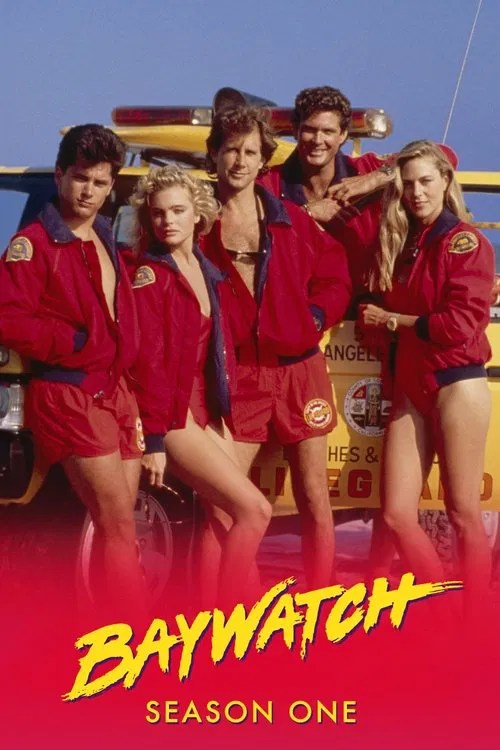
Welcome to Retro Television Reviews, a feature where we review some of our favorite and least favorite shows of the past!  On Saturdays, I will be reviewing Baywatch, which ran on NBC and then in syndication from 1989 to 2001.  The entire show can be viewed on Tubi.

This week, we meet John D. Cort.

Episode 1.13 “Home Cort”

(Dir by Paul Schneider, originally aired on January 12th, 1990)

There’s a new lifeguard on the beach!

His name is John D. Cort (John Allen Nelson) and he’s a former Navy SEAL with a dark and mysterious past.  He drives a motorcycle.  He wears a cowboy hat.  He has a quick smile.  He’s dangerous and he’s now a member of the cast.  I’m going to guess that he was added to bring some mystery to the show.  Originally, Eddie Kramer was supposed to be the dangerous lifeguard with the mysterious past but Billy Warlock was just too earnest and young to really pull that off.  John D. Cort, on the other hand, is at least 40.

Now, I said that Cort was the “new lifeguard on the beach.”  That’s not quite true.  It turns out that he’s actually an old lifeguard who was a friend of Mitch’s and Craig’s.  In fact, it’s insinuated that their friendship is legendary amongst the lifeguards.  Of course, no one’s ever mentioned Cort before but whatever.  Baywatch was never exactly known for its continuity.

Cort says that he’s returned to the beach so that he can work as a lifeguard for ten days and keep his eligibility.  Actually, he’s been hired to retrieve a mysterious package that’s at the bottom of the ocean.  He recruits his old friend, Sam (Bruce Fairbairn), to take him out into the ocean so that he can retrieve the package.  However, an explosion costs Sam his life and forces Cort to deal with the fact that someone wants him dead.  Who wants Cort dead?  Some guy named Jack Burton (Drew Snyder).  Why does he want Cort dead?  Who cares?  I got bored with the whole thing so I missed his motive.  I could go back and find out but, as far as I’m concerned, if the answer was worth knowing, I wouldn’t have gotten bored the first time around.  The story is really just an excuse to introduce Cort.  At the end of the episode, he inherits Sam’s surf shop and makes peace with being a regular member of the cast for at least the rest of the season.

As for the B-plot, Shauni and and Jill go into business selling sandwiches on the beach!  They take a lot of business away from crooked sandwich hustler Buddy Semple (played by George Clooney’s future production partner, Grant Heslov).  Buddy reacts by hiring two women in bikinis to hand out his sandwiches.  That’s the entire plot.

Oh, this episode.  I’ll be so happy when the first season of Baywatch is over with and the show fully and cheerfully embraces the stupidity of its concept.  Until then …. welcome to the beach, John Cort!

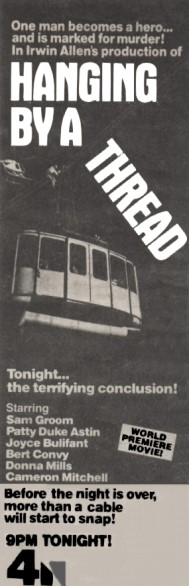
Hanging By A Thread (1979, directed by Georg Fenady)


A group of old friend who call themselves the Uptowners’ Club (yes, really) want to go on a picnic on top of a remote mountain.  The only problem is that they have to ride a cable car up to the mountain and there are reports of potentially bad weather.  It’s not safe to ride in a cable car during a thunderstorm.  Drunken ne’er-do-well Alan (Bert Convy) doesn’t care and, since his family owns both the mountain and the tramway, his demands that he and his friends be allowed to ride the cable car are met.  One lightning strike later and the members of the Uptowners’ Club are stranded in a cable car that is perilously suspended, by only a frayed wire, over treacherous mountain valley.

With no place to go, there’s not much left for the members of the Uptowners’ Club to do but bicker amongst themselves and have lengthy flashbacks that reveal every detail of their own sordid history.  Paul (Sam Groom) is angry with Alan because Alan is now engaged to his ex-wife (Donna Mills).  Sue Grainger (Patty Duke) is angry with everyone else because they don’t want to admit how their old friend Bobby Graham (Doug Llewellyn) actually died.  The other members of the Uptowners’ Club are angry because there’s not much for them to do other than watch Duke and Convy chew on the scenery.  Because of the supposedly fierce winds, someone is going to have to climb out on top of the cable car and repair it themselves.  Will it be Paul or will it be cowardly drunk Alan?  On top of everything else, Paul is set to enter the witness protection program and has got hitmen who want to kill him.

This made-for-TV disaster movie was produced by Irwin Allen.  Are you surprised?  It’s also three hours long and amazingly, Leslie Nielsen is not in it.  It’s hard to understand how anyone could have produced a cable car disaster film and not given a role to Leslie Nielsen.  Cameron Mitchell’s in the film but he’s not actually in the cable car so it’s a missed opportunity.  Any film that features Patty Duke detailing how her friends got so drunk that they ended up killing the future host of The People’s Court is going to at least have some curiosity value but, for the most part, Hanging By A Thread gets bogged down by its own excessive runtime and lack of convincing effects.  Hanging By A Thread came out at the tail end of the 70s disaster boom and it shows why the boom didn’t continue into the 80s.

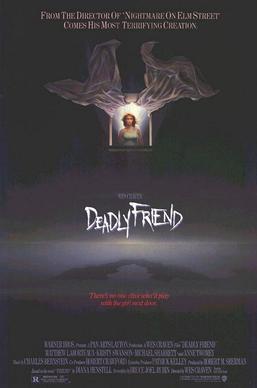
A Movie A Day #277: Deadly Friend (1986, directed by Wes Craven)


Things I learned from watching Deadly Friend:

Girls love nerds who build robots.

In 1986, nerds could build robots that displayed human feelings.

Angry old neighbors hate robots.

If a nerd can build a robot that displays human feelings, then he can also bring his girlfriend back to life by putting a computer chip from the robot in her brain.

Once brought back to life, the girlfriend will start to behave just like the robot.

Basketballs can be used to do anything.

Deadly Friend is best remembered for the scene where the newly revived Samantha (Kristy Swanson) throws a basketball with such force that it causes the head of her neighbor (Anne Ramsey) to explode.  It is also remembered for BB, the big yellow robot that was built by Paul (Matthew Laborteaux).  Deadly Friend starts out as the ultimate nerd fantasy: a beautiful girlfriend. a big robot, and a killer basketball.  By the end of the movie, the fantasy has turned into a nightmare.

Deadly Friend was Wes Craven’s follow-up to A Nightmare on Elm Street.  Craven intended for the film to be a dark love story between a teenage outcast and his zombie girlfriend, with a strong emphasis on the hypocrisy of the adults around them.  Craven said that, in his version of Deadly Friend, people like Samantha’s abusive father were meant to be scarier than Zombie Samantha With A Microchip In Her Brain.  Warner Bros. wanted a film that would appeal to teenage horror fans and demanded Elm Street-stlye nightmares and buckets of more blood.  As a result, Craven practically disowned the finished movie and Deadly Friend is a tonally inconsistent, with sentimental first love scenes competing for space with heads exploding and necks being snapped.  Despite good performances from Laborteaux and Swanson, the final film is too much of a mess to work.  However, I know that I will never look at a basketball the same way again.