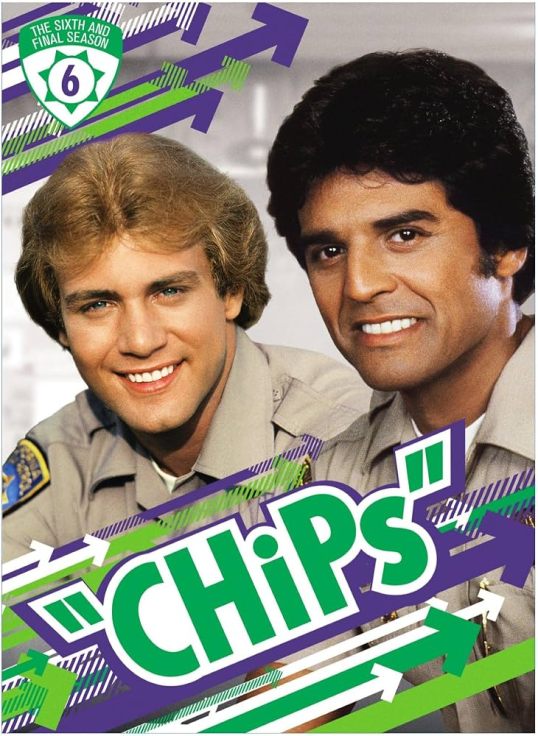
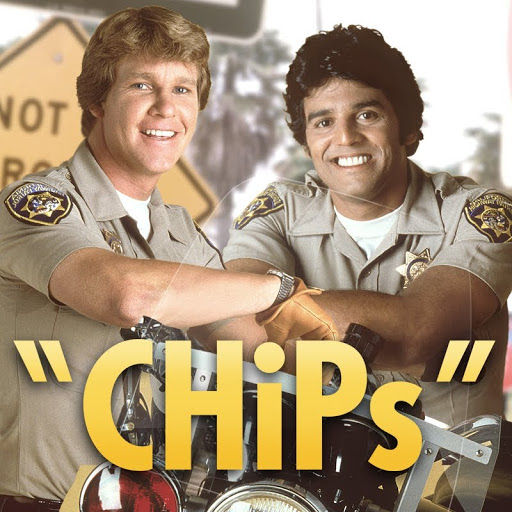
Welcome to Late Night Retro Television Reviews, a feature where we review some of our favorite and least favorite shows of the past! On Mondays, I will be reviewing CHiPs, which ran on NBC from 1977 to 1983. The entire show is currently streaming on Prime!
This week, we meet the future of the Highway Patrol.
Episode 6.5 “Speedway Fever”
(Dir by Chuck Bail, originally aired on November 7th, 1982)
This week, we meet Bobby’s younger brother, Bruce Nelson (Bruce Penhall). Bruce is both a world motorcycle speedway champion and a student at the Highway Patrol Academy. He hopes soon to be riding a motorcycle in the name of the law, just like Bobby and Ponch.
Unfortunately, Bruce has a hard time following orders. He likes to show off when he’s riding his motorcycle. He’s a good driver and a good shooter, but he’s struggling at the Academy. And when things start to get too tough for him, he decides to walk away from it. It’s an impulsive decision that he regrets. Can Ponch and Bobby talk the head of the Academy into giving Bruce a second chance? Of course they can! Ponch and Bobby can do anything.
Bruce Penhall was a real-life speedway champion. The footage of Bruce Nelson winning his race is actually taken from one of Penhall’s actual races. Judging from this episode, Penhall was a likable, if somewhat stiff, actor. In fact, watching this episode, I couldn’t help but notice that Bruce Penhall had better chemistry with Erik Estrada than Tom Reilly did. One gets the feeling that the purpose of this episode was to introduce Penhall as a potential replacement for Reilly. If nothing else, Penhall brought a good deal of earnest energy to his performance and provided quite a contrast to Tom Reilly’s rather spacey acting style.
This episode wasn’t entirely taken up with scenes of Penhall racing. There were two storylines. The more annoying one featured three 16-year-old girls (one of whom was played by Moon Unit Zappa) who would hitchhike and then use a water pistol to rob whoever picked them up. The girls introduced themselves as being from the Valley and spent the entire episode saying stuff like “For sure!” and “Gag me with a spoon!” (I’m not kidding; they said that more than once.) Frank Zappa’s “Valley Girl” played on the soundtrack whenever the girls showed up. It was kind of embarrassing all around. Between this episode, the Moloch episode, and the UFO episode, this season appears to have found CHiPs desperately struggling to stay culturally relevant.
As for the other storyline, it featured two motorcycle-riding thieves who were robbing couriers on the highway. One of the thieves was Bruce’s best friend, Ray (Robert Romanus). What a coincidence! Romanus, of course, played Mike Damone in Fast Times at Ridgemont High, which was probably still in theaters when this episode aired. He gives pretty much the same performance here that he gave in Amy Heckerling’s film. In the end, this episode left you wondering just how Mike Damone eventually ended up going so bad.
The episode ends with Bruce not only winning the world speedway championship but also returning to the Academy. It looks like the Highway Patrol is getting some new blood, and not a minute too soon!
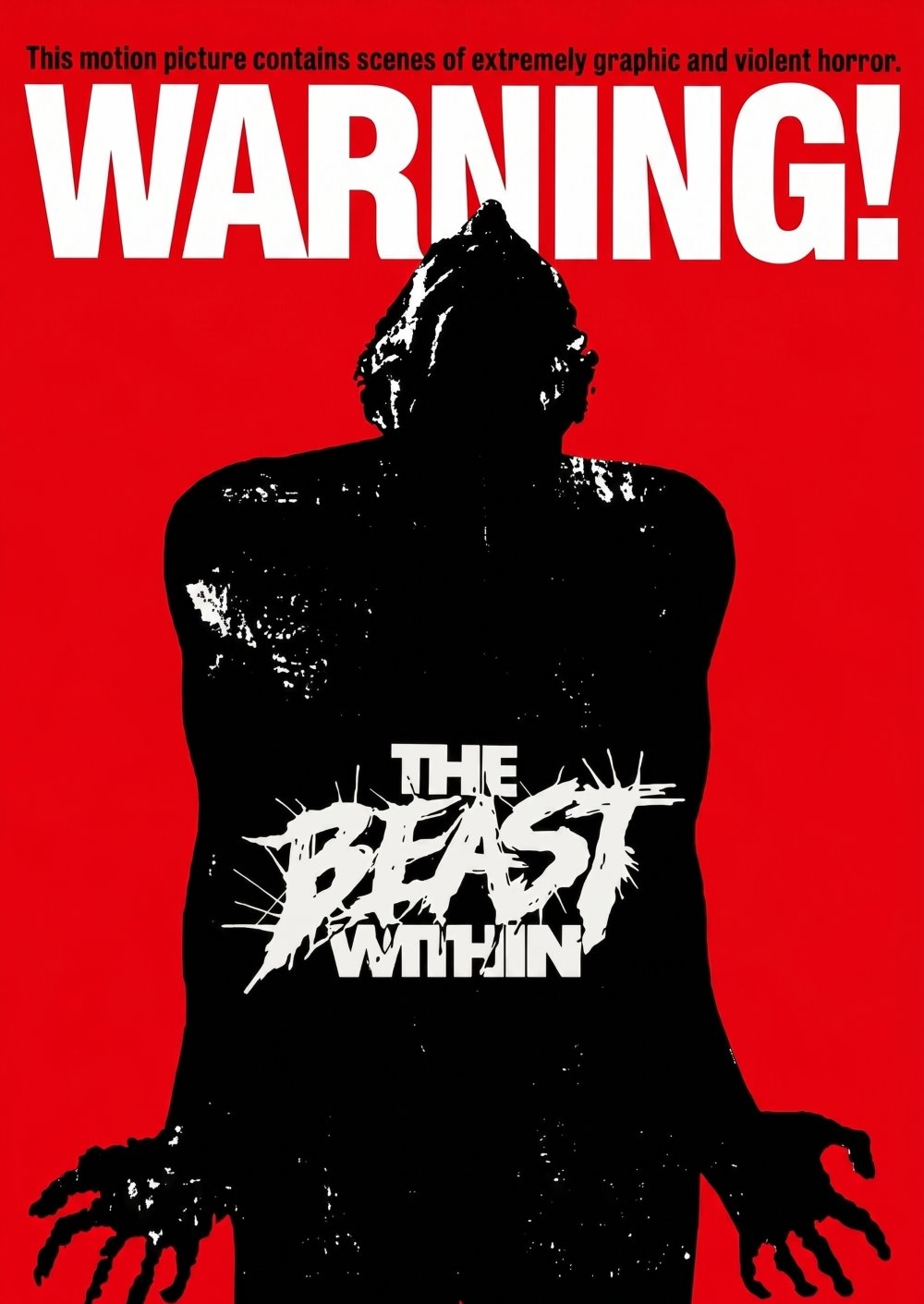
The Beast Within (1982), directed by Philippe Mora, is one of those strange, sticky relics of early ’80s horror that feels like it crawled out of a drive-in double feature and just kept mutating long after the credits rolled. It’s not a good film—let’s just get that out of the way early—and it barely qualifies as a coherent one, but it lands squarely in that fascinating gray area where failure and ambition collide. This is the kind of messy, overstuffed genre hybrid that earns its reputation less through quality and more through sheer, stubborn weirdness. It’s got ambition in odd places, tonal swings that don’t quite land, and a sincerity that almost convinces you it knows what it’s doing. Almost.
What makes The Beast Within so compelling is how aggressively it borrows from exploitation cinema without ever fully committing to being exploitative in tone. All the raw ingredients are here: sexual violence, grotesque bodily transformation, cannibalistic undertones, grave robbing, demonic suggestion, and generational curses. It’s like Mora raided the entire playbook of grindhouse staples and tried to stitch them together into something resembling a prestige Southern Gothic drama. The result is a tonal contradiction that becomes the film’s defining trait. You’re watching material that, in another context, would lean hard into sleaze or pulp sensationalism, yet here it’s played with a stiff, almost theatrical seriousness.
The film opens with one of its most infamous sequences—a brutal assault in the woods by something that is distinctly not human. It’s uncomfortable, lurid, and feels like the start of a much nastier film than what ultimately unfolds. Seventeen years later, the child born from that attack begins to change, physically and psychologically unraveling as something monstrous pushes its way to the surface. From there, the narrative spirals into a hazy blend of small-town mystery, family melodrama, and creature feature chaos, with buried secrets clawing their way into the present.
There’s a clear attempt to elevate all of this with Southern Gothic sensibilities. The setting leans heavily into decay and repression—sweltering air, crumbling structures, and a community weighed down by unspoken sins. Characters behave as if they’ve wandered in from a Tennessee Williams play, all strained emotions and suppressed truths, but the film keeps undercutting that mood with bursts of grotesque horror. It’s an awkward balancing act that never quite works. If anything, the material might have been better served by leaning into something closer to a Joe R. Lansdale tone—meaner, pulpier, and more self-aware—rather than reaching for a kind of literary weight it can’t sustain.
Still, what keeps The Beast Within watchable—sometimes even oddly engaging—is how seriously everyone takes it. Ronny Cox and Bibi Besch play the parents with unwavering commitment, treating the story as a straight drama about a family unraveling under impossible circumstances. Their performances don’t wink at the audience or acknowledge the absurdity creeping in around the edges, and that refusal to break tone actually works in the film’s favor. It creates a strange tension where the more ridiculous the plot becomes, the more grounded the performances try to keep it.
Paul Clemens, as the afflicted son Michael, is tasked with carrying the film’s most extreme elements, and he does what he can within the limits of the material. His performance is less about subtlety and more about physical deterioration and panic as his body betrays him, but he sells the desperation well enough to keep things from completely falling apart. When the transformation finally takes center stage, the film dives headfirst into full-on creature horror, complete with practical effects that are equal parts impressive and absurd. They’re messy, tactile, and unmistakably of their era—exactly the kind of thing that feels right at home in a late-night grindhouse slot.
And then there’s L.Q. Jones as Sheriff Poole, who shows up like icing on top of this bizarre, overcooked cake. Jones brings that weathered, lived-in presence he honed across decades of Westerns and genre films, and he slips into this decaying Southern setting effortlessly. There’s a quiet authority to his performance that helps ground the film, even when everything else is threatening to spiral into nonsense. He doesn’t overplay the role or try to elevate it beyond what it is, but his presence adds a layer of credibility that the film desperately needs. It’s like he wandered in from a more confident, self-aware movie and decided to play it straight anyway, and somehow that makes the chaos around him feel just a little more intentional.
Visually, Mora leans into atmosphere when he can, giving the film a hazy, humid texture that reinforces its Southern Gothic aspirations. The town feels insular and vaguely cursed, like it’s been rotting from the inside out long before the events of the film begin. There are moments where the imagery and tone almost align into something genuinely evocative, but they’re fleeting, quickly swallowed up by the film’s inability to maintain a consistent identity.
That lack of cohesion is ultimately what keeps The Beast Within from being anything close to a good film, but it’s also what makes it linger in your mind. It’s constantly shifting—family drama one minute, body horror the next, then veering into supernatural mystery without warning. That unpredictability gives it a kind of scrappy energy, like it’s trying to reinvent itself scene by scene. Most of those attempts don’t quite land, but they’re rarely dull.
What’s surprising is the film’s underlying sincerity. For all its exploitation trappings, this isn’t a cynical or lazy effort. There’s a genuine attempt here to grapple with themes of inherited trauma, guilt, and the inescapability of the past, even if those ideas get buried under layers of monster makeup and narrative clutter. That earnestness creates an odd charm, making it easier to forgive the film’s many missteps.
In the end, The Beast Within sits comfortably in guilty pleasure territory. It’s not something you’d point to as an overlooked gem, and it certainly doesn’t rise to the level of a true grindhouse classic, but it has all the markings of one. It’s messy, uncomfortable, tonally confused, and packed with more ideas than it knows what to do with—but it’s also strangely compelling because of that. Not great, not even good, but just effective enough in flashes to make the whole experience worthwhile. It’s the kind of film that sticks with you less for what it achieves and more for how bizarrely it tries.
When an arrogant true crime writer named Bradley Thompson (David Warner) is poisoned while attending a writers conference, his ex-wife (Barbara Babcock) is arrested and charged with his murder. Perry Mason (Raymond Burr) and Ken Malansky (William R. Moses), who had their own run-in with Thompson, defend her in court and try to track down the real murderer.
This was a good whodunit. The mystery was pretty easy to solve but all of the suspects were memorable and the supporting cast, which included Cindy Williams, Tony Lo Bianco, and Earl Boen, were entertaining to watch. My favorite character was Max Mulgrew, a tough-guy crime writer who was played by Kiel Martin. When Mulgrew was asked if he hated Thompson enough to murder him, Mulgrew says yes but he would have shot him instead of poisoning him!
Amy Hastings, who Alexandra Paul played in the previous three movies, is not in this movie and nobody says anything about her so, hopefully, her character has moved on. Without Amy around, that means that Della (Barbara Hale) gets to help out with the investigation for once. It was nice to see Della showing why she was the best assistant that Perry could have ever hoped for.
I remember enjoying this movie when I watched it with my aunt a few years ago. I enjoyed it again when I watched it last night.
Welcome to Late Night Retro Television Reviews, a feature where we review some of our favorite and least favorite shows of the past! On Fridays, I will be reviewing Freddy’s Nightmares, a horror anthology show which ran in syndication from 1988 to 1990. The entire series can be found on Plex!
This week, who the Hell knows?
Episode 1.10 “The Bride Wore Red”
(Dir by George Kaczender, originally aired on December 18th, 1988)
This was a dumbass episode.
The first half of the episode dealt with Gavin (Eddie Driscoll) and his anxiety about his upcoming wedding to Jessica (Diane Franklin). His friends take him out to a bar (called the Ball and Chain) where a stripper (Michele Pawk) ties him up and then taunts him about how bad marriage is going to be. At the wedding, Gavin keeps seeing a mysterious woman (Katherine Moffat) who is dressed in red. Then, we flash forward and see how miserable Gavin and Jessica are as a married couple. Jessica no longer wear dresses and instead spends all day in sweatpants. Gavin only kiss her when he wants sex. He spends all of his time at the office. Suddenly, we’re back at the church and Gavin says, “I do,” and kisses Jessica while the woman in red watches from her pew.
Obviously, the flashforwards were all a part of Gavin’s fantasy while standing at the altar. But if the flashforwards were the fantasy, what are we to make of the equally cartoonish scenes at the bar? Was all of that supposed to be real? Even more importantly, who cares one way or the other? There really wasn’t much of a story here.
The second half of the episode opened with Jessica and Gavin returning from their honeymoon. Jessica is upset when she learns her father wants them to come over for dinner. Jessica then goes out on her own, picks up a married man, ties him to a hotel room bed, and takes his picture. She has an entire album full of pictures so apparently, she’s been doing this for a long time.
A dream sequence reveals that, when Jessica was a child, she caught her father cheating on her mother and he told her that if she ever told anyone, it would lead to divorce and Jessica would be carved up like a Thanksgiving turkey.
Back in the “real” world, Jessica and Gavin arrive for dinner but Jessica freaks out when she sees that her father (Arthur Roberts) is holding a carving knife. Jessica reveals that her father cheated on her mother (Margaret Shinn) but her mother reveals that she already knows. Jessica runs from the house and is kidnapped by the guy she previously photographed. Soon, she’s the one who is tied to a bed while the guy sharpens a knife….
But then, suddenly, Jessica is tied down to a bed in a mental hospital and her husband is telling a doctor that “this always happens” whenever she has dinner with her parents. Hey, Gavin — maybe y’all should just stop having dinner with her parents. Just a thought.
Despite the presence of the talented Diane Franklin, this episode felt pretty superfluous. Gavin’s story felt pointless. Jessica’s story at least had a point but it still fell flat. I’m not sure why Freddy would waste his time with either one of these nightmares.
Welcome to Retro Television Reviews, a feature where we review some of our favorite and least favorite shows of the past! On Tuesdays, I will be reviewing the original Fantasy Island, which ran on ABC from 1977 to 1984. Unfortunately, the show has been removed from most streaming sites. Fortunately, I’ve got nearly every episode on my DVR.
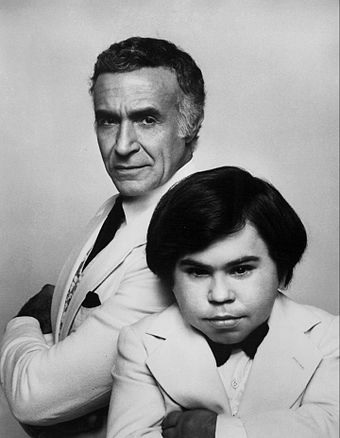
This week, we have two more fantasies that do not feature Tattoo. What even is the point?
Episode 7.8 “Random Choices/My Mommy, The Swinger”
(Dir by Bob Sweeney, originally aired on December 3rd, 1983)
Elaine Ashley (Florence Henderson) is divorced and raising two kids on her own. Her fantasy is to be a swinger for the weekend! Mr. Roarke arranges for Lawrence to watch the kids and then he sets Elaine up with tennis player Martin Avery (Robert Goulet). While Lawrence attempts to explain to the kids why their mother doesn’t want them around for the weekend, Martin offers Elaine a job. It’s a good job with a nice salary but it would require her to put her children in a boarding school. On the plus side, I guess Elaine would finally get laid again since that seems to be her main concern. On the negative side, no more kids.
Elaine is tempted. In fact, Elaine is so tempted that it actually make her into a really unsympathetic character. At first, Elaine takes the job but then, when she sees how upset her children are about no longer living with her, she changes her mind. Hey, Elaine — how did you think the children would react!?
This fantasy irked me. Of course, to be absolutely honest about things, Florence Henderson irks me in general. Maybe I’m still holding the last episode of The Brady Bunch Variety Hour against her but, whenever Florence Henderson appeared on this show or on The Love Boat, the characters she played always came across as being judgmental and self-absorbed. That’s certainly the case here. You take your children to a tropical paradise and then you abandon them with the butler? Really?
As for the other fantasy, it featured Jose Ferrer as a dying billionaire who needed to find someone who he could trust to give away his money to people who deserved it. Roarke determined that person was Eddie Random (James Read), an angry young man who felt his father had been cheated by Ferrer’s tycoon. The entire fantasy came down to Eddie proving himself by taking supplies to an Island and helping a crotchety old man come to terms with the death of his wife.
This second fantasy felt like a backdoor pilot. It literally ended with Eddie and the billionaire leaving to have many more adventures. As such, the fantasy itself felt rather incomplete and …. well, silly. Why would the tycoon need Fantasy Island to help him find the right person to give away his money? Why does he even need a person to do that? He should have just arranged for a big scavenger hunt and whoever found the most items would get the money. That would have been a lot more fun.
You know who always enjoyed fantasies dealing with money? Tattoo. I miss him.
Welcome to Late Night Retro Television Reviews, a feature where we review some of our favorite and least favorite shows of the past! On Mondays, I will be reviewing CHiPs, which ran on NBC from 1977 to 1983. The entire show is currently streaming on Prime!
This week, Ponch fixes everything.
Episode 4.11 “11-99: Officer Need Help”
(Dir by Phil Bondelli, originally aired on January 18th, 1981)
Three criminals are stealing trucks from a trucking company. One of the criminals works for the company but he gets fired, not for his thievery but because he accidentally put a cate of corrosive chemicals on the wrong truck. Now, the highway patrol has to track down the chemicals and also stop the criminals.
It’s a typical episode of CHiPs. A man loses his job after he’s wrongly accused of being the thief. The man’s son (Greg Bradford) helps Jon and Ponch catch the real criminals. There’s a subplot about all of the members of the high patrol carrying a new device that sends out of a signal whenever an officer’s down. Grossman accidentally pushes the button while chasing a lost dog. The emphasis here is on everyone working together and the Highway Patrol going out of their way to always have the best equipment to do their job. In the end, this is such a typical episode that the whole thing is kind of boring.
Really, for me, the only interesting thing about this episode is that it featured a subplot about a new police dispatcher who spoke with a stammer and who had trouble sending out instructions over the radio. I had a lot of sympathy for Kathie Lark (Katherine Moffat) because I had a pretty pronounced stammer up until I was about twelve years old. (It now only comes out if I’m extremely tired or stressed.) That said, considering just how important the dispatchers are when it comes to the Highway Patrol, I was a bit surprised that Kathie got the job in the first place. Kathie mentioned that she had previously been a dispatcher in a small town and again, I wondered how she got that job. To me, it seemed like the Highway Patrol was basically setting Kathie up for failure.
The good thing is that eventually someone gives Kathie some advice that helps her to overcome her nervousness and become an excellent dispatcher. Do you want to guess who gave her the advice? Seriously, I dare you to guess who, out of the show’s cast of characters, magically knew exactly the right thing to say to help Kathie out. If you’re thinking that Ponch was responsible for Kathie becoming a badass on the airwaves, you are exactly right! Is there no problem that Ponch can’t solve? Ponch’s advice, by the way, was that Kathie should always imagine that she was speaking directly to him. The next time that I find myself tripping over a word that starts with B, I’ll try the same thing.
It’s the Ponch Show! Seriously, there’s nothing that Ponch can’t do! Beyond that, this was a boring episode. The California scenery was nice to look at but otherwise, this episode felt like CHiPs on autopilot.
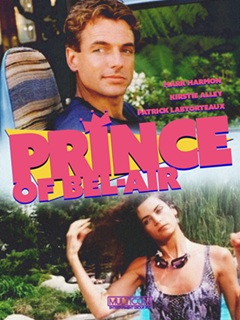
Robin Prince (Mark Harmon) is a laid-back former volleyball player who, at the age of 32, makes his living as a pool guy. It’s an easy life and he enjoys it. He sleeps with the wife (Deborah Harmon) of one of his clients and he hangs out with his richer friends. Robin enjoys being a bachelor but that all changes when he agrees to give a job to Justin (Patrick Labyorteaux), the son of Stanley Auerbach (Robert Vaughn) and meets Justin’s cousin, an artist named Jamie Harrison (Kirstie Alley). Justin goes from being bitter about having to work to idolizing Robin and his lifestyle. Robin, meanwhile, falls for Jamie.
This film came out before SummerSchool, another movie that featured Mark Harmon as a laid-back guy who falls for Kirstie Alley, but it has a similar vibe. Again, Mark Harmon is playing a likable guy who has never grown up and again, Kirstie Alley is playing a sophisticated woman who, at first, seems like she’s too serious for Harmon’s character. Robin’s mentorship of Justin feels a lot like Hamon’s mentorship of his SummerSchool students. (Dean Cameron even plays a supporting role in both Prince of Bel-Air and SummerSchool, though he’s far more memorable in Summer School.) Prince of Bel-Air is more dramatic than Summer School. In Prince of Bel-Air, Mark Harmon plays a character who secretly understands that there’s not much of a future in his lifestyle, even if he’s not initially willing to admit it.
Princeof Bel-Air is a likable movie. Mark Harmon gives an amiable and relatable performance as someone who is finally trying to grow up and, as always, Robert Vaughn is a perfectly smug villain. Kirstie Alley’s sultry performance is the highlight of the film. In the 1980s, Alley has a smoky-eyed beauty that, when combined with her ribald sense of humor, made her irresistible. It only takes a few minutes to understand why Robin would be willing to give up his previous life to be with her. There’s nothing particularly deep about PrinceofBel-Air but it’s still an entertaining 100 minutes.
Welcome to Retro Television Reviews, a feature where we review some of our favorite and least favorite shows of the past! On Sundays, I will be reviewing the made-for-television movies that used to be a primetime mainstay. Today’s film is 1985’s International Airport! It can be viewed on YouTube!
It’s not easy working at an international airport!
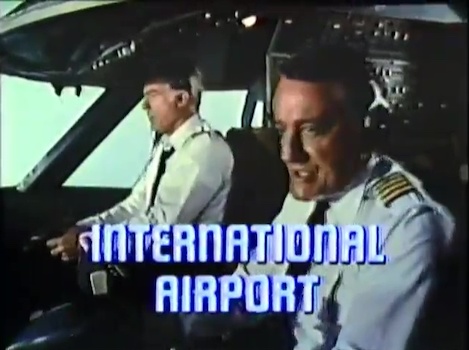
At least, that’s the message of this made-for-television film. Produced by Aaron Spelling and obviously designed to be a pilot for a weekly television series, International Airport details one day in the life of airport manager David Montgomery (Gil Gerard). Everyone respects and admires David, from the recently graduated flight attendants who can’t wait for their first day on the job to the hard-working members of the airport security team. The only person who really has a problem with David is Harvey Jameson (Bill Bixby), the old school flight controller who throws a fit when he learns that a woman, Dana Fredricks (Connie Sellecca), has been assigned to work in the tower. Harvey claims that women can’t handle the pressure of working the tower and not having a personal life. He demands to know what Dana’s going to do during that “one week of the month when you’re not feeling well!” Harvey’s a jerk but, fortunately, he has a nervous breakdown early on in the film and Dana gets to take over the tower.
Meanwhile, David is trying to figure out why an old friend of his, Carl Roberts (played by Retro Television mainstay Robert Reed, with his bad perm and his retired porn star mustache), is at the airport without his wife (Susan Blakely). David takes it upon himself to save Carl’s troubled marriage because it’s all in a day’s work for the world’s greatest airport manager!
While Carl is dealing with his mid-life crisis, someone else is sending threatening letters to the airport. One of the letters declares that there’s a bomb on a flight that’s heading for Honolulu. David and Dana must decide whether to allow Captain Powell (Robert Vaughn) to fly to Hawaii or to order him to return to California. And Captain Powell must figure out which one of his passengers is the bomber. Is it Martin Harris (George Grizzard), the sweaty alcoholic who want shut up about losing all of his friends in the war? Or is it the woman sitting next to Martin Harris, the cool and aloof Elaine Corey (Vera Miles)?
Of course, there are other passengers on the plane. Rudy (George Kennedy) is a veteran airline mechanic. Rudy is hoping that he can talk his wife (Susan Oliver) into adopting Pepe (Danny Ponce), an orphan who secretly lives at the airport. Unfortunately, when Pepe hears that Rudy’s plane might have a bomb on it, he spends so much time praying that he doesn’t realize he’s been spotted by airport security. Pepe manages to outrun the security forces but he ends up hiding out in a meat freezer and, when the door is slammed shut, it appears that Pepe may no longer be available for adoption. Will someone hear Pepe praying in time to let him out? Or, like Frankie Carbone, will he end up frozen stiff?
International Airport was an attempt to reboot the Airport films for television, with the opening credits even mentioning that the film was inspired by the Arthur Hailey novel that started it all. As well, Gil Gerard, Susan Blakely, and George Kennedy were all veterans of the original Airport franchise. George Kennedy may be called Rudy in International Airport but it’s easy to see that he’s still supposed to be dependable old Joe Patroni. Unfortunately, despite the familiar faces in the cast, International Airport itself is a bit bland. It’s a disaster film on a budget. While the viewers gets all of the expected melodrama, they don’t get anything as entertaining or amusing as Karen Black flying the plane in Airport 1975 or the scene in Concorde: Airport ’79 where George Kennedy leaned out the cockpit window (while in flight) and fired a gun at an enemy aircraft. Probably the only thing that was really amusing (either intentionally or unintentionally) about International Airport was the character of Pepe and that was just because young Danny Ponce gave perhaps the worst performance in the history of television.
International Airport did not lead to a television series. Watching it today, it’s a bit on the dull side but, at the same time, it is kind of nice to see what an airport was like in the days before the TSA. If nothing else, it’s a time capsule that serves as a record of the days when the world was a bit more innocent.
 Through the Shattered Lens