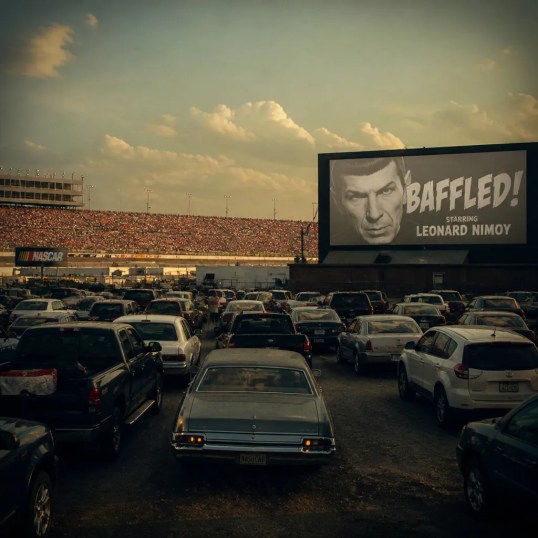
This is a film that I share every year for Horrorthon and can you blame me? Check out this pitch: Leonard Nimoy is a race car driver who can see into the future and who uses his powers to solve crimes!
Seriously, if that’s not enough to get you to watch the 1973 made-for-TV movie Baffled!, then I don’t know what is. In the film, Nimoy takes a break from racing so that he and a parapsychologist (played by Susan Hampshire) can solve the mystery of the visions that Nimoy is having of a woman in a mansion. This movie was meant to serve as a pilot and I guess if the series had been picked up, Nimoy would have had weekly visions. Of course, the movie didn’t lead to a series but Baffled! is still fun in a 70s television sort of way. Thanks to use of what I like to call “slo mo of doom,” a few of Nimoy’s visions are creepy and the whole thing ends with the promise of future adventures that were sadly never to be. And it’s a shame because I’ve always wondered what was going on with that couple at the airport!
Enjoy Baffled! Can you solve the mystery before Leonard?
Hi, everyone! Tonight, on Mastodon, I will be hosting the #TubiThursday watch party! Join us for The Creeping Terror!
You can find the movie on Tubi and YouTube and you can join us on Mastodon at 9 pm central time! (That’s 10 pm for you folks on the East Coast.) We will be using #TubiThursday hashtag! See you then!
Today’s scene that I love comes from 2014’s A Field In England. This film may (or may not) take place during a solar eclipse. I won’t try to explain everything that is happening in the scene, beyond stating that this particular field in England is home to some interesting mushrooms. I encourage you see to watch the film for yourself.
4 Shots From 4 Films is just what it says it is, 4 shots from 4 of our favorite films. As opposed to the reviews and recaps that we usually post, 4 Shots From 4 Films lets the visuals do the talking!
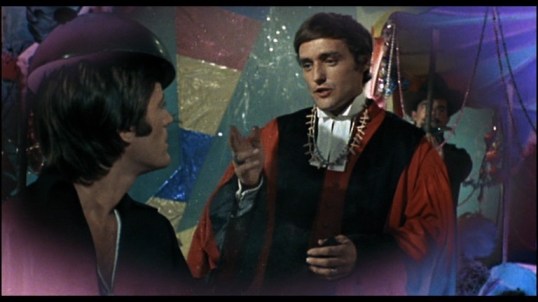
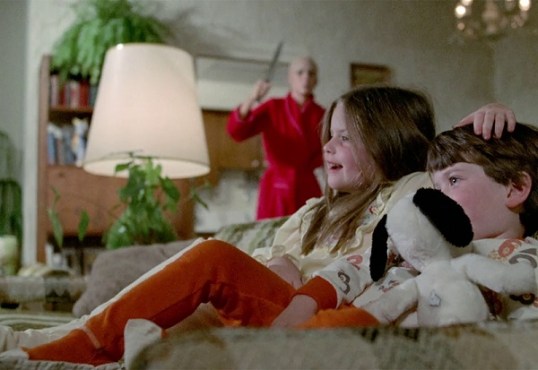
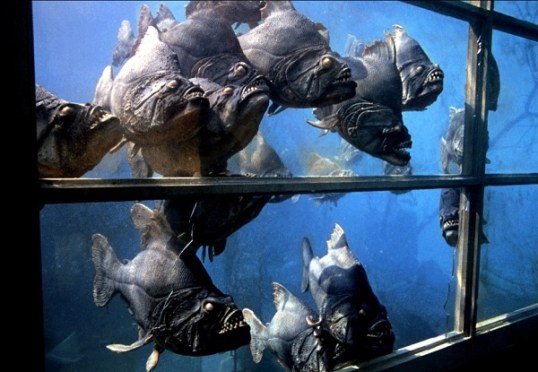
4 Shots From 4 Horror Films
The Trip (1967, dir by Roger Corman, DP: Archie Dalzell)
Blue Sunshine (1978, dir by Jeff Lieberman, DP: Don Knight)
Piranha (1978, dir by Joe Dante, DP: Jamie Anderson)
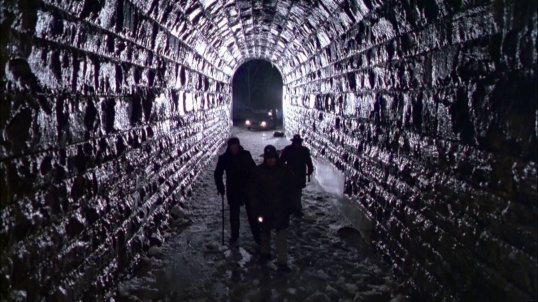
The Dead Zone (1983, dir by David Cronenberg, DP: Mark Irwin)
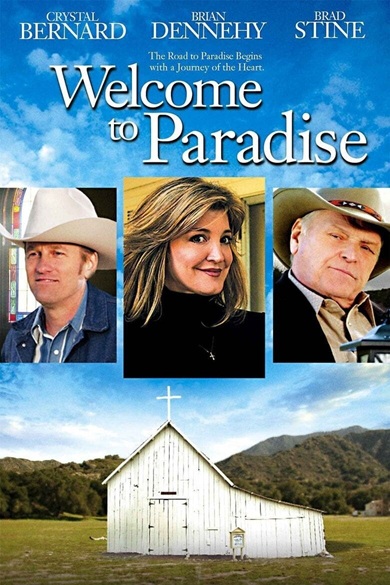
In 2007’s Welcome to Paradise, Crystal Bernard stars as Debbie Laramie. Debbie is a preacher who belongs to one of those weird Protestant churches where it’s apparently appropriate to heckle someone while they’re giving a sermon. After Debbie scandalizes her parish by removing her jacket while preaching, she is reassigned to a church in the small town of Paradise. Apparently, this is not the first time that Debbie has been reassigned. She’s a rebellious preacher who does things her own way or, at least, that’s what we’re told. (She doesn’t ever seem that rebellious to me, but then again, I’m used to the Jesuits.) Debbie’s teenage son certainly isn’t happy about having to move again.
In Paradise, Debbie makes a name for herself by reaching out to the town’s surprisingly large homeless population. She invites a street performer named Trevor (Lou Beatty, Jr.) to play his guitar at the church. She holds a potluck dinner to help feed the residents of the local shelter. When a sudden storm approaches, she allows Frances (Beth Grant) to spend the night on the church’s back porch. (Debbie tries to convince Frances to come home with her, but Frances doesn’t want to impose.) Unfortunately, Frances gets cold and tries to build a small fire for warmth. The next thing anyone knows, the church is burning down.
A snooty bishop tells Debbie that the decision has been made to revoke the church’s charter and that all the members will be assigned to the new megachurch. Debbie, however, has already found an abandoned barn that she thinks she can turn into a church, and a local businessman named Bobby Brown (Brian Dennehy—wait, BRIAN DENNEHY!?) has agreed to help fund the new church. Debbie is told that if she can have everything ready to go in a week, the church will keep its charter. Otherwise, Debbie will have to find yet another new job, her son will have to move again, and the residents of the shelter won’t have anywhere to go.
This film wasn’t actually that bad. I liked the fact that it not only took place in small-town Texas but also captured the feeling of living in a small town. Paradise is the type of town where the richest man in town owns a used car lot and where everyone lends a helping hand to those in need. If this were a horror movie, of course, the town would have turned out to be a haven for vampires. Since this was a religious movie, it just turned out to be a nice place to live. Crystal Bernard gave a likable performance as Debbie, and Brian Dennehy, of course, was perfectly cast as the gruff but good-natured businessman. There were actually quite a few familiar faces in the film. William Shockley, Beth Grant, Ken Jenkins, and Jim O’Heir all made appearances. Even comedian Timothy Stack showed up in a small role.
In the end, Welcome to Paradise is a sweet-natured and likable movie. If it had been set during a December snowstorm, it could have easily been mistaken for a Hallmark film.
AI is not always great. I do use it a lot for patent-related work, legal questions, and drafting legal documents. However, for AI to be a tool- you can’t be one. A guy jogs in casual Friday gear, he gets shot with a tree dart, hallucinates, and is kidnapped by a large bat-crow. I never thought about making something boring. Maybe, my writing is not always great, but I don’t think it’s boring.
If the apocalypse is this boring, I pass. Maybe it’s just crow-related apocalypses that are boring? I’m not sure, but this was 4 minutes of my life that was stolen from me. Just stolen!
One of my favorite things about my lifetime of loving movies has been those times when I’ve discovered the actors who really appeal to me. It all started with Charles Bronson when I was in grade school. I call it going through a phase, and while I’m in that phase, I try to watch everything that actor has done that looks the least bit interesting to me. Of course, my Charles Bronson phase has never ended, but there has always been room for additional phases, whether it be actors like Roy Scheider, James Woods, Toshiro Mifune, Chow Yun-Fat, or yes, Michael Caine. When I went through my initial Caine phase, I focused on movies like THE ITALIAN JOB, GET CARTER, and DRESSED TO KILL. Later in his career, I focused on his movies like A SHOCK TO THE SYSTEM, SECONDHAND LIONS, and HARRY BROWN. I knew about THE HAND, but I never watched it before moving on to the next phase. But this being Horror-Thon, and me looking for interesting movies I’ve never seen before, this seemed like the perfect time to spend a couple of hours with Michael Caine and his hand!
THE HAND finds Caine playing Jonathan Lansdale, a successful comic book artist whose life takes a turn for the worse after a car accident results in the gruesome loss of his right hand. That would be bad enough for anyone, but his newfound situation will no longer allow him to create his beloved comic book, and his struggling marriage only seems to be getting worse. When a series of increasingly disturbing events seem to be taking place around him, we’re left to wonder… is his missing hand somehow responsible for the escalating violence around him, or is he going out of his mind?!
One of the intriguing aspects of THE HAND is that it was directed by Oliver Stone who would go on to win Oscars for directing the films PLATOON and BORN ON THE FOURTH OF JULY. Having just won the Oscar for Best Screenplay for MIDNIGHT EXPRESS, Stone was a hot property at the time so it’s no surprise that he was given another chance to direct. He had written and directed the film SEIZURE back in 1974, but this was his first major studio film. With a man of his acclaim and talent in the director’s chair, and with a legendary actor like Michael Caine in the lead, THE HAND would have to be worth watching, right?
I’m going to definitely say “Yes!” Watching Stone deliver the absurd visuals of a creepy severed hand performing a series of gruesome killings brought a ridiculous smile to my face. I’m actually laughing as I type this and think about them again. Not content with my cheap thrills though, Stone also tries to get deep into his main character’s mind so he can play with the uncertainty between reality and imagination. I’m not saying this attempt at psychological depth always works, but it’s kind of fun seeing him try to turn such silly material into something of more substance.
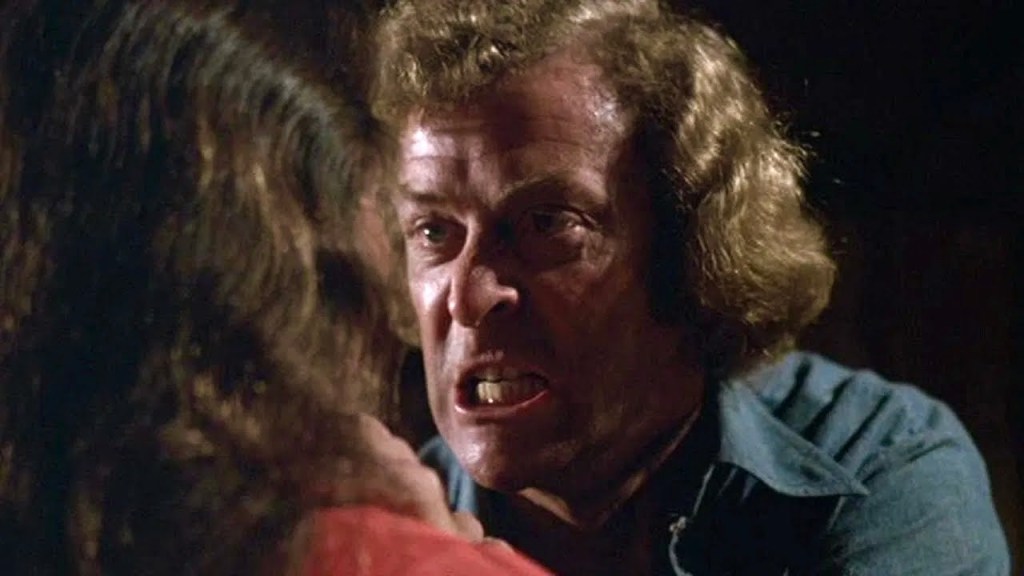
And then there’s Caine in the lead role, which is my primary reason for watching the film. I always like it when he loses it on screen, and he definitely gets to explore his dark side as Jonathan Lansdale. There’s nothing suave about this guy. Rather, he’s playing a man whose life is falling completely apart. While we can at least superficially understand why he would be so frustrated, Caine’s eyes reveal a man who’s leaving the world of reality, and there’s no scenery that he’s not willing to chew by the end. I’ve read that Caine did this movie for the paycheck, and while that may be true, he definitely seems invested to me. Other solid performances come from Andrea Marcovicci as his wife, Bruce McGill as his friend, and Annie McEnroe as his lover. Unfortunately, no one who gets too close is safe from his hand of death!
I understand that not everyone is going to enjoy THE HAND. I’ve said many times before that I’m a fan of actors, and if a movie stars one of my favorites, I’ll give it a lot of grace. Still, I can’t deny that I had a good time watching it even if it might have overstayed its welcome just a bit. While I won’t give the movie a hearty, full-throated recommendation, if you’re a fan of Stone, Caine, or oddball horror films, you just may find a lot to enjoy about this film like I did.
“Man is a feeling creature, and because of it, the greatest in the universe….”
Hell yeah! You tell ’em, Peter Graves!
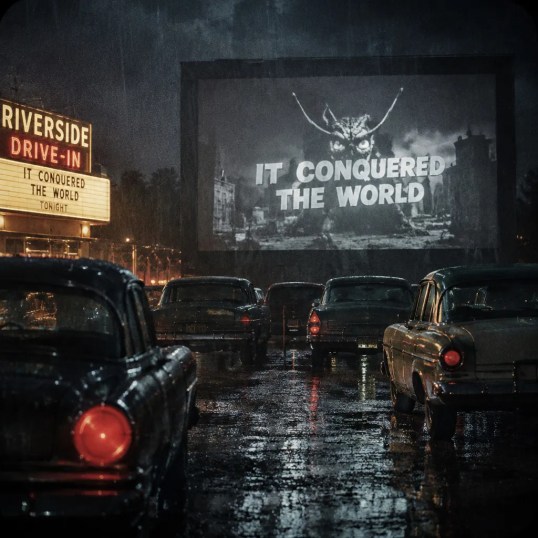
In 1956’s It Conquered The World. Graves plays a scientist who watches in horror as his small town and all of the people who he loves and works with are taken over by an alien. Rival scientist Lee Van Cleef thinks that the alien is going to make the world a better place but Graves understands that a world without individual freedom isn’t one that’s worth living in.
This is one of Corman’s most entertaining films, featuring not only Graves and Van Cleef but also the great Beverly Garland. Like many horror and science fiction films of the 50s, it’s subtext is one of anti-collectivism. Depending on your politics, you could view the film as either a criticism of communism or McCarthyism. Watching the film today, with its scenes of the police and the other towns people hunting anyone who fails to conform or follow orders, it’s hard not to see the excesses of the COVID era.
Of course, there’s also a very persuasive argument to be made that maybe we shouldn’t worry too much about subtext and we should just enjoy the film as a 50s B-movie that was directed with the Corman touch.
Regardless of how interpret the film, I defy anyone not to smile at the sight of ultra-serious Peter Graves riding his bicycle from one location to another.
Here, for your viewing pleasure, is It Conquered The World!
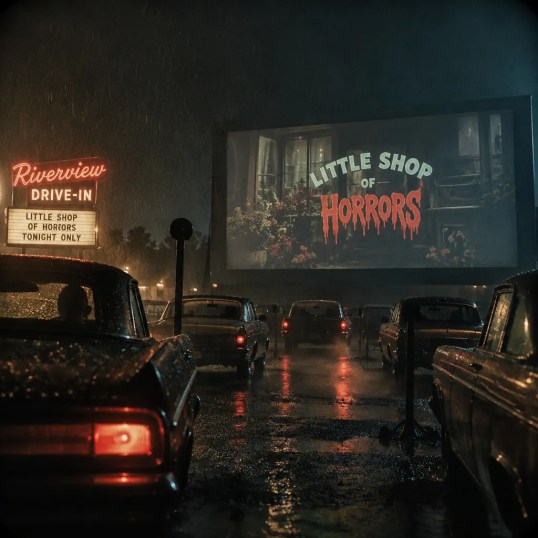
Whenever it’s time to share this film for Horrorthon, I have a little story that I like to tell:
Enter singing.
Little Shop.…Little Shop of Horrors.…Little Shop.…Little Shop of Terrors….
When I was 19 years old, I was in a community theater production of the musical Little Shop of Horrors. Though I think I would have made the perfect Audrey, everybody always snickered whenever I sang so I ended up as a part of “the ensemble.” Being in the ensemble basically meant that I spent a lot of time dancing and showing off lots of cleavage. And you know what? The girl who did play Audrey was screechy, off-key, and annoying and after every show, all the old people in the audience always came back stage and ignored her and went straight over to me. So there.
Anyway, during rehearsals, our director thought it would be so funny if we all watched the original film. Now, I’m sorry to say, much like just about everyone else in the cast, this was my first exposure to the original and I even had to be told that the masochistic dentist patient was being played by Jack Nicholson. However, I’m also very proud to say that — out of that entire cast — I’m the only one who understood that the zero-budget film I was watching was actually better than the big spectacle we were attempting to perform on stage. Certainly, I understood the film better than that screechy little thing that was playing Audrey.
The first Little Shop of Horrors certainly isn’t scary and there’s nobody singing about somewhere that’s green (I always tear up when I hear that song, by the way). However, it is a very, very funny film with the just the right amount of a dark streak to make it perfect Halloween viewing.
So, if you have 72 minutes to kill, check out the original and the best Little Shop of Horrors….