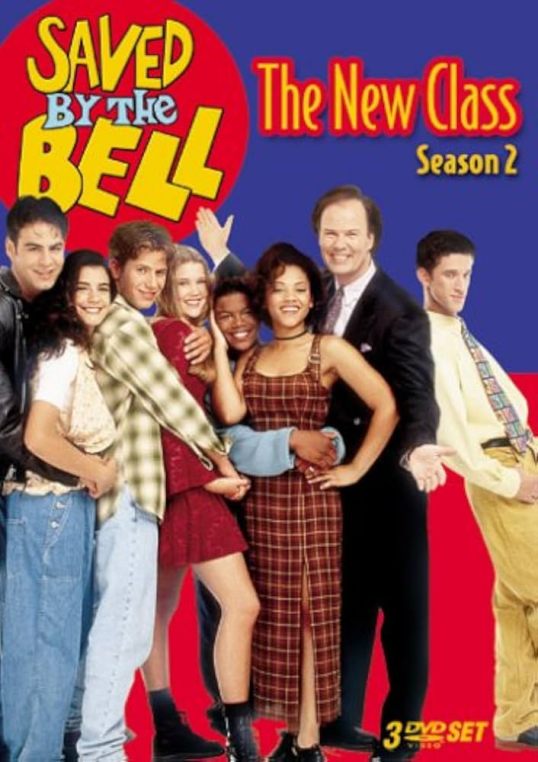
Retro Television Review: Saved By The Bell: The New Class 2.10 “A Matter of Trust”


Welcome to Retro Television Reviews, a feature where we review some of our favorite and least favorite shows of the past!  On Tuesdays, I will be reviewing Saved By The Bell: The New Class, which ran on NBC from 1993 to 2o00.  The show is currently on Prime.

This week, it’s all for charity!

Episode 2.10 “A Matter of Trust”

(Dir by Don Barnhart, originally aired on October 8th, 1994)

Oh crap, it’s another country club episode.

It’s time for the annual charity event!  The male employees of the club are auctioned off to various women bidders so that they can compete together in a contest.  The winning team gets a hot air balloon ride.  Mr. Belding makes it sound like a big deal but it’s hard not to notice that hardly anyone outside of the main group seems to take part.  Apparently, this is a charity being funded exclusively by teenagers with summer jobs.

Bobby asks Megan to bid on him because he thinks it’ll make him more attractive to the woman who he hopes will buy him.  Instead, Megan bids too much and she wins Bobby.

Lindsay wins her boyfriend, Tommy D.  Lindsay is excited but Tommy is worried because he’s scared of heights.

Because Mr. Belding says that Screech has too many responsibilities to be auctioned off, Screech can only watch as his girlfriend, Alison, purchases Brian.

Brian’s girlfriend, Rachel, buys Hubert Dweebly (Mark David) because she feels sorry for him.  That’s something that I would definitely do.  Hubert then turns out to be a total perv who spends the entire competition pawing Rachel and trying to get her to kiss him.  This would perhaps have been funnier if Sarah Lancaster had been older than 14 when she played Rachel.

Anyway, Screech gets jealous and tries to get Brian in trouble so that he can take Brian’s place.  And Tommy doesn’t want to win so he tires to help Bobby cheat but everything gets screwed up and Tommy and Lindsay win anyways.  It’s a typical Saved By The Bell episode, you can probably already guess everything that happens.  Allison turns out to be very forgiving.  Allison might not be that smart.

The main problem with this episode is that it asks us to believe that Allison would find needy, uberemotional, shrill-voiced Screech to be in any way attractive.  During the second season, Dustin Diamond’s performance was nowhere near as obnoxious as it would eventually get.  But his version of Screech was still too cartoonish to be taken seriously.  His performance in this episode is …. well, it’s just bad.  There’s no other way to put it.  You really do find yourself thinking, “Allison and Brian actually make a lot more sense than Allison and Screech.”

It’s funny to me that the first Country Club episode was all about the importance of working hard when you have a job and we haven’t actually seen anyone doing their job since.

Late Night Retro Television Reviews: CHiPs 5.27 “Force Seven”


Welcome to Late Night Retro Television Reviews, a feature where we review some of our favorite and least favorite shows of the past!  On Mondays, I will be reviewing CHiPs, which ran on NBC from 1977 to 1983.  The entire show is currently streaming on Prime!

This week, the fifth season comes to an end.

Episode 5.27 “Force Seven”

(Dir by Leslie H. Martinson, originally aired on May 23rd, 1982)

When evil rich guy Nakura (John Rhys-Davies) steals a short-range missile from a military convoy,  he informs the Mayor of Los Angeles that he will fire that missile at the city unless he’s paid a healthy ransom.  The Mayor wants to send in the SWAT Team but one-eyed Lt. John Legarre (an eyepatch wearing Fred Dryer — yes, the star of Hunter) objects.  Guns won’t do the job, Legarre explains.  Why not send in Force Seven?

Led by Legarre, Force Seven is a secret division of the LAPD.  Including Legarre, there’s only four of them.  (So, why aren’t they Force Four?)  Sly (Tony Longo — hey, Mad Dog from 1st & Ten) is tough and strong and also a ventriloquist.  Cindy (Dona Kei Benz) is small but fast and doesn’t have a sense of humor.  Rick Nichols (Tom Reilly) is a rebel cop who does things …. HIS WAY!  What do they all have in common?  They all know karate!

This doesn’t sound like an episode of CHiPs, does it?

Well, technically, it’s not.  It’s a backdoor pilot.  Ponch and Baker appear at the start of the episode, arresting an engineer who is carrying the schematics for the stolen missile.  And they also appear at the very end of the episode, in which Getraer asks them if they remember that engineer they pulled over.  However, neither Ponch nor Baker interact with anyone from Force Seven.  I get the feeling that the Force Seven pilot was shot and then someone decided, “Why don’t we add Erik Estrada and Larry Wilcox and disguise this as an episode of CHiPs?”

Imagine if you were a CHiPs fan in 1982.  It’s the night of the season finale.  You turn on the TV because you want to watch motorcycle chases and car crashes.  Instead, you find yourself watching Fred Dryer wearing an eye patch and Tony Longo using a puppet to discuss elements of Eastern philosophy.  That’s one reason why backdoor pilots have never made sense to me.  They always seem like they would have just ticked off anyone who was watching.

Force Seven did not become a show.  From watching this episode, I think it probably would have been enjoyably dumb if it had led to a series.  As I already mentioned, Fred Dryer wears an eye patch.  Tony Longo is made up to look like Sylvester Stallone.  (His character is even named Sly!)  There’s something kind of amusing about two guys who are so big that they could obviously just take anyone out with one punch instead choosing to drag out every fight with karate.

(Amusingly enough, in Force Seven, the mayor of Los Angeles was played by former real-life mayor Sam Yorty, who ran for President in 1972.  The police commissioner was played by Ed Davis, the real life former chief of the LAPD who was serving in the California State Senate at the time and who later ran for the U.S. Senate in 1986.)

It is a little sad that this was Larry Wilcox’s final episode of CHiPs.  Fed up with Estrada getting all of the good storylines, Wilcox did not return for Season 6.  (His replacement would be played by Force Seven‘s Tom Reilly, though as a different character.)  For the first two seasons, Wilcox was the main character while Erik Estrada was the comedic sidekick.  However, by the time season 5 rolled around, it was clear that the producers were far more interested in Estrada than Wilcox.  As an actor, Wilcox wasn’t a showy as Estrada but he was more believable a cop.  In his final episode, Wilcox gets not a grand goodbye but instead appears only in two brief scenes.

Next week, we’ll start the sixth and final season!

Retro Television Review: Crime Story 1.11 “Crime Pays”


Welcome to Retro Television Reviews, a feature where we review some of our favorite and least favorite shows of the past!  On Mondays, I will be reviewing Crime Story, which ran on NBC from 1986 to 1988.  The entire show can be found on Tubi!

Our story so far….

Episode 1.11 “Crime Pays”

(Originally aired on December 5th, 1986)

This week’s show will be easy to review because it’s a clip show.  It’s a bit more honest than most television clip shows.  It doesn’t feature the character sitting around saying stuff like, “I’ll never forget that time we gunned down half of Luca’s crew.”  Instead, the show’s narrator (Jack Angel) tells us that we’re going to see the story so far and then we see just that.  The best thing about this episode is Angel’s tough guy voice.

It’s not bad for a clip show.  It’s basically all of the Torello and Luca scenes without any of the filler.  If nothing else, it lets us know which of the past plotlines we should remember and which ones we can safely forget.  (Remember that Torello is obsessed with Luca.  Remember that Luca is determined to become a big man in the mob.  Don’t necessarily forget about David Arbams’s storylines but, at the same time, don’t worry if your memory’s a little fuzzy.)  But it’s still a clip show, nonetheless.


Retro Television Review: Homicide: Life On The Street 5.17 “Kaddish”


Welcome to Retro Television Reviews, a feature where we review some of our favorite and least favorite shows of the past!  On Sundays, I will be reviewing Homicide: Life On The Street, which aired from 1993 to 1999, on NBC!  It  can be viewed on Peacock.

This week, both Munch and Pembleton go on an inner journey.

Episode 5.17 “Kaddish”

(Dir by Jean de Segonzac, originally aired on February 21st, 1997)

When Munch and Kellerman investigate a crime scene in which a woman has been found murdered, Munch is stunned when the woman is revealed to be Helen Rosenthal, his high school crush.  In between flashbacks to Munch’s awkward teen years, Munch and Kellerman investigate the crime.  At first, it seems like the murderer might be one of two former classmates, one of whom was Helen’s ex-husband.  Ultimately, the truth turns to be much simpler.  As if so often the case, Helen was the victim of stranger.  She was in the wrong place at the wrong time.

During the investigation, Munch bonds with Helen’s daughter, Sarah (Jean Louisa Kelly).  Per Jewish law, Helen is buried within 24 hours and Munch and Kellerman later attend her shiva, where Munch begs out of being a part of the minyan.  Because Kellerman has apparently never met a Jewish person in his life, Munch has to explain to him the concept of sitting shiva and reciting the Kaddish.  On the one hand, I wish this episode didn’t resort to making Kellerman into a total doofus.  (At one point, he even asks what a “shiksa” is,) but, on the other hand, I did appreciate that it dealt with a side of Munch that we really haven’t seen before.  As a viewer, I’m so used to seeing Munch as just being the squad’s resident cynic that it was interesting to see him dealing with issues of faith.

Speaking of faith, Pembleton is continually to struggle with his.  He even goes to Mass in this episode and remember a debate he once had with a nun about whether or not any signs of God can be found while working as a homicide detective.  Pembleton does find a sign towards the end of the episode.  Called in when a woman dies in home hospice care, Bayliss and Pembleton discover that no murder occurred.  Instead, the woman has passed with a look of peace on her face and a crucifix on her nightstand.  Having lost his family and nearly his life, Pembleton finally seems to have found his faith.  And I’m glad about that because Pembleton the Heretic was getting to be a bit of a slog.

This was a good episode, one that used death as a way to shine a light on life.  Richard Belzer gave one of his better performances in the role of John Munch and, as always, Andre Braugher was outstanding as Pembleton.  I’m also happy to say that Pembleton and Bayliss are once again partners.  That’s the way it should be.

Late Night Retro Television Review: Hunter 1.12 “The Avenging Angel”


Welcome to Late Night Retro Television Reviews, a feature where we review some of our favorite and least favorite shows of the past!  On Thursdays, I will be reviewing Hunter, which aired on NBC from 1984 to 1991.  The entire show is currently streaming on Tubi and several other services!

This week, someone wants to help out Hunter!

Episode 1.12 “The Avenging Angel”

(Dir by James Whitmore, Jr., originally aired on January 18th, 1985)

After Hunter receives an anonymous phone tip, he arrests Dr. Pierpoint (Angus Duncan) for attempting to hire a criminal known as “The Rat” to kill his wife.  When Hunter makes the arrest, he actually has to Mirandize him twice because the doctor was unconscious the first time that Hunter read him his rights.  Oh, Hunter!

Unfortunately, things fall apart at trial.  The Rat (Robert Pastorelli, whose career later fell apart after the mysterious death of his girlfriend) changes his testimony at the last minute and says that Pierpoint never hired him to kill his wife.  The case is dismissed.  Hunter is upset.  Even more upset is Arnold Morton (Robert Gray), a surveillance expert who idolizes Hunter and who makes it his mission to take down not just Pierpoint and the Rat but also defense attorney Nell Armstong (Nancy Stafford).

This was an interesting episode.  The story didn’t quite work but the idea behind it was intriguing.  Morton, who has bugged Hunter and has been following him for weeks, considers himself to be Hunter’s avenging angel.  When Hunter makes it clear that he’s not cool with the whole vigilante thing, Morton turns on him like a lover scorned.  This is like Hunter’s version of Magnum Force.

As for McCall, she spends most of this episode just trying to go on a date with her latest boyfriend, Ted (Rod Haase).  Unfortunately, Hunter keeps interrupting.  Ted is a nice guy about it but it’s pretty obvious that McCall and Hunter are meant to be together.

The highlight of this episode?  Hunter destroying his phone while searching for a bug.  In the role of Captain Dolan, John Amos got to do his whole, “Hunter, what the Hell are you doing!?” thing.  That’s always entertaining.

As I said, the episode didn’t quite work.  I never really bought that Arnold could do everything that he managed to do in this episode.  I mean, for someone who lived in an abandoned arcade and drove a broken-down van, Arnold seemed to have unlimited resources.  I will give a shout out to the show’s art department for including a poster of Lucio Fulci’s Zombi 2 in Arnold’s office.

It’s always funny to me how, in every episode, Hunter has got someone trying to kill him and no one but McCall seems to care.

Retro Television Review: Decoy 1.38 “First Arrest”


Welcome to Retro Television Reviews, a feature where we review some of our favorite and least favorite shows of the past!  On Thursdays, I will be reviewing Decoy, which aired in Syndication in 1957 and 1958.  The show can be viewed on Tubi!

This week, it’s the next-to-last episode Decoy!

Episode 1.38 “First Arrest”

(Dir by Arthur H. Singer, originally aired on June 30th, 1958)

Casey meets with a new, rookie policewoman (Ellen Madison) at Coney Island.  The rookie just made her first arrest and is now in tears because she’s worried that she’s ruined someone’s life.  Casey tells the story of her first assignment and what it was like to make her first arrest.

Flashback time!

The NYPD believes that a fencing operation is being run out of a Coney Island carnival sideshow.  Young and eager, Casey gets a job as an exotic dancer at the carnival.  (Calm down, boys.  She wears one of the least-revealing costumes of all time.)  Shy and insecure Willie Graff (Joshua Shelley) develops a crush on Casey.  Casey, suspecting that Willie is the fence, plays along but she starts to feel guilty as she realizes that Willie isn’t some sort of dangerous criminal.  He’s just a down-on-his-luck guy who is cutting a few corners.  He even introduces Casey to his mother (Ruth McDevitt).

When Willie gives Casey a diamond necklace, she assumes that it must be stolen but it turns out that it’s his mother’s necklace and that Mrs. Graff wants Casey to have it.  Casey is actually relieved because it seems like Willie isn’t the fence that she’s looking for.  However, then Willie gives her a mink coat and admits that he bought it from someone who had stolen it.  Though saddened, Casey forces herself to arrest Willie.

In the present, Casey assures the rookie that she will soon get used to arresting people and she won’t care about them anymore.  Yikes!

As you may have guessed, I didn’t really care much for this episode.  That idea of Casey being someone who doesn’t care about the people who she arrests pretty much goes totally against everything we’ve seen over the past 37 episodes.  The thing that always set Casey apart was that she does care.  She has to do her job but she also understands that sometimes, people just make mistakes.  Unless it’s case in which she was threatened, Casey usually doesn’t take any joy in slapping the handcuffs on someone.

As much as I hate to say it, Beverly Garland is not particularly convincing in the flashback scenes.  Young Casey is written as being continually breathless and unsure of herself.  There’s nothing about Beverly Garland’s screen presence that suggests insecurity.

This was a disappointing episode.  Next week, we’ll be finishing up Decoy and I hope it goes out on a better note than this.

Late Night Retro Television Review: 1st & Ten 4.8 “Injustice For All”


Welcome to Late Night Retro Television Reviews, a feature where we review some of our favorite and least favorite shows of the past! On Wednesdays, I will be reviewing 1st and Ten, which aired in syndication from 1984 to 1991. The entire series is streaming on Tubi.

Oh my, this epiosde.

Episode 4.8 “Injustice For All”

(Dir by Stan Lathan, originally aired on November 23rd, 1988)

The Bulls narrowly win a game against Texas’s team when Coach Denardo decides to give the ball not to usual running back but instead to Bubba Kincaid.  Bubba is pronounced the hero of the game, which makes Jethro jealous.  During the next game, when Denardo tries to pull off the same play, Bubba insists that the ball should be given to Jethro.  Jethro fumbles the ball and Bubba falls on it, scoring once again for the Bulls.  Afterwards, Bubba assures the press that Jethro was supposed to fumble and that Jethro is actually the hero of the game.  That’s  nice!

Less nice is what happens when the press talks to Coach Denardo.  When asked whether or not he thought Texas lost because they had a black quarterback, he shrugs and says, “Maybe.  Blacks have excelled at every other position in the game.  Eventually, they’ll excel as quarterbacks.”  Denardo is branded a racist.  He insists that his words were taken out of context.

Personally …. I don’t know, it all sounds pretty racist to me.  The question was definitely racist.  Denardo wasn’t asked if he felt Texas lost because their quarterback didn’t play well.  Instead, he was specifically asked if Texas lost because their quarterback was black.  Then, Denardo’s answer is that apparently blacks are not good quarterbacks right now but they will be someday.  How is that not racist?  Denardo (and the reporter) are taking an individual player, considering nothing about him beyond his race, and then saying that’s why his team lost.  All Denardo had to say was that the quarterback struggled, just as many white quarterbacks have struggled.  Denardo could have just said, “Race doesn’t have anything to do with it.”  Instead …. well, you get the idea.

The Dobbs Corporation, which now owns the Bulls, has recently had to settle a lawsuit about their discriminatory employment practices.  Executive Michal Westwood (Paul Tuerpe) wants Denardo fired and really, Denardo probably should be fired.  But TD Parker (OJ Simpson) tries to play peacemaker.  He tells Denardo that it would help if he apologized.

“TD,” Denardo says, “I’ve got white friends and I’ve got black friends.  But if you don’t drop this, I might have one less black friend.”

And then, presumably, Denardo complimented TD for being articulate.

Meanwhile, Dr. Death’s attempt to have a one night stand with a biker chick (Beth Broderick …. wait a minute, Aunt Zelda!?) comes to an end when he meets her son and discovers that the kid is being abused by his mother’s other boyfriend.  Dr. Death takes the kid under his wing and then beats up the abuser.  Yay!  Seriously, this whole episode should have just been Dr. Death beating up that guy.

And Denardo really should have been fired.

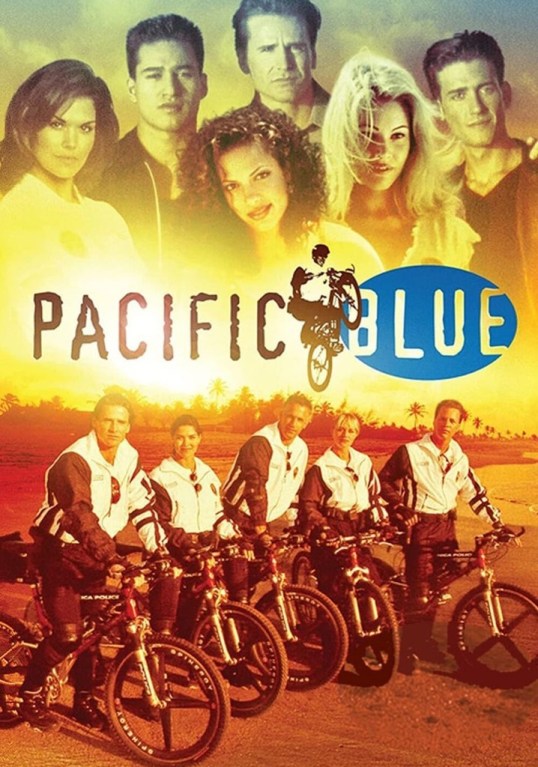
Late Night Retro Television Review: Pacific Blue 4.10 “Thrill Week”


Welcome to Late Night Retro Television Reviews, a feature where we review some of our favorite and least favorite shows of the past! On Tuesdays, I will be reviewing Pacific Blue, a cop show that aired from 1996 to 2000 on the USA Network!  It’s currently streaming everywhere, though I’m watching it on Tubi.

This week, the local college fraternity is out of control and somehow, it’s up to the bicycle patrol to restore order to the campus.

Episode 4.10 “Thrill Week”

(Dir by Sara Rose, originally aired on November 29th, 1998)

It’s rush week, which means that the beach is full of drunk college students.  Fortunately, the bike patrol is there to keep the peace.  Bobby Cruz is upset when he discovers that his teenager sister, Teresa (Susan Enriquez), is hanging out at the rush events, drinking beer, smoking, and hooking up with frat boys.

So, let’s see.  Bobby is a Latino bicycle cop who grew up in a poor neighborhood.  He flirts with Cory.  He’s fiercely overprotective of his teenage sister.  So, basically, he’s exactly like Victor del Toro, except for the fact that he’s played by Mario Lopez.  It wouldn’t surprise me if, when Lopez was handed this script, someone had just gone through and crossed-out Victor’s name and written in Bobby’s name instead.

Anyway, the frat hazing is getting out-of-hand so TC decides to send Granger in undercover.  (I  know I ask this every week but, seriously, why are bicycle cops doing undercover work?)  TC is a former member of the fraternity so he introduces Granger as being his nephew and arranges for Granger to be accepted into the frat as a legacy.  At first, Granger has no interest in being  a member of a frat but then he sees all the beer and changes his mind.

What’s the plot here?  Good question.  Tanner Sexton (Thomas Caron) attempts to drug and rape his ex-girlfriend at a fraternity party but, fortunately, Bobby and Cory show up in time to stop him.  (Granger helps Teressa escape being caught at the party by punching Bobby.)  Despite the fact that he’s dating his son’s ex, Tanner’s father (Clint Carmichael) pulls some strings and gets Tanner released from jail.

Later, Bobby, Cory, and TC confront Tanner at the frat house and Tanner pulls a gun.  Bobby shoots Tanner in the shoulder.  “You’ll be okay,” TC tells Tanner.  Uhmm, the dude just get shot in the shoulder.  That’s not a minor wound!

Eh.  Who cares?  This episode was dumber than usual.  I’m less concerned about the frat and more curious as to why new cast members Shanna Moakler and Amy Hunter always seem to be absent (or, in Hunter’s case, mostly absent) from any episode involving Granger.  For that matter, Darlene Vogel was missing from this episode as well.  One gets the feeling that show couldn’t afford to ever have the entire cast in the same episode at the same time.

Four seasons in and this show has yet to convince that a bike patrol is even necessary.

Retro Television Review: Saved By The Bell: The New Class 2.9 “Belding’s Prank”


Welcome to Retro Television Reviews, a feature where we review some of our favorite and least favorite shows of the past!  On Tuesdays, I will be reviewing Saved By The Bell: The New Class, which ran on NBC from 1993 to 2o00.  The show is currently on Prime.

This week, we have an episode that you should watch at your own risk.

Episode 2.9 “Belding’s Prank”

(Dir by Don Barnhart, originally aired on October 8th, 1994)

This is one of those episodes where the plot just gives you a headache.

It’s Prank Week at Bayside and Mr. Belding is all in.  He thinks that Prank Week is a great way to build school spirit.  When Screech informs Belding that the new superintendent is coming to inspect the school, Belding assumes that it’s a prank.  Meanwhile, Brian, Tommy, and Bobby are trying to prank Rachel, Lindsay, and Megan and vice versa.  Brian, Tommy, and Bobby sabotage a sink in the girls locker room.  Rachel, Lindsay, and Megan put a live chicken in the boys locker room.

Finally, Screech is able to convince Belding that the superintendent is coming.  Belding suspends prank week.  However, when a plumber (Ken Thorley) shows up to look at the sink, the girls tell Screech that he’s the superintendent.  (The plumber was at the Plumber Awards Banquet and is wearing a suit.)  Belding and Screech give the plumber a tour of the school.  Belding take him to the Max for lunch.

The real superintendent (Raye Birk) shows up but Screech thinks he’s the plumber.  (Oh my God, this hurts my head just to write.)  Screech tells the superintendent to fix the sink.  The superintendent gets sprayed with black sludge.  Screech takes the superintendent to the boys locker room to wash up.  The superintendent runs into the chickens and ends up covered in feathers.

The superintendent demands to speak to Belding in his office.  Our core group of students — who apparently don’t have any classes to go to — wait outside.  Belding steps out of the office and announces, “I’ve been fired.”

Well, yeah, I should say so.  There’s absolutely no reason for Belding not to be fired.  He obviously can’t control his school.  Hell, he can’t even get his students to go to class.

The next day, the superintendent returns and, at a school assembly, says he’s going to introduce the new principal.

“We want Mr. Belding back!” Brian cries out.

“Then you should have appreciated him when he was here,” the superintendent replies.

The superintendent then introduces the new principal — “Mr. Richard Belding!”

Belding steps out on stage, disappointing Screech who thought he was going to be the new principal.  “Got ya!” Belding says to the students.  Hey, it was all a prank!  Belding mentions that it’s a good thing that the superintendent had a sense of humor.

WHAT!?

I’ve seen this episode a few times.  Dennis Haskins actually gives one of his better performances as Belding in this episode.  You really do believe him when he says, “I’ve been fired,” which makes it all the more strange when it turns out it was all just an elaborate prank.

Overall, though, this is one of those episodes that gives me a headache in that every problem could have been resolved by everyone not acting like an idiot.  This is migraine television.  And that’s no prank!