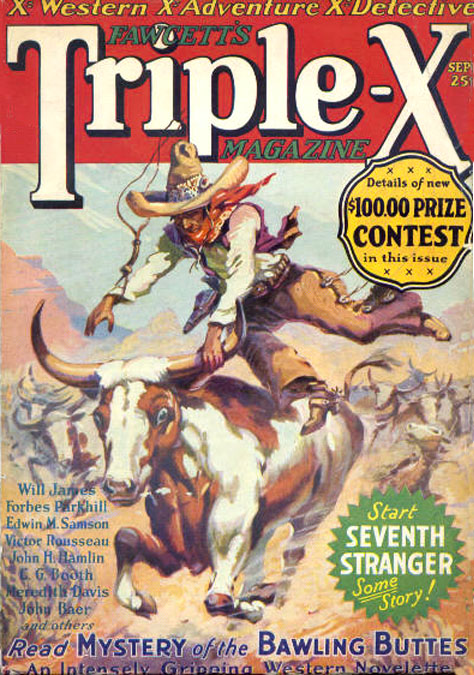
by F.R. Glass
This cover is from 1929.
by F.R. Glass
This cover is from 1929.
Rest in peace, the great Angry Anderson.
Welcome to Late Night Retro Television Reviews, a feature where we review some of our favorite and least favorite shows of the past! On Wednesdays, I will be reviewing 1st and Ten, which aired in syndication from 1984 to 1991. The entire series is streaming on Tubi.
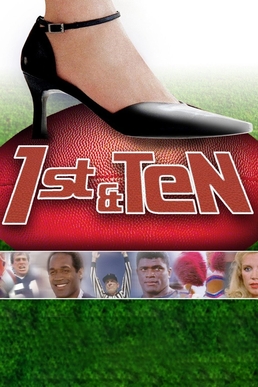
This week, the Bulls sign a new player!
Episode 5.4 “Mind Games”
(Dir by Stan Lathan, originally aired on November 1st, 1989)
The Bulls have signed college phenom Achilles Byron (Ronald William Lawrence) to the roster. However, in order to his name on the dotted line, they also have to sign his loud-mouthed, wheelchair-bound father (Ron O’Neal). Mr. Byron is tough taskmaster who constantly yells at Achilles and forces him to do extra drills. Denardo isn’t happy about Mr. Byron’s presence on the sidelines. Quite rightly, he explains to TD Parker and Kristy that there can only be one coach on the field.
Fortunately, Achilles scores the game-winning touchdown in his first game and Mr. Byron announces that Achilles no longer needs him. Mr. Byron also reveals that he was driving drunk on the night that he crashed his car, injured his spine, and killed Achilles’s mother. Wow, that’s a lot to dump on a kid who just won a football game. Luckily, Achilles had already figured out all of that on his own. Achilles is like No hard feelings and I’m going to say, “Ouch,” on the behalf of the deceased Mrs. Bryon.
Denardo, as a sign of respect, rolls Mr. Byron out of the locker room. Denardo also threatens to roll Mr. Byron down a flight of stairs. Mr. Byron suddenly starts laughing.
1st & Ten has this weird habit of tossing new characters into the mix and expecting us to get emotionally invested in them despite the fact that we’ve never seen them before and we’ll never seem them again. I’ve already checked with the IMDb. This is the only appearance of the character of Achilles Byron on the show. The Bulls agreeing to let Mr. Byron sit on the sidelines never made any sense and the final revelation about the night he was driving drunk came out of nowhere. It almost felt like a parody of badly-done melodrama.
While all of that was going on, Dr. Death was briefly brainwashed by a cult. It doesn’t look like he’ll ever get his killer instinct back! But then an opposing player calls Dr. Death a “pinhead” and he snaps out of it. He scores a viscous tackle that leaves the other player so dazed that that he wanders over to the wrong sideline. Obviously, he has a concussion but the laugh track tells us not to worry about it.
Dr. Death getting brainwashed actually was kind of funny. Ron O’Neal, best known for starring in Superfly, does a lot of yelling as Mr. Byron. It’s not exactly a good performance but one gets the feeling that was more the fault of the script than O’Neal. This was another curiously insubstantial episode of 1st & Ten.
Henry Silva was born on September 23rd, 1926 and lived all the way up to September 14th, 2022. During his years on earth he played a lot of bad guys in movies. From my growing up years, I remember him in stuff like LOVE AND BULLETS (1979) with Charles Bronson, SHARKY’S MACHINE (1981) with Burt Reynolds, CODE OF SILENCE (1985) with Chuck Norris, and ABOVE THE LAW (1988) with Steven Seagal. These were some of my favorite movies at a time when I was really getting into movies as a teenager. I’ve always considered LOVE AND BULLETS a missed opportunity, because he never fights Charles Bronson. Seriously!!
Silva got his start playing bad guys very early in his career. I guess he just had the right face for it. An early psychopath performance that I really appreciate came all the way back in 1957, when he played a vicious gunman in Director Budd Boetticher’s THE TALL T. Let’s just say that cute kids are not safe when his character of Chink is around. In a cast that included Randolph Scott, Richard Boone and Arthur Hunnicutt, Silva stood out like a sore thumb. Here’s a scene of Silva shooting the breeze around a campfire while eating some grub. He doesn’t seem like such a bad guy here, which is one of the things that makes him so good in the role… because he’s capable of absolute evil, and not caring one bit about it. Enjoy!
Welcome to Retro Television Reviews, a feature where we review some of our favorite and least favorite shows of the past! On Wednesdays, I will be reviewing the original Love Boat, which aired on ABC from 1977 to 1986! The series can be streamed on Paramount Plus!
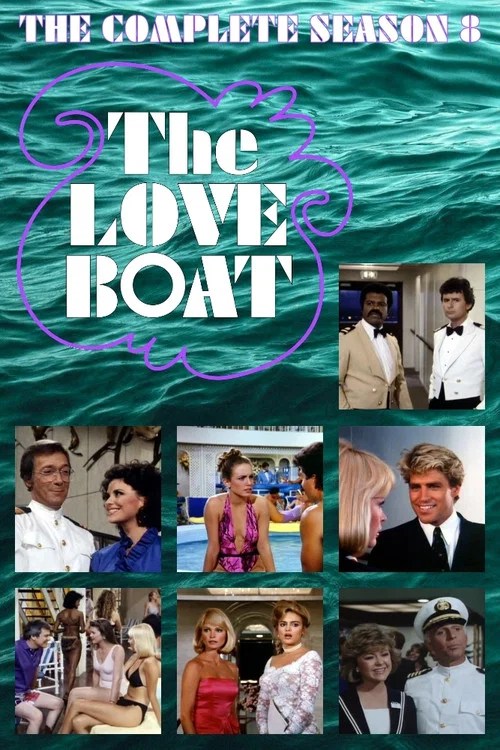
Welcome aboard! We’re expecting you….
Episode 8.13 “Paying the Piper/Baby Sister/Help Wanted”
(Dir by Richard Kinon, originally aired on December 1st, 1984)
Cheryl Enicker (Rue McClanahan) is sick of her husband, button manufacturer Harold (Donald O’Connor), taking her for granted. When she gives him a watch that cost $1,200, Harold points out that, since she gets all of her money from him, he basically bought the watch himself. Cheryl gets upset and hands Harold an invoice, listing everything that she’s done as a wife and mother for 25 years and demanding that Harold pay her half a million dollars. That’ll show him! After the episode, I was kind of of curious as to why the invoice was only for half a million dollars. It seems like it should have been more. I did some calculations and discovered that $520,00 in 1980 was the equivalent of $2,000,000 today. Wow!
Recent high school graduate Patty Springer (Dana Plato) can’t understand why her much older sister, Eleanor (Jaime Lynn Bauer), is freaking out about Patty hanging out with Peter Barkan (Christopher Knight). Eleanor goes as far as to kiss Peter in order to make Patty think that Peter is cheating on her. Patty’s mother, Eve (Vera Miles), suggests that Eleanor should tell Patty the truth. Eleanor isn’t actually Patty’s sister. Eleanor is …. Patty’s mother! And Eve is actually Patty’s grandmother. Needless to say, Patty is shaken by this news but she accepts it by the time the cruise ends. The Love Boat was only an hour show so most cases of generational trauma had to be resolved fairly quickly.
Kim Carlisle (Michelle Johnson) is the niece of a friend of Captain Stubing’s. Kim shows up, saying that her uncle said Stubing would find something for her to do on the ship. Kim goes from department-to-department, screwing things up. She removes all of the labels from the wine bottles so she can wash them. She snaps a picture of a man cheating on his wife. However, when she starts doing aerobics, several passengers join her. Kim is hired to be the new recreation director and — WAIT A MINUTE! I thought that was Charo’s job! Well, apparently, Charo is out and Kim is in.
This cruise was pleasant but forgettable, which seems to be becoming the norm for season 8. It didn’t take me long to guess the big twist about Eleanor being Patty’s mother. Poor Dana Plato. Knowing what I now know about her life and what the future had in store for her adds a definite melancholy feel to this episode.
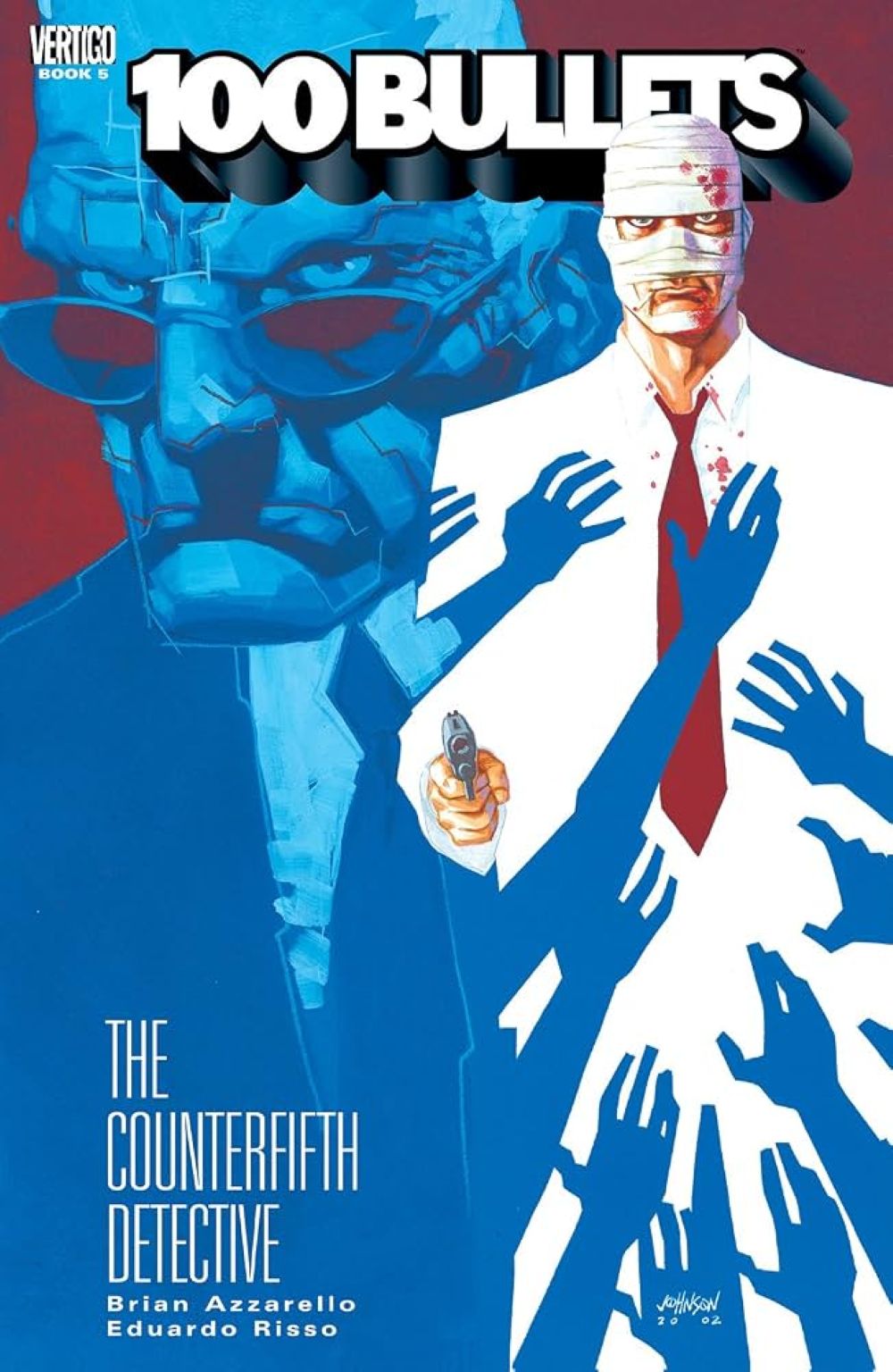
“You don’t need a face to know who you are.” — Agent Graves
With The Counterfifth Detective, Brian Azzarello and Eduardo Risso pull 100 Bullets back toward the kind of hard-boiled detective story its title and visual style have been flirting with since the beginning. The series has spent four volumes building from Agent Graves’s deceptively simple revenge offer into a much wider conspiracy involving the Trust, the Minutemen, and a long list of people carrying old grudges, hidden loyalties, and enough baggage to sink a city block. This fifth collection does not exactly slow that larger story down, but it does give it a tighter, more focused mystery to work through.
The central character is Milo Garret, a Los Angeles private investigator who wakes up in a hospital after what appears to have been a very bad car accident. His face is wrapped in bandages, his memories are incomplete, and his life has somehow become even more miserable than the average 100 Bullets protagonist’s. Naturally, Agent Graves shows up at exactly the moment when Milo is vulnerable, angry, and looking for somebody to blame. Graves gives him the familiar attaché case containing a gun, proof, and one hundred untraceable bullets, then suggests that Milo’s accident may not have been accidental at all.
That setup brings the series back to its original premise, but there is an important difference this time. Milo is not merely an ordinary person presented with a chance to kill the person who ruined his life. He is a detective, or at least he very badly wants to be the kind of detective he has seen in old movies and read about in pulp novels. He drinks too much, gets knocked around constantly, talks like somebody trying to turn every conversation into a Bogart monologue, and keeps walking into dangerous situations because it is what he thinks a real private eye is supposed to do. It would be easy for that to become irritating, but Azzarello makes Milo’s self-conscious noir act part of what makes him interesting.
Milo is clearly performing an identity, even before the story begins questioning whether he really understands his own past. He treats the hard-drinking, wisecracking private detective routine like armor. With his face literally hidden beneath layers of bandages, he has even more reason to cling to the image of who he believes he is. That gives The Counterfifth Detective a stranger and more personal angle than the earlier revenge stories. Milo is not just trying to find out who hurt him. He is trying to find out what he has forgotten, why so many people seem to know more about him than he does, and whether the version of himself he believes in has ever been real.
The title itself is one of those Azzarello word games that sounds like nonsense until the book starts circling around identity, forgery, and false versions of the truth. Milo gets drawn into the search for a stolen painting, but the painting is not simply a MacGuffin to move the plot along. It becomes tied to memory, deception, and the larger secrets that have been buried around the Trust and the Minutemen. Like much of 100 Bullets, the plot does not always hand the reader clean explanations right away. People speak in half-truths, conversations seem to skip over the most important details, and every time Milo gets what looks like an answer, it creates two more questions.
That can make the volume feel deliberately tangled. Azzarello is not writing a traditional detective mystery where every clue fits neatly into place by the final chapter. This is a conspiracy story told from the point of view of a man who has been dropped into the middle of it with a damaged memory and a gun in his hand. Milo is confused because he should be confused. The reader is meant to feel that same instability as the people around him lie, betray each other, disappear, get beaten up, or turn up dead before they can explain what they know.
At the same time, this is one of the more accessible volumes since the early days of the series because Milo gives the story a strong point of view. A Foregone Tomorrow was important for expanding the scope of the Trust and making the Minutemen feel like a real part of the series rather than vague backstory, but it was also intentionally scattered. The Counterfifth Detective still feeds the larger mythology, yet it is built around one man trying to survive one increasingly ugly case. The result feels more focused, even when the actual plot becomes more complicated.
Agent Graves is especially effective here because his role has changed so much from the early volumes. He still presents himself as a man offering someone the tools to take revenge, but it is impossible to see him as a neutral facilitator anymore. Graves knows far more about Milo than Milo does. He is not just giving the detective a choice; he is guiding him toward a confrontation that has clear value in Graves’s wider war against the Trust. The attaché case remains a powerful symbol because it looks like freedom. It promises immunity, a weapon, and a chance to settle the score. But in this series, the case is never really freedom. It is an invitation into Graves’s game.
The presence of Lono also helps give the story some extra menace. Lono is one of the series’ most unnerving characters because he is not merely violent; he seems to enjoy making everybody else feel smaller, dirtier, and more helpless. Whenever he appears, the atmosphere immediately gets worse. He brings a kind of ugly unpredictability that contrasts nicely with Graves’s calm manipulation. Graves always seems like he has calculated the next ten moves. Lono feels like he might wreck the board just to hear the pieces crack.
Risso’s artwork continues to carry an enormous amount of the book’s personality. The bandaged Milo is a great visual creation because he looks both mysterious and ridiculous, like a cheap horror-movie monster trying to pass himself off as a tough guy. Risso finds the humor in that image without undercutting the danger around it. He is also excellent at making Los Angeles feel appropriately worn down and hostile. The city is not glamorous here. It is a place of cheap offices, dim bars, empty roads, battered cars, suspicious hotel rooms, and people who look like they have been awake for three days making terrible decisions.
His use of shadow remains one of the series’ biggest strengths. A room can be almost empty and still feel tense because of the angle of a lamp, the silhouette of somebody standing in a doorway, or the way a character’s face is half-covered by darkness. That visual approach suits a story about missing memories and hidden identities perfectly. Risso rarely needs to make a big flashy gesture to sell danger. Sometimes all it takes is someone sitting too calmly in the wrong place.
Azzarello’s dialogue is still sharp, vulgar, and often very funny in a nasty way. Not every line lands, and the characters can sometimes sound like they are competing to be the most quotable person in the room, but that heightened style has become part of the book’s identity. These are people who use tough talk as a weapon. They insult, threaten, flirt, and lie in the same breath because direct honesty would make them too vulnerable.
100 Bullets Vol. 5: The Counterfifth Detective is a strong installment because it combines the series’ expanding conspiracy with a satisfying noir setup. Milo Garret is not as immediately sympathetic as Dizzy Cordova or as tragically lost as Loop Hughes, but he is a memorable lead precisely because he is such an imperfect version of a classic private eye. He wants answers, revenge, and a sense of control, but the deeper he goes, the clearer it becomes that he may be chasing a life that was invented for him by somebody else.
This is not the cleanest or easiest 100 Bullets volume, and readers looking for every mystery to be fully explained may come away frustrated. But it is stylish, mean, funny, and packed with the kind of uneasy connections that make the larger series addictive. Azzarello keeps tightening the web around Agent Graves, the Trust, and the surviving Minutemen, while Risso makes every page look like it was pulled from the darkest corner of a crime film. By the end, Milo may have found some answers, but like everybody who accepts Graves’s offer, he has paid far more for them than he ever expected.
100 Bullets Volume Reviews
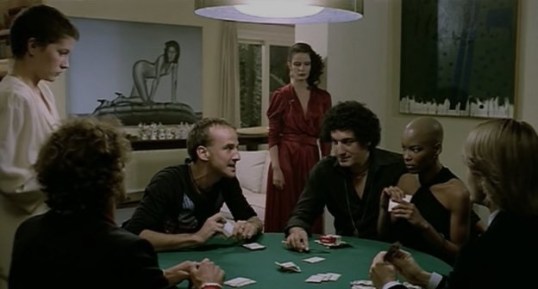
The House on the Edge of the Park (1980, dir by Ruggero Deodato)
Today’s song of the day is a deathless little disco song that comes from the soundtrack of Ruggero Deodato‘s legendarily tacky film, The House On The Edge Of The Park. This was one of many songs composed by Riz Ortolani, the John Williams of Italian exploitation cinema.
(This is also the song that Giovanni Lombardo Radice was dancing to in today’s scene that I love.)
Today, the Shattered Lens celebrates what would have been the 72nd birthday of the great Italian actor (and my friend), Giovanni Lombardo Radice!
I’ve shared this scene before but I’ll happily share it again. In Ruggero Deodato’s The House On The Edge of the Park, Giovanni Lombardo Radice shows a bunch of rich jerks how he can dance. Dancing with Radice is his frequent co-star, Lorraine De Selle. Wearing the yellow suit is the equally iconic David Hess.
4 Shots From 4 Films is just what it says it is, 4 shots from 4 of our favorite films. As opposed to the reviews and recaps that we usually post, 4 Shots From 4 Films lets the visuals do the talking!
Today, we pay tribute to the cinematic year of 2018. It’s time for
4 Shots From 4 2018 Films

Mandy (2018, dir by Pan Cosmatos)
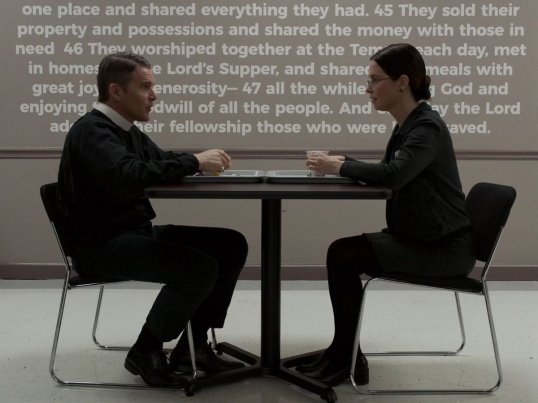
First Reformed (2018, dir by Paul Schrader)
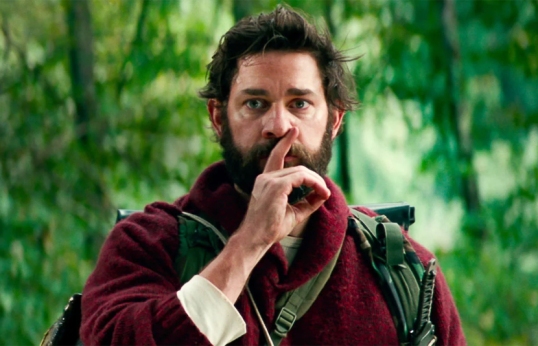
A Quiet Place (2018, dir by John Krasinski)
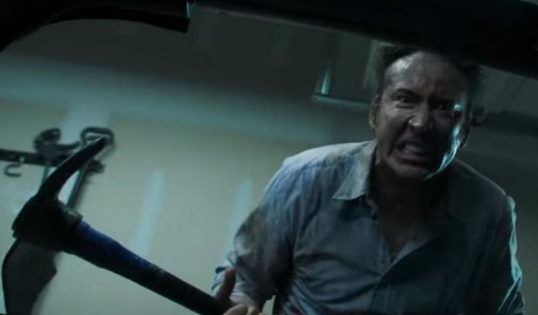
Mom and Dad (2018, dir by Brian Taylor)
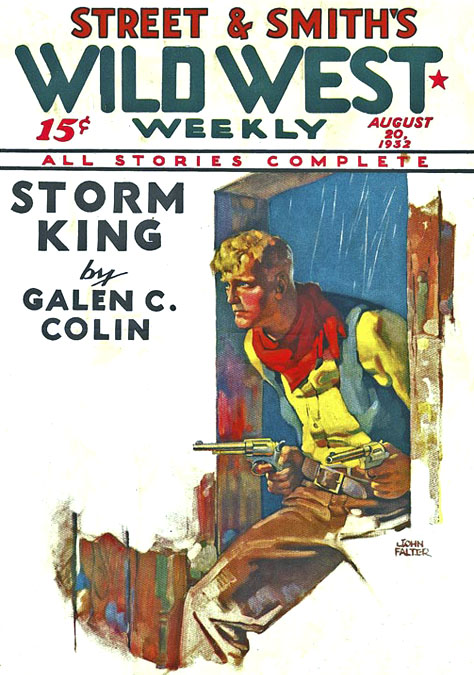
by John Falter
This cover is from 1932.

