The Adventures of a History Nerd: Candidates ’72


1972!  Now, that’s a presidential election that I’m sorry I wasn’t around to witness!

1972, of course, was the year that the Democrats nominated George McGovern and President Richard Nixon went on to win 49 states.  McGovern was considered to be one of the most left-wing presidential candidates of all time.  He started out as a dark horse but ultimately won the Democratic nomination after the more moderate Edmund Muskie’s campaign turned to be not as strong as people assumed and after Governor George Wallace’s campaign was ended by gunfire in Maryland.  (Wallace survived being shot but spent the rest of his life in wheelchair.)  McGovern’s campaign knew how to win a primary but had no idea how to win a general election.  He ended up getting around 37% of the popular vote.  He carried Massachusetts but he lost his home state of South Dakota.

Today, it’s usually assumed that Nixon’s victory was a foregone conclusion but that’s not true.  The Republicans had a weak midterm in 1970.  The Vietnam War was unpopular.  Nixon, himself, had managed to upset both the conservative and the liberal wings of the Republican Party with some of his policies.  Much as in 2020, a record number of candidates threw their hat into the ring to take on the incumbent President.  1972 is a great “What if” election.  What if the Democrats had nominated Edmund Muskie or Hubert Humphrey?  What if the Watergate burglars hadn’t been arrested?  What if George McGovern hadn’t picked Thomas Eagleton for Vice President or later asked him to step down as his running mate?  Would history be different today?

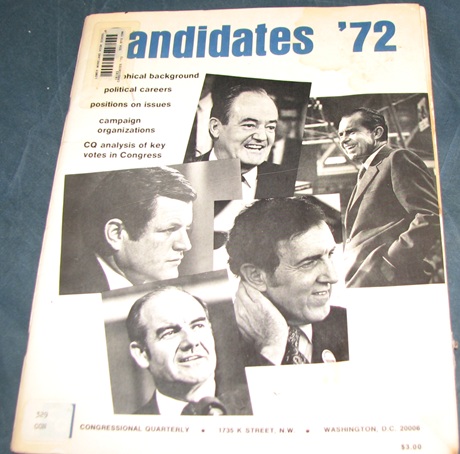
That’s why I’m glad that I have a copy of Candidates ’72.

Candidates ’72 was published, in 1971, by Congressional Quarterly.  It featured profiles of the many men and women who ended up running for President in 1972.  It not only detailed their backgrounds and their political stances but it also analyzed their chances of winning their party’s nomination.  For a history nerd like me, this book is wonderful because it was written without the benefit of hindsight.  It’s a chance to see what people were actually saying about the election of 1972 while it was going on.  Often times, it’s quite different from the biased analysis that was written about the election after it had already happened.

The other reason why I like Candidates ’72 is because so many memorable people ran for the Presidency in that year.  George McGovern, New York Mayor John Lindsay, U.S. Rep. Shirley Chisholm, Hubert Humphrey, Eugene McCarthy, Los Angles Mayor “Mad Sam” Yorty, George Wallace, Dr. Benjamin Spock, they are just some of the candidates profiled here.  Reading the profiles really does reveal that America was at a crossroads in the early 70s.  Much like today, a lot of people assumed that radicalism was ascendant while failing to consider just how serious the backlash would eventually become.  Some of the other Democrats running actually made George McGovern look like a moderate.  Meanwhile, on the Republican side, Nixon was challenged by an anti-war congressman named Pete McCloskey.  McCloskey eventually lost his house seat in the 80s but briefly reemerged in 2006 as an environmentalist and anti-war activist.  He was also a Holocaust denier so let’s be happy that he never got anywhere near the White House.

(It’s probably a sign of just how chaotic the 1972 election was that a few candidates — John Ashbrook, Terry Sanford — did not get profiled in Candidates ’72, presumably because they jumped into the fray after the book went to the presses.)

Here are the candidates and potential candidates who are profiled in Candidates ’72.

Republicans:

  1. Vice President Spiro Agnew of Maryland (elected Vice President in the General Election)
  2. Treasury Secretary John Connally of Texas (declined to run)
  3. Lobbyist John Gardner (declined to run)
  4. U.S. Rep. Pete McCloskey of California (suspended campaign during the primaries)
  5. President Richard M. Nixon of California (won the general election)

Democrats:

  1. U.S. Rep. William Anderson of Tennessee (dropped out before the primaries)
  2. Sen. Birch Bayh of Indiana (dropped out before the primaries)
  3. U.S. Rep. Shirley Chisholm of New York (defeated at the Democratic Convention)
  4. Former Attorney General Ramsey Clark of New York (declined to run)
  5. Sen. Fred Harris of Oklahoma (dropped out before the primaries)
  6. U.S. Sen. Vance Hartke of Indiana (withdrew during the primaries)
  7. Sen. Howard Hughes of Iowa (dropped out before the primaries)
  8. Sen. Hubert Humphrey of Minnesota (defeated at the Democratic Convention)
  9. Sen. Henry Jackson of Washington (defeated at the Democratic Convention)
  10. U.S. Sen. Edward M. Kennedy of Massachusetts (declined to run)
  11. New York Mayor John V. Lindsay (withdrew during the primaries)
  12. Lt. Gov. Lester Maddox of Georgia (withdrew during the primaries)
  13. Fmr. Sen. Eugene McCarthy of Minnesota (withdrew during the primaries)
  14. Sen. George McGovern of South Dakota (defeated in the General Election)
  15. U.S. Rep. Wilbur Mills of Arkansas (withdrew during the primaries)
  16. U.S. Rep. Patsy T. Mink of Hawaii (withdrew during the primaries)
  17. U.S. Sen. Walter Mondale of Minnesota (declined to run)
  18. Sen. Edmund Muskie of Maine (suspended campaign during the primaries)
  19. Sen. William Proxmire of Wisconsin (dropped out before the primaries)
  20. R. Sargent Shriver of Maryland (nominated for vice president, lost the general election)
  21. Gov. George Wallace of Alabama (suspended campaign after being shot in Maryland)
  22. Los Angeles Mayor Sam Yorty (withdrew during the primaries)

Independents:

  1. Ralph Nader (declined to run)
  2. Dr. Benjamin Spock (lost the general election)

Ran, but not profiled:

  1. U.S. Rep. John Ashbrook (R-OH)
  2. U.S. Sen. Thomas Eagleton (D-MO, nominated for Vice President but stepped down from the ticket and was replaced by Sargent Shriver)
  3. State Rep. Sissy Farenthold (D-TX, ran for the Vice Presidency at the Democratic Convention)
  4. U.S. Rep. Walter Fauntroy (D-DC)
  5. U.S. Sen. Mike Gravel of Alaska (D-Alaska, run for the Vice Presidency at the Democratic Convention)
  6. U.S. Rep. Wayne Hays (D-OH)
  7. Former Governor Endicott Peabody (D-Massachusetts, ran in the nonbinding Vice Presidential primary)
  8. Former Governor Terry Sanford (D-NC)
  9. U.S. Rep. John G. Schmitz (R-CA, ran as the candidate of the American Party)
  10. Cleveland Mayor Carl Stokes (D-OH)

I ordered my copy of Candidates ’72 shortly after I ordered Candidates ’76.  Sadly, my copy of Candidates ’72 is not in the best condition and I doubt I’ll ever find another copy.  As a proud history nerd, though, I’m still happy to have it.


The Adventures of a History Nerd: Right From The Start by Gary Hart


The 1972 presidential campaign was a strange one.

Today, it’s best-remembered for the fact that Richard Nixon carried 49 states and won 60.7% of the popular vote.  Nixon’s victory came after the Democratic nominee, George McGovern, dropped his running mate, Thomas Eagleton, from the ticket after it was revealed that Eagleton had undergone electroshock treatment for depression.  McGovern was also, at that point, one of the most liberal candidates to ever be nominated by a major political party.  Much as with the earlier Barry Goldwater campaign, many of McGovern’s campaign volunteers and aides went on to have long careers in politics but their enthusiasm did not translate into votes for McGovern.  Today, Nixon’s victory is seen as being such a foregone conclusion that people still wonder why a group of campaign operatives and White House aides even felt like they needed to break into the Watergate hotel to win.

1972 was a bit before my time but, if you look at the number of candidates who ran for the Democratic nomination, it’s obvious that, despite how thing ultimately turned out, quite a few people originally thought Nixon was vulnerable in 1972.  Over 20 Democratic office holders competed for the right to run against Nixon.  Sen. Edmund Muskie was the early favorite but, in the end, George McGovern won the nomination as the result of a largely grassroots effort.  McGovern became the first Democrat to win the nomination through the primary system as opposed to making deals with political and labor bosses.  McGovern’s campaign was fueled by opposition to the Vietnam War and an earnest idealism that got on the nerves of just about everyone outside of the campaign.  One of McGovern’s rivals, Sen. Henry Jackson, said that McGovern was the candidate of “abortion, amnesty, and acid.”

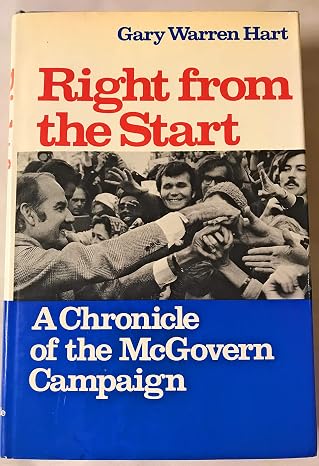
McGovern’s campaign manager was a Colorado lawyer named Gary Hart.  Hart would later be elected to the U.S. Senate and would twice run for president himself.  (Hugh Jackman played Hart in the rather forgettable film, The Front Runner.)  However, before Hart first ran for the Senate, he took the time to write a book about the McGovern campaign.  That book was called Right From The Start.  I ordered a used copy off of Amazon about ten years ago.  It cost me about twenty dollars.  If I ordered the book today, it would only cost me $16.00.

The book is an interesting historical document.  Hart writes about the day-to-day operations of the McGovern campaign.  He does a very good job of showing how McGovern came from behind to win the Democratic nomination.  Hart writes about how the campaign recruited people who were new to politics but who were passionate about the issues.  He writes about how Morris Dees (yes, the Southern Poverty Law Center guy) spearheaded the campaign’s fundraising.  He writes about the day that Governor George Wallace was shot in Maryland.  He shows how a group of committed activists were able to bypass the party bosses and win their candidate the nomination.  Where Hart struggles is with explaining why McGovern lost the general election.  Hart puts a lot of the blame on Thomas Eagleton and perhaps that’s justified.  But McGovern still lost 49 states.  To me, that would indicate there were even bigger problems then picking a bad running mate.  But, because Hart was on the same side of McGovern, it’s perhaps understandable that he would struggle to admit that the electorate simply didn’t respond to what McGovern was selling.

(Ironically, in 1984, Hart and McGovern would both run for the Democratic presidential nomination.)

The chapter where Hart discusses the process that led to Thomas Eagleton becoming, albeit temporarily, McGovern’s running mate is the book’s highlight.  As Hart explains it, he and the rest of McGovern’s aides had been so busy winning McGovern the nomination that none of them had really bothered to consider who McGovern should run with.  McGovern had his own preferences but they all declined to join the ticket.  A bunch of exhausted men ended up sitting around and tossing out names like CBS anchorman Walter Cronkite and Boston Mayor Kevin White.  Someone suggested that, since the convention was being held in Miami, the second spot should go to New Orleans Mayor Moon Landrieu just so the next day’s paper would read “MOON OVER MIAMI.”  In the end, Thomas Eagleton was picked not because anyone feels strongly about him but instead because he was the only one that nobody felt any passion about whatsoever.  He was serviceable and inoffensive and, when he was asked if there was anything in his past that might embarrass the campaign, he replied that they’re wasn’t.  A few weeks later, Eagleton’s psychiatric history was leaked to the press and the McGovern campaign imploded.  Maybe they should have just asked Cronkite.

Right From The Start is an compulsively readable and interesting campaign memoir, perfect for history nerds like you and me.

The Adventures Of A History Nerd: Candidates ’76


President Milton Shapp.

That sounds strange, doesn’t it?  There’s never been a President named Milton Shapp.  The name itself doesn’t exactly sound all the Presidential.  A president named Milton?  At one time, Milton brought to mind Paradise Lost.  Today, for many people, Milton might bring to mind Stephen Root protectively holding his red stapler in Office Space.  It’s not a name that we associate with presidents.

And yet, in 1976, Milton Shapp was one of the many people who ran an at least semi-serious campaign for presidency.  He was the governor of Pennsylvania, having first been elected in 1970 and narrowly re-elected in 1974.  He was the owner of an electronics company, a self-made millionaire.  He played the violin.  He wrote poetry.  He was the author of several musicals that had never actually been produced.  He ran for the Democratic Presidential nomination and, as you can probably guess, he didn’t get far.  If he had been elected, he would have been the country’s first Jewish President.

Of course, he wasn’t elected President.  If he had been elected, it’s doubtful that he would have been any better than Jimmy Carter.  But he would be remembered.  Milton Shapp would be the one with the books written about his life and Jimmy Carter would be the one reduced to being an obscure footnote in someone else’s story.

Unfortunately for Milton Shapp and the majority of the other people who ran for President in 1976, people don’t remember the also-rans.  They remember the candidates who won their party’s nominations.  To me, that’s a shame.  Sometimes, the also-rans are far more intriguing than the people who won.  In 1976, the first election after America’s only presidential resignation, over 20 candidates either ran or considered running for the White House.  Arizona’s Mo Udall was a one-eyed Mormon who was also a former basketball player.  North Carolina’s Terry Sanford was the President of Duke University.  Oklahoma’s Fred Harris traveled across the country in a RV and stayed in the homes of his supporters.  Indiana’s Birch Bayh and Idaho’s Frank Church were respected technocrats.  Maryland’s Sargent Shriver was a Kennedy brother-in-law.  Texas’s Lloyd Bentsen was a protegee of Lyndon B. Johnson and once called for nuking North Korea.  Washington’s Henry “Scoop”  Jackson was the original front runner who was still referred to be his childhood nickname despite being in his 50s.  Alabama’s George Wallace campaigned from his wheelchair.  At one point, every candidate had a shot at breaking through but only a few made it to the Convention.  How different would America be if Mo Udall or Lloyd Bentsen or Milton Shapp had won in 1976?

If you’re wondering how I know about all of these folks, it’s because I recently ordered a copy of Candidates ’76, a collection of candidate profiles that was put together by Congressional Quarterly.  Along with taking a look at their positions on the issues of the day, it also details their individual backgrounds and assesses their prospects.  Because Candidates ’76 was written in 1976, there’s no benefit of hindsight here.  Instead, it’s an honest historical document, one that was written at a time when no one was sure what the post-Watergate political scene would eventually look like.  For a history nerd like me, it’s the type of thing that is fascinating to read.

For the record, the following candidates and potential candidates are profiled in Candidates ’76.  Candidates with an asterisk by their name actually ended up on the primary ballot in 1976.

Republicans:

  1. Gerald Ford*
  2. Ronald Reagan*
  3. Nelson Rockefeller
  4. John B. Connally
  5. Howard Baker
  6. Charles Percy
  7. Charles Mathias
  8. Elliot Richardson
  9. Donald Rumsfeld
  10. George H.W. Bush

Democrats:

  1. Birch Bayh*
  2. Lloyd Bentsen*
  3. James “Jimmy” Carter*
  4. Frank Church*
  5. Fred Harris*
  6. Hubert Humphrey
  7. Henry Jackson*
  8. Edward M. Kennedy
  9. Edmund Muskie
  10. Terry Sanford*
  11. Milton Shapp*
  12. R. Sargent Shriver*
  13. Morris L. “Mo” Udall*
  14. George C. Wallace*
  15. George McGovern
  16. Jerry Brown*
  17. Hugh Carey

Independent;

  1. Eugene McCarthy*

(As far as I can tell, the only candidate that CQ missed was Robert Byrd, who ran as a favorite son in West Virginia.  Future Vice President Walter Mondale also ran briefly for President but ended his campaign before Candidates ’76 was put together.)

One of the great things about being a history nerd is that I can find a lot of happiness in reading something like Candidates ’76 and playing the “What If?” game.  At a time when misinformation is everywhere and when historical revisionism has been normalized, it’s nice to be able to go back and look at an original document.  It’s the next best thing to having a time machine.

Horror Novel Review: Teddy by John Gault


Yesterday, I wrote about a Canadian horror film called The Pit.  I mentioned that it was a film about a creepy 12 year-old named Jamie who had conversations with his teddy bear, developed a not-so-innocent crush on his babysitter, and who regularly fed the people he disliked to a bunch of underground monsters who lived in a pit in the woods.

Yesterday, I also read Teddy, the 1980 novelization of The Pit.

(The Pit was originally titled Teddy.)

Teddy is even more creepy than The Pit, largely because it includes all of the disturbing details that were either cut from the finished film or perhaps dropped when the script was rewritten.  Jamie is still a creepy 12 year-old who talks to his teddy bear.  Unlike the film, the novel makes it clear that Teddy is actually a living force of evil and that his words are not just a figment of Jamie’s imagination.  The book actually suggests that Teddy moves from child to child, corrupting each of its owners.  Teddy in the book is also a hundred times more pervy than Teddy in the movie, making some rather crude comments about Jamie’s mom and later encouraging Jamie to join him in checking out some porno magazines.

The book also delves into the investigations surrounding the disappearance of Jamie’s many victims.  As a result, we get to know the victims a bit better in the book than we did in the movie.  Also as a result, Jamie also comes across as much more deliberately evil in the book than he does in the movie.  Even if he is under the possible demonic influence of Teddy, Jamie still seems to take way too much pleasure in people dying.  This is especially true of the scene where his babysitter falls into the pit.  In the movie, Jamie tries to help her escape.  In the book, Jamie not only pushes her but smiles afterwards as he listens to her screams.

Agck!  What a creepy kid!

Teddy is a pretty effective little horror novelization.  It’s also not easy to find a physical copy.  However, you can read it at Open Library.

Horror Novel Review: Killer On The Road by James Ellroy


First published in 1986 and considerably shorter than the typical James Ellroy novel, Killer On The Road takes the form of the memoirs of Martin Plunkett, a child genius who grew up to be a prolific serial killer.

The book starts with Plunkett already serving a life sentence at Sing Sing.  He’s a killer who is now off the road and his memoirs are less about his plans and more about his own struggle to understand how he became the killer that he became.  There are plenty of possible explanations, going all the way back to his dysfunctional childhood and the trauma of his parent’s divorce.  He may be brilliant but he spends all of his time wishing that he could turn invisible like a comic book character and spy on people in their homes.  He comes to idolize Charles Manson but is disappointed when, while in prison, he meets the actual Manson and discovers that he’s just a rambling loser.  The book is written in Plunkett’s own words and, in typical sociopath fashion, he thinks very highly of himself but careful readers will look between the lines and see someone who is just as confused by what he became as everyone else.  For all of his intelligence and his nonstop speculation about the human condition, Plunkett ultimately seems like an empty vessel.  Plunkett’s years on the road are full of unexpected detours.  A meeting with a cop definitely do not go the way that anyone would probably expect it to go.  Even though the story is narrated Plunkett, people like FBI agent Dusenberg come across as fully developed characters as well.

It’s a disturbing and sad but compulsively readable book.  It may have been written before Ellroy developed his signature style but it stills shows his strengths as a storyteller.  Interestingly enough, Ellroy later stated in My Dark Places that he based Martin Plunkett’s dysfunctional youth on his own, which definitely leaves one happy that James Ellroy discovered writing as an outlet for his emotions.  Unlike Martin Plunkett, James Ellroy went on to become one of the best writers of our current era.

Horror Book Review: X-Isle By Peter Lerangis


X-Isle!?

Is this a book about an island that is populated by the twenty or so people who actually refer to twitter by it’s “new” name of X?

No, actually, it’s not.  X-Isle was published in 2002, in the days before social media and ever-present phones.  X-Isle is a slasher story, one in which a group of good-looking teens end up hanging out at the exclusive Spinnaker Lodge, a luxury resort on an isolated island.  It’s like that island that Kim Kardashian took all of her friends and employees to during the COVID epidemic?  Remember that?  Everyone else was locked inside or wandering around triple-masked while Kim went to an island and then scolded everyone else for not taking proper precautions.

(Sorry to get off topic there but seriously, the COVID era was messed up in ways that people are still struggling to full comprehend.)

Reading X-Isle, I found myself wandering if you really could write an effective, non-ironic, old school slasher story nowadays.  The whole key to the slasher genre is that people have to be isolated and there has to be no way of reaching out for help.  Every slasher movie now has to come up with some extended to reason to explain why no one can call the police.  Whenever a horror movie starts with someone saying, “Give me your phone, you’ll get it back after the weekend,” I roll my eyes a little just because it’s become such a cliche.  At this point, I imagine even Camp Crystal Lake has free wi-fi.  It’s easy to imagine a camp counselor tweeting out, “Help!  There’s a murderer at Crystal Lake!” and someone replying, “Whatever, Jussie.”

X-Isle gets off to a good start with a collection inner-office dossiers that introduce us to the main characters.  What the memo reveals is that the main requirement to work at the resort is a handsome face or a good body.  Once the story kicks in, we meet our group of potential victims and, unfortunately, none of them really live up to all the hype in the introduction.  We spend a good deal of time with Carter, a womanizer who, at one point, feels the need to tell us that he’s not psychotic despite the fact that his behavior is often manipulative and narcissistic.  When you actually have to tell people that you’re not a psycho, you probably are. Of course, in this book, Carter is one of the heroes.

Someone is killing guests and employees.  It’s a YA book so we don’t actually see the kills but the aftermath is described in properly grisly fashion.  The reveal of who the killer was doesn’t make much sense but, given that the book ends with a cliffhanger, that was perhaps deliberate.

Anyway, I’ve always kind of enjoyed the slasher genre, even with all of its cliches and its issues towards anyone who shows the slightest spark of independence.  X-Isle was a fast and entertaining read.  None of the characters were particularly likable which made it a lot less stressful to read about them being put in danger.  In the end, the main lesson is to stay away from mysterious islands.  That’s probably good advice.

4 Books For The Weekend (10/3/25)


I want to start by recommending The Friday Afternoon Club, Griffin Dunne’s memoir of growing up amongst the rich and famous in Hollywood and Manhattan.  The son of Dominick Dunne and the nephew of John Gregory Dunne, Griffin Dunne came of age in the 60s and the 70s.  Reading his memoir, it’s easy to wonder if there’s anyone who he didn’t rub shoulders with at one time or another.  Sean Connery saves him from drowning when he’s just eight.  He attends one of Ken Kesey’s acid tests with John Gregory Dunne and Joan Didion.  A pre-stardom Harrison Ford does carpentry work at the Dunne family home and shares his weed with the young Griffin.  In New York, Griffin’s roommate and (for the most part) platonic best friend is a hyperactive young actress named Carrie Fisher.  While Griffin tries to find himself in Hollywood and New York, his father Dominick drops in and out of the film business.

For it’s first half, The Friday Afternoon Club is, at times, a laugh-out-loud memoir.  Griffin Dunne is a very funny storyteller and his command of language reveals a bright and insightful mind.  However, the second half of the book takes a dark turn with the murder of his sister, Dominique.  Dominique, who had just appeared in Poltergeist, was strangled by her abusive boyfriend, a chef named John Thomas Sweeney.  Griffin Dunne writes unsparingly of the horror of watching as Sweeney’s lawyers tried to present Dominique as somehow being to blame for her own death.  After the judge refused to allow the prosecution to introduce evidence showing that Sweeney had a history of abusing and choking women, the jury found Sweeney guilty of manslaughter.  (The jury foreman later said that, if the jury had been allowed to hear the evidence of Sweeney’s past abusive behavior, they would have found Sweeney guilty of murder.)  Sweeney was sentenced to six years in prison and was paroled after only 30 months.  Griffin Dunne writes of the years that both he and his father spent obsessing on Sweeney’s whereabouts.  (Sweeney, for those curious, continued to find work as a chef even after his prison sentence.  He currently goes by the name of John Maura.)

It’s a powerful memoir.  Griffin writes honestly about his dysfunctional family, describing even their conflicts with a good deal of love.  Probably the most touching passages in the book are about his relationship with his brother Alex, the one member of the family to see through Sweeney from the start.  Those looking for Hollywood gossip will find plenty, though Griffin is never malicious.  Those looking for details about the filming of An American Werewolf in London and After Hours will find those as well.

Published earlier this year, Susan Morrison’s Lorne is a biography of Lorne Michaels, the man behind Saturday Night Live.  Lorne has actually produced quite a few other shows and movies but, as this book makes clear, his legacy will always be Saturday Night Live.  The book follows Lorne from his beginnings in Canada to his time as a counter-culture tastemaker to his current position as a senior member of America’s cultural establishment.  Lorne went from being a rebel to being a member of the club and, reading about the process, one comes to suspect that he was always more comfortable in the club than outside of it.  It’s an interesting journey and the Lorne Michaels who emerges is occasionally idealistic, occasionally pragmatic, and — even after 595 pages — rather enigmatic.  It’s a fascinating story, one that provides insight into American culture has changed and developed over the past 50 years.  There’s certainly more insight to be found in this book than in Jason Reitman’s Saturday Night.

On a similar note, Todd S. Purdum’s Desi Arnaz: The Man Who Invented Television argues that Arnaz deserves far more credit for …. well, inventing television than he’s usually given.  Often dismissively described as being Lucille Ball’s less talented husband, Purdom persuasively argues that Arnaz deserves far more credit for the success of I Love Lucy than he is commonly given.  The book details how Arnaz’s family lost their fortune in one of Cuba’s many revolutions, how Arnaz came to America and built a career for himself, and how Arnaz revolutionized television as the producer of I Love Lucy.  The book deals with both the good and the bad of Lucy and Desi’s marriage.  Desi emerges as a complex and flawed character, one whose career never really recovered after his divorce from Lucille Ball.

Finally, an old friend recommended that I read Bryan Burrough’s 2015 book, Days of RageDays of Rage takes a look at the the domestic terrorism of the 70s, the bombings, kidnappings, and even murders that were committed by members of such groups as the Weatherman, the BLA, the SLA (they kidnapped Patty Hearst), and the FALN.  Along with taking a look at the motivations of the terrorists themselves, Burrough also writes about how the FBI reacted.  In the end, it’s a book without any heroes.  The FBI frequently violated the law in their pursuit of domestic enemies.  Meanwhile, the radicals often come across as being a collection of hypocrites who were essentially more interested in playing revolution than actually accomplishing anything.  The Weathermen, in particular, come across as being a bunch of smug and overly privileged LARPers.  It’s an interesting book and one that feels very relevant in our current cultural moment.

Check out my previous book recommendations here!

Horror Novel Review: My Secret Admireir by Carol Ellis


First published in 1989, My Secret Admirer tells the story of Jenny.

Jenny is a teenager who has lived in four different town over the past six years.  Her dad’s job requires him to move from town to town and her mother doesn’t like the idea getting tied down anywhere.  I have to admit that I could relate to Jenny because my family used to move all over the place.  By the time I was 12 years old, I had lived in Texas, Oklahoma, Arkansas, New Mexico, Colorado, and Louisiana.  Frequently moving meant that I had to continually get used to new towns, new schools, new teachers, and new friends.  Years later, I realized that spending my childhood on the go left me with massive trust and abandonment issues.  In other words, it really sucked.  My heart went out to Jenny.

When the book opens, Jenny has only been in her new home for a few days.  She’s still nervous about the house and the town.  She’s scared of the hills that are near her home and the rocky bluffs that sit behind the hills.  She worries about wild animals.  She doesn’t know anyone in town and school doesn’t start for another few days.

So, of course, her parents decide to abandon her.

When they are informed that their old house has been sold, Jenny’s parents buy plane tickets so that they can fly back to their former home and collect the rest of their belongings.  Jenny is left behind so that she can deal with the painters (who are scheduled to show up in three days).  Parents in YA book — especially YA horror books — are usually not that great but I have to say that Jenny’s parents take selfish parenting to a whole other level.

Fortunately, Jenny meets her neighbor, the very talkative Sally.  Sally ropes Jenny into taking part in a big scavenger hunt.  During the hunt, Jenny meets Dave and his bitchy girlfriend, Diana.  Diana and Dave are having a fight so Dave teams up with Jenny for the scavenger hunt and, within an hour or so, Jenny and Dave are in love.  Unfortunately, the scavenger hunt does not go as well for Diana.  A day after a sudden storm brings the hunt to a close, Diana is found at the bottom of the cliff.  With Diana in a coma, Jenny wonders if it’s possible that Dave pushed her.

Meanwhile, Jenny seems to have a secret admirer, someone who calls the house and leaves messages on her answering machine.  It’s all good and well until someone leaves a present on her porch.  When Jenny opens the package, she discovers the head of a rattlesnake!

This novel was fairly ridiculous.  Between Jenny’s parents basically abandoning her in a town and house that she barely knew to Jenny falling in love with Dave after spending 30 minutes with him, this book was all about people making bad decisions.  Unfortunately, despite all of the silly plot developments, the book never quite becomes the sort of over-the-top, melodramatic spectacle that one might hope it would become.  That said, I could relate to how Jenny felt about always being the new girl and it was a quick read.  For that matter, I don’t like heights either.

In the end, the book’s message was one to which I could relate:

No, not that!  Instead, if you believe in yourself, you can get a boyfriend and you can survive being stuck in a scary old house!  That’s an important lesson to learn!


Horror Book Review: Driver’s Dead by Peter Lerangis


Poor Kirsten!

In the 1994 novel Driver’s Dead, teenage Kirsten is not only currently living in a house that she thinks might be haunted by the ghost of the son of the previous owners but she’s also somehow gotten a reputation for being a bad driver!  (Ironically enough, the son of the previous owners was also killed in a car crash …. or was he?)

When it come to having one’s driving unfairly criticized, I could relate to Kirsten.  I can still remember the pain of those days when I was “learning” how to drive.  Learning is in quotes because, quite frankly, I already knew how to drive.  I had seen enough TV shows and gone on enough road trips with my family to know which pedal to push and how to turn the steering wheel.  And yet, every driving instructor that I had to deal with insisted on being like totally critical of me.  One of the first times that I drove on the road, I got yelled at by the instructor because I didn’t look both ways before making a lane change.

“I looked in the rearview mirror!” I snapped.

Apparently, that was not the right answer because she kept yelling at me until I finally said, “How am I supposed to concentrate on driving with you talking all the time!?”

That also did not go over well.  That particular instructor refused to ride with me anymore.  I went home in tears so my mother went up to the school and yelled at all of the instructors for being rude to me.  The next time I drove, it was with the owner of the school, who was much nicer to me.  The owner of the school asked me if I had a lazy eye.  “Not anymore,” I replied.

Anyway, you get my point.  I somehow managed to get my license despite having to deal with some pretty clueless driving instructors.

Anyway, back to Driver’s Dead.  Kirsten decides to deal with her driving struggles by getting some help from Rob.  Rob shows her how to drive but it turns out that his father is a big-time racist and Rob is kind of a jerk as well.  When Rob tries to grope her, Kirsten tells him to get lost.  (Yay!)  Then Rob turns up dead.  Uh-oh.

Who murdered Rob and how is it connected to the blood that keeps seeping out from underneath the closet in Kirsten’s bedroom?  And what to make of Mr. Busk, the alcoholic driver’s teacher who has apparently never gotten over his experiences in Vietnam?

Driver’s Dead is a YA book from the mid-90s so it’s definitely a bit dated.  Check out the reference to floppy disks and running DOS on a computer!  Check out Kirsten’s crush on Jason Priestly!  But I still found it to be entertaining because Kirsten was a likable character and the plot neatly mixed the supernatural with a standard YA mystery story.

Plus, who can’t relate to being a better driver than most people realize?  Ghosts and murder aside, I shared Kirsten’s struggle.


A Book For The Weekend (7/25/25)


Yesterday, I received Daniel Budnick’s 80s Action Movies On The Cheap and I’m already in love with this book!

This book features 284 reviews of the 80s action films that tend to be ignored by those who now sing the praises of Stallone and Schwarzenegger.  We’re talking about the films of Michael Dudikoff here.  We’re talking about the directorial efforts of Cirio Santiago, Nico Mastorakis, Sam Firstenberg, and so many others.  We’re talking Italian action cinema.  In short, we’re talking about some of the most entertaining and unfairly overshadowed films of all time.

Yes, the American Ninja films are reviewed (or, at least, the ones that came out in the 80s are).  Yes, there’s a review of The Last Hunter and Space Mutiny and the Deathstalker films.  Much like me, Daniel Budnik appreciates Red Brown even if Reb’s habit of shouting during his action scenes does seem to be a bit weird.  But what I truly love about this book is that it also features reviews of films that even I previously didn’t know about.  I mean, honestly, there are hundreds of film guides out there.  What sets the great film guides apart from the good ones is how many previous unknown titles you can discover by just randomly flipping through it.  And when it comes to film reviews, the most important question is whether or not the review inspires you to try track down a film that you may not have seen or even heard about before.  The best film reviews inspire you to watch so that you can judge for yourself.  I’ve discovered a lot just by randomly opening this book.  And I now have a long list of cheap 80s actions films that I want to watch and which I will be watching and hopefully reviewing myself.

With 80s Action Movies On The Cheap as my guide, I look forward to all sorts of new discoveries.

(Click here for my previous entry in weekend books!)