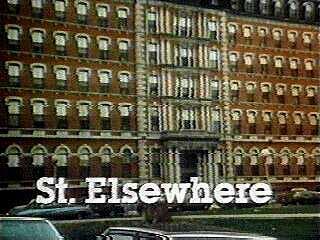
Welcome to Retro Television Reviews, a feature where we review some of our favorite and least favorite shows of the past! On Fridays, I will be reviewing St. Elsewhere, a medical show which ran on NBC from 1982 to 1988. The show can be found on Daily Motion.
This week, it’s a dark night in Boston.
Episode 4.20 “Come Home, Oh Sapien”
(Dir by Allan Arkush, originally aired on March 5th, 1986)
This is one of those episodes that takes place over the course of just one night.
Artist Alex Corey (Jeff Allin) has been commissioned to brighten up St. Eligius’s lobby. Mostly, he just wanders around and gets on everyone’s nerves. Seeing as quirky characters usually suffer a terrible death on this show, I spent the episode expecting Alex to have an aneurysm or to fall down the stairs, but it didn’t happen.
Elliott takes care of a patient who was suffering from pneumonia, and he also learns that his ex-girlfriend, Marcy, has gotten married without telling anyone ahead of time and is now living in Zurich. Marcy’s mother, Nurse Rosenthal, assures Elliott that Marcy has spent zero time pining for him.
Ehrlich is upset about his OB/GYN rotation and misses working with Dr. Craig. Having had a fight with Ellen, Craig is spending the night at the hospital and observes Ehrlich performing a C-section. Afterwards, Craig tells Ehrlich that he’s becoming a fine doctor.
Carol Novino has dinner with Dr. Westphall and his family and, in a truly cringeworthy scene, dances with Westphall’s daughter in the kitchen. When Westphall and Novino meet up at the hospital the next morning, they share a kiss. ACK! Seriously, the only thing more depressing than having dinner with Westphall is dating him.
Finally, speaking of depressing, Chandler spends the night working at the crisis hotline. It’s all part of Westphall’s community service program. (Previously, Chandler worked at the women’s health clinic, but since it was bombed, Westphall has decided that it doesn’t count. Like, seriously? Westphall’s a jerk.) Chandler spends the night talking to a neglected teenage girl and promising her that life gets better. At the end of Chandler’s shift, the girl calls one more time, thanks Chandler for his help, and then shoots herself. Roll the end credits.
WOW! What a depressing ending. Seriously, St. Elsewhere, would it kill you to end on a happy note for once? Then again, the whole community service thing is Westphall’s idea, so I guess it makes sense that it would lead to Chandler first nearly getting blown up and then being scarred for life. Here’s my question: Why isn’t Westphall the one working the crisis hotline? Why isn’t he off doing community service? What the hell, Westphall!?
I will say that it was nice to see that, even if I don’t quite buy Ellen kicking Dr. Craig out of the house (surely, if that was going to happen, it would have already happened by now), I was glad that Ehrlich finally got some positive reinforcement. Now, if Elliott could just get some for once.
Welcome to Retro Television Reviews, a feature where we review some of our favorite and least favorite shows of the past! On Fridays, I will be reviewing St. Elsewhere, a medical show which ran on NBC from 1982 to 1988. The show can be found on Daily Motion.
Life goes on at St. Eligius.
Episode 4.19 “Out On A Limb”
(Dir by Eric Laneuville, originally aired on February 26th, 1986)
A new crop of residents has come to the hospital. Among them is Carol Novino (Cindy Pickett), who we are told was a nurse at the hospital before Dr. Westphall encouraged her to go to medical school. That’s right — Carol is a protégée of Donald’s. That really should put fear in the heart of anyone who has been watching this show from the start. The only people more depressing than Donald are the people who look up to him. Just look at Jack Morrison.
Novino has a difficult first day. The nurses think that she’s a snob. Dr. Chandler gets mad at her for disagreeing with him while doing rounds. She manages to get on Dr. Craig’s bad side… well, everyone gets on Dr. Craig’s bad side so I’m not sure why she should be any different. That said, I’ve already checked and I’ve discovered that Novino is going to be with the show to the end. It pays to be friends with Westphall. At least, I hope they’re just friends. If this turns into a romance, it’s going to be the most depressing romance ever.
There were a few other things that happened. Jack, paranoid after Pete got abducted, carried his son around with him while doing his job. Meanwhile, Dr. Craig carried his granddaughter with him. Axelrod and Fiscus went to California for a medical conference. Axelrod loved the sunny weather while Fiscus realized that he’s a Boston guy at heart. Morrison had to tell a little boy that he was going to lose his arm. Alan Autry showed up as a football player who could barely walk after all the damage he had sustained on the field.
It was …. well, to be honest, this season was kind of boring. After Bobby leaving the hospital and the two-part flashback episode, I guess it was inevitable that St. Elsewhere would need at least one episode to reset. This was a reset episode and a reminder that not every day is a melodrama.
Welcome to Retro Television Reviews, a feature where we review some of our favorite and least favorite shows of the past! On Fridays, I will be reviewing St. Elsewhere, a medical show which ran on NBC from 1982 to 1988. The show can be found on Daily Motion.
In this special two-part episode, 50 years of St. Elsewhere are documented in just two hours.
Episodes 4.17 and 4.18 “Time Heals”
(Dir by Mark Tinker, originally aired on February 19th and February 20th, 1986)
Aired over two nights, “Time Heals” uses St. Eligius’s 50th anniversary to give us 50 years of history. While the staff prepares to observe half a century of serving Boston, the episode skips back and forth in time.
In 1935, a young and enthusiastic priest named Joseph McCabe (Edward Herrmann) prepares for the opening of a hospital that he hopes will serve the downtrodden and forgotten of Boston. Monsignor Senti (Norman Burton) views McCabe as a troublemaker. Meanwhile, a young Donald Westphall watches as his father helps bring a wounded man named Patrick O’Casey (William Russ) to the hospital. Later, Westphall’s sister and mother are killed in a house fire.
In 1945, a young liver specialist named Daniel Auschlander (James Stephens) is brought on staff and meets an angry teenage Donald Westphall (Michael Sharrett). Donald shines shoes in the hospital lobby. When Donald is caught stealing, Father McCabe takes him to the hospital’s gym and gives him a boxing lesson. As for Auschlander, he allows a returning serviceman named Patrick O’Casey to see his young daughter, who is suffering from polio and has been placed in an isolation ward.
In 1955, the Archdiocese sells the hospital to the city and Father McCabe is fired. McCabe gets drunk. Auschlander says that he intends to resign in protest. McCabe replies that that would be a mistake—Auschlander is the man McCabe has recommended as his replacement. Meanwhile, Patrick O’Casey’s daughter dies after spending ten years in an iron lung, and a cocky intern named Mark Craig (William Daniels, sans mustache) has a panic attack while performing his first operation. The demanding Dr. David Domedion (Jackie Cooper) orders Craig back into the operating room. Later, Craig tells another resident, Donald Westphall (Ed Flanders, his hair dyed black but still looking quite middle-aged), that he’s been offered a position at Boston General and will never return to St. Eligius.
In 1965, Dr. Craig returns to St. Eligius, bitter that he was passed over for chief of surgery at Boston General. While a young Luther Hawkins sits in the waiting room, a newly arrived nurse named Helen Eisenberg helps Dr. Westphall deal with Terence O’Casey (Brian Kerwin), a young man having a bad acid trip. “Get a haircut, hippie,” Dr. Craig says at one point.
In 1975, Terence O’Casey is back in the hospital, waiting as Dr. Craig performs open-heart surgery on his father, Patrick. Donald Westphall is appointed hospital administrator. The same night, his wife, Maureen (Anita Gillette), is in an auto accident that leaves her brain-dead. Westphall is the one who has to decide to remove her breathing tube and allow her to pass on.
In 1985, high school principal Terence O’Casey is brought to the hospital with sudden paralysis. His doctor, Jack Morrison, struggles to diagnose Terence’s condition until he goes down to the basement, looks through the earliest hospital records, and reads about Terence’s sister, who died in an iron lung. Jack diagnoses Terence with Guillain-Barré syndrome, a paralyzing condition that can resemble polio.
Meanwhile, Jack’s son, Pete, is apparently abducted by a man at the hospital. I say “apparently” because the plotline feels a bit underdeveloped. The episode ends with the police returning Pete to Jack during St. Eligius’s anniversary party. Pete seems to be physically unharmed, and we’re not really given any details as to who abducted him or how the police tracked him down.
The subplot featuring Morrison’s son being abducted is oddly undeveloped, but that’s really the only flaw to be found in “Time Heals.” This is not only a great episode of St. Elsewhere; it’s also one of the greatest episodes of television I’ve ever seen. That said, it isn’t just a great episode of television. It’s a great work of art, period, from the excellent performances to the way the episode seamlessly mixes the flashbacks so that they come together to tell one epic story of the 20th century. Featuring both the story of the hospital and the story of the O’Caseys, “Time Heals” is a portrait of how times change and how they remain the same.
A few random notes:
For those who think Dr. Craig is too hard on his residents, this episode shows that Craig’s mentor was equally hard on him, and that it helped turn Craig into the surgeon he is today. That said, it’s also amusing to see that young Mark Craig was just as obnoxious as Victor Ehrlich.
I’ve often complained about how depressed Westphall always seems to be. This episode shows that Westphall has a lot of reasons to be depressed. The man’s life has been one tragedy after another.
One cannot overlook the importance of the O’Caseys to this episode’s power. The O’Caseys represent the community St. Eligius is meant to serve. The hospital is part of the family’s life. History repeats itself throughout the O’Casey storyline. In 1935, Patrick O’Casey is injured and nearly killed in a fight. By 1945, he’s married and a member of the U.S. Army. In 1965, Patrick’s son, Terence, is a drug-abusing member of the counterculture. By 1985, he’s a conservative high school principal who has an estranged relationship with his gay son, Kevin (John Scott Clough). All of the male O’Caseys have more in common than they realize.
Each decade is shot in a different visual style, which helps us keep track of things. The 1935 scenes are shot in black and white. The 1945 scenes feature muted colors. As we move through time, the colors become clearer and more vibrant until we finally find ourselves in 1985.
“Time Heals” is touching, powerful, and even funny. It’s a true work of art.
During a flight from Los Angeles to Boston, ten passengers fall asleep and then wake up to discover the plane is otherwise deserted. Conveniently, one of the passengers (David Morse) is also a pilot and he’s able to fly the plane to Bangor airport, which is as deserted as Graham Platner’s campaign office. As the other passengers try to figure out where they are and what’s going on, bond trader Craig (Bronson Pinchot) worries about the Langoliers, monsters that chase lazy people. Craig’s father told him about the Langoliers and sure enough, it turns out that they’re real and they’re eating time.
There have been a lot of really bad movies made out of the work of Stephen King and this might be the worst. It was actually made for television and it aired over two nights in May of 1995. I can remember everyone watching it and, even among the generally easy-to-please crowd that I went to school with, everyone agreed it was pretty bad. Do you have a friend who claims that Stephen King can do no wrong? Show them all three hours of The Langoliers, which sticks pretty closely to King’s original novella.
The premise isn’t really that bad. It’s the type of thing that shows like The Twilight Zone and The Outer Limits used to work wonders with. The problem is that the movie drags on for a punishing 180 minutes and Bronson Pinchot is the only member of the cast who really shows much energy. In fact, Pinchot shows almost too much energy. I get that Pinchot was trying to show everyone that he wasn’t Serge and he wasn’t Cousin Balki, but his performance as Craig is so Type A that it’s tiring to watch. The movie also suffers because eventually the Langoliers show up and they look like a bunch of demonic Pac-Men.
Sometimes, a picture says a thousand words:
I know that some people now say that The Langoliers is underrated or it’s “so bad that it’s good.” Don’t buy it. Instead, watch one of Tom Holland’s genuinely good horror films, like the original Child’s Play or Fright Night. Don’t subject yourself to this.
Welcome to Retro Television Reviews, a feature where we review some of our favorite and least favorite shows of the past! On Fridays, I will be reviewing St. Elsewhere, a medical show which ran on NBC from 1982 to 1988. The show can be found on Daily Motion.
This week, Bobby Caldwell faces his future.
Episode 4.16 “Family Affair”
(Dir by Bruce Paltrow, originally aired on February 12th, 1986)
This episode deals with the fallout of the assassination of Sen. Gordon Endicott. As I watched it, I found it surprising that the doctors and the patients didn’t seem too shaken by the fact that a presidential contender had been shot in the chapel. One could argue that this was meant to show that violence in the United States had become so commonplace that people barely noticed it. I think it has more to do with bad writing. There is no real emotional impact to the Endicott family drama because the Endicotts themselves never come across as actual human beings. They’re thin stand-ins for the Kennedy family, and the show doesn’t seem to know what it wants to say about them. St. Elsewhere was an undeniably liberal show, and the Endicotts, with their sense of noblesse oblige, are clearly meant to evoke nostalgia for the Kennedy era. At the same time, the show can’t quite convince itself that the Kennedy era was all it was cracked up to be.
The Endicott story comes to an end here. Augusta survives her heart surgery. Her granddaughter goes into labor and gives birth to the first Endicott of the next generation. Augusta’s grandsons argue over who will lead the family. It falls flat. That’s especially true in 2026, when the Kennedys are no longer deified. Today the name Kennedy is just as likely to bring to mind vanity congressional campaigns as it is Camelot.
(For all the effort St. Elsewhere put into recreating the Kennedy family, no effort is made to recreate Mary Jo Kopechne.)
Far more compelling is the story of Bobby Caldwell, who struggles to carry on as a doctor despite his AIDS diagnosis. At first, only Westphall, Auschlander, and Morrison know. Morrison tells Fiscus, mostly to get Fiscus to stop giving Caldwell a hard time about his scar. Westphall tells Dr. Craig. Craig confronts Caldwell, says “Tough break,” and then asks him to leave the hospital. Craig also says he had no idea Caldwell was, in Craig’s words — not mine — “a fag.” Caldwell says that he’s not but the implication is clear. In Craig’s eyes, the virus is a punishment.
Caldwell’s illness makes Fiscus hesitant about sleeping with Clancy, at least until Fiscus’s own AIDS test comes back. Bobby’s ex, Joan Halloran (Nancy Stafford), gets tested and is relieved to discover she’s negative. When Joan complains that she’s never done anything to deserve getting sick, Morrison tells her that AIDS is a disease, not a metaphysical judgment. I’m glad someone finally pointed that out.
Caldwell resolves to kill himself in his apartment, but just as he’s about to take a lethal objection, someone knocks on his door. The young daughter of the woman who lives above him needs help with a leak in their bathroom. Caldwell realizes that having AIDS doesn’t mean he can’t help people.
In the end, Caldwell does leave St. Eligius. He tells Westphall that he’s moving to California to work at an AIDS hospice. He takes one last look around the hospital and then exits both St. Eligius and the show.
I have to admit I was really moved by the episode’s final image of Caldwell stepping outside. He hasn’t always been my favorite character. When he was first introduced in the second season, he seemed bland. During the third season, the show didn’t know what to do with him. He spent much of the fourth season treating everyone else terribly. But in this episode, Caldwell finally seemed like a real person. Mark Harmon’s performance, especially in those last moments, was outstanding.
Welcome to Retro Television Reviews, a feature where we review some of our favorite and least favorite shows of the past! On Fridays, I will be reviewing St. Elsewhere, a medical show which ran on NBC from 1982 to 1988. The show can be found on Daily Motion.
This week, Bobby Caldwell returns.
Episode 4.15 “Family Feud”
(Dir by Mark Tinker, originally aired on January 29th, 1986)
After being gone for the last few episodes, Bobby Caldwell (Mark Harmon) returns to St. Eligius. As he explains it, he’s spent the last month or so with his family in Baltimore. He worked on his family’s farm and got in touch with what actually matters in life. Westphall is so happy to hear this that he immediately starts talking about the time he spent volunteering in Ethiopia.
Caldwell is ready to get his facial scar taken care of. He meets with an old colleague from medical school, Dr. Duncan Harper (Kip Gilman). Harper says that the operation should be simple and quick and then Caldwell will be ready to hit the bars again. As a precaution, Caldwell gives blood, just in case it’s needed during the surgery.
Later, a shaken Harper comes to St. Eligius and meets privately with Caldwell. Harper says that the lab did some standard tests on Caldwell’s blood and that it appears that Caldwell might have AIDS. Caldwell says there has to be some sort of mistake, but Harper shakes his head. Harper retested the blood himself. He asks if Caldwell has any lesions. Caldwell looks down at a spot on his hand and says, “I thought it was just an infection.”
Caldwell tells Westphall about his diagnosis. Westphall tells Caldwell not to give up hope, that a cure might be right around the corner. Caldwell replies that he’s probably got 15 months to live and he’s not going to stop working. After Caldwell leaves, Westphall meets with Auschlander and they both agree that they have no idea what to do.
Meanwhile, it’s Jack Morrison’s birthday! Clancy arranges for him to have a birthday party in the doctor’s lounge. She also continues to flirt with Fiscus. You might expect Morrison to be upset about that, but Morrison is too busy flirting with Mona, Fiscus’s ex! Yeah, we’ll see how that works out….
Finally, Augusta Endicott previously told Dr. Craig that she didn’t want to have a bypass, even if it meant that she would die otherwise. However, when the entire Endicott family comes to visit her, she changes her mind. (During the operation, Dr. Wade comments that Dr. Craig must really be looking forward to the next Endicott presidential campaign. Craig snorts and says that the Endicotts are a bunch of bleeding-heart liberals and he wouldn’t vote for them in a million years. I love Dr. Craig.) Sen. Gordon Endicott (Charles Cioffi) goes to the chapel to pray and ends up getting shot by a lone gunman.
Gee, who saw that coming?
The Endicotts continue to bore me. They’re just not that interesting as either characters or as thinly-veiled stand-ins for the Kennedy family. On the other hand, Bobby Caldwell’s storyline was powerful and Mark Harmon gave an especially good performance. (I just wish the show had made it clear that AIDS wasn’t meant to be some sort of narrative punishment for Caldwell’s previous bad behavior.) It will be interesting to see how the hospital deals with Caldwell’s diagnosis. Will he actually be allowed to continue to do his job? We’ll find out next week.
Welcome to Retro Television Reviews, a feature where we review some of our favorite and least favorite shows of the past! On Fridays, I will be reviewing St. Elsewhere, a medical show which ran on NBC from 1982 to 1988. The show can be found on Daily Motion.
This week, the matriarch of a powerful Massachusetts political family comes to St. Eligius.
Episode 4.14 “Family Ties”
(Dir by Allan Arkush, originally aired on January 22nd, 1986)
After Elliot makes a clerical error that leads to one of his patients getting a mohawk, he’s more than happy to be assigned to check on a sick gorilla. Elliot not only diagnoses the gorilla as suffering from a brain tumor (luckily, it’s not malignant) but also gets a date with the animal’s keeper, Dr. Valerie Harding (Diana Canova).
When Fiscus freaks out about getting older, he tries to push up his wedding date with Mona and pressures her to abandon her career to start a family immediately. After Fiscus interrupts an operation to argue with her, Mona dumps him. (“I told you he was a bubblehead,” Dr. Craig says.) When Fiscus learns that his sperm has been used in an IVF procedure, he becomes obsessed with tracking down the woman who might be having his child. He then runs into Morrison’s ex-girlfriend, Clancy (Helen Hunt), and is soon flirting with her.
Why is Clancy back at the hospital? Morrison slipped on a wet floor and injured his knee. He has to have surgery. Clancy comes up with Morrison’s little-seen son, Pete. Pete, for his part, wanders over to Ken Valere (George Deloy), who, along with his wife (Deborah May), has been having second thoughts about whether to use a surrogate. Meeting Pete inspires the Valeres to adopt. So I guess that plotline is finally over, and I won’t have to ignore it anymore.
The majority of this episode is taken up with the arrival of Augusta Endicott (Dorothy McGuire), the matriarch of one of Massachusetts’s most powerful political families. She’s also the widow of a notorious anti-Semite, one who kept Auschlander from getting appointed to a state board in the 1960s.
From the minute Augusta and her family show up at the hospital, it’s obvious that they’re meant to be stand-ins for the Kennedys, even though Endicott is not an Irish name. (One gets the feeling the Endicotts are meant to be WASPy Episcopalians.) I always find it curious when an obvious Kennedy stand-in turns up on a television show. Does that mean St. Elsewhere takes place in a universe where the Kennedys don’t exist? The parallels are so obvious that it seems strange no one would point them out in-universe. This show is set in Boston. It seems as if someone would say, “Hey, Augusta Endicott sure has a lot in common with Rose Kennedy.”
Augusta is in the hospital for a checkup. She’s having heart problems, but she tells Dr. Craig that she would prefer to let nature take its course rather than spend the rest of her life having surgeries. Augusta also arranges for Auschlander to finally be appointed to the state medical board.
I’m getting the feeling that the Endicott family is going to be around for at least a few episodes. I can’t say I’m particularly enthused about the idea, but I get it. This is a show about Boston. You’ve got to have Kennedys.
Welcome to Retro Television Reviews, a feature where we review some of our favorite and least favorite shows of the past! On Fridays, I will be reviewing St. Elsewhere, a medical show which ran on NBC from 1982 to 1988. The show can be found on Daily Motion.
Has John Doe finally discovered his real identity?
Episode 4.13 “To Tell The Truth”
(Dir by Mark Tinker, originally aired on January 15th, 1986)
Last week’s episode ended with an abortion protester hiding a bomb in a custodial cart. The majority of this episode features various characters pushing that cart around the hospital, leaving us to wonder if and when the bomb is going to go off. At one point, even Dr. Craig gives the cart a frustrated shove. When the bomb finally does go off, it’s sitting outside the hospital gift shop. The hospital survives. An orderly is seriously injured. And Morrison gets to yell at the bomber (Rob Garrison).
Fiscus isn’t in the hospital when the bomb goes off. Instead, he’s out doing his Westphall-mandated community service. Fiscus is sent out on house calls, visiting elderly patients in their homes and doing follow-up exams. Fiscus hates it, and it’s easy to see why. For the most part, the old people are stereotypes. This episode is a rare case of St. Elsewhere trying too hard to be sentimental.
(And yes, when Fiscus complains, you can be sure that Westphall is ready with a long monologue about the time he spent in Ethiopia.)
The Valeres (George DelHoyo and Deborah May) are both getting frustrated with their inability to conceive. With Dr. Turner currently visiting her hometown in Mississippi, Ehrlich and Chandler have taken over the case. Ehrlich recommends that the Valeres consider adoption. Chandler, however, tells them that they should continue with IVF.
After a long day in court, Lucy slaps Helen, declares them to be even, and then drops her lawsuit.
Finally, Ramsey Headley (Ellis Rabb) and Lucinda Ferrare-Headley (Carrie Nye) show up at the hospital and claim that John Doe No. 6 is their long-lost brother and the heir to their family’s fortune. John Doe No. 6, who had been experimenting with being Shakespeare, says that he knows them and that he now realizes that he is Thomas Headley of New Orleans. Auschlander is happy that John has found his identity, but he’s still sad to see him go. (Auschlander does not seem to notice that the Headleys all speak like characters in a bad Tennessee Williams play.) After John leaves, the hospital gets a call from a “New Orleans sanitarium,” informing them that two of their patients have escaped and are heading to Boston. Yikes! If John returns next week, this will be a funny little incident. If he doesn’t, I’m never going to forgive Auschlander for letting him leave with two obvious charlatans.
This week’s episode was .… well, it was okay. It had its good moments, like the suspense with the custodial cart and the John Doe storyline. But it also got a bit too sentimental with the old people, and I’m at the point where I’m going to scream if I have to listen to another Westphall lecture about life in Ethiopia.
Let’s just be happy that the show didn’t kill Santa Claus again.
Welcome to Retro Television Reviews, a feature where we review some of our favorite and least favorite shows of the past! On Fridays, I will be reviewing St. Elsewhere, a medical show which ran on NBC from 1982 to 1988. The show can be found on Daily Motion.
This week, St. Elsewhere gets topical.
Episode 4.12 “The Boom Boom Womb”
(Dir by Nicholas Mele, originally aired on January 8th 1986)
When Elliot’s car gets stuck in the snow, Luther offers to help in return for Elliot looking after Luther’s homing pigeon. Elliot, whose father was a veterinarian, agrees. Unfortunately, when Elliot attempts to turn his sink into a birdbath, the pigeon is electrocuted after it accidentally pulls an electric shaver into the water. Elliot originally tells Luther that the bird flew out a window and then froze to death on the windowsill. Luther accepts the story. A guilt-ridden Elliot later tells Luther the truth, and Luther shoves him to the ground.
Watching this storyline, I thought about how bad I always feel for Luther. In many ways, he’s the smartest guy on the show. He’s certainly the most compassionate and the least judgmental. (Yes, he pushed Elliot, but Elliot did lie to him about how the bird died.) And yet, because he didn’t grow up rich, Luther is stuck working as an orderly, and the doctors frequently seem to look down on him.
While Elliot’s lying to Luther, Helen Rosenthal is trying to figure out why her youngest son, Jeff (Ina Fried), keeps acting out in school and at home. She even takes him to see St. Eligius’s staff psychiatrist, Dr. Weiss (Philip Sterling). Dr. Weiss’s diagnosis is that Helen’s son is basically growing up to be a jerk.
As for the rest of the episode, it was all about current events, 1986-style. Pru (Amanda Wyss), the developmentally challenged teenager who got pregnant during her last hospital visit, has an abortion even though she doesn’t know what that means. Dr. Morrison struggles to reconcile his pro-life beliefs with his job as a doctor. Dr. Ehrlich, who has no beliefs, performs the operation. Meanwhile, a bomber (Rob Garrison) blows up the Boston Women’s Clinic and, as the episode ends, is seen sneaking a bomb into St. Eligius.
This is typically the type of storyline that would feature Westphall wandering around glumly. Westphall, however, is busy at a hearing to determine whether his housekeeper, Morena (Edith Diaz), will be deported back to El Salvador. Westphall is worried about her being deported because she’s so good with Tommy. In other words, this is yet another example of Westphall making someone else’s problem all about himself.
This episode was a bit too heavy-handed for my tastes, but I did appreciate that Dr. Morrison was at least not portrayed as a monster for his views. When it comes to being heavy-handed, the New Amsterdam episode that aired in 2022 and dealt with Roe v. Wade being overturned will always be the champion. That episode featured a slow-motion montage of people staring at their phones, dropping their coffee cups, and, in one case, running down a street. (“Maybe she’s running to the clinic to get an abortion while she still can,” Erin said when we saw the opening of the episode.) Compared to that, this episode of St. Elsewhere is actually pretty even-handed.
Welcome to Retro Television Reviews, a feature where we review some of our favorite and least favorite shows of the past! On Fridays, I will be reviewing St. Elsewhere, a medical show which ran on NBC from 1982 to 1988. The show can be found on Daily Motion.
This week, the lights go out.
Episode 4.10 “Loss of Power”
(Dir by Mark Tinker, originally aired on December 11th, 1985)
Due to a blizzard, the power has gone down in Boston. At St. Eligius, the backup generator comes to a sputtering and unreliable life. Over the course of the night shift, many things happen in the dark.
Dr. Craig successfully performs lifesaving surgery without being able to use any of the tools that surgeons have come to take for granted. After the grueling operation is completed, he leaves the ER without thanking anyone else. Dr. Wade chases after him and tells him that he should have at least told everyone that they did a good job. Dr. Craig replies that everyone did their job like they were supposed to. Just the fact that he allows them into his operating room should be thanks enough.
Pru Dowler (Amanda Wyss), the developmentally challenged teenager who was caught having sex in her hospital room a few episodes ago, returns with her mother (Terrence O’Connor). Pru has been having stomach pains and morning sickness. After Dr. Morrison confirms that Pru is pregnant, her mother says that Pru will be having an abortion. Morrison tries to talk her out of it, to no avail.
Working at the nurses’ station, Helen Rosenthal gets a summons to appear in court. Lucy is suing over the incident in which Helen slapped her.
Fiscus and Mona have sex in the hospital and, when Fiscus proposes, Mona accepts.
Elliott treats a patient who claims that he’s going to turn into either a vampire or a werewolf at midnight. Elliott thinks that the man belongs in the psych ward, but then he discovers that the man is actually suffering from a real condition that makes it difficult for him to go out during the day. The man spent so much time being made fun of for his nocturnal lifestyle that he eventually decided that he really was a vampire.
And finally, Dr. Westphall is stuck in an elevator with a claustrophobic man (Michael Des Barres) who is also named Donald. Stuck in an elevator with a stranger, Westphall does what he always does. He uses the situation as an excuse to start talking about the volunteer work he did in Ethiopia and how disappointed he is that everyone doesn’t share his attitude when it comes to community outreach. The other Donald responds by talking about the time he was thrown in jail for marijuana possession. Eventually, the other Donald dislocates his shoulder when he throws himself against the elevator doors.
Seriously, can you think of anything worse than being stuck in an elevator with Donald Westphall? Westphall is already one of the most depressing people on the planet. Now imagine being trapped in a confined space with him. Once again, this episode proves that Westphall can take any situation and turn it into a lesson about how he’s right and everyone else is wrong.
That said, I liked this episode. It reminded me of the season-one episode that featured a small group of doctors working the night shift. It was interesting to see how everyone adjusted to the darkness. This was a workplace episode in which we watched as everyone did their best under less than ideal conditions. In the end, it was obvious that Dr. Craig was correct.
His people are the best.
It would just be nice if he would let them know that once in a while.