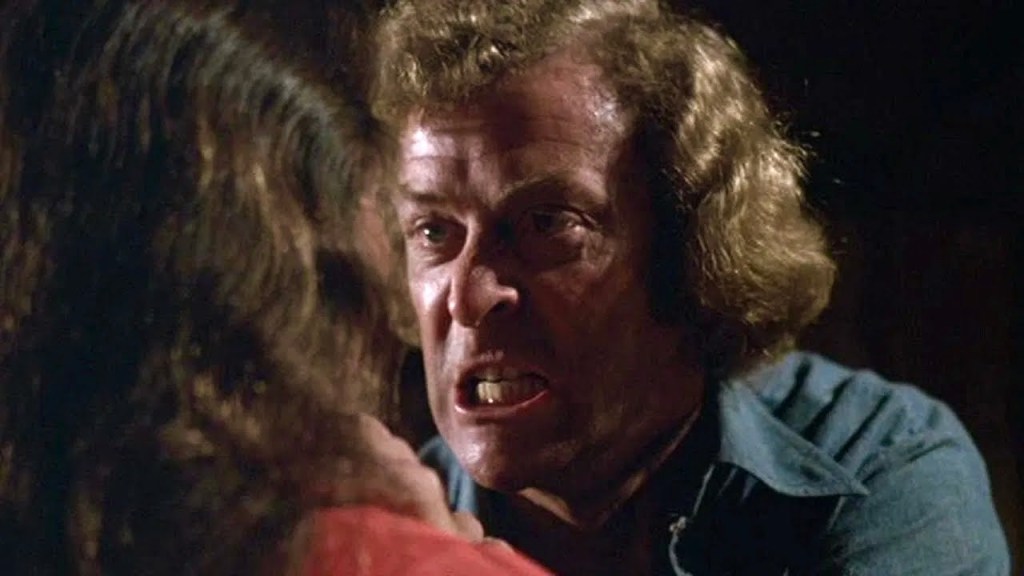
Brad takes on THE WHITE BUFFALO (1977), starring Charles Bronson and Will Sampson!


Charles Bronson as Wild Bill Hickok

Back in 2023, my family visited the Black Hills of South Dakota. The first thing we did was visit Mount Rushmore. The second thing we did was visit the Mount Moriah Cemetery and the final resting place of Wild Bill Hickok. Situated on the top of a hill overlooking the city of Deadwood, it’s a beautiful place that also includes the graves of Calamity Jane and Sheriff Seth Bullock. I insisted that we see the location for possibly the most superficial reason possible… because Charles Bronson played Hickok in THE WHITE BUFFALO.

Based on a novel by Richard Sale, the story opens with Hickok having a recurring nightmare of a snowy showdown with a giant white “spike.” And if he has pistols handy, he wakes up firing them uncontrollably and you’d better not be nearby. Determined to face his fear, he heads out into the hills with his friend Charlie Zane (Jack Warden), hoping to find the albino buffalo, so he can put him down and end the nightmares. Around the same time, the great beast has stampeded the camp of Crazy Horse (Will Sampson) killing his child in the process. Convinced that the child cannot have peace in the afterlife, Crazy Horse sets out to kill the buffalo so he can wrap his child in its white “robe” and free her spirit. With Hickok a prolific killer of Indians, and Crazy Horse a brave Lakota Oglala warrior, the two men seem to be on a deadly collision course in those snowy hills.

Charles Bronson’s final western, THE WHITE BUFFALO has a lot of the scenes you’d expect. With Bronson playing a famous gunman, we get to see several gunfights as he makes his way through various Wyoming towns, featuring well-known actors like Clint Walker and Ed Lauter. We also get to see him visit various saloons, as well as the widow Schermerhorn, played by Kim Novak. When he really “knew” her, she was a prostitute named Poker Jenny. Along with those I’ve already mentioned, it’s an all-star affair as we see such familiar faces as Stuart Whitman, John Carradine, Slim Pickens, and even a young Martin Kove sprinkled throughout the film. And of course, we get to see Bronson take on the gigantic white buffalo of the title, first in his dreams, and then later in reality! Directed by veteran filmmaker J. Lee Thompson, these scenes are staged and executed well, with Hickok’s nightmares given an especially eerie quality.

Will Sampson as Crazy Horse

While the movie has the expected scenes, it’s the unexpected character moments that sets THE WHITE BUFFALO apart as a uniquely strong entry in Bronson’s filmography. Hickok may be a man haunted by dreams of a monstrous white buffalo, but Bronson plays him in such a way that we can feel his exhaustion and literal sickness from too many years of a dangerous and difficult life. The buffalo is more than just an animal… it’s a symbol of guilt, fear and the coming of death itself. Bronson could always underplay a role better than just about anyone else, but here he’s reflective and haunted in way that I’ve not seen before, and he’s really good.

I also think the movie gets better every time Bronson shares a scene with Will Sampson. Sampson brings dignity and intelligence to Crazy Horse. His mission is more noble than Hickok’s, and an unexpected friendship develops between the two men, despite their vast differences. Ultimately, it’s this relationship that provides the film an emotional weight that sneaks up on you by the end, even if it’s not meant to last.

THE WHITE BUFFALO is not a perfect film. The animatronic buffalo may look a little hokey, and the film may seem a little slow at times for those expecting an action-packed western or monster movie. However, Bronson and Sampson are so good in their myth-making performances that the film eventually becomes something more. It’s the idea of watching two aging warriors, bound together through the bravery of confronting death, that I found to be more interesting and compelling than anything else on display.

THE WHITE BUFFALO is currently streaming on Amazon Prime, Tubi, PlutoTV, and The Roku Channel.

Wild Bill Hickok’s gravesite in Mount Moriah Cemetery in Deadwood, South Dakota

Brad revisits A BETTER TOMORROW II (1987), starring Chow Yun-Fat & directed by John Woo!


John Woo’s A BETTER TOMORROW was such a gigantic hit in Hong Kong cinemas when it came out in 1986 that you had to know that a sequel would soon follow. A BETTER TOMORROW II would open a year later, bringing back all the stars from the original. This film would go even bigger with both the action and the melodrama, with varying levels of success, but we’ll get to that in a little bit.

The plot seems familiar at first, as ex-gangster Ho (Ti Lung) is let out of prison to work with the police to dig up dirt on his old friend Lung (Dean Shek), a former criminal who’s trying to run a legitimate business down at the shipyard. The main reason he agrees to help though, is because his younger brother / undercover cop Kit (Leslie Cheung) is working on the case and Ho wants to protect him. After a series of double-crosses and betrayals, it seems that we’re in for the same type of story that we got in the first film. Key differences emerge when Lung is framed for murder and escapes to New York City. There we meet Ken Gor (Chow Yun-Fat), the conveniently discovered twin brother of tragic hero Mark Gor. Ken tries to help Lung, who has fallen into a state of catatonic shock upon learning that his daughter has been killed. When death squads come after him in New York, Ken shows his badass cred and saves his ass. Lung eventually snaps out of it and the two head back to Hong Kong together. There they team up with Ho and Kit to exact bloody vengeance on all who have gotten in the way of their efforts at personal reform!        

The first thing I’ll say about A BETTER TOMORROW II is that the film has some incredible action sequences, some of the best you’ll ever see, and some of Woo’s best work. The finale where the trio of Ken, Ho and Lung storm the bad guy’s mansion is a masterpiece of extended and creative bloody violence. I 100% recommend the film for the action.

The second thing I’ll say about A BETTER TOMORROW II is that it has some of the most over the top melodrama that you’ll ever see. My comment is mainly aimed at the section of the film where Ken tries to get Lung to snap out of his shock. I really don’t enjoy these scenes, with my least favorite being the scene where Chow Yun-Fat tries to force a completely zoned out Dean Shek to eat. There is a lot of good-looking food wasted in that scene, and I cringe every time I watch it!   

I’ve read that the film was a troubled production, and that John Woo and producer Tsui Hark had very different ideas on the type of movie that each wanted to make. Both tried to produce different edits of the film, and with too many cooks in the kitchen, we ended up with this glorious Frankenstein. When the dust settled, John Woo mostly disowned the film except for that majestic, crimson-stained finale. Tsui Hark would take over the series and turn out A BETTER TOMORROW III a couple of years later, while Woo would move on to THE KILLER.  

There are interesting ideas here, and the film almost wants to turn into a comic book. For example, the scene that first introduces us to Ken Gor, Mark’s twin brother, features an old man who’s devoted his life to drawing storyboard illustrations of the adventures of Mark, Ho and Kit. He even has Mark’s trademark sunglasses and blood-stained, bullet-riddled coat, which you know Ken will put on at some point. This seems appropriate to many of the shenanigans that go on, but then the film will switch its focus to extended scenes of a depressed Kit or a drooling Lung, and it seems like we’re in a different movie. There are parts of this film that I love and there are parts that I just want to be over.

At the end of the day, if you’ve come to A BETTER TOMORROW II for the promise of John Woo’s awesome action, you will get your fill. You’ll get to see Chow Yun-Fat at his charismatic best, wearing his long coat and sunglasses, and wielding twin barettas as he takes out hordes of henchmen. You’ll get to see Ti Lung swinging a sword that might bring back images of his Shaw Brothers heydays! Just be prepared to watch Dean Shek spill milk, eat through an orange (peel and all), and gnaw on a piece of frozen meat along the way.       

A BETTER TOMORROW II is currently streaming on Amazon Prime, Tubi, and Plex.

Brad reviews SMOKE SIGNALS (1998), starring Adam Beach!


There’s a scene early in SMOKE SIGNALS where Victor Joseph, played by Adam Beach, tries to teach Thomas Builds-the-Fire (Evan Adams) how to be a real Indian. He ends the scene with “This ain’t Dances-with-Salmon you know?!” It’s a funny exchange, but it also clues the audience in on the fact that this isn’t going to be your typical Hollywood movie about Indians. Directed by Chris Eyre and written by Sherman Alexie, it’s the first feature-length film written, directed, and produced by Native Americans to reach a wide audience both in the United States and beyond. As such, we get a story that feels fresh while tackling a variety of difficult subjects with humor and optimism.

The story focuses on Victor as he travels from the Coeur d’Alene Indian Reservation in Idaho to Phoenix, Arizona to retrieve his father’s possessions after learning that he’s passed away. His father abandoned him and his mother when he was just a boy, and he’s clearly been scarred by the situation. Along for the ride, mainly because he can afford to pay their bus fare, is Thomas Builds-the-Fire, his nerdy and talkative friend. From this point, the film becomes a road trip, and we follow along as they make it to Arizona and back. While there is funny stuff along the way, the movie is mostly interested in observing Victor as he comes to terms with the trauma and pain left behind when his dad went away.

I’ve always liked Adam Beach, and he’s very good here as Victor. His character spends a lot of the movie angry at the world, but from time to time, he’ll flash this big, wonderful smile. It’s a nice inside-out performance as he seems to be simmering on the inside and just trying not to explode. And then there’s Evan Adams, whose Thomas is awkward and optimistic, and who loves to tell big stories about Victor’s dad. For example, they have this awesome exchange where Thomas tells Victor that his dad looks like Charles Bronson. As Bronson’s biggest fan, I can tell you that Victor’s dad, played by Gary Farmer, looks nothing like Charles Bronson. The scene has a nice punchline as Thomas tells him that he doesn’t mean the Charles Bronson from the first DEATH WISH, but more like the Charles Bronson of DEATH WISH 5! The movie has several unexpected scenes like this, and the genuine chemistry between these two guys is what makes the movie work for me. I believe it when their characters begin to understand and appreciate each other, and it’s their emotional connection that gives the film some staying power even after the credits roll.

There are some additional performances that I enjoyed. I mentioned Gary Farmer, who plays Victor’s dad. His Arnold Joseph is not the most sympathetic character in the world, as he chooses to run away from a guilt that he can never deal with. Somehow, by the end, we have some understanding of his actions. And then there’s Irene Bedard as Suzy Song, the young lady who befriends Victor’s dad and calls his mom when he passes away. Best known for being the voice of Pocahontas in the Disney animated classic, she conveys kindness and compassion in her relatively small role. Tantoo Cardinal is good as Victor’s mom, and Tom Skerritt even shows up in a cameo as a police chief in Arizona. Sherman Alexie’s screenplay, based on his book “The Lone Ranger and Tonto Fistfight in Heaven,” is simple, yet full of depth, and it’s brought to life by an excellent cast.        

Even though SMOKE SIGNALS was made almost thirty years ago, it’s still a very relevant film to this day. It’s funny, it tackles difficult subjects that are universal to all of us, and it’s told from a Native American perspective that we seldom see. In other words, it feels like we’re dealing with real people, not the romantic caricatures or noble victims that Hollywood still tries to push on us in movies about Indians. It’s not a flashy film in any way, and that’s okay. It’s one of those movies that understands its characters and trusts the audience enough to just hang out and observe them. Anchored by an excellent performance from Adam Beach, it’s a perfect example of how movies can be a lot better when Hollywood gets out of the way and let’s genuine, talented people tell their stories.  

I watched SMOKE SIGNALS on the Paramount Plus streaming service.

Brad reviews COLD WAR II (2016), with Chow Yun-Fat, Aaron Kwok & Tony Leung Ka-fai!


As soon as I finished watching COLD WAR (2012), I went to the fridge, grabbed myself a refreshing beverage and immediately started up COLD WAR II (2016). The original film ends on a cliffhanger, so I was excited to see what happens next!

COLD WAR II opens right after the events of the first film, resolves its pressing cliffhanger in the first 20 minutes, and then doubles down on the intrigue and political power plays that defined the original. I don’t want to give away too much of the plot, so as not to take away some of the fun surprises. I will say that most sequels go bigger by doubling body counts or explosions, but in this film the conspiracies just get a lot deeper, and the political manipulations start reaching for much broader power. I still found the situations to be interesting thanks to the intense atmosphere of the film and the strong performances of the cast.   

In the roles of Sean Lau and M.B. Lee, Aaron Kwok and Tony Leung Ka-fai continue to excel, but circumstances quickly erode some of the goodwill that was created between their characters at the end of the first film. This temporarily creates the risk that this follow-up could end up feeling like a retread of their heated rivalry in part 1. Higher, even more personal stakes helped alleviate some of that concern.

The best thing that happens for COLD WAR II is the addition of Chow Yun-fat to the cast in the important supporting role of Oswald Kan. Kan is a former judge and brilliant legal mind who leads a special committee investigating the fallout from the events of the first film. The middle section of the film features a series of scenes with Chow in intense confrontations with both Tony Leung and Aaron Kwok. It’s especially fun seeing Chow mix it up with Tony as their careers go way back to working with each other in classics like PRISON ON FIRE (1987) and A BETTER TOMORROW III (1989). These scenes freshen up the material, but they also connect us emotionally to Hong Kong cinema of the golden years through one of its biggest, most honorable stars. Chow gives the film a moral center as Oswald Kan seems free from the ethical compromises that our other main characters are having to make. It’s an impressive and charismatic turn from Hong Kong’s all-time greatest leading man.

Just as in the first film, there aren’t a lot of action scenes, but the ones we have are bigger and even more impressive. There’s an action sequence in a tunnel about an hour into the film that blew me away with its execution and intensity. Its resolution also surprised me, which is not always easy to do. Still, this incredible scene serves the plot well, providing clear and obvious motivation for the actions of each of the main characters throughout the remainder of the film.

COLD WAR II follows the motto of most sequels to box office smashes… “Go big or go home!” While the plot becomes even more complicated this time around, the continued excellence in the performances, especially with the addition of Chow Yun-Fat, helps to provide the solid emotional payoffs needed to keep the series moving forward. With the excellent action set pieces also adding to the fun, the filmmakers have managed to create a sequel that I rate just as high as the original. Now, bring on COLD WAR 1994!

COLD WAR II is currently streaming on Amazon Prime, Tubi, PlutoTV, Plex, and the Roku Channel!

Brad reviews COLD WAR (2012), starring Aaron Kwok & Tony Leung Ka-fai!


As I continue revisiting various movies that feature Chow Yun-Fat during his birthday month of May, I decided I would revisit his work in the COLD WAR franchise, specifically COLD WAR II from 2016. The problem is that I hadn’t watched COLD WAR (2012) since it was released on Blu ray well over a decade ago, so I couldn’t remember much about it. And when you consider that another sequel, COLD WAR 1994 (2026), was released to boffo box office in China just last week, now seemed like a perfect time for another viewing of the original.

Set in Hong Kong, Asia’s “safest big city,” COLD WAR begins with the disappearance of a police emergency response van, as well as all five officers on board. We soon meet deputy commissioners Sean Lau (Aaron Kwok) and M.B. Lee (Tony Leung Ka-fai) who have vastly different ideas of how the situation should be handled. Lau wants to take a calm, measured, and analytical approach that prioritizes public safety, while Lee wants to take a bulldozer to the city and stop at nothing to find the officers and punish those responsible. Admittedly, Lee’s motivation is clouded by the fact that his only son Joe (Eddie Peng) is one of the missing officers. This setup kicks off a battle between dedicated cops, ambitious politicians, and motivated terrorists in a world where saying the wrong thing could cost you your career. Depending on which side you’re on, it could even cost you your life.

Aaron Kwok and Tony Leung Ka-fai are excellent as the rival deputy commissioners trying to manage the crisis while also outmaneuvering each other. Kwok plays the colder and more procedural Sean Lau, who sparingly shows the cracks in his armor. It’s a nicely controlled performance by Kwok, making the scenes where we see his humanity that much stronger. Leung’s M.B. Lee is more old-school, driven by instincts and results. His intense performance provides life to the film, and he was rewarded for his work with that year’s Hong Kong Film Award for Best Actor.

The primary intrigue of the film is provided by the tense meetings and phone calls between these men and their teams, as well as the political fallout of those standoffs. It’s strange for a Hong Kong crime film, but the actual retrieval of the missing cops comes across as secondary, and it still works. First time directors Sunny Luk and Longman Leung really like their dialogue scenes and trust the audience enough to let these moments carry the suspense for large chunks of time. Imagine that happening in a Hollywood action film?!!

Even with all the dialogue and posturing, the action scenes in COLD WAR are exciting when they do come. There’s a freeway shootout where we get to see that agent Lau has some incredible shooting and survival skills to go along with stoic demeanor. The final action sequences hit hard, featuring a step up in the graphic violence in comparison to what we’d seen up to that point in the film. The players and the stakes had been firmly established, so when violence does erupt, I was invested in its outcome, whether it be good or bad.

COLD WAR gets an easy recommendation from me. I thought it was well acted and well directed, with enough meaningful action to remind me why I like Hong Kong movies in the first place. It was also fun to see so many familiar faces in important roles, including cameos from the likes of Andy Lau and Michael Wong. A word of warning though, you will need to pay attention to the film if you want to enjoy it. So much of the fun comes from the tension created by the situations and the dialogue, so this is not a viewing experience designed to co-exist with a lot of other distractions.

Brad reviews CITY ON FIRE (1987), starring Chow Yun-Fat, and directed by Ringo Lam!


Ringo Lam’s CITY ON FIRE is one of the first movies starring Chow Yun-Fat that I really wanted to see after I had made my way through the John Woo films. Chow worked with Ringo on a total of 5 films from 1987 – 1992, and they’re a gold mine. I have previously reviewed PRISON ON FIRE and FULL CONTACT, so I decided now was a good time to take a fresh look at this one.  

Opening with an awesomely 80’s, neon-drenched saxophone solo from Teddy Robin Kwan, CITY ON FIRE tells the story of undercover cop Ko Chow (Chow Yun-Fat). He’s practically forced by his handler on the force, Inspector Lau (Sun Yueh), to infiltrate a violent gang of jewel thieves. The problem is that he has a history of getting in way too deep, so deep that he forgets where the job ends and his real life begins. It happens again when he’s able to get close to the leader of the thieves, Fu, played by his KILLER co-star, Danny Lee. When the gang hits a jewelry store with Chow in tow, and with the cops on their trail, everything goes to hell. Some store employees are killed, some gang members are taken out, and Chow even takes one in the gut. As the survivors meet back up at the warehouse, it becomes clear that there’s a mole in their midst, even though not everyone wants to admit it.

Does that premise sound familiar to you? If you’re a big fan of Quentin Tarantino and RESERVOIR DOGS, you can’t help but recognize how strongly his film was influenced by CITY ON FIRE. The influence is clear, especially in the broad strokes of the plotline and at the famous finale, but these are two very different crime films in execution, and they’re both excellent in their own ways.

In the late 80’s, some of the best action and crime films in the world were being made in Hong Kong. So many of the films had a reckless energy, which seems to be especially evident in director Lam’s works. In contrast to John Woo’s stylish action scenes, Lam’s scenes aren’t polished. They’re more grounded, they’re chaotic, and they’re not “cool” at all. For example, the film opens with an undercover named Chan Kam-Wah (Elvis Tsui) being called out and murdered in the middle of a busy market. Stabbed multiple times with a big butcher knife while desperately fighting for his life, the scene plays out in a realistic, clumsy, and very bloody way. In other words, it’s painful to watch without a slow-mo tracking shot in sight. We know immediately that no one is safe, and there’s a palpable tension as the undercover cop / criminal drama plays out that really works for the film.

Chow Yun-fat is fantastic, with his performance winning him his 2nd consecutive Hong Kong Film Award for Best Actor. He’s not the impossibly cool heroic bloodshed hero of the prior year’s A BETTER TOMORROW. Rather, while he’s charming in certain early scenes with his girlfriend Hung (Carrie Ng), when he starts his new assignment, you can see that he’s completely exhausted with his life as an undercover cop, a life that seems to have broken him emotionally. You can almost feel an impending doom with his character that lingers over the film, turning it into something different than your average cops and robbers story. In the other major lead of the film, Danny Lee is so good as the leader of the gang of jewel thieves, Fu. He’s very professional, and once he’s accepted Chow into their ranks, he’s very friendly and personable to him. In these moments, you can see how the two men could bond. But Fu’s also shown that he will kill anyone who gets in his way, so you know it’s inevitable that the two will collide head-on at the end. When it comes, it hits hard.

I highly recommend CITY ON FIRE to any person who enjoys gritty crime films. The action is brutal, the lead performances are excellent, and the drama of the story will leave you emotionally drained as the end credits roll. I can see why it would have had a major impact on a lover of Hong Kong cinema like a young Tarantino!

CITY ON FIRE is currently streaming on Prime Video, PlutoTV, Tubi, and Plex.

Brad reviews PROJECT GUTENBERG (2018), starring Chow Yun-Fat & Aaron Kwok!


There was a time when Chow Yun-Fat was one of the hardest working actors in show business. He had 11 different films come out in 1987 alone, and his dedication to making movies would eventually lead him to superstardom all around the world by the turn of the century. Alas, even the greats must eventually slow down and by the end of the 2010’s, it felt like he had practically retired. He only starred in one film between 2017 and 2019. That film was 2018’s PROJECT GUTENBERG, and to say I was looking forward to the film would be quite the understatement. The filmmakers knew how to draw me in as the trailer recreated Chow’s famous scene from A BETTER TOMORROW where he lights his cigarette with a counterfeit $100 bill. The movie promised to play up his most iconic on-screen images, and I was down for it!

PROJECT GUTENBERG introduces us to an artist named Lee Man (Aaron Kwok), who’s been arrested in Thailand and taken to Hong Kong. The local police interrogate him for information about a ruthless counterfeiter known as “Painter.” Reluctant to talk at first due to fear, Lee is convinced that he must provide some information, or he could spend the rest of his life in jail. He eventually begins to tell the story of his time with the elusive criminal mastermind, played by Chow Yun-fat, through a series of flashbacks. Director Felix Chong (writer of the INFERNAL AFFAIRS and OVERHEARD trilogies) has crafted a story that seems like the confession of small fish being used to bait a big fish, before eventually turning into something much more sinister and fascinating. I won’t say anything else about the plot as there’s much fun to be had in watching it unravel!

I’m going to state right up front that Chow Yun-Fat is in prime form. Some actors age with grace, and then there’s the 63-year-old Chow of this film, who’s managed to age with almost a mythic gravitas. This film masterfully highlights his incredible charisma, recreates iconic images of his past gunplay, and then turns it all on its head by making Painter into one of the most evil bastards he’s ever played on screen! It’s an incredible use of his legendary career to provide levels of depth that no words on paper ever could.

Even with the iconic images of Chow Yun-Fat, PROJECT GUTENBERG would not work nearly as well if it wasn’t also a captivating crime thriller. Its counterfeit money operations, double-crosses, gun battles and international intrigue pulled me in, and I found myself on the edge of my seat at times as the story unfolded. The last 30 minutes of the film made me question everything I’d seen up to that point, but in a way that did not take away one moment of my enjoyment. It’s not a completely unique ending, as film lovers will certainly notice, but it works.  

Aaron Kwok’s character of Lee Man is weak in comparison to Painter, but the actor navigates the tightrope of showing just enough emotional desperation that we understand why he’s doing what he does. When the plot starts taking some crazy twists and turns, I was still right there with him. I’ve always liked Aaron Kwok, and even with his bad haircut in the film, I still thought he did a fine job. I also want to shoutout actress Zhang Jingchu (RUSH HOUR 3, OVERHEARD), who plays the woman that Lee Man loves. Her character drives a lot of Lee’s actions in the film, and I found her very beautiful and compelling. Last, but not least, Liu Kai Chi (KILL ZONE, CALL OF HEROES) gets one of the best supporting roles in the film as a vital member of the counterfeiting team who befriends Lee before making an unforgivable mistake.    

PROJECT GUTENBERG was a critical and box office smash when it was released in China in the fall of 2018. It won Best Picture, Director, Screenplay, Cinematography and Editing at the 2019 Hong Kong Film Awards. On a budget of around $40 million dollars, it would bring in over $150 million in China alone, on its way to around $200 million worldwide. It’s a slick crime thriller that serves as a reminder that in the right role, Chow Yun-fat is still one of the great movie stars on the planet. This film understands that, bet the house, and won big.

PROJECT GUTENBERG is currently streaming on the free “Fawesome” streaming service.

Brad reviews THE STORY OF WOO VIET (1981), starring Chow Yun-Fat!


When I became obsessed with Chow Yun-Fat in the latter half of the 1990’s, I would constantly search for his movies at the Suncoast Video Store in the Park Plaza Mall whenever we’d go to Little Rock. Unfortunately, I’d run into cheap looking DVDs with titles like “God of Killers,” but I’d buy them anyway. That’s the title under which I first attempted to watch THE STORY OF WOO VIET, starring a young Chow-Yun-Fat and directed by Hong Kong legend Ann Hui. Whoever distributed the film was making a blatant cash grab on Chow Yun-Fat’s worldwide popularity at the time, and the DVD was terrible. I turned it off after a little while because the print was so dark you could barely see it, and the subtitles were illegible, constantly falling off the screen. I had not attempted to watch the film again until very recently. My friends on “Podcast on Fire” devoted an episode to THE STORY OF WOO VIET, which piqued my interest again. Lo and behold, I found a fine print with English subtitles streaming on Tubi!

As the story starts, we meet Woo Viet (Chow Yun-Fat) on a boat full of starving refugees. We learn that he’s a former Vietnamese soldier escaping to Hong Kong in hopes of making his way to the United States. It’s a tough start as we see a baby die of malnourishment and an old man murdered by Vietnamese special agents, which leads to Woo Viet fighting off and killing those same agents, all within the first 15 minutes. On the run for murder, he’s lucky that his Hong Kong pen pal, social worker Lap-Quan (Cora Miao), can help him get fake papers for his escape to the United States. As he’s getting ready to leave, he meets the beautiful Shum Ching (Cherie Chung), who’s also using fake documents to get to the U.S. Unfortunately, the Hong Kong trafficker who’s supposed to be helping them, has sold Shum Ching to a powerful gangster in the Philippines with plans to turn her into a prostitute. When she’s taken away from the Manila airport, Woo Viet goes after her. Unable to kick enough ass to save her, he ends up working as a hired gun for her kidnapper in hopes of buying her freedom. Throw in Shaw Brothers legend Lo Lieh as Sarm, Woo Viet’s partner in crime in Manila, and the stage is set for an escape to a better tomorrow or loneliness and a quick death.

After viewing the film, it’s probably best that I couldn’t watch THE STORY OF WOO VIET back in the late 1990’s. At that time, I wanted Chow Yun-Fat as the honorable gangster of films like A BETTER TOMORROW and THE KILLER, or the badass cop of HARD-BOILED. I could not have appreciated director Ann Hui’s work here, the second film in her “Viet Nam trilogy.” Gritty and downbeat, it’s about as far away from John Woo’s stylish films as you can get. When the violence comes, it lands with a painful thud as nails enter heads, knives slash bodies, and even toothbrushes are shoved through cheeks. This is Ann Hui working within a genre film plotline while infusing it with something akin to bleak realism. She would go on to develop her legendary career with the next year’s BOAT PEOPLE, and she would use Chow a couple of more times in films like LOVE IN A FALLEN CITY and THE POSTMODERN LIFE OF MY AUNT. This is not peak Ann Hui, but she still brings something interesting to this early effort.

As far as the performances go, Chow may have been 5 years away from the superstardom of A BETTER TOMORROW, but he already had what it took to be a film lead. Even in a film like this, without his heroic bloodshed honor, he has a way of making it look easy. Cherie Chung is appealing as Shum Ching, and she was soon on her way to film stardom in Hong Kong hits like PEKING OPERA BLUES, AN AUTUMN’S TALE (with Chow), and John Woo’s ONCE A THIEF (also with Chow). Like many Hong Kong actresses before her, after a string of successful films she would get married and retire in 1991. I like Cora Miao early in the film as the kind social worker, but she fades as the film progresses. Miao would work with Chow and Ann Hui frequently throughout the 80’s. Like Chung, she retired in 1991 and married director Wayne Wang (THE JOY LUCK CLUB). Finally, I wanted to give a shoutout to Lo Lieh as Woo Viet’s one friend, Sarm. While he may be known best for his classic work with Shaw Brothers in films like the FIVE FINGERS OF DEATH and THE 36TH CHAMBER OF SHAOLIN, he gives a solid character performance here and would go on to work in Hong Kong for another two decades.

THE STORY OF WOO VIET is not at the top of the list of films that Hong Kong legends Chow Yun-Fat and Ann Hui would work on, but it’s still an important watch to see their obvious talent at this point in their careers. I’m glad I finally watched the film in 2026. After all the life I’ve lived since those days digging through the DVDs at the Park Plaza Mall, there’s no way it could have hit me the same way then that it does now.

Brad reviews THE LAST TYCOON (2012), starring Chow Yun-Fat!


When fans of Hong Kong cinema think of high-quality film craftsmanship, the name Wong Jing doesn’t immediately come to mind. Sure, he directed one of my all-time favorite films, GOD OF GAMBLERS (1989), and he’s had his share of box office success over the years, but he’s also churned out a lot of crap. His name is not often the stamp of quality on a film production, but there’s something about working with Chow Yun-Fat that will sometimes bring out his best.

THE LAST TYCOON tells the story of Shanghai crime boss Cheng Daqi, portrayed here in two separate timelines by actor Huang Xiaoming in his younger years, and by the legendary Chow Yun-Fat in his older years. When we meet young Cheng, he seems like an awfully nice guy and then fate places him in a jail cell with the shady Mao Zai (Francis Ng). To escape and save his own life, and with a little help from Mao, Cheng commits his first murder. Forced to flee, Cheng aligns himself with a gang led by Hong Shouting (Sammo Hung). A natural leader, and as badass as it gets, Cheng rises rapidly in the ranks. The narrative isn’t as straight forward as this sounds so far, because it leaps frequently back and forth between younger Cheng and older Cheng. When the film finally settles in with Chow Yun-Fat for its latter half, we have seen how Cheng rose to become one of the most powerful men in Shanghai. We also understand how he has found himself in an extremely difficult wartime position with the Japanese that will test his loyalty to his country, as well as to the people he loves.

Right out of the gate, I want to give kudos to Wong Jing for putting together a highly entertaining film, set against an incredible 30-year backdrop of historical Shanghai! I don’t mention it in the summary above, but THE LAST TYCOON finds time to feature an abundance of romance between Cheng and the two loves of his life. We’re talking about grand melodrama done right, offset periodically with awesome action sequences, whether they be hand-to-blade street brawls, heroic bloodshed shoot-outs, or explosive wartime bombing raids. The emotions and the blood flow very strongly in this one!

The role of Cheng Daqi fits Chow Yun-Fat like a glove. He emotes early and often, and when he takes a break from that, it’s usually to pick up a pistol that he’s able to wield with maximum precision and efficiency. For a long-time fan like me, it’s high-quality fan service that fits seamlessly into the pulpiness of the story. As the younger version of Cheng, Huang Xiaoming does a fine job with the romance and the action. It seems perfectly natural that he’d eventually turn into the legend. Huang gets a lot of screentime, and without his solid portrayal, I don’t think the film would have worked nearly as well.

I did want to mention some of the notable supporting performances in THE LAST TYCOON. Veteran Francis Ng is as reliable as ever as we see his character go from a mystery lifesaver at the beginning to an evil villain by the end. The role may be underdeveloped, but Ng makes it work. I’m going to be looking for more from actor Gao Hu, who’s a total badass in his role as Cheng’s loyal soldier Lin Huai. Present over the entire 30-year timeline of the film, the man’s expert switchblade skills and gun-handling abilities are crucial to Cheng’s safety! Yolanda Yuan and Monica Mok are very good as the two women in Cheng’s life. They are very different, but it’s easy to see why he loves them both, and I think the movie ultimately gets the ending right where the romance is concerned. Finally, I did want to mention that I was somewhat disappointed in the character of Hong Shouting, played by the legendary Sammo Hung. Even though he was a powerful boss, I don’t think he comes across very strongly in the film. For someone of his stature, I see this as one of the few missteps from writer / director Wong Jing.

Small quibbles aside, I recommend THE LAST TYCOON without any reservations. Fans of Chow Yun-Fat and Hong Kong cinema can’t go wrong!

THE LAST TYCOON is currently available for streaming on Amazon Prime, Tubi, PlutoTV, and Plex.

Brad reviews PEACE HOTEL (1995), starring Chow Yun-Fat!


Just like November is Charles Bronson month in my house, May is Chow Yun-Fat month. My favorite living actor, Chow made so many good movies during his Hong Kong heyday, he made a few good movies here in America, and he’s still working to this day! This year I plan on revisiting some of his lesser known films and sharing my thoughts on them with you. I don’t know how many reviews I’ll have time to write, but I’m certainly looking forward to the movies! To kick off the month, I decided to revisit PEACE HOTEL, which was the last Hong Kong film that Chow starred in prior to making his English language debut with THE REPLACEMENT KILLERS in 1998.

PEACE HOTEL is a Chinese “western,” which is certainly different for Chow Yun-Fat who made his name by playing heroic gangsters and badass cops. Even though it’s not a movie I revisit often, its uniqueness in his filmography is something I enjoy when the right mood hits. The story setup, which is credited to Chow, is classic. Chow plays the notorious “killer,” a reformed man who has set up a remote “hotel” where violence is never allowed, no matter who you are or who’s after you. When a desperate woman shows up at the hotel, with a horde of outlaws right behind her, the rules are tested. The outlaws set up shop just outside the gates of the hotel and give the residents a few days to get out, or they’re all going to die. Considering they’ll have to go through the killer, things are certainly going to get interesting. 

Fans of westerns and samurai films will recognize many of the story elements, but I’d have to say that this movie is less about originality and more about establishing a mythic mood. Director Wai Ka-Fai plays up the legend of the killer, so there’s a lot of setup to get through. This does require some patience for those used to the star’s wall to wall action-fests with director John Woo. Let’s just say the action is used sparingly, but when it comes, it’s good stuff. 

Chow Yun-Fat carries the film effortlessly. His charisma, toughness and charm is fully on display whether he’s horsing around with a small child, romancing the beautiful Cecilia Yip, or dispatching throngs of bad guys with his blade. The role certainly isn’t flashy, but he’s just so cool. Nobody can portray a noble killer as well as Chow Yun-Fat.

PEACE HOTEL is currently playing on Tubi. When I first saw the film back in the 90’s, I remember a sequence where Chow Yun-Fat slides down a ladder while mowing down bad guys with a machine gun. That sequence is not included in the cut playing on Tubi, which is a little disappointing for me. Still, the film has so much going in its favor, that I still give it an easy recommendation. It may not be balls-to-the-wall action like THE KILLER, FULL CONTACT or HARD BOILED, but I’ll definitely be reaching for PEACE HOTEL again someday when I’m in the mood for something different than your typical action film.