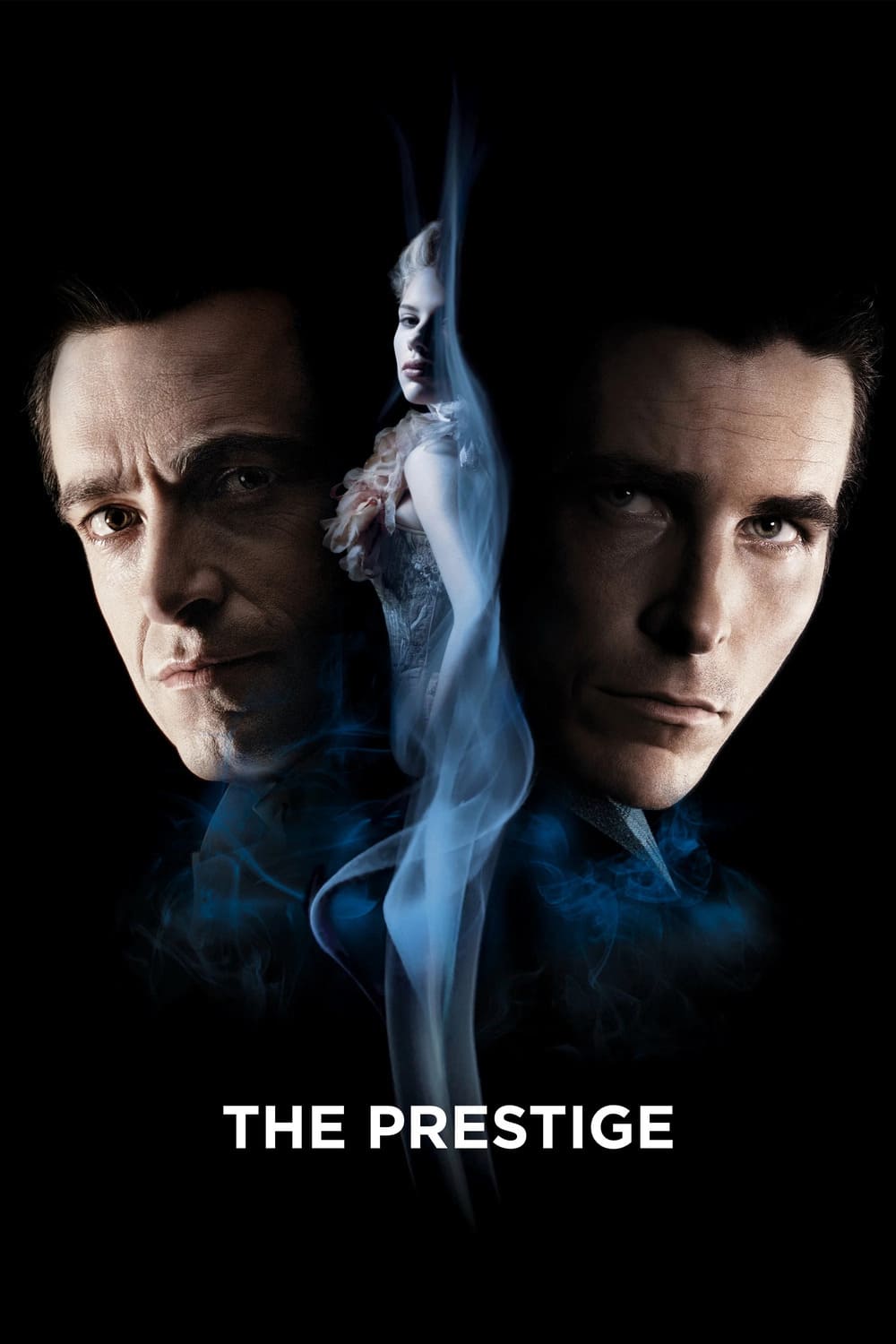
Film Review: The Prestige (dir. by Christopher Nolan)


“You don’t really want to work it out. You want to be fooled.” — Cutter

The best magic tricks depend on a peculiar agreement between performer and audience: we know we are being deceived, yet we want the deception to succeed. Christopher Nolan’s The Prestige turns that agreement into the foundation of a film about two men who can no longer distinguish the pleasure of creating an illusion from the need to possess its secret. Their rivalry begins on the stage, but it soon consumes everything beyond it. What emerges is more than a mystery built around competing magicians. It is a dark, absorbing examination of obsession, sacrifice, and the terrible distance between earning applause and finding satisfaction.

Adapted by Christopher and Jonathan Nolan from Christopher Priest’s novel, The Prestige follows Alfred Borden (Christian Bale) and Robert Angier (Hugh Jackman), magicians whose professional ambitions become inseparable from a deeply personal feud. Having read the novel, I approached the adaptation with some hesitation. Much of the book’s appeal comes from the way its journals and personal accounts allow characters to reveal information while concealing their intentions. Bringing that experience to the screen requires more than faithfully reproducing the plot. It requires finding a cinematic equivalent for the uncertainty of reading someone else’s carefully constructed version of events.

The Nolan brothers understand that distinction. Rather than presenting the rivalry as a straightforward progression from friendship to hostility, they move among its beginnings, consequences, and apparent resolutions. One scene supplies information that changes our understanding of another; a confession becomes a provocation; an explanation raises a new question. The fractured chronology recalls Christopher Nolan’s narrative experimentation in Memento, but here the structure has a different effect. We are not simply trying to determine what happened. We are trying to decide who controls the story—and what that person gains by telling it.

The film gives us its organizing principle through Cutter, the stage engineer played by Michael Caine. He explains that a magic trick has three parts. In “the pledge,” the magician presents something ordinary. In “the turn,” that ordinary thing undergoes an extraordinary transformation or disappearance. Finally, “the prestige” completes the illusion by bringing back what seemed to be lost. Nolan uses this explanation as both an invitation and a warning. He tells us to watch closely, then trusts that our eagerness to see something extraordinary will distract us from the significance of what we see.

That approach makes The Prestige especially satisfying as a mystery. Its clues are not merely withheld until the screenplay decides to reveal them. Many are placed directly before us, disguised by context or overshadowed by something more immediately dramatic. An attentive viewer may anticipate part of the solution relatively early, but recognizing a secret does not necessarily diminish the film. There is still the question of how it works, what it costs, and how far either magician is willing to go to protect it.

Those costs give the elaborate construction its emotional weight. Borden and Angier begin as colleagues working for Milton the Magician, played by Ricky Jay, with Cutter providing the technical expertise behind the act. Even then, their differences are apparent. Borden is instinctively inventive, impatient with limitations, and willing to take risks in pursuit of a better illusion. Angier understands presentation: the timing, confidence, and theatrical flair that persuade an audience to invest in a performance. Each has a talent the other lacks, and neither can comfortably accept that imbalance.

A tragedy turns those differences into grievances. From that point forward, professional competition becomes a means of assigning blame and exacting punishment. Their efforts to improve their acts increasingly serve another purpose: to deny the other man the satisfaction of success. They interrupt performances, steal information, manipulate loyalties, and endanger the people around them. Eventually, it becomes difficult to separate their desire to achieve greatness from their desire to make the other suffer.

One of the screenplay’s strongest decisions is its refusal to make either man an uncomplicated hero. Angier’s charm does not excuse his cruelty, and Borden’s ingenuity does not make his emotional evasiveness easier to bear. The film allows us to understand their grievances without asking us to endorse their actions. Our sympathies shift because both men remain recognizably human even as their behavior becomes increasingly monstrous.

Jackman is particularly effective at showing how an accomplished public performer can become privately consumed by resentment. Angier knows how to hold an audience, but he cannot enjoy that gift while Borden possesses a secret he cannot explain. Jackman lets the frustration accumulate beneath the polished exterior until the pursuit of an answer becomes more important than the applause that supposedly motivated him.

Bale gives Borden a more guarded, abrasive presence. His confidence in his craft contrasts with his difficulty explaining himself to the people closest to him. At times, he seems capable of extraordinary commitment; at others, he appears maddeningly indifferent to the consequences of that commitment. Bale makes those contradictions compelling without smoothing them away. Together, the two actors turn the rivalry into something more unsettling than a contest between evenly matched opponents. Each man becomes the justification for the other’s worst impulses.

Caine provides an essential counterweight. Cutter understands the labor behind an illusion, but he also recognizes that technical possibility is not the same as moral permission. His practical manner grounds the film whenever its central characters threaten to disappear into their own grand ambitions. He is persuasive as someone who loves the craft while retaining a sense of proportion about what it should demand.

The women caught in the rivalry make its consequences harder to dismiss. Scarlett Johansson’s Olivia is more than a glamorous addition to the stage act. Her shifting loyalties reveal how readily both magicians turn intimacy into strategy. She may be drawn to their talent, but neither man can reliably separate affection from advantage. The film is at its most painful when their need to preserve a secret prevents them from responding honestly to another person.

The production design reinforces the divide between public enchantment and private effort. Onstage, an illusion appears graceful and instantaneous. Backstage, it depends on cramped spaces, concealed mechanisms, repetition, and people whose work the audience never sees. Nathan Crowley’s Victorian settings give those hidden processes a persuasive physical presence. The theaters and workshops belong to the same world, but they offer very different views of what constitutes magic.

That world expands with the arrival of Nikola Tesla, played by David Bowie. Bowie’s restrained, enigmatic performance makes Tesla feel distinct from the showmen seeking his help. He has little need to command a room, yet his work promises something more astonishing than anything their theatrical ingenuity can produce. The machinery surrounding him introduces a steampunk atmosphere and pushes the story toward science fiction without abandoning its central concerns.

For me, this shift works because the film has already established the dangerous appeal of an impossible solution. Tesla’s experiments offer another way to pursue the same ambition that drives the rivalry: to accomplish something so extraordinary that no competitor can answer it. The question is no longer simply whether an illusion can be perfected. It is whether either magician would recognize a point at which perfection demands too much.

There is a risk that such an intricately constructed film will seem more interested in concealing its mechanism than in developing its characters. Some viewers will undoubtedly regard The Prestige as an elaborate gimmick, and its screenplay certainly invites admiration for its engineering. Yet the revelations matter because they change our understanding of the behavior that precedes them. What first appears to be stubbornness, inconsistency, or theatrical bravado acquires a darker significance. The solution does not erase the drama; it exposes the full extent of it.

What stayed with me after The Prestige was not simply the satisfaction of learning how its tricks were done. It was the realization that neither magician could accept a life in which the other remained beyond his understanding. Nolan delivers the pleasures of a cleverly concealed mechanism, but the final revelation leaves something less comfortable than admiration in its wake. We can finally see what these men have made of themselves, even if they never fully can. The secrets are impressive, but the human wreckage behind them is what gives the illusion its lasting power.
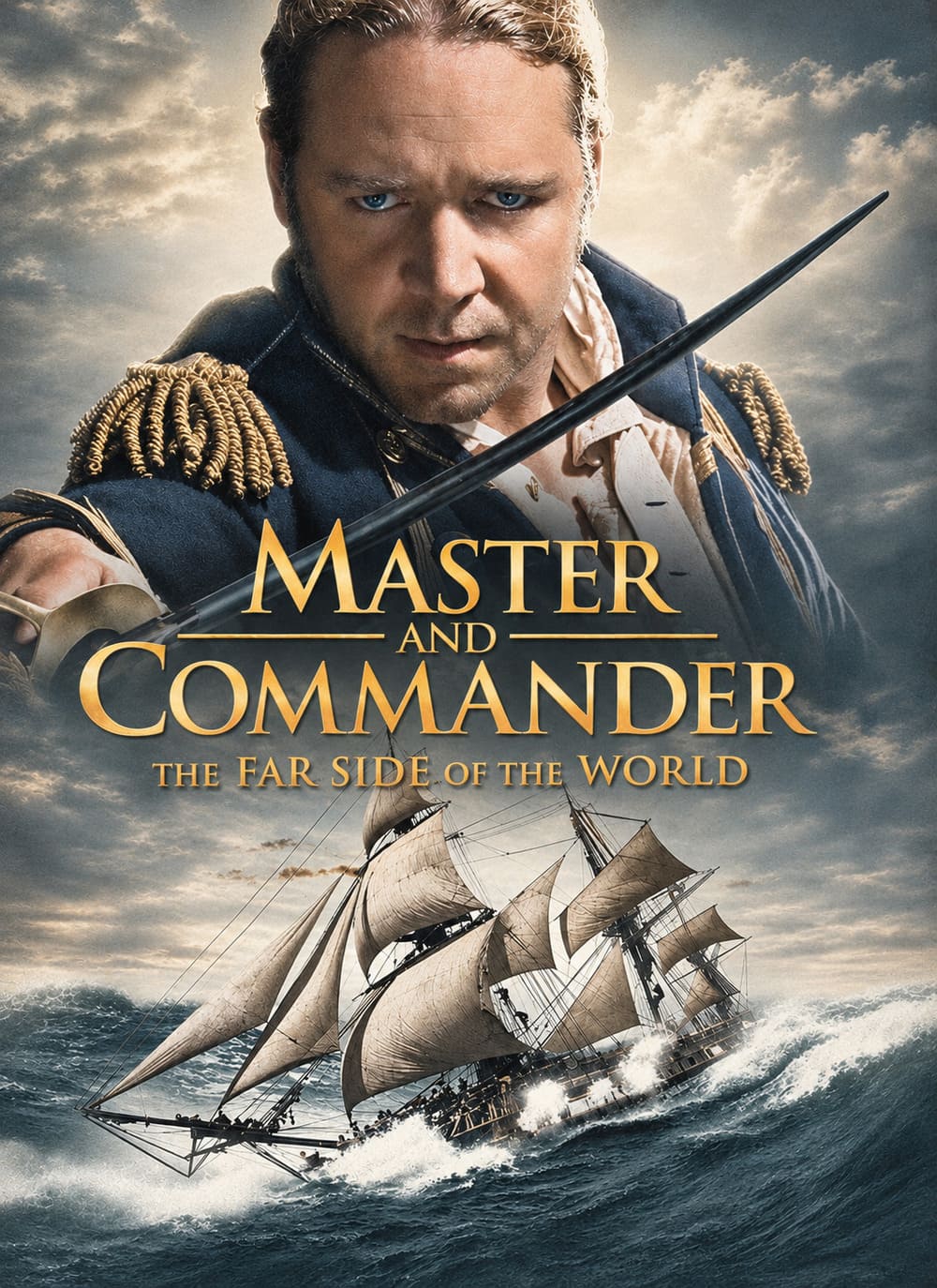
Master and Commander: The Far Side of the World (dir. by Peter Weir) Review


“This is the second time he’s done this to me. There will not be a third.” — Jack Aubrey

A lesser adventure movie would treat the ocean as empty space between battles. In Peter Weir’s Master and Commander: The Far Side of the World, it becomes an entire way of life. Meals, friendships, work, and terrible injuries all happen within the same cramped wooden walls, with nowhere to go when things get uncomfortable. That sense of confinement makes the film surprisingly absorbing. The cannon fire is exciting, but so is watching people figure out how to live together under pressure. What starts as a pursuit of an enemy ship gradually becomes a closer look at the man who refuses to let that enemy escape.

The film draws from the first and tenth books in Patrick O’Brian’s Aubrey–Maturin series, Master and Commander and The Far Side of the World, with the tenth supplying most of the central storyline. Rather than closely following the opening novel and introducing its characters from the beginning, Weir places us inside an established friendship and a working shipboard community. That choice gives the adaptation a lived-in quality. Aubrey and Maturin already have habits, disagreements, and ways of understanding each other that do not need explaining. We learn about their relationship by watching it function, which is more engaging than having their history handed to us.

Russell Crowe’s Captain Jack Aubrey commands HMS Surprise during the Napoleonic Wars. His target is the Acheron, a French privateer with enough speed and firepower to make their encounter seriously uneven. Weir establishes that imbalance through a brutal opening attack rather than a long explanation. The Surprise takes a beating, and suddenly the captain’s confidence has to compete with the evidence of shattered timber and injured men. Aubrey survives, but he cannot simply move on. Catching the Acheron becomes unfinished business, and everyone aboard gets pulled into his determination to settle it. The chase supplies the plot, but his reasons for continuing it supply the tension.

Crowe is a huge part of why this works. He gives Aubrey an easy authority that makes the crew’s loyalty believable. This captain can share a joke, appreciate a good meal, and make difficult decisions without appearing to switch between different personalities. There is warmth beneath his command, but also an expectation that his judgment will prevail. Crowe makes both sides convincing. You understand why the men feel safer with him in charge, even when he is asking them to do something dangerous. His confidence is attractive, and the film lets us enjoy it before making us consider its limits.

Those limits become clearer as Aubrey’s obsession with tracking down the Acheron builds. His assignment gives him a legitimate reason to pursue the French privateer, but the chase gradually becomes tangled up with his pride. Being beaten at his own game bothers him more than he wants to admit. Each setback seems to strengthen his need to prove that he can win. What makes this unsettling is how calmly he justifies himself. He never stops being intelligent or capable. Instead, military reasoning and personal ambition become difficult to separate. He can explain why the pursuit matters, but that does not mean he fully understands why it matters so much to him.

The person most willing to challenge him is Stephen Maturin, the ship’s surgeon and Aubrey’s close friend. Paul Bettany brings a dry, thoughtful quality to the role that plays beautifully against Crowe’s confidence. Maturin sees the wounded bodies behind the captain’s calculations, so arguments about duty are never purely theoretical for him. His scientific interests also give him priorities beyond the conflict. Where Aubrey sees a destination or a tactical advantage, Maturin notices something worth studying. Their disagreements make the voyage feel larger than its military objective. There is a whole world around them, even when Aubrey seems determined to reduce it to the distance between two ships.

Thankfully, the film does not turn their friendship into a series of lectures. Their shared musical sessions reveal a companionship that exists independently of whatever disagreement they are having. These scenes feel relaxed without becoming disposable. Watching them play together explains why they keep making room for each other despite their frustrations. Crowe and Bettany suggest familiarity through small changes in expression and tone rather than big emotional speeches. As a result, their arguments carry weight. They are not simply defending different opinions; they are testing how much disagreement a valued friendship can withstand, especially when one friend has the authority to overrule the other.

Weir gives the wider crew a similar sense of life beyond the plot. The Surprise feels like a workplace, a home, and an unforgiving social system all at once. Everyone has duties, everyone depends on someone else, and privacy barely seems to exist. Brief moments of joking or nervous conversation make the sailors feel individual without requiring formal introductions. The younger officers are especially affecting. Their uniforms and responsibilities cannot quite hide how young they are. Watching them try to behave bravely adds an uncomfortable edge to the adventure, because courage here is something children are already expected to demonstrate.

That attention to people makes the battles much more effective. By the time the guns start firing again, damage to the ship feels like damage to a community we recognize. The violence is messy and frightening rather than cleanly heroic. Splintering wood turns familiar spaces into hazards, while Maturin’s medical work makes the aftermath impossible to ignore. There is still plenty of excitement in watching a plan come together, but clever tactics do not erase their cost. Aubrey’s skill matters enormously, yet skill cannot guarantee that the people carrying out his orders will come through unharmed. Victory never feels quite as simple as being the better captain.

Just as importantly, the battles between the Surprise and the Acheron are exceptionally well-staged and executed. Weir makes the tactics understandable without draining the encounters of confusion or danger. You can follow the importance of positioning, timing, and coordinated work while still feeling how little separates an effective maneuver from disaster. The action moves between the larger contest at sea and the immediate struggle on deck, keeping strategy and physical consequences connected. There is a satisfying sense that the sailors’ everyday routines have prepared them for these moments. All that hauling, drilling, and following orders becomes the machinery that gives Aubrey’s ideas a chance of succeeding.

The climactic confrontation brings those strengths together, but its most satisfying ingredient comes from an unexpected place: Maturin’s interest in nature. Aubrey takes a couple of pages from his friend’s observations of camouflage and disguises the Surprise as a vulnerable whaling ship, hoping to lure the Acheron close enough to overcome its advantages. It is a clever solution because it grows out of the relationship rather than arriving as a last-minute burst of genius. After allowing the pursuit to overshadow Maturin’s scientific interests, Aubrey finds something useful in the very subjects he has been too impatient to appreciate.

That connection gives the final battle more meaning than a straightforward test of firepower. Aubrey succeeds by adapting, looking beyond his usual expertise, and recognizing the value of another person’s perspective. The plan offers a small but important counterpoint to his stubbornness: his confidence becomes more productive when it leaves room for curiosity. Meanwhile, the execution delivers the excitement the long pursuit has promised. Preparation gives way to sudden violence, and the fighting feels close, exhausting, and dangerous. The deception may create an opening, but it does not make the confrontation easy. Weir lets the tactical payoff and the human cost occupy the same scene.

Outside the fighting, the contrast between the crowded ship and the enormous ocean remains one of the film’s strongest features. Inside, everything feels close enough to touch. Outside, the water seems capable of swallowing the whole enterprise without noticing. The storms sharpen that contrast by presenting a threat Aubrey cannot intimidate or defeat through determination alone. His experience can improve their chances, but it cannot give him complete control. That limitation matters in a story about a man accustomed to trusting himself. Nature keeps reminding him—and us—that confidence is not the same thing as power, however reassuring it may look from the deck.

The film’s patience will not work for everyone. Some stretches linger over routine or scientific curiosity when a more conventional action movie would hurry toward another confrontation. The Galápagos sequences are the clearest example, shifting attention toward Maturin’s interests and slowing the pursuit. For me, that breathing room mostly pays off. It makes the world feel worth exploring rather than merely crossing, and the later camouflage strategy gives those observations a satisfying place in the adventure. Occasionally, the contrast between the two friends feels a little neatly arranged. Still, removing those quieter passages would leave a faster movie with much less personality and far less reason to care about its outcome.

By the end, the Surprise feels less like a spectacular movie location than a place whose routines you have learned. You understand why these men need their captain, why his friendship with Maturin matters, and why his certainty can be reassuring and dangerous at the same time. That is what gives Master and Commander: The Far Side of the World its staying power. Weir delivers the adventure without treating the people as equipment needed to stage it. The battles draw you in, but the lasting pleasure is the company—even when the man setting the course makes you nervous about where everyone is headed.

Here Are The 2017 Nominations From The Chicago Independent Film Critics!


The Chicago Independent Film Critics Circle should not be mistaken for the Chicago Film Critics Association.  However, since they’re both in Chicago, that does give me an excuse to once again use this picture of Al Capone.

Here are the nominees!

THE 10 BEST INDEPENDENT FILMS (in alphabetical order):

The Big Sick, Call Me By Your Name, The Florida Project, Get Out, A Ghost Story, Lady Bird, Lucky, Mudbound, The Shape of Water, Three Billboards Outside Ebbing, Missouri

THE 10 BEST STUDIO FILMS (in alphabetical order):

Baby Driver, Blade Runner 2049, Dunkirk, Logan, The Lost City of Z, mother!, Phantom Thread, The Post, Star Wars: The Last Jedi, Wonder Woman


The complete list of nominees for the 2017 CIFCC Awards:

BEST INDEPENDENT FILM

BEST STUDIO FILM

BEST FOREIGN FILM

  • Raw
  • The Square
  • Thelma

BEST DOCUMENTARY

  • Faces Places
  • Jane
  • Whose Streets?

BEST ANIMATED FILM

BEST DIRECTOR

  • Greta Gerwig, Lady Bird
  • Christopher Nolan, Dunkirk
  • Jordan Peele, Get Out

BEST ORIGINAL SCREENPLAY

  • The Big Sick– Emily V. Gordon and Kumail Nanjiani
  • Get Out- Jordan Peele
  • Lady Bird- Greta Gerwig

BEST ADAPTED SCREENPLAY

  • Call Me By Your Name- James Ivory
  • The Disaster Artist- Scott Neustadter and Michael H. Weber
  • Mudbound– Dee Rees and Virgil Williams

BEST ACTOR

  • Timothée Chalamet, Call Me By Your Name
  • Daniel Kaluuya, Get Out
  • Gary Oldman, Darkest Hour

BEST ACTRESS

  • Sally Hawkins, The Shape of Water
  • Frances McDormand, Three Billboards Outside Ebbing, Missouri
  • Saoirse Ronan, Lady Bird

BEST SUPPORTING ACTOR

  • Willem Dafoe, The Florida Project
  • Richard Jenkins, The Shape of Water
  • Sam Rockwell, Three Billboards Outside of Ebbing, Missouri
  • Michael Stuhlbarg, Call Me By Your Name

BEST SUPPORTING ACTRESS

  • Tiffany Haddish, Girls Trip
  • Allison Janney, I, Tonya
  • Laurie Metcalf, Lady Bird

BEST ENSEMBLE CAST

  • Get Out
  • Mudbound
  • The Post
  • The Shape of Water
  • Three Billboards Outside Ebbing, Missouri

BEST CINEMATOGRAPHY

  • Blade Runner 2049– Roger Deakins
  • Dunkirk- Hoyte van Hoytema
  • The Shape of Water– Dan Laustsen

BEST PRODUCTION DESIGN

  • Blade Runner 2049– Dennis Gassner
  • mother!- Philip Messina
  • The Shape of Water- Paul D. Austerberry

BEST EDITING

BEST COSTUME DESIGN AND MAKEUP

  • Darkest Hour– Jacqueline Durran (costumes), Kazuhiro Tsuji, Lucy Sibbick and David Malinowski (makeup)
  • Phantom Thread– Mark Bridges (costumes), Paul Engelen (makeup)
  • The Shape of Water– Luis Sequeria (costumes), Jordan Samuel and Paula Fleet (makeup)

BEST ORIGINAL SCORE

BEST VISUAL EFFECTS


TRAILBLAZER AWARD

  • Sean Baker, The Florida Project
  • Jordan Peele, Get Out
  • Dee Rees, Mudbound

IMPACT AWARD

  • Greta Gerwig, Lady Bird
  • Patty Jenkins, Wonder Woman
  • Jordan Peele, Get Out

The St. Louis Film Critics Association Names The Shape Of Water As The Best of 2017!


On Sunday, the St. Louis Film Critics Association announced their picks for the best of 2017!

You can check out their nominees here and their winners below!

Best Film: The Shape of Water
Runner-up: The Post

Best Director: Guillermo del Toro – The Shape of Water
Runner-u: Denis Villeneuve – Blade Runner 2049

Best Actor: Gary Oldman – Darkest Hour
Runner-up: James Franco – The Disaster Artist

Best Actress: Frances McDormand – Three Billboard Outside Ebbing, Missouri
Runner-up: Sally Hawkins – The Shape of Water

Best Supporting Actor: Richard Jenkins – The Shape of Water
Runner-up: Sam Rockwell – Three Billboards Outside Ebbing, Missouri

Best Supporting Actress: Laurie Metcalf – Lady Bird
Runner-up: Holly Hunter – The Big Sick

Best Original Screenplay: The Shape of Water – Guillermo del Toro & Vanessa Taylor
Runner-up: Lady Bird — Greta Gerwig

Best Adapted Screenplay: The Disaster Artist – Scott Neustadter & Michael H. Weber (Screenplay); Greg Sestero and Tom Bissell (Book)
Runners-up: Call Me By Your Name – James Ivory (Screenplay); Andre Aciman (Book) and Molly’s Game – Aaron Sorkin (Screenplay); Molly Bloom (Book) – tie

Best Editing: Baby Driver – Jonathan Amos and Paul Machliss
Runners-up: Dunkirk – Lee Smith and Sidney Wolinsky – The Shape of Water (tie)

Best Cinematography: Blade Runner 2049 – Roger Deakins
Runner-up: Hoyte Van Hoytema – Dunkirk

Best Production Design: The Shape of Water – Paul D. Austerberry
Runner-up: Blade Runner 2049 – Dennis Gassner

Best Visual Effects: Blade Runner 2049
Runner-up: The Shape of Water

Best Score: Phantom Thread – Jonny Greenwood
Runner-up: Dunkirk – Hans Zimmer

Best Soundtrack: Baby Driver
Runner-up: Three Billboards Outside Ebbing, Missouri

Best Animated Feature: Coco
Runner-up: Loving Vincent

Best Documentary Feature: Jane
Runner-up: Last Men in Aleppo

Best Foreign Language Feature: Land of Mine
Runner-up: First They Killed My Father

Best Scene: The Disaster Artist – Sixty-seven takes of “I did not hit her”.
Runners-up: Baby Driver – Baby gets coffee/opening credits and Lady Bird – The coach directing The Tempest using chalk talk (tie)

Here Are The Online Film Critics Society Nominations!


The winners will be announced on December 28th.

It’s interesting to note that The Post is almost totally shut out here.  One thing I’ve noticed that critics who work for newspapers love The Post.  They see it as proof of their importance.  Online critics are far less impressed with The Post.  They tend to view it as a lament for a dead medium, a somewhat stodgy celebration of the past.  Whenever I finally get a chance to see The Post, I’ll let you know who’s right.

Best Picture
Call Me By Your Name
Dunkirk
The Florida Project
Get Out
A Ghost Story
Lady Bird
mother!
Phantom Thread
The Shape of Water
Three Billboards Outside Ebbing, Missouri

Best Director
Paul Thomas Anderson – Phantom Thread
Greta Gerwig – Lady Bird
Christopher Nolan – Dunkirk
Jordan Peele – Get Out
Guillermo del Toro – The Shape of Water

Best Actor
Timothée Chalamet – Call Me By Your Name
James Franco – The Disaster Artist
Daniel Kaluuya – Get Out
Gary Oldman – Darkest Hour
Robert Pattinson – Good Time

Best Actress
Sally Hawkins – The Shape of Water
Cynthia Nixon – A Quiet Passion
Frances McDormand – Three Billboards Outside Ebbing, Missouri
Margot Robbie – I, Tonya
Saoirse Ronan – Lady Bird

Best Supporting Actor
Armie Hammer – Call Me By Your Name
Richard Jenkins – The Shape of Water
Sam Rockwell – Three Billboards Outside Ebbing, Missouri
Patrick Stewart – Logan
Michael Stuhlbarg – Call Me By Your Name

Best Supporting Actress
Mary J. Blige – Mudbound
Tiffany Haddish – Girls Trip
Holly Hunter – The Big Sick
Allison Janney – I, Tonya
Laurie Metcalf – Lady Bird

Best Ensemble
Get Out
Mudbound
Lady Bird
The Post
The Shape of Water
Three Billboards Outside Ebbing, Missouri

Breakout Star
Timothée Chalamet – Call Me By Your Name
Tiffany Haddish – Girls Trip
Daniel Kaluuya – Get Out
Dafne Keen – Logan
Brooklynn Prince – The Florida Project

Best Original Screenplay
Jordan Peele – Get Out
Greta Gerwig – Lady Bird
Paul Thomas Anderson – Phantom Thread
Guillermo del Toro and Vanessa Taylor – The Shape of Water
Martin McDonagh – Three Billboards

Best Adapted Screenplay
Sofia Coppola – The Beguiled
James Ivory – Call Me By Your Name
Scott Nestadter and Micheal Weber – The Disaster Artist
James Gray – Lost City of Z
Aaron Sorkin – Molly’s Game

Best Editing
Paul Machliss and Jonathan Amos – Baby Driver
Lee Smith – Dunkirk
Ben Safdie and Ronald Bronstein – Good Time
Tatiana S Riegel – I, Tonya
Sidney Wolinsky – The Shape of Water

Best Cinematography
Roger Deakins – Blade Runner 2049
Hoyte van Hoytema – Dunkirk
Darius Khondji – Lost City of Z
Rachel Morrison – Mudbound
Dan Laustsen – The Shape of Water

Best Animated Feature
Coco
The Breadwinner
In This Corner Of The World
The LEGO Batman Movie
Loving Vincent

Best Foreign Film
BPM (Beats Per Minute)
First They Killed My Father
Nocturama
Raw
The Square
Thelma

Best Documentary
Dawson City: Frozen Time
Ex Libris: The New York Public Library
Faces Places
Jane
The Work

Memorial Award
Jonathan Demme
John Hurt
Bill Paxton
George A. Romero
Harry Dean Stanton

Lifetime Achievement Award
Willem Dafoe
Daniel Day-Lewis
Roger Deakins
Christopher Plummer
Agnes Varda

The Seattle Film Critics Name Get Out The Best of 2017!


“Get out!”

That’s not just what the city of Seattle told Mayor Ed Murray earlier this year.  It’s also the title of the film that the Seattle Film Critics have officially selected as their pick for the best of 2017!

Check out their nominees here and the winners below!

BEST PICTURE OF THE YEAR

Get Out (Universal)

BEST DIRECTOR

Christopher Nolan – Dunkirk

BEST ACTOR in a LEADING ROLE

Daniel Day-Lewis – Phantom Thread

BEST ACTRESS in a LEADING ROLE

Saoirse Ronan – Lady Bird

BEST ACTOR in a SUPPORTING ROLE

Willem Dafoe – The Florida Project

BEST ACTRESS in a SUPPORTING ROLE

Laurie Metcalf – Lady Bird

BEST ENSEMBLE CAST

Get Out

BEST SCREENPLAY

Lady Bird – Greta Gerwig

BEST ANIMATED FEATURE

Coco – Adrian Molina, Lee Unkrich, directors

BEST FOREIGN LANGUAGE FILM

Raw – Julia Ducournau, director

BEST DOCUMENTARY FEATURE

Faces Places – JR, Agnès Varda, co-directors

BEST CINEMATOGRAPHY

Blade Runner 2049 – Roger A. Deakins

BEST COSTUME DESIGN

Phantom Thread – Mark Bridges

BEST FILM EDITING

Dunkirk – Lee Smith

BEST ORIGINAL SCORE

Phantom Thread – Jonny Greenwood

BEST PRODUCTION DESIGN

Blade Runner 2049 – Dennis Gassner (Production Designer); Alessandra Querzola (Set Decorator)

BEST VISUAL EFFECTS

War for the Planet of the Apes – Joe Letteri, Dan Lemmon, Daniel Barrett, Joel Whist

BEST YOUTH PERFORMANCE (18 years of age or younger upon start of filming)

Brooklynn Prince – The Florida Project

VILLAIN OF THE YEAR

Dennis and various multiple personalities – Split – portrayed by James McAvoy

Here Are The Seattle Film Critics Nominations!


Earlier today, the Seattle Film Critics Society announced their nominations for the best of 2017!  The winners will be announced on December 18th.

The most interesting thing about Seattle’s nominations?  The amount of love that they showed to Blade Runner 2049, an acclaimed film that, with the exception of Roger Deakins’s cinematography, was running the risk of being forgotten during the precursor season.  They also showed some love to Logan and The Disaster Artist, which made me happy.

With a tip of the hat to AwardsWatch, here are their nominations:

BEST PICTURE OF THE YEAR:

Blade Runner 2049 (Warner Bros.)

The Disaster Artist (A24)

Dunkirk (Warner Bros.)

The Florida Project (A24)

Get Out (Universal)

Lady Bird (A24)

Logan (20th Century Fox)

Phantom Thread (Focus Features)

The Post (20th Century Fox)

Three Billboards Outside Ebbing, Missouri (Fox Searchlight)


BEST DIRECTOR:

Sean Baker – The Florida Project

Greta Gerwig – Lady Bird

Christopher Nolan – Dunkirk

Jordan Peele – Get Out

Denis Villeneuve – Blade Runner 2049


BEST ACTOR in a LEADING ROLE:

Daniel Day-Lewis – Phantom Thread

James Franco – The Disaster Artist

Daniel Kaluuya – Get Out

Gary Oldman – Darkest Hour

Robert Pattinson – Good Time


BEST ACTRESS in a LEADING ROLE:

Sally Hawkins – The Shape of Water

Frances McDormand – Three Billboards Outside Ebbing, Missouri

Margot Robbie – I, Tonya

Saoirse Ronan – Lady Bird

Meryl Streep – The Post


BEST ACTOR in a SUPPORTING ROLE:

Willem Dafoe – The Florida Project

Barry Keoghan – The Killing of a Sacred Deer

Sam Rockwell – Three Billboards Outside Ebbing, Missouri

Michael Shannon – The Shape of Water

Patrick Stewart – Logan


BEST ACTRESS in a SUPPORTING ROLE:

Tiffany Haddish – Girls Trip

Holly Hunter – The Big Sick

Allison Janney – I, Tonya

Lesley Manville – Phantom Thread

Laurie Metcalf – Lady Bird


BEST ENSEMBLE CAST:

Call Me by Your Name

Get Out

Lady Bird

The Post

Three Billboards Outside Ebbing, Missouri


BEST SCREENPLAY:

The Big Sick – Emily V. Gordon & Kumail Nanjiani

The Disaster Artist – Scott Neustadter & Michael H. Weber

Get Out – Jordan Peele

Lady Bird – Greta Gerwig

Three Billboards Outside Ebbing, Missouri – Martin McDonagh


BEST ANIMATED FEATURE:

The Breadwinner – Nora Twomey, director

Coco – Adrian Molina, Lee Unkrich, directors

The LEGO Batman Movie – Chris McKay, director

Loving Vincent – Dorota Kobiela, Hugh Welchman, directors

Your Name. – Makoto Shinkai, director


BEST FOREIGN LANGUAGE FILM:

Blade of the Immortal – Takashi Miike, director
BPM (Beats Per Minute) – Robin Campillo, director

Frantz – François Ozon, director

Raw – Julia Ducournau, director

Thelma – Joachim Trier, director


BEST DOCUMENTARY FEATURE:

City of Ghosts – Matthew Heineman, director

Ex Libris: The New York Public Library – Frederick Wiseman, director

Faces Places – JR, Agnès Varda, co-directors

LA 92 – Daniel Lindsay, T.J. Martin, directors

Step – Amanda Lipitz, director


BEST CINEMATOGRAPHY:

Blade Runner 2049 – Roger A. Deakins

Columbus – Elisha Christian

Dunkirk – Hoyte von Hoytema

The Florida Project – Alexis Zabé

The Shape of Water – Dan Laustsen


BEST COSTUME DESIGN:

Beauty and the Beast – Jacqueline Durran

Blade Runner 2049 – Rénee April

Darkest Hour – Jacqueline Durran

Phantom Thread – Mark Bridges

The Shape of Water – Luis Sequeira


BEST FILM EDITING:

Baby Driver – Paul Machliss, Jonathan Amos

Blade Runner 2049 – Joe Walker

Dunkirk – Lee Smith

Get Out – Gregory Plotkin

Lady Bird – Nick Houy


BEST ORIGINAL SCORE:

Blade Runner 2049 – Benjamin Wallfisch, Hans Zimmer

Dunkirk – Hans Zimmer

Phantom Thread – Jonny Greenwood

War for the Planet of the Apes – Michael Giacchino

Wonderstruck – Carter Burwell


BEST PRODUCTION DESIGN:

Blade Runner 2049 – Dennis Gassner (Production Designer); Alessandra Querzola (Set Decorator)

Dunkirk – Nathan Crowley (Production Designer); Gary Fettis (Supervising Set Decorator)

Murder on the Orient Express – Jim Clay (Production Designer); Rebecca Alleway (Set Decorator)

Phantom Thread – Mark Tildesley (Production Designer); Véronique Melery (Set Decorator)

The Shape of Water – Paul Denham Austerberry (Production Designer); Shane Vieau, Jeff Melvin (Set Decorators)


BEST VISUAL EFFECTS:

Blade Runner 2049 – John Nelson, Paul Lambert, Richard R. Hoover, Gerd Nefzer
Dunkirk – Andrew Jackson, Andrew Lockley, Scott Fisher, Paul Corbould

The Shape of Water – Dennis Berardi, Luke Groves, Trey Harrell, Kevin Scott

Valerian and the City of a Thousand Planets – Scott Stokdyk, Jérome Lionard

War for the Planet of the Apes – Joe Letteri, Dan Lemmon, Daniel Barrett, Joel Whist


BEST YOUTH PERFORMANCE (18 years of age or younger upon start of filming):

Dafne Keen – Logan
Sophia Lillis – It

Brooklynn Prince – The Florida Project

Millicent Simmonds – Wonderstruck

Jacob Tremblay – Wonder


VILLAIN OF THE YEAR:

Dennis and various multiple personalities – Split – portrayed by James McAvoy

Martin – The Killing of a Sacred Deer – portrayed by Barry Keoghan

Pennywise – It – portrayed by Bill Skarsgård

Philip Krauss – Detroit – portrayed by Will Poulter

Richard Strickland – The Shape of Water – portrayed by Michael Shannon

Here Are The 2017 Nominations of the San Francisco Film Critics Circle!


Yesterday, the San Francisco Film Critics Circle announced their nominees for the best of 2017!  The winner will be announces tomorrow!

Like almost all of the precursors so far, San Francisco seems to really like The Shape of Water.

Best Picture
CALL ME BY YOUR NAME
THE FLORIDA PROJECT
GET OUT
THE SHAPE OF WATER
THREE BILLBOARDS OUTSIDE EBBING, MISSOURI

Best Director
Sean Baker  – THE FLORIDA PROJECT
Guillermo del Toro  – THE SHAPE OF WATER
Greta Gerwig  – LADY BIRD
Christopher Nolan  – DUNKIRK
Jordan Peele – GET OUT

Best Actor
Timothee Chalamet – CALL ME BY YOUR NAME
James Franco  – THE DISASTER ARTIST
Daniel Kaluuya  – GET OUT
Gary Oldman – DARKEST HOUR
Andy Serkis  – WAR FOR THE PLANET OF THE APES

Best Actress
Annette Bening – FILM STARS DON’T DIE IN LIVERPOOL
Sally Hawkins – THE SHAPE OF WATER
Frances McDormand  – THREE BILLBOARDS OUTSIDE EBBING, MISSOURI
Margot Robbie – I, TONYA
Saoirse Ronan – LADY BIRD

Best Supporting Actor 
Willem Dafoe  – THE FLORIDA PROJECT
Armie Hammer – CALL ME BY YOUR NAME
Richard Jenkins – THE SHAPE OF WATER
Sam Rockwell  – THREE BILLBOARDS OUTSIDE EBBING, MISSOURI
Michael Stuhlbarg  – CALL ME BY YOUR NAME

Best Supporting Actress
Holly Hunter – THE BIG SICK
Allison Janney – I, TONYA
Melissa Leo – NOVITIATE
Lesley Manville – PHANTOM THREAD
Laurie Metcalf – LADY BIRD

Best Foreign Language Film
BPM
A FANTASTIC WOMAN
FRANTZ
IN THE FADE
THE SQUARE

Best Animated Feature
THE BREADWINNER
COCO
THE LEGO BATMAN MOVIE
LOVING VINCENT
YOUR NAME

Best Documentary
BRIMSTONE & GLORY
CITY OF GHOSTS
DAWSON CITY: FROZEN TIME
FACES PLACES
JANE

Best Cinematography
BLADE RUNNER 2049 – Roger Deakins
DUNKIRK – Hoyte van Hoytema
THE FLORIDA PROJECT – Alexis Zabe
THE SHAPE OF WATER – Dan Laustsen
WONDER WHEEL – Vittorio Storaro

Best Production Design
BLADE RUNNER 2049  – Dennis Gassner
DUNKIRK  – Nathan Crowley
PHANTOM THREAD  – Mark Tildesley
THE SHAPE OF WATER  – Paul D. Austerberry
WONDERSTRUCK – Mark Friedberg

Best Editing
BABY DRIVER – Paul Machliss and Jonathan Amos
BLADE RUNNER 2049 – Joe Walker
DUNKIRK – Lee Smith
THE POST – Michael Kahn
THE SHAPE OF WATER – Sidney Wolinsky

Best Screenplay (original)
THE BIG SICK – Kumail Nanjiani and Emily V. Gordon
GET OUT – Jordan Peele
LADY BIRD  – Greta Gerwig
THE SHAPE OF WATER  – Guillermo Del Toro and Vanessa Taylor
THREE BILLBOARDS OUTSIDE EBBING, MISSOURI  – Martin McDonagh

Best Screenplay (adapted)
THE DISASTER ARTIST  – Scott Neustadter and Michael H. Weber
CALL ME BY YOUR NAME  – James Ivory
MOLLY’S GAME – Aaron Sorkin
MUDBOUND  – Dee Rees and Virgil Williams
WONDERSTRUCK  – Brian Selznick

Best Original Score
BLADE RUNNER 2049  – Hans Zimmer and Benjamin Wallfisch
DUNKIRK  – Hans Zimmer
PHANTOM THREAD  – Jonny Greenwood
THE SHAPE OF WATER  – Alexandre Desplat
WAR FOR THE PLANET OF THE APES – Michael Giacchino

Special Citation (for that underappreciated indie gem)
BRIMSTONE & GLORY
COLUMBUS
THE OTHER KIDS

Here Are The Nominations From The San Diego Film Critics Society!


The San Diego Film Critics Society announced their nominations for the best of 2017 earlier today!  The actual winners will be announce on December 11th.

Check them out below!

(I know this might seem a little dry to some people but I love lists.)

(By the way, in case you’re wondering which sites I usually put the most trust in when it comes to Oscar coverage, here they are: AwardsWatch and AwardsCircuit.  Two of my favorite sites ever, right there.)

Best Picture
CALL ME BY YOUR NAME
DUNKIRK
GET OUT
LADY BIRD
THREE BILLBOARDS OUTSIDE OF EBBING, MISSOURI

Best Director
Christopher Nolan, DUNKIRK
Greta Gerwig, LADY BIRD
Guillermo del Toro, THE SHAPE OF WATER
Jordan Peele, GET OUT
Martin McDonagh, THREE BILLBOARDS OUTSIDE OF EBBING, MISSOURI

Best Actor
Gary Oldman, DARKEST HOUR
James Franco, THE DISASTER ARTIST
James McAvoy, SPLIT
Robert Pattinson, GOOD TIME
Timothée Chalamet, CALL ME BY YOUR NAME

Best Actress
Frances McDormand, THREE BILLBOARDS OUTSIDE OF EBBING, MISSOURI
Margot Robbie, I, TONYA
Sally Hawkins, MAUDIE
Sally Hawkins, THE SHAPE OF WATER
Saoirse Ronan, LADY BIRD

Best Supporting Actor
Ethan Hawke, MAUDIE
Oscar Isaac, SUBURBICON
Sam Rockwell, THREE BILLBOARDS OUTSIDE OF EBBING, MISSOURI
Willem Dafoe, THE FLORIDA PROJECT
Woody Harrelson, THREE BILLBOARDS OUTSIDE EBBING, MISSOURI

Best Supporting Actress
Allison Janney I, TONYA
Bria Vinaite, THE FLORIDA PROJECT
Catherine Keener, GET OUT
Holly Hunter, THE BIG SICK
Laurie Metcalf, LADY BIRD

Best Comedic Performance
Daniel Craig, LOGAN LUCKY
Ezra Miller, JUSTICE LEAGUE
James Franco, THE DISASTER ARTIST
Lil Rel Howery, GET OUT
Ray Romano, THE BIG SICK

Best Original Screenplay
Christopher Nolan, DUNKIRK
Greta Gerwig, LADY BIRD
Emily V. Gordon and Kumail Nanjiani, THE BIG SICK
Jordan Peele, GET OUT
Martin McDonagh, THREE BILLBOARDS OUTSIDE OF EBBING, MISSOURI

Best Adapted Screenplay
James Gray, THE LOST CITY OF Z
James Ivory, CALL ME BY YOUR NAME
Scott Neustadter & Michael H. Weber, THE DISASTER ARTIST
Sofia Coppola, THE BEGUILED
Virgil Williams & Dee Rees, MUDBOUND

Best Documentary
EX LIBRIS: THE NEW YORK PUBLIC LIBRARY
FACES PLACES
JANE
LAST MEN IN ALEPPO
THE WORK

Best Animated Film
COCO
LOVING VINCENT
MY ENTIRE HIGH SCHOOL SINKING INTO THE SEA
MY LIFE AS A ZUCCHINI
THE BOSS BABY

Best Foreign Language Film
BPM (BEATS PER MINUTE)
FACES PLACES
THE OTHER SIDE OF HOPE
THE SQUARE
THELMA

Best Editing
Jonathan Amos & Paul Machliss, BABY DRIVER
Jon Gregory, THREE BILLBOARDS OUTSIDE EBBING, MISSOURI
Lee Smith, DUNKIRK
Sarah Broshar, Michael Kahn, THE POST
Sidney Wolinsky, THE SHAPE OF WATER

Best Cinematography
Ben Richardson, WIND RIVER
Dan Laustsen, THE SHAPE OF WATER
Darius Khondji, THE LOST CITY OF Z
Hoyte Van Hoytema, DUNKIRK
Roger Deakins, BLADE RUNNER 2049

Best Production Design
Anne Ross, THE BEGUILED
Alessandora Querzola and Dennis Gassner, BLADE RUNNER 2049
Nathan Crowley, DUNKIRK
Paul D. Austerberry, THE SHAPE OF WATER
Sarah Greenwood, BEAUTY AND THE BEAST

Best Visual Effects
BEAUTY AND THE BEAST
BLADE RUNNER 2049
DUNKIRK
THE SHAPE OF WATER
WAR FOR THE PLANET OF THE APES

Best Costume Design
Jacqueline Durran, BEAUTY and the BEAST
Jenny Eagan, HOSTILES
Luis Sesqueria, THE SHAPE OF WATER
Mark Bridges, PHANTOM THREAD
Sonia Grande, THE LOST CITY OF Z
Stacey Battat, THE BEGUILED

Best Use of Music
BABY DRIVER
BEAUTY AND THE BEAST
CALL ME BY YOUR NAME
DUNKIRK
THE SHAPE OF WATER

Breakthrough Artist
Barry Keoghan
Brooklyn Prince
Greta Gerwig
Jordan Peele
Sophia Lillis
Timothée Chalamet

Best Ensemble
GET OUT
LADY BIRD
MUDBOUND
THE POST
THREE BILLBOARDS OUTSIDE OF EBBING, MISSOURI

The Boston Online Film Critics Name Get Out The Best of 2017!


Earlier today, The Boston Online Film Critics Association announced their picks for the best of 2017!  They really liked Get Out.

Check out their picks below:

Best Picture — Get Out

Best Director — Paul Thomas Anderson, Phantom Thread

Best Actor — Timothee Chalamet, Call Me By Your Name

Best Actress — Frances McDormand, Three Billboards Outside Ebbing, Missouri

Best Supporting Actor — Willem DaFoe, The Florida Project

Best Supporting Actress — Laurie Metcalf, Lady Bird

Best Screenplay — Jordan Peele, Get Out

Best Foreign Language Film — First They Killed My Father

Best Documentary — Faces Places

Best Animated Feature — Coco

Best Cinematography — Roger Deakins, Blade Runner 2049

Best Editing — Lee Smith, Dunkirk

Best Original Score: Alexandre Desplat, The Shape of Water and Johnny Greenwood, Phantom Thread

Best Films of 2017:

  • “Get Out”
  • “The Florida Project”
  • “Call Me By Your Name”
  • “Lady Bird”
  • “Phantom Thread”
  • “Dunkirk”
  • “The Shape of Water”
  • “Three Billboards outside Ebbing, Missouri”
  • “A Ghost Story”
  • “Good Time”