“Hell House doesn’t mind a guest or two. What it doesn’t like is people who come snooping around.” — Benjamin Franklin Fischer
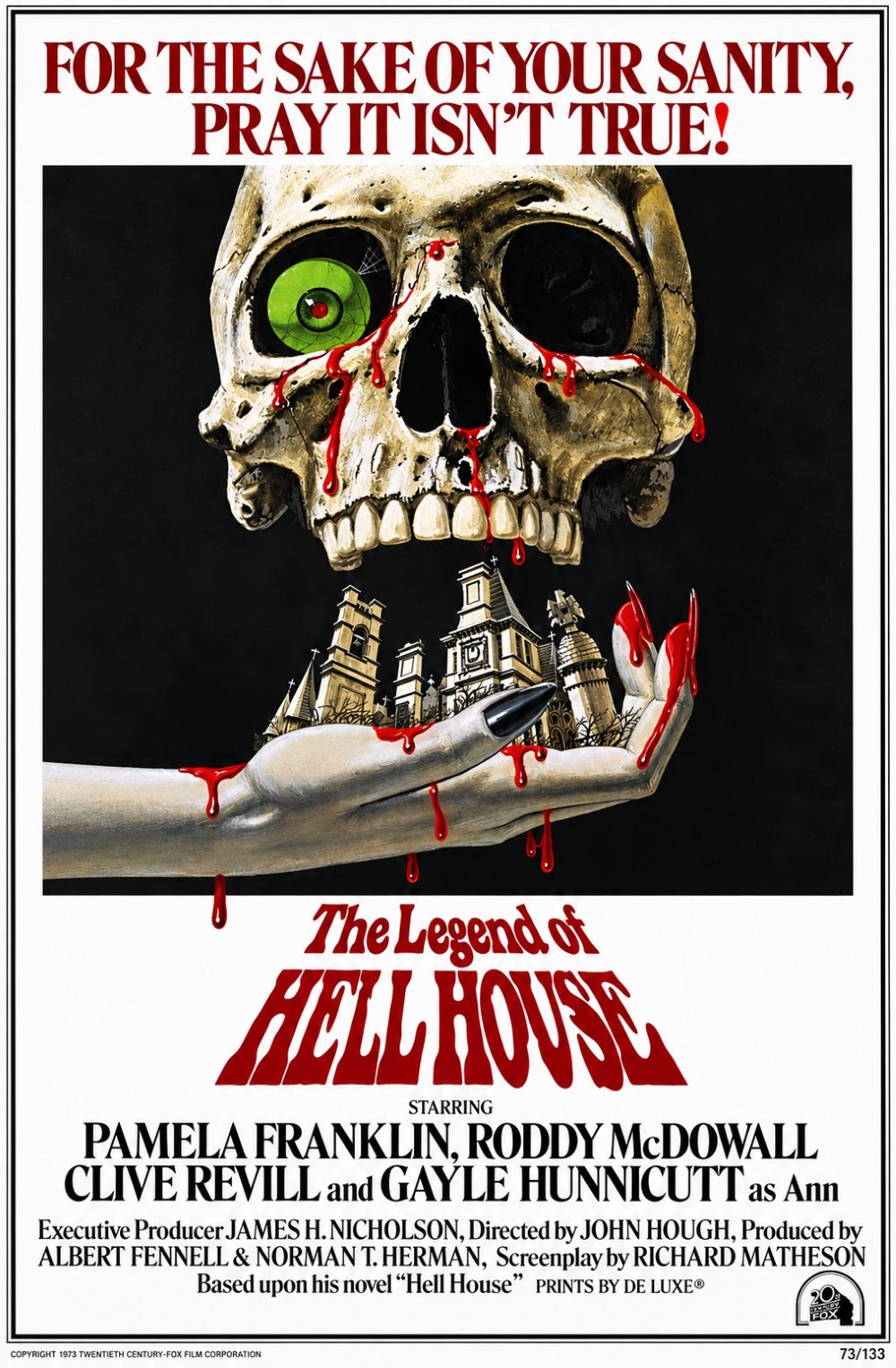
There is something deeply unpleasant about The Legend of Hell House, and that is exactly what makes it so effective. Directed by John Hough and adapted by Richard Matheson from his own 1971 novel Hell House, the film takes a fairly simple haunted-mansion premise and turns it into something mean, claustrophobic, and surprisingly adult. It is not the most visually elaborate ghost story ever made, nor the most frightening in a conventional jump-scare sense, but it has a cold, nasty atmosphere that lingers. This is a haunted-house movie where the house does not just contain evil; it seems designed to degrade everyone who steps inside.
The setup is strong because it puts several opposing viewpoints under the same roof. A wealthy man hires physicist Dr. Lionel Barrett, played by Clive Revill, to investigate the notorious Belasco House and settle the question of whether life after death exists. Barrett brings along his wife Ann, played by Gayle Hunnicutt, and the couple joins two people with far more personal connections to the place: Florence Tanner, a deeply spiritual medium played by Pamela Franklin, and Benjamin Franklin Fischer, played by Roddy McDowall, the sole survivor of an earlier investigation. The job has a deadline, a large payday, and an obvious catch: every previous expedition into the house ended in death, insanity, or both.
It is the kind of premise that could have easily become an old-fashioned “wait for the next victim” thriller, but Matheson’s script gives it more bite than that. Every character arrives with a different theory of the supernatural, and those theories become personal weapons. Barrett is the hard-line rationalist, convinced that any haunting can be explained through physical energy. Florence believes in trapped souls and approaches the house with a nearly religious determination. Fischer knows better than anyone that Belasco House does not care what people believe, while Ann becomes the emotional pressure point between all those men and their supposedly superior ideas. The ghost story works because the haunting pushes directly on each character’s vulnerabilities instead of merely making lights flicker and doors slam.
Clive Revill makes Barrett an interesting kind of horror-movie skeptic. He is not simply smug or foolish, although he can be both. He has the conviction of a man who thinks he is on the verge of solving the biggest mystery in human history with engineering equipment and enough confidence. That makes him a perfect target. Revill plays the character with a blunt, almost comically forceful seriousness that fits the film’s style. Barrett is a man who keeps insisting that the house is a machine, even as it starts treating him like a piece of disposable machinery.
Roddy McDowall is arguably the film’s secret weapon. Fischer could have been a standard nervous survivor whose only job is to warn the newcomers not to go into the basement. Instead, McDowall gives him a sly, guarded, intermittently hostile energy. He knows the house, he has seen what it does, and he has built a personality around refusing to be emotionally open about any of it. His sunglasses, dry delivery, and generally strange behavior make Fischer seem a little ridiculous at first, but that awkwardness becomes part of the performance’s appeal. By the time the film gets into the mystery of Emeric Belasco, the wealthy sadist who once ruled the estate, Fischer’s trauma feels like the one thing in the movie that cannot be explained away by a machine.
Pamela Franklin is also excellent as Florence Tanner, particularly because the film lets her be forceful rather than purely fragile. Florence is sympathetic, but she is not passive. She believes in her gifts enough to challenge Barrett head-on, and her desire to help the lost spirits of Hell House gives the story some genuine emotional stakes. The movie can be pretty ruthless with her, especially in the way it explores sexual humiliation, possession, and psychic assault, but Franklin never plays Florence as merely victimized. Her scenes with McDowall have an uneasy charge because they represent two different forms of faith: Florence sees the dead as people worth saving, while Fischer treats the dead as weapons that must be avoided.
That unpleasant streak is really what separates The Legend of Hell House from a lot of cleaner, more comforting haunted-house films. The Belasco House is not merely spooky; it is aggressively cruel, with a history rooted in sexual degradation, murder, and the grotesque whims of its former owner. Matheson’s novel was more explicit than the movie, and the screenplay softens some of its more graphic sexual and violent material. Even so, the film remains unusually frank for a mainstream early-1970s supernatural thriller. Its horror is not just that ghosts exist. It is that a dead man’s perversions can keep poisoning the living decades later.
John Hough handles all this with a remarkably physical visual style. The camera prowls through corridors, peers around corners, tilts at unnerving angles, and uses wide lenses to make the mansion feel warped and hostile. The movie’s low, wide-angle shots give the characters an exposed, trapped quality, as if the building is staring down at them. The direction is not subtle in the same manner as Robert Wise’s The Haunting, but that is not a flaw. Hough makes Hell House feel less like an unknowable mystery and more like a spiritual pressure cooker.
The film does have limitations. Its effects are sometimes modest, and a few of its shock moments are more abrupt than scary. The climax gives the haunting a concrete answer, which makes the story’s blend of supernatural Gothic horror and strange pseudo-scientific logic feel even more pulpy and distinctive. It may not carry the elusive ambiguity of The Haunting, but The Legend of Hell House is not trying to be that kind of ghost story. It wants the audience to feel trapped in a hostile space with people whose certainty, fear, and private weaknesses are being exposed one ugly piece at a time. Even when its mechanics are a little dated, that sense of contamination remains powerful.
It also benefits from being lean. At around 90 minutes, The Legend of Hell House wastes little time building out the haunted-house situation, escalating the attacks, and forcing its investigators to choose between their competing explanations. That economy makes it feel more vicious than many later possession or paranormal movies that inflate a similar premise into two-hour lore marathons. There is no elaborate mythology to memorize. There is a bad house, a horrible dead man, four damaged people, and a deadline. That is enough.
As for influence, the film has clear roots in The Haunting and Henry James-style psychological ghost stories, but it also left traces of its own. Its combination of paranormal investigation, supposedly scientific equipment, skeptical experts, psychic mediums, and a house that manipulates people’s sexuality and emotional weaknesses can be felt in many later haunted-house stories. The direct influence is most explicitly documented in Edgar Wright’s fake trailer Don’t, made for Grindhouse: Wright and Simon Pegg riffed on Hell House’s fog-shrouded mansion imagery and echoed Roddy McDowall’s distinctive 1970s look. It also features one of the earlier cinematic depictions of sexual assault by an unseen supernatural force, a disturbing concept later revisited much more brutally in The Entity.
It would be a stretch to claim that every modern “ghost hunters enter a cursed house” movie comes directly from The Legend of Hell House, but its DNA is easy to spot. The procedural side of paranormal investigation, the conflict between technical explanation and spiritual belief, and the sense that a house preserves human evil like an infection all became familiar horror tools. Its visual atmosphere has also invited comparisons to The Shining, especially in its use of ominous spatial compositions and its fixation on the house’s ability to reshape the mental state of its occupants. The connection should not be overstated—Stanley Kubrick’s film is its own colossal thing—but they are clearly kindred haunted-house nightmares.
Ultimately, The Legend of Hell House is a rougher, nastier, more aggressively lurid cousin to The Haunting. It does not have that earlier film’s sublime ambiguity, but it has its own grimy personality: a mixture of British Gothic atmosphere, American genre bluntness, psychic melodrama, and just enough 1970s sleaze to make the mansion feel truly diseased. It is best approached not as a polished prestige classic, but as a smart, compact supernatural shocker with a nasty sense of humor and an unusually strong cast. Hell House may not be the most famous haunted mansion in horror, but once you have spent an hour and a half inside it, you can understand why nobody should want to go back.