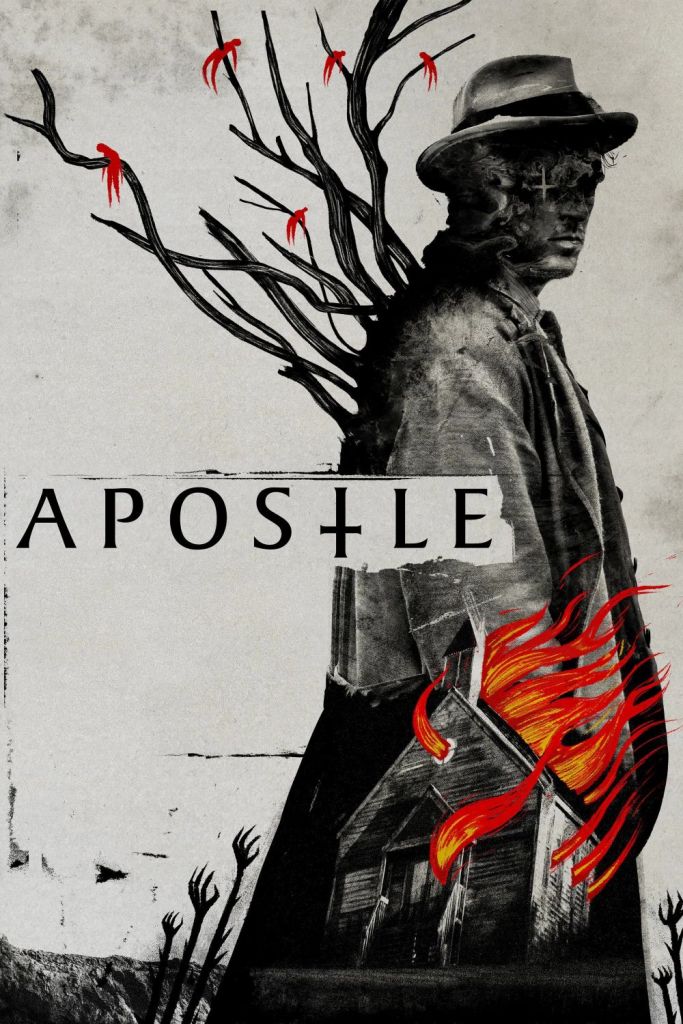
“She’s no god. She’s just a machine.” — Quinn
Apostle is one of those films that feels like Gareth Evans deliberately swerved away from the kinetic precision of The Raid and The Raid 2, as if to test whether he could still dominate the screen without back‑to‑back martial‑arts set pieces. The result is not a clean crowd‑pleaser, but a grim, blood‑soaked folk‑horror descent that trades velocity for dread, atmosphere, and the slow peeling away of civilized surfaces until what’s left is pure cruelty. It’s ambitious, dense, and at times unwieldy, but it is never the kind of hollow, algorithm‑friendly Netflix original that feels assembled by committee. The film leans into a slow‑burn approach, letting its cult setting and religious unease simmer before it erupts into something truly grotesque.
Set in 1905, Apostle follows Thomas Richardson, played by Dan Stevens with the exact right mix of haunted intensity and bruised arrogance, as he infiltrates a remote island cult to rescue his kidnapped sister. That setup sounds straightforward enough, but Evans uses it as a trapdoor into a much uglier story about faith, coercion, exploitation, and the grotesque systems people build when belief curdles into power. The cult is not merely spooky window dressing; it’s a functioning social organism with labor, hierarchy, punishment, and ritual, which gives the film a more grounded menace than a simple haunted‑house scenario. The island’s wrongness is not just in its rituals, but in the way ordinary domestic life has been turned into a kind of ongoing penance.
What makes Apostle compelling is how patiently Evans allows the island to breathe before he starts tearing it apart. The first half is almost methodical in the way it maps the place: the political tension within the cult, the uneasy alliances, the daily routines, the controlled scarcity, and the sense that every face hides some compromise. That slow construction is crucial, because once the film starts revealing what the island is actually built on, the horror lands with more force. It does not chase jump scares; it lets the audience sit inside the wrongness until the wrongness starts to feel inevitable. The film’s real horror is in the way it treats belief as a system of control rather than a source of comfort.
Michael Sheen is the other major pillar here, and he gives the film a wickedly slippery center as Malcolm, the island’s charismatic prophet. Sheen plays him as part messiah, part salesman, part exhausted tyrant, which is exactly the right tone for a character whose authority depends on performance. He isn’t merely loud or theatrical; he’s persuasive, and that is much scarier. The film understands that the most dangerous religious figures are often not the ones who snarl the loudest, but the ones who can make oppression sound like purpose. Dan Stevens plays beautifully against that energy, keeping Thomas in a state of wary observation until desperation forces him into action. The two actors give the movie a dramatic spine sturdy enough to support all the blood and theology around them.
Evans’ direction is, unsurprisingly, the film’s great technical asset. Even when Apostle feels overloaded, it never feels careless. He stages the island as an environment of mud, wood, fog, and decay, and his eye for spatial clarity keeps the film legible even when the narrative starts layering on secrets and hidden machinery. If The Raid was about velocity and geometry, Apostle is about pressure and contamination. The violence, when it arrives, still carries the director’s unmistakable talent for framing brutality on screen: every blow lands with a clarity and weight that makes the gore feel integral rather than gratuitous. But in Apostle he deftly dips his filmmaking talents into the world of gothic folk horror, slotting his sensibility alongside classics like The Wicker Man, Witchfinder General, and The Witch. The island’s rituals, its mix of agrarian dread and religious paranoia, and its sense of a sealed community preparing for a bloody reckoning all echo those earlier works, while Evans colors them in his own grimy palette.
There’s also something interesting about how the film handles world‑building. It is overstuffed, yes, but it is overstuffed in a way that feels earned rather than random. The island has systems, factions, and ugly little bureaucracies of suffering, and the film keeps revealing new layers of control and corruption until the whole place feels like a machine designed to consume bodies and faith at the same time. Some viewers will see that density as a flaw, and they’re not entirely wrong; Apostle can feel a little overextended, as if Evans has too many ideas he wants to wring out of the same pressure cooker. But it could also be argued that the excess is part of the film’s personality. It’s not elegant horror. It’s horrified by its own abundance.
Thematically, Apostle works best when it treats religion not as a decorative taboo, but as a field of contesting desires. The film isn’t interested in simple anti‑faith provocation. Instead, it examines what happens when belief becomes a resource to be managed, weaponized, and monetized. The cult claims to reject corruption from the outside world, but its inner life is every bit as predatory, which makes the island feel less like an isolated aberration and more like a compressed version of the larger world Thomas came from. That’s one of the movie’s smartest ideas: the mainland and the island are different expressions of the same rot. The difference is only one of scale and visibility.
As a horror film, Apostle is strongest when it is patient and weakest when it has to juggle too many moving parts at once. The final stretch escalates into an effectively feral confrontation, but the movie occasionally risks losing the eerie precision of its setup in favor of sheer attritional chaos. Still, even that chaos has a purpose. Evans is not just trying to shock; he’s trying to show what happens when systems of belief collapse under the weight of their own lies. The result is messy, unpleasant, and often very good. It is also one of the more distinctive Netflix originals of its era, precisely because it refuses to be easy or tidy.
Apostle feels like a filmmaker known for kinetic precision making a movie about spiritual and social collapse, and the contradiction works in its favor. Even as he steps into the domain of gothic folk horror, Evans never loses his gift for filming violence or his sense of where the camera should sit in relation to pain. It has the rough edges of an ambitious film reaching for too much, but those edges are part of what makes it memorable. Part of the reason the film is underappreciated as quietly as it is may be that it arrived with a reputation attached: if Evans did not already have a name as a master of action filmmaking, Apostle might be celebrated more openly as a standalone horror achievement. Sometimes moving out of one’s comfort zone and still succeeding is exactly what gets held back by one’s reputation for what they’re “supposed” to be good at.
Between the bleak atmosphere, the commanding performances, the grim folk‑horror imagery, and Evans’ refusal to soften the ugliness of his subject, Apostle stands as a smart, vicious, and unusually committed piece of genre filmmaking. It may not be the Gareth Evans movie action fans expected, but it is very much the one horror fans deserved.


