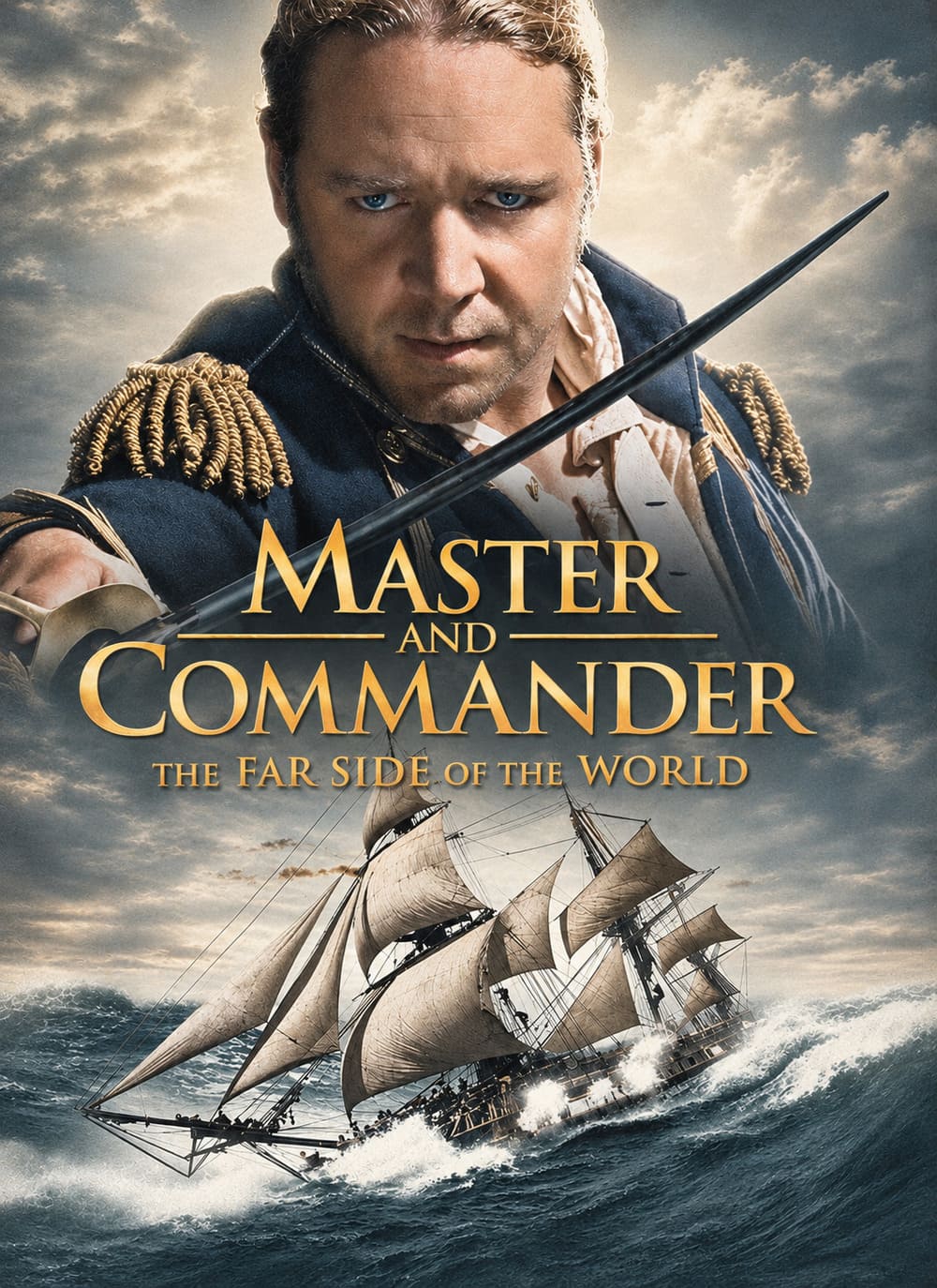
“This is the second time he’s done this to me. There will not be a third.” — Jack Aubrey
A lesser adventure movie would treat the ocean as empty space between battles. In Peter Weir’s Master and Commander: The Far Side of the World, it becomes an entire way of life. Meals, friendships, work, and terrible injuries all happen within the same cramped wooden walls, with nowhere to go when things get uncomfortable. That sense of confinement makes the film surprisingly absorbing. The cannon fire is exciting, but so is watching people figure out how to live together under pressure. What starts as a pursuit of an enemy ship gradually becomes a closer look at the man who refuses to let that enemy escape.
The film draws from the first and tenth books in Patrick O’Brian’s Aubrey–Maturin series, Master and Commander and The Far Side of the World, with the tenth supplying most of the central storyline. Rather than closely following the opening novel and introducing its characters from the beginning, Weir places us inside an established friendship and a working shipboard community. That choice gives the adaptation a lived-in quality. Aubrey and Maturin already have habits, disagreements, and ways of understanding each other that do not need explaining. We learn about their relationship by watching it function, which is more engaging than having their history handed to us.
Russell Crowe’s Captain Jack Aubrey commands HMS Surprise during the Napoleonic Wars. His target is the Acheron, a French privateer with enough speed and firepower to make their encounter seriously uneven. Weir establishes that imbalance through a brutal opening attack rather than a long explanation. The Surprise takes a beating, and suddenly the captain’s confidence has to compete with the evidence of shattered timber and injured men. Aubrey survives, but he cannot simply move on. Catching the Acheron becomes unfinished business, and everyone aboard gets pulled into his determination to settle it. The chase supplies the plot, but his reasons for continuing it supply the tension.
Crowe is a huge part of why this works. He gives Aubrey an easy authority that makes the crew’s loyalty believable. This captain can share a joke, appreciate a good meal, and make difficult decisions without appearing to switch between different personalities. There is warmth beneath his command, but also an expectation that his judgment will prevail. Crowe makes both sides convincing. You understand why the men feel safer with him in charge, even when he is asking them to do something dangerous. His confidence is attractive, and the film lets us enjoy it before making us consider its limits.
Those limits become clearer as Aubrey’s obsession with tracking down the Acheron builds. His assignment gives him a legitimate reason to pursue the French privateer, but the chase gradually becomes tangled up with his pride. Being beaten at his own game bothers him more than he wants to admit. Each setback seems to strengthen his need to prove that he can win. What makes this unsettling is how calmly he justifies himself. He never stops being intelligent or capable. Instead, military reasoning and personal ambition become difficult to separate. He can explain why the pursuit matters, but that does not mean he fully understands why it matters so much to him.
The person most willing to challenge him is Stephen Maturin, the ship’s surgeon and Aubrey’s close friend. Paul Bettany brings a dry, thoughtful quality to the role that plays beautifully against Crowe’s confidence. Maturin sees the wounded bodies behind the captain’s calculations, so arguments about duty are never purely theoretical for him. His scientific interests also give him priorities beyond the conflict. Where Aubrey sees a destination or a tactical advantage, Maturin notices something worth studying. Their disagreements make the voyage feel larger than its military objective. There is a whole world around them, even when Aubrey seems determined to reduce it to the distance between two ships.
Thankfully, the film does not turn their friendship into a series of lectures. Their shared musical sessions reveal a companionship that exists independently of whatever disagreement they are having. These scenes feel relaxed without becoming disposable. Watching them play together explains why they keep making room for each other despite their frustrations. Crowe and Bettany suggest familiarity through small changes in expression and tone rather than big emotional speeches. As a result, their arguments carry weight. They are not simply defending different opinions; they are testing how much disagreement a valued friendship can withstand, especially when one friend has the authority to overrule the other.
Weir gives the wider crew a similar sense of life beyond the plot. The Surprise feels like a workplace, a home, and an unforgiving social system all at once. Everyone has duties, everyone depends on someone else, and privacy barely seems to exist. Brief moments of joking or nervous conversation make the sailors feel individual without requiring formal introductions. The younger officers are especially affecting. Their uniforms and responsibilities cannot quite hide how young they are. Watching them try to behave bravely adds an uncomfortable edge to the adventure, because courage here is something children are already expected to demonstrate.
That attention to people makes the battles much more effective. By the time the guns start firing again, damage to the ship feels like damage to a community we recognize. The violence is messy and frightening rather than cleanly heroic. Splintering wood turns familiar spaces into hazards, while Maturin’s medical work makes the aftermath impossible to ignore. There is still plenty of excitement in watching a plan come together, but clever tactics do not erase their cost. Aubrey’s skill matters enormously, yet skill cannot guarantee that the people carrying out his orders will come through unharmed. Victory never feels quite as simple as being the better captain.
Just as importantly, the battles between the Surprise and the Acheron are exceptionally well-staged and executed. Weir makes the tactics understandable without draining the encounters of confusion or danger. You can follow the importance of positioning, timing, and coordinated work while still feeling how little separates an effective maneuver from disaster. The action moves between the larger contest at sea and the immediate struggle on deck, keeping strategy and physical consequences connected. There is a satisfying sense that the sailors’ everyday routines have prepared them for these moments. All that hauling, drilling, and following orders becomes the machinery that gives Aubrey’s ideas a chance of succeeding.
The climactic confrontation brings those strengths together, but its most satisfying ingredient comes from an unexpected place: Maturin’s interest in nature. Aubrey takes a couple of pages from his friend’s observations of camouflage and disguises the Surprise as a vulnerable whaling ship, hoping to lure the Acheron close enough to overcome its advantages. It is a clever solution because it grows out of the relationship rather than arriving as a last-minute burst of genius. After allowing the pursuit to overshadow Maturin’s scientific interests, Aubrey finds something useful in the very subjects he has been too impatient to appreciate.
That connection gives the final battle more meaning than a straightforward test of firepower. Aubrey succeeds by adapting, looking beyond his usual expertise, and recognizing the value of another person’s perspective. The plan offers a small but important counterpoint to his stubbornness: his confidence becomes more productive when it leaves room for curiosity. Meanwhile, the execution delivers the excitement the long pursuit has promised. Preparation gives way to sudden violence, and the fighting feels close, exhausting, and dangerous. The deception may create an opening, but it does not make the confrontation easy. Weir lets the tactical payoff and the human cost occupy the same scene.
Outside the fighting, the contrast between the crowded ship and the enormous ocean remains one of the film’s strongest features. Inside, everything feels close enough to touch. Outside, the water seems capable of swallowing the whole enterprise without noticing. The storms sharpen that contrast by presenting a threat Aubrey cannot intimidate or defeat through determination alone. His experience can improve their chances, but it cannot give him complete control. That limitation matters in a story about a man accustomed to trusting himself. Nature keeps reminding him—and us—that confidence is not the same thing as power, however reassuring it may look from the deck.
The film’s patience will not work for everyone. Some stretches linger over routine or scientific curiosity when a more conventional action movie would hurry toward another confrontation. The Galápagos sequences are the clearest example, shifting attention toward Maturin’s interests and slowing the pursuit. For me, that breathing room mostly pays off. It makes the world feel worth exploring rather than merely crossing, and the later camouflage strategy gives those observations a satisfying place in the adventure. Occasionally, the contrast between the two friends feels a little neatly arranged. Still, removing those quieter passages would leave a faster movie with much less personality and far less reason to care about its outcome.
By the end, the Surprise feels less like a spectacular movie location than a place whose routines you have learned. You understand why these men need their captain, why his friendship with Maturin matters, and why his certainty can be reassuring and dangerous at the same time. That is what gives Master and Commander: The Far Side of the World its staying power. Weir delivers the adventure without treating the people as equipment needed to stage it. The battles draw you in, but the lasting pleasure is the company—even when the man setting the course makes you nervous about where everyone is headed.

