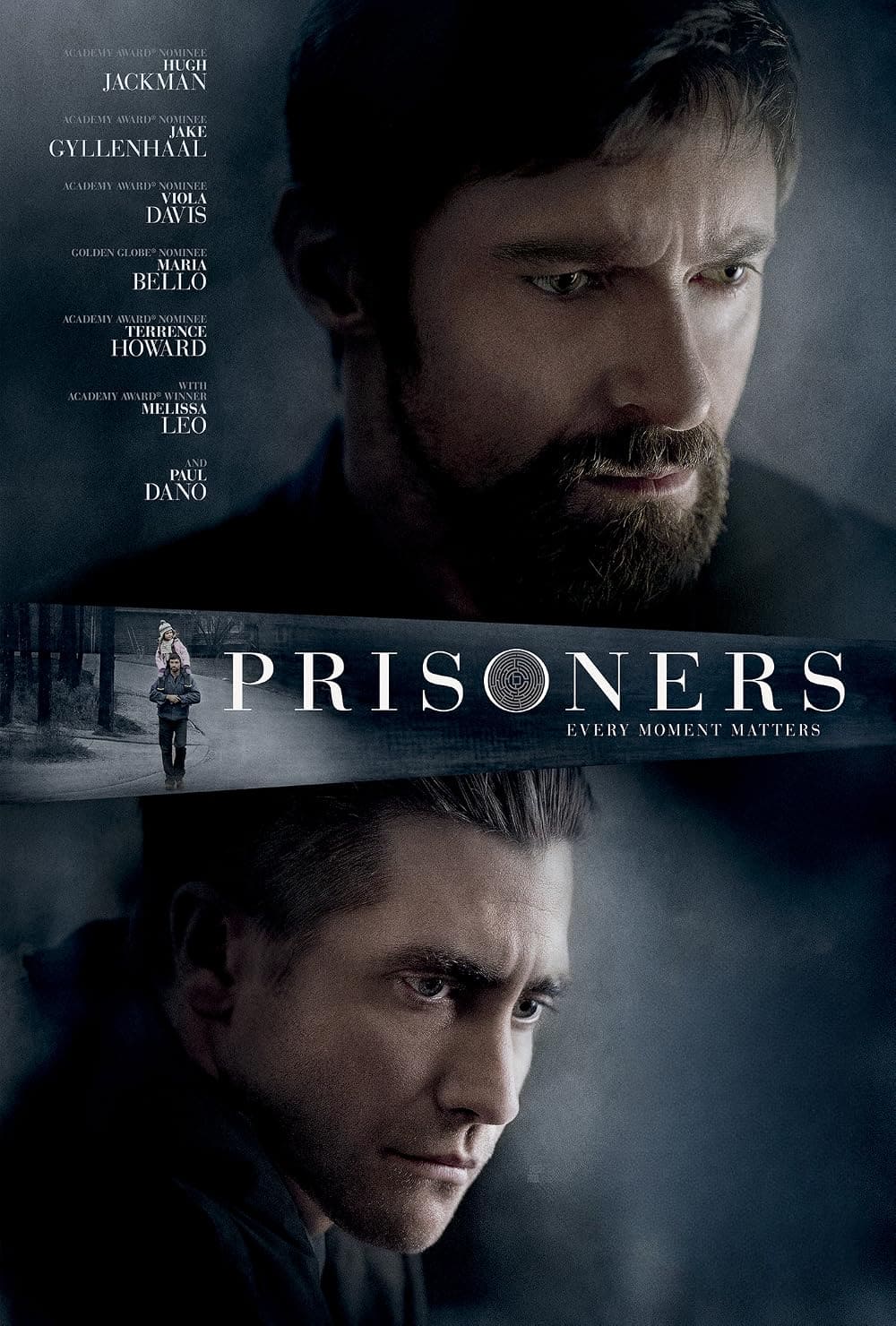
“He’s not a person anymore. He stopped being a person when he took our daughters.” — Keller Dover
There’s a point in Prisoners (2013) when waiting starts to feel like the most unbearable thing a person could do. A child is missing, answers aren’t coming, and every passing hour makes restraint seem harder to defend. Denis Villeneuve builds his thriller around that pressure, then asks what happens when someone mistakes the need to act for the right to do anything. The result is gripping, ugly, and emotionally exhausting in ways that go beyond its kidnapping mystery. It’s a film about a father trying to rescue his daughter while steadily losing the ability to judge himself.
The nightmare begins when two young girls disappear during Thanksgiving. Their families scramble for answers, and suspicion falls on Alex Jones, a young man whose RV was parked nearby. Detective Loki, played by Jake Gyllenhaal, questions him, but the police don’t have enough evidence to hold him. Keller Dover, played by Hugh Jackman, cannot accept his release. Convinced Alex knows where his daughter is, Keller abducts him and begins torturing him for information. What he considers a necessary response to an emergency becomes a second crime unfolding alongside the one he wants to solve.
Keller’s reasoning is frightening because its starting point is understandable. His daughter might be suffering, and he cannot bear to imagine himself standing around while there’s still a chance to help her. But he turns that fear into a false choice: either he hurts Alex, or he fails his child. Once he accepts those as the only options, cruelty starts looking like duty. The film’s strongest insight is that terrible choices don’t always feel terrible to the people making them. Sometimes they feel like the only responsible thing left to do.
That thinking grows out of Keller’s identity as someone who prepares for disaster. He stores supplies, anticipates danger, and treats protecting his family as a responsibility that demands constant vigilance. His daughter’s disappearance makes all that preparation feel useless. He has built his life around being ready, only to discover that readiness cannot guarantee safety. Holding Alex captive gives him something he can control when everything else feels beyond his reach. He can set the conditions and demand a response. It doesn’t mean he’s getting closer to his daughter, but it lets him feel less helpless.
Jackman makes that helplessness visible even when Keller is at his most intimidating. The shouting and physical aggression are forceful, but the performance works because they never completely conceal his panic. He looks like a man trying to force the world back into a shape he recognizes. There’s also an increasingly stubborn quality to his behavior, as though admitting doubt would bring the whole structure crashing down. Jackman lets us understand Keller’s anguish without asking us to confuse it with innocence. His grief is real, and so is the suffering he chooses to inflict.
The longer Keller holds Alex, the more his obsession protects itself from challenge. Silence becomes evidence that Alex is hiding something. Confusion becomes a refusal to cooperate. The failure to produce useful information becomes an argument for more violence rather than a reason to reconsider. Paul Dano makes this painful to watch, giving Alex an unreadability that never cancels out his vulnerability. Keller believes he is stripping away deception, but he is actually making it impossible for anything to contradict him. He wants an answer, yet he has already decided which answer he will accept.
The film also understands that crossing a moral line can make retreat harder rather than easier. If Keller stops, he has to face the possibility that his actions were pointless as well as cruel. Continuing allows him to postpone that reckoning. His obsession becomes partly about finding his daughter and partly about proving that everything he has done belongs to a rescue mission. That’s an especially uncomfortable idea: people can become more committed to a terrible decision because of the damage it has already caused. The cost becomes their reason to keep going.
Terrence Howard and Viola Davis, playing the other missing girl’s parents, widen that conflict beyond Keller’s individual behavior. Their characters share his desperation, but their responses expose the difference between being horrified by violence and actually intervening. Fear makes compromise tempting, especially when someone else is willing to do the thing you can barely stand to consider. These scenes aren’t as explosive as Jackman’s, but they matter. They show how an obsession can draw other people into its logic, asking them to accept one more violation because this might finally be the one that produces answers.
Gyllenhaal gives Loki a different kind of intensity. His tense posture, restless blinking, and clipped exchanges suggest someone working hard to contain frustration. He isn’t an emotionless representative of procedure; he cares about finding the girls, and the lack of progress clearly weighs on him. What separates him from Keller is the need to keep investigating uncertainty rather than erase it through conviction. Gyllenhaal makes that effort compelling. The contrast challenges Keller’s assumption that restraint means indifference, or that the person willing to go furthest must be the person who cares most.
Villeneuve’s patient direction makes the waiting feel oppressive without turning Keller’s violence into a satisfying release. The cold surroundings and gloomy interiors seem to drain comfort from ordinary places. Scenes linger long enough for us to register the consequences rather than simply anticipate the next clue. The mystery does become elaborate, and some developments feel more engineered than the emotional conflict around them. Still, the performances keep pulling the film back toward something painfully human. Its most effective suspense comes from wondering not just what Keller will do next, but what he will tell himself afterward.
By the end, Prisoners has made action itself feel morally complicated. Doing something isn’t automatically better than waiting, especially when the action depends on treating doubt as weakness and another person’s suffering as an acceptable expense. That’s what gives the film its staying power beyond the mechanics of its mystery. Keller wants to be the father who never gives up, but he stops distinguishing perseverance from destruction. Villeneuve leaves that confusion exposed rather than making it noble. The hardest thing to watch isn’t a man abandoning his principles. It’s a man convincing himself that violating them is how he proves they matter.