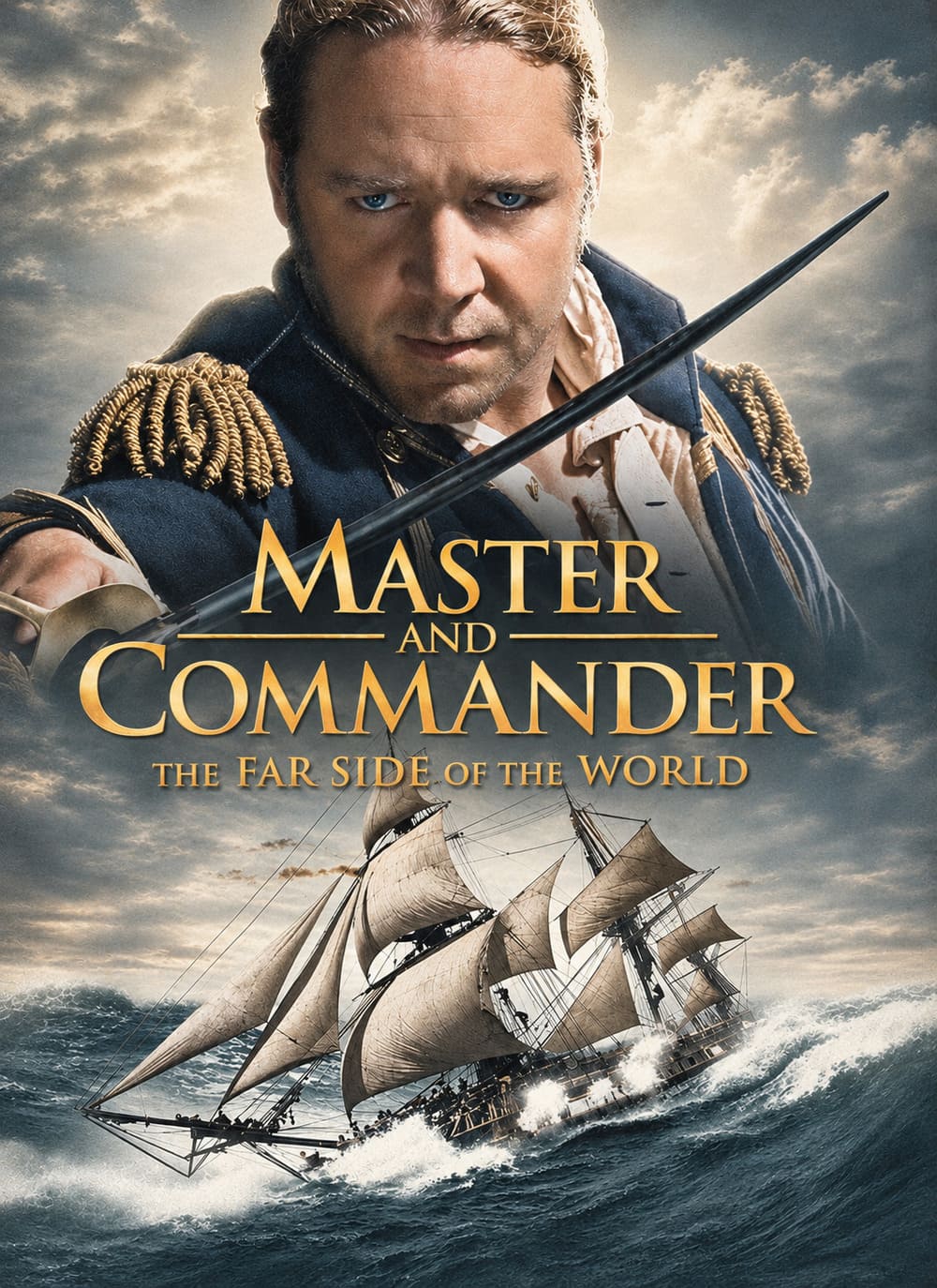
Master and Commander: The Far Side of the World (dir. by Peter Weir) Review


“This is the second time he’s done this to me. There will not be a third.” — Jack Aubrey

A lesser adventure movie would treat the ocean as empty space between battles. In Peter Weir’s Master and Commander: The Far Side of the World, it becomes an entire way of life. Meals, friendships, work, and terrible injuries all happen within the same cramped wooden walls, with nowhere to go when things get uncomfortable. That sense of confinement makes the film surprisingly absorbing. The cannon fire is exciting, but so is watching people figure out how to live together under pressure. What starts as a pursuit of an enemy ship gradually becomes a closer look at the man who refuses to let that enemy escape.

The film draws from the first and tenth books in Patrick O’Brian’s Aubrey–Maturin series, Master and Commander and The Far Side of the World, with the tenth supplying most of the central storyline. Rather than closely following the opening novel and introducing its characters from the beginning, Weir places us inside an established friendship and a working shipboard community. That choice gives the adaptation a lived-in quality. Aubrey and Maturin already have habits, disagreements, and ways of understanding each other that do not need explaining. We learn about their relationship by watching it function, which is more engaging than having their history handed to us.

Russell Crowe’s Captain Jack Aubrey commands HMS Surprise during the Napoleonic Wars. His target is the Acheron, a French privateer with enough speed and firepower to make their encounter seriously uneven. Weir establishes that imbalance through a brutal opening attack rather than a long explanation. The Surprise takes a beating, and suddenly the captain’s confidence has to compete with the evidence of shattered timber and injured men. Aubrey survives, but he cannot simply move on. Catching the Acheron becomes unfinished business, and everyone aboard gets pulled into his determination to settle it. The chase supplies the plot, but his reasons for continuing it supply the tension.

Crowe is a huge part of why this works. He gives Aubrey an easy authority that makes the crew’s loyalty believable. This captain can share a joke, appreciate a good meal, and make difficult decisions without appearing to switch between different personalities. There is warmth beneath his command, but also an expectation that his judgment will prevail. Crowe makes both sides convincing. You understand why the men feel safer with him in charge, even when he is asking them to do something dangerous. His confidence is attractive, and the film lets us enjoy it before making us consider its limits.

Those limits become clearer as Aubrey’s obsession with tracking down the Acheron builds. His assignment gives him a legitimate reason to pursue the French privateer, but the chase gradually becomes tangled up with his pride. Being beaten at his own game bothers him more than he wants to admit. Each setback seems to strengthen his need to prove that he can win. What makes this unsettling is how calmly he justifies himself. He never stops being intelligent or capable. Instead, military reasoning and personal ambition become difficult to separate. He can explain why the pursuit matters, but that does not mean he fully understands why it matters so much to him.

The person most willing to challenge him is Stephen Maturin, the ship’s surgeon and Aubrey’s close friend. Paul Bettany brings a dry, thoughtful quality to the role that plays beautifully against Crowe’s confidence. Maturin sees the wounded bodies behind the captain’s calculations, so arguments about duty are never purely theoretical for him. His scientific interests also give him priorities beyond the conflict. Where Aubrey sees a destination or a tactical advantage, Maturin notices something worth studying. Their disagreements make the voyage feel larger than its military objective. There is a whole world around them, even when Aubrey seems determined to reduce it to the distance between two ships.

Thankfully, the film does not turn their friendship into a series of lectures. Their shared musical sessions reveal a companionship that exists independently of whatever disagreement they are having. These scenes feel relaxed without becoming disposable. Watching them play together explains why they keep making room for each other despite their frustrations. Crowe and Bettany suggest familiarity through small changes in expression and tone rather than big emotional speeches. As a result, their arguments carry weight. They are not simply defending different opinions; they are testing how much disagreement a valued friendship can withstand, especially when one friend has the authority to overrule the other.

Weir gives the wider crew a similar sense of life beyond the plot. The Surprise feels like a workplace, a home, and an unforgiving social system all at once. Everyone has duties, everyone depends on someone else, and privacy barely seems to exist. Brief moments of joking or nervous conversation make the sailors feel individual without requiring formal introductions. The younger officers are especially affecting. Their uniforms and responsibilities cannot quite hide how young they are. Watching them try to behave bravely adds an uncomfortable edge to the adventure, because courage here is something children are already expected to demonstrate.

That attention to people makes the battles much more effective. By the time the guns start firing again, damage to the ship feels like damage to a community we recognize. The violence is messy and frightening rather than cleanly heroic. Splintering wood turns familiar spaces into hazards, while Maturin’s medical work makes the aftermath impossible to ignore. There is still plenty of excitement in watching a plan come together, but clever tactics do not erase their cost. Aubrey’s skill matters enormously, yet skill cannot guarantee that the people carrying out his orders will come through unharmed. Victory never feels quite as simple as being the better captain.

Just as importantly, the battles between the Surprise and the Acheron are exceptionally well-staged and executed. Weir makes the tactics understandable without draining the encounters of confusion or danger. You can follow the importance of positioning, timing, and coordinated work while still feeling how little separates an effective maneuver from disaster. The action moves between the larger contest at sea and the immediate struggle on deck, keeping strategy and physical consequences connected. There is a satisfying sense that the sailors’ everyday routines have prepared them for these moments. All that hauling, drilling, and following orders becomes the machinery that gives Aubrey’s ideas a chance of succeeding.

The climactic confrontation brings those strengths together, but its most satisfying ingredient comes from an unexpected place: Maturin’s interest in nature. Aubrey takes a couple of pages from his friend’s observations of camouflage and disguises the Surprise as a vulnerable whaling ship, hoping to lure the Acheron close enough to overcome its advantages. It is a clever solution because it grows out of the relationship rather than arriving as a last-minute burst of genius. After allowing the pursuit to overshadow Maturin’s scientific interests, Aubrey finds something useful in the very subjects he has been too impatient to appreciate.

That connection gives the final battle more meaning than a straightforward test of firepower. Aubrey succeeds by adapting, looking beyond his usual expertise, and recognizing the value of another person’s perspective. The plan offers a small but important counterpoint to his stubbornness: his confidence becomes more productive when it leaves room for curiosity. Meanwhile, the execution delivers the excitement the long pursuit has promised. Preparation gives way to sudden violence, and the fighting feels close, exhausting, and dangerous. The deception may create an opening, but it does not make the confrontation easy. Weir lets the tactical payoff and the human cost occupy the same scene.

Outside the fighting, the contrast between the crowded ship and the enormous ocean remains one of the film’s strongest features. Inside, everything feels close enough to touch. Outside, the water seems capable of swallowing the whole enterprise without noticing. The storms sharpen that contrast by presenting a threat Aubrey cannot intimidate or defeat through determination alone. His experience can improve their chances, but it cannot give him complete control. That limitation matters in a story about a man accustomed to trusting himself. Nature keeps reminding him—and us—that confidence is not the same thing as power, however reassuring it may look from the deck.

The film’s patience will not work for everyone. Some stretches linger over routine or scientific curiosity when a more conventional action movie would hurry toward another confrontation. The Galápagos sequences are the clearest example, shifting attention toward Maturin’s interests and slowing the pursuit. For me, that breathing room mostly pays off. It makes the world feel worth exploring rather than merely crossing, and the later camouflage strategy gives those observations a satisfying place in the adventure. Occasionally, the contrast between the two friends feels a little neatly arranged. Still, removing those quieter passages would leave a faster movie with much less personality and far less reason to care about its outcome.

By the end, the Surprise feels less like a spectacular movie location than a place whose routines you have learned. You understand why these men need their captain, why his friendship with Maturin matters, and why his certainty can be reassuring and dangerous at the same time. That is what gives Master and Commander: The Far Side of the World its staying power. Weir delivers the adventure without treating the people as equipment needed to stage it. The battles draw you in, but the lasting pleasure is the company—even when the man setting the course makes you nervous about where everyone is headed.
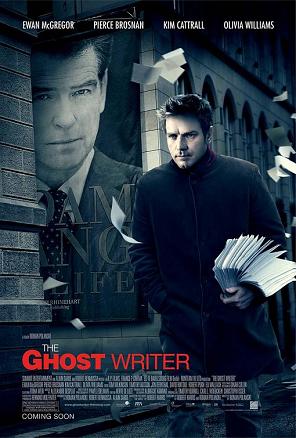
Shattered Politics #87: The Ghost Writer (dir by Roman Polanski)


GhostwriterlargeIn the 2010 film The Ghost Writer, Ewan McGregor plays a character known as the Ghost. We never actually learn the name of his character and that’s perhaps appropriate.  The Ghost has made his living by being anonymous.  He’s a ghost writer.  He’s the guy who is hired to help inarticulate and occasionally illiterate celebrities write best-selling biographies.

The Ghost has been given a new assignment.  He is to ghost write the memoirs of former British Prime Minister Adam Lang (Pierce Brosnan).  Despite the fact that Adam is one of the most famous men in the world, the Ghost is not initially enthusiastic about working with him.

First off, there’s the fact that Adam and his wife, Ruth (Olivia Williams), are currently hiding out in America because America is one of the few countries that will not extradite him to be prosecuted for war crimes at the International Criminal Court.  It seems that Adam (much like Tony Blair) is a controversial figure because of some of the actions he may have authorized as a part of the war on terror.  Not only does the Ghost have political objections to working with Adam but he has to leave his London home and go to Massachusetts in order to do so.

Secondly, there’s the fact that, once the Ghost arrives in America, he discovers that — for such a controversial figure — Adam is actually rather boring and seems to have very little knowledge about anything that he did while he was prime minister.  Instead, he seems to be more interested in spending time with his mistress (Kim Cattrall, giving the film’s one bad performance).  Ruth seems to be the political (and smart) one in the marriage.

And finally, there’s the fact that the Ghost is actually the second writer to have worked with Adam.  The previous writer mysteriously drowned.  While that death was ruled to be an accident, the Ghost comes to suspect that it was murder and that the motive is hidden in the first writer’s manuscript…

The Ghost Writer is a favorite of mine, a smart and witty political thriller that features great performances from Ewan McGregor, Olivia Williams, and Pierce Brosnan.  Brosnan especially seems to be having a lot of fun sending up his dashing, James Bond image.  Roman Polanski directs at a fast pace and maintains a perfect atmosphere of growing paranoia throughout the entire film. In the end, The Ghost Writer proudly continues the tradition of such superior paranoia films as The Conversation, Three Days of the Condor, and the Parallax View.

Incidentally, I have a theory that Adam Lang was also the unseen Prime Minister who was featured in Into the Loop.  Watching The Ghost Writer, it’s hard not to feel that Adam really feel apart without Malcolm around to help him out.


Review: Game of Thrones S2E03 “What Is Dead May Never Die”


“For they are the Knights of Summer and Winter is coming.” — Catelyn Stark

Yes, they are the Knights of Summer and Winter is coming. It’s a foreboding observation made by Catelyn Stark as she visits Renly Baratheon who also happens to be one of the five kings jockeying for control of parts or all of the Kingdom of Westeros. It’s an observation that perfectly fits tonight’s episode (third of the new season) as we see characters who are either better prepared for the war coming or still just playing at war. It’s a war that doesn’t just fit North versus South or Ironborn versus Wolves, but a war that’s coming straight down from beyond the Wall to engulf everyone in the kingdom no matter one’s allegiances.

“What Is Dead May Never Die” is part of the religious ritual performed by those of House Greyjoy and those who live and die on the Iron Isles. We see Theon Greyjoy having to prove himself worthy of his father and family’s trust that he is still an Ironborn and not the throwaway son turned soft by the Wolves of the North. It doesn’t help Theon’s confidence that his own sister Yara (forever Asha in my opinion) has been put above him in both succession and power by the very father who gave him up and bent knee to the people who he grew up with. He’s a prodigal son whose return to his family is not just wanted but ridiculed. Whether his taking of the oaths to become Ironborn in the ceremony of the Drowned God will show his true allegiance or further show that his father was correct about him and how he has changed from one who “Doesn’t Sow” to someone who has turned soft through the teachings of the Wolves and the Westerosi.

Theon is definitely not ready for the true war about to descend on Westeros.

In Winterfell, we get a brief interlude with Bran confessing to Maester Luwin about his peculiar dream where he sees himself running through the Godswood but not as himself but as an animal (most likely his direwolf Summer). This part of tonight’s episode once again shows that while the show hasn’t been focusing very much on the supernatural and magic which seem to still exist in Westeros and beyond it is definitely going to be part of the main narrative being spun since season one. Bran has begun to accept that he is more than just a young boy playing as lord of his House, but someone who has been tapping into something old and clearly forgotten (or dismissed as old supersitions by many). It’s a thing of the Children of the Forest and something that doesn’t frighten Bran. Even in this interlude we see Bran as someone more prepared for the true nature of the winter coming while those he looks to for counsel remain still a knight of summer.

While we’re up north, we finally get to see Jon Snow’s fate after last week’s episode. He’s definitely not dead, but he probably wishes he was as Craster evicts all the Night’s Watch from his home after Jon’s curiosity about what happens to boys born from Craster’s incestuous pairings with his daughter-wives. The reaction he was hoping to get from his Lord Commander wasn’t what he expected. Once again Jeor Mormont gives Jon a lesson in leadership and how with it comes the responsibility of having to make some very tough decisions for the greater good. A greater good that sometimes supersedes the evil next door as long as it that evil remains a convenient ally North of the Wall. It is a lesson that could go a long way into making Jon someone truly prepared for the Winter that is coming or fail to temper his idealism and put him on the path of failure.

But the true signs of power being wielded comes from characters in the South.

At The Reach we see Renly Baratheon and his queen, Margaery Tyrell (played by Natalie Dormer), holding court at a knight’s tournament where we also see the introduction of fan favorite (of the books, at least) Brienne of Tarth. A lady knight who seem to best even the talented Knight’s Flower, Loras Tyrell, and thus earn the right to become one of Renly’s Seven Kingsguard. It is not Brienne’s ability to fight the coming conflict that we see in this part of tonight’s episode but that of two powerful women trying to guide their respective king’s through the murky and dangerous waters of power. On one hand, we have Catelyn Stark who has arrived to offer terms of alliances with Renly for her son Robb Stark. On the other side we have Margaery Tyrell whose grasp of political intrigue surpasses that of her husband king and could be more than a match for both Catelyn and Cersei over at King’s Landing.

Catelyn doesn’t seem overly impressed by Renly’s show of power or his declaration that he has under his command over a hundred thousand men ready to march toward’s King’s Landing and take the Iron Throne and/or that of Joffrey’s head. What Catelyn sees around her are the Knight’s of Summer. Young men as bold and full of idealistic fire as their king, but wholly unprepared for the true nature and horrors that war brings. It doesn’t matter whether it’s war against the Lannisters or the true war that the gathering wildlings would give everyone south of the Wall. In the end, Catelyn Stark knows that for all the pomp and shows of strength that Renly has displayed at her arrival would count for nothing if their unpreparedness gets everyone butchered. To say that this doesn’t sit well with the young king would be an understatement.

Then there’s Margaery Tyrell who knows more about her husband’s personal proclivities in the bedroom than he thought she knew. She understands that despite the men rallying to Renly’s banner his hold on power remains tenuous if he’s unable to secure a line of succession by conceiving a son with her. This would be a difficult proposition considering how much Renly prefers Margaery’s brother Loras, but showing some iron strength as a queen she’s willing to do whatever it takes to give Renly that very son to secure their hold on the Iron Throne. She’s go to such lengths that she’ll invite Loras to their bedchamber if that would make Renly perform his kingly duties more comfortably.

Catelyn Stark and Margaery Tyrell may be two women who don’t wield weapons of war on the field, but they show that they’re two individuals who know the stark realities of the current state of the kingdom and more than willing to do the necessary steps to ensure success for their respective rulers. They’re definitely not knights of summer.

Finally, we return to King’s Landing where one Tyrion Lannister has begun to flex the very power that the Hand of the King wields in the kingdom. He may be sitting in the role because his father is off fighting Robb Stark, but Tyrion fully intends to do the job without interference from those inside the castle whose allegiance is more with his sister Cersei than with him. Tyrion has shown that while he detest having to play around in the circles of power in King’s Landing he has grown to be quite adept to it. His plan to root out Cersei’s spies amongst the Small Council was the highlight of tonight’s episode. His manipulation of Maester Pycelle, Varys and Littlefinger was some of the best performances Peter Dinklage has had in the role of Tyrion. With his plans and sting Tyrion has shown not just Cersei that he was someone not to be trifled with and at the same time show that he more than knows how the Game of Thrones works and as good playing such a dangerous game as Cersei, Varys or Littlefinger. He may have made enemies with those involved, but he’s also put them on notice that he is once again not Ned Stark and he may be better at this game than them.

The episode ends not with a character exercising their power over others or failing to do so, but of one of the youngest beginning to understand that in times of war even the young must begin to set aside childish things for hardship and violence. It is fitting that we see the episode end with Arya as she loses another valued mentor to violence, but shows her capacity to play those who think they have power over her. It’s another step that fans of the book will recognize that would lead this fan favorite (of both show and book) to places and sights, seen and unseen, that would make her one of the most important characters in George R.R. Martin’s medieval fantasy saga.

Notes

  • Great performance by James Cosmo as Lord Commander Jeor Mormont in the scene with Jon Snow after Craster kicks them out of his home. We see the weight of command of the Night’s Watch etched in every line on his weather-beaten face as he Jon’s news about what Craster does with newborn baby boys doesn’t come as a surprise. This is a man who pragmatism has become his new religion as he sees their true war against those North of the Wall has superseded what idealism he might have had when he first arrived on the Wall. This dawns on Jon Snow’s face during their conversation and it’ll be interesting if Jon sees what could happen to him when he looks at Jeor Mormont.
  • A sweet moment with Sam and Gilly, one of Craster’s young daughter-wives.
  • We have a Hodor sighting! HODOR! HODOR! HODOR!
  • We get the introduction of two new faces to the growing cast this second season: Natalie Dormer as Margaery of House Tyrell and Gwendoline Christie as the very imposing Brienne of Tarth.
  • Dormer definitely makes quite a first appearance as Margaery in something that Jennifer Lopez would consider quite the daring fashion. The fact that even with such a plunging neckline it doesn’t detract from the skill and power she wields to keep her peculiar husband from misstepping when it comes to prosecuting the war against King Joffrey (most likely against his older brother Stannis as well) and cementing their hold on the Iron Throne with a clear line of succession.
  • Christie’s first appearance as Brienne of Tarth was pitch perfect. This was a role that fans of the novels were going to scrutinize from the time it was announced who would play the Brienne the Beauty to how she would look in her knight’s armor. When I say she’s quite imposing it wasn’t being colored by hyperbole. She literally towers over Loras and Renly and probably most of the men in the scene she was in. She shows the same stance towards honor and duty tha Ned Stark showed during season 1. Time will tell whether this honor and duty-bound warrior would suffer the same fate as Ned Stark before the war sees it’s end.
  • We get a Sansa Stark sighting. Sophie Turner continues to play the role of Joffrey’s hesistant queen beautifully. People may hate her for how she acted during most of season 1, but this season has shown that Sansa has learned to navigate the dangerous corridors of King’s Landing in order to keep her true feelings about Joffrey, Cersei and the Lannisters from getting her killed. Like Theon, she becomes more and more sympathetic with each appearance this season.
  • Peter Dinklage is the man. The Emmy’s should just put his name on the best supporting actor in a drama series (or maybe on best lead actor) in the next awards show. His scenes with Pycelle, Varys, Littlefinger and Cersei wasn’t just fun to watch but a marvel as well.
  • Outmaneuvering the slippery Littlefinger made for quite the verbal joust between Dinklage and Aiden Gillen. It must be such a blow to Littlefinger’s ego to have not just one Lannister show where true power lies, but now a second has manipulated him not through violence but through intrigue.
  • Interesting to note how Tyrion treats the whores he comes across with more respect and care than those in power he finds himself surrounded with.
  • Tyrion and Varys may not like each other but tonight’s episode shows that they have come to respect each other’s abilities. Quite the odd couple the two make.
  • The show continues to show more than imply the relationship between Renly and Loras. Some fans of the books may howl at this, but it made the scene which comes after Loras leaves Renly’s bedchamber that much more powerful as Margaery literally throws Renly’s relationship with her brother back at her king and doesn’t see anything wrong with it as long as he performs his kingly duty with her. Loras may be the Knight’s Flower of Highgarden but Margaery is the true steel of this House.
  • Once again Gemma Whelan continues to impress in the role of Yara Greyjoy. She continues to be one of the stronger new faces this season. Her treatment of Theon in tonight’s episode has made who had been an annoying hanger-on to Robb Stark with a wide streak of misogyny to someone brought low by his family less than gracious welcome. We’re seeing in how Gemma Whelan plays Yara why Balon Greyjoy prefers her over his only son, but at the same time she has also made Theon a sympathetic figure.
  • While Theon continues to get browbeaten by both Yara and Balon he at least gets a shot in at Balon. He reminds the old man that for all his talk of the Greyjoy’s taking what they want he’s still somewhat of a hypocrite for bending knee to Robert Baratheon after his failed rebellion a decade’s past. Not just bending knee but giving up his remaining son to live amongst the very people who defeated him.
  • His decision in the end to take the oath and not warn Robb puts Theon on a collision course with the very person he calls brother and a House he’s known longer than his own birth.
  • “What is dead may never die but rises again.”
  • This Drowned God ritual takes on a more symbolic gesture than how it appears in the novels which literally involves
  • Yoren of the Night’s Watch, just like Syrio Forel of Braavos, you went out like a BOWSE. Arya may have lost another badass mentor, but she’s now been taught by them both how to survive and tell death not today.
  • Jaqen H’ghar appears briefly and I wouldn’t be surprised if he shows up more as the season continues.
  • Gendry is going to miss that bull’s helm.
  • Last and most important observation, the men may hold the power in Westeros but there seem to be a very powerful woman standing behind each and every throne and seat of power: Catelyn Stark with Robb, Melisandre with Stannis, Margaery with Renly and Cersei with Joffrey.

Review: Game of Thrones S2E02 “The Night Lands”


“You shouldn’t insult people bigger than you.” — Gendry

Tonight’s episode of Game of Thrones saw some major power plays from old stalwarts fans have grown to love since season 1 and from newly introduced character from this season’s premiere episode. The show has continued to go on its own pace with some episode bereft of action and heavy on character interactions and exposition. Tonight’s episode was one of them.

“The Night Lands” was tonight’s episode and it comes from the Dothraki term for death. It’s interesting to note that the title itself didn’t lead to much death with tonight’s episode. What it did was set-up plans that would lead to the death of hundreds, if not thousands, and also reveal that all the power plays all the self-proclaimed kings and queens south of the wall will be for naught if the true danger posed by the gathering wildlings north of the Wall doesn’t get it’s due focus. Then there’s the problem of a long winter arriving and with it the prospect of the Others (renamed White Walkers for the show) posing the greatest danger to everyone on Westeros, if not, the world itself.

Tonight’s episode gave quality time, some of it brief, to several characters. We got to see the continuing hardship being felt by Daenerys and her khalasar as they travel the Red Waste. Their very privations would get compounded by the dangers posed by rival khals led by the very commanders who once called Daenerys’ husband, Khal Drogo, their liege. She had the briefest time during tonight’s episode but we got to see some growth to her becoming a true leader as she refuses to run from the very people hunting her for just being a leader in a land where men have always held power.

We also get an exercise in personal power from Littlefinger who was rudely disabused by Queen Regent Cersei that for all his talk about knowledge being the source of power in the end he held no more than what’s allowed him by those who are of higher station and of noble birth. Littlefinger gets back a semblance of his personal power by telling quite a horrific tale to his favorite whore in Ros. One who has earned his disfavor by not doing well what he has trained and paid her to do. The quiet way Littlefinger tells the story of another whore of his in the past who failed to do her job and thus forced him to have her used and abused was chilling and definitely gave Ros the hint that she better shape up or the same would befall her.

A power play of another sort involved the plans and machinations of Ser Davos Seaworth has he successfully gets the pirate captain Salladhor Saan to commit his fleet of 30 ships to fight for Stannis Baratheon when they make for King’s Landing. While his loyalty towards Stannis is borne out of gratitude and one well-earned his son looks to be more loyal towards the new religion sweeping Dragonstone and Stannis followers. Even Stannis has begun to tire of Melisandre’s talk of faith in the Lord of Light to grant him the victory he so wants, but knows he cannot achieve unless he pries the 100,000 or so men who have pledge loyalty to Renly into his own army. Melisandre’s own move to cementing her influence and power over the elder brother plays upon Stannis’ longing to have a son his sickly wife hasn’t been able to give him. For all his talk of black-and-white when it comes to the realities of the world Stannis is still more than willing to deal with cutthroats and pirates. He’s even willing to forgo his marriage vow if it means Melisandre will give him the son he wants.

But tonight’s episode was about two men whose attempts to tip the balance of power in the kingdom and in the war was met with success for one and abject humiliation and defeat for another.

We finally get to see the Iron Islands from whence Theon Greyjoy’s family holds power and where he is returning home to offer King Robb Stark’s terms for an alliance against the Lannisters. Theon (played by Alfie Allen) has always come off as the wanna-be hanger on who thinks the leftover crumbs left by the Stark boys meant he has power and influence. He’s disabused of this notion when he gets a less than ostentatious welcome when he arrives on his land of birth. His penchant for bragging about his self-importance has made him into a lecherous joke when his initial encounter with his younger sister Yara (who he doesn’t recognize as such and thus his lame attempt at seduction makes for a very funny and uncomfortable scene) shows him to be soft, no iron in his make-up and a fool as well. His father, Balon Greyjoy, further insults his western ways and attire and parades Yara as his new heir and one worthy to lead the Greyjoy fleets. A fleet Theon had hoped would fight with Robb against the Lannister, but instead strike at a much more inviting and less defended target (not said but implied that Winterfell will soon get a visit from the men of the Iron Isles).

Farther south, we see Tyrion further cementing his power in the role his father has appointed him. While Tyrion has always seemed the one person in the whole series who sees the joke kings, queens and lords have made of themselves and the kingdom, he seem to be perfect in the role of the new Hand of the King. As he proclaims to Varys during their brief weighing of each other at his room in the castle, Tyrion is not Ned Stark. He knows how to play the game of thrones and he’s not honorable to fall for whatever plans Varys and others may have for and against him. He even exercises his new found power by banishing the Lord Commander of the City Watch (the Goldcloaks) Janos Slynt for his role in the massacre of King Robert’s bastard sons. Tyrion may be an imp who no one takes seriously and, who himself, doesn’t take his role as seriously as he thinks he should, but he draws the line when it comes to the slaughter of innocent babes and children. The fact that he has correctly guessed the pulse of the people has made him Cersei’s biggest ally in the Royal Court in reining in the power-mad King Joffrey, but familial resentment between sister and younger brother means Tyrion will forever by trying to clean up after his family and it’s a job that he knows he cannot hope to win.

Tonight’s episode was once again helmed by Alan Taylor who also directed the season premiere. Like that episode, tonight had the show moving from different points on the map. We go from North of the Wall to King’s Landing then to the Iron Isles, the Red Waste and Dragonstone. Taylor seems able to juggle these different threads that could easily have made tonight’s episode hard to follow. It’s a testament to Benioff and Weiss as writers to have been able to cram all these scenes together and make them easy to follow.

Next week’s episode sees a new director at the help and a new writer. It’d be interesting to see if the show can continue such a high level of execution without Taylor, Weiss and Benioff manning the till.

Notes

  • Tonight’s opening title sequence gets a new location added to it’s clockwork mechanism with the inclusion of Pyke on the Iron Isles.
  • It was great to see Arya getting some screen time as she deals with hiding as a boy with the rest of the caravan being led by Yoren to the Wall.
  • We get our first introduction to someone who will have a major impact in Arya’s future with the mysterious prisoner Jaqen H’ghar play by Tom Wlaschiha.
  • The elder brother-little sister dynamic growing between Arya and Gendry was also good to see especially with Arya’s whole world being turned upside down and her not knowing if her own brothers still live.
  • Bronn appear briefly to take over as the new Lord Commander of the City Watch and his brief dialogue between himself and Tyrion was a welcome sight. If they ever made a spin-off series about the adventures of Tyrion and Bronn it would be well-watched.
  • North of the Wall, Jon’s direwolf Ghost makes an appearance that looks better executed than the CGI used to enlarge Robb’s Greywind.
  • The introduction of one of Caster’s young daughter-wives (a piece of detail that’s sure to make many viewers disturbed for even knowing) and Sam as her potential savior is another brick laid down for the show’s future.
  • Interesting to note that Salladhor Saan is played by a black man instead of the fair-skinned man of Lys as originally described by Martin in the novels. I’m all for the change, but I’m sure the less-educated fans of the books would find the change none to their liking. I call it the “Hunger Games Rant”.
  • Great turn by Gemma Whelan as Yara Greyjoy (Asha Greyjoy in the books). Her manipulation of Theon was pitch-perfect especially during their disturbingly inappropriate horse ride to Castle Pyke.

Review: Game of Thrones S2E01 “The North Remembers”


“The night is dark and full of terrors old man, but the fire burns them all away.” — Melisandre

George R.R. Martin’s medieval fantasy epic novel series, A Song of Ice and Fire, made a triumphant debut on HBO with Game of Thrones in the Spring of 2010. The show was headed to be a big success due to the huge fan-base that have read and re-read the novels, but the show was able to attract those who wouldn’t know George R.R. Martin or his books. This was the show that further cemented the notion that genre has become the ruling king of quality tv.

A new season of Game of Thrones now arrives with the premiere episode titled “The North Remembers” and while it shows Robb Stark (now proclaimed King of the North by his bannerman and liegelords) flush with success against the forces of House Lannisters and thus King Joffrey at King’s Landing the episode also weaves in an ominous tone that looks to dominate this second season. It’s a season based mostly on the second novel in the series titled A Clash of Kings and tonight’s episode has set-up not just King Robb Stark of the North against King Joffrey Baratheon at King’s Landing, but the old king’s two surviving brothers (elder brother Stannis Baratheon at the Isle of Dragonstone and younger brother Renly Baratheon at Storm’s End) as these four kings begin their path into a clash for the Iron Throne.

One thing to be said about tonight’s episode is just how much happens throughout it’s running time. We see how life since the execution of Ned Stark has changed the kingdom of Westeros for the worst as refugees fleeing the war between Lannister and Stark has made things near-untenable in King’s Landing. While the peasants and commoners of the kingdom suffer we’re quickly re-introduced to the author of the war in King Joffrey (played with an almost psychotic glee by Jack Gleeson) who hold’s knightly games to commemorate his naming day and plays at being a conquering monarch by redecorating the throne room. Trying to manage this petulant boy king is both his manipulative mother, Cersei Lannister, and his dwarf uncle Tyrion Lannister who also has been appointed the latest Hand of the King to help advise.

While we see the North with Robb sending peace offerings and terms to the Lannisters in the hope of getting his sisters (Sansa and Arya) back we also see him in a nice scene confronting Jaime Lannister still his prisoner and still trying to gain an upper-hand on the young king. It’s a huge difference winning battles can do to a young man’s confidence as Jaime’s veiled insults about his age only amuses Robb. It helps that his direwolf looks to have grown double in size since we last saw Greywind. The episode went a long way to showing Robb not just becoming King of the North in name, but also in manner and deeds.

Tonight’s episode might have been called “The North Remembers” but it’s the arrival of Melisandre of Asshai (Carice van Houten), the priestess of R’hllor (Lord of the Light) and her sway over Stannis Baratheon that adds a sense of the magical to what had been a series steeped heavily in medieval realism. It’s the addition of Melisandre and her seeming real gift for magic plus a glimpse of Daenerys’ dragons that offers glimpses to a world of magic and shadows behind the reality of war and the suffering it puts a kingdom’s people through.

As one could see this is quite a lot for one episode to juggle, but series director Alan Taylor has done a great job of keeping things from becoming too confusing to follow. Even the dark turn into infanticide and bloody purge in the end of the episode was a consequence born out of one of the king’s advisors in Petyr Belish (aka Littlefinger) who thought himself witty and clever by telling the Queen Regent Cersei that he knew exactly what had gone on between her and Jaime and the true parentage of King Joffrey. Taylor kept the episode from being bogged down in one area but at the same time still gives each character in the episode some character growth. Everyone looks to have aged and grown since last season and some for the better (Tyrion enjoying the fruits of being Hand of the King but also reveling in the fact that of all his father’s children it is he who is now trusted and not the disappointment) while others for the worst (Joffrey continuing his path towards Caligula-level mania).

One thing tonight’s busy episode has done is re-introduce the show’s audience to the world of the Seven Kingdoms and it’s many interesting characters and stories that came out of season one. It’s a world that continues to be a complex web of intrigue, moral greyness and ambiguity. While we see certain character on the extreme spectrum of right and wrong (Stannis and Joffrey respectively) we’re truly shown by tonight’s season premiere that everyone has their own agenda. Even characters we might have been led to believe as good show signs of cruelty while those we’re to see as amoral show signs of benevolence.

“The North Remembers” was a great start to what looks to be a season that will blow the first season out of the water (I don’t just mean because of the epic Battle of Blackwater that would highlight the season), but it also showed that despite being a show that had a legion’s worth of characters and subplots it still remained must-see and captivating to watch. Let the clash of kings commence.

Notes

  • It was great to see the opening title sequence once more and this time with the addition of Dragonstone to the stable of clockwork strongholds that has become famous.
  • We see Sansa Stark still pretty much a hostage of King Joffrey and trying to keep her head by parroting what he wants to hear. She did redeem herself somewhat by keeping a drunkard looking to become a knight from being drowned to death in wine and instead becoming Joffrey’s latest court fool.
  • Tyrion’s entrance in the same scene may not have had him slapping Joffrey (a meme that grew out of a slapping scene early in season 1), but his veiled insults at Joffrey’s ability to rule as king shows us why Peter Dinklage was deserving of winning that Emmy for his role as Tyrion Lannister.
  • The scene with Tyrion visiting his mistress Shae in the manor he had set her up in King’s Landing was brief but showed just how much Tyrion seemed happiest when close to her. Though it still doesn’t stop him from keeping her secret from everyone especially his father.
  • Once again I like to point out just how huge the direwolf looked as it growled menacingly at Jaime Lannister while Robb Stark held onto it. It’s almost as if Robb had to keep Greywind from lunging forward to rip the Kingslayer’s throat out. Maybe Greywind thinks Jaime was partly responsible for the death of Sansa’s direwolf Lady in the first season.
  • Speaking of direwolves…we get more clues that the Stark boys may be closer to their direwolves more than we thought as Bran Stark back in Winterfell dreams of roaming the forest near the God’s Wood and seeing it all through the eyes of his direwolf Summer.
  • HODOR! HODOR! HODOR!
  • Great sequence between Littlefinger and Cersei in the castle courtyard. Littlefinger may think of himself as the smartest and cleverest man in King’s Landing, but he still finds himself outmaneuvered, manipulated and laid low by Cersei. Those who doubted that Lena Headey would make for a great Cersei shouldn’t be having any more doubts about that casting choice with tonight’s episode.
  • We get a hint at the future introduction of what could be another self-proclaimed king in what looks to be quite a busy batch already with Theon Greyjoy asking to be sent back to the Iron Isle to speak with his father, Balon Greyjoy, on behalf of Robb who will need those hundred of Greyjoy ships to take on King’s Landing.
  • Was surprised to see Robert Pugh as Craster. I thought he looked like Shipmaster Mr. Allen from Master and Commander.
  • Also great to see Liam Cunningham as Ser Davos the Onion Knight who looks to be the clear-headed counsel to Stannis Baratheon.
  • Was disappointed there was very little of one of the show’s more interesting players in Varys the Spider, but it looks like he gets to have a juicy little scene in next week’s episode, “The Night Lands”.