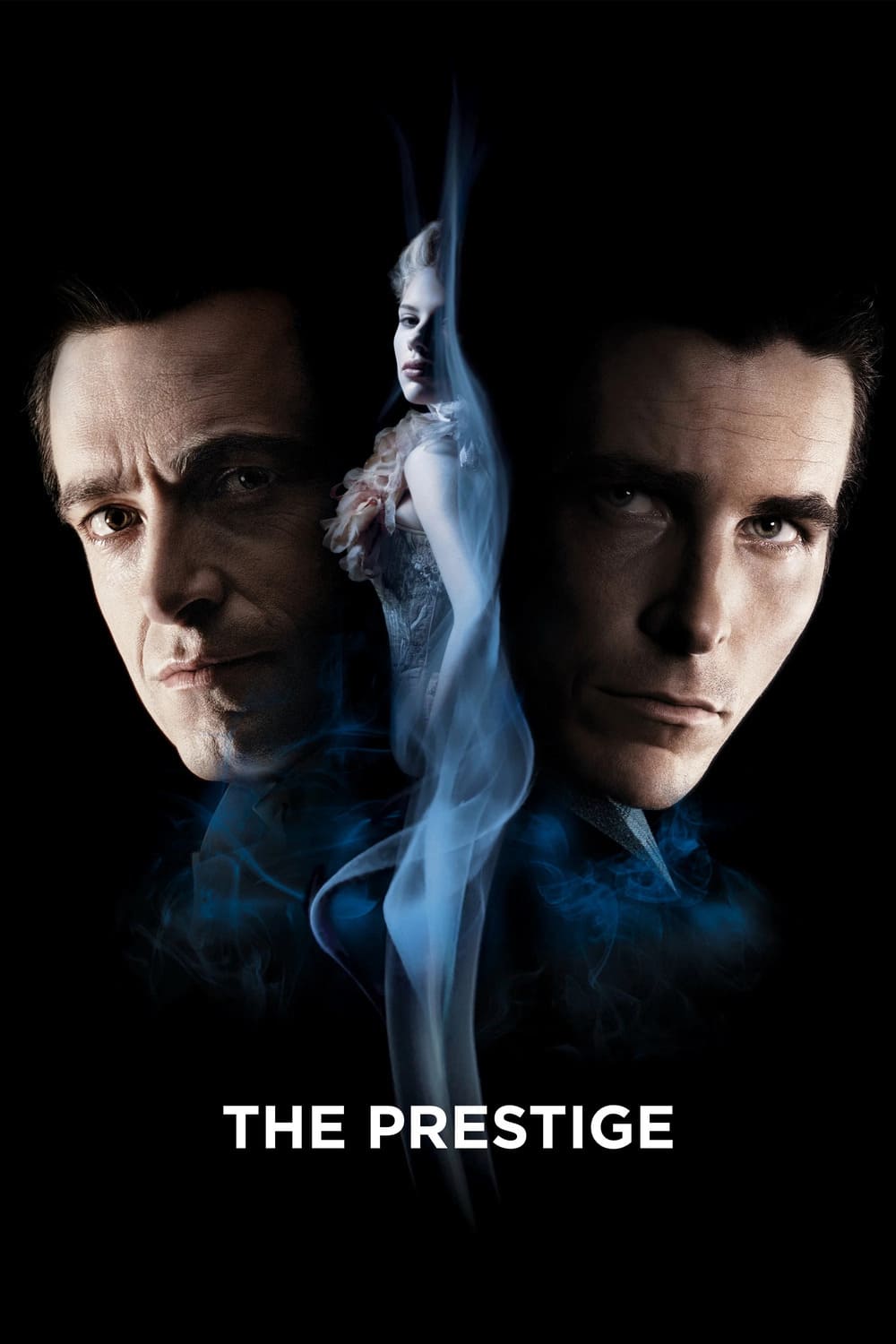
“You don’t really want to work it out. You want to be fooled.” — Cutter
The best magic tricks depend on a peculiar agreement between performer and audience: we know we are being deceived, yet we want the deception to succeed. Christopher Nolan’s The Prestige turns that agreement into the foundation of a film about two men who can no longer distinguish the pleasure of creating an illusion from the need to possess its secret. Their rivalry begins on the stage, but it soon consumes everything beyond it. What emerges is more than a mystery built around competing magicians. It is a dark, absorbing examination of obsession, sacrifice, and the terrible distance between earning applause and finding satisfaction.
Adapted by Christopher and Jonathan Nolan from Christopher Priest’s novel, The Prestige follows Alfred Borden (Christian Bale) and Robert Angier (Hugh Jackman), magicians whose professional ambitions become inseparable from a deeply personal feud. Having read the novel, I approached the adaptation with some hesitation. Much of the book’s appeal comes from the way its journals and personal accounts allow characters to reveal information while concealing their intentions. Bringing that experience to the screen requires more than faithfully reproducing the plot. It requires finding a cinematic equivalent for the uncertainty of reading someone else’s carefully constructed version of events.
The Nolan brothers understand that distinction. Rather than presenting the rivalry as a straightforward progression from friendship to hostility, they move among its beginnings, consequences, and apparent resolutions. One scene supplies information that changes our understanding of another; a confession becomes a provocation; an explanation raises a new question. The fractured chronology recalls Christopher Nolan’s narrative experimentation in Memento, but here the structure has a different effect. We are not simply trying to determine what happened. We are trying to decide who controls the story—and what that person gains by telling it.
The film gives us its organizing principle through Cutter, the stage engineer played by Michael Caine. He explains that a magic trick has three parts. In “the pledge,” the magician presents something ordinary. In “the turn,” that ordinary thing undergoes an extraordinary transformation or disappearance. Finally, “the prestige” completes the illusion by bringing back what seemed to be lost. Nolan uses this explanation as both an invitation and a warning. He tells us to watch closely, then trusts that our eagerness to see something extraordinary will distract us from the significance of what we see.
That approach makes The Prestige especially satisfying as a mystery. Its clues are not merely withheld until the screenplay decides to reveal them. Many are placed directly before us, disguised by context or overshadowed by something more immediately dramatic. An attentive viewer may anticipate part of the solution relatively early, but recognizing a secret does not necessarily diminish the film. There is still the question of how it works, what it costs, and how far either magician is willing to go to protect it.
Those costs give the elaborate construction its emotional weight. Borden and Angier begin as colleagues working for Milton the Magician, played by Ricky Jay, with Cutter providing the technical expertise behind the act. Even then, their differences are apparent. Borden is instinctively inventive, impatient with limitations, and willing to take risks in pursuit of a better illusion. Angier understands presentation: the timing, confidence, and theatrical flair that persuade an audience to invest in a performance. Each has a talent the other lacks, and neither can comfortably accept that imbalance.
A tragedy turns those differences into grievances. From that point forward, professional competition becomes a means of assigning blame and exacting punishment. Their efforts to improve their acts increasingly serve another purpose: to deny the other man the satisfaction of success. They interrupt performances, steal information, manipulate loyalties, and endanger the people around them. Eventually, it becomes difficult to separate their desire to achieve greatness from their desire to make the other suffer.
One of the screenplay’s strongest decisions is its refusal to make either man an uncomplicated hero. Angier’s charm does not excuse his cruelty, and Borden’s ingenuity does not make his emotional evasiveness easier to bear. The film allows us to understand their grievances without asking us to endorse their actions. Our sympathies shift because both men remain recognizably human even as their behavior becomes increasingly monstrous.
Jackman is particularly effective at showing how an accomplished public performer can become privately consumed by resentment. Angier knows how to hold an audience, but he cannot enjoy that gift while Borden possesses a secret he cannot explain. Jackman lets the frustration accumulate beneath the polished exterior until the pursuit of an answer becomes more important than the applause that supposedly motivated him.
Bale gives Borden a more guarded, abrasive presence. His confidence in his craft contrasts with his difficulty explaining himself to the people closest to him. At times, he seems capable of extraordinary commitment; at others, he appears maddeningly indifferent to the consequences of that commitment. Bale makes those contradictions compelling without smoothing them away. Together, the two actors turn the rivalry into something more unsettling than a contest between evenly matched opponents. Each man becomes the justification for the other’s worst impulses.
Caine provides an essential counterweight. Cutter understands the labor behind an illusion, but he also recognizes that technical possibility is not the same as moral permission. His practical manner grounds the film whenever its central characters threaten to disappear into their own grand ambitions. He is persuasive as someone who loves the craft while retaining a sense of proportion about what it should demand.
The women caught in the rivalry make its consequences harder to dismiss. Scarlett Johansson’s Olivia is more than a glamorous addition to the stage act. Her shifting loyalties reveal how readily both magicians turn intimacy into strategy. She may be drawn to their talent, but neither man can reliably separate affection from advantage. The film is at its most painful when their need to preserve a secret prevents them from responding honestly to another person.
The production design reinforces the divide between public enchantment and private effort. Onstage, an illusion appears graceful and instantaneous. Backstage, it depends on cramped spaces, concealed mechanisms, repetition, and people whose work the audience never sees. Nathan Crowley’s Victorian settings give those hidden processes a persuasive physical presence. The theaters and workshops belong to the same world, but they offer very different views of what constitutes magic.
That world expands with the arrival of Nikola Tesla, played by David Bowie. Bowie’s restrained, enigmatic performance makes Tesla feel distinct from the showmen seeking his help. He has little need to command a room, yet his work promises something more astonishing than anything their theatrical ingenuity can produce. The machinery surrounding him introduces a steampunk atmosphere and pushes the story toward science fiction without abandoning its central concerns.
For me, this shift works because the film has already established the dangerous appeal of an impossible solution. Tesla’s experiments offer another way to pursue the same ambition that drives the rivalry: to accomplish something so extraordinary that no competitor can answer it. The question is no longer simply whether an illusion can be perfected. It is whether either magician would recognize a point at which perfection demands too much.
There is a risk that such an intricately constructed film will seem more interested in concealing its mechanism than in developing its characters. Some viewers will undoubtedly regard The Prestige as an elaborate gimmick, and its screenplay certainly invites admiration for its engineering. Yet the revelations matter because they change our understanding of the behavior that precedes them. What first appears to be stubbornness, inconsistency, or theatrical bravado acquires a darker significance. The solution does not erase the drama; it exposes the full extent of it.
What stayed with me after The Prestige was not simply the satisfaction of learning how its tricks were done. It was the realization that neither magician could accept a life in which the other remained beyond his understanding. Nolan delivers the pleasures of a cleverly concealed mechanism, but the final revelation leaves something less comfortable than admiration in its wake. We can finally see what these men have made of themselves, even if they never fully can. The secrets are impressive, but the human wreckage behind them is what gives the illusion its lasting power.

