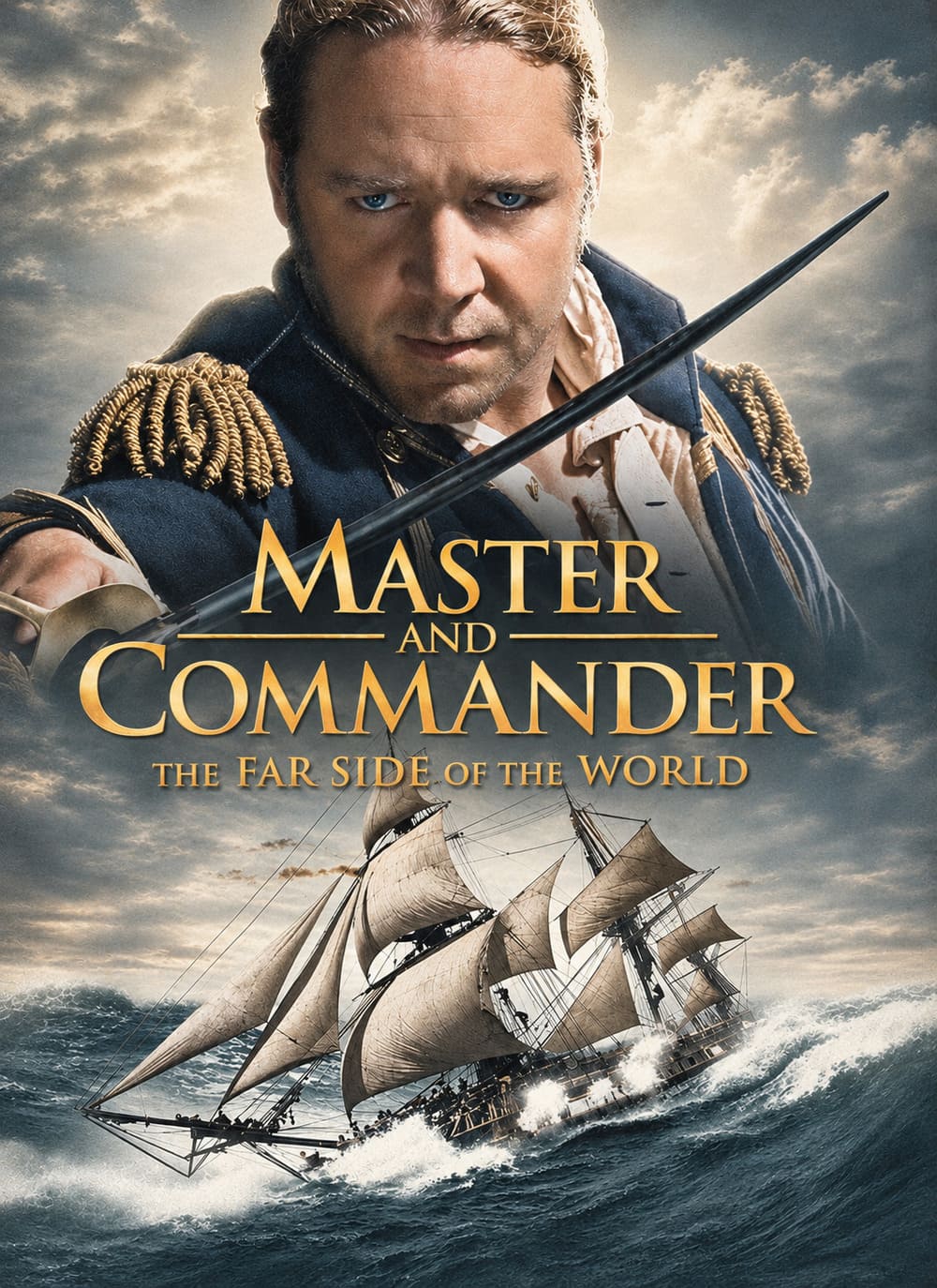
Master and Commander: The Far Side of the World (dir. by Peter Weir) Review


“This is the second time he’s done this to me. There will not be a third.” — Jack Aubrey

A lesser adventure movie would treat the ocean as empty space between battles. In Peter Weir’s Master and Commander: The Far Side of the World, it becomes an entire way of life. Meals, friendships, work, and terrible injuries all happen within the same cramped wooden walls, with nowhere to go when things get uncomfortable. That sense of confinement makes the film surprisingly absorbing. The cannon fire is exciting, but so is watching people figure out how to live together under pressure. What starts as a pursuit of an enemy ship gradually becomes a closer look at the man who refuses to let that enemy escape.

The film draws from the first and tenth books in Patrick O’Brian’s Aubrey–Maturin series, Master and Commander and The Far Side of the World, with the tenth supplying most of the central storyline. Rather than closely following the opening novel and introducing its characters from the beginning, Weir places us inside an established friendship and a working shipboard community. That choice gives the adaptation a lived-in quality. Aubrey and Maturin already have habits, disagreements, and ways of understanding each other that do not need explaining. We learn about their relationship by watching it function, which is more engaging than having their history handed to us.

Russell Crowe’s Captain Jack Aubrey commands HMS Surprise during the Napoleonic Wars. His target is the Acheron, a French privateer with enough speed and firepower to make their encounter seriously uneven. Weir establishes that imbalance through a brutal opening attack rather than a long explanation. The Surprise takes a beating, and suddenly the captain’s confidence has to compete with the evidence of shattered timber and injured men. Aubrey survives, but he cannot simply move on. Catching the Acheron becomes unfinished business, and everyone aboard gets pulled into his determination to settle it. The chase supplies the plot, but his reasons for continuing it supply the tension.

Crowe is a huge part of why this works. He gives Aubrey an easy authority that makes the crew’s loyalty believable. This captain can share a joke, appreciate a good meal, and make difficult decisions without appearing to switch between different personalities. There is warmth beneath his command, but also an expectation that his judgment will prevail. Crowe makes both sides convincing. You understand why the men feel safer with him in charge, even when he is asking them to do something dangerous. His confidence is attractive, and the film lets us enjoy it before making us consider its limits.

Those limits become clearer as Aubrey’s obsession with tracking down the Acheron builds. His assignment gives him a legitimate reason to pursue the French privateer, but the chase gradually becomes tangled up with his pride. Being beaten at his own game bothers him more than he wants to admit. Each setback seems to strengthen his need to prove that he can win. What makes this unsettling is how calmly he justifies himself. He never stops being intelligent or capable. Instead, military reasoning and personal ambition become difficult to separate. He can explain why the pursuit matters, but that does not mean he fully understands why it matters so much to him.

The person most willing to challenge him is Stephen Maturin, the ship’s surgeon and Aubrey’s close friend. Paul Bettany brings a dry, thoughtful quality to the role that plays beautifully against Crowe’s confidence. Maturin sees the wounded bodies behind the captain’s calculations, so arguments about duty are never purely theoretical for him. His scientific interests also give him priorities beyond the conflict. Where Aubrey sees a destination or a tactical advantage, Maturin notices something worth studying. Their disagreements make the voyage feel larger than its military objective. There is a whole world around them, even when Aubrey seems determined to reduce it to the distance between two ships.

Thankfully, the film does not turn their friendship into a series of lectures. Their shared musical sessions reveal a companionship that exists independently of whatever disagreement they are having. These scenes feel relaxed without becoming disposable. Watching them play together explains why they keep making room for each other despite their frustrations. Crowe and Bettany suggest familiarity through small changes in expression and tone rather than big emotional speeches. As a result, their arguments carry weight. They are not simply defending different opinions; they are testing how much disagreement a valued friendship can withstand, especially when one friend has the authority to overrule the other.

Weir gives the wider crew a similar sense of life beyond the plot. The Surprise feels like a workplace, a home, and an unforgiving social system all at once. Everyone has duties, everyone depends on someone else, and privacy barely seems to exist. Brief moments of joking or nervous conversation make the sailors feel individual without requiring formal introductions. The younger officers are especially affecting. Their uniforms and responsibilities cannot quite hide how young they are. Watching them try to behave bravely adds an uncomfortable edge to the adventure, because courage here is something children are already expected to demonstrate.

That attention to people makes the battles much more effective. By the time the guns start firing again, damage to the ship feels like damage to a community we recognize. The violence is messy and frightening rather than cleanly heroic. Splintering wood turns familiar spaces into hazards, while Maturin’s medical work makes the aftermath impossible to ignore. There is still plenty of excitement in watching a plan come together, but clever tactics do not erase their cost. Aubrey’s skill matters enormously, yet skill cannot guarantee that the people carrying out his orders will come through unharmed. Victory never feels quite as simple as being the better captain.

Just as importantly, the battles between the Surprise and the Acheron are exceptionally well-staged and executed. Weir makes the tactics understandable without draining the encounters of confusion or danger. You can follow the importance of positioning, timing, and coordinated work while still feeling how little separates an effective maneuver from disaster. The action moves between the larger contest at sea and the immediate struggle on deck, keeping strategy and physical consequences connected. There is a satisfying sense that the sailors’ everyday routines have prepared them for these moments. All that hauling, drilling, and following orders becomes the machinery that gives Aubrey’s ideas a chance of succeeding.

The climactic confrontation brings those strengths together, but its most satisfying ingredient comes from an unexpected place: Maturin’s interest in nature. Aubrey takes a couple of pages from his friend’s observations of camouflage and disguises the Surprise as a vulnerable whaling ship, hoping to lure the Acheron close enough to overcome its advantages. It is a clever solution because it grows out of the relationship rather than arriving as a last-minute burst of genius. After allowing the pursuit to overshadow Maturin’s scientific interests, Aubrey finds something useful in the very subjects he has been too impatient to appreciate.

That connection gives the final battle more meaning than a straightforward test of firepower. Aubrey succeeds by adapting, looking beyond his usual expertise, and recognizing the value of another person’s perspective. The plan offers a small but important counterpoint to his stubbornness: his confidence becomes more productive when it leaves room for curiosity. Meanwhile, the execution delivers the excitement the long pursuit has promised. Preparation gives way to sudden violence, and the fighting feels close, exhausting, and dangerous. The deception may create an opening, but it does not make the confrontation easy. Weir lets the tactical payoff and the human cost occupy the same scene.

Outside the fighting, the contrast between the crowded ship and the enormous ocean remains one of the film’s strongest features. Inside, everything feels close enough to touch. Outside, the water seems capable of swallowing the whole enterprise without noticing. The storms sharpen that contrast by presenting a threat Aubrey cannot intimidate or defeat through determination alone. His experience can improve their chances, but it cannot give him complete control. That limitation matters in a story about a man accustomed to trusting himself. Nature keeps reminding him—and us—that confidence is not the same thing as power, however reassuring it may look from the deck.

The film’s patience will not work for everyone. Some stretches linger over routine or scientific curiosity when a more conventional action movie would hurry toward another confrontation. The Galápagos sequences are the clearest example, shifting attention toward Maturin’s interests and slowing the pursuit. For me, that breathing room mostly pays off. It makes the world feel worth exploring rather than merely crossing, and the later camouflage strategy gives those observations a satisfying place in the adventure. Occasionally, the contrast between the two friends feels a little neatly arranged. Still, removing those quieter passages would leave a faster movie with much less personality and far less reason to care about its outcome.

By the end, the Surprise feels less like a spectacular movie location than a place whose routines you have learned. You understand why these men need their captain, why his friendship with Maturin matters, and why his certainty can be reassuring and dangerous at the same time. That is what gives Master and Commander: The Far Side of the World its staying power. Weir delivers the adventure without treating the people as equipment needed to stage it. The battles draw you in, but the lasting pleasure is the company—even when the man setting the course makes you nervous about where everyone is headed.
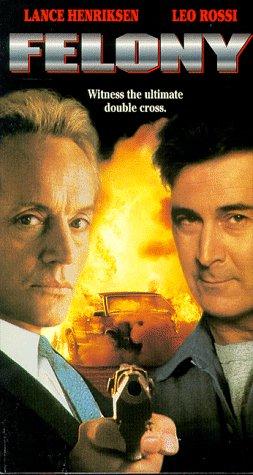
Felony (1994, directed by David A. Prior)


In New Orleans, a drug raid gone wrong leads to eleven cops being gunned down and then blown up.  The disastrous raid was being filmed for a Cops-like reality show  The show’s producer, Bill Knight (Jeffrey Combs) finds himself being pursued through New Orleans by a collection of rogue intelligence agents, cops, and gangsters, all of whom want the tape of the massacre.

It’s a simple direct-to-video premise and the film’s plot hits every chase film cliche, while keeping the action moving at a decent pace.  Bill Knight is not supposed to be a typical action hero.  He’s just a television producer who was in the wrong place at the wrong time.  Yet Knight proves himself to be as indestructible as any Arnold Schwarzenegger hero.  He gets shot, twice.  He falls from a great height.  He crashes through a window.  He repeatedly gets hit over the head.  And yet, his injuries never seem to really slow him down or even hurt that much.  He does hook up with a nurse (Ashley Laurence) but still, it’s hard to believe anyone could take that much punishment and keep running.  Jeffrey Combs, the brilliant star of films like Re-Animator, is miscast as Knight but he’s still always entertaining to watch.

In fact, the cast is the main thing that Felony has going for it.  David Prior was able to assemble a true group of B-movie all-stars.  Lance Henriksen and David Warner are the evil intelligence agents who are determined to kill Knight.  (Warner finally gets to handle a grenade launcher and we’re all the better for it.)  Leo Rossi and Charles Napier are the two New Orleans cops who are investigating the drug raid.  Joe Don Baker is the rogue intelligence agent who dresses like a cowboy and who is trying to clean up everyone else’s mess.  The cast keeps the action moving and there are enough eccentric personalities in this film that it’s always watchable.  I think this might be the only film to feature Joe Don Baker and Lance Henriksen performing opposite each other.  If nothing else, it deserves to be watched for that!

(The cover for Felony features Lance Henriksen and Leo Rossi but not Jeffrey Combs, even though Combs is the lead in the film and Rossi’s role is actually pretty small.  Henriksen also doesn’t have blonde hair in the movie.  There are plenty of double crosses in the movie but I can’t think of any that really qualify as the “ultimate double cross.”)

Even with its miscast lead and its cliche-heavy plot, Felony is what direct-to-video action movies should be all about, fact-paced action and a cast unlike any other,


Film Review: Judgment (dir by Andre Van Heerden)


After three previous movies that all dealt with the growing power of Franco Macalousso (Nick Mancuso) and the revolution spearheaded by former journalist Helen Hannah (Leigh Lewis), the Apocalypse saga finally came to a close with the 2001 film, Judgment.

One of the more interesting things about the Apocalypse franchise is that each film was done in the style of a different genre.  Apocalypse was pretty much a straight-forward, faith-based film.  Revelation attempted to be an action film.  Tribulation was a horror film.  Meanwhile, Judgment is a courtroom drama, complete with a witnesses, objections, a corrupt judge, two former lovers turned legal adversaries, and a verdict.  Of course, the verdict itself is never in question.

Helen Hannah has finally been captured by O.N.E.  (That stands for One Nation Earth.)  Instead of just executing her like he does everyone else, Macalousso wants to put her on trial.  He wants to humiliate her while the entire world is watching.  He wants a show trial.  Mitch Kendrick (Corbin Bernsen), who father was a preacher who was executed after a previous show trial, is assigned to serve as Helen’s defense attorney,  Prosecuting the case is Victoria Thorne (Jessica Steen), who is Mitch’s former lover and one of the few people to know that Mitch has a fake mark of the beast on his hand.  Victoria believes that taking part in the trial will finally bring Mitch fully over to the side of Macalousso.

The trial has been carefully scripted out but, to everyone’s shock, Mitch refuses to follow the script.  Instead, he says that Helen cannot be punished because she has only been doing what her God told her to do so, therefore, God should be on trial instead of Helen.  Macalousso decides that he actually likes the idea of putting God on trial so he agrees to let Mitch do his thing.

Meanwhile, a revolutionary named  J.T. (Mr. T) is making plans to bust Helen out of prison but he finds himself frustrated by Helen’s aversion to violence.  J.T. just wants to break into the court and shoot everyone.  “There’s another way,” everyone keeps telling him….

Judgment is the best of the Apocalypse films, which may not be saying much when you consider how bad the other films are.  That said, Leigh Lewis had considerably improved as an actress by the time that she appeared in this film and Corbin Bernsen gives a good performance as a man torn between doing the right thing or doing what he has to do to keep himself safe.  Jessica Steen and Michael Copeman (as the Judge) bring a little bit more nuance than expected to their roles and Nick Mancuso is properly charismatic and smug as Franco Macalousso.  For a faith-based film, Judgment is not particularly preachy and I appreciated the fact that the film’s message was ultimately one of peaceful resistance.  Unfortunately, the film is also about 20 minutes too long.  It clocks in at 102 minutes and there are some parts of this film that seriously dragged.

As I’ve said about the previous Apocalypse films, Judgment actually works better as a political film than a religious tract.  The film presents Franco Macalousso as being the Beast but he could just as easily be seen as the ultimate symbol of collectivism.  When it’s announced that Helen is being prosecuted for the crime of “Hatred of the Human Race” and when witnesses in the court swear an oath to the “unity of all people,” it’s not a subtle moment but it’s a lot of fun for those viewers who tend to value personal freedom over the demands of the collective.

Judgment was the final Apocalypse film, though it doesn’t really bring the overall story to a close.  Tomorrow, we’ll bring our look at the apocalypse to a close with a look at the — God help us — Left Behind series.

Film Review: Revelation (dir by André van Heerden)


The world which started to end in the 1998 film Apocalypse continues to end in its first sequel, 1999’s Revelation!

Revelation beings three months after the end of Apocalypse.  The people of the world worship the president of the European Union, Franco Macalousso (Nick Mancuso, replacing Sam Bornstein from the first film).   The world is ruled over by O.N.E., which stands for One Nation Earth.  Those who oppose Macalousso’s claim to the messiah are known as “The Haters.”  At the start of the film, a school bus has been bombed and all of the children aboard have been killed.  O.N.E. claims that the Haters bombed the bus but counterterrorist agent Thorold Stone (Jeff Fahey) comes across evidence that it was actually an inside job.  When Macalousso’s second-in-command, Len Parker (David Roddis), attempts to murder Thorold, he’s forced to go on the run.

The Day of Wonders is approaching.  On this day, everyone on Earth is to put on a VR headset.  Macalousso hasn’t made clear what the headset will do but everyone’s planning on doing it because Macalousso has told them to do it and everyone on the planet does what Macalousso says.  Thorold tracks down Willy Spino (Tony Nappa), a wheelchair-bound programmer (in the 90s sense of the term, of course) who is somehow involved with setting up The Day of Wonders.  Willy says that O.N.E. is not the benevolent organization that everyone thinks it is.  You would have thought that Thorald would have figured that out after Parker attempted to kill him but Thorald remains convinced that Maclousso is the messiah and that his wife and daughter previously vanished not because they were Christians but because they were abducted by aliens.

Anyway, long story short, it turns out that Willy’s stepsister is Helen Hannah (Leigh Lewis), the news anchor from the first film.  Helen is now a leader in the Hater underground.  While she tries to convince Thorold that Macalousso is actually the Devil, Willy spends his time flirting with a cynical blind woman named Cindy (Carol Alt).  Both Willy and Cindy find themselves tempted to put on the VR headset, just to see what the Day of Wonders will hold for them….

Revelation is a marked improvement on Apocalypse though, considering how shoddy the production of that first film was, that’s really not saying much.  As opposed to the first film’s stiff performances and reliance on stock footage, Revelation features actual actors, actual sets, and an actual script.  There’s even a few action sequences and some attempts at intentional humor.  That said, if you’re a nonbeliever, Revelation isn’t going to convert you and, about halfway through the film, all of the action stops so that Thorold and Hannah can have a very long discussion about faith and whether or not God should prove his existence by turning over a glass of water.

Like the first film, Revelation actually works better as a political allegory than a religious tract.  Today, it’s kind of easy to laugh at the bulky computers that fill O.N.E.’s headquarters and the scenes where Willy carefully explains what virtual reality and computer viruses are serve as a reminder that, apparently, there was a time when all of this stuff was still viewed as being somehow exotic.  I mean, it’s easy to be snarky about this movie.  But let’s be honest — it’s probably easier today than it was when this film was first released to imagine a world where everyone blindly does whatever the government tells them to do.  And the idea of a group running a false flag operation — like blowing up a school bus and blaming it on unseen enemies — no longer seems quite as outlandish as it perhaps did it 1999.

Revelation was apparently enough of a success that it was followed by yet another sequel.  This one was called Tribulation and I’ll be posting a review of it in about 15 minutes.  Hope to see you then!