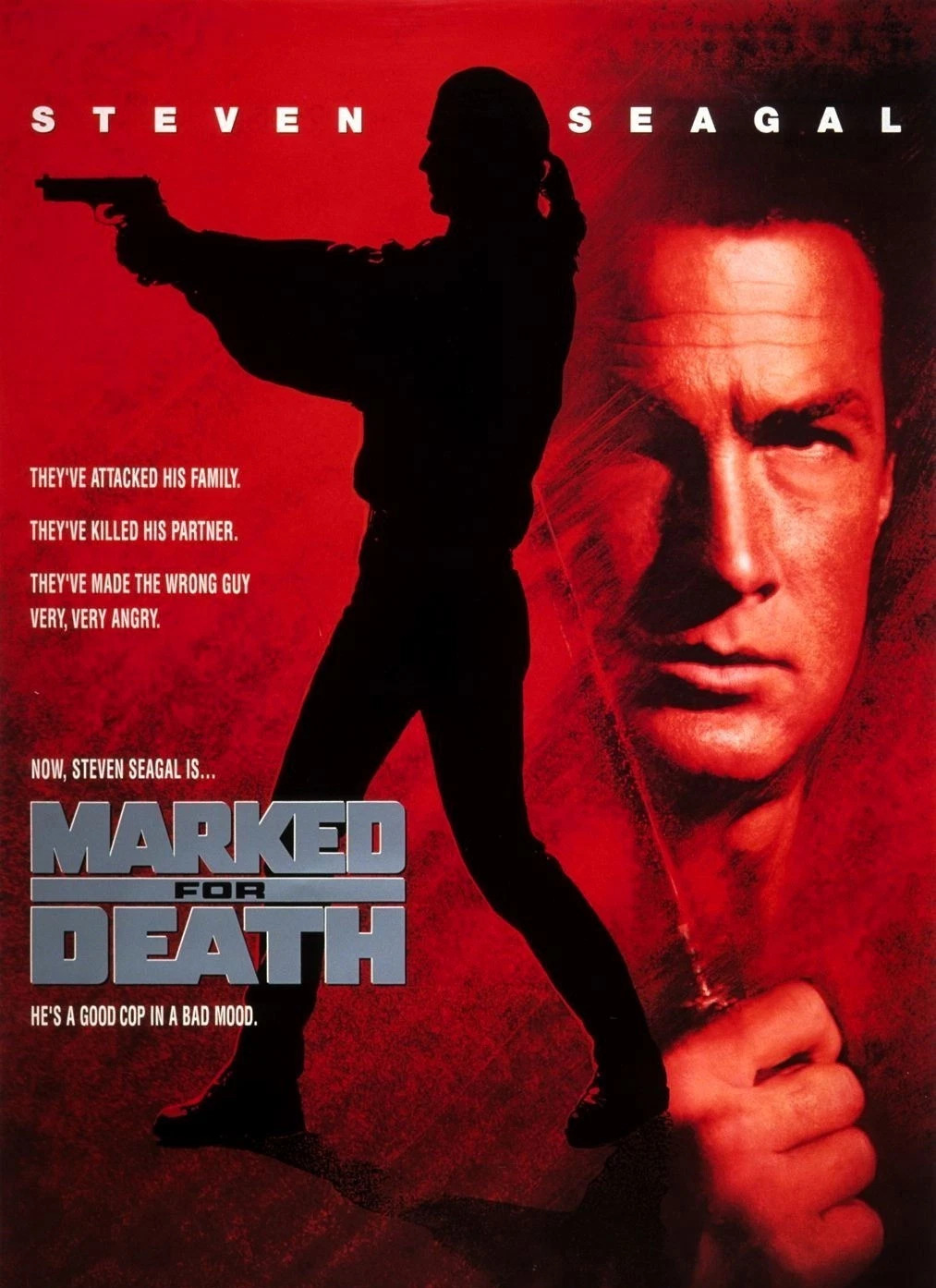
Guilty Pleasure No. 119: Marked for Death (dir. by Dwight H. Little)


There’s a specific, almost mystical, pleasure in watching a movie that is, by almost every conventional standard, a complete mess. It’s a guilty pleasure, that sweet spot where a film is so unapologetically over-the-top, so earnestly ridiculous, that it circles back around to being utterly entertaining. And for my money, few films embody this “so bad it’s good” vibe quite like Steven Seagal’s 1990 action opus, Marked for Death. This is prime, uncut, vintage Seagal, a film that feels like it was beamed in from an alternate dimension where ponytails are a symbol of power, whispering threats is a sign of deep menace, and the streets of Chicago are apparently overrun with voodoo-practicing Jamaican drug lords. It’s silly, sure, but it’s a very specific kind of silly—grounded enough in its grim, urban revenge fantasy to feel almost earnest, which is precisely what makes it work. To put it in perspective, Marked for Death is downright restrained compared to the coked-out, reality-defying lunacy Seagal would unleash just a year later in Out for Justice. That film, with its infamous “anybody seen Richie?” barroom brawl and its general air of sweaty, unhinged mania, operates on a completely different, far more unhinged wavelength. Marked for Death still has one foot in the real world, however wobbly that stance may be, whereas Out for Justice seems to have been fueled by a warehouse full of stimulants and a complete disregard for narrative coherence.

For those who don’t remember the heyday of Seagal-mania, Marked for Death is a perfect time capsule. This was before the bloated, straight-to-DVD era; this was Seagal in his physical prime, slim, athletic, and seemingly capable of snapping every bone in a human body without breaking a sweat. He plays John Hatcher, a burnt-out DEA agent who, after a botched operation in Mexico, decides to retire and seek some peace and quiet by visiting his sister and niece in his old Chicago neighborhood. This is the first of the film’s many logical leaps, because apparently, a retired DEA agent’s idea of a stress-free vacation is moving back to the neighborhood where he grew up and where a violent turf war is raging. It’s a classic action movie setup that requires you to immediately check your brain at the door, but compared to the sheer narrative anarchy of Out for Justice, it practically feels like Shakespeare.

You see, the peace and quiet Hatcher seeks doesn’t exist. The town is being terrorized by a Jamaican drug posse led by the wonderfully named and gloriously performed villain, Screwface. Played with scenery-chewing, eye-rolling relish by Basil Wallace, Screwface is more than just a drug dealer; he’s a voodoo priest with a penchant for giving people a “t’ousand dets wurse dan yoo doo.” He’s a cartoon character in the best possible way, a man so over-the-top that his presence alone elevates the film from a standard revenge flick into something far more memorable. When he declares Hatcher and his family “marked for death,” you can’t help but lean in, not because you’re scared for the hero, but because you want to see what bizarre, hammy line he’s going to come up with next. It’s absurd, but it’s a controlled absurdity, a deliberate performance that knows exactly what movie it’s in. That’s the key difference between this and the later Seagal outings; Marked for Death plays its absurdity with a straight face, whereas Out for Justice feels like it’s sweating and twitching through every frame, as if the filmmakers themselves had just snorted a mountain of the very product their hero was supposedly fighting against.

The plot, such as it is, kicks into gear when a gang shootout at a local bar forces Hatcher into action, and the posse retaliates by shooting up his sister’s house and wounding his young niece. This is the moment where the film’s narrative pivots from “watch the hero mope” to “watch the hero mope and then absolutely obliterate everyone in his path.” The central premise, like many critics have noted, is as formulaic as they come: a former lawman with a troubled past is forced out of retirement to avenge his family using excessive force. One reviewer put it perfectly, noting the film follows the “familiar one-note, bone-crunching action vehicle for Steven Seagal.” And while that might sound like a criticism, in this context, it’s a promise of the guilty pleasures to come. But even within that formula, there’s a certain grim logic that holds it together—something you absolutely cannot say about the gloriously unhinged Out for Justice, where the plot seems to be held together with duct tape and pure, unfiltered rage.

What makes Marked for Death such a classic guilty pleasure is the sheer, unrelenting brutality of the action sequences. This is not the sanitized, quick-cut action of today. This is a film where every punch sounds like a gunshot and every bone snapped echoes with a sickening, satisfying crunch. Director Dwight D. Little, who later went on to direct TV episodes for shows like Prison Break and Bones, stages the action with a “tight handling,” making sure the camera is right there to capture Seagal’s trademark Aikido. The violence is so extreme that it becomes comical. We’re talking broken arms, broken necks, gouged eyes, a decapitation, and a finale so over-the-top that it involves Seagal using a samurai sword to fight his way through a compound. Yet even with all that mayhem, it never quite reaches the hallucinatory, sweaty-palmed frenzy of Out for Justice, where the violence feels less choreographed and more like a bar brawl that somehow escaped onto film stock.

There are moments in Marked for Death that are so ridiculous they deserve their own standing ovation. There’s the infamous department store fight, where Hatcher dismantles a small army of henchmen while surrounded by mannequins and glass displays. It’s a perfect showcase for Seagal’s skills as a fighter and a complete lack of interest in things like, say, civilian casualties or property damage. Then there’s the entire third act, where Hatcher and his buddy Max (played with stoic reliability by the great Keith David), somehow manage to smuggle an entire arsenal of weapons into Jamaica for a final assault on Screwface’s compound. The logic of this is never explained, but it doesn’t matter. We’re given a montage of them prepping their weapons, and the next thing you know, they’re on a plane. It’s this kind of brazen disregard for realism that makes the film such a hoot, but again, it’s a calculated hoot. The cocaine-fueled silliness of Out for Justice would never bother with such a montage—it would just have Seagal appear in Jamaica with a shotgun, no explanation given, because who needs logic when you have that much manic energy coursing through the projector?

Perhaps the most surprising element is that despite the malevolent tone, the film has become a beloved “cult classic” for many. As one reviewer from the time stated, “it’s easy to see how someone could end up not liking Marked for Death. Its plot is ridiculous, it was overly violent for its time period… On the other hand, this is a film that doesn’t seem to care what you think and instead gleefully exist as a throwback to old-school Grindhouse films.” There’s a sense that Seagal and the filmmakers were in on the joke, even if they were playing it completely straight. The film is excessive, ruthless, and mindlessly numbing in all the right ways, a sentiment that perfectly encapsulates its enduring appeal. It’s the cinematic equivalent of comfort food—you know it’s bad for you, but it tastes so good. And it tastes a whole lot more grounded than the chaotic, unfiltered blast of pure id that is Out for Justice, a film that feels like it was edited by a hyperactive squirrel on a sugar rush.

Marked for Death isn’t a great film by any objective measure. The acting is wooden, the dialogue is laughable, and the cultural stereotypes are, to put it mildly, a product of their time. The Miami Herald even noted that Seagal dispatches his foes with “such an obnoxious sense of higher purpose that we get the feeling he’s not in on the fun.” The film’s portrayal of Jamaican culture as a hotbed of violent, voodoo-worshipping drug dealers is certainly problematic and not something that would fly today, which adds to the movie’s bizarre, anachronistic charm. It’s a film that, while considered one of his better works from that era, is far from what you’d call high art. But it knows its lane and stays in it, which is more than you can say for the gloriously unhinged Out for Justice, a movie that seems to have forgotten what lane it was in, swerved into oncoming traffic, and somehow kept driving anyway.

In the end, Marked for Death is the ultimate “bad movie night” experience. It’s a window into a time when action heroes were larger than life, plots were just excuses for mayhem, and a villain named Screwface could be a legitimate threat. It’s a film where you can quote terrible dialogue and cheer for the excessive violence without feeling guilty, because it’s all part of the deal. As one IMDb user succinctly put it, “Marked for Death is a thoroughly entertaining overblown unnecessarily violent & foul mouthed action film, the sort of film which Seagal was perfectly suited to star in. Sure it’s predictable & unoriginal but when a films this much fun who cares?” And honestly, isn’t that the highest praise you can give a movie like this? It’s a big, dumb, brutal, and brilliant piece of schlock that proudly wears its awfulness as a badge of honor. It’s silly, absolutely, but it’s a grounded, almost respectable kind of silly—the kind that makes you appreciate just how far off the deep end Seagal would go with Out for Justice, a film so wildly, unapologetically unhinged that it makes Marked for Death look like a quiet, contemplative drama by comparison.

Previous Guilty Pleasures

  1. Half-Baked
  2. Save The Last Dance
  3. Every Rose Has Its Thorns
  4. The Jeremy Kyle Show
  5. Invasion USA
  6. The Golden Child
  7. Final Destination 2
  8. Paparazzi
  9. The Principal
  10. The Substitute
  11. Terror In The Family
  12. Pandorum
  13. Lambada
  14. Fear
  15. Cocktail
  16. Keep Off The Grass
  17. Girls, Girls, Girls
  18. Class
  19. Tart
  20. King Kong vs. Godzilla
  21. Hawk the Slayer
  22. Battle Beyond the Stars
  23. Meridian
  24. Walk of Shame
  25. From Justin To Kelly
  26. Project Greenlight
  27. Sex Decoy: Love Stings
  28. Swimfan
  29. On the Line
  30. Wolfen
  31. Hail Caesar!
  32. It’s So Cold In The D
  33. In the Mix
  34. Healed By Grace
  35. Valley of the Dolls
  36. The Legend of Billie Jean
  37. Death Wish
  38. Shipping Wars
  39. Ghost Whisperer
  40. Parking Wars
  41. The Dead Are After Me
  42. Harper’s Island
  43. The Resurrection of Gavin Stone
  44. Paranormal State
  45. Utopia
  46. Bar Rescue
  47. The Powers of Matthew Star
  48. Spiker
  49. Heavenly Bodies
  50. Maid in Manhattan
  51. Rage and Honor
  52. Saved By The Bell 3. 21 “No Hope With Dope”
  53. Happy Gilmore
  54. Solarbabies
  55. The Dawn of Correction
  56. Once You Understand
  57. The Voyeurs 
  58. Robot Jox
  59. Teen Wolf
  60. The Running Man
  61. Double Dragon
  62. Backtrack
  63. Julie and Jack
  64. Karate Warrior
  65. Invaders From Mars
  66. Cloverfield
  67. Aerobicide 
  68. Blood Harvest
  69. Shocking Dark
  70. Face The Truth
  71. Submerged
  72. The Canyons
  73. Days of Thunder
  74. Van Helsing
  75. The Night Comes for Us
  76. Code of Silence
  77. Captain Ron
  78. Armageddon
  79. Kate’s Secret
  80. Point Break
  81. The Replacements
  82. The Shadow
  83. Meteor
  84. Last Action Hero
  85. Attack of the Killer Tomatoes
  86. The Horror at 37,000 Feet
  87. The ‘Burbs
  88. Lifeforce
  89. Highschool of the Dead
  90. Ice Station Zebra
  91. No One Lives
  92. Brewster’s Millions
  93. Porky’s
  94. Revenge of the Nerds
  95. The Delta Force
  96. The Hidden
  97. Roller Boogie
  98. Raw Deal
  99. Death Merchant Series
  100. Ski Patrol
  101. The Executioner Series
  102. The Destroyer Series
  103. Private Teacher
  104. The Parker Series
  105. Ramba
  106. The Troubles of Janice
  107. Ironwood
  108. Interspecies Reviewers
  109. SST — Death Flight
  110. Undercover Brother
  111. Out for Justice
  112. Food Wars!
  113. Cherry
  114. Death Race
  115. The Beast Within
  116. Girl Series
  117. Gone in 60 Seconds
  118. Swordfish

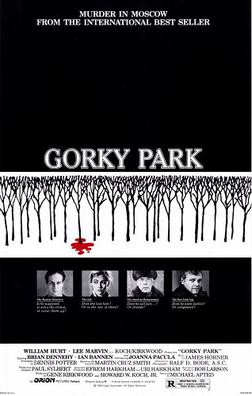
Gorky Park (1983, directed by Michael Apted)


Earlier today, I saw that the writer Martin Cruz Smith has died.  He was 82 years old and was best known for a series of detective novels about Arkady Renko, a Russian police detective.  Starting with 1981’s Gorky Park, Smith’s novels not only dealt with Renko’s adventures but also provided a look at contemporary Russia, as it went from being controlled by the communists to being controlled by Putin.  Renko was a cynical observer whose cases often exposed the corruption of the Russian elite, regardless of who was in charge.

The first of Smith’s Renko novels was turned into a movie in 1983.  Gorky Park stars William Hurt as Renko.  Renko investigates the discovery of three dead bodies at a ice skating rink in Moscow.  One of the victims in an American whose brother (Brian Dennehy) is a tough New York cop who has come to Russia to investigate his disappearance.  Renko’s investigation leads him to an American businessman (Lee Marvin) who is smuggling sables out of Russia and who is also a KGB asset.  Joanna Pacula plays a woman whose hope to escape from Russia leads to her getting caught up in the murders and the subsequent investigation.

Gorky Park‘s mystery is easily solved.  Just by casting Lee Marvin in the role, it is automatically clear who is responsible for the murders and it doesn’t take long for Renko to figure it out either.  Instead, the movie is about how Renko’s investigation exposes the corruption of the Russian state, with the KGB first protecting Lee Marvin’s businessman when he’s considered to be an asset and then expecting Renko to assassinate him once it becomes obvious that his activities are becoming a liability.  The subdued William Hurt and the brash Brian Dennehy make for an compelling investigative team while the underappreciated Joanna Pacula gives an outstanding performance as a woman who is so desperate to escape the oppression of the Soviet Union that she’ll risk everything.  (Even though the murderer is an American businessman, the Soviet Union still banned Gorky Park as both a book and a film.)  Gorky Park’s snowy cinematography and Michael Apted’s measured direction captures the chilly paranoia of Smith’s story and the bleak depiction of a society where national pride mixes with healthy a dose of fear.

Upon release, Gorky Park was a box office disappointment, which meant that there would be no further adventures of William Hurt’s Renko on the big screen.  Martin Cruz Smith continued to write, ultimately publishing ten novels about his unconventional hero.

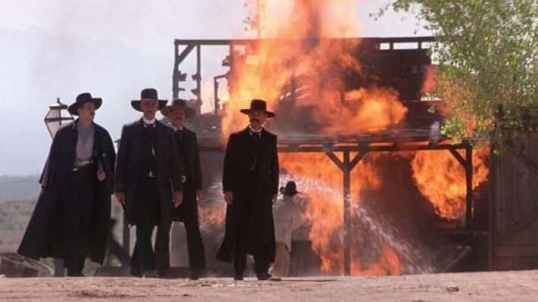
The Unnominated #12: Tombstone (dir by George Pan Cosmatos)


Though the Academy of Motion Picture Arts and Sciences claim that the Oscars honor the best of the year, we all know that there are always worthy films and performances that end up getting overlooked.  Sometimes, it’s because the competition too fierce.  Sometimes, it’s because the film itself was too controversial.  Often, it’s just a case of a film’s quality not being fully recognized until years after its initial released.  This series of reviews takes a look at the films and performances that should have been nominated but were, for whatever reason, overlooked.  These are the Unnominated.

I have come around on Tombstone.

The first time I watched this 1993 film, I was a bit confused as to why so many of my friends (especially my male friends) worshipped the film.  To me, it was a bit too messy for its own good, an overlong film that told a familiar story and which featured so many characters that it was difficult for me to keep track of them all.  Perhaps because everyone I knew loved the film so much, I felt the need to play contrarian and pick out every flaw I could find.

And I still think those flaws are there.  The film had a troubled production, with original director Kevin Jarre falling behind in shooting and getting replaced by George Pan Cosmatos, a director who didn’t have any real interest in the material and whose all-business approach rubbed many members of the cast the wrong way.  Kurt Russell took over production of the film, directing the actors and reportedly paring down the sprawling script to emphasize the relationship between Russell’s Wyatt Earp and Val Kilmer’s Doc Holliday.  On the one hand, this led to a lot of characters who really didn’t seem to have much to do in the finished film.  Jason Priestley’s bookish deputy comes to mind.  On the other hand, Russell was right.

The film’s heart really is found in the friendship between Wyatt and Doc.  It doesn’t matter that, in real life, Wyatt Earp was hardly as upstanding as portrayed by Kurt Russell.  It also doesn’t matter that the real-life Doc Holliday was perhaps not as poetic as portrayed by Val Kilmer.  Today, if you ask someone to picture Wyatt Earp, they’re probably going to picture Kurt Russell with a mustache, a cowboy hat, and a rifle.  And if you ask them to picture Doc Holliday, they’re going to picture Val Kilmer, sweating due to tuberculosis but still managing to enjoy life.  Did Doc Holliday every say, “I’ll be your huckleberry,” before gunning someone down?  He might as well have.  That’s how he’s remembered in the popular imagination.  And it’s due to the performances of Russell and Kilmer that I’ve come around to eventually liking this big and flawed western. With each subsequent viewing, I’ve come to appreciate how Russell and Kilmer managed to create fully realized characters while still remaining true to the Western genre.  If Wyatt Earp initially fought for the law, Doc Holliday fought for friendship.  Kilmer is not only believable as a confident gunslinger who has no fear of walking into a dangerous situation.  He’s also believable as someone who puts his personal loyalty above all else.  He’s the type of friend that everyone would want to have.

That said, I do have to mention that there are a lot of talented people in the cast, many of whom are no longer with us but who will live forever as a result their appearance here.  When Powers Boothe delivered the line, “Well …. bye,” he had no way of knowing that he would eventually become a meme.  Boothe is no longer with us, I’m sad to say.  But he’ll live forever as long as people need a pithy way to respond to someone announcing that they’re leaving social media forever.  Charlton Heston appears briefly as a rancher and he links this 90s western with the westerns of the past.  Robert Mitchum provides the narration and it just feels right.  The large ensemble cast can be difficult to keep track of and even a little distracting but there’s no way I can’t appreciate a film that manages to bring together not just Russell, Kilmer, Boothe, Heston, and Mitchum but also Sam Elliott, Bill Paxton, Michael Biehn, Michael Rooker, Billy Bob Thornton, Frank Stallone, Terry O’Quinn, and even Billy Zane!  The female roles are a bit underwritten.  Dana Delaney is miscast but Joanna Pacula feels exactly right as Doc Holliday’s lover.

But ultimately, this film really does belong to Val Kilmer.  When I heard the sad news that he had passed away last night, I thought of two films.  I thought of Top Gun and then I thought of Tombstone.  Iceman probably wouldn’t have had much use for Doc Holliday.  And Doc Holliday would have resented Iceman’s attitude.  But Val Kilmer — that brilliant actor who was so underappreciated until he fell ill — brought both of them to brilliant life.  In the documentary Val, Kilmer attends a showing of Tombstone and you can say he much he loves the sound of audience cheering whenever Doc Holliday showed up onscreen.

Tombstone was a flawed film and 1993 was a strong year.  But it’s a shame that Val Kilmer was never once nominated for an Oscar.  Tombstone may not have been a Best Picture contender but, in a year when Tommy Lee Jones won the Oscar for Best Supporting Actor for his role in the similarly flawed The Fugitive, it seems a shame that Kilmer’s Doc Holliday was overlooked.

Tombstone (1993, dir by George Pan Cosmatos (and Kurt Russell), DP: William Fraker)

Previous entries in The Unnominated:

  1. Auto Focus 
  2. Star 80
  3. Monty Python and The Holy Grail
  4. Johnny Got His Gun
  5. Saint Jack
  6. Office Space
  7. Play Misty For Me
  8. The Long Riders
  9. Mean Streets
  10. The Long Goodbye
  11. The General

#SundayShorts presents ESCAPE FROM SOBIBOR (1987) – Rutger Hauer helps lead another great escape during World War II!


Since Sunday is a day of rest for a lot of people, I present #SundayShorts, a mini review of a movie I’ve recently watched.

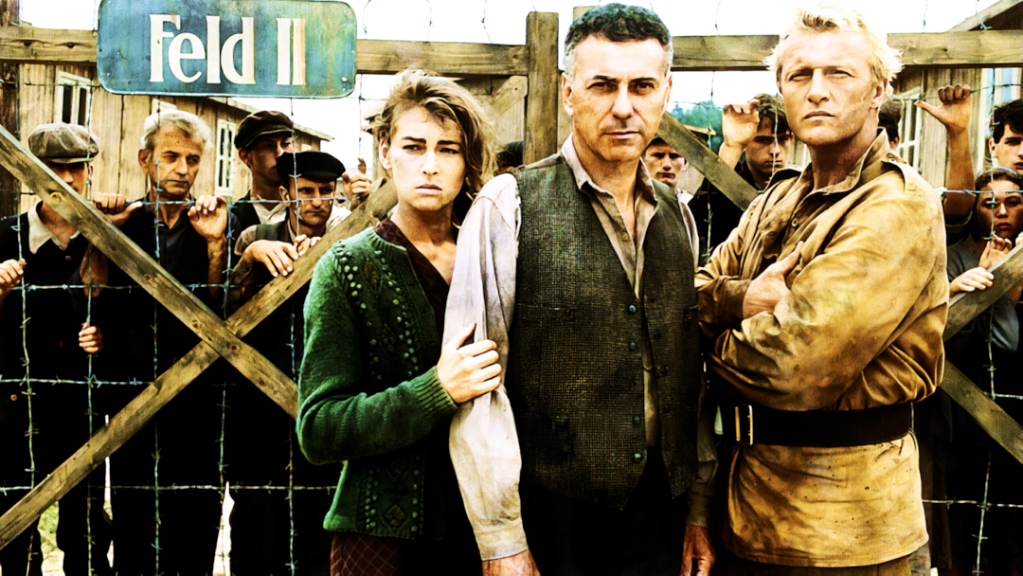
The 1987 movie ESCAPE FROM SOBIBOR is the historical re-creation of the escape from the Nazi Death Camp Sobibor, where approximately two hundred fifty thousand Jews were executed. Of the approximately six hundred prisoners who attempted to escape, around three hundred succeeded with somewhere between 50 and 60 surviving to see the end of the war.

The plot of ESCAPE FROM SOBIBOR revolves around Leon Feldhendler (Alan Arkin), the leader of the Jewish prisoners at Sobibor, who eventually comes to realize that they are being held in nothing more than a death camp. He figures out that the only people being allowed to live are the goldsmiths, seamstresses, shoemakers, and tailors; these are the people who are able to repair the shoes, recycle the clothing, and melt down any silver or gold for the Nazis. He also knows that once the trains stop coming in, all the remaining Jews will be murdered. As such, he and a group of men devise a plan for every prisoner to escape by luring the Nazi officers into the prisoners’ barracks and killing them as quietly as possible. With the help of a group of highly skilled Jewish, Russian soldiers, led by Sacha Pechersky (Rutger Hauer), their plan was put into action on October 14th, 1943, leading to the largest escape from a prison camp of any kind in Europe during World War II. 

ESCAPE FROM SOBIBOR is an excellent film, and it’s currently streaming on Amazon Prime and TUBI as I type this. If you enjoy THE GREAT ESCAPE (1963), I promise you will enjoy this film. It’s very hard to watch at times, as most Nazi concentration camp movies are, but you can’t help but be completely invested when the prisoners attempt their escape at the end. It’s always important to remind ourselves of the levels of evil and heroism that our fellow humans are capable of. ESCAPE FROM SOBIBOR does an excellent job of that. 

Here are five interesting facts about the film:

  1. Y’all know how much I love Rutger Hauer. He won a 1988 Golden Globe for his performance as Sasha Pechersky.
  2. Not only did Hauer win a Golden Globe for his performance, the movie itself won as the “Best Miniseries or Motion Picture Made for Television.”
  3. Over 30 million Americans saw this movie when it premiered on CBS on April 12th, 1987.
  4. Shortly after the revolt depicted in the film, Camp Sobibor was closed down and any trace of its existence was removed. Pine trees were later planted on the site.
  5. The movie ends with famed newscaster Howard K. Smith narrating the fates of the survivors on whose accounts the film was based. It’s an amazing, uplifting, and sometimes heartbreaking way for the outstanding movie to end. 

I highly recommend ESCAPE FROM SOBIBOR. It’s an important film and one of the greatest films that Rutger Hauer ever worked on. Enjoy the trailer below!

The Eric Roberts Collection: Amazing Racer (dir by Frank E. Johnson)


2009’s Amazing Racer is the story of a teenage girl who meets her mother and learns how to ride a horse.

Shannon Greene (Julianne Michelle) is traumatized when her father dies and, having been told that her mother died giving birth to her, she now believes herself to be an orphan.  However, Dr. Rita Baker (Daryl Hannah) reveals that Shannon’s father was just a damn liar.  First, he told Shannon’s mother that her baby was stillborn.  Then, as Shannon was growing up, he told her that her mother was dead.  This is a lot to take in for both Shannon and the viewer.  Myself, I wondered not only how someone could do that but why they would do that.  Making the scene in which Shannon hears the truth even more surreal was the presence of Michael Madsen and Joanna Pacula, playing Shannon’s guardians.  Madsen played his good guy role in much the same way he played his bad guy in Reservoir Dogs.

Anyway, Shannon ends up living with her mother, Dr. Christine Pearson (Claire Forlani), and her mother’s boyfriend, Eric (Jason Gedrick).  Understandably, considering everything that she’s been through, Shannon is initially difficult and bratty but eventually, she comes to enjoy working on Eric’s horse ranch.  She even starts riding a horse and winning races!  This brings her to the attention of evil Mitchell Prescott (Eric Roberts), who wants her horse for himself and even has a spy working on the ranch….

There are a lot familiar faces in this movie.  Charles Durning makes his final film appearance as Floyd.  Steve Guttenberg has a bizarre cameo as a guy transporting a horse trailer.  Scott Eastwood and Kirsta Allen show up.  When it’s time for Shannon to finally start training for the big race, Lou Gossett Jr. pops up as the trainer.  The film itself a fairly predictable horse ranch movie and it’s enjoyable if you like that sort of thing.  (Myself, I like ranches and I like horses so I don’t mind movies like this.)  But really, most of the movie’s entertainment value comes from guessing who is going to show up next.  Some of the famous faces are bit distracting.  But sometimes, it really pays off.  I really wish Lou Gossett, Jr.’s role had been bigger because he does a great job with what little time he has.

As for Eric Roberts, he gets a bit more screentime than usual.  One gets the feeling that he may have actually spent more than two days shooting his scenes for this one.  Roberts is playing a villain here and he gives a enjoyably avuncular performance as the evil Mitchell.  Roberts has fun with the role and, as a result, he’s fun to watch in this movie.

I enjoyed Amazing Racer.  It had horses and it has Eric Roberts.  What more could you want?

Previous Eric Roberts Films That We Have Reviewed:

  1. Star 80 (1983)
  2. Blood Red (1989)
  3. The Ambulance (1990)
  4. The Lost Capone (1990)
  5. Love, Cheat, & Steal (1993)
  6. Voyage (1993)
  7. Love Is A Gun (1994)
  8. Sensation (1994)
  9. Dark Angel (1996)
  10. Doctor Who (1996)
  11. Most Wanted (1997)
  12. Mercy Streets (2000)
  13. Wolves of Wall Street (2002)
  14. Mr. Brightside (2004)
  15. Six: The Mark Unleased (2004)
  16. Hey You (2006)
  17. In The Blink of an Eye (2009)
  18. Enemies Among Us (2010)
  19. The Expendables (2010) 
  20. Sharktopus (2010)
  21. The Dead Want Women (2012)
  22. Deadline (2012)
  23. The Mark (2012)
  24. Miss Atomic Bomb (2012)
  25. Bonnie And Clyde: Justified (2013)
  26. Lovelace (2013)
  27. The Mark: Redemption (2013)
  28. Self-Storage (2013)
  29. This Is Our Time (2013)
  30. Inherent Vice (2014)
  31. Road to the Open (2014)
  32. Rumors of War (2014)
  33. Amityville Death House (2015)
  34. A Fatal Obsession (2015)
  35. Stalked By My Doctor (2015)
  36. Enemy Within (2016)
  37. Joker’s Poltergeist (2016)
  38. Prayer Never Fails (2016)
  39. Stalked By My Doctor: The Return (2016)
  40. The Wrong Roommate (2016)
  41. Dark Image (2017)
  42. Black Wake (2018)
  43. Frank and Ava (2018)
  44. Stalked By My Doctor: Patient’s Revenge (2018)
  45. Clinton Island (2019)
  46. Monster Island (2019)
  47. The Savant (2019)
  48. Seven Deadly Sins (2019)
  49. Stalked By My Doctor: A Sleepwalker’s Nightmare (2019)
  50. The Wrong Mommy (2019)
  51. Exodus of a Prodigal Son (2020)
  52. Free Lunch Express (2020)
  53. Her Deadly Groom (2020)
  54. Top Gunner (2020)
  55. Deadly Nightshade (2021)
  56. The Elevator (2021)
  57. Just What The Doctor Ordered (2021)
  58. Killer Advice (2021)
  59. The Poltergeist Diaries (2021)
  60. The Rebels of PT-218 (2021)
  61. A Town Called Parable (2021)
  62. Bleach (2022)
  63. My Dinner With Eric (2022)
  64. Aftermath (2024)
  65. The Wrong Life Coach (2024)

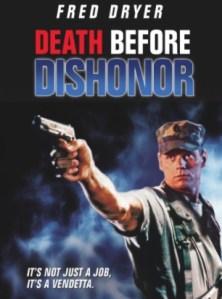
A Movie A Day #300: Death Before Dishonor (1987, directed by Terry Leonard)


In a fictional Middle Eastern country, tough-as-nails Col. Halloran (Brian Keith) has been kidnapped by terrorists.  The leader of the terrorists is named Jihad and he is played by the No Mercy Man himself, Rockne Tarkington.  The American ambassador (Paul Winfield) is a weak-willed Carter appointee who says, “We have to go through proper channels.”  Gunnery Sgt. Burns (Fred Dryer) ain’t got no time for the proper channels.  All of his men have been killed.  His mentor has been kidnapped and is being tortured with a power drill.  Even if it means breaking all the rules, Sgt. Burns is going to rescue Halloran, defeat Jihad, and kill anyone who has ever chanted “Death to the U.S.A.”
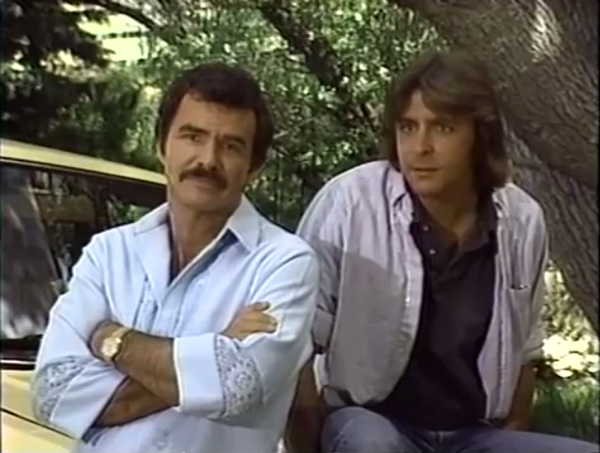
Totally a product of the 80s and about as politically incorrect as they come, Death Before Dishoner was an attempt to turn former football player-turned-TV star Fred Dryer into a movie star.  It did not work, though Fred does his best Clint Eastwood impersonation, chugging beer and speaking exclusively in tough one-liners.  Death Before Dishonor is dumb but entertaining.  (It may have been made for New World Pictures but it’s a Cannon Film at heart.)  The movie’s highlight if Fred Dryer chasing the bad guys in a jeep, keeping one hand on the steering wheel while using the other hand to fire a bazooka.  A close second is Brian Keith barely flinching while taking a power drill to the back of the hand.  No one’s tougher than an 80s action hero!

A Movie A Day #207: Every Breath (1994, directed by Steve Bing)


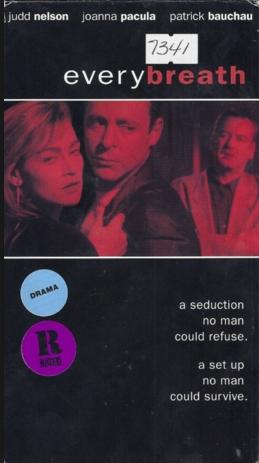
Jimmy (Judd Nelson) is an actor, best known for yelling in a toothpaste commercial.  However, Jimmy is a serious actor and his perfectionist attitude makes it difficult for him to even find work in commercials.  When a wealthy but impotent arms dealer named Richard (Patrick Bachau) offers to pay to watch Jimmy have sex with Richard’s wife, Lauren (Joanna Pacula), Jimmy agrees.  When Jimmy meets Lauren at a party, he introduces himself.  She walks away.  He introduces himself again.  She slaps him.  He follows her to a lesbian bar and ends up getting beaten up outside.  After all of that, he finally gets invited to accompany Lauren back to her mansion.  Suddenly, Richard emerges from the shadows, holding a gun.  He fires at Jimmy.  Jimmy screams but then discovers that the gun was full of blanks.  He has been the victim of an elaborate game, one that Richard and Lauren play every night with a constantly changing cast of victims.

At first, Jimmy is upset and humiliated.  He returns home to his clueless girlfriend (Camille Cooper) and tries to sleep it off.  But he can’t stop thinking about Lauren.  The next day, he returns to Richard and Lauren’s mansion and soon finds himself being dragged back into their games.  What Jimmy does not know is that Richard doesn’t just enjoy humiliating people.  He also likes to kill them.

Every Breath was the first and only movie to be directed by Hollywood real estate mogul, film producer, and political donor Steve Bing.  There are enough weird camera angles, dream sequences, and monologues about love and morality that it is obvious that Bing was going for something more artistic than the typical Judd Nelson direct-to-video production.  For a first time director, Bing’s direction is slick but not slick enough to make up for large plot holes and a lot of half-baked philosophical dialogue.  For all of its pretensions towards being something more, Every Breath is a typical 90s neo-noir with little to distinguish it from something like In The Cold of the Night or Body Chemistry.  As Lauren, Joanna Pacula is sultry and sexy while Patrick Bachau does a good job playing a junior grade Marquis de Sade.  As for Judd, he’s Judd Nelson, which means scenes like this:

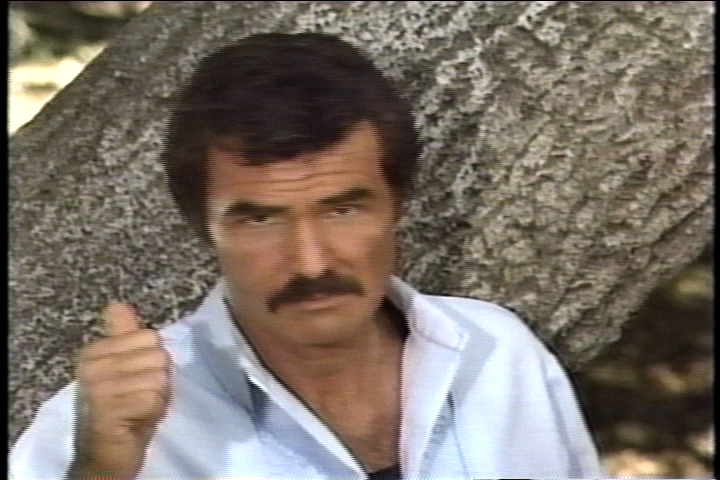
Whenever I watch a Judd Nelson movie, I wonder what Burt Reynolds, Judd’s co-star from Shattered If Your Kid’s On Drugs, would think.

On the one hand, Every Breath is a pretentious movie about three unlikable people.

On the other hand, Joanna Pacula.


Insomnia File No. 5: Black Ice (dir by Neill Fearnley)


What’s an Insomnia File? You know how some times you just can’t get any sleep and, at about three in the morning, you’ll find yourself watching whatever you can find on cable? This feature is all about those insomnia-inspired discoveries!

Black Ice 2

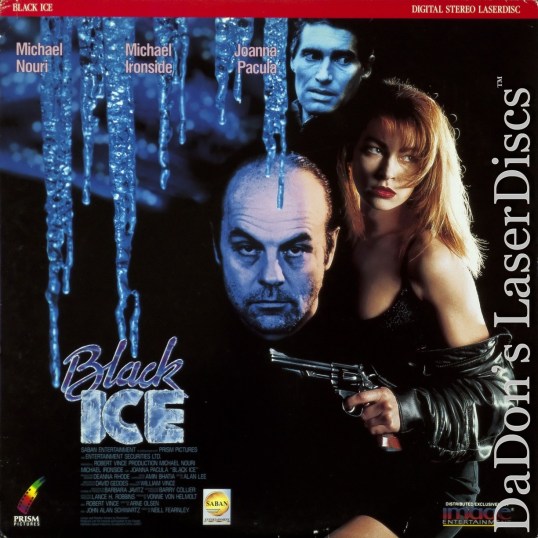
If you were having trouble getting to sleep last night at 2 a.m., you could have turned over to Indieplex and watched Black Ice, a Canadian thriller from 1992.

Why is the film called Black Ice?  Well, that’s a good question.  There’s a lot of snow and ice to be seen in the film but absolutely none of it is black.  According to the imdb, this film was also released under the title A Passion for Murder.  I have to admit that I kind of like A Passion For Murder as a title, simply because it’s so generic and empty that it becomes oddly brilliant.  If you were making a parody of the type of movies that Netflix usually lists in the “steamy thriller” category,  A Passion For Murder is probably the title that you would come up with.

But, as for this film, it opens as all thrillers from the early 90s must, with a man in a suit meeting his clad-in-black-lingerie mistress in a hotel room.  The man in the suit is an up-and-coming senator.  His mistress is the mysterious Vanessa (Joanna Pacula).  When Vanessa pressures him to leave his wife, the senator gets mad and leaves.  Vanessa goes back to her apartment, where she is soon visited by the senator.  She and the senator get into a fight.  She shoves the senator into a window, which shatters and promptly kills the senator.

Meanwhile, Ben Shorr (Michael Nouri) is barely making a living as a taxi driver.  He’s an aspiring writer and, just in case we had any doubts about his intellectual bona fides, he has a pony tail and talks almost nonstop.  (Ben also owns a goldfish that he’s named Travis, as in Taxi Driver‘s Travis Bickle.)  Ben is pretty annoying and when he picks up Vanessa, you’re kind of hoping that she’ll end up killing him like she killed the senator.

But no, it turns out that Ben is supposed to be our hero.  Vanessa asks Ben to drive her from Detroit to Seattle.  And, of course, Ben agrees because … well, there wouldn’t be a movie otherwise.

It turns out that Vanessa is actually a secret agent.  She was supposed to seduce and eventually marry the senator.  Now that she’s accidentally killed him, her supervisor, Quinn, is determined to kill her.  Because this movie was made in Canada, the villainous Quinn is played by Michael Ironside.

The rest of the film is basically Quinn chasing Ben and Vanessa across the northwest.  Along the way, Vanessa and Ben fall in love.  One huge problem with Black Ice is that the audience knows everything about Vanessa before Ben does.  There are a lot of scenes of Ben trying to figure out why Quinn is pursuing Vanessa but, since we already know why, those scenes mostly feel like filler.  If  Vanessa had been as much of a mystery to the audience as she was to Ben for most of the film’s running time, Black Ice probably would have been a bit more intriguing.

As it is, Black Ice is pretty much a standard, low-budget chase film.  Michael Nouri is pretty annoying but Joanna Pacula and Michael Ironside both give good performances.  It snows throughout the entire film and there’s a few genuinely impressive shots of the three main characters running across the icy landscape.  Otherwise, Black Ice is pretty forgettable but it also doesn’t require much thought, which might make it an appropriate film to watch if you’ve got insomnia.

Black Ice

Previous Insomnia Files:

  1. Story of Mankind
  2. Stag
  3. Love Is A Gun
  4. Nina Takes A Lover

Horror Quickie Review: Virus (dir. by John Bruno)


Virus

Not every comic book film is about superheroes. There’s been quite a bit of comic books adapted to film that has no superheroes, capes and superpowers at all. One such film came out in 1999. It was a film adapted from Chuck Pfarrer’s Dark Horse Comics mini-series titled Virus. This was a comic book that had a unique art-style to it that lent itself well to its scifi and body horror tale.

The film itself skews close enough to the comic book with some minor changes. Instead of a Chinese research vessel where most of the story takes place we find the film set on a derelict Soviet research ship. Even with the changes from comic book to film they both shared one common denominator and that would be the alien lifeform that has decided to systematically kill all humans aboard the ship.

Virus stars Jamie Lee Curtis and Donald Sutherland in two roles they probably wish they took a pass on or asked more money to do. While the film has some imaginative set pieces involving the melding of robotics and scavenged human body parts to create something bigger and homicidal the majority of the film involves pretty much every cast member in one stage or another of hysteria, incredulity and denial. Really, the only person in the whole film who seemed to go through the story with a clear and level head was Cliff Curtis’ seaman Hiko. All this means was that he would be one not to survive to the end of the film.

While the comic book itself was a nice piece of scifi horror storytelling then film stumbles right out of the gate not just because of the terrible acting, but just a dull and boring adaptation of the story. While, as stated earlier, some of the robotic designs were quite good and the use of practical effects made the killer robots something terrible behold, director John Bruno didn’t seem to have any ideas on how to put together an exciting sequence to take advantage of these inventive pieces at his disposal.

Virus was one film that comic book fans who read the mini-series were quite excited to see when it was first announced as a film in production. Stills of gruesome effects work would be admired and just add to the high expectations. What we got instead was a huge pile of a mess that was neither horrific, terrifying or remotely entertaining. Virus is one such film that I wouldn’t even bother catching on TV being shown for free.