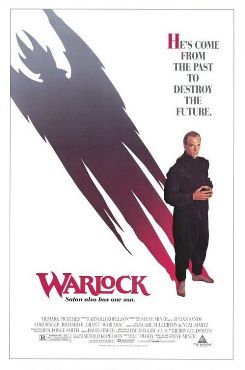
Before he can be executed in the late 17th century, an unnamed warlock (Julian Sands) is propelled through time by Satan. He ends up in 20th-century Los Angeles, where he seeks the three pieces of the Grand Grimoire, a legendary spellbook that, when reassembled, can undo creation. The Warlock is pursued by Giles Redferne (Richard E. Grant), a witch hunter whose wife was previously killed by the Warlock and who manages to make it through the Warlock’s time portal. Helping Giles navigate the modern world is Kassandra (Lori Singer), a woman who made the mistake of taking the Warlock in and got hit by an aging spell for her trouble. Giles and Kassandra pursue Warlock across the the country as he searches from the three pieces of the book. It’s a quest that takes them from Los Angeles to a Mennonite community and finally to modern-day Massachusetts where the final piece of the Grimoire turns out to be in a very unexpected location.
Warlock definitely benefits from David Twohy’s clever script and Steve Miner’s no-nonsense, energetic direction, but the real secret of its success was the performance of Julian Sands as the Warlock. If you were of a certain age in 1991, Julian Sands will always primarily be the Warlock to you. With his coldly self-amused manner and his unapologetic cruelty, Sands was the epitome of cool evil. The first time I saw Warlock, I was surprised at just how far the film’s villain was willing to go in his quest. Warlock is one of those films where the characters who usually survive do not. No one is safe from the warlock.
The film also benefits from Richard E. Grant taking his role seriously. As for Lori Singer, she’s stuck with a lot of bad old-age makeup and delivers her lines with a lack of enthusiasm. Her performance, though, still doesn’t distract from this surprisingly entertaining film. When I recently rewatched, I recognized Mary Woronov in the role of a psychic. As always when it comes to Mary Woronov, I wished her role had been larger.
Warlock was released in Europe and Australia in 1989 but, because of the financial difficulties of New World Pictures, it didn’t get an American release until 1991. The film did moderately well at the box office and went on to become, for a while, a mainstay on HBO and Cinemax. Julian Sands, who had mostly played young romantic up until that point, was subsequently typecast as a cool, Continental villain. It was followed by two sequels.
Dario Argento spent years trying to bring his version of The Phantom of the Opera to life.
Argento has said that he’s always been fascinated by the story of the mysterious and deformed man living underneath the Paris Opera. He has described watching Arthur Lubin’s 1943 version of the tale as one of the formative events of his childhood. In the ’70s, when he was at the height of his popularity, Argento sought to film his own version of the story in Moscow. When that didn’t work out, Argento put his plans for the Phantom aside. It wasn’t until he was filming Trauma and caught a television airing of the 1925 Phantom of the Opera that Argento returned to the project. Argento’s version of The Phantom of the Opera was released in 1998 and was dismissed by most critics. Even today, it has a reputation for being Argento’s worst film. It’s also not an easy one to see. Whereas most of Argento’s films are always streaming somewhere, The Phantom of the Opera usually is not.
Argento’s Phantom of the Opera opens in Paris in the 19th century. A baby is placed in a basket and, much like Moses, is set adrift in a river. A group of empathetic rats save the baby. The baby grows up to be the Phantom of the Opera (Julian Sands), a classically handsome man who lives in the sewers and protects the rats from anyone who might try to harm them. (Just as rats are killed if they leave the sewers, humans are killed if they enter them.) After the Phantom hears Christine Daaé (Asia Argento) singing alone on the stage of the Paris Opera, he approaches her in the empty theater and tells her that her singing has brought light to his heart. The Phantom and Christine develop a telepathic bond, and she becomes the only person whom he allows to enter the sewers and live. Sometimes Christine loves the Phantom and sometimes she doesn’t. Sometimes the Phantom is a tragically romantic figure and sometimes he’s just a black-clad figure who bites people’s tongues out of their mouths. The Phantom becomes obsessed with Christine, and Christine becomes just as obsessed with the Phantom. Meanwhile, Christine’s other suitor—the aristocratic Raoul (Andrea Di Stefano)—smokes opium, hallucinates that Christine has turned into a prostitute, and languidly watches as two men jump into a pool and fight over the merits of Rimbaud. Painter Edgar Degas makes a cameo appearance but manages to avoid the Phantom’s wrath.
As I mentioned earlier, The Phantom of the Opera is not one of Argento’s more highly regarded films. It’s a slow-paced film, one in which the action often seems to go off on strange tangents that don’t really pay off in the long run. (The opium den brings to mind the deliberately ugly orgy scenes that Tinto Brass directed for Caligula, just without the subversive snap.) Argento attempts to portray the Phantom as both an achingly romantic figure and the type of sociopath who brutally kills anyone who enters the sewer. If he were only killing the rat catchers, the Phantom’s actions could be understood. But as soon as he kills two lovers who just happened to be looking for some privacy, it becomes impossible to sympathize with him. Argento’s attempt to portray The Phantom of the Opera as a story of romance sits uncomfortably with scenes in which the Phantom forces himself on Christine.
That said, I actually like Julian Sands’s performance as the Phantom. Argento’s Phantom is not disfigured in any way and, while that may go against the spirit of the story, at least it means Julian Sands didn’t have to wear a mask while filming his role. Sands exudes a cool, sexy danger, and that makes him just right for Argento’s version of the character. Asia Argento plays Christine as someone who only looks innocent, and it does bring an interesting subtext to the story. Indeed, if not for the prologue featuring the rats saving the Phantom as a baby, one could interpret the Phantom as a manifestation of Christine’s own psychosis. As for the rats, they are yet another example of Argento suggesting that animals have special telepathic powers. For all the criticism Argento has taken for the mystical animals he has included in his later films, it appears to be an idea Argento really likes. Personally, I think there’s a quirky charm to it, but I seem to be in the minority.
I can defend elements of The Phantom of the Opera, but I can’t really defend the film as a whole. It’s a bit too cluttered in its storytelling, and the mix of grand romance and brutal violence doesn’t really work. If this film had been made earlier in Argento’s career, perhaps he could have recreated the grandeur of Paris, but at a time when his films were no longer automatic box-office hits and when the Italian film industry itself was struggling, The Phantom of the Opera often looks cheap and unconvincing. Every director has the occasional misfire. Dario Argento has The Phantom of the Opera.
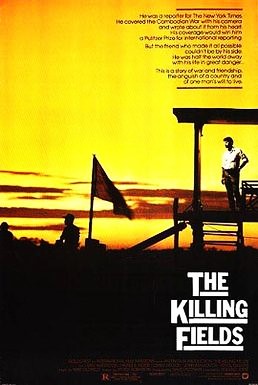
1984’s The Killing Fields opens in 1973. While America is distracted by the growing Watergate scandal and the final battles of the Vietnam War, the nation of Cambodia descends into chaos. Civil War has broken out between the Cambodian National Army and the Khmer Rouge, a savage communist group led by Pol Pot. In its desire to return Cambodia to “year zero,” the Khmer Rouge targets anyone who is considered to be too educated or too urban.
Sent to cover the war, journalist Sydney Schanberg (Sam Waterston) meets up with his translator, Dith Pran (played, in an Oscar-winning performance, by Haing S. Ngor). For two years, Schanberg covers the war in Cambodia, taking pictures of bombed out cities, dead Cambodians, and the bullying teenagers who seem to make up the majority of the Khmer Rouge’s membership. The Khmer Rouge’s leadership may claim to be creating an equal society but it’s hard not to notice that they act like gangsters, posing with their cigarettes and making a great show over deciding who will live and who will die. In 1975, when it becomes apparent that the Khmer Rouge have won the war, the press and the diplomats all prepare to evacuate. Sydney and his colleagues are able to return to their home countries. Dith Prain’s family escape but Dith Pran himself is left behind in Cambodia where, disguising himself as a disabled beggar, he witnesses the horrors of the Khmer Rouge’s Year Zero.
The Killing Fields is an accidental anti-communist film. Director Roland Joffe, produced David Puttnam, and screenwriter Bruce Robinson were all men in the left and, in the film, Sydney Schanberg puts the blame for the rise of the Khmer Rouge directly on the American bombing campaign of the early 70s. The film somehow has the audacity to end with John Lennon’s Imagine, a song that epitomized the worst excesses of the Khmer Rouge’s philosophy, playing over the end credits.
I’ll be the first to admit that the film probably does have a point about the bombing of Cambodia. The chaos that followed the bombing undoubtedly helped the Khmer Rouge to both organize and to bring in new recruits. In this film, the Khmer Rouge commanders love to show off their power because, as Cambodians, they had previously been made to feel that they had no control over their destinies. However, in the scenes with Dith Pran faces the horrors of the reeducation camps and discovers the fields full of skulls and other human remains, the viewer is reminded that it takes more than confusion to lead to this type of concentrated brutality. It takes a group of people brainwashed by a destructive ideology.
(How destructive was the Khmer Rouge’s Maoist philosophy? The Khmer Rouge’s plan was to return Cambodia to being an agricultural society, one where the State stood in for both family and religion. To do so, cities were razed. People who were considered to be intellectuals and free thinkers were tortured and executed. Doctors were murdered. Having bad eyesight was considered to be a sign of intelligence and, as such, people who wore glasses were specifically targeted. As Dith Pran says in the film, the Cambodians who survived were told that they no longer had families, friends, or beliefs. Now they were to only worry only about serving the organization, the Angkar.)
It’s the scenes of Dith Pran in Cambodia that drive home the powerful anti-communist message that the filmmakers were perhaps not aware that they were delivering. Haing S. Ngor was not a professional actor when he played Dith Pran. Instead, he was a gynecologist and an obstetrician who, after the Khmer Rouge came to power, pretended to be dumb to survive. Like Dith Pran, he was sent to a reeducation camp and he eventually escaped by making his way through the area that Dith Pran called “the Killing Fields.” Unlike Dith Pran, Ngor’s family did not survive. (After being sent to work on a rice farm, his wife died in childbirth.) In the film, when we see Dith Pran discovering the Killing Fields for the first time, we are witnessing Haing Ngor recreating the moment that he discovered them. The pain and the horror in his eyes is not only Dith Pran’s but also Haing Ngor’s and every other Cambodian who was forced to flee their country to escape the Khmer Rouge. The film may blame America for the rise of the Khmer Rouge but Ngor’s performance makes it clear that only the Khmer Rouge can be blamed for what happened after they came to power.
The film was nominated for Best Picture of 1984 but lost to Amadeus. Dr. Ngor did win the Oscar for Best Supporting Actor, becoming the second non-professional (after Harold Russell for The Best Years of Our Lives) to do so. Ngor went on the appear in a handful of films before being murdered in 1996. Three members of a street gang were convicted of the murdering Ngor while attempted to rob him. (Ngor was shot when, after giving them his Rolex, he refused to surrender a locket that contained a picture of his late wife.) In 2009, Kang Kek lew, a Khmer Rouge official on trial for war crimes, claimed that Ngor’s murder was actually ordered by Pol Pot, the leader of the Khmer Rouge.
The Killing Field was obviously meant to be primarily critical of American foreign policy but, intentionally or not, it has since proven itself to be one of the strongest anti-communist films ever made.
“And behold a Pale Rider, and his name that sat upon him was Death, and Hell followed with him. Revelations 6:8. This is God’s country—you better acquire a taste for it.” — Kai Proctor
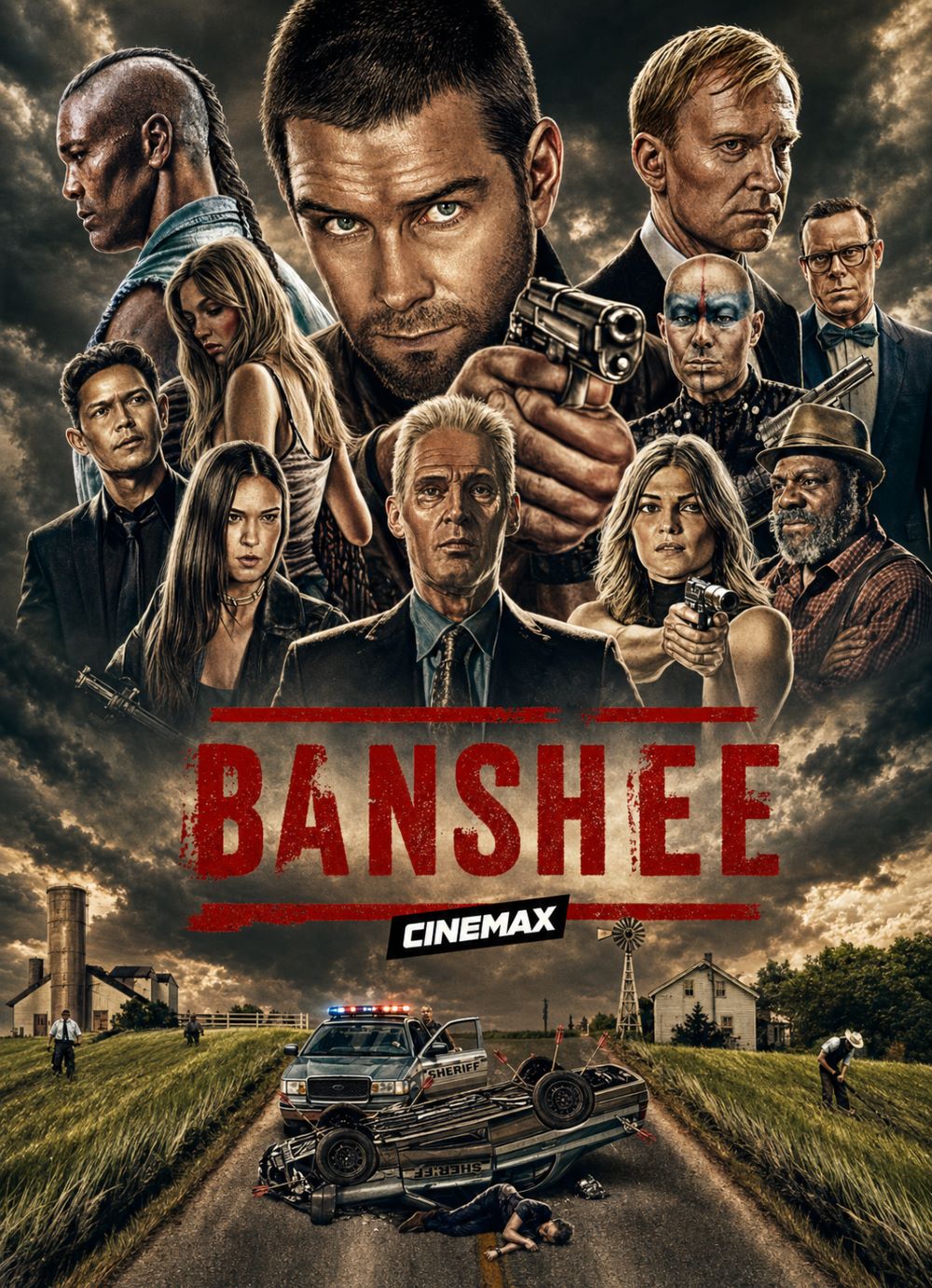
There’s a show that’s been criminally underappreciated, standing shoulder-to-shoulder with some of the prestige heavyweights of the last 10-15 years despite its cult-status rabid fans. It’s a gem that blends pulpy noir tropes like antiheroes, femme fatales, and morally gray characters flipping from foes to allies, all fused with brutal action choreography second to none that could hold its own against any big-screen blockbuster. That show is Banshee, delivering action that’s as raw and relentless as it gets, with choreography so tight and brutal it turns every fight into a visceral event you can’t look away from.
The series thrives on that intricate staging, where punches land with bone-crunching impact and chases spill across entire towns. But it’s the core performances anchoring it all that make the violence feel human and the drama stick through four wild seasons. Antony Starr as Lucas Hood, Ulrich Thomsen as Kai Proctor, and Hoon Lee as Job don’t just carry the show—they ground its over-the-top brutality in characters you buy into, making the punches hit harder emotionally as well as physically.
Starr’s Lucas Hood is the beating heart of Banshee, a tattooed ex-con who slips into the skin of a dead sheriff and never quite shakes the impostor vibe, even as he owns the role. This was the role that made him known to TV watchers well before his star turn as the diabolical Homelander in The Boys, showcasing his coiled menace and raw charisma in a way that demanded attention. He’s got this coiled intensity that explodes in the action scenes, where his fights feel like extensions of his fractured psyche—desperate, improvisational brawls that leave him bloodied but standing. You see it in those long-take beatdowns, like the prison riot or the bar fights that turn rooms into war zones, where Starr sells every grunt, stagger, and counterpunch with a physicality that’s equal parts athletic and unhinged.
Over four seasons, he evolves from a smirking thief to a man wrestling his own darkness, but his charisma keeps you rooting for him even when he’s pummeling half the town. It’s a star-making turn that holds the show’s reckless energy together, making Hood’s brutal choreography feel personal and earned. From there, the dynamic shifts seamlessly to his key adversaries and allies.
Then there’s Ulrich Thomsen as Kai Proctor, the ice-cold crime boss whose calm menace makes him the perfect foil to Hood’s chaos. Proctor doesn’t throw punches like a street fighter; he’s calculated, almost surgical, which amps up the brutality when he unleashes. Thomsen plays him with this quiet menace simmering under a polished exterior—think Amish roots clashing with modern savagery—and it pays off in scenes where Proctor’s fights turn primal, like the knife work or those family feuds that escalate into full-on carnage.
His performance anchors the series’ criminal underbelly, giving the action a strategic edge; every beatdown he orders or delivers feels like a chess move in a blood-soaked game. Through the seasons, as Proctor’s empire crumbles and rebuilds, Thomsen’s steely gaze and understated violence keep the stakes feeling lethal, turning what could be a generic villain into a chilling force. Completing this powerhouse trio is the one who brings a wildly different energy.
Hoon Lee’s Job rounds out the core, a brilliant hacker whose razor-sharp intellect makes him indispensable to Hood’s crew, cracking systems and outsmarting foes from the shadows while his loyalty to Lucas remains unshakable. This holds firm even amid the absurdity of his fabulous, urban edge clashing with Banshee’s sleepy countryside vibe. Lee nails Job’s dual nature: the tech wizard who can dismantle security grids or reroute funds with a few keystrokes, turning digital battles into the show’s cerebral counterpoint to the physical brutality.
Yet always backing Hood with a fierce devotion that shines through in clutch moments. But it’s Job’s comedic flair—those sassy one-liners, the glittering outfits and heels that scream big-city glamour in this podunk town of pickup trucks and dive bars—that tempers his seriousness, making him the series’ sparkling wildcard who lightens the grim action without ever undercutting it. Lee plays it with magnetic charm, his fish-out-of-water antics (strutting through cornfields or snarking at rednecks) adding hilarious contrast to the bone-crunching fights.
Those rare physical outbursts—like improvised knife work or quick takedowns—feel earned because they stem from intellect-fueled precision rather than brute force. Across four seasons, as Job’s past traumas surface and alliances strain, Lee keeps the character’s loyalty as the emotional core, blending brainy hacks, loyal grit, and out-of-place humor into a performance that elevates the show’s savage rhythm. Together, these leads create a perfect storm for the action.
These three performances don’t just elevate the fights; they make the choreography sing by tying the physicality to emotional undercurrents. Starr’s raw desperation clashes beautifully with Thomsen’s cold precision and Lee’s brainy, flamboyant flair, powering the series’ best action set pieces—like the multi-man melees where their styles bounce off each other and the stunt team’s work shines. The show’s willingness to let them go full throttle, season after season, without pulling punches (literally) keeps the brutality fresh; you feel the toll on their bodies and souls, which makes the intricate staging hit deeper.
Sure, Banshee can get cartoonishly violent, with limbs snapping and blood spraying in glorious excess, but these actors anchor it, proving that great action needs great performers to make the mayhem matter. That synergy carries the series forward without missing a beat.
It’s that interplay that powers Banshee through its four seasons of escalating insanity. Hood’s barroom demolitions, Proctor’s calculated hits, and Job’s digital disruptions feeding into physical chaos aren’t isolated spectacles—they build in storylines that lead to climactic brawls, like season finales where the whole town becomes a battlefield. The choreography is brutally efficient, using practical effects and minimal cuts to let you track every impact, and these leads sell it with commitment that borders on masochistic.
Starr takes hit after hit, emerging grimier each time; Thomsen’s subtle menace makes his rare outbursts explosive; Lee turns smarts and sass into action catalysts, his hacks setting up the brutal payoffs. They weather the show’s weaker plot detours—those soapier subplots or Native American gang arcs—by keeping the energy dialed up, ensuring the action remains the glue. Even under scrutiny, their work holds strong.
Critically, there’s a slight edge to how they handle the excess: Starr occasionally overplays Hood’s brooding, Thomsen can feel too restrained amid the pulp, and Lee’s comedic beats sometimes flirt with caricature in the rural backdrop, but it rarely derails the momentum. Instead, it adds texture to the brutality, making fights feel like character clashes rather than random violence. Take the recurring motif of improvised weapons—shards of glass, chair legs, car hoods—where their physicality shines, turning everyday objects into extensions of their rage or cunning.
The stunt coordinators deserve props for matching their intensities, crafting sequences that are as punishing as they are precise, with geography and exhaustion playing key roles in every throwdown. This builds to a fitting crescendo by the end.
By season four, as the body count climbs and alliances fracture, these performances reach a peak, culminating in action that’s not just brutal but poignant. Hood’s final stands feel tragic because Starr has made us invest; Proctor’s downfall stings with Thomsen’s quiet devastation; Job’s loyalty and hacks culminate in high-stakes saves, his out-of-place flair making the countryside carnage even more surreal. The choreography evolves too, incorporating more group dynamics and environmental havoc, but it’s always anchored by their work.
Banshee could have been just another forgettable action romp, but these three make its intricate, bone-snapping violence unforgettable, proving that in a show this unapologetically savage, the right actors can turn pulp into something profound.
Michael Jai White is Bone, an ex-convict who also happens to be a badass martial artist. After getting out of prison, Bone heads to Los Angeles and rents a room from Tamara (Nona Gaye), a foster mother to three kids. Once there, he hooks up with Pinball (Dante Basco) and enters the underground street-fighting scene, quickly gaining a reputation as the best fighter around. This catches the attention of the ruthless James (Eamonn Walker) who controls the local fighting action. Bone takes a special interest in James’ woman, the beautiful Angela (Michelle Belegrin). When Bone easily dispatches James’ best fighter Hammer (Bob Sapp), James invites him into his life because he wants him to take on Pretty Boy Price (Matt Mullins). Price is the prize fighter of the wealthy and powerful Franklin McVeigh (Julian Sands), and James sees Bone as his chance to beat Price and join the big time. But Bone is much more complicated than he initially seems, and he has an agenda that involves Angela and keeping a promise he made to an old friend.
I’m a fan of B-movie star and martial artist Michael Jai White. I remember buying the DVD of BLOOD AND BONE a decade or more ago and thinking it was a good movie. I decided to revisit the film today and my opinion remains the same. It has a memorable opening scene where mixed martial artist Kimbo Slice and his crew confront White’s character Bone in the bathroom of an unnamed prison. Slice runs his mouth, and we soon learn that Bone is the biggest badass around. It’s a simple, awesome scene that proves to be a perfect introduction to our hero. From this point forward, BLOOD AND BONE seems to follow a similar storyline to my favorite Charles Bronson film HARD TIMES (1975). In HARD TIMES, Bronson is a badass fighter who rolls into town, hooks up with the fast talking James Coburn, dominates the local street fighting competition, and then heads back out of town. In BLOOD AND BONE, Michael Jai White rolls into town, hooks up with the fast talking Dante Basco, and dominates the local street fighting competition. However, in this film we find out that White is doing all of this to keep a jailhouse promise to a friend before heading out of town. I like White as an actor, martial artist, and charismatic screen presence, so I was all in as the action and the story played out.
Aside from Michael Jai White’s basic badass character, I also like the relationship that develops between his Bone and Nona Gaye’s character, Tamara. She has a world weariness and bullshit detector, but she also realizes that his character has more depth than it may initially appear. They have some good moments sprinkled throughout the film that seem more grounded in reality than your typical B action movie relationships. Eamonn Walker is appropriately evil as the ruthless James, a man who has zero redeeming qualities. His character may not be set in the real world, but a movie like this needs someone to really dislike and Walker fits the bill. Dante Basco is fine as the fast-talking Pinball who helps break Bone into the underground fighting scene, but I didn’t find his character especially memorable. Julian Sands is prominently billed, but his part is quite small. He shows up at the beginning and the end, and delivers an outrageous monologue to Eamonn Walker about how he and his rich, white buddies are entertained by African Americans, but they don’t really want to hang out with them. It’s a pretty uncomfortable scene to be honest with you even though it’s being delivered to a completely despicable character.
Overall, I like BLOOD AND BONE as a badass action and martial arts film with some heart. It’s not always easy to watch as it’s pretty violent, with multiple arms broken and shoulders dislocated to graphic effect. It also throws around some inappropriate slurs, which is somewhat typical of B movies made fifteen to twenty years ago, but they still stand out in this day and time. However, thanks to Michael Jai White’s badass performance, BLOOD AND BONE delivers the goods for anyone looking for an entertaining, bone-crunching action film. In that context, I definitely recommend it. See the trailer below:
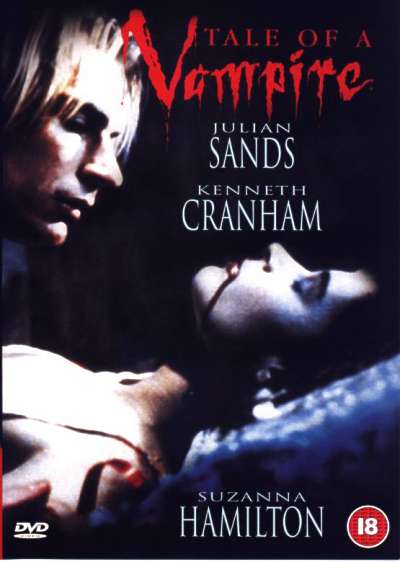
When Anne (Suzanna Hamilton) gets a job at the library, she is immediately attracted to the quiet and studious Alex (Julian Sands) and he to her. Alex claims to be a scholar who is at the library to do research on “religious martyrs” but Anne cannot escape the feeling that she has known him before. What Anne does not immediately realize is that Alex is a vampire and that she was set up with a job at the library through the machination of Edgar (Kenneth Cranham), another vampire who claims to be a doctor. Once, Edgar and Alex were both in love with the same woman, the beautiful Virginia. After circumstances led to Virginia being taken away from both men, Edgar dedicated the rest of his vampiric existence to making Alex miserable. Anne, who looks exactly like Virginia and may even be the reincarnated version of her, is a pawn in Edgar’s latest scheme. When Alex and Anne start to fall in love with each other, Edgar’s plan leads to tragedy.
Tale of the Vampire is an unjustly obscure vampire film from the early 90s. It used to play frequently on late night Cinemax, where it was advertised as just being another sex-fueled horror film but actually, Tale of the Vampire is a moody and contemplative art film. The focus is on Alex’s feelings of guilt and his fear of hurting Anne in the same way that Virginia was hurt while Anne has to decide how far she is willing to go to be with Alex. All three of the main actors give good performances, with Cranham nearly stealing the show as someone whose actual identity will become obvious after repeat viewings. Tale of the Vampire has never gotten the attention that it deserves and it’s not an easy film to find but I recommend it.
(For those following at home, Lisa is attempting to clean out her DVR by watching and reviewing 38 films by the end of today!!!!! Will she make it? Keep following the site to find out!)
Poor Cecil Vyse.
The 1986 film A Room With A View is a love story. It’s about a young woman who meets a young man in Florence, Italy and then, upon returning to England, she discovers that the same young man and his father are now her neighbors. From the minutes they meet, it’s obvious that the young man and the young woman are destined to be together. The only thing that’s standing in their way is the strict culture of conformity of Edwardian England. That and the fact that the young woman is engaged to Cecil Vyse.
Cecil represents the establishment. He comes from a good family. He’s well-educated. He talks about the right subjects. He holds all the right opinions. He’s not an exciting man but he’s a good man who is destined to have successful but not very interesting life. From the minute that we meet him, we know that our heroine is not meant to stay with Cecil.
And it’s heart-breaking because the film goes out of its way to show that Cecil is not a bad person. In his own befuddled way, he’s one of the most likable people in the entire film. He may not have an interesting mind but he does have a good heart. When the moment comes that Cecil’s heart is broken, the film treats him with respect.
Of course, it helps that Cecil was played, in one of his first roles, by Daniel Day-Lewis. Day-Lewis plays the role with a quiet dignity. Instead of just turning Cecil into a mere nuisance that has to be pushed out of the way in the name of love, Day-Lewis emphasizes Cecil’s humanity. There’s a quiet scene where the recently heart-broken Cecil ties his shoes that is an example of truly great acting.
As for the two young lovers, Lucy Honeychurch is played by Helena Bonham Carter while George Emerson is played by Julian Sands. Both of them are achingly beautiful and, even more importantly, they both look as if they belong in Edward England and with each other. Still, seeing this film today, it takes a little while to adjust to seeing both Bonham Carter and Sands playing such … normal characters. We’re so used to seeing Helena killing people in Tim Burton movies that it’s nice to see her getting to rather sweetly fall in love for once.
The entire film is full of great British actors, all at their best. Denholm Elliott plays George’s father and gets to deliver a rousing defense of both true love and free thought. Maggie Smith plays Lucy’s overprotective aunt while Rosemary Leach is Lucy’s supportive mother. And then you’ve got Simon Callow as an eccentric vicar. (Because every British film needs an eccentric vicar.) Lucy’s younger brother is played by an actor named Rupert Graves and he’s so adorable that I kind of found myself wishing that he could have had a spin-off movie of his own.
A Room With A View is a wonderfully romantic film, one that I could easily see myself spending days just watching over and over again. A Room With A View was nominated for best picture but it lost to the far less romantic Platoon.
(For those following at home, I now have one more review to go to reach my goal of reviewing 38 films in 10 days!)