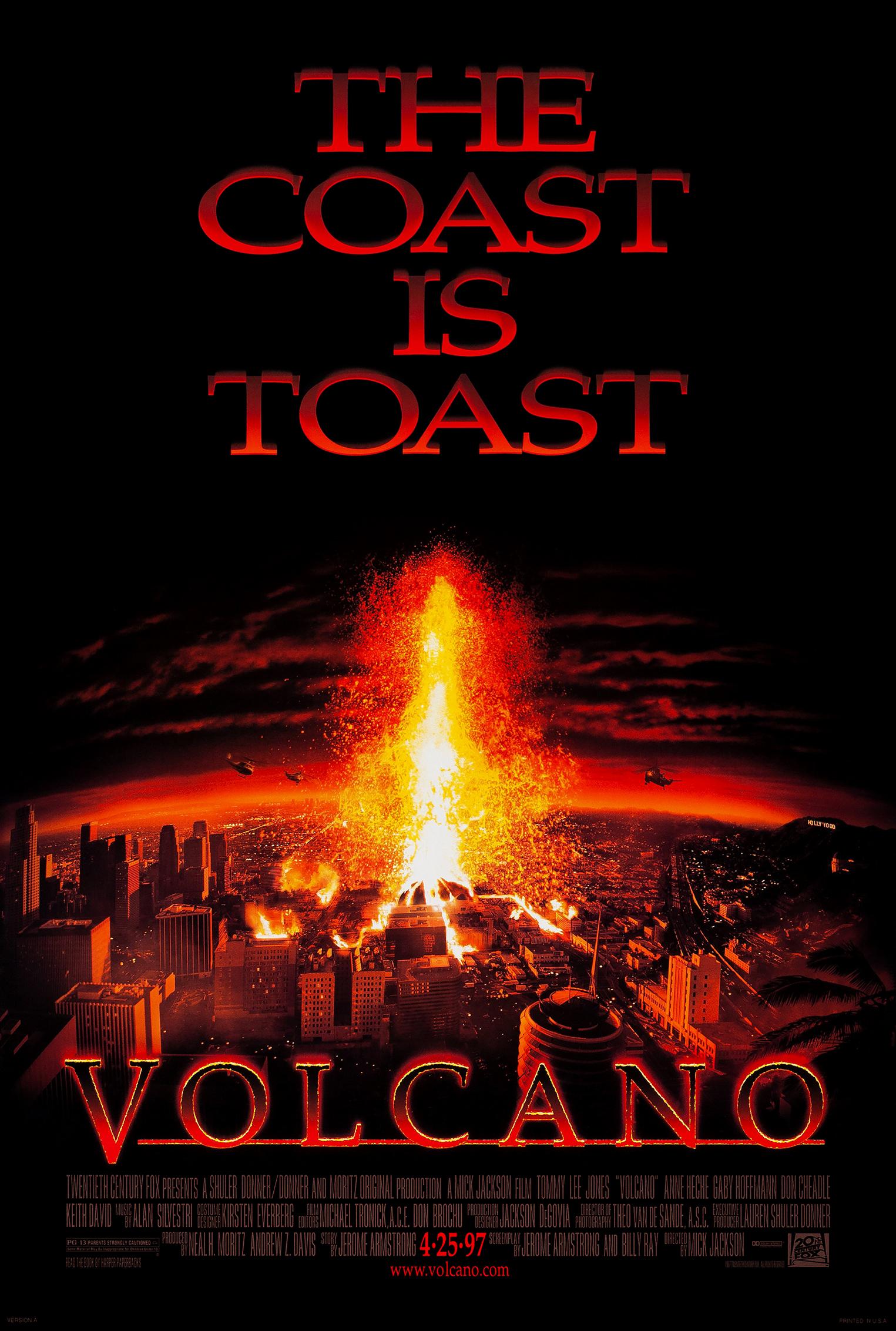
Review: Volcano (dir. by Mick Jackson)


“Lava? Right here in L.A.?” — Mike Roark

In Volcano, Los Angeles does not just face an earthquake, fire, or some ordinary civic emergency—it finds itself threatened by a river of lava tearing through the heart of the city. Directed by Mick Jackson, the 1997 disaster movie takes a premise that is almost impossible to accept on paper and sells it through speed, scale, and the sheer force of Tommy Lee Jones barking orders at people. A volcano erupting beneath Los Angeles, near the La Brea Tar Pits no less, is not exactly a model of scientific credibility. Still, the film is energetic enough to make its absurdity part of the entertainment.

The setup is wonderfully direct. An earthquake rattles Los Angeles, workers begin dying in underground tunnels, and a strange source of extreme heat is discovered beneath the city. Before long, lava is spilling into the streets, buildings are catching fire, and the city’s Emergency Management director Mike Roark, played by Tommy Lee Jones, has to coordinate an increasingly desperate effort to keep downtown Los Angeles from being wiped out. Anne Heche plays Dr. Amy Barnes, the geologist who realizes that the city is dealing with more than an earthquake or a gas leak. Together, Roark and Barnes become the film’s central problem-solving team: he is the practical, politically frustrated municipal leader, while she is the scientific expert trying to explain the impossible thing happening under everyone’s feet.

What makes Volcano enjoyable is that it does not waste much time pretending to be a subtle character drama. The movie’s main concern is escalation. Every time the heroes think they have contained the problem, the lava finds another way to spread. It comes through the subway. It crashes through pavement. It turns a normal Los Angeles intersection into a landscape from hell. The film understands the simple pleasure of watching ordinary urban infrastructure become a weapon or a liability. A train tunnel, a concrete barrier, construction equipment, storm drains, and even a city block all become parts of an enormous improvised plan to redirect molten rock.

Mick Jackson directs the action with enough urgency that the movie often works even when the science is wobbling badly. The special effects are very much of their era, combining practical fire, miniatures, digital lava, and lots of actors reacting to bright orange light. Some of the CGI has aged about as gracefully as one would expect from 1997, but the physical effects still have impact. The lava itself has a thick, almost muscular quality in the film. It does not just look like glowing liquid; it moves like an unstoppable wall that eats concrete, cars, and people. The images of lava flooding Los Angeles streets remain the reason to watch the movie. They are absurd, but memorably absurd.

The film also benefits from treating the crisis as a citywide emergency rather than simply a personal survival story. Roark is not a scientist, soldier, or superhero. He is basically a city official who has to make decisions under impossible conditions, manage multiple agencies, argue with politicians, and keep people from panicking. Tommy Lee Jones is perfect casting for that role. He has the right mixture of exhaustion, irritation, authority, and reluctant decency. Jones does not play Roark as a polished action hero; he plays him like a man who had plans for a quiet weekend with his daughter and instead ends up trying to stop Los Angeles from being buried under lava. His natural gruffness gives the movie more weight than it might otherwise have.

Anne Heche brings a different energy as Amy Barnes. Her character is often stuck delivering exposition, explaining volcanic activity, underground pressure, and why everyone is probably about to die, but Heche commits to it. She gives Amy enough urgency and intelligence that the scientific dialogue feels less like a lecture and more like another kind of emergency response. The relationship between Roark and Amy is also refreshingly restrained. The movie could have forced a big romantic subplot between them, but it mostly keeps their connection professional. They respect each other because they are both good at their jobs, which is more interesting than a last-minute disaster-movie love story.

The supporting cast is solid as well. Don Cheadle has a memorable role as Emmit Reese, a subway supervisor who becomes one of Roark’s most important allies. Keith David also adds welcome presence as a police lieutenant helping coordinate the response. Gaby Hoffmann plays Roark’s daughter Kelly, and while the daughter-in-peril material is fairly standard, it gives Jones’s character an emotional stake outside the command center. The film occasionally leans hard on familiar disaster-movie formulas, including separated family members, skeptical officials, and civilians making terrible decisions near obviously dangerous lava, but that is part of the package. Volcano is not trying to reinvent the genre. It is trying to make the genre run hot and fast for 104 minutes.

It is hard not to compare Volcano with Dante’s Peak, the other major volcano disaster movie released earlier in 1997. Dante’s Peak at least tries to ground its eruption in recognizable volcanic warning signs, scientific procedure, and the danger of officials ignoring experts until it is too late. Even when it becomes exaggerated, the film wants viewers to feel that its disaster could plausibly grow out of real geological conditions. Volcano, on the other hand, does not have much interest in maintaining that kind of credibility. Its premise is already much wilder: molten lava suddenly emerging beneath one of the largest cities in the United States. Rather than fight that inherent silliness, Mick Jackson’s film leans into it. Where Dante’s Peak aims for science-flavored suspense, Volcano goes for spectacle, turning Los Angeles itself into a giant disaster-movie set piece.

The biggest issue is that the movie never really decides how seriously it wants to take itself. At times, it is a grim urban catastrophe film in which people die in horrifying ways. One scene involving a transit worker trying to rescue another man from the lava is still surprisingly brutal and sad. At other times, Volcano is close to accidental comedy, especially whenever the film attempts to explain its geology with complete confidence. The idea of a full-scale volcanic eruption beneath Los Angeles is already a major stretch, but the movie goes beyond that into a kind of aggressively convenient science. The lava moves where the plot needs it to move, barriers hold until they need to fail, and the city seems able to mobilize massive engineering projects at a speed that would make any real emergency planner laugh.

Still, questioning the realism too closely misses the appeal. Volcano belongs to that specific 1990s era when major studios were throwing big budgets at destruction spectacles with recognizable stars and high-concept premises. The movie is essentially a monster film where the monster is a river of lava rolling through Los Angeles. Instead of a creature smashing buildings, it is molten rock swallowing streets, derailing infrastructure, and forcing ordinary people to run for their lives.

The movie is also unintentionally revealing about late-1990s disaster filmmaking. It has a strong faith in public-service workers, engineers, transit employees, firefighters, police officers, and regular people doing dangerous jobs because somebody has to do them. Roark’s strategy is not to defeat nature through one genius solution. It is to coordinate an enormous group effort, with people hauling concrete barriers, driving equipment, evacuating neighborhoods, and taking risks to buy the city more time. That civic-minded quality gives the film a little more heart than its reputation as a silly lava movie might suggest.

In the end, Volcano is neither a great disaster movie nor a completely disposable one. It is too scientifically goofy to be taken seriously as a realistic thriller, and its dialogue can be very blunt. Yet it has pace, personality, some genuinely effective spectacle, and a reliably entertaining Tommy Lee Jones performance at its center. It is the kind of movie where a man can face a molten river in downtown Los Angeles and somehow make you believe that yelling louder might solve the problem. For viewers in the mood for a big, fiery, unapologetically 1990s popcorn movie, Volcano remains a fun eruption of chaos.
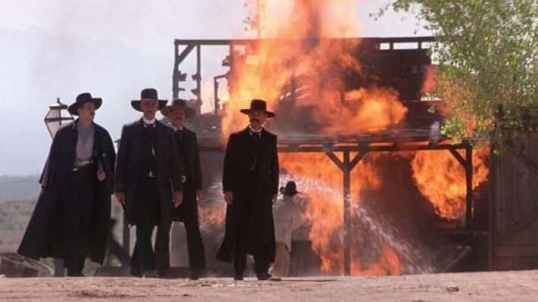
The Unnominated #12: Tombstone (dir by George Pan Cosmatos)


Though the Academy of Motion Picture Arts and Sciences claim that the Oscars honor the best of the year, we all know that there are always worthy films and performances that end up getting overlooked.  Sometimes, it’s because the competition too fierce.  Sometimes, it’s because the film itself was too controversial.  Often, it’s just a case of a film’s quality not being fully recognized until years after its initial released.  This series of reviews takes a look at the films and performances that should have been nominated but were, for whatever reason, overlooked.  These are the Unnominated.

I have come around on Tombstone.

The first time I watched this 1993 film, I was a bit confused as to why so many of my friends (especially my male friends) worshipped the film.  To me, it was a bit too messy for its own good, an overlong film that told a familiar story and which featured so many characters that it was difficult for me to keep track of them all.  Perhaps because everyone I knew loved the film so much, I felt the need to play contrarian and pick out every flaw I could find.

And I still think those flaws are there.  The film had a troubled production, with original director Kevin Jarre falling behind in shooting and getting replaced by George Pan Cosmatos, a director who didn’t have any real interest in the material and whose all-business approach rubbed many members of the cast the wrong way.  Kurt Russell took over production of the film, directing the actors and reportedly paring down the sprawling script to emphasize the relationship between Russell’s Wyatt Earp and Val Kilmer’s Doc Holliday.  On the one hand, this led to a lot of characters who really didn’t seem to have much to do in the finished film.  Jason Priestley’s bookish deputy comes to mind.  On the other hand, Russell was right.

The film’s heart really is found in the friendship between Wyatt and Doc.  It doesn’t matter that, in real life, Wyatt Earp was hardly as upstanding as portrayed by Kurt Russell.  It also doesn’t matter that the real-life Doc Holliday was perhaps not as poetic as portrayed by Val Kilmer.  Today, if you ask someone to picture Wyatt Earp, they’re probably going to picture Kurt Russell with a mustache, a cowboy hat, and a rifle.  And if you ask them to picture Doc Holliday, they’re going to picture Val Kilmer, sweating due to tuberculosis but still managing to enjoy life.  Did Doc Holliday every say, “I’ll be your huckleberry,” before gunning someone down?  He might as well have.  That’s how he’s remembered in the popular imagination.  And it’s due to the performances of Russell and Kilmer that I’ve come around to eventually liking this big and flawed western. With each subsequent viewing, I’ve come to appreciate how Russell and Kilmer managed to create fully realized characters while still remaining true to the Western genre.  If Wyatt Earp initially fought for the law, Doc Holliday fought for friendship.  Kilmer is not only believable as a confident gunslinger who has no fear of walking into a dangerous situation.  He’s also believable as someone who puts his personal loyalty above all else.  He’s the type of friend that everyone would want to have.

That said, I do have to mention that there are a lot of talented people in the cast, many of whom are no longer with us but who will live forever as a result their appearance here.  When Powers Boothe delivered the line, “Well …. bye,” he had no way of knowing that he would eventually become a meme.  Boothe is no longer with us, I’m sad to say.  But he’ll live forever as long as people need a pithy way to respond to someone announcing that they’re leaving social media forever.  Charlton Heston appears briefly as a rancher and he links this 90s western with the westerns of the past.  Robert Mitchum provides the narration and it just feels right.  The large ensemble cast can be difficult to keep track of and even a little distracting but there’s no way I can’t appreciate a film that manages to bring together not just Russell, Kilmer, Boothe, Heston, and Mitchum but also Sam Elliott, Bill Paxton, Michael Biehn, Michael Rooker, Billy Bob Thornton, Frank Stallone, Terry O’Quinn, and even Billy Zane!  The female roles are a bit underwritten.  Dana Delaney is miscast but Joanna Pacula feels exactly right as Doc Holliday’s lover.

But ultimately, this film really does belong to Val Kilmer.  When I heard the sad news that he had passed away last night, I thought of two films.  I thought of Top Gun and then I thought of Tombstone.  Iceman probably wouldn’t have had much use for Doc Holliday.  And Doc Holliday would have resented Iceman’s attitude.  But Val Kilmer — that brilliant actor who was so underappreciated until he fell ill — brought both of them to brilliant life.  In the documentary Val, Kilmer attends a showing of Tombstone and you can say he much he loves the sound of audience cheering whenever Doc Holliday showed up onscreen.

Tombstone was a flawed film and 1993 was a strong year.  But it’s a shame that Val Kilmer was never once nominated for an Oscar.  Tombstone may not have been a Best Picture contender but, in a year when Tommy Lee Jones won the Oscar for Best Supporting Actor for his role in the similarly flawed The Fugitive, it seems a shame that Kilmer’s Doc Holliday was overlooked.

Tombstone (1993, dir by George Pan Cosmatos (and Kurt Russell), DP: William Fraker)

Previous entries in The Unnominated:

  1. Auto Focus 
  2. Star 80
  3. Monty Python and The Holy Grail
  4. Johnny Got His Gun
  5. Saint Jack
  6. Office Space
  7. Play Misty For Me
  8. The Long Riders
  9. Mean Streets
  10. The Long Goodbye
  11. The General

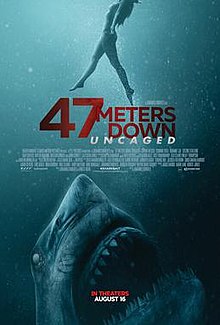
Horror Film Review: 47 Meters Down: Uncaged (dir by Johannes Roberts)


Let us take a moment or two to give some thought to the poor, misunderstood shark.

Sharks have a reputation for being the most dangerous predators in the ocean but, for the most part, sharks just swim around and eat whatever is in front of them.  They are certainly not harmless but they’re also not the clever, calculating monsters that they’ve been made out to be.  As opposed to what all the sequels to Jaws have told us, sharks do not stalk people.  They do not seek revenge.  They do not look at certain humans and think, “That is my mortal enemy.”  A shark will not follow you from New England to the Caribbean just because you’re the widow of the man who killed its cousin.  Sharks look scary and, certainly, you should stay out of the water if one of them is swimming nearby.  But, for the most part, the only thing that one needs to have to avoid being attacked by a shark is common sense.

Unfortunately, none of the characters in the 2019 film, 47 Meters Down Uncaged, have any common sense.  The film tells the tale of Mia (Sophie Nelisse) and her stepsister, Sasha (Corrine Fox).  Mia and Sasha are both students at a new school in Mexico.  Their father, Grant (John Corbett), has been exploring a submerged Mayan city.  Along with their two friends, Alexa (Brianne Tju) and Nicole (Sistine Stallone), Mia and Sasha decide to spend the weekend scuba diving and exploring the ancient city.  The girls have a good time looking at all of the mummies and the sacrificial chamber.  Unfortunately, a great white shark shows up to ruin their fun.  The simplest solution would probably be too leave the city but, because the girls keep screaming and accidentally knocking stuff over, they soon find themselves trapped in the newly collapsed city.  Not only have they upset a shark but they’ve managed to destroy a bunch of valuable historical artifacts.  Way to go!

47 Meters Down: Uncaged was sold as being a sequel to 47 Meters Down, the Mandy Moore/shark film that came out in 2017.  However, other than having the same director, the only thing that the two films have in common is that they both spend a lot of time underwater and they both feature a shark.  In fact, I’m not even sure if they get down to the 47 meters in Uncaged but that’s just because, as an American, I find the metric system to be extremely confusing.  The original 47 Meters Down also had a slightly interesting premise and a good performance from Mandy Moore.  47 Meters Down: Uncaged, on the other hand, is just about four girls who did something incredibly stupid and then did something else incredibly stupid and then just kept on doing every stupid thing that came to mind.  Most people will be cheering for the shark.

That said, it should be noted that Johannes Roberts definitely uses that shark for all that its worth.  The film’s characters may be stupid but the shark itself is scary and generates its share of effective jump scares.  This is one of those diabolically clever sharks that knows how to hide behind corners until someone swims by.  As I mentioned at the start of this review, that’s not exactly realistic shark behavior but it’s definitely effective movie behavior.  The scenes where the shark suddenly emerged from the darkness definitely made jump.  The scene where one of the girls attempted to climb out of the cave and then fell into the water in super slow motion made me laugh.  There’s something to be said for a film that can make you both jump and laugh.

One final note: the sharks lived in that submerged Mayan city for over a hundred years without damaging anything.  Mia, Sasha, and their friends visit the city for less than an hour and manage to destroy the place.  Remember that the next time anyone says anything against the sharks.

Horror Film Review: The Silence (dir by John R. Leonetti)


“Don’t make a sound!”

“Why not?”

“Because we’re characters in the 2019 film, The Silence.”

“Uhmmm….okay.”

“And there’s monsters flying around the car.”

“Oh, is that what those are?  I thought they were like fruit bats or something.”

“And they only hunt by sound.”

“Wait.”

“So, if you make a sound, they’ll swoop down and kill the entire family, even old grandma in the back seat.”

“Does any of this seem familiar?”

“Shhhh….”

“I swear this film feels familiar.”

“Oh please …. this is nothing like A Quiet Place.”

“Uhmm …. big flying creatures swarming on people who make noise and killing them.  How is this not like A Quiet Place?”

“Well, The Silence not only features creatures that only hunt by sound but there’s also a subplot that comes out of nowhere, about a bunch of cultists who have cut out their tongues and who want to sacrifice the family to the monsters.”

“Oh.”

“Nothing like A Quiet Place.”

“So, basically, this just A Quiet Place meets a bad episode of Fear The Walking Dead.”

“Kind of but you know what?  The Silence has got Stanley Tucci in the cast and he’s an Oscar nominee!  Plus, Kiernan Shipka plays Tucci’s deaf daughter and she’s Sabrina.  Also, Miranda Otto is in it and she-costars with Kiernan on that Sabrina show, so this entire movie really does feel like a particularly messed-up episode of Chilling Adventures of Sabrina.”

“So, basically, this movie is a A Quiet Place meets Fear The Walking Dead meets that terrible Sabrina show.”

“My point is that this film has a really good cast and it’s also got the guts to totally waste them in uninteresting roles.”

“How does that take guts?”

“It also has the guts to kill off the adorable family dog because sometimes you just have to make difficult choices to say alive.”

“Especially when you’re living in a second-rate version of A Quiet Place, right?”

“LISTEN!”

“Uhmm …. should you have just yelled like that, considering all the monsters killing anyone who makes a sound?”

“Whoops.”

“Well, we’re screwed …. AAAAAAGH!”

And the rest is silence.


Mardi Gras Film Review: On Hostile Ground (dir by Mario Azzopardi)


Uh-oh!  New Orleans might be in trouble!

In the 2000 film, On Hostile Ground, John Corbett plays a geologist named Matt Andrews.  Matt has been asked to investigate why two giant sinkholes have suddenly opened in New Orleans.  The mayor’s press secretary, George Regan (Peter Stebbins), hopes that Matt will just do a perfunctory investigation and then declare the sinkholes to be no big deal.  After all, it’s nearly time for Mardi Gras and it would be an economic disaster to cancel this year’s celebration.  One can only assume that, like most movie bureaucrats, Regan has never seen Jaws and therefore doesn’t understand the folly of saying, “We can’t close the city during tourist season!”

However, Matt’s a geologist and he holds himself up to a higher standard.  He doesn’t care about whether or not people get to celebrate Mardi Gras or not.  In fact, just listening to him talk and watching him work, you get the feeling that Matt was probably the guy who, during previous Mardi Gras celebrations, would say, “You guys go without me.  I’ve got to get some work done.”  Anyway, Matt does some investigating and discovers that New Orleans is basically about to collapse into the Earth.  It could happen tomorrow or it could happen 3,000 years from now but it will happen.  Matt also points out that, even if the entire city manages to not sink into the Earth, the sinkholes could cause the levees to collapse and then the entire city would be flooded.  (This movie was made before Katrina.)

Regan hears Matt out and then decides to hide all of his evidence and let Mardi Gras go on as planned.

Can you guess what happens?

There’s a few things that I immediately noticed about On Hostile Ground.

First off, my family lived in Louisiana for about a year and a half.  I’ve been to New Orleans during Mardi Gras.  I can usually tell when a film has actually been shot in Louisiana as opposed to some place nearby like, say, Georgia.  Watching On Hostile Ground, I noticed that it appeared that at least a few of the Mardi Gras scenes had actually been filmed in New Orleans.  There wasn’t quite as much Mardi Gras footage as I was expecting but what there was appeared to be authentic.  However, whenever the action moved outside of the French Quarter, I couldn’t help but notice that the surroundings looked very Canadian and that very few of the extras sounded like they had ever spent any time anywhere near the Big Easy.  In short, it quickly became obvious that the majority of this made-for-television film was shot in Montreal and Toronto.  Canada really can’t pass for Louisiana, much as how they could have never shot an episode of Degrassi in New Orleans.

The other thing I noticed is that, despite New Orleans being below sea level, Matt and his fellow geologists had no trouble finding dry underground caverns underneath the city.  It reminded me a bit of that old X-Files movie where the kids find an underground cavern right outside of Dallas.  Some things just aren’t going to happen, okay?

Anyway, this is one of those low-budget disaster films where everyone refuses to listen to the scientist and disaster follows.  This is the type of film that, nowadays, would probably be made by the Asylum for the SyFy Network.  That said, the Asylum version would probably be a lot more fun because there would be probably be like a sea serpent or killer Mardi Gras floats or something.  This one is just kind of dull and spends too much time on build-up without enough pay-off.

On Hostile Ground is not really worth sacrificing any beads for.


50 Shades of Obsession: The Boy Next Door and Bound


Happy Valentine’s Day!

Okay, I know.  It’s not Valentine’s Day yet.  But it will be soon.  50 Shades of Grey is opening tomorrow and I have a feeling that, come November, there will be hundreds of newborn babies being named Christian and Anastasia.  (And, in a few years, they’ll all have teenage babysitters named Bella…)

However, in case you can’t get into 50 Shades of Grey, here’s two other films that you could possibly watch on Valentine’s Day.  Much like 50 Shades, they both involve a woman having sex with a manipulative sociopath.  The Boy Next Door is still in theaters while Bound has just been released on video.

And they’re both reviewed below!
The-Boy-Next-Door-2015

The Boy Next Door, which was released towards the end of January, was the first film of 2015 that I was really excited about seeing.  That’s not because I thought that the film was going to be any good.  Instead, it was because I literally couldn’t watch any movie on Lifetime without seeing about a dozen commercials for The Boy Next Door.  The commercials promised a lot of cheap thrills and sordid melodrama.

Anyway, my BFF Evelyn and I saw The Boy Next Door on the weekend that it was first released and we had a great time watching it.  Though the film may start slow, it eventually becomes a minor triumph of so-bad-its-good filmmaking.  This is the type of film that you would normally expect to see going straight to cable but, somehow, it managed to get a theatrical release.  Making it all the more fun is the fact that it stars Jennifer Lopez, playing the type of role that you would normally expect to see Jennifer Love Hewitt or Elizabeth Berkley playing in a Lifetime movie.

Jennifer Lopez plays an AP English teacher who has recently separated from her adulterous husband (John Corbett).  When a teenage boy (Ryan Guzman) moves in next door and starts standing naked in front of his bedroom window, can you really be surprised that he and Lopez end up spending one night making torrid love?  Well, unfortunately, Guzman turns out to be a bit obsessive and, when the new school year begins, he suddenly shows up as one of Lopez’s students.  And you can probably guess what happens from there…

As directed by Rob Cohen, there’s really nothing surprising or interesting to be found in The Boy Next Door but we still had a lot of fun watching it, if just because it gave us an excuse to be snarky.  Ryan Guzman was undeniably hot and, wisely, Jennifer Lopez didn’t seem to be taking the film that seriously.  The great Kristin Chenoweth showed up as Lopez’s best friend and the film’s climax was appropriately over the top.

And, three weeks after seeing the film, Evelyn and I are still laughing about the scene where Guzman gives Lopez a gift, a copy of The Illiad.   Looking down at the book, J. Lo says, “Oh!  A first edition!”  Evelyn and I were just like, “Really?  So, that book’s from 760 B.C!?”  Seriously, did the character have a time machine?

Now, that would have made for an interesting movie!

Bound

If, for some reason, you can’t find a theater showing 50 Shades of Grey this weekend, I would suggest instead watching the Asylum’s mockbuster version, Bound.  

(Personally, I would have titled the film 50 Shades of Charisma but anyway…)

In Bound, Charisma Carpenter plays Michelle, a real estate broker who has an unsatisfying sex life and who finds herself regularly being bullied by her boss (Daniel Baldwin).  However, Michelle then meets Ryan (Bryce Draper), who is young, handsome, rich, and very much into domination  He even has a red room in his mansion where…

Oh wait, does this sound familiar?

Okay, so Bound pretty much tells the same story as 50 Shades of Grey but there are a few significant differences.  A big one is that, as played by Carpenter, Michelle is a much stronger character than Anastasia Steele.  For one thing, she’s not an innocent and naive girl being introduced to sex for the first time by a charming sociopath.  Instead, she’s significantly older than Ryan, which also brings an interesting dynamic to the film.  Michelle’s not a virgin, she doesn’t say things like “jeez” or “oh my,” and she’s capable of getting aroused without obsessing about what her inner goddess is doing as a result.  And, while her relationship with Ryan does head in a similar direction as Anastasia’s relationship with Christian Grey, Michelle never seems weak as a result.  Instead, she’s experimenting and there’s no way you can’t root for her as you watch the movie.

(Ryan, meanwhile, is ultimately portrayed as being the type of manipulative sociopath that Christian Grey would be in real life.)

Perhaps my favorite part of the film was Michelle’s relationship with her teenage daughter, Dara (Morgan Oberender).  The two actresses play off each other well and, from the minute they first interacted, I believed that they could be mother and daughter.  They’re relationship felt real and, as a result, you cared about both of them and found yourself hoping that things would work out for the best.  And, as a result, it made one of the film’s final plot twists feel very immediate and real.

Bound is the type of film that will be (and has been) dismissed by a lot of mainstream critics but it deserves more consideration than it’s been given.