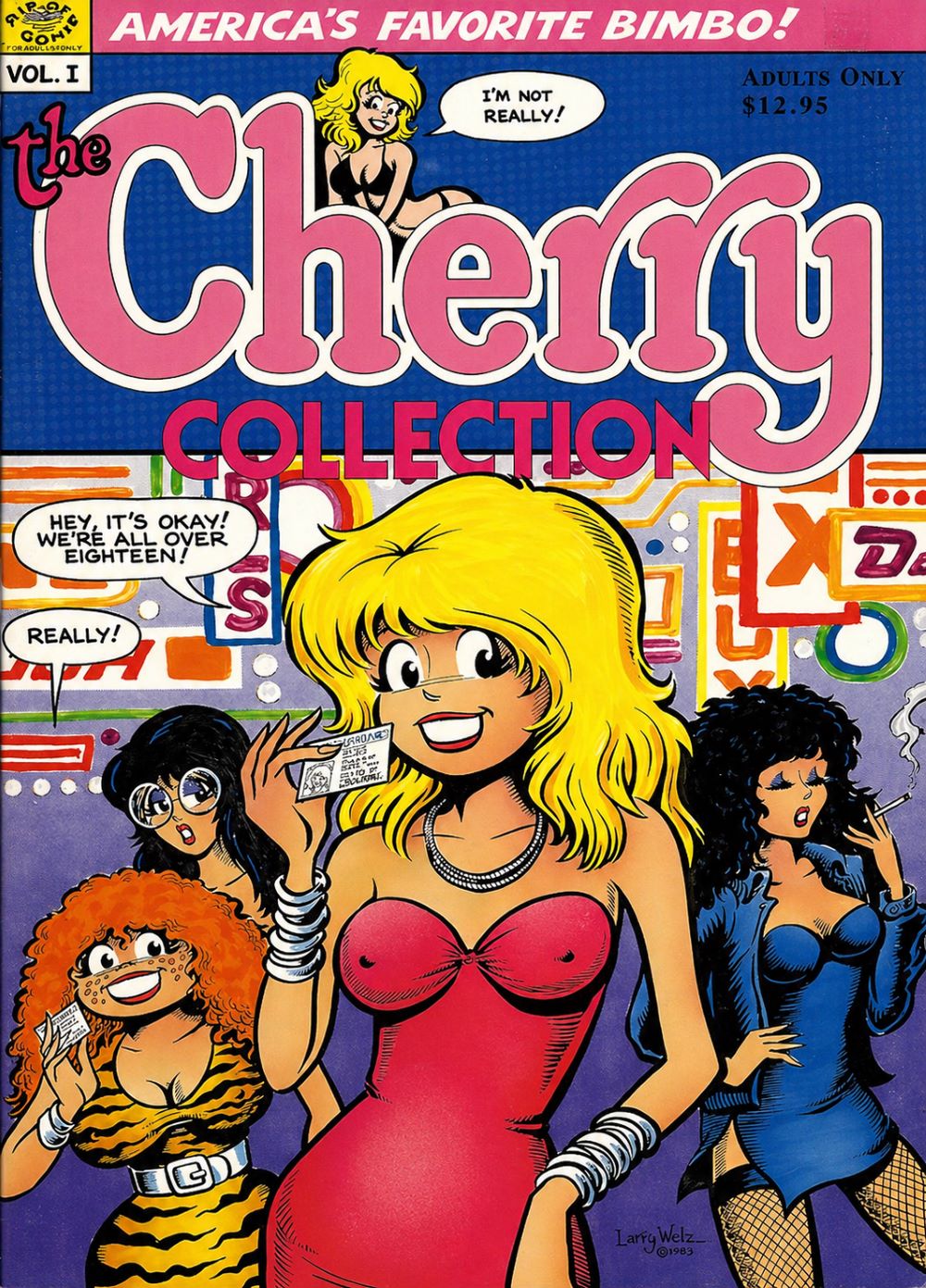
In the sprawling, often grimy landscape of underground comics, few characters have managed to carve out as distinct—or as controversial—a niche as Cherry, the perpetually eighteen-year-old protagonist born from the mind of cartoonist Larry Welz. Originally debuting in 1971 under the moniker Cherry Poptart, the character became a fixture of counter-culture erotica, eventually settling into a self-titled series that would span decades. Welz’s work was instrumental in helping to usher in the vibrant, anarchic underground comics movement in San Francisco during the tumultuous social and political landscape of the 1960s and 1970s. Engaging with Cherry today is an exercise in complex appreciation; it is the definition of a “guilty pleasure,” a work that exists at the intersection of satirical wit, overt hedonism, and a stylistic homage to the quintessential American comic book aesthetic.
At the core of the series’ appeal is the striking contrast between its visual presentation and its mature, often raunchy subject matter. Welz famously adopted an art style that directly mirrored the work of Dan DeCarlo, the legendary artist who defined the iconic look of the Archie comics. By utilizing the clean, “happy teenager” lines of mid-century Americana—often associated with the wholesome, classic adventures of Riverdale—and infusing them with unrestrained, sex-positive, and frequently explicit content, Welz created a powerful visual dichotomy. This deliberate juxtaposition of a quintessential teen comic aesthetic with an adults-only narrative creates a jarring, transgressive experience that makes the work particularly effective as a guilty pleasure. There is an undeniable, subversive thrill in seeing character designs that evoke the innocent charm of Betty or Veronica placed in scenarios that would have sent the strict mid-century Comics Code Authority into a tailspin.
The character of Cherry herself is a fascinating, if problematic, focal point. Defined by her insatiable curiosity, liberal attitude, and complete lack of inhibitions, she is less of a traditional narrative character and more of an agent of chaos who wanders through various high-school-adjacent tropes. Because she remains eighteen, the series avoids the weight of traditional character growth, opting instead for an episodic format where the pleasure is derived entirely from the immediate situation—be it a pop-culture parody, a bizarre social commentary, or a sexual escapade. While the series is categorized as erotica, to dismiss it solely as such is to overlook the sharp satirical edge that occasionally pokes through the panels. Fans of the underground and transgressive culture scene often point out that Cherry frequently served as a vehicle for Welz to comment on the broader socio-political zeitgeist of the era. By utilizing the “anything goes” freedom of the underground press, the series tackled issues and social norms that mainstream comics dared not touch, masking biting critiques within its provocative and irreverent framing.
This thematic depth, however, exists in tension with the repetitive nature of the stories. As a guilty pleasure, the series relies on a specific cadence: the setup of a conventional trope, the predictable introduction of sexual absurdity, and the punchline. For the dedicated reader, this repetition is comforting and familiar, but it is also the source of the series’ main weakness. There are moments where the narrative feels like it is running on fumes, and the reliance on sexual shock value can feel stagnant compared to more modern or structurally daring indie comics. Furthermore, admitting to enjoying Cherry in a contemporary landscape is complicated by how the series has—or hasn’t—aged. Much of the humor and the treatment of gender dynamics feel firmly rooted in the specific, often male-gaze-dominated world of mid-century underground comix.
Consequently, it is a work that requires a reader to compartmentalize; one can admire the historical significance of Welz’s contribution to erotic art and the audacity of his stylistic parody while simultaneously acknowledging that the execution of certain themes feels archaic. This is why Cherry remains a quintessential guilty pleasure. It does not aim for the lofty aspirations of a graphic novel masterpiece, nor does it try to serve as a beacon of progressive morality. Instead, it succeeds as a piece of “low-brow” entertainment that is proud of its own transgression. The inclusion of guest work, such as a rare script by Neil Gaiman in Cherry Deluxe, highlights that the series was often respected within its own subculture as a legitimate, if edgy, playground for creative expression.
Looking back, the series acts as a testament to the “anything goes” ethos of the underground press era. While there are certainly other adult-oriented comics that might offer more robust character arcs or sophisticated storytelling, few manage to balance the specific blend of nostalgia, irreverence, and raw, unapologetic hedonism that defines the Cherry universe. It is a series that invites the reader to lean into the discomfort and find humor in the sheer absurdity of the scenarios. For those who enjoy exploring the fringes of comic history, Cherry remains a vital, if occasionally flawed, artifact. It represents a time when comics were a battlefield for free speech and a canvas for uninhibited adult fantasy. As a guilty pleasure, it holds up because it never pretends to be anything other than what it is: a fun, slightly reckless, and undeniably bold experiment in the possibilities of the medium.
Previous Guilty Pleasures
- Half-Baked
- Save The Last Dance
- Every Rose Has Its Thorns
- The Jeremy Kyle Show
- Invasion USA
- The Golden Child
- Final Destination 2
- Paparazzi
- The Principal
- The Substitute
- Terror In The Family
- Pandorum
- Lambada
- Fear
- Cocktail
- Keep Off The Grass
- Girls, Girls, Girls
- Class
- Tart
- King Kong vs. Godzilla
- Hawk the Slayer
- Battle Beyond the Stars
- Meridian
- Walk of Shame
- From Justin To Kelly
- Project Greenlight
- Sex Decoy: Love Stings
- Swimfan
- On the Line
- Wolfen
- Hail Caesar!
- It’s So Cold In The D
- In the Mix
- Healed By Grace
- Valley of the Dolls
- The Legend of Billie Jean
- Death Wish
- Shipping Wars
- Ghost Whisperer
- Parking Wars
- The Dead Are After Me
- Harper’s Island
- The Resurrection of Gavin Stone
- Paranormal State
- Utopia
- Bar Rescue
- The Powers of Matthew Star
- Spiker
- Heavenly Bodies
- Maid in Manhattan
- Rage and Honor
- Saved By The Bell 3. 21 “No Hope With Dope”
- Happy Gilmore
- Solarbabies
- The Dawn of Correction
- Once You Understand
- The Voyeurs
- Robot Jox
- Teen Wolf
- The Running Man
- Double Dragon
- Backtrack
- Julie and Jack
- Karate Warrior
- Invaders From Mars
- Cloverfield
- Aerobicide
- Blood Harvest
- Shocking Dark
- Face The Truth
- Submerged
- The Canyons
- Days of Thunder
- Van Helsing
- The Night Comes for Us
- Code of Silence
- Captain Ron
- Armageddon
- Kate’s Secret
- Point Break
- The Replacements
- The Shadow
- Meteor
- Last Action Hero
- Attack of the Killer Tomatoes
- The Horror at 37,000 Feet
- The ‘Burbs
- Lifeforce
- Highschool of the Dead
- Ice Station Zebra
- No One Lives
- Brewster’s Millions
- Porky’s
- Revenge of the Nerds
- The Delta Force
- The Hidden
- Roller Boogie
- Raw Deal
- Death Merchant Series
- Ski Patrol
- The Executioner Series
- The Destroyer Series
- Private Teacher
- The Parker Series
- Ramba
- The Troubles of Janice
- Ironwood
- Interspecies Reviewers
- SST — Death Flight
- Undercover Brother
- Out for Justice
- Food Wars!


Pingback: Lisa Marie’s Week In Review: 4/27/26 — 5/3/26 | Through the Shattered Lens
Pingback: Guilty Pleasure #120: The Internship (dir by Shawn Levy) | Through the Shattered Lens
Pingback: Guilty Pleasure No. 122: 2012 (dir. by Roland Emmerich) | Through the Shattered Lens
Pingback: Guilty Pleasure No. 124: No Escape (dir. by Martin Campbell) | Through the Shattered Lens
Pingback: Guilty Pleasure No. 129: Congo (dir. by Frank Marshall) | Through the Shattered Lens