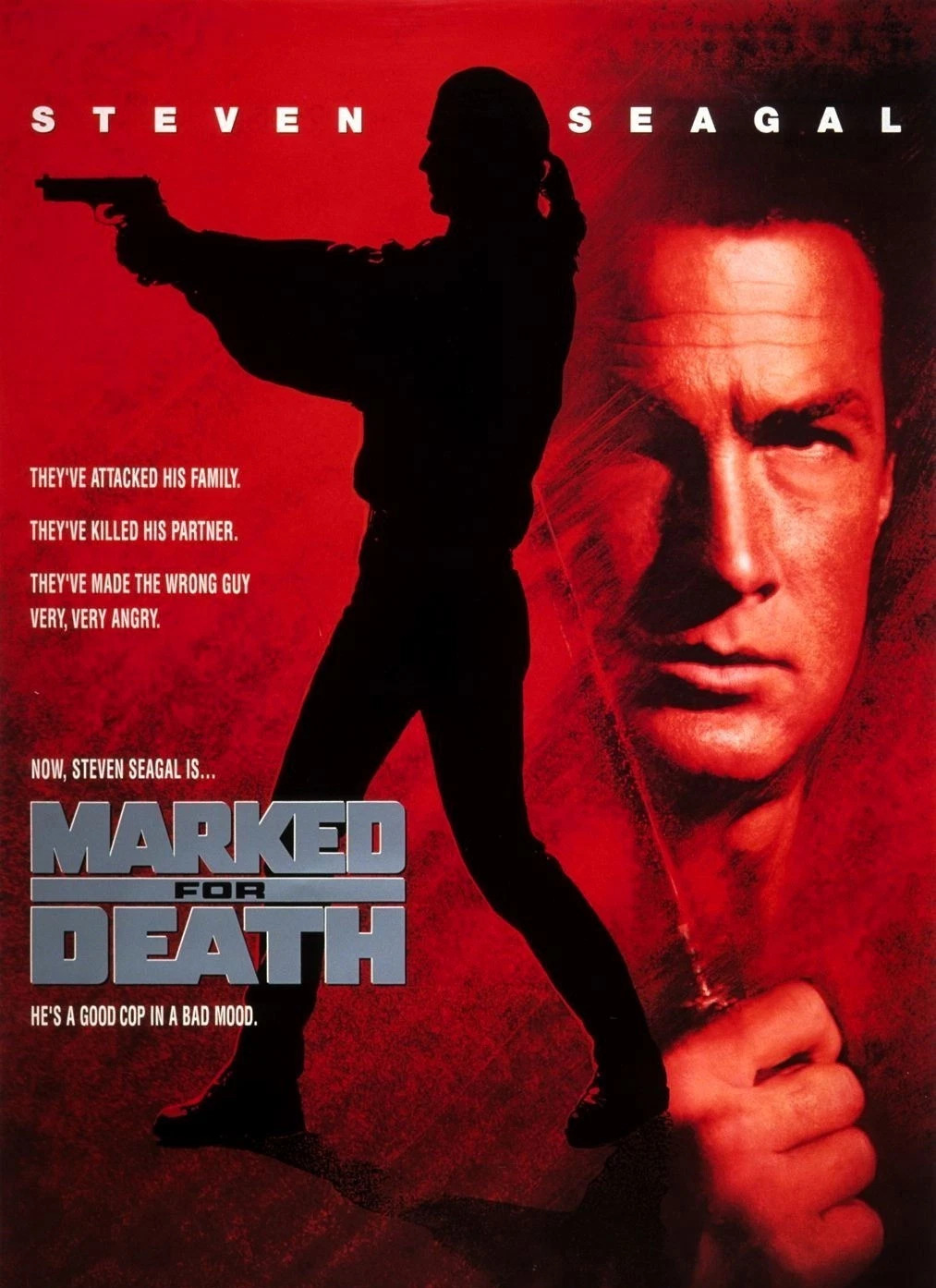
Guilty Pleasure No. 119: Marked for Death (dir. by Dwight H. Little)


There’s a specific, almost mystical, pleasure in watching a movie that is, by almost every conventional standard, a complete mess. It’s a guilty pleasure, that sweet spot where a film is so unapologetically over-the-top, so earnestly ridiculous, that it circles back around to being utterly entertaining. And for my money, few films embody this “so bad it’s good” vibe quite like Steven Seagal’s 1990 action opus, Marked for Death. This is prime, uncut, vintage Seagal, a film that feels like it was beamed in from an alternate dimension where ponytails are a symbol of power, whispering threats is a sign of deep menace, and the streets of Chicago are apparently overrun with voodoo-practicing Jamaican drug lords. It’s silly, sure, but it’s a very specific kind of silly—grounded enough in its grim, urban revenge fantasy to feel almost earnest, which is precisely what makes it work. To put it in perspective, Marked for Death is downright restrained compared to the coked-out, reality-defying lunacy Seagal would unleash just a year later in Out for Justice. That film, with its infamous “anybody seen Richie?” barroom brawl and its general air of sweaty, unhinged mania, operates on a completely different, far more unhinged wavelength. Marked for Death still has one foot in the real world, however wobbly that stance may be, whereas Out for Justice seems to have been fueled by a warehouse full of stimulants and a complete disregard for narrative coherence.

For those who don’t remember the heyday of Seagal-mania, Marked for Death is a perfect time capsule. This was before the bloated, straight-to-DVD era; this was Seagal in his physical prime, slim, athletic, and seemingly capable of snapping every bone in a human body without breaking a sweat. He plays John Hatcher, a burnt-out DEA agent who, after a botched operation in Mexico, decides to retire and seek some peace and quiet by visiting his sister and niece in his old Chicago neighborhood. This is the first of the film’s many logical leaps, because apparently, a retired DEA agent’s idea of a stress-free vacation is moving back to the neighborhood where he grew up and where a violent turf war is raging. It’s a classic action movie setup that requires you to immediately check your brain at the door, but compared to the sheer narrative anarchy of Out for Justice, it practically feels like Shakespeare.

You see, the peace and quiet Hatcher seeks doesn’t exist. The town is being terrorized by a Jamaican drug posse led by the wonderfully named and gloriously performed villain, Screwface. Played with scenery-chewing, eye-rolling relish by Basil Wallace, Screwface is more than just a drug dealer; he’s a voodoo priest with a penchant for giving people a “t’ousand dets wurse dan yoo doo.” He’s a cartoon character in the best possible way, a man so over-the-top that his presence alone elevates the film from a standard revenge flick into something far more memorable. When he declares Hatcher and his family “marked for death,” you can’t help but lean in, not because you’re scared for the hero, but because you want to see what bizarre, hammy line he’s going to come up with next. It’s absurd, but it’s a controlled absurdity, a deliberate performance that knows exactly what movie it’s in. That’s the key difference between this and the later Seagal outings; Marked for Death plays its absurdity with a straight face, whereas Out for Justice feels like it’s sweating and twitching through every frame, as if the filmmakers themselves had just snorted a mountain of the very product their hero was supposedly fighting against.

The plot, such as it is, kicks into gear when a gang shootout at a local bar forces Hatcher into action, and the posse retaliates by shooting up his sister’s house and wounding his young niece. This is the moment where the film’s narrative pivots from “watch the hero mope” to “watch the hero mope and then absolutely obliterate everyone in his path.” The central premise, like many critics have noted, is as formulaic as they come: a former lawman with a troubled past is forced out of retirement to avenge his family using excessive force. One reviewer put it perfectly, noting the film follows the “familiar one-note, bone-crunching action vehicle for Steven Seagal.” And while that might sound like a criticism, in this context, it’s a promise of the guilty pleasures to come. But even within that formula, there’s a certain grim logic that holds it together—something you absolutely cannot say about the gloriously unhinged Out for Justice, where the plot seems to be held together with duct tape and pure, unfiltered rage.

What makes Marked for Death such a classic guilty pleasure is the sheer, unrelenting brutality of the action sequences. This is not the sanitized, quick-cut action of today. This is a film where every punch sounds like a gunshot and every bone snapped echoes with a sickening, satisfying crunch. Director Dwight D. Little, who later went on to direct TV episodes for shows like Prison Break and Bones, stages the action with a “tight handling,” making sure the camera is right there to capture Seagal’s trademark Aikido. The violence is so extreme that it becomes comical. We’re talking broken arms, broken necks, gouged eyes, a decapitation, and a finale so over-the-top that it involves Seagal using a samurai sword to fight his way through a compound. Yet even with all that mayhem, it never quite reaches the hallucinatory, sweaty-palmed frenzy of Out for Justice, where the violence feels less choreographed and more like a bar brawl that somehow escaped onto film stock.

There are moments in Marked for Death that are so ridiculous they deserve their own standing ovation. There’s the infamous department store fight, where Hatcher dismantles a small army of henchmen while surrounded by mannequins and glass displays. It’s a perfect showcase for Seagal’s skills as a fighter and a complete lack of interest in things like, say, civilian casualties or property damage. Then there’s the entire third act, where Hatcher and his buddy Max (played with stoic reliability by the great Keith David), somehow manage to smuggle an entire arsenal of weapons into Jamaica for a final assault on Screwface’s compound. The logic of this is never explained, but it doesn’t matter. We’re given a montage of them prepping their weapons, and the next thing you know, they’re on a plane. It’s this kind of brazen disregard for realism that makes the film such a hoot, but again, it’s a calculated hoot. The cocaine-fueled silliness of Out for Justice would never bother with such a montage—it would just have Seagal appear in Jamaica with a shotgun, no explanation given, because who needs logic when you have that much manic energy coursing through the projector?

Perhaps the most surprising element is that despite the malevolent tone, the film has become a beloved “cult classic” for many. As one reviewer from the time stated, “it’s easy to see how someone could end up not liking Marked for Death. Its plot is ridiculous, it was overly violent for its time period… On the other hand, this is a film that doesn’t seem to care what you think and instead gleefully exist as a throwback to old-school Grindhouse films.” There’s a sense that Seagal and the filmmakers were in on the joke, even if they were playing it completely straight. The film is excessive, ruthless, and mindlessly numbing in all the right ways, a sentiment that perfectly encapsulates its enduring appeal. It’s the cinematic equivalent of comfort food—you know it’s bad for you, but it tastes so good. And it tastes a whole lot more grounded than the chaotic, unfiltered blast of pure id that is Out for Justice, a film that feels like it was edited by a hyperactive squirrel on a sugar rush.

Marked for Death isn’t a great film by any objective measure. The acting is wooden, the dialogue is laughable, and the cultural stereotypes are, to put it mildly, a product of their time. The Miami Herald even noted that Seagal dispatches his foes with “such an obnoxious sense of higher purpose that we get the feeling he’s not in on the fun.” The film’s portrayal of Jamaican culture as a hotbed of violent, voodoo-worshipping drug dealers is certainly problematic and not something that would fly today, which adds to the movie’s bizarre, anachronistic charm. It’s a film that, while considered one of his better works from that era, is far from what you’d call high art. But it knows its lane and stays in it, which is more than you can say for the gloriously unhinged Out for Justice, a movie that seems to have forgotten what lane it was in, swerved into oncoming traffic, and somehow kept driving anyway.

In the end, Marked for Death is the ultimate “bad movie night” experience. It’s a window into a time when action heroes were larger than life, plots were just excuses for mayhem, and a villain named Screwface could be a legitimate threat. It’s a film where you can quote terrible dialogue and cheer for the excessive violence without feeling guilty, because it’s all part of the deal. As one IMDb user succinctly put it, “Marked for Death is a thoroughly entertaining overblown unnecessarily violent & foul mouthed action film, the sort of film which Seagal was perfectly suited to star in. Sure it’s predictable & unoriginal but when a films this much fun who cares?” And honestly, isn’t that the highest praise you can give a movie like this? It’s a big, dumb, brutal, and brilliant piece of schlock that proudly wears its awfulness as a badge of honor. It’s silly, absolutely, but it’s a grounded, almost respectable kind of silly—the kind that makes you appreciate just how far off the deep end Seagal would go with Out for Justice, a film so wildly, unapologetically unhinged that it makes Marked for Death look like a quiet, contemplative drama by comparison.

Previous Guilty Pleasures

  1. Half-Baked
  2. Save The Last Dance
  3. Every Rose Has Its Thorns
  4. The Jeremy Kyle Show
  5. Invasion USA
  6. The Golden Child
  7. Final Destination 2
  8. Paparazzi
  9. The Principal
  10. The Substitute
  11. Terror In The Family
  12. Pandorum
  13. Lambada
  14. Fear
  15. Cocktail
  16. Keep Off The Grass
  17. Girls, Girls, Girls
  18. Class
  19. Tart
  20. King Kong vs. Godzilla
  21. Hawk the Slayer
  22. Battle Beyond the Stars
  23. Meridian
  24. Walk of Shame
  25. From Justin To Kelly
  26. Project Greenlight
  27. Sex Decoy: Love Stings
  28. Swimfan
  29. On the Line
  30. Wolfen
  31. Hail Caesar!
  32. It’s So Cold In The D
  33. In the Mix
  34. Healed By Grace
  35. Valley of the Dolls
  36. The Legend of Billie Jean
  37. Death Wish
  38. Shipping Wars
  39. Ghost Whisperer
  40. Parking Wars
  41. The Dead Are After Me
  42. Harper’s Island
  43. The Resurrection of Gavin Stone
  44. Paranormal State
  45. Utopia
  46. Bar Rescue
  47. The Powers of Matthew Star
  48. Spiker
  49. Heavenly Bodies
  50. Maid in Manhattan
  51. Rage and Honor
  52. Saved By The Bell 3. 21 “No Hope With Dope”
  53. Happy Gilmore
  54. Solarbabies
  55. The Dawn of Correction
  56. Once You Understand
  57. The Voyeurs 
  58. Robot Jox
  59. Teen Wolf
  60. The Running Man
  61. Double Dragon
  62. Backtrack
  63. Julie and Jack
  64. Karate Warrior
  65. Invaders From Mars
  66. Cloverfield
  67. Aerobicide 
  68. Blood Harvest
  69. Shocking Dark
  70. Face The Truth
  71. Submerged
  72. The Canyons
  73. Days of Thunder
  74. Van Helsing
  75. The Night Comes for Us
  76. Code of Silence
  77. Captain Ron
  78. Armageddon
  79. Kate’s Secret
  80. Point Break
  81. The Replacements
  82. The Shadow
  83. Meteor
  84. Last Action Hero
  85. Attack of the Killer Tomatoes
  86. The Horror at 37,000 Feet
  87. The ‘Burbs
  88. Lifeforce
  89. Highschool of the Dead
  90. Ice Station Zebra
  91. No One Lives
  92. Brewster’s Millions
  93. Porky’s
  94. Revenge of the Nerds
  95. The Delta Force
  96. The Hidden
  97. Roller Boogie
  98. Raw Deal
  99. Death Merchant Series
  100. Ski Patrol
  101. The Executioner Series
  102. The Destroyer Series
  103. Private Teacher
  104. The Parker Series
  105. Ramba
  106. The Troubles of Janice
  107. Ironwood
  108. Interspecies Reviewers
  109. SST — Death Flight
  110. Undercover Brother
  111. Out for Justice
  112. Food Wars!
  113. Cherry
  114. Death Race
  115. The Beast Within
  116. Girl Series
  117. Gone in 60 Seconds
  118. Swordfish

Late Night Retro Television Review: 1st & Ten 4.1 “The Bulls Own Up”


Welcome to Late Night Retro Television Reviews, a feature where we review some of our favorite and least favorite shows of the past! On Wednesdays, I will be reviewing 1st and Ten, which aired in syndication from 1984 to 1991. The entire series is streaming on Tubi.

This week, we start season 4.

Episode 4.1 “The Bulls Own Up”

(Dir by Stan Lathan, originally aired on October 5th, 1988)

It’s time for a new season of 1st & Ten and things have changed!

Yinessa is nowhere to be seen.  Instead, this episode features a college quarterback named Sonny Clowers (Gary Kasper) who is being courted by agent Max Green (Mark Lonow).  Also not around is Jill Schrader, the team’s owner.  She has sold the team to a fast food chain.  The new owner of the Bulls is Charles (Monte Markham).  In his first meeting with TD Parker (OJ Simpson), Charles explains that he runs a clean-cut, all-American company and he expects the Bulls to be a clean-cut, all-American team.

In other words, it’s time to trade all of the trouble makers and the drug abusers.  Charles doesn’t want a team of individuals.  He wants a team of …. well, whatever the opposite of an individual is.

TD is not happy to hear about this.  Neither is Mad Dog, who is revealed to come from a fabulously wealthy family.  Mad Dog’s father wants Mad Dog to do something that requires more skill than football.  Hmmm …. maybe Mad Dog and all the other players could form their own company and buy the team themselves?

That doesn’t really sound like a great idea to me.  How can you release or trade a player when that player owns the team?  However, TD thinks that it’s a good idea.  Zagreb thinks it’s a good idea.  And Dr. Death shows up for practice in a three-piece suit, which somehow convinces everyone else that it’s a good idea!

Why do I get the feeling that this idea will dropped after six episodes?

This was an okay season opener.  The Bulls being sold to a fast food chain certainly makes more sense than Delta Burke acquiring them in a divorce settlement.  OJ Simpson recoiling at the thought of the team being expected to avoid scandal?  That was almost to on the nose!

Finally, I can’t end this review without saying Donald Gibb, RIP.  On a show not known for great acting, Gibb was definitely the exception.

So, I Watched Cheerleader Camp (1988, Dir. by John Quinn)


My sister asked me to watch and review this one.  I’ll have to remember to thank her for that.

A group of cheerleaders go to a cheerleading camp for the summer.  In between all of the usual camp shenanigans, someone is killing the cheerleaders.  Alison (Betsy Russell) seems like the likeliest suspect because she keeps having weird dreams and is really possessive of her unfaithful boyfriend, Brent (Leif Garrett).  Is Alison the murderer or is she being set up?  Cheerleading is a cut-throat business so anything is possible.

As a former cheerleader, there were a few scenes that I could relate to.  Alison has the same nightmare that I used to have all through high school, where you show up for the game late, you have to put on your uniform in such a rush that you don’t even have time to put on a bra, and then you run out on the field and no one’s there.  I had that dream a hundred times.  And the movie was right about everyone making fun of the mascot.  I felt bad for Cory (Lucinda Dickey).

Overall, the movie left me with some questions.  The main one was whether or not these were supposed to be high school or college cheerleaders.  Some of them looked really old to still be in high school.  Brent had a receding hairline.  I also wondered why there was a pervy fat guy on Alison’s cheerleading squad.  There’s nothing wrong with male cheerleaders but I would not be comfortable with a male cheerleader who kept trying to see all of the other cheerleaders naked.  Finally, I wondered how everyone at the camp could be so stupid.  Why would anyone stay after the first dead body is found?  I liked Alison but even I groaned when she picked up a bloody meat cleaver.  Girl, that’s evidence!  Don’t get your fingerprints on that!  I also figured out who the murderer was after the first fifteen minutes.  It was pretty obvious.

I enjoyed cheering but I’m glad I never went to that cheerleader camp.  Most of the routines were awful and everyone ended up dead.  It’s not worth it.

Retro Television Review: Miami Vice 2.15 “One Way Ticket”


Welcome to Retro Television Reviews, a feature where we review some of our favorite and least favorite shows of the past!  On Mondays, I will be reviewing Miami Vice, which ran on NBC from 1984 to 1989.  The entire show can be purchased on Prime!

This week, the Canadians are coming!

Episode 2.15 “One Way Ticket”

(Dir by Craig Bolotin, originally aired on January 24th, 1986)

This week’s episode of Miami Vice opens with one of the most unintentionally hilarious shots that I’ve ever seen.  The action starts at a fancy wedding.  The daughter of District Attorney Richard Langley (Jon DeVries) is getting married.  The cream and the crop of Miami society has turned out.  The camera pans over all of the formally dressed men and women until it finally comes to a stop on Sonny, wearing his white suit, a blue t-shirt, and no socks.  He’s attending the wedding Tubbs, who at least bothered to put on a dress shirt.

Seriously, Sonny …. it’s wedding!  Would it kill you to wear a tie or maybe put on socks to go to a wedding?  And, I know I bring this up every week, but how can Sonny continually convince every bad guy in Miami that he’s a drug dealer named Sonny Burnett when he’s doing stuff like attending the wedding of the District Attorney’s daughter?  Does he think that no one is going to notice that the drug dealer who always wears the same white suit looks and sounds exactly like the cop who is always wearing the same white suit?

That said, I guess it’s good that Sonny and Tubbs are the wedding because, during the reception, a coked-up assassin named Sagot (Lothaire Bluteau) pulls a gun and kills not only Langley but also two bridesmaids who happened to be standing close by.  Sagot manages to escape from the reception but, that night, Zito and Switek track him down to Miami’s hottest French Canadian nightclub, Le Lieu, and arrest him on possession charges.

Sagot is working for a French Canadian drug lord named Faber (Jean-Pierre Matte) and, as with all of Faber’s men, his attorney is Laurence Thurmond (John Heard).  Thurmond was a good friend of Langley’s and it’s obvious from the start that he’s not comfortable with the idea of defending the men who killed him.  Thurmond and Crockett also have a long history together.  Crockett blames Thurmond for getting a case dismissed against someone who shot one of Crockett’s partners, though it sounds like Thurmond was just doing his job and Crockett is actually to blame for not following proper procedure while making his arrest.  (Seriously, due process may be a pain in the ass but Sonny has no excuse for not knowing what’s going to happen when he violates it.)  Crockett continually demands to know how Thurmond can live with himself.  Thurmond, who likes to fly a private plane in his spare time, says that it’s not easy.  Then again, Thurmond can afford his own airplane and a wedding suit so, even if it is difficult to live with himself, at least he’s living well.  (And again, Sonny may not like it but everyone has the right to an attorney.  Again, if you’re sloppy enough to not read someone their rights or to search someone’s house without probable cause, that’s on you and not on the person who pointed it out.)

As much as Crockett would love to spend all of his time harassing Thurmond, he has a case to solve.  He wants to get revenge for Langley’s death.  He also wants to figure out who keeps sending him anonymous tips that are full of information that presumably only a defense attorney would know….

Lothaire Bluteau’s makes for a memorably unhinged villain and all of the evil French Canadians made for a nice change of pace from the show’s usual rogue’s gallery.  That said, this episode was pretty much dominated by John Heard, playing the type of role that he played best.  Heard’s morally conflicted attorney has a lot in common with the morally conflicted police detective that he later played on The Sopranos and Heard’s melancholy performance was a nice contrast to Don Johnson’s intensity.  Full of twists and turns, this episode ended on a perfect note.  In the end, Crockett may still not like Thurmond but he finally understands him.

Film Review: Savage Beach (dir by Andy Sidaris)


1989’s Savage Beach is yet another Andy Sidaris film that doesn’t make a damn bit of sense.

This time, Donna (Dona Speir) and Taryn (Hope Marie Carlton) have been hired to perform a very important mission.  You may remember that Donna works for a super secret government agency while, at one point, Taryn was in the witness protection program.  As a part of their cover, they fly a plane in Hawaii, making deliveries and giving tours.

(To be honest, you would think that, after everything that happened in Hard Ticket To Hawaii and Picasso Trigger, their cover would have blown but apparently not.)

Anyway, this time, they’ve been hired to fly a very important vaccine to a nearby island.  They manage to deliver the vaccine but a huge storm has come up.  As soon as they get back in their plane and start back towards Hawaii, Donna says, “Shouldn’t we get out of these wet clothes?”  While usually I roll my eyes at all of the nudity in Sidaris’s films, I have to admit that line made me laugh out loud.  Maybe it was just the sincerity with which Dona Speir delivered it.  Or maybe it’s just the fact that Andy Sidaris actually sat down, thought up that line, wrote it down, and then directed someone saying it.  One thing that can definitely be said for Andy Sidaris: as a filmmaker, he was totally without shame.

Anyway, the storm gets really bad and Donna and Taryn end up crashing on what they think is a deserted island.  Neither of them appear to be too upset about being stranded on that island, perhaps because Savage Beach was filmed nearly two decade before Lost.  Make no doubt about it, Donna and Taryn are optimists!

It turns out that they’re not alone.  Apparently, there’s treasure buried on the island and, as a result, all sorts of people are showing up.  Most of them are villainous.  Some of them are heroic.  There’s even another Abilene cousin, Shane Abilene (Michael J. Shane).  Everyone wants that treasure.  Everyone except for … THE WARRIOR!

Who is the Warrior (Michael Mikasa)?  He was a soldier in the Japanese army during World War II.  Left behind on the island, he’s still fighting the war.  Or something.  Actually, it’s not always easy to understand what the Warrior or anyone else is doing on the island.  The Warrior does decide to protect Donna and Taryn and both of them try to keep his existence a secret from the rest of the people on the island but that doesn’t really work out.

Honestly, Savage Beach should not have been as complicated as it was.  It should have been a simple story where Donna and Taryn outwitted a bunch of pirates on a desert island.  Instead, more and more people just keep showing up on that beach.  Good luck trying to keep them all straight.

It’s probably unnecessary to say that Savage Beach was a mess.  I think “mess” is probably one of the words most commonly used in any review of an Andy Sidaris film.  However, like most Sidaris films, the whole thing is too good-natured to really dislike.  In fact, the plot is so incoherent that it actually becomes strangely fascinating.

Add to that, as a result of watching Savage Beach, I now know that you can safely undress and fly a plane at the same time.  If I ever get my pilot’s license, I’ll be sure to remember that!

A Movie A Day #330: The Banker (1989, directed by William Webb)


It’s hard out here for a pimp and even worse for a banker.
Spaulding Osborne (Duncan Regehr) is a successful banker at the height of the 80s but handling all that money can be stressful.  Everyone needs a way to relax.  Osborne unwinds by painting his face like a tiger and murdering prostitutes with a laser sighted crossbow.  A worshipper of the ancient Gods, Osborne believes himself to be immortal and sees his murder spree as a way to collect souls.  Two pimps (Leif Garrett and Jeff Conaway) keep Osborne supplied with victims.  When Osborne suspects that one of the pimps has betrayed him, he demands that the pimp name all of the seven dwarves if he wants to live.  It pays to know your Disney.

What Osborne didn’t count on was that the chief of police (Richard Roundtree) would assign one of his weariest detectives, Dan (Robert Forster), to the case or that the detective’s TV reporter ex-wife (Shanna Reed) would get promoted to the anchor desk and start a crusade to have him captured.  Can Detective Dan capture Osborne before Osborne kills every prostitute in the city?  Will Dan be able to protect his ex-wife from the banker?

A film about a greedy banker who kills poor people on the side?  The Banker was released twenty years too early.  If it had been released in 2009, it probably would have an Oscar.  Instead, it was released straight-to-video in 1989 and exiled to late night Cinemax.  Unfortunately, the idea behind The Banker is more interesting than the execution, with most of the kills happening offscreen and any social commentary being rushed through so that the movie can get to the next nude scene.  Not surprisingly, the best thing about The Banker is Robert Forster, who is at his world-weary best.  Forster went through some tough times before Quentin Tarantino resurrected his career with Jackie Brown but movies like The Banker show that Forster never stopped giving good performances.


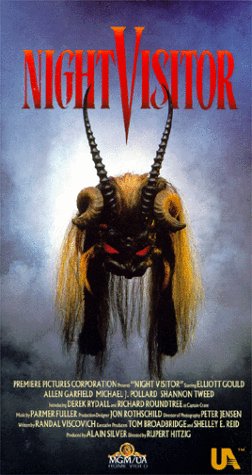
A Movie A Day #289: Night Visitor (1989, directed by Rupert Hitzig)


Billy Colton (Derek Rydall) is a teenager who has a reputation for exaggeration.  Lisa Grace (Shannon Tweed) is his next door neighbor, a high-priced prostitute who does not mind if Billy spies on her.  When Billy tries to tell everyone about his wild new neighbor, no one believes him.  Billy decides to prove his story by grabbing his camera and sneaking next door.  Instead of getting proof that she’s a prostitute, Billy witnesses his neighbor being murdered by a robed Satanist, who just happens to be Zachary Willard (Allen Garfield), Billy’s hated science teacher!  Billy goes to the police with his camera but Captain Crane (Richard Roundtree) points out that Billy forgot to take off the lens cap.

What can Billy do?  He knows that Zachary and his strange brother, Stanley (Michael J. Pollard), are sacrificing prostitutes to Satan but he can’t get anyone to believe him.  Working with his best friend (Teresa Van der Woude) and a burned out ex-cop (Elliott Gould), Billy sets out to stop the Willard Brothers.

Combine Rear Window with late 80s Satanic conspiracy theories and this is the result.  Not as bad as it sounds, Night Visitor is an unfairly obscure movie about Satanism in suburbia. While it has its share of dumb moments (like when Billy uses a watermelon to end a car chase), it also has enough good moments that suggest that Night Visitor is deliberately satirizing the excesses of the Satanic panic that, at the time of filming, was sweeping across the nation.  It also has a once in a lifetime cast.  Along with those already mentioned, keep an eye out for character actor extraordinaire Henry Gibson and future adult film star Teri Weigel.  Allen Garfield is especially good as the evil Mr. Willard.  Any actor can say, “I sacrifice you in the name of Satan.”  It takes a good actor like Allen Garfield to say it without making anyone laugh.

One final note: this movie was originally called Never Cry Devil, which is a much better title than Night Visitor.