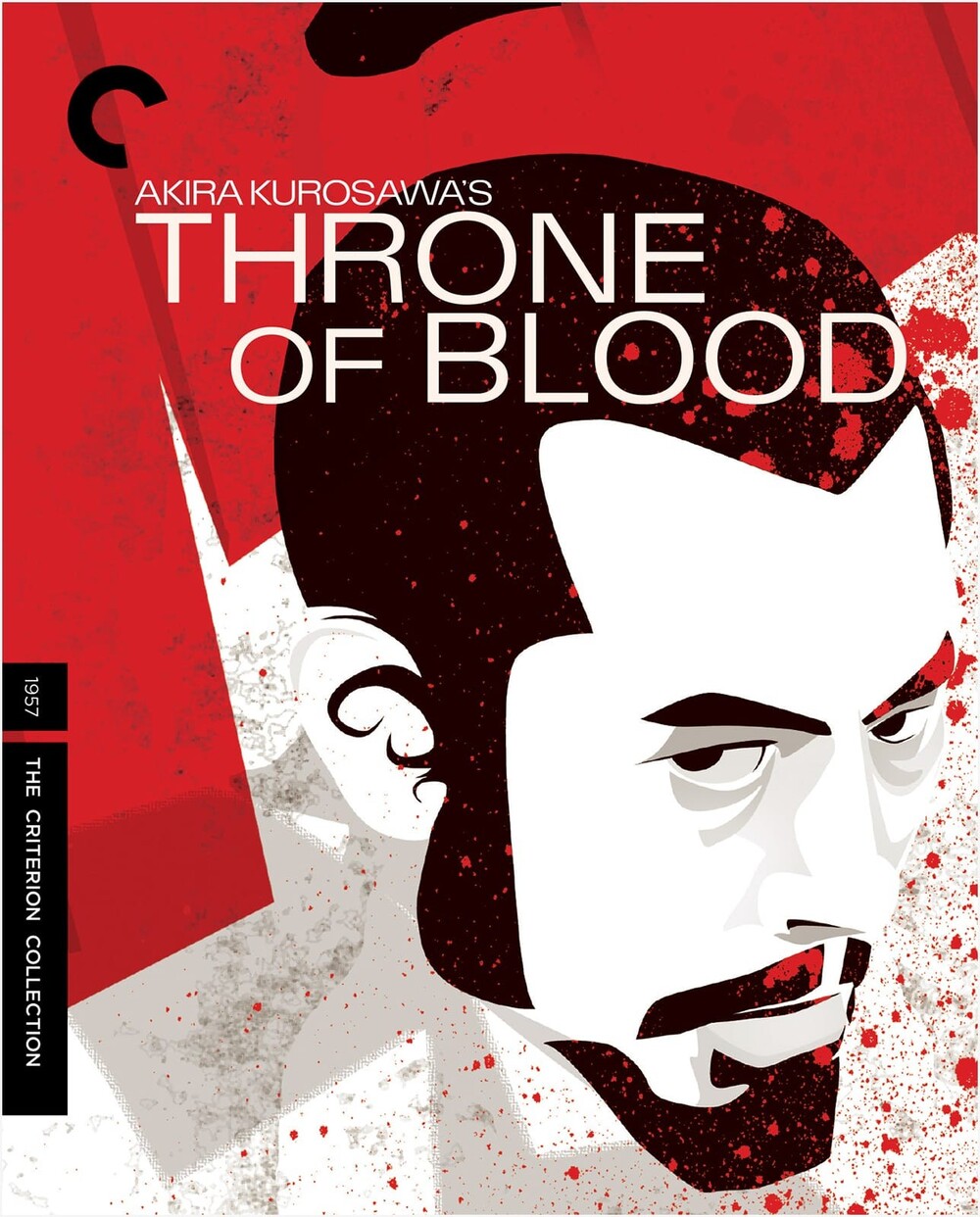
“This is a wicked world. To save yourself you often first must kill.” — Lady Asaji Washizu
A promotion should make life easier, but in Throne of Blood, moving up in the world mostly means acquiring better reasons to panic. Akira Kurosawa’s 1957 adaptation of Macbeth understands ambition as a problem that success only makes worse. Every reward suggests another prize, every ally becomes a potential rival, and every attempt to secure the future makes the present more dangerous. Set in feudal Japan and shaped by the traditions of Noh drama, the film turns Shakespeare’s tragedy into something both culturally distinct and immediately recognizable. Beneath the armor and ceremony are people making disastrous choices for reasons they find perfectly sensible. Kurosawa makes watching those choices unfold riveting, even when we know exactly where they lead.
The trouble begins after a victory. Washizu, played by Toshiro Mifune, and his fellow commander Miki, played by Minoru Chiaki, encounter a mysterious spirit while traveling through Spider’s Web Forest. It predicts that Washizu will eventually rule Spider’s Web Castle and that Miki’s descendants will inherit its authority. When the first signs of the prophecy come true, Washizu begins wondering whether he should help the remaining predictions along. His wife, Lady Asaji Washizu, has considerably fewer reservations. Together, they turn a possibility into a justification for murder. Kurosawa preserves the essential machinery of Shakespeare’s plot while making its progression feel less like a familiar literary exercise than a series of increasingly terrible practical decisions.
Before any of that can happen, though, Washizu and Miki have to find their way out of the woods. Their disorientation is one of the film’s smartest introductions to its characters. These accomplished warriors ride through fog, struggle to identify their surroundings, and discover that confidence does not necessarily get them anywhere. Kurosawa lets the confusion stretch beyond a quick atmospheric flourish. The landscape becomes an early challenge to their belief in their own competence. They can defeat an army, but they cannot make the world reveal itself clearly. The prophecy seems to solve that problem by offering knowledge of what comes next. In reality, it gives Washizu just enough information to become dangerously certain.
The castle provides a striking contrast to the forest without offering much relief. Where the trees and fog obscure everything, the interiors are spare, orderly, and exposed. Kurosawa uses empty floor space and carefully arranged figures to turn conversations into visual contests. A character’s position in a room can reveal who holds the advantage before a line is spoken. The black-and-white photography makes the difference between these environments especially vivid, yet both leave Washizu uncomfortable. Outside, he cannot tell where he is going. Inside, he cannot escape the implications of where he has arrived. His rise brings larger rooms, but they never seem to contain more freedom.
Mifune is superb at making that contradiction physical. A longtime Kurosawa collaborator, he has the force to make Washizu convincing as a successful warrior, but he repeatedly exposes the insecurity beneath the imposing surface. His eyes search for danger, his posture hardens into defensiveness, and his anger often seems to arrive a fraction of a second after fear. The performance is big without being emotionally vague. You can see the effort involved in Washizu’s attempts to look commanding. Mifune understands that a man may be capable of extraordinary violence without possessing much control over himself. That gap becomes more apparent each time Washizu tries to solve an internal crisis through an external show of strength.
There is something almost embarrassing about his deterioration, and the film is stronger for allowing it. Mifune does not insist that Washizu remain dignified simply because he is a tragic protagonist. He can be brave, evasive, bullying, and visibly rattled within a single exchange. His authority never quite settles into place because he keeps imagining the circumstances under which it might disappear. Ambition and fear become mutually reinforcing habits: he wants more power because he feels vulnerable, then feels more vulnerable because he has more to lose. Mifune gives that cycle variety and momentum. His performance makes the tragedy feel like an exhausting way to live long before it becomes a spectacular way to die.
Isuzu Yamada delivers an equally remarkable, standout performance as Lady Asaji Washizu. Where Mifune fills the frame with restless energy, she makes restraint impossible to ignore. Her pale, mask-like face, controlled voice, and precise gestures create an impression of almost unshakable composure. Asaji does not need to compete with her husband’s volume because she knows how to direct his thinking. Yamada makes her arguments frighteningly plausible. Murder becomes a precaution, betrayal becomes self-preservation, and hesitation becomes the most dangerous choice available. She never needs to announce herself as monstrous. Her calm treatment of monstrous ideas is far more unsettling.
Their scenes together are the film’s psychological center. Washizu may occupy more physical space, but Asaji often controls the rhythm of the exchange. He reacts, she waits, and the silence gives his anxiety room to grow. Yamada makes those pauses feel purposeful without turning the character into a simple mechanism of manipulation. Asaji understands what her husband wants and what he needs to hear before admitting that he wants it. When her composure finally breaks into obsessive handwashing, the reversal is devastating. A woman who once appeared to choose every movement becomes trapped in one repeated gesture. The guilt she had treated as manageable finally overwhelms her capacity to manage anything.
Yamada’s performance also provides the clearest expression of Kurosawa’s use of traditional Noh drama. The stylized movement, mask-like expressions, spare interiors, and haunting musical textures establish a dramatic language quite different from conversational realism. Feelings emerge through posture, spacing, duration, and controlled changes in expression. At first, the formality can seem distancing, particularly alongside Mifune’s explosive physicality. Gradually, though, the contrast becomes one of the film’s great pleasures. Kurosawa teaches us to register small movements as major events. A slight shift in Yamada’s face or body can alter the balance of an entire scene.
This influence makes Throne of Blood a wholly Japanese interpretation of Shakespeare rather than a straightforward relocation of his plot. The feudal setting gives loyalty and betrayal their own social framework, while Noh offers a way to express the tragedy through Japanese theatrical tradition. None of that diminishes the Bard’s impact. The language changes, but the pressure remains: ambition disguises itself as necessity, guilt destroys the security that violence was supposed to provide, and a marriage becomes a place where destructive ideas gain strength through repetition. Kurosawa trusts the underlying drama enough to transform its surface completely. The result feels neither subordinate to Shakespeare nor anxious to prove its independence from him.
Takashi Shimura, another longtime Kurosawa collaborator, contributes a smaller but valuable performance as Noriyasu Odagura. He does not receive a showcase comparable to Mifune’s or Yamada’s, yet his grounded authority helps establish a world beyond their increasingly poisonous marriage. Shimura’s reserve suggests loyalties and judgments that exist independently of Washizu’s fears. That is an important counterweight in a film so closely aligned with its protagonist’s unraveling. Washizu may start treating everyone as a piece in his private struggle for survival, but Shimura gives the surrounding political world a firmness that resists that perspective. His performance works through economy rather than display.
Chiaki’s Miki serves a related purpose. Because he hears the same prophecy, his different response keeps Washizu’s behavior from looking inevitable. The supernatural encounter creates a temptation, not a complete set of instructions. Kurosawa maintains that distinction even as the atmosphere grows increasingly fatalistic. We feel the weight of an approaching catastrophe while still seeing the choices that help produce it. That tension keeps the film from becoming a simple demonstration of destiny. Washizu repeatedly tries to protect himself from an imagined future, and his efforts make that future more threatening. He is caught in a trap, but he also keeps tightening it.
The film’s restraint makes its violent eruptions especially effective. At the banquet, Washizu’s public authority buckles under a terror he cannot contain. In the final assault, the collapse becomes brutally physical. Arrows turn the space around him into a lethal enclosure, and Mifune’s frantic movements strip away the last suggestion of command. The sequence is spectacular without restoring any grandeur to its subject. Washizu cannot negotiate, intimidate, or strike his way out of the situation. After spending the film trying to control what comes next, he cannot even find a safe place to stand. Kurosawa makes the end feel both shockingly immediate and horribly consistent with everything that preceded it.
What finally makes Throne of Blood so affecting is the distance between the authority Washizu imagines and the life he actually creates. He wants the certainty of being untouchable; he gets a world in which every sound might announce a threat. Mifune makes that disappointment frantic and bodily, Yamada gives its rationalizations a chilling calm, and Kurosawa’s severe compositions leave neither character much room for comforting illusions. The film is grand in scale but mercilessly specific about the cost of its characters’ choices. By the end, the throne has become the least enviable seat imaginable—not because power is meaningless, but because they have destroyed everything that might have made possessing it worthwhile.
Kurosawa-Mifune Collaborations

