Tom Cruise is 64 years old today! He still doesn’t look a day over 36. Insert your own Dorian Gray joke here.
No matter what else you may want to say about Tom Cruise, you can’t deny that he’s one of the last of the genuine movie stars. He’s been a star in since the 80s, doing things onscreen that you could never imagine some of our younger actors even attempting. Juat four years agp, Top Gun: Maverick was unstoppable with audiences and critics. There were many reasons for Maverick‘s popularity but one cannot deny that a lot of it is the fact that Cruise just has that old-fashioned movie star charisma.
Today’s scene that I love comes from the first Top Gun. In this scene, Tom Cruise, Anthony Edwards, Val Kilmer, and Rick Rossovich play beach volleyball. The scene kind of comes out of nowhere and there are times when the whole thing comes close to self-parody. (Actually, if we’re going to be honest, it crosses the line into self-parody more than a few times.) But, Cruise and the much-missed Kilmer manage to save it, like the movie stars they are!
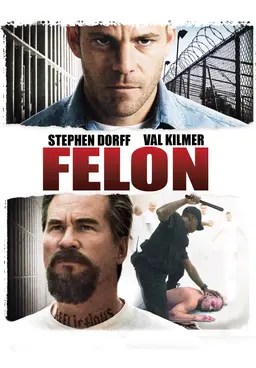
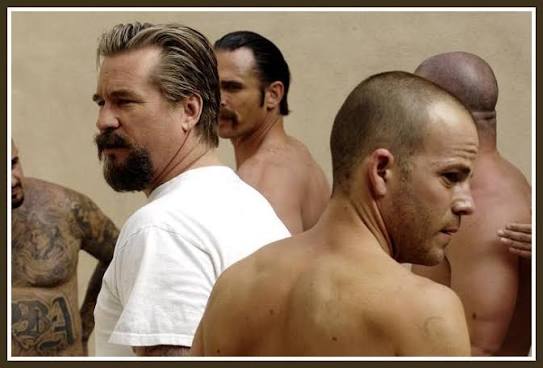
FELON is a movie that caught my attention when I was scrolling through Val Kilmer’s filmography on IMDB. I was looking for a movie and performance that seemed worthy of his talents, and this one stood out to me based on its high rating. It was directed by Ric Roman Waugh, who has helmed several solid Gerard Butler films over the last decade, including ANGEL HAS FALLEN (2019), GREENLAND (2020), and KANDAHAR (2023). I decided to go ahead and check it out on a lazy, and hot, Sunday afternoon in Arkansas.
Stephen Dorff stars as Wade Porter, a man whose life takes a serious turn when he kills a burglar who has broken into his home. He’s sentenced to 3 years in prison for manslaughter and soon learns just how difficult it is to survive in prison. In what may be the best performance of his career, Dorff’s transformation from business-minded family man to brutal, prison survivor is incredible. As hard as he becomes, you never stop seeing the decent man trapped beneath the hardened exterior that prison forces on him. Val Kilmer plays John Smith, a mysterious lifer whose emotional scars and wisdom prove invaluable to Porter’s survival. While Smith may never go down as one of Kilmer’s most well-known characters, he gives an excellent, understated performance that proved he could still command the screen.
After looking through the IMDB profile for FELON, I expected a gritty prison drama with plenty of violence. You do get that, but I was surprised by how much the film affected me emotionally. This movie sets up a scenario that proves how quickly an ordinary guy’s life can be destroyed by one difficult situation, and then how hard it is to hold on to your humanity when your new world is completely built on violence.
Director Waugh is able to keep the stakes high from the very beginning of the film to its end. Porter not only has to fight with all he has to survive behind the walls of the prison, but he also has to do whatever he can to to hold his family together, especially when it looks like his wife Laura (Marisol Nichols) is going to divorce him. There is a lot of violence behind the prison walls, but it feels ugly rather than entertaining, which adds meaning and a layer of depth to the film. I want to shout out Harold Perrineau, who I know from the TV series LOST. He is absolutely chilling as the evil prison lieutenant Jackson, who lost his own humanity years earlier and who now treats inmates as nothing more than pawns in his own ugly game. His performance is especially affecting when coupled with Dorff’s decent character.
Val Kilmer put his name on a lot of movies later in his career that aren’t that great. FELON isn’t a classic, but it’s a very strong film. After enjoying their work together in THUNDERHEART, I really enjoyed seeing Kilmer work again with Sam Shepard, who plays his last remaining friend here. It’s a wonderful bonus for a low budget film from 2008. What stayed with me most, though, is the film’s reminder that justice and fairness aren’t always the same thing. Wade goes to prison wanting to quietly serve his time so he can move on with his life, but he quickly learns that survival often depends on abandoning the ideals that allow him to be a man of integrity in the real world. It’s a somewhat unsettling thought that has stuck with me after the movie ended.
FELON is a film that’s probably never received the attention it deserved, but it’s a good prison drama. Anchored by excellent performances from Stephen Dorff and Val Kilmer, it provides an emotionally compelling story that’s well worth a watch. If you’re a fan of Val Kilmer like I am, this one’s a forgotten gem!
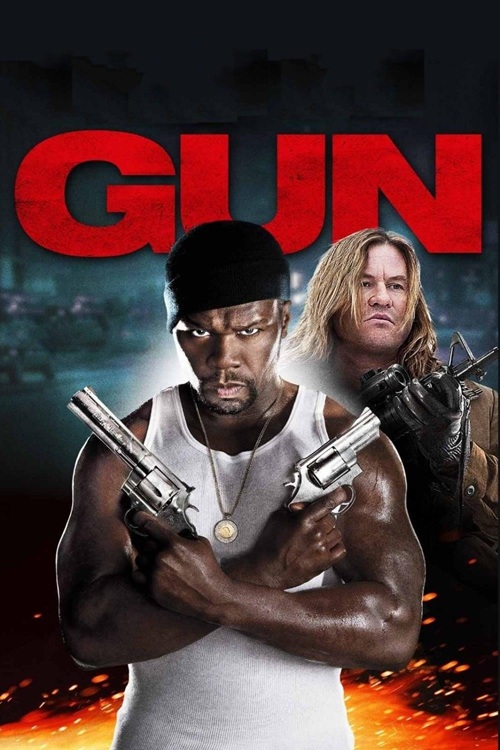
Angel (Val Kilmer) has just been released from prison and he’s returned to the hard streets of Detroit. Hooking up with his old friend Rich (50 Cent), Angel gets involved in a gun-running operation.
Unfortunately, it’s no longer easy or safe to sell guns in Detroit. The police are cracking down. Rival gun dealers are trying to take out a competition. A raid at a club leaves a dealer dead and a huge power void in Detroit’s criminal underworld. When it becomes obvious that the police have a snitch in Rich’s crew, Rich’s girlfriend (AnnaLynne McCord) suspects that it’s Angel. Can Rich find the snitch without having to betray his best friend? And does Angel have secrets of his own?
First released in 201o, Gun was the third film that Val Kilmer made with 50 Cent and it’s apparently their only collaboration that Kilmer didn’t mention in his autobiography. It probably should be noted that Val Kilmer doesn’t look particularly happy in the movie but that actually works for his character. Angel has just gotten out of prison, he’s mourning his wife, and he’s found himself right in the middle of the type of violent situation that could lead to him going back to prison. In many ways, Angel feels like he could be a version of Heat’s Chris Shiherlis. It’d easy to imagine that maybe Chris changed his name after escaping Los Angeles. He became Angel and he found a new partner in the form of Rich. Unfortunately, Detroit is a lot uglier than Los Angeles, Rich is no Neil McCauley, and Michael Mann’s not directing. Kilmer’s performance is not bad. Even in a low-budget movie like this, he still did his best.
That said, the film is centered around 50 Cent. 50 Cent plays Rich. 50 Cent provides the music. 50 Cent produced the film, along with Randall Emmett, a producer who largely made a career out of getting faded stars to appear in B-movies. (He’s best-known for producing the many of Bruce Willis’s final films.) As Rich, 50 Cent gives a rather stiff performance. It’s not so much that he’s not convincing as a street smart gun dealer as he’s just not very interesting to watch. There’s a predictability to his performance, one that is reflected in the songs that appear on the film’s soundtrack. How many rap songs about making money and shooting people can one listen to before admitting that it all gets boring after a while?
In the end, the most interesting thing about Gun is the number of familiar faces who appear in small roles. James Remar plays a cop. Paul Calderon, the bartender from Pulp Fiction and the traitor from King of New York, plays a detective. John Larroquette and, somewhat inevitably, Danny Trejo both make appearances. Perhaps most oddly, Mike “Boogie” Malin, the winner of Big Brother All-Stars, plays an ATF agent. I should mention that, in real life, Boogie Mike and Dr. Will Kirby (winner of Big Brother 2) had a friendship that widely mirrored the friendship between Rich and Angel. I doubt that factored into his casting. That would be giving Gun to much credit.
Gun was not a particularly compelling film, though it did win some authenticity points by actually being shot on location in Michigan. That said, Val Kilmer gave a better performance than perhaps the material deserved. Val is definitely missed.
In 2009’s TheChaosExperiment, Val Kilmer stars as James Pettis, a twitchy man who shows up at the offices of a Michigan newspaper and says that he wants them to publish an editorial he has written. The editorial is about global warming (yawn) and the danger of humanity going extinct (double yawn). Pettis goes on to explain that he has trapped six people in a steam room and that he has turned the temperature up to 130 degrees, the better to demonstrate what destroying the environment is doing to humanity.
Cynical detective Manicni (Armanda Assante) is called and he listens to Pettis’s story. Mancini has some doubts as to whether or not Pettis is who he says he is. As Pettis describes what is happening in the steam room, Mancini comes to suspect that Pettis is either lying or else the murders happened a while ago. Pettis, for his part, seems to grow more and more delusional as he speaks to Manicni.
When we’re not listening to Mancini and Pettis, we’re watching six unfortunate people trapped in steam room. They are played by Eric Roberts, Patrick Muldoon, Megan Brown, Eve Mauro, Quinn Duffy, and Cordelia Reynolds. They start out as a friendly group but, once it becomes apparent that they’re trapped in the room, they lose it. They start turning on and attacking each other. The first to die is killed while strangling another hostage. The second is taken out by a unseen person with a nail gun. Cast as a former football player who claims to be from “Dallas-Fort Worth,” Eric Roberts goes from being the voice of reason to being a paranoid wreck. Meanwhile, the viewer is left to figure out whether or not any of this is happening or if it’s all just in Pettis’s mind.
I kind of cringed when Pettis said he had written an editorial about global warming but the environmental stuff is just a red herring. The film is actually about the cat-and-mouse game between Pettis and Detective Mancini and the investigation into whether or not Pettis has actually trapped six people in a steam room. It’s an intriguing premise and Val Kilmer gives a surprisingly committed performance as the unstable Pettis. Unfortunately, whenever the film cuts to the people in the steam room, it gets bogged down in all the usual Saw-style dramatics. I appreciate that the film found room for Eric Roberts to give a real performance (and Roberts does a good job, going from being affable to murderous over the course of the movie) but, even at the time when this film first came out, the people-trapped-in-a-room thing had been done to death and the scenes in steam room were ultimately a bit too repetitive to be as effective as they needed to be. That said, the film does end with a nice twist and it did hold my attention.
If nothing else, this is your only chance to see Val Kilmer, Armand Assante, Patrick Muldoon, and Eric Roberts, all in the same movie. That counts for something.
Previous Eric Roberts Films That We Have Reviewed:
Though the Academy of Motion Picture Arts and Sciences claim that the Oscars honor the best of the year, we all know that there are always worthy films and performances that end up getting overlooked. Sometimes, it’s because the competition too fierce. Sometimes, it’s because the film itself was too controversial. Often, it’s just a case of a film’s quality not being fully recognized until years after its initial released. This series of reviews takes a look at the films and performances that should have been nominated but were, for whatever reason, overlooked. These are the Unnominated.
First released in 1995, Heat is one of the most influential and best-known films of the past 30 years. It also received absolutely zero Oscar nominations.
Maybe we shouldn’t be too surprised that Academy — especially the Academy of the 1990s — didn’t shower the film with nominations. For all of its many strengths, Heat is still a genre piece, an epic three-hour crime film from director Michael Mann. It’s a film about obsessive cops and tightly-wound crooks and it’s based on a made-for-TV movie that Mann directed in the late 80s. While the Academy had given a best picture nomination to The Fugitive just two years before, it still hadn’t fully come around to honoring genre films.
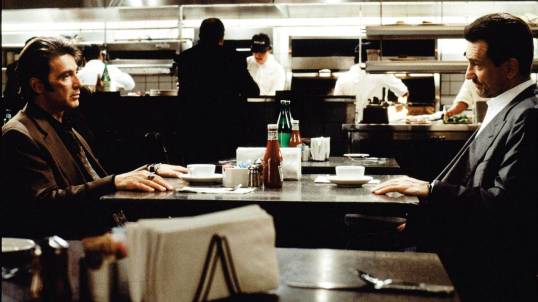
And yet one would think that the film could have at least picked up a nomination for its editing or maybe the sound design that helps to make the film’s signature 8-minute gun battle so unforgettable. (Heat is a film that leaves you feeling as if you’re trapped in the middle of its gunfights, running for cover while the cops and the crooks fire on each other.) The screenplay, featuring the scene where Al Pacino’s intense detective sits down for coffee with Robert De Niro’s career crook, also went unnominated.
Al Pacino was not nominated for playing Vincent Hanna and maybe we shouldn’t be too surprised at that. Pacino yells a lot in this movie. When people talk about Pacino having a reputation for bellowing his lines like a madman, they’re usually thinking about the scene where he confronts a weaselly executive (Hank Azaria) about the affair that he’s having with Charlene (Ashley Judd), the wife of criminal Chris Shiherlis (Val Kilmer). And yet, I think that Pacino’s performance works in the context of the film and it’s often forgotten that Pacino has quite scenes in Heat as well. Pacino’s intensity provides a contrast to Robert De Niro’s tightly controlled career criminal, Neil McCauley. McCauley has done time in prison and he has no intention of ever going back. But, as he admits during the famous diner scene, being a criminal is the only thing that he knows how to do and it’s also the only thing that he wants to do. (“The action is the juice,” Tom Sizemore says in another scene.) If any two actors deserved a joint Oscar nomination it was Pacino and De Niro. In Heat, they’re the perfect team. Pacino’s flamboyance and De Niro’s tightly-controlled emotions come together to form the heart of the picture.
No one from the film’s supporting cast was nominated either, despite there being a wealth of riches to choose from. Ashley Judd and Val Kilmer come to mind as obvious contenders. Kilmer is amazing in the shoot-out that occurs two hours into the film. Ashley Judd has a killer scene where she helps her husband escape from the police. Beyond Judd and Kilmer, I like the quiet menace of Tom Sizemore’s Michael Cheritto. (Just check out the look he gives to an onlooker who is getting a little bit too curious.) Kevin Gage’s sociopathic Waingro is one of the most loathsome characters to ever show up in a movie. William Fichtner, Jon Voight, Danny Trejo, and Tom Noonan all make a definite impression and add to Michael Mann’s portrait of the Los Angeles underworld. In an early role, Natalie Portman plays Hanna’s neglected stepdaughter and even Amy Brenneman has some good moments as Neil’s unsuspecting girlfriend, the one who Neil claims to be prepared to abandon if he sees “the heat coming.”
I have to mention the performance of Dennis Haysbert as Don Breedan, a man who has just been released from prison and who finds himself working as a cook in a diner. (The owner of the diner is played by Bud Cort.) Haysbert doesn’t have many scenes but he gives a poignant performance as a man struggling not to fall back into his old life of crime and what eventually happens to him still packs an emotional punch. For much of the film’s running time, he’s on the fringes of the story. It’s only by chance that he finds himself suddenly and briefly thrown into the middle of the action.
Heat is the ultimate Michael Mann film, a 3-hour crime epic that is full of amazing action sequences, powerful performances, and a moody atmosphere that leaves the viewer with no doubt that the film is actually about a lot more than just a bunch of crooks and the cops who try to stop them. Hanna and McCauley both live by their own code and are equally obsessed with their work. Their showdown is inevitable and, as directed by Michael Mann, it takes on almost mythological grandeur. The film is a portrait of uncertainty and fear in Los Angeles but it’s also a portrait of two men destined to confront each other. They’re both the best at what they do and, as a result, only one can remain alive at the end of the film.
I rewatched Heat yesterday and I was amazed at how well the film holds up. It’s one of the best-paced three-hour films that I’ve ever seen and that epic gunfight is still powerful and frightening to watch. Like Martin Scorsese’s Casino, it was a 1995 film that deserved more Oscar attention than it received.
Heat (1995, dir by Michael Mann, DP: Dante Spinotti)
Today’s scene that I love is a little scene from 1995’s Heat.
This isn’t a scene that regularly gets mentioned when it comes to discussing the many iconic scenes in this film but I picked it because it features good work from two actors who are no longer with us, Val Kilmer and Tom Sizemore. Add to that, Danny Trejo’s pithy comment at the end — after all the discussion that’s happened before it — is simply perfect.
1999’s At First Sight tells the story of Amy (Mira Sorvino) and her boyfriend, Virgil (Val Kilmer).
Virgil seems to be just about perfect. He’s intelligent. He’s sensitive. He knows just what to say when Amy’s crying. He’s a masseuse and who doesn’t want to come home to a nice massage? He loves hockey. He’s a great guy to go for a walk with and he’s someone who always has his own individual way of interpreting the world. However, Virgil is blind. He’s been blind since he was three years old. When Amy comes across an article about a doctor named Charles Aaron (Bruce Davison), who has developed an operation that could restore Virgil’s sight, Amy pushes Virgil to get operation. In fact, Amy pushes him maybe just a bit too much. Virgil regains his sight but struggles to adjust to being able to see the world around him.
For instance, he has no idea how to read Amy’s facial expressions. He struggles with his depth perception and, at one point, even walks into a glass door. He’s seeing the world for the first time and a lot of the things that amaze him are things that Amy takes for granted. Virgil getting back his sight totally changes the dynamic of his relationship with Amy and soon, despite their best efforts, the two of them find themselves drifting apart. Amy is even tempted by her ex (Steven Weber). Meanwhile, Dr. Aaron suggests that Virgil talk to a therapist who can help him adjust to his new life. Seize every experience, Phil Webster (Nathan Lane) suggests. Really? That’s the great advice? I could have come up with that!
However, Virgil has a secret that he has been keeping from Amy. There were no guarantees when it came to the operation and now, Virgil’s sight is starting to grow dim. He’s just gained the ability to see the world but now, he’s about to lose it again. Will he make it to one final hockey game before he loses his eyesight? Will he finally discover what “fluffy” thing he was looking at before he went blind at the age of three? And will Amy ever realize that it was kind of wrong for her to push him into getting an experimental operation that he didn’t even want?
At First Sight has its flaws, as you may have guessed. The plot is often predictable. The message of “seizing the day” and “enjoying every moment” has been delivered by countless other films. (The movie seems to think we won’t notice the message is a cliche as long as it’s delivered by Nathan Lane.) As directed by Irwin Winkler (who was better-known as a producer than as a director), the film moves at a slow pace and the two-hour plus running time feels excessive. But it almost doesn’t matter when you’ve got stars as attractive and charismatic as Val Kilmer and Mira Sorvino. Whatever other flaws the film may have, it doesn’t lack chemistry between the two leads and I actually found myself very much caring about these characters and their relationship. When it comes to romance, good chemistry can make up for a lot!
It was hard not to feel a bit sad while watching the film’s stars act opposite each other. After the film was released, Mira Sorvino was blacklisted by Harvey Weinstein and her career has yet to really recover. With his health struggles and his own reputation for being eccentric, Val Kilmer struggled to get good roles during the latter half of his career. It was nice, though, to see them in At First Sight, looking young and happy and hopeful. That’s one wonderful thing about the movies. They save the moment.
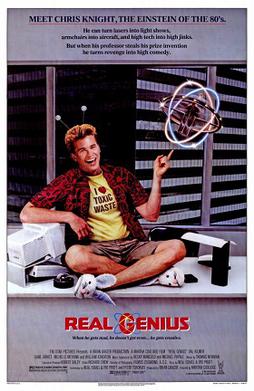
Mitch Taylor (Gabriel Jarrett) is a teenage genius who is recruited by Prof. Jerry Hathaway (William Atherton) to study at Pacific Tech University. The real reason why Hathaway has recruited Mitch is because Chris Knight (Val Kilmer), another genius, has been slacking on developing the power source for an experimental laser called “crossbow.” Hathaway hopes that Mitch can get Chris to take his work seriously and to focus on the project. Instead, Chris teaches Mitch that he has to learn how to enjoy life or his great intelligence will become a burden and he’ll end up burned out and living in the tunnel underneath the university. That’s what happened to Laszlo Holyfield (Jon Gries). That’s what nearly happened to Chris. Chris is determined not to let it happen to Mitch.
Real Genius combines college hijinks with a serious examination of the pressures of being a “real genius.” Mitch knows everything about laser physics but he still misses his parents and cries after getting yelled at by Prof. Hathaway. He’s just a kid, no matter how smart he is. Chris proves himself to be a good friend, encouraging Mitch to relax and enjoy life. Just because you’re a genius doesn’t mean that you can’t have fun. As played by Val Kilmer, Chris Knight is the best friend that everyone wishes they could have, whether they’re a genius or not. Even when the film gets sophomoric, Kilmer plays his role seriously and never loses sight of Chris’s humanity or why it’s so important to Chris that Mitch not become consumed by the pressure of being smarter than almost everyone else in the room. This is one of the early Val Kilmer performances that showed just how good an actor he truly was. With Chris’s encouragement, Mitch pursues a romance with Jordan Cochran (Michelle Meyrink) and gets revenge (more than once) on the arrogant Kent (Robert Prescott).
Eventually, Chris and Mitch realize that their research is being used to construct a weapon for the CIA and this leads to the film’s famous ending. Ever since this movie came out, there’s been a debate over whether or not a laser could be used to make popcorn and, even more importantly, whether or not a gigantic amount of popcorn could actually destroy someone’s house. I don’t know the answers to those questions but I’d like to think that Real Genius got it right and I have no interest in any evidence that suggests otherwise. Sometimes, you owe it yourself to believe in the power of lasers and popcorn. The next person who takes advantage of your hard work, destroy his house with popcorn and then sing Everybody Wants To Rule The World. Learn the lessons of Real Genius.
Finally, when I was growing up, Real Genius was one of those films that seemed to be on HBO all the time. Somehow, I always turned it on right when the popcorn started popping. That popcorn-filled house, followed by Everybody Want To Rule The World, was a huge part of my childhood. Real Genius will always bring back good memories for me.
That can be a dangerous thing to admit, about both the band and Oliver Stone’s 1991 film. Yes, both the band and the film could be a bit pretentious. They both tended to go on for a bit longer than necessary. They were both centered around a guy who wrote the type of poetry that I used to love back in my emo days. It’s all true.
But, with The Doors as a band, I find that I can’t stop listening to them once I start. Even if I might roll my eyes at some of the lyrics or if I might privately question whether any blues song really needs an organ solo, I can’t help but love the band. They had a sound that was uniquely their own, a psychedelic carnival that brought to mind images of people dancing joyfully while the world burned around them. And say what you will about Jim Morrison as a poet or even a thinker, he had a good voice. He had the perfect voice for The Doors and their rather portentous style. From the clips that I’ve seen of him performing, Morrison definitely had a stage presence. Morrison died young. He was only 27 and, in the popular imagination, he will always look like he’s 27. Unlike his contemporaries who managed to survive the 60s, Morrison will always eternally be long-haired and full of life.
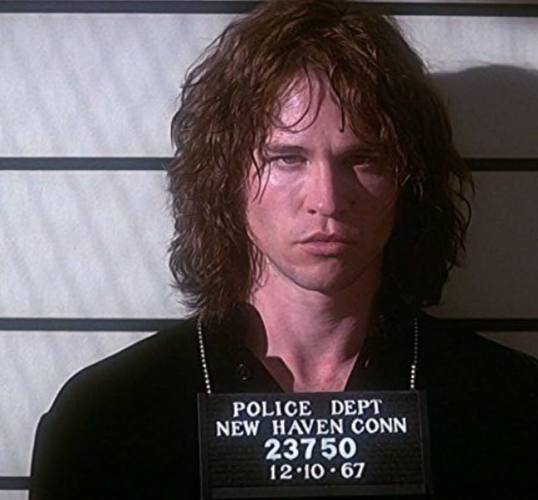
As for The Doors as a movie, it’s definitely an Oliver Stone film. It’s big. It’s colorful. It’s deliberately messy. Moments of genuinely clever filmmaking and breath-taking visuals are mixed with scenes that are so heavy-handed that you’ll be inspired to roll your eyes as dramatically as you’ve ever rolled them. Stone loved the music and that love comes through in every performance scene. Stone also loves using Native Americans as symbols and that can feel a bit cringey at times. Why would Jim Morrison, whose was of Scottish and Irish ancestry, even have a Native American spirit guide? At its best The Doors captures the chaos of a world that it’s the middle of being rebuilt. The 60s were a turbulent time and The Doors is a turbulent movie. I’ve read many reviews that criticized The Doors for the scene in which Morrison gets involved in a black magic ceremony with a journalist played by Kathleen Quinlan. I have no idea whether or not that scene happened in real life but the movie is so full of energy and wild imagery that the scene feels like it belongs, regardless of whether it’s true or not. Stone turns Jim Morrison into the warrior-artist-priest that Morrison apparently believed himself to be and the fact that the film actually succeeds has far more to do with Oliver Stone’s enthusiastic, no-holds-barred direction and Val Kilmer’s charismatic lead performance than it does with Jim Morrison himself.
The Doors spent several years in development and there were several actors who, at one time or another, wanted to play Morrison. Everyone from Tom Cruise to John Travolta to Richard Gere to Bono was considered for the role. (Bono as Jim Morrison, what fresh Hell would that have been?) Ultimately, Oliver Stone went with Val Kilmer for the role and Kilmer gives a larger-than-life performance as Morrison, capturing the charisma of a rock star but also the troubled and self-destructive soul of someone convinced that he was destined to die young. Kilmer has so much charisma that you’re willing to put up with all the talk about opening the doors of perception and achieving a higher consciousness. Kilmer was also smart enough to find the little moments to let the viewer know that Morrison, for all of his flamboyance, was ultimately a human being. When Kilmer-as-Morrison winks while singing one particularly portentous lyric, it’s a moment of self-awareness that the film very much needs.
(When the news of Kilmer’s death was announced last night, many people online immediately started talking about Tombstone, Top Gun, and Top Secret. For his part, Kilmer often said he was proudest of his performance as Jim Morrison.)
In the end, The Doors is less about the reality of the 60s and Jim Morrison and more about the way that we like to imagine the 60s and Jim Morrison as being. It’s a nonstop carnival, full of familiar faces like Kyle MacLachlan, Michael Madsen, Crispin Glover (as Andy Warhol), Frank Whaley, Kevin Dillon, and a seriously miscast Meg Ryan. It’s a big and sprawling film, one that is sometimes a bit too big for its own good but which is held together by both Stone’s shameless visuals and Val Kilmer’s charisma. If you didn’t like the band before you watched this movie, you probably still won’t like them. But, much like the band itself, The Doors is hard to ignore.
Though the Academy of Motion Picture Arts and Sciences claim that the Oscars honor the best of the year, we all know that there are always worthy films and performances that end up getting overlooked. Sometimes, it’s because the competition too fierce. Sometimes, it’s because the film itself was too controversial. Often, it’s just a case of a film’s quality not being fully recognized until years after its initial released. This series of reviews takes a look at the films and performances that should have been nominated but were, for whatever reason, overlooked. These are the Unnominated.
I have come around on Tombstone.
The first time I watched this 1993 film, I was a bit confused as to why so many of my friends (especially my male friends) worshipped the film. To me, it was a bit too messy for its own good, an overlong film that told a familiar story and which featured so many characters that it was difficult for me to keep track of them all. Perhaps because everyone I knew loved the film so much, I felt the need to play contrarian and pick out every flaw I could find.
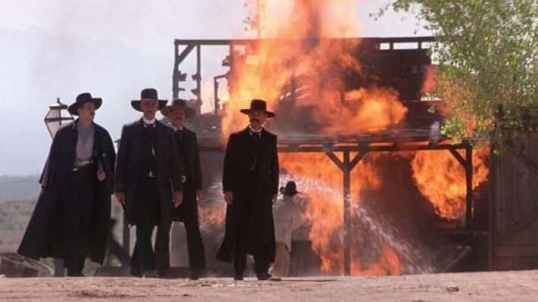
And I still think those flaws are there. The film had a troubled production, with original director Kevin Jarre falling behind in shooting and getting replaced by George Pan Cosmatos, a director who didn’t have any real interest in the material and whose all-business approach rubbed many members of the cast the wrong way. Kurt Russell took over production of the film, directing the actors and reportedly paring down the sprawling script to emphasize the relationship between Russell’s Wyatt Earp and Val Kilmer’s Doc Holliday. On the one hand, this led to a lot of characters who really didn’t seem to have much to do in the finished film. Jason Priestley’s bookish deputy comes to mind. On the other hand, Russell was right.
The film’s heart really is found in the friendship between Wyatt and Doc. It doesn’t matter that, in real life, Wyatt Earp was hardly as upstanding as portrayed by Kurt Russell. It also doesn’t matter that the real-life Doc Holliday was perhaps not as poetic as portrayed by Val Kilmer. Today, if you ask someone to picture Wyatt Earp, they’re probably going to picture Kurt Russell with a mustache, a cowboy hat, and a rifle. And if you ask them to picture Doc Holliday, they’re going to picture Val Kilmer, sweating due to tuberculosis but still managing to enjoy life. Did Doc Holliday every say, “I’ll be your huckleberry,” before gunning someone down? He might as well have. That’s how he’s remembered in the popular imagination. And it’s due to the performances of Russell and Kilmer that I’ve come around to eventually liking this big and flawed western. With each subsequent viewing, I’ve come to appreciate how Russell and Kilmer managed to create fully realized characters while still remaining true to the Western genre. If Wyatt Earp initially fought for the law, Doc Holliday fought for friendship. Kilmer is not only believable as a confident gunslinger who has no fear of walking into a dangerous situation. He’s also believable as someone who puts his personal loyalty above all else. He’s the type of friend that everyone would want to have.
That said, I do have to mention that there are a lot of talented people in the cast, many of whom are no longer with us but who will live forever as a result their appearance here. When Powers Boothe delivered the line, “Well …. bye,” he had no way of knowing that he would eventually become a meme. Boothe is no longer with us, I’m sad to say. But he’ll live forever as long as people need a pithy way to respond to someone announcing that they’re leaving social media forever. Charlton Heston appears briefly as a rancher and he links this 90s western with the westerns of the past. Robert Mitchum provides the narration and it just feels right. The large ensemble cast can be difficult to keep track of and even a little distracting but there’s no way I can’t appreciate a film that manages to bring together not just Russell, Kilmer, Boothe, Heston, and Mitchum but also Sam Elliott, Bill Paxton, Michael Biehn, Michael Rooker, Billy Bob Thornton, Frank Stallone, Terry O’Quinn, and even Billy Zane! The female roles are a bit underwritten. Dana Delaney is miscast but Joanna Pacula feels exactly right as Doc Holliday’s lover.
But ultimately, this film really does belong to Val Kilmer. When I heard the sad news that he had passed away last night, I thought of two films. I thought of Top Gun and then I thought of Tombstone. Iceman probably wouldn’t have had much use for Doc Holliday. And Doc Holliday would have resented Iceman’s attitude. But Val Kilmer — that brilliant actor who was so underappreciated until he fell ill — brought both of them to brilliant life. In the documentary Val, Kilmer attends a showing of Tombstone and you can say he much he loves the sound of audience cheering whenever Doc Holliday showed up onscreen.
Tombstone was a flawed film and 1993 was a strong year. But it’s a shame that Val Kilmer was never once nominated for an Oscar. Tombstone may not have been a Best Picture contender but, in a year when Tommy Lee Jones won the Oscar for Best Supporting Actor for his role in the similarly flawed The Fugitive, it seems a shame that Kilmer’s Doc Holliday was overlooked.
Tombstone (1993, dir by George Pan Cosmatos (and Kurt Russell), DP: William Fraker)