I first saw Salma Hayek when her character was introduced in DESPERADO (1995). It’s fair to say I’ve considered her one of the most beautiful women in the world ever since. Happy Birthday, Salma, and enjoy my friends!
Tag Archives: Danny Trejo
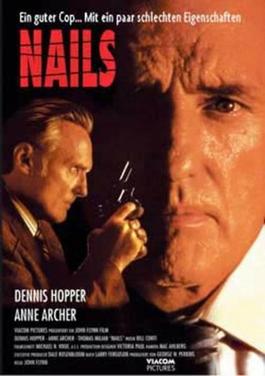
Insomnia File #78: Nails (dir by John Flynn)
What’s an Insomnia File? You know how some times you just can’t get any sleep and, at about three in the morning, you’ll find yourself watching whatever you can find on cable or streaming? This feature is all about those insomnia-inspired discoveries!
If you’re having trouble getting to sleep, you can always go over to YouTube and watch 1992’s Nails.
Dennis Hopper stars Harry “Nails” Nile, a cop who …. wait for it …. doesn’t go by the book! He’s just a few days away from retirement but before Nails turns in his badge and his gun, he has to track down the drug dealers responsible for the death of his partner (Earl Billings). His superior officer doesn’t like him. His wife (Anne Archer) doesn’t trust him. Both the cartel and a local political fixer want him taken down. But Nails isn’t going to give up. He’s going to solve the case and stop the bad guys and get revenge. And he’s going to do it …. wait for it …. HIS WAY!
As you can probably already guess, Nails features just about every cop cliche imaginable. Nails’s partner talks about how much he’s enjoying life right before he gets gunned down. Nails’s boss yells about how much Nails’s out-of-control antics are costing the city. There are car chases. There are foot chases. There are shoot-outs and one-liners. There’s even a moving van chase that features the sight of Dennis Hopper frantically running down the street. And, of course, Danny Trejo shows up in a small role. It’s predictable and mindless and kind of entertaining if that’s what you’re in the mood for.
The thing that sets this film apart — really, the only thing — is that Dennis Hopper gives such an over-the-top performance as Nails. He’s the type of cops who randomly yells at strangers, occasionally giggles, and has a habit of repeating back any threat that he happens to hear. When I watched the film, I originally thought a better title than Nails would be Method Cop because Hopper truly does seem to be going out of his way to bring the full weight of the Method onto the type of role that could have just as easily been played by Chuck Norris. However, as the film progressed, I realized that Hopper was basically giving the same performance that he gave in Blue Velvet, except he was now playing the good guy. What if Frank Booth was the hero? Nails answers the question.
Of course, once the film ended, I was reminded that Hopper’s villain in Speed was a former cop. Is it possible that Speed was actually a sequel to Nails?
As far as I’m concerned, it definitely was!
The world misses you, Dennis!
Previous Insomnia Files:
- Story of Mankind
- Stag
- Love Is A Gun
- Nina Takes A Lover
- Black Ice
- Frogs For Snakes
- Fair Game
- From The Hip
- Born Killers
- Eye For An Eye
- Summer Catch
- Beyond the Law
- Spring Broke
- Promise
- George Wallace
- Kill The Messenger
- The Suburbans
- Only The Strong
- Great Expectations
- Casual Sex?
- Truth
- Insomina
- Death Do Us Part
- A Star is Born
- The Winning Season
- Rabbit Run
- Remember My Name
- The Arrangement
- Day of the Animals
- Still of The Night
- Arsenal
- Smooth Talk
- The Comedian
- The Minus Man
- Donnie Brasco
- Punchline
- Evita
- Six: The Mark Unleashed
- Disclosure
- The Spanish Prisoner
- Elektra
- Revenge
- Legend
- Cat Run
- The Pyramid
- Enter the Ninja
- Downhill
- Malice
- Mystery Date
- Zola
- Ira & Abby
- The Next Karate Kid
- A Nightmare on Drug Street
- Jud
- FTA
- Exterminators of the Year 3000
- Boris Karloff: The Man Behind The Monster
- The Haunting of Helen Walker
- True Spirit
- Project Kill
- Replica
- Rollergator
- Hillbillys In A Haunted House
- Once Upon A Midnight Scary
- Girl Lost
- Ghosts Can’t Do It
- Heist
- Mind, Body & Soul
- Candy
- Shortcut to Happiness
- Dallas Cowboy Cheerleaders
- Dallas Cowboy Cheerleaders II
- Don’t Kill It
- Listen To Me
- 300 Miles For Stephanie
- Hackers
- Rolling Vengeance
Guilty Pleasure No. 119: Marked for Death (dir. by Dwight H. Little)
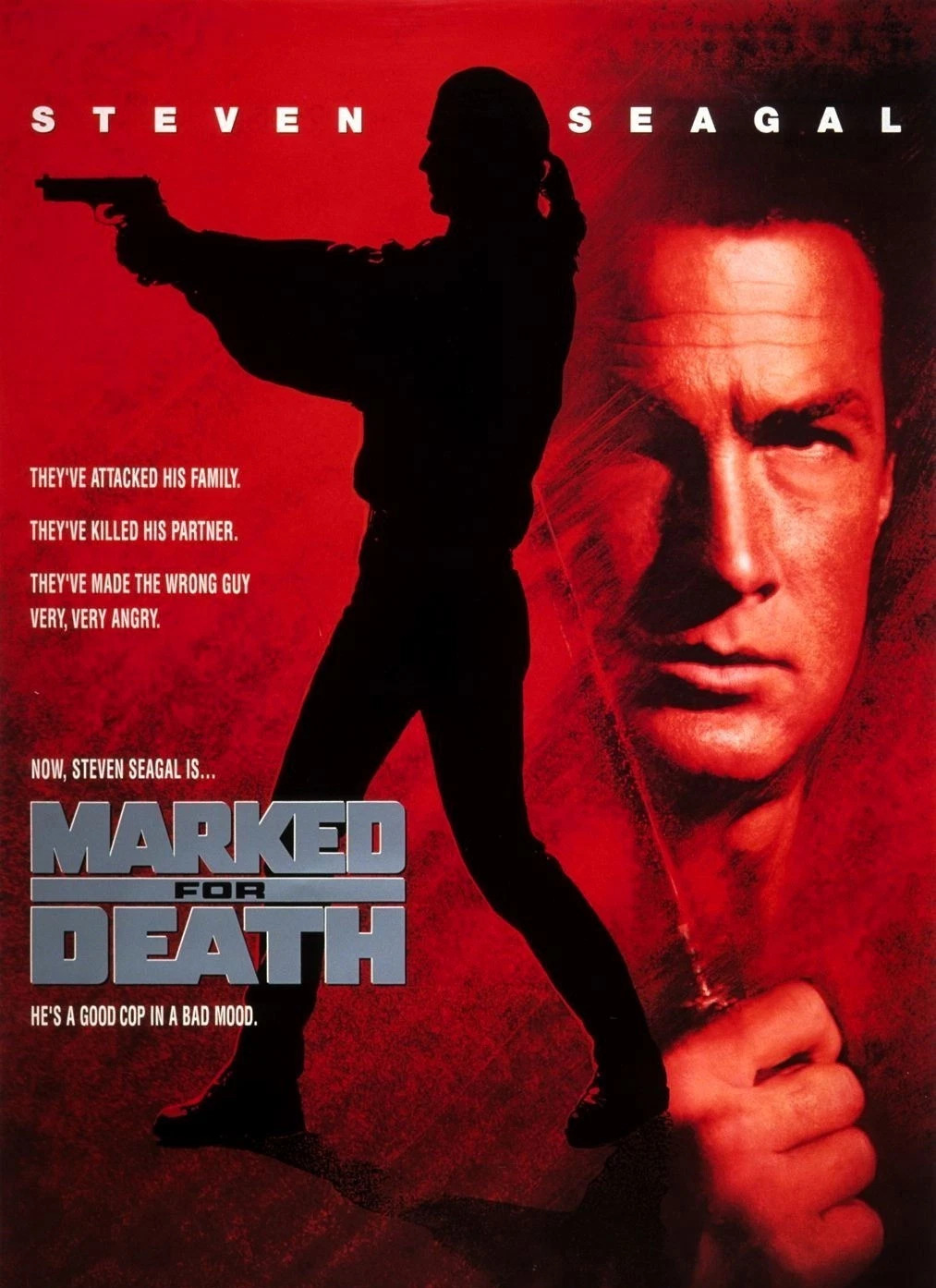
There’s a specific, almost mystical, pleasure in watching a movie that is, by almost every conventional standard, a complete mess. It’s a guilty pleasure, that sweet spot where a film is so unapologetically over-the-top, so earnestly ridiculous, that it circles back around to being utterly entertaining. And for my money, few films embody this “so bad it’s good” vibe quite like Steven Seagal’s 1990 action opus, Marked for Death. This is prime, uncut, vintage Seagal, a film that feels like it was beamed in from an alternate dimension where ponytails are a symbol of power, whispering threats is a sign of deep menace, and the streets of Chicago are apparently overrun with voodoo-practicing Jamaican drug lords. It’s silly, sure, but it’s a very specific kind of silly—grounded enough in its grim, urban revenge fantasy to feel almost earnest, which is precisely what makes it work. To put it in perspective, Marked for Death is downright restrained compared to the coked-out, reality-defying lunacy Seagal would unleash just a year later in Out for Justice. That film, with its infamous “anybody seen Richie?” barroom brawl and its general air of sweaty, unhinged mania, operates on a completely different, far more unhinged wavelength. Marked for Death still has one foot in the real world, however wobbly that stance may be, whereas Out for Justice seems to have been fueled by a warehouse full of stimulants and a complete disregard for narrative coherence.
For those who don’t remember the heyday of Seagal-mania, Marked for Death is a perfect time capsule. This was before the bloated, straight-to-DVD era; this was Seagal in his physical prime, slim, athletic, and seemingly capable of snapping every bone in a human body without breaking a sweat. He plays John Hatcher, a burnt-out DEA agent who, after a botched operation in Mexico, decides to retire and seek some peace and quiet by visiting his sister and niece in his old Chicago neighborhood. This is the first of the film’s many logical leaps, because apparently, a retired DEA agent’s idea of a stress-free vacation is moving back to the neighborhood where he grew up and where a violent turf war is raging. It’s a classic action movie setup that requires you to immediately check your brain at the door, but compared to the sheer narrative anarchy of Out for Justice, it practically feels like Shakespeare.
You see, the peace and quiet Hatcher seeks doesn’t exist. The town is being terrorized by a Jamaican drug posse led by the wonderfully named and gloriously performed villain, Screwface. Played with scenery-chewing, eye-rolling relish by Basil Wallace, Screwface is more than just a drug dealer; he’s a voodoo priest with a penchant for giving people a “t’ousand dets wurse dan yoo doo.” He’s a cartoon character in the best possible way, a man so over-the-top that his presence alone elevates the film from a standard revenge flick into something far more memorable. When he declares Hatcher and his family “marked for death,” you can’t help but lean in, not because you’re scared for the hero, but because you want to see what bizarre, hammy line he’s going to come up with next. It’s absurd, but it’s a controlled absurdity, a deliberate performance that knows exactly what movie it’s in. That’s the key difference between this and the later Seagal outings; Marked for Death plays its absurdity with a straight face, whereas Out for Justice feels like it’s sweating and twitching through every frame, as if the filmmakers themselves had just snorted a mountain of the very product their hero was supposedly fighting against.
The plot, such as it is, kicks into gear when a gang shootout at a local bar forces Hatcher into action, and the posse retaliates by shooting up his sister’s house and wounding his young niece. This is the moment where the film’s narrative pivots from “watch the hero mope” to “watch the hero mope and then absolutely obliterate everyone in his path.” The central premise, like many critics have noted, is as formulaic as they come: a former lawman with a troubled past is forced out of retirement to avenge his family using excessive force. One reviewer put it perfectly, noting the film follows the “familiar one-note, bone-crunching action vehicle for Steven Seagal.” And while that might sound like a criticism, in this context, it’s a promise of the guilty pleasures to come. But even within that formula, there’s a certain grim logic that holds it together—something you absolutely cannot say about the gloriously unhinged Out for Justice, where the plot seems to be held together with duct tape and pure, unfiltered rage.
What makes Marked for Death such a classic guilty pleasure is the sheer, unrelenting brutality of the action sequences. This is not the sanitized, quick-cut action of today. This is a film where every punch sounds like a gunshot and every bone snapped echoes with a sickening, satisfying crunch. Director Dwight D. Little, who later went on to direct TV episodes for shows like Prison Break and Bones, stages the action with a “tight handling,” making sure the camera is right there to capture Seagal’s trademark Aikido. The violence is so extreme that it becomes comical. We’re talking broken arms, broken necks, gouged eyes, a decapitation, and a finale so over-the-top that it involves Seagal using a samurai sword to fight his way through a compound. Yet even with all that mayhem, it never quite reaches the hallucinatory, sweaty-palmed frenzy of Out for Justice, where the violence feels less choreographed and more like a bar brawl that somehow escaped onto film stock.
There are moments in Marked for Death that are so ridiculous they deserve their own standing ovation. There’s the infamous department store fight, where Hatcher dismantles a small army of henchmen while surrounded by mannequins and glass displays. It’s a perfect showcase for Seagal’s skills as a fighter and a complete lack of interest in things like, say, civilian casualties or property damage. Then there’s the entire third act, where Hatcher and his buddy Max (played with stoic reliability by the great Keith David), somehow manage to smuggle an entire arsenal of weapons into Jamaica for a final assault on Screwface’s compound. The logic of this is never explained, but it doesn’t matter. We’re given a montage of them prepping their weapons, and the next thing you know, they’re on a plane. It’s this kind of brazen disregard for realism that makes the film such a hoot, but again, it’s a calculated hoot. The cocaine-fueled silliness of Out for Justice would never bother with such a montage—it would just have Seagal appear in Jamaica with a shotgun, no explanation given, because who needs logic when you have that much manic energy coursing through the projector?
Perhaps the most surprising element is that despite the malevolent tone, the film has become a beloved “cult classic” for many. As one reviewer from the time stated, “it’s easy to see how someone could end up not liking Marked for Death. Its plot is ridiculous, it was overly violent for its time period… On the other hand, this is a film that doesn’t seem to care what you think and instead gleefully exist as a throwback to old-school Grindhouse films.” There’s a sense that Seagal and the filmmakers were in on the joke, even if they were playing it completely straight. The film is excessive, ruthless, and mindlessly numbing in all the right ways, a sentiment that perfectly encapsulates its enduring appeal. It’s the cinematic equivalent of comfort food—you know it’s bad for you, but it tastes so good. And it tastes a whole lot more grounded than the chaotic, unfiltered blast of pure id that is Out for Justice, a film that feels like it was edited by a hyperactive squirrel on a sugar rush.
Marked for Death isn’t a great film by any objective measure. The acting is wooden, the dialogue is laughable, and the cultural stereotypes are, to put it mildly, a product of their time. The Miami Herald even noted that Seagal dispatches his foes with “such an obnoxious sense of higher purpose that we get the feeling he’s not in on the fun.” The film’s portrayal of Jamaican culture as a hotbed of violent, voodoo-worshipping drug dealers is certainly problematic and not something that would fly today, which adds to the movie’s bizarre, anachronistic charm. It’s a film that, while considered one of his better works from that era, is far from what you’d call high art. But it knows its lane and stays in it, which is more than you can say for the gloriously unhinged Out for Justice, a movie that seems to have forgotten what lane it was in, swerved into oncoming traffic, and somehow kept driving anyway.
In the end, Marked for Death is the ultimate “bad movie night” experience. It’s a window into a time when action heroes were larger than life, plots were just excuses for mayhem, and a villain named Screwface could be a legitimate threat. It’s a film where you can quote terrible dialogue and cheer for the excessive violence without feeling guilty, because it’s all part of the deal. As one IMDb user succinctly put it, “Marked for Death is a thoroughly entertaining overblown unnecessarily violent & foul mouthed action film, the sort of film which Seagal was perfectly suited to star in. Sure it’s predictable & unoriginal but when a films this much fun who cares?” And honestly, isn’t that the highest praise you can give a movie like this? It’s a big, dumb, brutal, and brilliant piece of schlock that proudly wears its awfulness as a badge of honor. It’s silly, absolutely, but it’s a grounded, almost respectable kind of silly—the kind that makes you appreciate just how far off the deep end Seagal would go with Out for Justice, a film so wildly, unapologetically unhinged that it makes Marked for Death look like a quiet, contemplative drama by comparison.
Previous Guilty Pleasures
- Half-Baked
- Save The Last Dance
- Every Rose Has Its Thorns
- The Jeremy Kyle Show
- Invasion USA
- The Golden Child
- Final Destination 2
- Paparazzi
- The Principal
- The Substitute
- Terror In The Family
- Pandorum
- Lambada
- Fear
- Cocktail
- Keep Off The Grass
- Girls, Girls, Girls
- Class
- Tart
- King Kong vs. Godzilla
- Hawk the Slayer
- Battle Beyond the Stars
- Meridian
- Walk of Shame
- From Justin To Kelly
- Project Greenlight
- Sex Decoy: Love Stings
- Swimfan
- On the Line
- Wolfen
- Hail Caesar!
- It’s So Cold In The D
- In the Mix
- Healed By Grace
- Valley of the Dolls
- The Legend of Billie Jean
- Death Wish
- Shipping Wars
- Ghost Whisperer
- Parking Wars
- The Dead Are After Me
- Harper’s Island
- The Resurrection of Gavin Stone
- Paranormal State
- Utopia
- Bar Rescue
- The Powers of Matthew Star
- Spiker
- Heavenly Bodies
- Maid in Manhattan
- Rage and Honor
- Saved By The Bell 3. 21 “No Hope With Dope”
- Happy Gilmore
- Solarbabies
- The Dawn of Correction
- Once You Understand
- The Voyeurs
- Robot Jox
- Teen Wolf
- The Running Man
- Double Dragon
- Backtrack
- Julie and Jack
- Karate Warrior
- Invaders From Mars
- Cloverfield
- Aerobicide
- Blood Harvest
- Shocking Dark
- Face The Truth
- Submerged
- The Canyons
- Days of Thunder
- Van Helsing
- The Night Comes for Us
- Code of Silence
- Captain Ron
- Armageddon
- Kate’s Secret
- Point Break
- The Replacements
- The Shadow
- Meteor
- Last Action Hero
- Attack of the Killer Tomatoes
- The Horror at 37,000 Feet
- The ‘Burbs
- Lifeforce
- Highschool of the Dead
- Ice Station Zebra
- No One Lives
- Brewster’s Millions
- Porky’s
- Revenge of the Nerds
- The Delta Force
- The Hidden
- Roller Boogie
- Raw Deal
- Death Merchant Series
- Ski Patrol
- The Executioner Series
- The Destroyer Series
- Private Teacher
- The Parker Series
- Ramba
- The Troubles of Janice
- Ironwood
- Interspecies Reviewers
- SST — Death Flight
- Undercover Brother
- Out for Justice
- Food Wars!
- Cherry
- Death Race
- The Beast Within
- Girl Series
- Gone in 60 Seconds
- Swordfish
Retro Television Review: Baywatch 2.6 “Point Attack”
Welcome to Retro Television Reviews, a feature where we review some of our favorite and least favorite shows of the past! On Saturdays, I will be reviewing Baywatch, which ran on NBC and then in syndication from 1989 to 2001. The entire show can be viewed on Tubi.
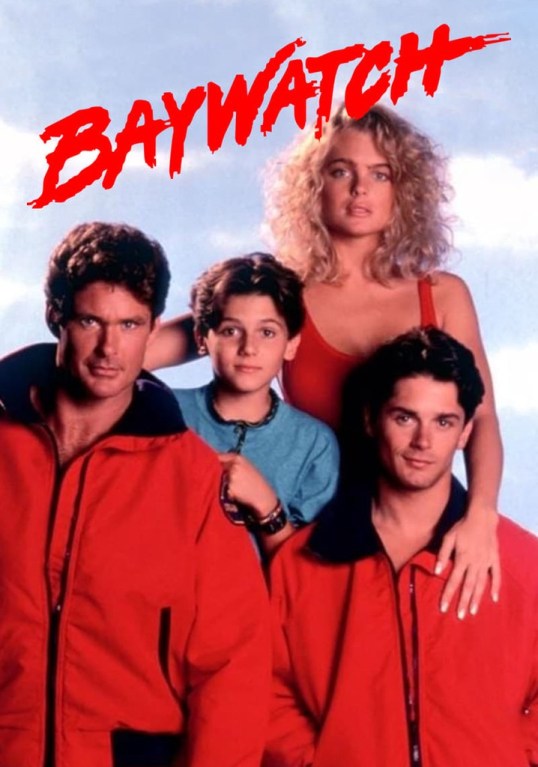
This week, Eddie tries to change a young man’s life.
Episode 2.6 “Point Attack”
(Dir by Alan Myerson, originally aired on October 21st, 1991)
Cort returns!
When the syndicated version of Baywatch first aired, John D. Cort (John Allen Nelson) was among the first season cast members who were no longer on the beach. His absence was not addressed. With this episode, we learn that he’s been in either South America, Kuwait, or Asia. No one’s sure. To me, it sounds like Cort’s a drug smugler.
Anyway, Cort shows up on the beach, just in time to help Eddie break up a gang fight! Eddie, remembering his own tough past in Philadelphia, arranges for the gang members to become a part of W.A.T.A.R., a lifeguard-run program for troubled youths. This the second episode of Baywatch’s second season to feature a gang subplot. It’s hard not to notice that whenever anyone who isn’t white shows up on this show, they’re always portrayed as being 1) poor and 2) affiliated with a gang.
Eddie hopes that he can convince gang leader Memo (Richard Coca) to change his ways. Unfortunately, Memo’s father (Danny Trejo) wants his son to follow in his footsteps as a gang member.
When told that Memo is facing jail, his father says that’s no big deal and adds, “I did time!”
“So did I,” Eddie replies.
Eddie — do you really want to challenge Danny Trejo on the subject of prison?
On the one hand, it’s always good to see Danny Trejo and there’s a definite authenticity to his performance that the rest of this episode lacks. At the same time, having Trejo around makes it all the more clear just how miscast Billy Warlock was a former juvenile delinquent-turned-lifeguard. Watching this episode, I could buy Billy Warlock as someone who could save me if I was drowning. (Thanks, Billy!) But seeing him a graduate of the hard streets of Philadelphia? That was a step too far.
As for the rest of this episode, Cort is far less of a rogue in this episode and he even helps out with the W.A.T.A.R. program. (If anything John Allen Nelson seems to get all the lines that would usually have gone to David Hasselhoff, who is barely in this episode.) When Eddie catches Memo trying to steal from the locker room, there’s a chase scene that goes on for so long that I was literally wondering if Eddie and Memo were eventually going to end up back at Baywatch Headquarters. I’m all for a good action scene but this chase went on for so long that it verged on parody and left me wondering if maybe the show’s director realized, at the last minute, that the episode needed padding.
Unfortunately, Danny Trejo and David Hasselhoff don’t share any scenes in this episode. As mentioned earlier, the Hoff is barely in it! That seems like a missed opportunity to me.
4 Shots From 4 Films: Special Danny Trejo Edition
4 Shots From 4 Films is just what it says it is, 4 shots from 4 of our favorite films. As opposed to the reviews and recaps that we usually post, 4 Shots From 4 Films lets the visuals do the talking!
Today, the Shattered Len wishes a happy 82nd birthday to the man and the legend, Danny Trejo! Trejo’s journey from being a gang member to an ex-con to a drug counselor to a pop cultural institution is an inspiring one, all the more so because Danny Trejo is so candid about both his past struggles and his present successes.
It’s time for….
4 Shots From 4 Danny Trejo Films

Runaway Train (1985, dir by Andrei Konchalovsky, DP: Alan Hume)

Death Wish 4: The Crackdown (1987, dir by J. Lee Thompson, DP: Gideon Porath)

Heat (1995, dir by Michael Mann, DP: Dante Spinotti)

Machete Kills (2013, dir by Robert Rodriguez, DP: Robert Rodriguez)
Film Review: Gun (dir by Jessy Terrero)
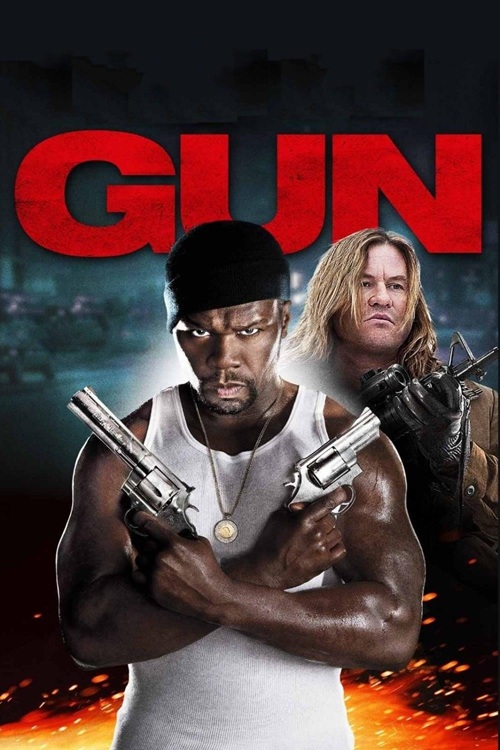 Angel (Val Kilmer) has just been released from prison and he’s returned to the hard streets of Detroit. Hooking up with his old friend Rich (50 Cent), Angel gets involved in a gun-running operation.
Unfortunately, it’s no longer easy or safe to sell guns in Detroit. The police are cracking down. Rival gun dealers are trying to take out a competition. A raid at a club leaves a dealer dead and a huge power void in Detroit’s criminal underworld. When it becomes obvious that the police have a snitch in Rich’s crew, Rich’s girlfriend (AnnaLynne McCord) suspects that it’s Angel. Can Rich find the snitch without having to betray his best friend? And does Angel have secrets of his own?
First released in 201o, Gun was the third film that Val Kilmer made with 50 Cent and it’s apparently their only collaboration that Kilmer didn’t mention in his autobiography. It probably should be noted that Val Kilmer doesn’t look particularly happy in the movie but that actually works for his character. Angel has just gotten out of prison, he’s mourning his wife, and he’s found himself right in the middle of the type of violent situation that could lead to him going back to prison. In many ways, Angel feels like he could be a version of Heat’s Chris Shiherlis. It’d easy to imagine that maybe Chris changed his name after escaping Los Angeles. He became Angel and he found a new partner in the form of Rich. Unfortunately, Detroit is a lot uglier than Los Angeles, Rich is no Neil McCauley, and Michael Mann’s not directing. Kilmer’s performance is not bad. Even in a low-budget movie like this, he still did his best.
That said, the film is centered around 50 Cent. 50 Cent plays Rich. 50 Cent provides the music. 50 Cent produced the film, along with Randall Emmett, a producer who largely made a career out of getting faded stars to appear in B-movies. (He’s best-known for producing the many of Bruce Willis’s final films.) As Rich, 50 Cent gives a rather stiff performance. It’s not so much that he’s not convincing as a street smart gun dealer as he’s just not very interesting to watch. There’s a predictability to his performance, one that is reflected in the songs that appear on the film’s soundtrack. How many rap songs about making money and shooting people can one listen to before admitting that it all gets boring after a while?
In the end, the most interesting thing about Gun is the number of familiar faces who appear in small roles. James Remar plays a cop. Paul Calderon, the bartender from Pulp Fiction and the traitor from King of New York, plays a detective. John Larroquette and, somewhat inevitably, Danny Trejo both make appearances. Perhaps most oddly, Mike “Boogie” Malin, the winner of Big Brother All-Stars, plays an ATF agent. I should mention that, in real life, Boogie Mike and Dr. Will Kirby (winner of Big Brother 2) had a friendship that widely mirrored the friendship between Rich and Angel. I doubt that factored into his casting. That would be giving Gun to much credit.
Gun was not a particularly compelling film, though it did win some authenticity points by actually being shot on location in Michigan. That said, Val Kilmer gave a better performance than perhaps the material deserved. Val is definitely missed.
October Hacks: L.A. Slasher (dir by Martin Owen)
In 2016’s L.A. Slasher, an androgynous killer wearing a white suit and a mask decides that reality stars are the worst people in the world so he starts kidnapping them and torturing them and live-streaming their murders. Even worse, he talks to them and talks to us about how he feels about them. I say “even worse” because the voice of the Slasher is provided by Andy Dick. Andy Dick’s nasal voice is even more whiny than usual in this film and it left me wondering what if perhaps death would preferable to listening to Dick speak.
L.A. Slasher is meant to be a satire and I will give it some credit. It hits its targets and there’s even some bite to the scenes in which people on social media start talking about how much they love the slasher. In many ways, this film predicted the Cult of Luigi. Unfortunately, the film itself is so overdirected and cartoonishly-staged that it’s never quite as effective as it wants to be. It’s essentially a live action cartoon and a fairly exhausting one of that. The flashing lights, the constantly prowling camera, the jump cuts, the neon, it’s meant to be overwhelming but instead it’s just annoying.
There are a lot of familiar faces in the cast. Dave Bautista and Danny Trejo shows up as drug dealers. Mischa Barton is the Actress. Drake Bell is the Popstar. Brooke Hogan is the Reality Star. And, of course, Eric Roberts shows up very briefly as The Mayor. Personally, I think the film would have worked better if Andy Dick had played the Mayor and if Roberts had been the voice of the Slasher. Roberts has a much better voice and, with Dick playing the Mayor, it would be easy to just leave his scenes on the cutting room floor.
In the end, I think the main problem is that L.A. Slasher is a film from 2016 that acts as if it’s the first film to ever criticize reality television and the people who populate it. Even in 2016, that argument was hardly new or original. It certainly didn’t need to be made in the voice of Andy Dick.
Previous Eric Roberts Films That We Have Reviewed:
- Paul’s Case (1980)
- Star 80 (1983)
- Runaway Train (1985)
- To Heal A Nation (1988)
- Best of the Best (1989)
- Blood Red (1989)
- The Ambulance (1990)
- The Lost Capone (1990)
- Best of the Best II (1993)
- Love, Cheat, & Steal (1993)
- Voyage (1993)
- Love Is A Gun (1994)
- Sensation (1994)
- Dark Angel (1996)
- Doctor Who (1996)
- Most Wanted (1997)
- Mercy Streets (2000)
- Raptor (2001)
- Rough Air: Danger on Flight 534 (2001)
- Strange Frequency (2001)
- Wolves of Wall Street (2002)
- Border Blues (2004)
- Mr. Brightside (2004)
- Six: The Mark Unleased (2004)
- We Belong Together (2005)
- Hey You (2006)
- Depth Charge (2008)
- Amazing Racer (2009)
- The Chaos Experiment (2009)
- In The Blink of an Eye (2009)
- Bed & Breakfast (2010)
- Enemies Among Us (2010)
- The Expendables (2010)
- Sharktopus (2010)
- Beyond The Trophy (2012)
- The Dead Want Women (2012)
- Deadline (2012)
- The Mark (2012)
- Miss Atomic Bomb (2012)
- Assault on Wall Street (2013)
- Bonnie And Clyde: Justified (2013)
- Lovelace (2013)
- The Mark: Redemption (2013)
- The Perfect Summer (2013)
- Self-Storage (2013)
- Sink Hole (2013)
- A Talking Cat!?! (2013)
- This Is Our Time (2013)
- Bigfoot vs DB Cooper (2014)
- Doc Holliday’s Revenge (2014)
- Inherent Vice (2014)
- Road to the Open (2014)
- Rumors of War (2014)
- Amityville Death House (2015)
- Deadly Sanctuary (2015)
- A Fatal Obsession (2015)
- Las Vegas Story (2015)
- Sorority Slaughterhouse (2015)
- Stalked By My Doctor (2015)
- Enemy Within (2016)
- Hunting Season (2016)
- Joker’s Poltergeist (2016)
- Prayer Never Fails (2016)
- Stalked By My Doctor: The Return (2016)
- The Wrong Roommate (2016)
- Dark Image (2017)
- The Demonic Dead (2017)
- Black Wake (2018)
- Frank and Ava (2018)
- Stalked By My Doctor: Patient’s Revenge (2018)
- Clinton Island (2019)
- Monster Island (2019)
- The Reliant (2019)
- The Savant (2019)
- Seven Deadly Sins (2019)
- Stalked By My Doctor: A Sleepwalker’s Nightmare (2019)
- The Wrong Mommy (2019)
- Exodus of a Prodigal Son (2020)
- Free Lunch Express (2020)
- Her Deadly Groom (2020)
- Top Gunner (2020)
- Deadly Nightshade (2021)
- The Elevator (2021)
- Just What The Doctor Ordered (2021)
- Killer Advice (2021)
- Megaboa (2021)
- Night Night (2021)
- The Poltergeist Diaries (2021)
- The Rebels of PT-218 (2021)
- Red Prophecies (2021)
- A Town Called Parable (2021)
- Bleach (2022)
- Dawn (2022)
- My Dinner With Eric (2022)
- 69 Parts (2022)
- The Rideshare Killer (2022)
- D.C. Down (2023)
- Aftermath (2024)
- Bad Substitute (2024)
- Devil’s Knight (2024)
- Insane Like Me? (2024)
- The Wrong Life Coach (2024)
- Broken Church (2025)
- When It Rains In L.A. (2025
I Re-Watched Anchorman (2005, Dir. by Adam McKay)
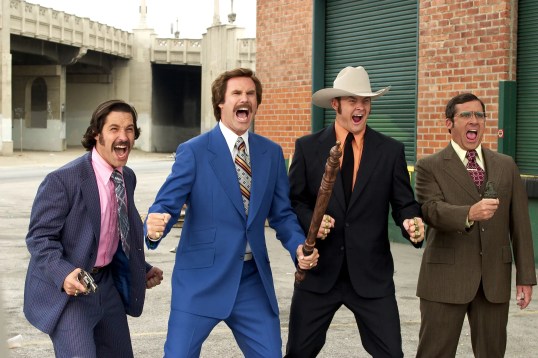
“Ron Burgundy was the balls.”
You got that right! That’s one reason why I’ve lost track of the number of times that I’ve watched Anchorman. Whatever’s going on in the world or my life, I know that Anchorman is going to make me laugh and make me feel better about things. The adventures of anchorman Ron Burgundy (Will Ferrell) and his news team (Paul Rudd, David Koechner, Steve Carell) never cease to amuse me, whether they’re capturing the birth of a panda or getting involved in a street fight with their rival newsmen.
“Brick killed a guy.”
He did! Where did Brick get a trident from? When the street fight started, he only had a hand grenade. Ron Burgundy suggests that Brick should find a safehouse and I hope Brick took his advice. There’s a lot of funny people in Anchorman but Steve Carell, playing the weatherman with an IQ under 80, is my favorite. Brick saying that he loves the lamp is so touching.
“Fare thee well, Baxter. You shall always be a friend of the bears.”
The first time I saw Anchorman, I couldn’t believe it when Baxter was drop-kicked off that bridge. I swore that I would never watch another movie featuring Jack Black! Baxter was so cute! When Ron broke down over the loss of his dog, I wanted to break down with him. Later, when Baxter emerged from the river and barked, “I’m coming, Ron!,” I was so relieved. Baxter lives! Baxter’s conversation with the bears warmed my heart.
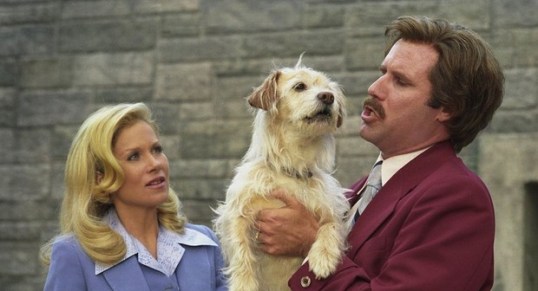
“Stay classy, San Diego.”
That’s right, San Diego! Stay classy. Anchorman is in a class all of its own. Ron Burgundy makes beautiful music with his jazz flute. Brian Fantana is a walking advertisement for Sex Panther. Veronica Corningstone (Christine Applegate) strikes a blow for women’s liberation and teaches Ron an important lesson about teleprompters. It’s the little moments that make me laugh the most, whether it’s Fred Willard talking to his son’s school about why his son has been expelled or Tim Robbins as the PBS anchor who smokes a pipe and chops off Luke Wilson’s arm or Vince Vaughn shouting about the ratings. Best of all, Will Ferrell has never been better than as the pompous Ron Burgundy, so stupid but so committed to his job that you can’t help but love him.
“Wow, that really escalated.”
You bet it did, Ron! Each moment of Anchorman is funnier than the last. (I wish the same was true of Anchorman 2.) That’s why Anchorman is a film that I watch and rewatch. In fact, I think I’ll go watch it right now!
“Thanks for stopping by, San Diego.”
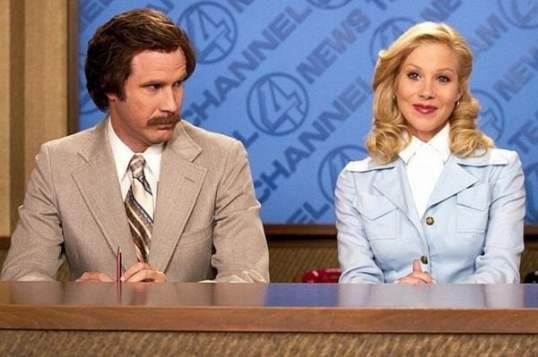
Brad’s Scene of the Day – Paul Kersey meets Machete!
In honor of the 111th birthday in cinema heaven of director J. Lee Thompson, I’ve chosen to share a scene from one of his last few movies, the action packed sequel, DEATH WISH 4: THE CRACKDOWN (1987). Actors Charles Bronson and Danny Trejo crossed paths a couple of times in the late 80’s when Bronson was near the end of his legendary career and Trejo was at the very beginning of his. This scene is interesting as it presents Bronson using a wine bottle as a weapon instead of an huge gun! Enjoy my friends!
Scenes That I Love: Danny Trejo In Machete
The Shattered Lens wishes a happy birthday to Danny Trejo!
Today’s scene that I love comes from 2010’s Machete and it features Danny Trejo being a total badass! Check out that motorcycle!
 Through the Shattered Lens