I’m not always successful, but I spend a fairly large part of my life trying to make my wife happy. One of the ways I do that is I try to find movies for us to watch that she will enjoy, and that I will have at least some interest in. So anytime I can find a movie starring Alicia Witt, most notable in our household for her voluminous work with the Hallmark Channel, I’m definitely heading in the right direction. I was looking through her filmography on IMDB the other day and noticed she was in URBAN LEGEND. I remember the movie coming out in the late 90’s, but I had never seen it, and I had no idea she was the primary lead! It being the spooky season, I thought now was the perfect time for the two of us to cuddle up on the couch with some popcorn and enjoy the show!
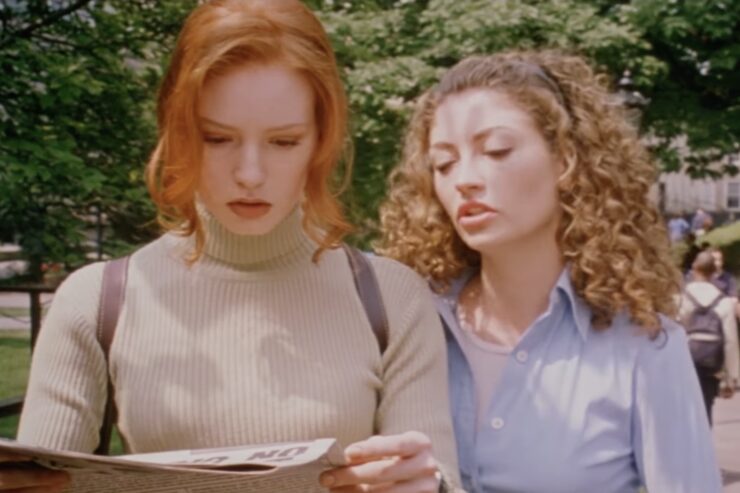
Alicia Witt is Natalie Simon, a student with a dark, secretive past, who begins to suspect that a series of gruesome murders on the campus of Pendleton College are being committed by a killer obsessed with “urban legends.” Each murder seems to take a cue from those scary stories that pretty much all of us grew up hearing, and maybe even believing. As her friends are being picked off one by one, Natalie must do everything to find the killer before she becomes the next victim!
I must admit I had fun with this one. We watched it on a night where we just wanted to relax and see a bunch of obnoxious college students getting whacked in a variety of ways while we try to figure out who the killer is. I remember when SCREAM came out back in 1996 when I was 22 years old. Like so many others, I saw it in the theater and loved it. URBAN LEGEND is in that same tradition. It gives us some suspicious characters and some interesting murders inspired by stories I heard as a kid, and that late-90’s nostalgia kicked right in for me.
It was also fun looking back at the popular young cast whose careers have gone a variety of ways since the movie was made. Along with Witt, our cast of potential killers and victims include Jared Leto, Rebecca Gayheart, Joshua Jackson, and Tara Reid. I really enjoyed seeing veteran genre actors pop up as the movie goes along. The opening scene with Brad Dourif is very effective and lets us know immediately that we can’t trust our normal expectations. Robert Englund is also on hand to provide a creepy and suspicious professor. Heck, Danielle Harris is also in the cast, which was right at the beginning of her extensive career in horror movies.
Until I watched this movie, I didn’t realize just how universal some urban legends really are! A couple of freaky ones I remember as a kid include the story of the gang initiation where potential members drive around with their lights off just waiting for someone to flash their lights at them. Even more disturbing is the one where someone hides under your car ready to slice your Achilles tendon. Each of those stories are represented here. Building a scary movie around those legends, and many more, is a darn clever idea, and I enjoyed seeing what the filmmakers might come up with next.
URBAN LEGEND isn’t a horror masterpiece. It’s not very original, and it’s full of dumb characters making dumb decisions. But I still had a good time with it. For me, it’s a fun little slasher that takes an interesting premise and provides a few cheap scares. And most importantly, it made my wife happy, and that means a lot!
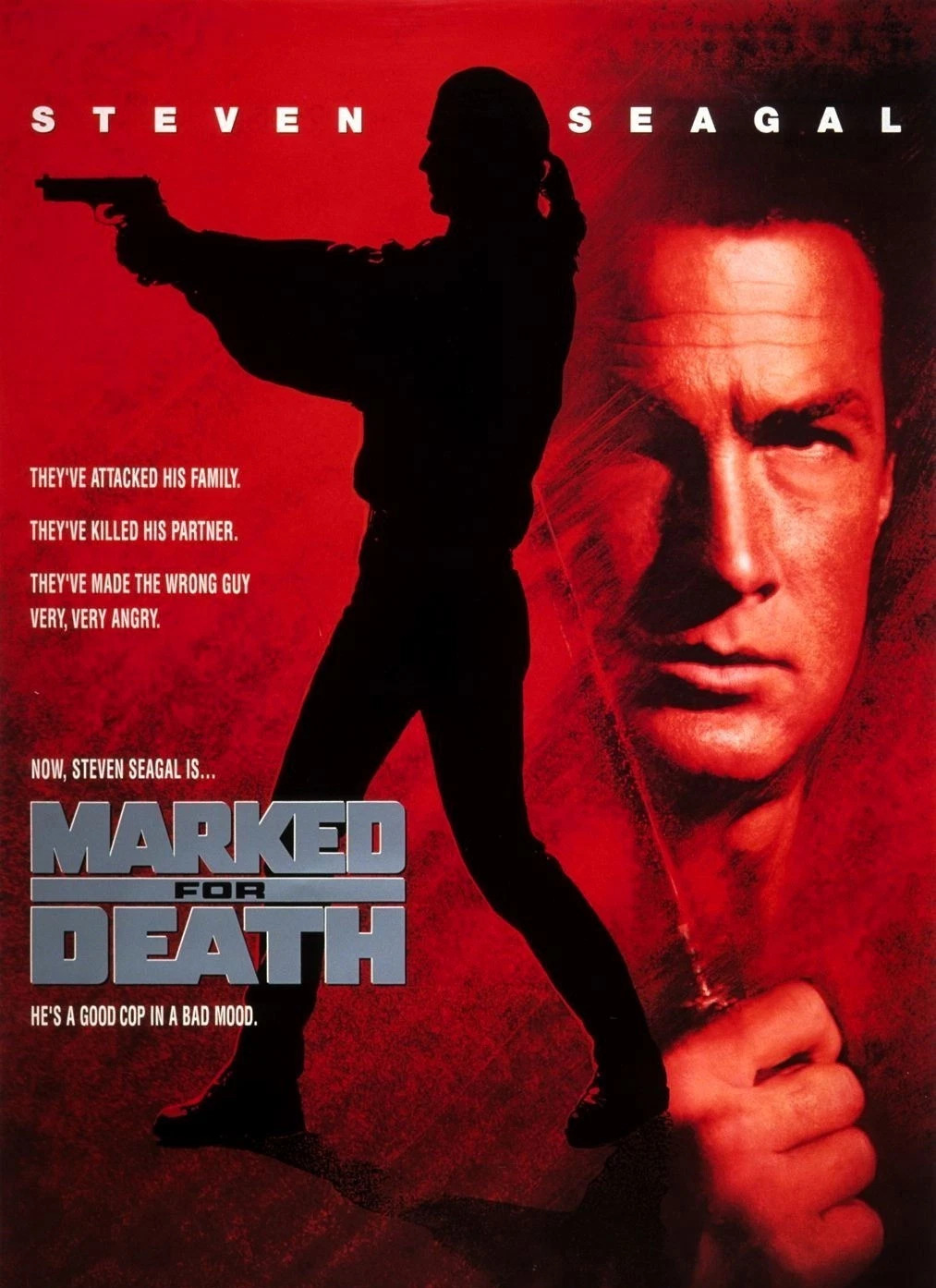
There’s a specific, almost mystical, pleasure in watching a movie that is, by almost every conventional standard, a complete mess. It’s a guilty pleasure, that sweet spot where a film is so unapologetically over-the-top, so earnestly ridiculous, that it circles back around to being utterly entertaining. And for my money, few films embody this “so bad it’s good” vibe quite like Steven Seagal’s 1990 action opus, Marked for Death. This is prime, uncut, vintage Seagal, a film that feels like it was beamed in from an alternate dimension where ponytails are a symbol of power, whispering threats is a sign of deep menace, and the streets of Chicago are apparently overrun with voodoo-practicing Jamaican drug lords. It’s silly, sure, but it’s a very specific kind of silly—grounded enough in its grim, urban revenge fantasy to feel almost earnest, which is precisely what makes it work. To put it in perspective, Marked for Death is downright restrained compared to the coked-out, reality-defying lunacy Seagal would unleash just a year later in Out for Justice. That film, with its infamous “anybody seen Richie?” barroom brawl and its general air of sweaty, unhinged mania, operates on a completely different, far more unhinged wavelength. Marked for Death still has one foot in the real world, however wobbly that stance may be, whereas Out for Justice seems to have been fueled by a warehouse full of stimulants and a complete disregard for narrative coherence.
For those who don’t remember the heyday of Seagal-mania, Marked for Death is a perfect time capsule. This was before the bloated, straight-to-DVD era; this was Seagal in his physical prime, slim, athletic, and seemingly capable of snapping every bone in a human body without breaking a sweat. He plays John Hatcher, a burnt-out DEA agent who, after a botched operation in Mexico, decides to retire and seek some peace and quiet by visiting his sister and niece in his old Chicago neighborhood. This is the first of the film’s many logical leaps, because apparently, a retired DEA agent’s idea of a stress-free vacation is moving back to the neighborhood where he grew up and where a violent turf war is raging. It’s a classic action movie setup that requires you to immediately check your brain at the door, but compared to the sheer narrative anarchy of Out for Justice, it practically feels like Shakespeare.
You see, the peace and quiet Hatcher seeks doesn’t exist. The town is being terrorized by a Jamaican drug posse led by the wonderfully named and gloriously performed villain, Screwface. Played with scenery-chewing, eye-rolling relish by Basil Wallace, Screwface is more than just a drug dealer; he’s a voodoo priest with a penchant for giving people a “t’ousand dets wurse dan yoo doo.” He’s a cartoon character in the best possible way, a man so over-the-top that his presence alone elevates the film from a standard revenge flick into something far more memorable. When he declares Hatcher and his family “marked for death,” you can’t help but lean in, not because you’re scared for the hero, but because you want to see what bizarre, hammy line he’s going to come up with next. It’s absurd, but it’s a controlled absurdity, a deliberate performance that knows exactly what movie it’s in. That’s the key difference between this and the later Seagal outings; Marked for Death plays its absurdity with a straight face, whereas Out for Justice feels like it’s sweating and twitching through every frame, as if the filmmakers themselves had just snorted a mountain of the very product their hero was supposedly fighting against.
The plot, such as it is, kicks into gear when a gang shootout at a local bar forces Hatcher into action, and the posse retaliates by shooting up his sister’s house and wounding his young niece. This is the moment where the film’s narrative pivots from “watch the hero mope” to “watch the hero mope and then absolutely obliterate everyone in his path.” The central premise, like many critics have noted, is as formulaic as they come: a former lawman with a troubled past is forced out of retirement to avenge his family using excessive force. One reviewer put it perfectly, noting the film follows the “familiar one-note, bone-crunching action vehicle for Steven Seagal.” And while that might sound like a criticism, in this context, it’s a promise of the guilty pleasures to come. But even within that formula, there’s a certain grim logic that holds it together—something you absolutely cannot say about the gloriously unhinged Out for Justice, where the plot seems to be held together with duct tape and pure, unfiltered rage.
What makes Marked for Death such a classic guilty pleasure is the sheer, unrelenting brutality of the action sequences. This is not the sanitized, quick-cut action of today. This is a film where every punch sounds like a gunshot and every bone snapped echoes with a sickening, satisfying crunch. Director Dwight D. Little, who later went on to direct TV episodes for shows like Prison Break and Bones, stages the action with a “tight handling,” making sure the camera is right there to capture Seagal’s trademark Aikido. The violence is so extreme that it becomes comical. We’re talking broken arms, broken necks, gouged eyes, a decapitation, and a finale so over-the-top that it involves Seagal using a samurai sword to fight his way through a compound. Yet even with all that mayhem, it never quite reaches the hallucinatory, sweaty-palmed frenzy of Out for Justice, where the violence feels less choreographed and more like a bar brawl that somehow escaped onto film stock.
There are moments in Marked for Death that are so ridiculous they deserve their own standing ovation. There’s the infamous department store fight, where Hatcher dismantles a small army of henchmen while surrounded by mannequins and glass displays. It’s a perfect showcase for Seagal’s skills as a fighter and a complete lack of interest in things like, say, civilian casualties or property damage. Then there’s the entire third act, where Hatcher and his buddy Max (played with stoic reliability by the great Keith David), somehow manage to smuggle an entire arsenal of weapons into Jamaica for a final assault on Screwface’s compound. The logic of this is never explained, but it doesn’t matter. We’re given a montage of them prepping their weapons, and the next thing you know, they’re on a plane. It’s this kind of brazen disregard for realism that makes the film such a hoot, but again, it’s a calculated hoot. The cocaine-fueled silliness of Out for Justice would never bother with such a montage—it would just have Seagal appear in Jamaica with a shotgun, no explanation given, because who needs logic when you have that much manic energy coursing through the projector?
Perhaps the most surprising element is that despite the malevolent tone, the film has become a beloved “cult classic” for many. As one reviewer from the time stated, “it’s easy to see how someone could end up not liking Marked for Death. Its plot is ridiculous, it was overly violent for its time period… On the other hand, this is a film that doesn’t seem to care what you think and instead gleefully exist as a throwback to old-school Grindhouse films.” There’s a sense that Seagal and the filmmakers were in on the joke, even if they were playing it completely straight. The film is excessive, ruthless, and mindlessly numbing in all the right ways, a sentiment that perfectly encapsulates its enduring appeal. It’s the cinematic equivalent of comfort food—you know it’s bad for you, but it tastes so good. And it tastes a whole lot more grounded than the chaotic, unfiltered blast of pure id that is Out for Justice, a film that feels like it was edited by a hyperactive squirrel on a sugar rush.
Marked for Death isn’t a great film by any objective measure. The acting is wooden, the dialogue is laughable, and the cultural stereotypes are, to put it mildly, a product of their time. The Miami Herald even noted that Seagal dispatches his foes with “such an obnoxious sense of higher purpose that we get the feeling he’s not in on the fun.” The film’s portrayal of Jamaican culture as a hotbed of violent, voodoo-worshipping drug dealers is certainly problematic and not something that would fly today, which adds to the movie’s bizarre, anachronistic charm. It’s a film that, while considered one of his better works from that era, is far from what you’d call high art. But it knows its lane and stays in it, which is more than you can say for the gloriously unhinged Out for Justice, a movie that seems to have forgotten what lane it was in, swerved into oncoming traffic, and somehow kept driving anyway.
In the end, Marked for Death is the ultimate “bad movie night” experience. It’s a window into a time when action heroes were larger than life, plots were just excuses for mayhem, and a villain named Screwface could be a legitimate threat. It’s a film where you can quote terrible dialogue and cheer for the excessive violence without feeling guilty, because it’s all part of the deal. As one IMDb user succinctly put it, “Marked for Death is a thoroughly entertaining overblown unnecessarily violent & foul mouthed action film, the sort of film which Seagal was perfectly suited to star in. Sure it’s predictable & unoriginal but when a films this much fun who cares?” And honestly, isn’t that the highest praise you can give a movie like this? It’s a big, dumb, brutal, and brilliant piece of schlock that proudly wears its awfulness as a badge of honor. It’s silly, absolutely, but it’s a grounded, almost respectable kind of silly—the kind that makes you appreciate just how far off the deep end Seagal would go with Out for Justice, a film so wildly, unapologetically unhinged that it makes Marked for Death look like a quiet, contemplative drama by comparison.
Below, you’ll find the trailer for a film called Roadkill. Before watching, please be aware that the trailer pretty much spoils all of the film’s plot twists.
On a humid stretch of road that winds through the Florida bayous, a long-haired man with a beard (played by Ryan Knudson) hitchhikes and deals with traumatic flashbacks to his past. He’s given a ride by a young woman (Caitlin Carmichael) who is driving a red Nova. At first, most viewers will probably assume that the Driver is in danger from the Hitchhiker. However, it soon turns out that the Driver has some issues of her own.
And yes, this is the type of film where the two main characters do not actually have names.
As far as violent, low-budget road movies are concerned, Roadkill is …. well, it’s okay. It’s a film that wears its influences — films like Freeway, First Blood, and No Country For Old Men — on its sleeve and the plots twists are never quite as surprising as the film seems to think that they are. At the same time, the film does a good job of capturing the atmosphere of the Florida backroads and both Ryan Knudson and Caitlin Carmichael do a good-enough job of bringing their characters to life. There’s even a few shots of that red Nova driving down the highway at night that are downright good. The film’s pace is occasionally a bit too deliberate and there’s a chase scene where it’s obvious that neither one of the cars involved are going above the speed limit. But the final 30 minutes are nicely executed and the film’s ending does stick with you. Roadkill is the epitome of the flawed film that doesn’t quite work but which still has enough effective moments to remain watchable.
Horror fans will be happy to see Danielle Harris, even if her role is a small one. Harris plays Allison, a cheerful waitress at a diner. (A few years ago, Harris probably would have been playing The Driver.) Harris is likable, even if the role is a bit of a throw-away part. At least she gets to wear a cute uniform. Still, watching the film, you can’t help but wonder how a diner sitting in the most isolated spot of the Florida bayous manages to stay in business or why Allison is still working at the diner even after it becomes obvious that the diner’s owner is no longer going to be able to pay her salary.
I guess the main lesson of Roadkill is that you really shouldn’t hitchhike. But, to be honest, that’s a lesson that everyone should already know. You should not need a movie to know better than to accept rides from strangers. I think the more important lesson is the one that becomes obvious during the final 30 minutes, which is that it’s better to wear shorts than jeans in the bayou. The bayou can be a dangerous place, though we all know that they worst bayou is bayouself. Thank you, I’ll be here all week and every week afterwards.
You can view Roadkill on Tubi and YouTube. To quote the poet Bluto, it don’t cost nothing.
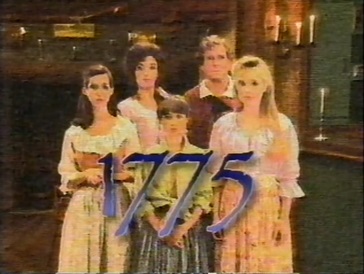
Welcome to Retro Television Reviews, a feature where we review some of our favorite and least favorite shows of the past! On Thursdays, I will be reviewing 1775, which aired on CBS in 1992. The entire show is currently streaming on YouTube!
This week, we take a trip into the past. Welcome to 1775!
Episode 1.1 “Pilot”
(Dir by David Trainer, originally aired on September 5th, 1992)
The year is 1775 and the streets of Philadelphia are awash in rumors of war and revolution. While some prepare for war and others continue to declare their loyalty to the British Empire, Jeremy (Ryan O’Neal) and Annabelle Proctor (Lesley-Anne Down) just try to run their inn and find suitable husbands for their three daughters. The youngest daughter (Danielle Harris, of Halloween fame) wants a horse because all of her friends have a horse. She also wants to run off with a patriot and is offended when the pro-British Governor Massengill (Jeffrey Tambor) stops by the inn.
The Proctors know that one way to marry off their daughters would be to have them attend a fancy ball. Unfortunately, that would require paying money that they don’t have. Jeremy may have to ask his smug brother-in-law for cash. His brother-in-law’s name? George Washington. Who plays George Washington? Somewhat inevitably, Adam West.
Now, I know Adam West playing a smug and superficial George Washington might sound like a lot of fun but West only shows up for one scene and it’s a short one at that. And he really doesn’t get any fun lines or really any opportunity to do any of his trademark Westing. It’s a bit of a wasted opportunity.
Actually, the entire show feels like a wasted opportunity. Reportedly, 1775 was an attempt to do a Blackadder for America but the pilot lacks all of Blackadder’s lacerating wit. Instead of poking fun at American history and traditions in the way that Blackadder did to the Brits, 1775 is just a typically lame family sitcom that happens to take place in 1775. The youngest daughter wants a horse …. BECAUSE IT’S 1775! If it was the modern era, she would want a car. That’s the entire joke.
As for the show’s cast, Lesley-Anne Down delivers a few snarky put-downs with elan but Ryan O’Neal appears to be lost in the main role. Have you seen that famous clip of Ryan O’Neal saying, “Oh man, oh God,” over and over again? Well, that’s the level of his performance here. O’Neal sleepwalks through the show, delivering his lines in the weary voice of someone who needs the paycheck but otherwise could hardly care less. When he gets exasperated with his daughters, he sounds numbly homicidal. It’s not a pleasant performance and it features none of the fierce intelligence that Rowan Atkinson brought to countless incarnations of Edmund Blackadder.
Not surprisingly, only one episode of the show aired before it was canceled. The series didn’t even reach the start of the Second Continental Congress but that’s okay. We all know how that went.
Here’s the trailer for Natty Knocks, an upcoming horror film that features three actors beloved by horror fans everywhere, Bill Moseley, Danielle Harris, and the great Robert Englund!
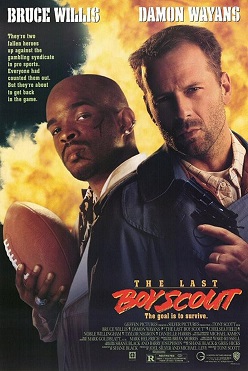
Like the majority of the films that have been written and/or directed by Shane Black, The Last Boy Scout takes place in December. It’s not quite as Christmas-y as some of Black’s other films. I think that I may have spotted a few decorations in the background of some of the scenes. And there’s a scene where private investigator Joe Hallenbeck (Bruce Willis) discovers that his daughter (played by a very young Danielle Harris) has been drawing pictures of “Satan Claus.” Otherwise, there’s not a lot of Christmas to be found in this December-set film and perhaps that’s for the best. Seriously, this movie is violent! Not even the comedic relief characters are safe from getting a bullet to the head. This is a film that actually begins with a football player shooting three other players during a game and then saying, “Ain’t life a bitch,” before shooting himself in the head.
The film’s plot isn’t always easy to follow. Joe is a private investigator who drinks too much and whose partner has just been blown up in front of his house. (His partner was also sleeping with Joe’s wife so guess who is now a suspect!) Joe is also hired to act as a bodyguard for a stripper named Cory (Halle Berry). Cory is dating Jimmy Dix (Damon Wayans), a former quarterback who used to be Joe’s hero. Then Jimmy got kicked out of the league for gambling and Joe stopped watching football. Cory says that she has a tape recording that will get Joe back into the NFL. But then, Cory is brutally gunned down in the middle of the street and the tape is accidentally destroyed by Joe’s crappy tape player. It’s time for Jimmy and Joe to team up, trade one liners, and uncover the conspiracy.
It all links back to the efforts of football team owner Shelley Marcuse (Noble Willingham) to legalize gambling. Senator Calvin Baynard (Chelcie Ross) is standing in Marcuse’s way because Marcuse didn’t offer him a big enough bribe. Marcuse is planning to assassinate the senator and he’s going to frame Joe for the crime because, in an amazing coincidence, Joe used to be a secret service agent until he caught Senator Baynard torturing a sex worker. Of course, the actual assassination will be carried out by Marcuse’s chief henchman, Milo (Taylor Negron, who is absolutely chilling in the role). Milo rarely shows emotion and always refers to everyone by their formal name. (Joe is called Joseph. Jimmy is called James.) Milo is also a total sociopath, one who will shoot anyone in the head without a second thought.
Shane Black, who is a genius regardless of what I may think of this particular film, has said that he wrote The Last Boy Scout after he broke up with a longtime girlfriend and he was suffering from depression. Disillusionment hangs over almost every frame of the movie. Joe did the right thing and lost his career. Jimmy lost his family on the same night that he played the best game of his career. The Senator is opposed to Marcuse’s scheme solely because he’s not getting enough of a cut. Marcuse is a respected businessman who thinks little of killing strangers. Jimmy and Joe are heroes not because they’re particularly good but because everyone else around them is just so bad. This is also very much a movie about guys doing guy things. I watched it with my brother-in-law and I have to say that I think he got a bit more out of the film than I did. Then again, I also think my sister Megan also got more out of it than I did so maybe I just wasn’t in the mood to watch so many people get shot in the head. It happens.
The Last Boy Scout was directed by Tony Scott so, no matter what else you might want to say about it, the movie looks great. Willis seems a bit bored with the film and Wayans sometimes struggles with the more dramatic moments. In many ways, the film feels like a precursor to Shane Black’s The New Guys, though Willis and Wayans never have the same chemistry as Russell Crowe and Ryan Gosling did in that underrated film. However, The Last Boy Scout’s action moves quickly and the screen is always full of neon lights. It’s a well-made action movie though, unlike Lethal Weapon, Die Hard, and The Nice Guys, it’s not one that really sticks around in your head after the end credits roll. Personally, I think it needed a little more holiday spirit.
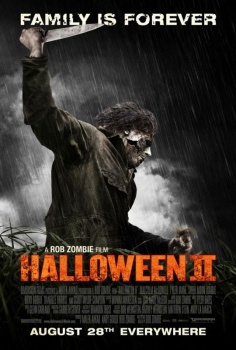
The thing about praising Rob Zombie’s Halloween is that you’re then contractually obligated to talk about the 2009 sequel, Halloween II. While I certainly don’t have any trouble defending the first film, Halloween II is about as big a mess as I’ve ever seen.
Much like the sequel to the original film,Halloween II opens with Laurie (Scout Taylor-Compton) being stalked in the hospital by her murderous older brother, Michael (Tyler Mane). And the hospital scenes are actually pretty good. Zombie makes good use of Nights in White Satin and the scenes of Michael chasing Laurie are genuinely suspenseful.
However, the film then jumps a year into the future and it’s all kind of annoying. Halloween II follows three separate storylines, all of which converge at the rushed conclusion.
My favorite storyline dealt with Dr. Loomis (again played by the brilliant Malcolm McDowell). Loomis has written a book about Michael and is now traveling the country, promoting himself as a true crime expert and dealing with people who think that he’s exploiting the whole tragedy for a quick buck. McDowell is perfect in these scenes, playing Dr. Loomis as a pompous man who secretly knows that he’s a fraud. “I was as much a victim as anyone,” he occasionally sputters. Perhaps the highlight of the film comes when he’s interviewed by a rather sarcastic Chris Hardwick and finds himself being ridiculed by Weird Al Yankovic (playing himself).
The second storyline features Annie (Danielle Harris) and Laurie struggling to get on with their lives. Laurie is now living with Annie and her father (Brad Dourif). As opposed to the virginal Laurie of the first Halloween, this Laurie is pissed off and out of control. On the one hand, I think Zombie deserves some credit for trying to deal with the PTSD that would obviously be the result of surviving being attacked by Michael Myers. On the other hand, to say that Laurie is never not pissed off would be an understatement. Scout Taylor-Compton does a good job playing her but, in Halloween II, a little Laurie Strode goes a long way. You can only watch someone rage at the world for so long before it starts to get boring.
And the third storyline, not surprisingly, is Michael still trying to track down and kill his sister. Michael continually sees visions of his dead mother (Sheri Moon Zombie), occasionally accompanied by a white horse, telling him, “It’s time.” (Eventually, Laurie starts to see the same thing.) Usually, if you come across someone online criticizing Halloween II, one of the first things that they’ll mention will be that white horse. To be honest, the white horse didn’t both me. I actually appreciated the surreal touch of Sheri Moon Zombie and a white horse appearing out of nowhere. But still, as opposed to first film, Michael is just boring in this film. The first film was memorable because it took the time to explore why Michael became who he became. In Halloween II, Michael’s just another killer in a mask. Leslie Vernon would have kicked his ass.
So, no, Halloween II does not really work. The story is too messy and, with the exception of Dr. Loomis, none of the characters are particularly interesting. I still stand by my claim that Rob Zombie is an underrated director but Halloween II is a definite misfire.
That’s the question that every horror fan has to ask themselves at some point. Needless to say, Zombie has a huge following and no one can doubt his love for the genre. And yet, despite that, it seems that Zombie’s detractors will always be as outspoken as his fans. His fans point out that Zombie makes movies that literally feel as if they’re filmed nightmares and that, as a committed horror fan, he’s willing to go further in his quest to shock you than most mainstream filmmakers. His detractors, meanwhile, tend to see Zombie as an excessive filmmaker who often uses an abundance of style to cover for a weak narrative.
Personally, I’m somewhere in the middle when it comes to Zombie. I think, as a storyteller, Rob Zombie does occasionally struggle to maintain a coherent narrative but, at the same time, I think his strengths as a director ultimately overcome his weaknesses. As a visual filmmaker, he’s a lot stronger than he’s often given credit for and I don’t think anyone would criticize the way that he uses music in his films. He may not be the strongest director of actors but he’s got a good eye for casting and he’s given work to some of our best character actors (Sid Haig, Malcolm McDowell, Brad Dourif, William Forsythe, and the late Karen Black, just to name a few). If his films are extremely graphic and bloody … well, that’s the current state of horror. If anything, I would argue that Zombie deserves credit for unapologetically embracing the mantle of being a 21st century grindhouse filmmaker.
That said, Rob Zombie’s films rarely seem to be as good on a second viewing as they were during the first. He’s one of those directors who comes at you strong that, to a certain extent, his films almost beat you into submission. During the first viewing of one of Zombie’s films, it’s not unusual to be overwhelmed by all the style and the music and the gore and the over-the-top characterizations. Even if you don’t like the film itself, it definitely makes an impression on you. It’s only on repeat viewing that you might start to notice that Zombie’s narratives are often rather clumsily slapped together. Several times, Zombie’s visual style seems to dictate the story as opposed to the other way around.
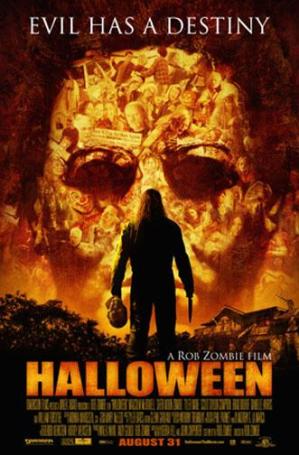
That was certainly the case with his 2007 remake of Halloween. While the film follows the same basic plot as John Carpenter’s original, it also spent a lot more time delving into the past of Michael Myers (Daeg Faerch as a child, Tyler Mane as an adult). It was obvious that Zombie was far more interested in Michael than in any of his victims. (Carpenter took the exact opposite approach, developing the characters of Annie, Laurie, and Linda and allowing Michael to remain a cipher.) As a result, the first half of the film deals with Michael and his dysfunctional childhood while only the second half features Michael escaping and returning to Haddonfield. Laurie, Annie, and Lynda are well-played by Scout Taylor-Compton, Danielle Harris, and Kristina Klebe but ultimately, they all remain rather generic.
The first time I saw Rob Zombie’s Halloween, I thought it was one of the most disturbing films that I had ever seen. I should clarify that I mean that in a good way. Zombie’s Michael was truly terrifying but, at the same time, Zombie portrayed him as a kid who never had a chance. Whereas Carpenter’s Michael started the film as a fresh-faced little boy dressed up like a clown and holding a bloody knife, Zombie’s Michael is born into a world of chaos and darkness. With his dysfunctional childhood, it was hard not to feel that Michael never had a chance. Feeling abandoned by both his family and, eventually, his therapist, Michael retreated into a world of pure anger and hate. Whereas John Carpenter’s Michael rarely seemed to be angry (instead he was just relentless), Zombie’s Michael is rage personified.
Unfortunately, Zombie’s Halloween spends so much time on Michael and his mother (Sheri Moon Zombie) and Dr. Loomis (Malcolm McDowell, perfectly cast) that it doesn’t leave much time for the night he came home. Essentially, the entirety of Carpenter’s original film is crammed into the film’s second half and, on repeat viewings, you can’t ignore how incredibly rushed it all feels. It’s obvious that Zombie’s heart was in the first half of the film. In the second half, he’s just going through the slasher movie motions.
Rob Zombie’s Halloween is definitely a flawed film. John Carpenter’s original remains the superior Halloween but, to be honest, I don’t think Rob Zombie would deny that. Zombie set out not to replace Carpenter’s Halloween but to tell a different version of the same story. When Zombie’s Halloween works, it really works. Flawed as it may be, Halloween proves that Rob Zombie is a talented filmmaker, albeit one with room to grow.
As for Halloween II … well, we’ll talk about that later…
Hi everyone! We are currently in the process of our annual horrorthon here at the Shattered Lens so I thought it would be a good idea if me and some of my fellow writers reviewed all of the Halloween films! Arleigh already reviewed the original Halloween back in 2010 and I took a look at the first sequel in 2012. So, it just made perfect sense to me that we go ahead and take a look at the rest of the films in the series!
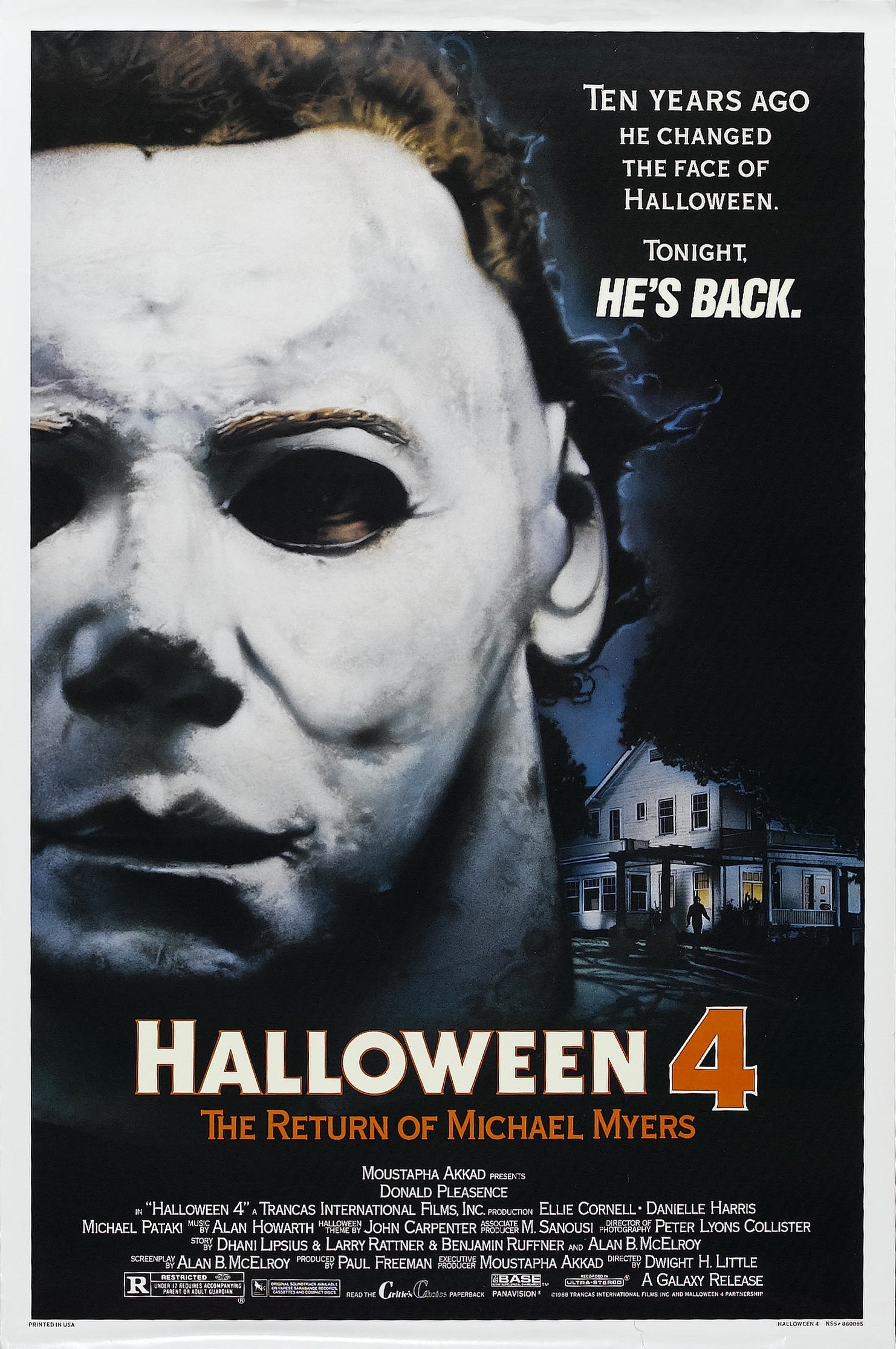
Yesterday, Case reviewed Halloween 4 and, later, he’ll be taking a look at Resurrection and H20. Jedadiah Leland is taking look at Halloween 6 tomorrow. So, that leaves me with … *sigh* Halloween 5.
BLEH!
Before we dive into the crapfest that was Halloween 5, let’s take a look at the trailer! It’ll be fun!
The trailer’s actually fairly effective. I have to wonder how many people, way back in 1989, were fooled into seeing this film as a result of this trailer? I imagine probably more than who are willing to admit it. Paying money to see Halloween 5 doesn’t seem like something anyone would want to brag about.
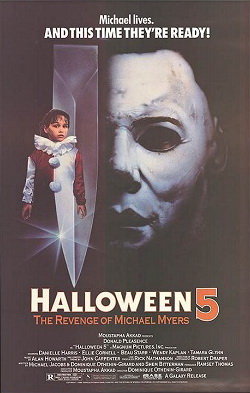
Halloween 5 is the one that has the dumb cops. Now, I know that every Halloween film seems to feature at least a few dumb cops but the ones in Halloween 5 are really dumb. And they get their own theme music! That’s right — whenever these two dumb cops show up on screen, comedic circus music plays. Needless to say, it’s woefully out of place in a horror movie. I read that this was apparently meant to be an homage to the dumb cops from the original Last House On the Left. This despite the fact that … EVERYONE HATED THE DUMB COPS IN LAST HOUSE ON THE LEFT!!! Even Wes Craven later said that the dumb cops were a mistake! If you’re going to rip off (or pay homage) to another movie, don’t pay homage to the part that sucked!
Anyway, you may remember that Halloween 4 ended with Jamie (Danielle Harris) attacking her mother and holding a knife. Uh-oh, looks like Jamie’s going to be a murderer! Well, no — that would have been too interesting. Halloween 5 finds Jamie being committed to a mental hospital for a year while Michael Myers (Don Shanks) is in a coma. Michael eventually comes out of his coma and starts stalking Jamie all over again.
Once again, Dr. Loomis (a depressingly frail Donald Pleasence) is one of the few people who realizes that Michael is still alive and once again, nobody is willing to listen to him. Here’s the thing: Dr. Loomis may be kinda crazy and yes, all the scars are kinda disturbing but he’s been right every single freaking time in the past. I understand that the people of Haddonfield are kind of in denial about Michael but this is just getting ridiculous.
Rachel Carrathurs (Ellie Cornell) returns for this movie but she gets killed early on. Apparently, she was killed so that the audience would know that anyone could be killed and that nobody was safe but Rachel was such a strong character and Ellie Cornell did such a good job playing her in the previous film that you really feel her absence in Halloween 5. Her death leaves a void that the film fails to adequately fill. Add to that, if you insist on killing a kickass character like Rachel, at least give her a memorable death scene. Don’t just have her blithely wandering around the house half-naked until she suddenly gets stabbed, as if she was just some generic slasher victim and not the lead of the previous movie.
With Rachel dead, it now falls to her amazingly annoying best friend, Tina (Wendy Kaplan), to serve as Jamie’s protector. Tina is hyperactive and talkative and quirky and blah blah blah. Basically, she’s like that person who is really annoying but since you’ve known her since the third grade, you feel obligated to hang out with her.
It all leads to another big Halloween party and few rather bloodless deaths. It’s all pretty boring, to be honest. There is one good scene where Michael chases Jamie in a car (the headlights cutting through the darkness create a wonderfully eerie effect) but, otherwise, it’s depressingly generic.
In the end, Michael is captured and put in a jail cell. Fortunately, a mysterious man in black shows up and breaks him out. Gee, I wonder what that’s about?
Halloween 5 is undoubtedly the worst of the Halloween films.
We open in rural …. Iowa? Illinois? Middlewest? We see lots of ramshackle farms and shitty halloween decorations, but that’s not all… there’s also a prison for the criminally insane. Apparently, it’s time to move Michael Myers from his basement asylum Hell to somewhere….else. MM is put in an ambulance for transport and proceeds to wake and stick his thumb through a man’s skull. I get it- MM is pissed, but why didn’t he use his thumb powers to get out of the prison basement?! Oops, I forgot to take my stupid pills….ahhhhh…. this is GENIUS!!!
We are in a suburban home and we meet Jaime who is the orphaned child of Jamie Lee Curtis AKA MM’s Niece. She is having all kinds of disturbing hallucinations of MM coming to get her. Her adoptive sister Rachel is not much help. She whines about babysitting her sister Jaime because she wants to be the latest conquest of the massively eye browed Brady.
Enter Donald Pleasance (DP). He’s all scarred up from his previous MM run-ins and limps his way to the Prison Administrator. They go back and forth: DP: MM is evil. Administrator: No, you are. DP: He’ll kill everyone. Administrator: You’ll kill everyone. DP: I’m evil. Administrator: No! MM is evi…. You got me! Phone Rings: MM has escaped.
MM has found a Diner/Gas Station who’s decor is wall to wall Abe Lincoln pictures. MM who is evil, and apparently a closeted supporter of John Wilkes Booth, kills everyone there. Donald Pleasance arrives and tries to kill MM and fails. MM steals a tow truck and drives off to Haddonfield, Illinois to purportedly kill his niece Jaime. DP is stranded and is forced to hitch rides.
Jaime is being bullied at school. Rachel picks her up to get a costume for Halloween, which you’d think would be this town’s least favorite holiday, but NOPE. They arrive at a drug store where one of the clerks is Kathleen Kinmont- the Sheriff’s daughter- who really really wants to sleep with Brady and Rachel is oblivious to this.
Rachel takes Jaime trick or treating and Brady decides to pork Kathleen Kinmont (KK) and gets totally busted when Rachel rings the bell and KK answers the door for some reason and for another some reason doesn’t have any pants on! Brady is in the background and no one seems phased that KK is without pants for 45 more minutes of the film. This cheating distracts Rachel, leaving Jaime on her own.
DP goes to the Haddonfield Sheriff and convinces him that MM has RETURNED!!! He lets the town know and a beer addled Drunken Posse forms. These men are beer fueled, shotgun toting, drunkards going on an MM hunt!!
The Drunk Posse thinks they’ve spotted MM, but they just shot up and murder a sleeping drunk guy. OOPS!
The Sheriff and DP find the police station filled with dead cops. They go outside and find Jaime and Rachel. They take the remaining police force to his house to make a last stand. This is where is gets weird…. Brady and KK are trying to pork and are interrupted by her dad the Sheriff and his deputy. KK never puts on pants even when her dad and his co-workers arrive. It could be a pants allergy. The Deputy proceeds to sit in a rocking chair…yep…a rocking chair. Huh? I was in the Army for a long time; I learned how to breach a building, hold a fixed position, and look awesome in Green, but I was never taught the Rocking Chair maneuver. Maybe, that was just for Delta Force guys.
Brady tries to board up the house a bit. KK checks on the deputy, but he’s dead. Looks like Myers did kill the DEP U TEE!!! [sung] Then, MM kills KK- She’s now pantsless forever with the angels in heaven. Jaime is upstairs with Rachel and MM goes after her. Brady tries to stop him, but MM kills him too. MM has more urge to kill than a person who had to sit through a 3 hour timeshare presentation.
The girls manage to escape: Jaime by being lowered slowly down from the roof and Rachel much more quickly by falling off the roof. They run for the school and MM pursues them. The Drunken Posse arrives and manages to not kill themselves or others for this scene only. They take the girls in the truck and drive away to safety …. or so they think!!! MM climbs up from under the truck Indiana Jones style and kills all of the Drunken Posse. Rachel takes the truck and slams on the brakes to get MM to fly off of the roof of the truck. She then runs him over. The Sheriff and some extras arrive to shoot up MM. Jaime goes to the now deceased MM and touches his corpse.
They go home and Jaime dresses up as a clown like MM did in Halloween 1 and stabs her adoptive mom to death. The End.
This is the most analysis this film has ever received or should, but it’s Halloween time. Thanks for enjoying this terrible film with me. Remember, as always, if you like my work, tell my boss Lisa Marie Bowman!!!