Let’s be real for a second: Swordfish is not a good movie. It’s not even a particularly competent one. The plot is a Rube Goldberg machine of logical fallacies, the dialogue sounds like it was written by a teenager who just discovered Ayn Rand and energy drinks, and the central “hacking” sequences are so technologically absurd they’d make a Best Buy geek squad member spit out their Mountain Dew. And yet, here we are, nearly a quarter-century later, still talking about this 2001 techno-thriller with a weird mix of scorn and affection. That’s the magic of Swordfish—it is the cinematic equivalent of a sugar rush, a headache-inducing, neon-lit, logic-defying blast of early-2000s excess that somehow earned a cult following precisely because of its flaws, not in spite of them. This is the movie where John Travolta wears a soul patch, quotes Thomas Jefferson, and chews scenery like it’s his last meal on death row, all while Halle Berry casually drops the most gratuitous topless scene in mainstream cinema history and Hugh Jackman pretends to crack Pentagon firewalls with a laptop from a moving van. It’s trash, sure, but it’s gloriously, unapologetically, big-budget trash, and that’s exactly why we can’t look away.
The premise, if you can call it that, is pure pulp madness. We are introduced to Gabriel Shear, played by Travolta with a level of hammy zeal that borders on performance art, a suave super-villain who leads a shadowy, off-the-books FBI black-ops cell that apparently operates with zero oversight and unlimited resources. Or is he a rogue agent? Or a master criminal? The film never quite decides, and honestly, it doesn’t care. What matters is that Gabriel has a plan to steal nine billion dollars from a government slush fund to finance his global war on terrorism—because, you know, post-9/11 vibes were still cooking in the editing bay when this came out, and the script was clearly written during a very caffeinated weekend. To pull off this digital heist, he needs the world’s best hacker, a man who can crack any firewall with a few furious keystrokes and a 3D visual interface that looks like a rave at MIT. Enter Stanley Jobson, played by Hugh Jackman, who was fresh off X-Men and clearly just happy to be there. Stanley is a former prodigy who got busted for writing a virus, lost his daughter to his vindictive ex-wife, and now spends his days in a rusted-out RV, presumably regretting his life choices. Gabriel offers him a deal: help with the hack, get ten million dollars, and win back his kid. It’s the kind of high-stakes, low-emotion motivation that drives every action movie protagonist, but Jackman sells it with a weary charm that makes you root for him despite the sheer idiocy of his situation.
Now, let’s talk about the elephant in the room—actually, let’s talk about Halle Berry. Her character, Ginger, is Gabriel’s sleek, deadly associate, and she exists in the film to look stunning, deliver cryptic warnings, and, most famously, get paid a then-record $500,000 to appear topless for a scene that has absolutely zero bearing on the plot. The moment is iconic for all the wrong reasons: it’s gratuitous, it’s abrupt, and it’s pure, uncut early-2000s exploitation filmmaking. Berry later admitted she only did it because the studio offered her a huge pay bump, and honestly, that transactional honesty makes the scene even more legendary. It’s not art; it’s a contractual obligation, and yet it became the film’s most enduring watermark. Every time Swordfish comes up in conversation, you can bet your bottom dollar someone will mention “that Halle Berry scene” before they mention the plot, the action, or even John Travolta’s terrifyingly sleek haircut. That’s the level of cinematic legacy we’re dealing with here—a film remembered more for a single shot than for its entire narrative structure. And because Ginger is just Gabriel’s operative, not a spurned lover or a damsel in distress for Stanley, the scene feels even more disconnected—it’s pure spectacle for spectacle’s sake, which in a movie this unhinged, feels oddly honest.
Speaking of unhinged, let’s properly set the record straight on that opening scene, because it’s arguably the film’s single smartest moment—and the biggest bait-and-switch. The movie kicks off not with an explosion, but with a tense, quiet café confrontation where Gabriel has already gotten the drop on Stanley and FBI agent J.T. Roberts, played by Don Cheadle with his trademark weary exasperation. Instead of a generic threat, Gabriel calmly orders a drink and launches into a rambling, passionate dissertation on Sidney Lumet’s Dog Day Afternoon, using Al Pacino’s desperate bank robber Sonny Wortzik as his case study. He points out how that film manipulated audiences into sympathizing with a criminal, how the so-called “good guys” were portrayed as incompetent or antagonistic, and how the entire construct of heroes and villains is just a narrative shell game. It’s a genuinely clever piece of meta-commentary that immediately signals this movie’s winking, self-aware ambition—Gabriel is essentially telling Stanley, Roberts, and the audience that we’re all about to be played, that our allegiances will be toyed with, and that morality in this universe is strictly situational. Travolta delivers it with such gleeful, unhinged conviction, sipping his coffee while holding two men at gunpoint, that you almost forget you’re watching a movie that will immediately abandon that intellectual nuance for car chases and slow-motion explosions. The famous bus detonation actually comes later, during the opening credits sequence, serving as pure stylistic overkill that sets the bombastic tone for everything that follows. That café scene is the film’s thesis statement—too bad the rest of the movie is a B-minus student trying to write an A-plus paper.
The actual heist sequence involves Stanley hacking into a government mainframe using a wireless laptop from a moving van, while Gabriel’s team engages in a firefight with SWAT teams that feels like a Call of Duty cutscene. The climax features a helicopter dangling a massive chain through a skyscraper’s glass windows, which is visually stunning and physically impossible, but who cares? The movie moves at such a breakneck pace that you don’t have time to ask questions—you’re too busy watching Travolta fire two handguns while smirking like he just told the world’s greatest dad joke. The dialogue is another highlight in this carnival of cheese. Travolta delivers lines like “It’s not about the money; it’s about the message” with the gravitas of a Shakespearean actor, while Jackman counters with whiny retorts that sound like they were workshopped in a writers’ room full of Red Bull. Cheadle spends most of the film looking like he desperately wants to transfer to a different movie, and honestly, he’s the audience surrogate—the one guy who realizes how bonkers everything is but is powerless to stop it. The plot twists are telegraphed from a mile away, and the final reveal that Gabriel might have been a covert government asset all along is so half-baked it feels like an afterthought. Yet, none of this matters. Swordfish is not a film you dissect; it’s a film you surrender to. It’s the cinematic equivalent of a rollercoaster that’s slightly off its rails—terrifying, thrilling, and you’re not entirely sure you’ll survive, but you’re grinning the whole way down.
Why has Swordfish become a cult hit? Simple: it’s the perfect guilty pleasure. It came out in that sweet spot of the summer movie season where studios threw insane budgets at anything with a cool title and a poster with shiny fonts. It’s a time capsule of post-millennial anxiety, when we were terrified of hackers and fascinated by sleek, amoral anti-heroes. The film’s ludicrous premise—secret FBI shadow cells running black-bag ops funded by digital theft—plays like a fever dream of libertarian fan fiction, but it’s sold with such straight-faced conviction that you can’t help but admire its chutzpah. Travolta’s performance alone is worth the price of admission; he’s clearly having the time of his life, twirling his metaphorical mustache and delivering philosophical diatribes between sips of espresso and bursts of gunfire. He elevates the material from forgettable schlock to memorable camp, and that’s a rare skill. Meanwhile, Berry’s Ginger isn’t given much to work with beyond cool stares and that one shocking moment, but she owns every second of screen time, making you wish the script had actually bothered to make her a three-dimensional character instead of a human prop. And Cheadle, bless him, plays Agent Roberts with such grounded frustration that he becomes the audience’s anchor in a sea of absurdity.
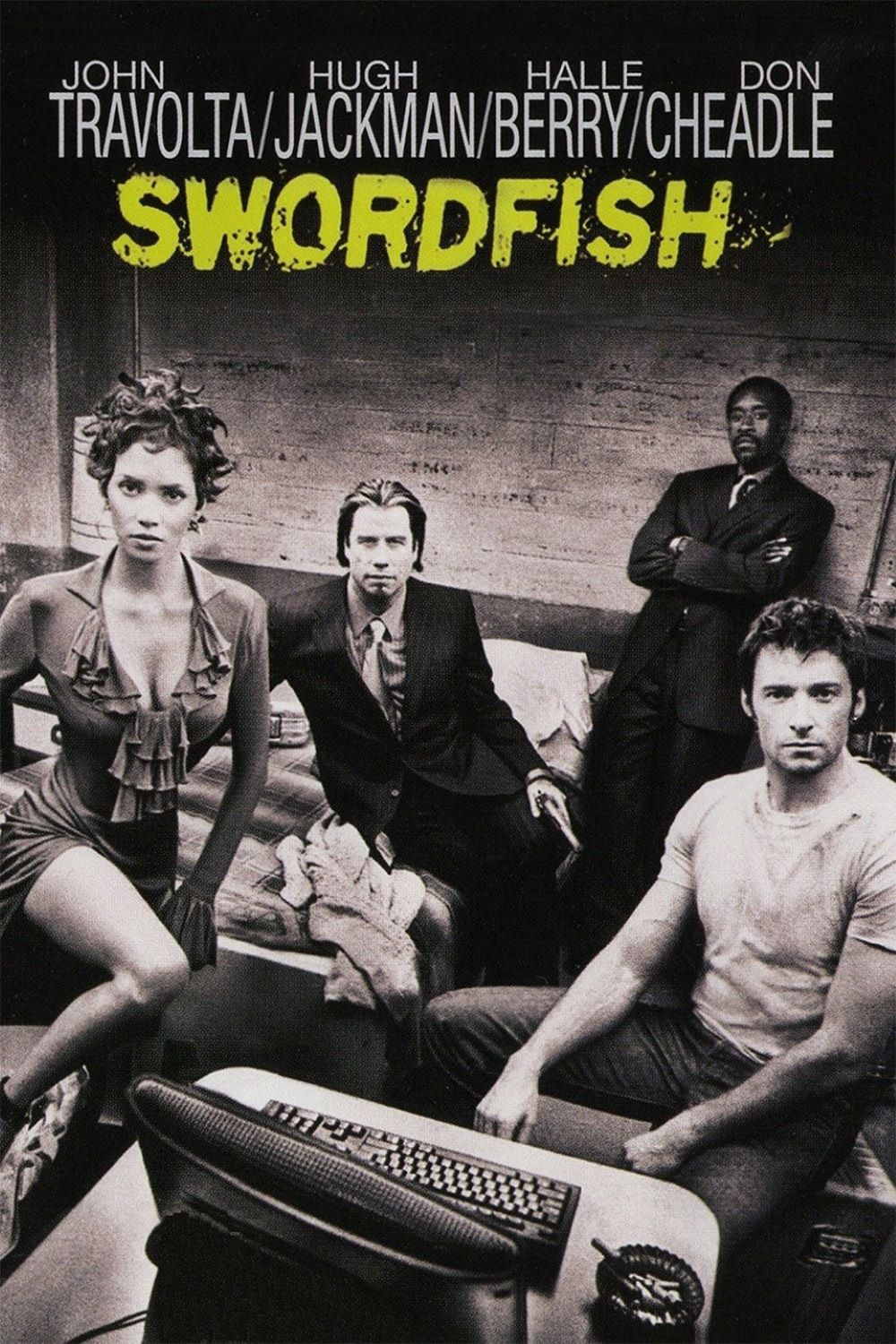
Moreover, Swordfish understands the first rule of summer blockbusters: never let logic get in the way of a good time. The hacking scenes are laughable—Stanley types at lightning speed, bypassing encryption in seconds while 3D grids spin around him like a screensaver from 1998. The action is over-the-top, the explosions are massive, and the body count is ridiculous. But it’s all in service of that visceral, popcorn-munching rush that defines the genre. You don’t watch Swordfish for a coherent narrative; you watch it for the sheer audacity of its existence. It’s a movie that dares to ask, “What if we paid Halle Berry half a million dollars to take her top off, put John Travolta in a bad wig, let Hugh Jackman pretend he understands PHP, made Don Cheadle play the straight man to all this chaos, and opened the whole thing with a pretentious café debate about Dog Day Afternoon?” And the answer, gloriously, is a cult classic that we’ll be arguing about for decades. It’s dumb, it’s dated, and it’s utterly irresistible. Even its theatrical one-sheet—with Travolta, Berry, Jackman and Cheadle sitting—looks less like a movie poster and more like the cover art for an alt-rock band about to drop its angsty sophomore album. So fire up your DVD player, crank the volume, and let the entropy wash over you—because Swordfish is, and always will be, the definitive summer guilty pleasure.
Previous Guilty Pleasures
- Half-Baked
- Save The Last Dance
- Every Rose Has Its Thorns
- The Jeremy Kyle Show
- Invasion USA
- The Golden Child
- Final Destination 2
- Paparazzi
- The Principal
- The Substitute
- Terror In The Family
- Pandorum
- Lambada
- Fear
- Cocktail
- Keep Off The Grass
- Girls, Girls, Girls
- Class
- Tart
- King Kong vs. Godzilla
- Hawk the Slayer
- Battle Beyond the Stars
- Meridian
- Walk of Shame
- From Justin To Kelly
- Project Greenlight
- Sex Decoy: Love Stings
- Swimfan
- On the Line
- Wolfen
- Hail Caesar!
- It’s So Cold In The D
- In the Mix
- Healed By Grace
- Valley of the Dolls
- The Legend of Billie Jean
- Death Wish
- Shipping Wars
- Ghost Whisperer
- Parking Wars
- The Dead Are After Me
- Harper’s Island
- The Resurrection of Gavin Stone
- Paranormal State
- Utopia
- Bar Rescue
- The Powers of Matthew Star
- Spiker
- Heavenly Bodies
- Maid in Manhattan
- Rage and Honor
- Saved By The Bell 3. 21 “No Hope With Dope”
- Happy Gilmore
- Solarbabies
- The Dawn of Correction
- Once You Understand
- The Voyeurs
- Robot Jox
- Teen Wolf
- The Running Man
- Double Dragon
- Backtrack
- Julie and Jack
- Karate Warrior
- Invaders From Mars
- Cloverfield
- Aerobicide
- Blood Harvest
- Shocking Dark
- Face The Truth
- Submerged
- The Canyons
- Days of Thunder
- Van Helsing
- The Night Comes for Us
- Code of Silence
- Captain Ron
- Armageddon
- Kate’s Secret
- Point Break
- The Replacements
- The Shadow
- Meteor
- Last Action Hero
- Attack of the Killer Tomatoes
- The Horror at 37,000 Feet
- The ‘Burbs
- Lifeforce
- Highschool of the Dead
- Ice Station Zebra
- No One Lives
- Brewster’s Millions
- Porky’s
- Revenge of the Nerds
- The Delta Force
- The Hidden
- Roller Boogie
- Raw Deal
- Death Merchant Series
- Ski Patrol
- The Executioner Series
- The Destroyer Series
- Private Teacher
- The Parker Series
- Ramba
- The Troubles of Janice
- Ironwood
- Interspecies Reviewers
- SST — Death Flight
- Undercover Brother
- Out for Justice
- Food Wars!
- Cherry
- Death Race
- The Beast Within
- Girl Series
- Gone in 60 Seconds


Pingback: Lisa Marie’s Week In Review: 6/15/26 — 6/21/26 | Through the Shattered Lens
Pingback: Guilty Pleasure No. 122: 2012 (dir. by Roland Emmerich) | Through the Shattered Lens
Pingback: Guilty Pleasure No. 124: No Escape (dir. by Martin Campbell) | Through the Shattered Lens
Pingback: Guilty Pleasure No. 129: Congo (dir. by Frank Marshall) | Through the Shattered Lens