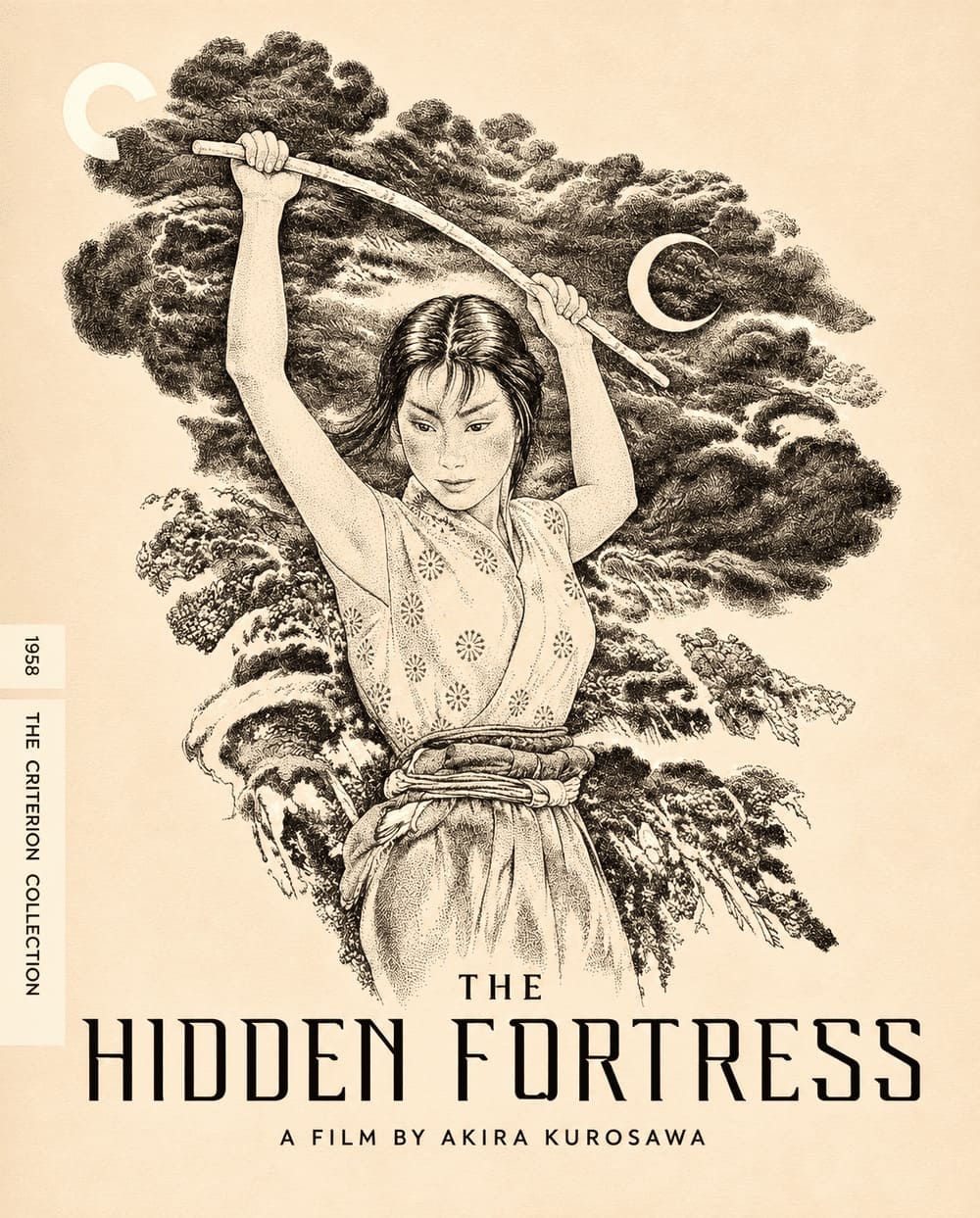
“I’ve seen their beauty and their ugliness with my own eyes.” — Princess Yuki
Nobody in The Hidden Fortress seems especially interested in making a heroic entrance. Its first companions are two filthy, complaining peasants who have wandered into a war hoping to make money and discovered that war is mostly terrible for business. They bicker, separate, reunite, and find fresh reasons to distrust each other. It is a wonderfully undignified way to begin an epic, and it establishes the attitude behind Akira Kurosawa’s 1958 adventure. Before offering noble sacrifice and spectacular combat, he puts us beside people wondering what they might get out of the situation. The grand adventure develops from there, but the dirt and desperation of that opening never entirely wash away.
Those unlikely companions are Tahei and Matashichi, played by Minoru Chiaki and Kamatari Fujiwara. Their fortunes become more complicated when they discover gold and encounter General Rokurota Makabe, played by Toshiro Mifune. Rokurota is escorting Princess Yuki, the heir of a defeated clan, through enemy territory while protecting the treasure needed for her people’s future. The peasants become part of the escape, although their participation involves considerably more intimidation than patriotic enthusiasm. Everyone needs the journey to succeed, but they disagree about what success should look like. Saving a royal dynasty sounds much less appealing to the peasants than leaving with its money.
That clash of priorities keeps the film moving. Rokurota thinks strategically, Yuki carries the responsibilities of her position, and the peasants keep looking for opportunities to improve their circumstances. Kurosawa makes those differences productive. A sensible military decision might seem intolerable to someone who wants a shortcut to wealth. An act of compassion might threaten the secrecy on which everyone’s survival depends. The suspense grows from the difficulty of getting these particular people to cooperate. They are not a ready-made team whose disagreements exist merely to supply amusing dialogue. Their competing interests can have dangerous consequences.
Chiaki and Fujiwara make an entertainingly unpleasant double act. Their suspicious glances, wounded pride, and endless negotiations give the journey a steady comic undertow. They are particularly funny when greed inspires teamwork, only for distrust to destroy it almost immediately. Still, the routine occasionally wears thin. Some arguments continue after the joke has landed, and their whining can become exhausting. That abrasiveness also distinguishes the film. Kurosawa does not reassure us that these men are secretly adorable. They can be cowardly, opportunistic, and mean, with desperation making their behavior understandable without necessarily making it forgivable.
Mifune’s performance is the film’s great stabilizing force. His Rokurota has the authority of someone who has assessed the situation before everybody else has finished panicking. Mifune communicates that confidence through his stance, his watchfulness, and the economical way he moves. He does not need to keep demonstrating the general’s strength because he makes the possibility of action feel constantly present. When that stillness breaks, the effect is tremendous. His physical performance has weight and speed, but also clarity: every movement seems connected to a decision. Intelligence and bodily confidence become parts of the same instinct.
He is also funny without turning Rokurota into a joke. His exchanges with the peasants suggest a capable professional whose work keeps being interrupted by assistants trying to steal the supplies. A glance can communicate an entire exhausted assessment of their behavior. Yet Mifune never makes the character merely a reassuring father figure. Rokurota intimidates and manipulates, and his dedication to duty has a hard edge. Warmth comes through selectively, which makes it persuasive. This is a commanding adventure performance because it preserves the distinction between a charismatic protector and an uncomplicatedly nice man.
Misa Uehara’s Princess Yuki supplies another kind of intensity. Her voice and bearing are imperious, sometimes almost confrontational, and the performance can initially seem rigid. That quality suits someone raised to embody authority rather than blend into ordinary life. What makes Yuki interesting is the pressure the journey places on that upbringing. Outside her protected environment, she encounters suffering that cannot be neatly absorbed into inherited ideas about duty. Her forcefulness does not disappear, but it begins responding to a broader understanding of other people. She becomes more than a royal passenger waiting for delivery.
Kurosawa’s widescreen compositions make those relationships visible. In his first widescreen feature, the expanded frame becomes a way of organizing power, vulnerability, and suspicion. Characters stand above one another, watch from a distance, or occupy separate areas until circumstances force them together. The landscapes are equally purposeful. Rocky slopes and exposed paths determine where the travelers can hide and how quickly they can escape. The scenery is beautiful, but never safely decorative. Moving through it requires effort, keeping the adventure grounded even when the storytelling takes on the simplicity of a fable.
That precision pays off in the action. The mass escape down a huge staircase turns architecture and human movement into a frightening surge. Rokurota’s mounted action has a thrilling physical directness, while his spear duel builds excitement through distance, anticipation, and controlled changes of pace. Kurosawa lets us understand the space before asking us to feel its dangers. The cutting sharpens the action rather than concealing it. The pauses become compelling because we can see what each fighter risks by advancing. It is action built around attention, and Mifune gives it tremendous bodily commitment.
The fire festival opens the film into a different emotional register. Flames, music, and collective movement briefly overwhelm the travelers’ calculations. The sequence serves the escape, but it also becomes something Yuki experiences rather than simply navigates. Its awareness of life’s brevity gives the adventure a reflective undertow without stopping it for a lecture. Moments like this complicate the film’s harsher instincts. Kurosawa recognizes cruelty and selfishness while allowing encounters that loosen the boundaries between people. His generosity feels earned because it emerges from a world that gives everyone reasons to remain guarded.
This was the Kurosawa adventure that would heavily influence a young filmmaker named George Lucas. Tahei and Matashichi helped inspire C-3PO and R2-D2 in Star Wars, particularly the decision to introduce a large conflict through two low-status, squabbling participants. The endangered princess and dangerous journey offer further connections, while Kurosawa’s wipe transitions became part of Lucas’s visual vocabulary. But The Hidden Fortress is harsher in tone and characterization. Its peasants are nastier than the droids, its protector more intimidating, and its humor less inclined to transform desperation into lovable eccentricity. The resemblance makes those differences especially revealing.
The film’s afterlife also includes Shinji Higuchi’s 2008 remake, Hidden Fortress: The Last Princess. Interestingly, that version reflects not only Kurosawa’s original but also the influence of Star Wars, bringing elements of the Hollywood spectacle it helped inspire back into a Japanese adventure. That circular exchange illustrates how film history actually works: stories cross borders, change shape, and return carrying traces of their descendants. Yet the original needs no family tree to justify its appeal. Its rhythms, performances, and uneasy mixture of comedy and cruelty remain distinctive rather than merely historically important.
What finally makes The Hidden Fortress satisfying is that its generosity never requires us to forget its roughness. Loyalty and mercy offer alternatives to the opening’s suspicion, but nobody erases the conditions that made suspicion reasonable. Even the comic characters remain recognizably themselves instead of becoming polished heroes. Mifune gives the journey its commanding center, while the surrounding friction gives it texture. Kurosawa delivers the pleasures of an escape story without sanding down the people making the escape. The result is a muscular, funny, sometimes abrasive adventure whose humanity comes from its willingness to let heroism and foolishness share the same road.
Kurosawa-Mifune Collaborations

