Film Review: Suffragette (dir by Sarah Gavron)


Suffragette_poster

It’s funny (or perhaps not) when you think about it.  I’ve always taken my right to vote (and, in theory at least, have some say over how I’m governed) for granted.  Even before I turned 18 and officially registered, I never had any doubt that, some day, I would be able to vote for President and every other elected office.  (And, even before that, I voted in student council and mock presidential elections.)  Voting is something that I so take for granted that, even when I cast my first official vote in the 2004 Presidential election, it didn’t really mean much to me.  Given the choice between Bush and Kerry, I wrote in the name of Charles Jay, the candidate of the Personal Choice Party.  I knew nothing about Mr. Jay but I had come across his name online and I liked the idea of personal choice and I thought it would make for a funny story to tell all of my friends who were actually taking the election seriously.  (Even back then, I enjoyed annoying people who actually cared.)  Essentially, I threw my vote away and I did it without a second thought.

Of course, what I didn’t understand at that time was that the right to vote was something that many brave women had fought for, gone to prison for, and even died for.  If I had lived before 1920, I would not have had the right to vote and I certainly would not have had the opportunity to so casually toss my vote away.  Women in the U.S. did not win the right to vote until 1920.  But before everyone starts in with the usual “America is so backwards!” crap, consider this.  In Britain, women did not win the right to vote until 1928.  Women could not vote in France until 1944 and Switzerland waited until 1984!  Last year, women in Saudi Arabia voted for the first time.

The struggle of British women to gain equal rights under the law is the subject of the film Suffragette.  Maud Watts (played by Carey Mulligan, my generation’s Audrey Hepburn) is a laundress living in London in 1912.  She spends her day working for little money and for a male boss who, for years, has sexually harassed and abused the women working under him.  Unlike a lot of the women who work at the laundry, Maud has a stable home life.  She is a devoted mother and her husband, Sonny (Ben Whishaw), is supportive.

Or, at least, he seems to be at first.  Things chance once Maud gets involved in the suffragette movement.  It’s not just that her lecherous boss laughs at her for wanting to be treated equally,  That, we expect.  No, what is truly infuriating is to watch how quickly Sonny goes from being a loving husband to a monster, the type who forbids Maud from seeing her own son and then callously puts the boy up for adoption.  Confronted by his wife’s demand to be treated as his equal, Sonny reveals himself to be no better than the casual misogynists that Maud must deal with, on a daily basis, at work.  Raised on a diet of films where men come to their senses and justice (and love) somehow prevails, I kept expecting Sonny to see the error of his ways or for Maud to at least be reunited with her son.  Needless to say, none of that happened.  This is a film that never lets us forget the sacrifice involved in fighting for equal rights.

Instead, having lost everything that previously defined her life, Maud throws herself into the battle for women’s rights.  And, as Suffragette makes clear, that meant a lot more than just winning the right to vote.

It’s an inspiring story and both Carey Mulligan and Helena Bonham-Carter (who plays another suffragette) give powerful performances.  At the same time — and this is something that many critics need to understand and acknowledge — you can love a film for what it has to say while, at the same time, acknowledging that it doesn’t totally work as a piece of cinema.  Suffragette is not a perfect film and reviewing it, I found myself torn between praising the film’s message and criticizing director Sarah Gavron’s frequently uninspired cinematic technique.  (From a strictly cinematic point of view, Suffragette will play better on television than on a big movie screen.)

Perhaps for me, the film’s great weakness was casting Meryl Streep in the role of real-life activist Emmeline Pankhurst.  Ms. Pankhurst was the leader of the Suffragette movement and is an inspiring historical figure.  Unfortunately, as soon as Meryl shows up for her four-minute cameo, it becomes impossible to see her as being anyone other than Meryl Streep, a wealthy white woman who — unlike the real-life Ms. Pankhurst — will never be sent to prison for demanding the right to vote.  When Meryl shows up as Ms. Pankhurst, it takes the viewer out of the historical reality of the film.  You’re no longer watching a group of brave women risking their lives and demanding to be treated equally under the law.  Instead, you’re just watching a Meryl Streep cameo.

Throughout the film, Maud stays in a succession of safe houses and decrepit offices.  She always has a picture of Ms. Pankhurst near her and occasionally, she looks to it for strength and guidance.  However, since the picture of Ms. Pankhurst is really just a picture of Meryl Streep, it again serves to take the viewer out of the film.  Perhaps if Meryl Streep had more screen time, she would be able to get us to think of her as being Ms. Pankhurst but since she’s only onscreen for four minutes, she instead just serves to distract from the film’s message.

(Personally, I would have cast either Emma Thompson and Kristin Scott Thomas in the role of Ms. Pankhurst, two great actresses who would could have portrayed her charisma without being quite as distracting as Meryl Streep.)

As I said earlier, Suffragette is not a perfect film but it does teach an important lesson that needs to be learned, especially by those of us who occasionally take our rights for granted.  It’s a film that reminds us that years ago, brave women fought for everything that we have now and it’s a film that encourages us to keep fighting.  It’s not a perfect film but it’s a film that deserves to be seen.

6 Reviews To Help Lisa Get Caught Up: Ant-Man, Cinderella, Jurassic World, Magic Mike XXL, The Man From UNCLE, Terminator: Genisys


So, it’s that time of year!  2015 is nearly over and soon, it will be time for me to make out my best-of and worst-of lists.  That means that now is the time that I look over all the films that I have watched up to this point, I realize how many of those films I have yet to review ,and I think, “Oh my God, how did I get this far behind?”

So, here are 6 capsule reviews, designed to help me get caught up!

Marvel's Ant-Man

Ant-Man (dir by Peyton Reed)

Ant-Man has already been reviewed twice on this site, once by Leonard Wilson and once by Ryan The Trashfilm Guru.  Leonard liked it.  Ryan did not.  As for me, my reaction was somewhere in between.  I enjoyed Ant-Man, though not as much as I’ve enjoyed some of the previous Marvel films.  Ant-Man was better than the second Thor film but nowhere close to being as good as Captain America: Winter Soldier.

What I did like about Ant-Man were the performances of Paul Rudd, Evangeline Lilly, and Michael Pena.  I even enjoyed Michael Douglas’s performance, which is saying something when you consider the fact that, as of late, Michael Douglas has really been making my skin crawl.  I also thought that the film did a good job creating Ant-Man’s microscopic world, even if I’m still not totally sold on the character as a dynamic hero.  I do wish that the film had a stronger villain.  Corey Stoll is such a good actor and capable of doing so much and it was hard not to regret that he was stuck playing such a generic bad guy.

Cinderella (dir by Kenneth Branagh)

Oh, how I loved Cinderella!  The film, a live-action retelling of the Cinderella story, was a gorgeous fairy tale and a wonderful reminder that a film doesn’t have to be dark and depressing to be good.  (In many ways, Cinderella serves as an antidote to not only Into The Woodsbut countless Tim Burton films as well.)  Lily James is beautiful in the title role, Richard Madden is wonderfully charming as the prince, and Cate Blanchett and Helena Bonham Carter are perfectly cast as the stepmother and the fairy godmother.

Jurassic World (dir by Colin Trevorrow)

Jurassic World was previously reviewed by Ryan the Trashfilm Guru.  I hate to admit it but I was, initially, one of those people who watched Jurassic World and got annoyed because the film was predictable and the script was a bit clunky.  Traditionally (and, if you doubt me, just read my review of Avatar), it bothers me when a film devotes so much time special effects that it can’t seem to be bothered with character development and clever dialogue.

But then I thought about it somewhat and I thought to myself, you know what?  This movie had Chris Pratt and it had some very convincing dinosaurs!  And, especially when it comes to a summer blockbuster, that is sometimes all you need.

(Why I enjoyed Jurassic World while disliking Avatar largely comes down to the difference between Chris Pratt and Sam Worthington.)

Magic Mike XXL (dir by Gregory Jacobs)

Oddly enough, I had the roughly the same reaction to Magic Mike XXL that I had to Jurassic World.  Yes, there are certain things — mostly concerning the film’s script — about which I could nitpick but what’s truly important is that Channing Tatum, Joe Manganiello, and most of the original cast of Magic Mike is back and they’re stripping again.  Magic Mike XXL is a huge (heh heh) crowd pleaser, a film that delivers exactly what it promises.

Though Steven Soderbergh served as cinematographer for Magic Mike XXL, he did not return to serve as director and perhaps that’s why Magic Mike XXL feels like a far less pretentious film than the first Magic Mike.  Out of the original cast, both Matthew McConaughey and Alex Pettyfer both declined to appear in the sequel.  McConaughey is missed, Pettyfer less so.

The Man From UNCLE (dir by Guy Ritchie)

The Man From Uncle is one of the many stylish spy films to be released this year.  Henry Cavill is an American spy, Armie Hammer is a Russian spy, and Hugh Grant is the Englishman who tells them both what to do.  The Man From Uncle was entertaining.  It took place in the 60s, so there was a lot of wonderful retro fashion and the whole movie moved at a nice, breezy pace.  Ultimately — and I’ll be the first to admit that this isn’t exactly fair — The Man From UNCLE suffered because it was released in the same year as Kingsman and Mission Impossible: Rogue Nation.  Man From UNCLE was entertaining but rather generic.  At no point did it reach the lunatic high of Kingsman’s Free Bird sequence.

Terminator: Genisys (dir by Alan Taylor)

You can read Ryan’s review of Terminator: Genisys here.  I have to admit that Terminator: Genisys confused the Hell out of me.  Not being a huge fan of the entire Terminator franchise (though, yes, I do know what Skynet is and I have seen the first two films), I do have to admit that I sometimes felt lost while watching Genisys.

But you know what?  If you just sit back and relax and try not to think about the film too much — if you just accept it as an action film and watch for the stunts and the explosions — Terminator: Genisys is not the disaster that many critics made it out to be.  I mean, let’s just be honest here.  Most critics would die before they gave a good review to any film featuring Arnold Schwarzenegger.  (Just check out all the negativity that greeted the brilliant zombie film, Maggie.)  After all, Schwarzenegger is an outspoken, confident, cheerfully arrogant Republican and most film critics can only relate to the arrogant part.  (And even then, they don’t ever seem to be very cheerful about it…)  Terminator: Genisys is a well-made and perfectly adequate action film, one that works as long as you don’t spend too much time dwelling on it.  It’s cinematic junk food and there’s nothing wrong with that.

terminator-genisys-super-bowl-ad-debuts

Lisa’s Early Oscar Predictions for August!


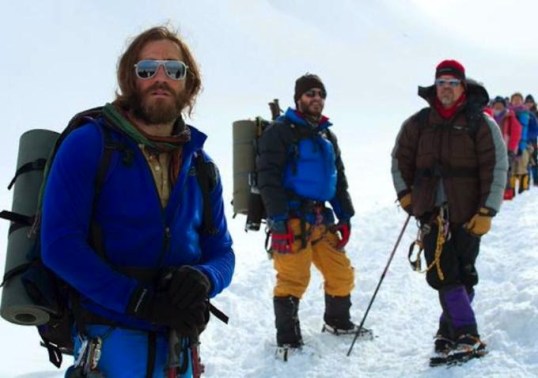
everest-jake-gyllenhaal

Well, here we are.  The year is more than halfway over.  The fall movie season is approaching.  And yet, not a single true Oscar front-runner has yet to emerge.  Could this be the year that a true populist hit, like Mad Max: Fury Road, or an unexpected art house wonder, like Ex Machina, manages to secure a spot?

Well, probably not.  But still, it’s fun to speculate!

(Are Oscar pundits being too quick to dismiss Straight Outta Compton?  I have not seen it yet but look at those reviews and look at that box office.  It’s an interesting question.)

Anyway, here are my prediction for August!  To see how my thinking has evolved over the year, check out my predictions of January, February, March, April, May, June, and July!

Best Picture

Black Mass

Brookyln

Carol

The Danish Girl

Everest

Inside Out

Joy

Sicario

Suffragette

Youth

Best Actor

Michael Caine in Youth

Don Cheadle in Miles Ahead

Johnny Depp in Black Mass

Michael Fassbender in Steve Jobs

Eddie Redmayne in The Danish Girl

Best Actress

Cate Blanchett in Carol

Jennifer Lawrence in Joy

Julianne Moore in Freeheld

Saoirse Ronan in Brooklyn

Lily Tomlin in Grandma

Best Supporting Actor

Robert De Niro in Joy

Benicio Del Toro in Sicario

Tom Hardy in The Revenant

Harvey Keitel in Youth

Kurt Russell in The Hateful Eight

Best Supporting Actress

Helena Bonham Carter in Suffragette

Jennifer Jason Leigh in The Hateful Eight

Rooney Mara in Carol

Ellen Page in Freeheld

Julie Walters in Brooklyn

Best Director

John Cowley for Brooklyn

Todd Haynes for Carol

David O. Russell for Joy

Paolo Sorrentino for Youth

Denis Villenueve for Sicario

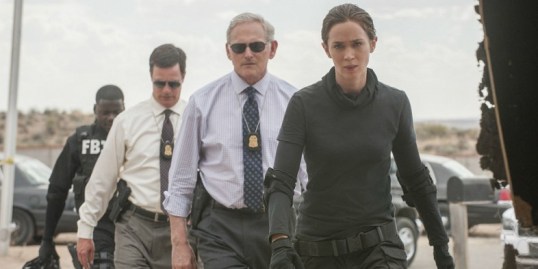
sicario-emily-blunt-trailer

Lisa’s Early Oscar Predictions for July!


Sicario

It’s shaping up to be a strange Oscar race.  Here we are halfway through the year and, yet, there are no front-runners.  Some very acclaimed films have been released this year and yet, few of them seem to be getting the type of buzz that usually accompanies a surprise Oscar nomination.  Last year at this time, there was cautious buzz for Grand Budapest Hotel while almost everyone felt pretty safe assuming that Sundance favorites like Boyhood and Whiplash would be players in the Oscar race and many of us were highly anticipating the release of films like Birdman and The Imitation Game.  (For that matter, a lot of people were also still convinced that Unbroken would win best picture.  The buzz is not always correct but still, the buzz was still there.)

This year, some people are hoping that Mad Max: Fury Road will somehow break through the Academy’s aversion to “genre” filmmaking.  (And seriously, the Doof Warrior deserves some sort of award, don’t you think?)  Quite a few are hoping that Ex Machina will not be forgotten.  Personally, I have high hopes for Inside Out.  The buzz around Bridge of Spies is respectful, largely because it seems like the type of film that usually would be be nominated.  (That said, this film also seems like it could bring out the worst impulses of both Steven Spielberg and Tom Hanks, leading to a movie that will have more in common with The Terminal than with War Horse.)  Carol was beloved at Cannes.

So there are definitely possibilities out there.  When I made my Oscar predictions for this month, I didn’t quite have to blindly guess as much as I did way back in January.  But still, it cannot be denied that — as of right now — this race is wide open and there’s a lot of room for surprise.

Below, you’ll find my Oscar predictions for July.  You can also check out my previous Oscar predictions for January, February, March, April, May, and June!

Best Picture

Black Mass

Brooklyn

Carol

I Saw The Light

In The Heart of the Sea

Inside Out

Sicario

Suffragette

The Walk

Youth

Best Actor

Michael Caine in Youth

Johnny Depp in Black Mass

Michael Fassbender in Steve Jobs

Tom Hiddleston in I Saw The Light

Eddie Redmayne in The Danish Girl

Best Actress

Cate Blanchett in Carol

Marion Cotillard in MacBeth

Sally Field in Hello, My Name Is Doris

Saoirse Ronan in Brooklyn

Lily Tomlin in Grandma

Best Supporting Actor

Albert Brooks in Concussion

John Cusack in Love & Mercy

Benicio Del Toro in Sicario

Harvey Keitel in Youth

Kurt Russell in The Hateful Eight

Best Supporting Actress

Joan Allen in Room

Helena Bonham Carter in Suffragette

Jane Fonda in Youth

Jennifer Jason Leigh in The Hateful Eight

Rooney Mara in Carol

Best Director

John Crowley for Brooklyn

Todd Haynes for Carol

Ron Howard for In The Heart of the Sea

Denis Villenueve for Sicario

Robert Zemeckis for The Walk

tom-hiddleston-hank-3


Embracing the Melodrama Part II #94: The Wings of the Dove (dir by Ian Softley)


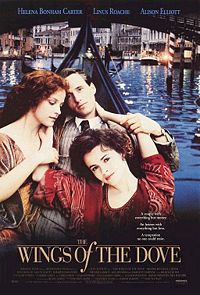
Wings_of_the_dove_ver1For nearly two months now, I’ve been in the process of reviewing 126 cinematic melodramas.  (I know that I originally said that I would be reviewing 126 films in 3 weeks but, even at the time I said that, I think a part of me knew that it would probably be more like 8 or 9 weeks.)  And, while it seems like forever since I started this series by reviewing the 1927 silent classic Sunrise, I’ve still been having fun discovering and rewatching some wonderful films.  It’s been a lot of work but if I’ve inspired anyone to see any of the 93 films that I’ve reviewed so far, then it’s all been worth it.

For our 94th entry, let’s take a quick look at the 1997 film The Wings of the Dove.

Based on a novel by Henry James, The Wings of the Dove open in London.  The year is 1910 and Kate Croy (Helena Bonham Carter) has problems.  Her mother has recently died and her father (Michael Gamon) is a penniless opium addict.  Kate is taken in and supported by her wealthy Aunt Maude (Charlotte Rampling).  Maude has plans for Kate to marry the vapid Lord Mark (Alex Jennings) and demands that Kate have no contact with either her father or any of her old friends.

Among those that Kate is supposed to abandon is a journalist named Merton Densher (Linus Roache).  Kate and Merton are in love but there’s no way that Maude would ever allow them to get married.  Merton is not only poor but he’s a bit of a radical as well.

While visiting with Lord Mark, Kate meets an American heiress named Milly (Alison Elliott).  As open and kind as Kate is cynical and manipulate, Milly is touring Europe.  Milly and Kate quickly become friends and Milly goes as far as to invite Kate to go to Venice with her.  It’s also through her friendship with Kate that Milly first meets Merton.  Attracted to him and unaware of her relationship with Kate, Milly invites him to come to Venice as well.

Kate, meanwhile, has discovered that Milly is terminally ill.  She comes up with a scheme, in which Merton will romance Milly.  Kate is convinced that Milly will then change her will to include Merton.  Once Milly dies, Merton will be rich and then Maude will have no reason to object to him marrying Kate.

At first, Merton is repulsed by the scheme but he finally agrees, specifically so that he can go to Venice with Kate.  However, once they’re all actually in Venice, things start to get complicated.  Merton starts to fall in love with Milly and Kate discovers that she loves Merton more than she originally realized…

The Wing of the Dove is an effective literary adaptation, one that brings a contemporary spin to the material while still remaining truthful to the spirit of the source material.  The costumes and the sets are beautiful to look at and Venice is as wonderfully romantic and cinematic as always.  Linus Roache is a bit of a stiff as Merton (but then again, the same could be said for the character himself) but it doesn’t matter because the film is dominated by Helena Bonham Carter’s ferocious performance in the role of Kate.  She plays Kate as a bundle of nervous energy and barely repressed carnality, an Edwardian femme fatale.  She was rightfully nominated for best actress for her performance in this film.  The award, however, went to Helen Hunt for As Good As It Gets.

(This, along with the complete snubbing of Boogie Nights, would seem to suggest that 1997 was not a banner year as far as the Academy Awards were concerned…)

The Wings of the Dove is currently available to be viewed on Netflix.  Don’t miss it.


Trash Film Guru Vs. The Summer Blockbusters : “The Lone Ranger”


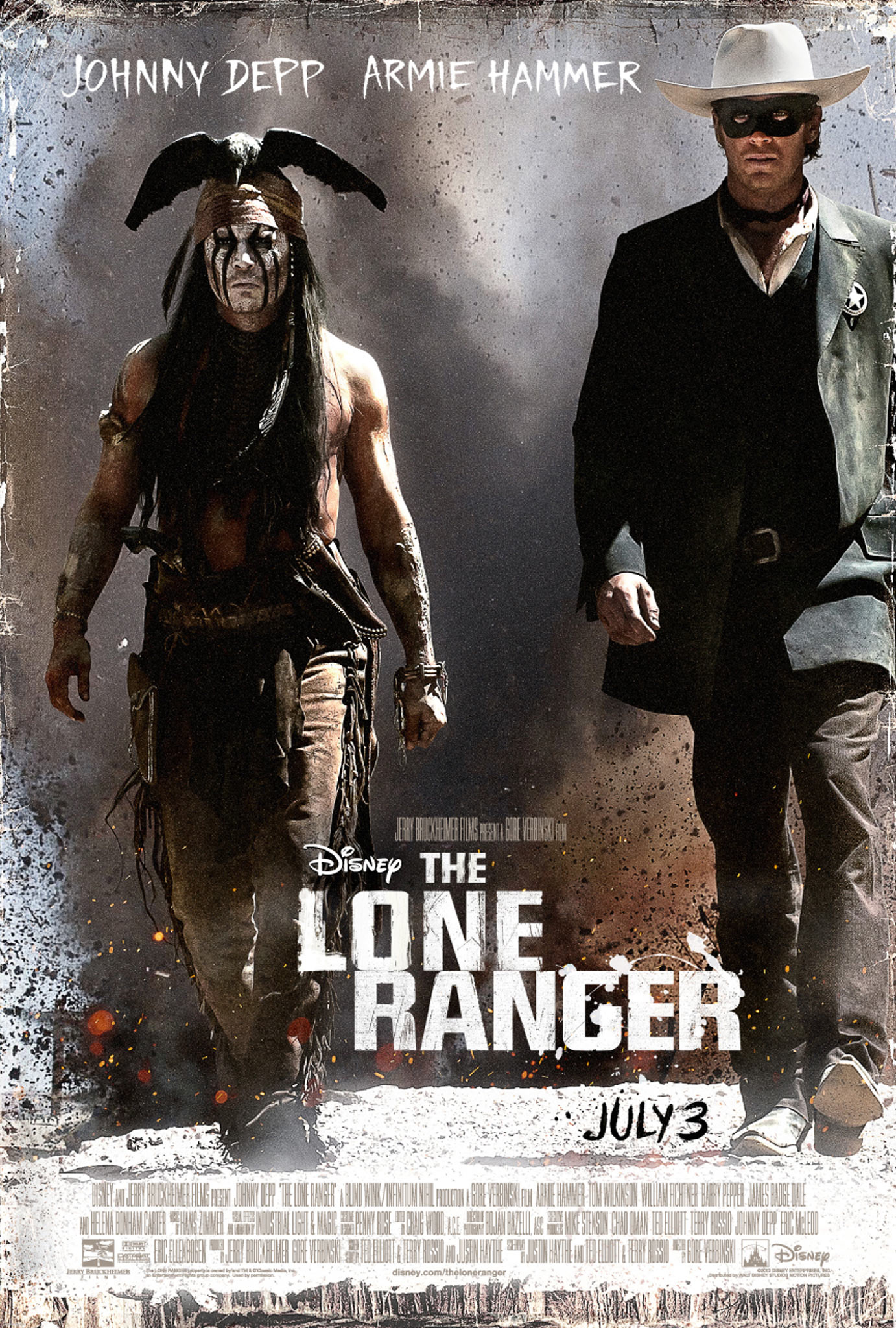
poster1


It all seemed like such a no-brainer, didn’t it?

Disney snaps up the cinematic rights to the most famous Western hero of them all — one that hasn’t been “rebooted” since 1981’s disastrous Legend Of The Lone Ranger — and turns it over, naturally enough, to Jerry Bruckheimer, who “gets the band back together,” so to speak, by hiring Gore Verbinski to direct and Johnny Depp to star as Tonto. Pirates Of The Caribbean Goes West, anyone?

It goes without saying that budget wouldn’t be a concern here — special effects, production values, sets and costumes — all would be state-of-the-state-of-the-art. Turn it loose on the public over the extended July 4th holiday weekend, sit back, and collect all that cold, hard cash. What could possibly go wrong? This was fool-proof.

Except for the fact that, well, it hasn’t been. The Lone Ranger has landed at the box office with a thud — not as big a thud as it did back in ’81, but a thud nonetheless. The critics seem to despise it, and while audiences have been considerably kinder in their appraisal of the film, they haven’t been large enough for Disney to come anywhere close to recouping their considerable investment in this rapidly-unfurling boondoggle.

All of which is kind of a shame because, as with last year’s panned (but considerably more successful at the box office) Men In Black 3, I honestly can’t figure out where all the hate is coming from. Simply put, The Lone Ranger is a damn fun movie, full of exactly the kind of kick-ass, jaw-dropping CGI, solid “out for justice” storytelling, tight, pacy plotting, and charismatic acting that makes for a sure-fire crowd-pleaser. Even if the crowds aren’t proving to be all that big.

Not exactly a “revisionist” take on the legend of John Reid (confidently played by Armie Hammer), a Texas Ranger who, when his life is turned tragically upside-down, dons a mask and adopts a new persona. this flick nevertheless provides a different spin on things by telling the tale from the point of view of an older, wiser, and maybe even somewhat broken-down Tonto (Johnny Depp in, quite honestly, one of the finest performances of his career), who earlier in life threw his lot in with Reid to bring to justice the source of all our hero’s troubles, renegade quasi-militia leader Butch Cavendish (William Fichtner, who makes for a terrific bad guy) and ,more generally, to put a stop to all the various shenanigans this good-for-nothing had a hand in.

If this sounds like your idea of a simple-minded, non-stop thrill ride full of all the excitement, adventure, humor, and yes, even human drama that you want in summertime popcorn fare, rest assured — it is. Good supporting turns from the likes of Helena Bonham Carter, Tom Wilkinson, and Ruth Wilson don’t hurt matters any, either.

Yeah, there are some gaping plot holes large enough for an entire herd of cattle to stampede through, but has that stopped folks from liking, say, World War Z or Man Of Steel, both of which are at least as guilty of counting on you to put your suspension of disbelief completely on hold for a couple of hours? If you can do it for them, surely you can do it for this, right?

Look, I won’t kid you — some small, petty, vengeful little corner of my dark and twisted soul is always happy to see a mega-budget Disney project end up costing the studio untold millions in losses. They’re bastards and they deserve it. But truth be told, if you join the legions of people who have already evidently decided to take a pass on The Lone Ranger, you’re not hurting the evil empire much — they’ve already got Monsters University to more than compensate for any bite this takes from their corporate balance sheet. The only thing you’re really doing by skipping it, then,  is robbing yourself of a good time.

It’s summer! Get out there and have some fun — by sitting on your ass in a cool, air-conditioned mega-plex and catching what’s most likely the best action-adventure film of the year so far.

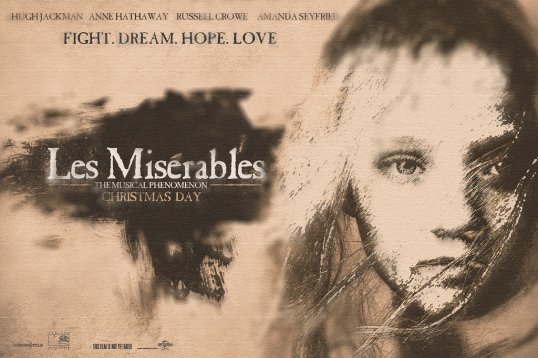
Film Review: Les Miserables (dir. by Tom Hooper)


I was recently talking to one of my fellow film bloggers when the subject of this year’s Oscar nominees came up.  After I told her that I thought that Beasts of the Southern Wild was the worst of this year’s nominees, she rather vigorously shook her head and said, “No film this year was less deserving of a nomination than Les Mis.”

Now, I have to admit that it’s rare that her and I ever agree on anything.  For instance, she thinks that Barack Obama is going to save the world whereas I … well, let’s just say that I don’t.  She watches Glee and I would watch Community if it would ever come back on the air.  However, we do usually agree about films and, in fact, our friendship was initially the result of our shared loathing for Avatar.  So, I was curious why her reaction to Les Miserables was so different from mine.

In her own words, Les Miserables was “bombastic” and over-directed by Tom Hooper.  She complained about Russell Crowe’s singing and she felt that Sacha Baron Cohen appeared to be acting in a totally different film from everyone else.  The term “style over substance” came up more than a few times and she felt that even the things that did work — like Anne Hathaway’s draining performance as Fantine, Samantha Barks’ poignant work as Eponine, and Aaron Tveit’s charismatic performance as Enjorlas — simply served to highlight how uneven the film was when taken as a whole.  Finally — and I think that this is actually the key behind a lot of the online backlash against Les Miserables — she admitted that a part of her reaction was due to the fact that she still resented the fact that Hooper’s previous film, The King’s Speech, defeated The Social Network for Best Picture way back in 2010.

What’s ironic is that I found myself agreeing with a lot of what she was saying.  The fact of the matter is that Hooper does over-direct Les Miserables and the frequent jump cuts do tend to detract from the film’s performances.  It’s not a coincidence that the film’s best performance is given by one of the few performers (Anna Hathaway, of course) who is actually allowed to sing an entire song in close-up without Hooper cutting away to distract us with something else.  And yes, Sacha Baron Cohen does feel out-of-place and yes, Russell Crowe is a bit miscast in the role of Javert.

And yet, despite those not minor complaints, I still loved Les Miserables and I think it’s more than deserving of its nomination for Best Picture of the year.

Les Miserables in an adaptation of the Broadway musical that was itself an adaptation of Victor Hugo’s classic novel.  The plot will be familiar to anyone who has ever taken an English class.  In 19th century France, Jean Valjean (Hugh Jackman) serves 19 years in prison for stealing bread.  When he’s paroled from prison, he adopts a new identity and starts a new life.  Eventually, he becomes a factory owner and a local politician and is known for his kindness and honesty.  When the tragic prostitute Fantine (Anne Hathaway) dies, Valjean adopts her daughter, Cosette.  However, when the obsessive Inspector Javert (Russell Crowe) learns of Valjean’s true identity, Valjean and Cosette are forced to go into hiding.  Many years later, the now grown Cosette (Amanda Seyfried) has fallen in love with the revolutionary Marius (Eddie Redmayne, who gives a performance that is just as good as Hathaway’s much more lauded work). As France descends into revolution, Javert again discovers Valjean, much blood is shed on the streets of Paris, and Sacha Baron Cohen keeps popping up and offering some awkward comedic relief.

Yes, Les Miserables is all about style and yes, it is a bit bombastic but is that necessarily a bad thing?  I loved Les Mis specifically because it was such an old school spectacle.  There have been several very serious, very sober-minded adaptations of Les Miserables and most of them, especially the nearly 5 hour French version from 1934, deserve to be seen.  Both the Broadway musical and Hooper’s adaptation play up the story’s inherent melodrama and the resulting show is one that is designed to get more of an emotional response than an intellectual one.  Tom Hooper’s Les Miserables is a film that has specifically been made for those of us who aren’t ashamed to shed a few tears at the movies.  When I walked out of the theater after watching Les Miserables, I had mascara everywhere and I can’t think of a higher compliment to pay this uneven but ultimately triumphant film.

Trailer: Les Misérables (International)


With all my attention on horror-theme last October I had forgotten that the latest trailer for this holiday season’ upcoming feature-length film adaptation of the musical Les Misérables has already come out.

The film will be directed by Academy Award-winning director Tom Hooper (fresh off his win for The King’s Speech) he leads a star-studded ensemble cast in putting on the big screen the much-beloved musical that dominated the 80’s and most of the 90’s. I don’t know any kid growing up during that decade who didn’t get dragged to see the musical in the big cities it entrenched itself in. Instead of hating the experience most kids ended up loving the musical. I know that I was one such highschooler who ended up loving it and musicals in general.

This international trailer shows more of the story compared to the teaser which arrived 5 months earlier. We get to see snippets of Crowe singing as Javert and Seyfried as Cosette. Whilethe West End and Broadway productions have come to an end or at the very least not as popular as they used to be) hopefully this film adaptation will introduce this classic to a new generation of kids. Show them that there’s more to music than the pop hits that dominates the radio waves and internet radio sites.

Les Misérables is set for a December 25, 2012 release date.

Image Source: JWoodhams Deviantart

Film Review: Harry Potter and the Deathly Hallows — Part 2 (dir. by David Yates)


Well, we all knew it would have to end someday and now, it’s over.  The Harry Potter film series, which began way back in 2001, is concluding right now in a theater near you.  On Friday night, me, Jeff, my sister Erin, and our friend Evelyn went down to the AMC Valley View and we saw Harry Potter and the Deathly Hallows, Part 2. 

The cinematic story of Harry Potter is over and yes, I did cry as I watched it end.  I didn’t just cry because of the movie, though the movie itself is one of the best of the year and it has one of those wonderful endings that just makes it impossible to remain dry-eyed.  No, I cried because — with this film — an era of my life is truly over.  

When the first Harry Potter film came out, I was only 16 and still trying to deal with the fact that I had been diagnosed as being bipolar just a few weeks earlier.  I felt alone and broken and destined to spend the rest of my life on the outside looking in.  The three hours that I spent watching Harry Potter and the Sorcerer’s Stone were three hours when I didn’t have to worry about suddenly bursting into tears and having everyone around me worrying about whether or not I was actually taking my hated medication.  For three hours, I could escape to another world where those who were different were celebrated precisely because they were different.  For three hours, I could imagine that just maybe I had a special purpose for existing too and maybe I had benevolent wizards and witches looking out for me too.  And I’m sorry if all that sounds trite in retrospect but, when you’re 16 and you think you’re too damaged to love, anything that gives you hope and pleasure in the present is a precious treasure.

Over the years, I eventually came to realize that being bipolar was hardly a curse and, as I matured and grew up and discovered new things, there was always a Harry Potter film either playing or about to come out.  Whether I was escaping high school, graduating college, or dealing with just every good or bad thing that makes up life, Harry Potter — this character who I first met (in book form) when I was 13 — was always there.  So, at the risk of sounding overdramatic, the end of Harry Potter is the end of a chapter of my life.

One final personal note: As I watched Harry Potter and the Deathly Hallows, Part Two, I had three dolls (or action figures, as boys insist on calling them) in my purse.  These dolls — Harry, Hermione, and Ron — came out around the same time as the second Harry Potter film and my mom (who collected dolls) ordered them off of Ebay three years ago, shortly before she entered the hospital for the final time.  Now, my mom was not a huge fan of the Harry Potter series but she knew that I loved it and that’s why she made those dolls her final gift to me.

And those are some of the reasons why I found myself crying as I watched the finale of Harry Potter.  However, there’s another reason why I cried and that’s that this is just a great film and the perfect conclusion to the series.

Essentially, Harry Potter and the Deathly Hallows, Part Two starts up immediately after the conclusion of Part One.  Dobby is dead, Lord Voldemort (a wonderfully neurotic Ralph Fiennes) and the Death Eaters are intent on destroying everything, and Severus Snape (Alan Rickman, wonderful as always) is in charge of Hogwarts.  After spending the first part of Deathly Hallows as fugitives, Harry Potter, Ron Weasley, and Hermione Granger (Daniel Radcliffe, Rupert Grint, and Emma Watson) return to Hogwarts to take a final stand against Voldemort.  Things end in a surprisingly bloody battle (this film is not for children) that leaves several characters dead and ultimately reveals that one wizard wasn’t the saint we always assumed he was while another is revealed to be the secret hero of the entire series.

Let’s get one question out of the way right now: will non-Harry Potter fans be able to follow this film?  Uhmmm…no.  Sorry.  Then again, why would a non-Harry Potter fan be at a film called Harry Potter and The Deathly Hallows Part Two anyway?  I mean, seriously, if you’re just going to film because everyone else is doing it than who are you to bitch anyway?  This is what you non-Harry Potter fans need to do.  Stop reading this review.  Go watch the previous Harry Potter films.  Watch them in order.  Take your time because Deathly Hallows is going to be in theaters for a while.  And then, once you’ve become immersed in the story, go see how it all concludes.  And then come back here and read rest of this review.

Okay, so is everybody up to date?

Cool.

One of the more interesting features of the Harry Potter series is that so many different directors (each with his own definite, individual style) have been involved in bringing these films to the screen.  Among Harry Potter fans, hours can literally be spent debating the merits (and weaknesses) of Chris Columbus, Alfonso Cuaron, Mike Newell, and David Yates.  My own theory is that each director was perfectly suited for each film he directed.  The audience-friendly vision of Chris Columbus was what the first two films needed, just as Prisoner of Azkaban needed Cuaron’s far darker vision and Mike Newell’s attention to character made Goblet of Fire one of the best of the Harry Potter films.  And while David Yates may not be as well-known (or critically acclaimed) as Newell or Cuaron, he brings exactly the right tone to Harry Potter and the Deathly Hallows, a perfect combination of spectacle and humanity.  It is to Yates’ credit that the scenes in which the characters simply talk to each other are just as compelling as the dramatic sequences where Voldemort and the Death Eaters attack Hogwarts.  Yates understands that this material could easily come across as silly or childish and to his credit, he never allows the audience to simply dismiss this film as a lot of blathering about wands and CGI magic.  As opposed to other directors who have given us summer blockbusters, Yates takes his film seriously.

And, fortunately, so does his cast.

One of the great pleasures of the Harry Potter series is that it’s given American audiences the chance to discover (and rediscover) some of the great British character actors and a lot of them show up (some for only a matter of minutes) here in the finale.  Maggie Smith, Jim Broadbent, Julie Walters, Robbie Coltrane, Gary Oldman, John Hurt, David Thewlis, Emma Thompson, and Jason Isaacs all put in appearances.  Kelly MacDonald has a great scene playing a ghost, Helena Bonham Carter is perfect as the evil Bellatrix Lestrange, and Alan Rickman is brilliantly ambiguous as Severus Snape.  (And yes, Snape’s actions are explained in this film and yes, I did cry.)

Ralph Fiennes plays so many villains that I now find myself expecting him to show up killing people in every movie I see.  He’s like a British Christopher Walken.  Still, it’s easy to take an actor like Fiennes for granted.  For the entire Harry Potter series to work, Lord Voldemort can’t just be an ordinary villain.  He’s got to be the sum total of all things evil and deadly.  You’ve got to believe that people would be scared to speak his name.  Great heroes need a great villain and Fiennes’ Voldermort is a great villain.

Ultimately, however, the true credit for the success of the Harry Potter series belongs to three actors who have literally grown up on the movie screen — Daniel Radcliffe, Rupert Grint, and Emma Watson.  The producers are fortunate indeed that the cute kids that they cast over a decade ago have all grown up to be talented, attractive, and likable actors.  If the first part of Harry Potter and the Deathly Hallows seemed to showcase both Grint and Watson (almost to Radcliffe’s expense), part 2 is most definitely centered on Harry Potter.  That doesn’t mean that Watson and Grint aren’t good in this film.  They are and they get to share one of the best movie kisses of 2011.  (As well, for those who keep count, Grint says “Bloody Hell,” three times in the film.)  But, for obvious reasons, this film is all about Harry and Radcliffe’s performance as Harry.  It’s a challenge for Radcliffe and it’s a challenge that he more than succeeds at conquering.  As the film ended, I realized that I was sad to know that the adventures of Harry Potter were done but I was excited to see what the future will hold for Radcliffe, Grint, and Watson. 

Incidentally, Harry Potter and the Deathly Hallows Part 2 has been released in both 3-D and 2-D.  We saw the 3-D version and if you have any knowledge of how I feel about 3-D (and how motion sick I tend to get while watching 3-D films) then that should show you just much I love the Harry Potter series.  I loved it so much that I was even willing to overlook my hatred of 3-D.  The 3-D here (which was added after the film has already been filmed) doesn’t really add much to the movie.  There were a few cool moments where I was all like, “Look, I can reach out and grab a piece of Voldemort,” but otherwise, the 3-D was a negligible factor as far as the overall film was concerned.

Still, there was one interesting thing about the 3-D.  The theater we saw the movie in was half-way empty.  At the same time, the neighboring theater — in which the 2-D version was playing — had a line of people waiting to get in.  They were not only waiting to see the 2-D version, they were waiting to see a showing that wouldn’t even begin until a full 90 minutes after the 3-D version started.  I mention this because, in the wake of Avatar, so many people have taken it for granted that 3-D is the future of movies and soon, as long as a film is in 3-D, we won’t have to worry about the difficult stuff like an interesting plot or compelling characters.  However, 3-D has become an overexposed gimmick.  For every film like Cave of Dreams that uses 3-D to craft an actual artistic statement, there’s a 1,000 films like Priest which use 3-D just because it’s an easy way to trick sucks into spending an extra dollars to see a crappy film. 

What so many filmmakers seem to forget is that the majority of film goers are not looking for 3-D.  We’re just looking for a good film.  And sometimes — like with Harry Potter and the Deathly Hallows — we get lucky and we find a great film.

(Oh, and one last thing: I know everyone always expects me to claim to be just like Hermione but actually, I’ve always related more to Ginny Weasley.  Like her, I’m the youngest of four siblings, I’ve got red hair, and I always get my man, in the end.)

Lisa And The Academy Agree To Disagree


The Oscar nominations were announced today and, for the most part, it’s pretty much what you would expect.  Below is the list of nominees.  If a nominee listed in bold print, that means they also appeared on my own personal list of nominations.

Best motion picture of the year

Black Swan
The Fighter
Inception
The Kids Are All Right
The King’s Speech
127 Hours
The Social Network
Toy Story 3
True Grit
Winter’s Bone

(The Academy and I agree on five of the ten nominees.  That’s actually more than I was expecting.)

Performance by an actor in a leading role

Javier Bardem (Biutiful)
Jeff Bridges (True Grit)
Jesse Eisenberg (The Social Network)
Colin Firth (The King’s Speech)
James Franco (127 Hours)

(The only real surprise here is Bardem.  I haven’t seen Biutiful but I’ve heard amazing things about it.)

Performance by an actor in a supporting role

Christian Bale (The Fighter)
John Hawkes (Winter’s Bone)
Jeremy Renner (The Town)
Mark Ruffalo (The Kids Are All Right)
Geoffrey Rush (The King’s Speech)

(Yay for John Hawkes!  Some people are surprised that Andrew Garfield wasn’t nominated for The Social Network.  I’m disappointed he wasn’t nominated for Never Let Me Go.)

Performance by an actress in a leading role

Annette Bening (The Kids Are All Right)
Nicole Kidman (Rabbit Hole)
Jennifer Lawrence (Winter’s Bone)
Natalie Portman (Black Swan)
Michelle Williams (Blue Valentine)

(I’m happy to see Lawrence and Portman recognized but I still so wish that the Academy had recongized Noomi Rapace and Katie Jarvis as well.  I knew it wouldn’t happen but still…)

Performance by an actress in a supporting role

Amy Adams (The Fighter)
Helena Bonham Carter (The King’s Speech)
Melissa Leo (The Fighter)
Hailee Steinfeld (True Grit)
Jacki Weaver (Animal Kingdom)

(Weaver — Yay!) 

Achievement in directing

Darren Aronofsky (Black Swan)
David O Russell (The Fighter)
Tom Hooper (The King’s Speech)
David Fincher (The Social Network)
Joel Coen and Ethan Coen (True Grit)

(The snubbing of Christopher Nolan for Inception is probably the closest thing to an outrage that the Oscars will produce this year.)

Adapted screenplay

127 Hours – Danny Boyle & Simon Beaufoy
The Social Network – Aaron Sorkin
Toy Story 3 – Michael Arndt (screenplay); John Lasseter, Andrew Stanton and Lee Unkrich (story)
True Grit – Joel Coen and Ethan Coen
Winter’s Bone – Debra Granik & Anne Rosellini

Original screenplay

Another Year – Mike Leigh
The Fighter – Scott Silver, Paul Tamasy and Eric Johnson (screenplay); Keith Dorrington, Paul Tamasy and Eric Johnson (story)
Inception – Christopher Nolan
The Kids Are All Right – Lisa Cholodenko and Stuart Blumberg
The King’s Speech – David Seidler

Best animated feature film of the year

How to Train Your Dragon
The Illusionist
Toy Story 3

 (I haven’t seen The Illusionist yet but I’m looking forward to it because the previews look great, it’s based on a script by Jacques Tati, and I love all things French.  Still, I kinda wish that Despicable Me had been nominated just so Arleigh could see the minions at the Academy Awards.)

Best foreign language film of the year

Biutiful (Mexico)
Dogtooth (Greece)
In a Better World (Denmark)
Incendies (Canada)
Outside the Law (Hors-la-loi) (Algeria)

Art direction

Alice in Wonderland – Robert Stromberg (production design), Karen O’Hara (set decoration)
Harry Potter and the Deathly Hallows Part 1 – Stuart Craig (production design), Stephenie McMillan (set decoration)
Inception – Guy Hendrix Dyas (production design), Larry Dias and Doug Mowat (set decoration)
The King’s Speech – Eve Stewart (production design), Judy Farr (set decoration)
True Grit – Jess Gonchor (production design), Nancy Haigh (set decoration) 

Achievement in cinematography

Matthew Libatique (Black Swan)
Wally Pfister (Inception)
Danny Cohen (The King’s Speech)
Jeff Cronenweth (The Social Network)
Roger Deakins (True Grit) 

Achievement in costume design

Colleen Atwood (Alice in Wonderland)
Antonella Cannarozzi (I Am Love)
Jenny Beavan (The King’s Speech)
Sandy Powell (The Tempest)
Mary Zophres (True Grit)

(That’s right, I ended up going 0 for 5 as far as Costume Design is concerned.  Which I guess goes to prove that I have better taste than the Academy.)

Best documentary feature

Exit Through the Gift Shop (Banksy and Jaimie D’Cruz)
Gasland (Josh Fox and Trish Adlesic)
Inside Job (Charles Ferguson and Audrey Marrs)
Restrepo (Tim Hetherington and Sebastian Junger)
Waste Land (Lucy Walker and Angus Aynsley)

 (If Banksy wins, I’ll be happy.  I have a feeling the award will go to Inside Job, however.  As a documentary, Inside Job reminded me a lot of Capt. Hindsight from the South Park Coon Vs. Coon And Friends trilogy.  Also, I’m a little bit surprised that Waiting for Superman wasn’t nominated.  I’m even more surprised that I actually saw enough feature documentaries last year to even have an opinion.  Also, interesting to note that Restrepo — a very nonpolitical look at military in the mid-east — was nominated while The Tillman Story, a much more heavy-handed and stridently political documentary was not.)

Best documentary short subject

Killing in the Name (Nominees to be determined)
Poster Girl (Nominees to be determined)
Strangers No More (Karen Goodman and Kirk Simon)
Sun Come Up (Jennifer Redfearn and Tim Metzger)
The Warriors of Qiugang (Ruby Yang and Thomas Lennon)

(It’s always interesting that nobody knows what these movies are about yet their producers always end up giving the longest speeches at the Oscars.  I’m hoping that Poster Girl wins because the actual producers have yet to be determined.  I imagine that means there might be some sort of legal action going on which means that, if it wins on Oscar night, there might be a big fight at the podium.  Plus, I like the title.  It makes me want to walk up to people I barely know, lean forward, and go, “Can I be your poster girl?”)

Achievement in film editing

Andrew Weisblum (Black Swan)
Pamela Martin (The Fighter)
Tariq Anwar (The King’s Speech)
Jon Harris (127 Hours)
Angus Wall and Kirk Baxter (The Social Network) 

Achievement in makeup

Adrien Morot (Barney’s Version)
Edouard F Henriques, Gregory Funk and Yolanda Toussieng (The Way Back)
Rick Baker and Dave Elsey (The Wolfman)

Achievement in music written for motion pictures (original score)

John Powell (How to Train Your Dragon)
Hans Zimmer (Inception)
Alexandre Desplat (The King’s Speech)
AR Rahman (127 Hours)
Trent Reznor and Atticus Ross (The Social Network)

Achievement in music written for motion pictures (original song)

Coming Home (from Country Strong, music and lyrics by Tom Douglas, Troy Verges and Hillary Lindsey)
I See the Light (from Tangled, music by Alan Menken, lyrics by Glenn Slater)
If I Rise (from 127 Hours, music by AR Rahman, lyrics by Dido and Rollo Armstrong)
We Belong Together (from Toy Story 3, music and lyrics by Randy Newman)

(I’ll just say it now — 4 nominations and I didn’t agree with a single one of them.  Seriously, they could have nominated up to 5 songs but instead of giving at least one nomination to Burlesque, they just nominated 4 songs.  What a load of crap.)

Best animated short film

Day & Night (Teddy Newton)
The Gruffalo (Jakob Schuh and Max Lang)
Let’s Pollute (Geefwee Boedoe)
The Lost Thing (Nick Batzias, Shaun Tan and Andrew Ruhemann)
Madagascar, carnet de voyage (Madagascar, a Journey Diary) (Bastien Dubois)

(I’ve actually seen Day & Night since it was shown before Toy Story 3.  I thought it went on a little bit too long, to be honest.)

Best live action short film

The Confession (Tanel Toom)
The Crush (Michael Creagh)
God of Love (Luke Matheny)
Na Wewe (Ivan Goldschmidt)
Wish 143 (Ian Barnes and Samantha Waite) 

Achievement in sound editing

Inception (Richard King)
Toy Story 3 (Tom Myers and Michael Silvers)
Tron: Legacy (Gwendolyn Yates Whittle and Addison Teague)
True Grit (Skip Lievsay and Craig Berkey)
Unstoppable (Mark P Stoeckinger)

Achievement in sound mixing

Inception (Lora Hirschberg, Gary A Rizzo and Ed Novick)
The King’s Speech (Paul Hamblin, Martin Jensen and John Midgley)
Salt (Jeffrey J Haboush, Greg P Russell, Scott Millan and William Sarokin)
The Social Network (Ren Klyce, David Parker, Michael Semanick and Mark Weingarten)
True Grit (Skip Lievsay, Craig Berkey, Greg Orloff and Peter F Kurland)

 (I would have probably had more matches in the sound category if I actually knew the difference between sound editing and sound mixing.)

Achievement in visual effects

Alice in Wonderland (Ken Ralston, David Schaub, Carey Villegas and Sean Phillips)
Harry Potter and the Deathly Hallows Part 1 (Tim Burke, John Richardson, Christian Manz and Nicolas Aithadi)
Hereafter (Michael Owens, Bryan Grill, Stephan Trojanski and Joe Farrell)
Inception (Paul Franklin, Chris Corbould, Andrew Lockley and Peter Bebb)
Iron Man 2 (Janek Sirrs, Ben Snow, Ged Wright and Daniel Sudick)

So there you go.  I went 50/50 on the Best Picture nominations and — well, it all pretty much went downhill from there, didn’t it?  Oh well.