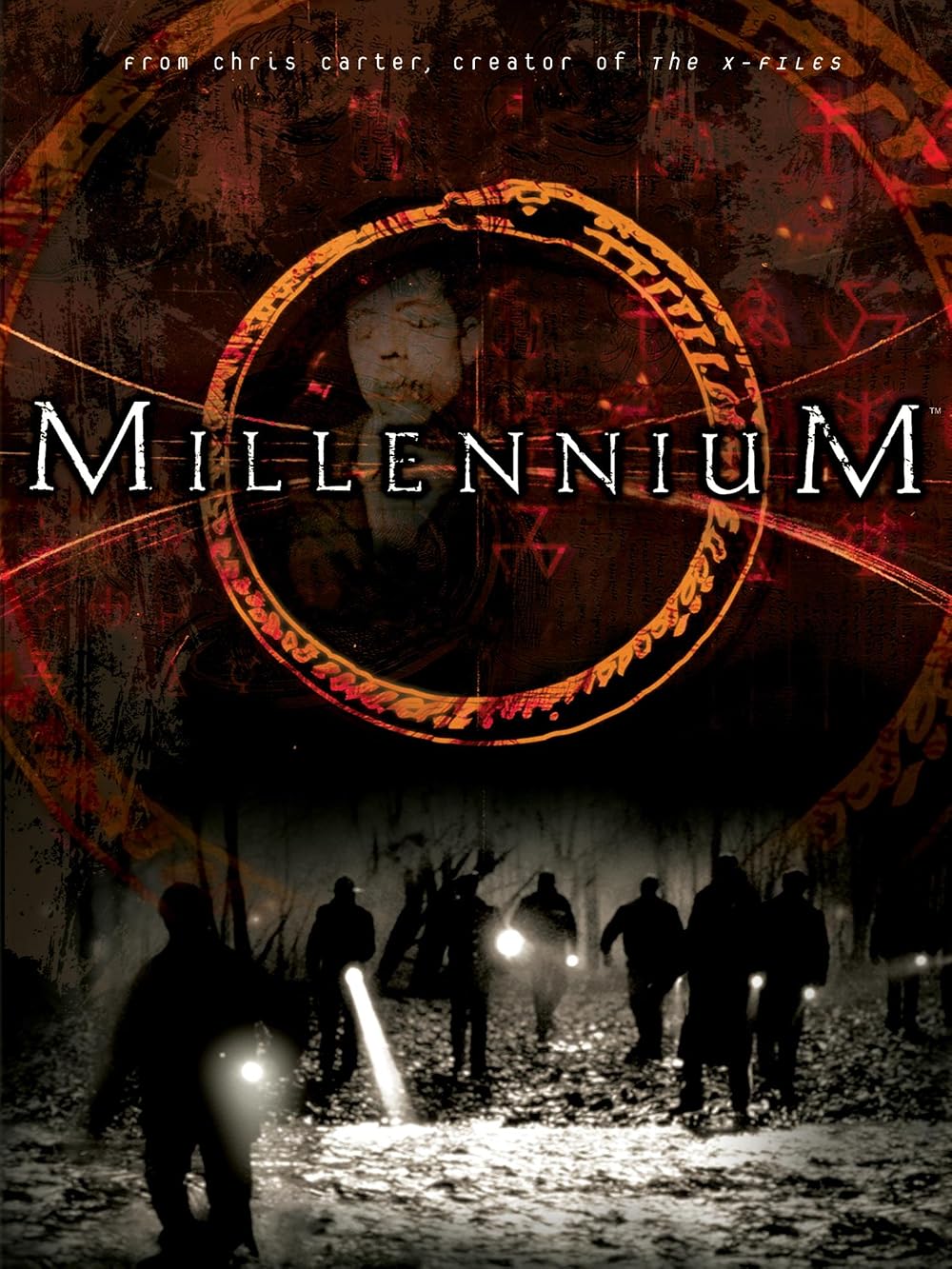
“If I see in the darkness it’s because there is light.” — Frank Black
The most unsettling thing about Millennium is how rarely catching the killer feels like a victory. Someone may be stopped, a case may be closed, but the damage remains—and another investigation is already waiting. Created by Chris Carter, who also created The X-Files, the series takes a familiar crime-show structure and drains away much of its reassurance. Its real subject is the strain of repeatedly confronting the worst people can do without accepting that cruelty defines everyone. That makes it a difficult show to spend time with, but also a more humane one than its grim reputation suggests.
Much of that humanity comes from Lance Henriksen as Frank Black, a former FBI profiler whose insight into violent minds borders on the supernatural. The show renders his understanding through sudden flashes of disturbing imagery, making each breakthrough feel like an intrusion rather than an achievement. Henriksen plays Frank with restraint, suggesting exhaustion without reducing him to a permanently tortured expression. His measured voice and weathered features carry authority, but the gentleness underneath matters more. Frank is compelling because he understands terrible people without treating everyone else as a potential monster.
The first season establishes that distinction through its story-of-the-week format. Working with the Millennium Group, initially presented as a network of experienced investigative specialists, Frank encounters crimes driven by obsession, resentment, and distorted belief. The investigations offer procedural momentum, but the show cares as much about the emotional aftermath as the solution. An arrest cannot undo what happened or remove the images lodged in Frank’s head. That approach produces powerful television, although it can become repetitive when another grotesque crime seems designed merely to confirm that the world is a terrible place.
What gives those cases a larger purpose is the suggestion that they are symptoms of something spreading. Religious imagery, social alienation, and anxiety about the approaching millennium connect seemingly separate acts of violence. Again and again, people turn private grievances into fantasies of judgment or purification. Long before the Group’s secrets dominate the narrative, the weekly stories establish the mythology’s central concerns: who claims to recognize evil, what authority that recognition grants them, and how easily conviction becomes an excuse for cruelty. The serialized story is strongest when it develops those questions rather than simply adding more secrets.
Frank’s home life provides the necessary counterweight. Catherine and Jordan are not just vulnerable loved ones waiting to motivate the next investigation. They represent a life that requires his attention and emotional availability, things his work steadily consumes. His determination to protect them can make him distant, and his awareness of danger does not necessarily help him recognize what they need. Henriksen’s warmth gives these scenes their weight. The show may surround Frank with reasons to despair, but it also gives him tangible reasons not to. Without that balance, the darkness would become empty provocation.
Season two, guided by Glen Morgan and James Wong, makes the relationship between the cases and the mythology more ambitious. The Millennium Group stops being a dependable source of professional support and becomes an organization whose beliefs, divisions, and hidden intentions require investigation themselves. Frank now has to question not only the evidence but the people directing his attention toward it. That shift makes the weekly stories more unstable in an interesting way. A case can reveal something about a criminal while also exposing the priorities of an institution that may be manipulating Frank’s understanding.
This is where Millennium becomes most adventurous—and occasionally most frustrating. Religious conspiracy and apocalyptic horror give the second season momentum, while black humor and unusual detours loosen its oppressive atmosphere. But expanding the mythology does not always clarify what is at stake. Sometimes the show mistakes cryptic information for depth, allowing uncertainty to become muddle. What keeps the escalation meaningful is its connection to Frank’s family and fragile sense of purpose. The threat of catastrophe works because it might destroy something the series has taught us to value, not simply because the mythology announces another approaching disaster.
The third season struggles to maintain that connection. Frank’s return to the FBI and partnership with Emma Hollis restore a clearer investigative framework, while his opposition to the Group preserves the serialized conflict. There are worthwhile tensions between institutional loyalty and personal experience, but the procedural and conspiracy elements do not always reinforce each other. Across three seasons, the series repeatedly changes its approach, creating both memorable experiments and visible seams. Its willingness to evolve deserves credit, though the larger narrative never feels entirely under control.
That instability was one obstacle to broader success; the sustained bleakness was another. The X-Files could be frightening, but humor, adventure, and Mulder and Scully’s chemistry made its darkness easier to revisit. Millenniumventured further into territory its sibling series generally stopped short of inhabiting for long. It lingered over cruelty and its consequences, often refusing the escape hatch of a joke or an exhilarating discovery. That uncompromising approach probably contributed to its demise. What distinguished it creatively also made it harder to turn into a pop-cultural phenomenon: audiences were not always eager to return to such an emotionally punishing world.
Seen now, however, that commercial disappointment looks less like proof of a dead end than evidence of an early arrival. Criminal Minds, Dexter, Hannibal, and Mindhunter would explore related territory through murderous psychology, damaged investigators, and the uncomfortable intimacy between hunters and their targets. Those shows have their own creative roots, so direct influence should not be assumed, but Millennium helped sketch the possibilities of psychologically punishing crime television. It also challenged the idea that television horror needed sanitizing, anticipating a landscape where American Horror Story and The Walking Dead could flourish in the 2010s. Its once-alienating qualities became increasingly acceptable television fare.
Millennium deserves appreciation without having its shortcomings explained away. Its mythology can wander, its solemnity can wear thin, and its darkness sometimes overwhelms the people meant to give it meaning. Yet the weekly investigations, the Group’s grand designs, and Frank’s threatened family all return to a struggle worth watching: how to remain compassionate when fear keeps offering easier alternatives. Like Icarus, the series soared too high and burned before it could be fully appreciated. But its lasting achievement is quieter than its apocalyptic ambitions. It made one exhausted man’s refusal to stop caring feel as consequential as the end of the world.
Previous Icarus Files:
- Cloud Atlas
- Maximum Overdrive
- Glass
- Captive State
- Mother!
- The Man Who Killed Don Quixote
- Last Days
- Plan 9 From Outer Space
- The Last Movie
- 88
- The Bonfire of the Vanities
- Birdemic
- Birdemic 2: The Resurrection
- Last Exit To Brooklyn
- Glen or Glenda
- The Assassination of Trotsky
- Che!
- Brewster McCloud
- American Traitor: The Trial of Axis Sally
- Tough Guys Don’t Dance
- Reach Me
- Revolution
- The Last Tycoon
- Express to Terror
- 1941
- The Teheran Incident
- Con Man
- Looker
- 1776
- Here
- The Adventures of Brisco County, Jr.
- The Cable Guy
- A Chorus Line
- Carrie

