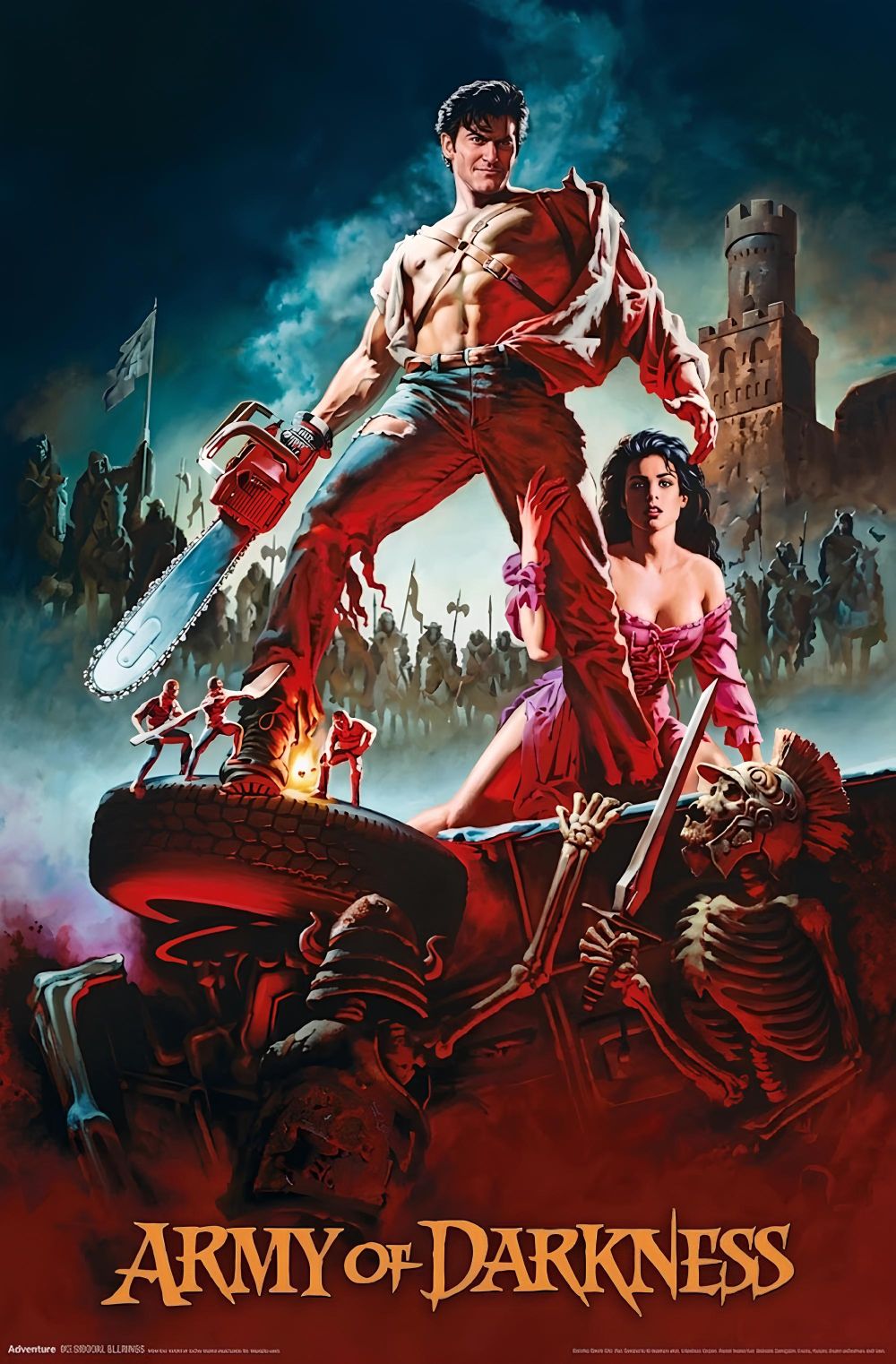
“Well hello, Mister Fancypants. Well, I’ve got news for you, pal: you ain’t leadin’ but two things right now: Jack and shit… and Jack just left town.” — Ash Williams
Few cult movies embrace their own insanity as joyfully as Sam Raimi’s Army of Darkness. Directed by Raimi and released in 1992, the third chapter in the Evil Dead series takes Ash Williams out of the isolated-cabin horror setting of The Evil Dead and Evil Dead II and drops him into a sword-and-sorcery adventure full of skeleton armies, haunted forests, miniature doppelgängers, exploding Deadites, and more quotable one-liners than most action comedies manage in an entire franchise. It is still technically a horror movie, but calling it just a horror movie misses the point. This is a slapstick fantasy-action comedy with monsters, and its ridiculousness is exactly why it has endured as a cult favorite.
The story picks up almost immediately after the end of Evil Dead II, with Ash getting sucked through a portal and landing in medieval England. Rather than being welcomed as some prophesied savior, he is immediately treated like a suspicious outsider and thrown into a pit with a Deadite. That opening alone tells you what kind of movie this will be. Ash is no longer simply a terrified everyman trying to survive an impossible nightmare. He is now a chainsaw-handed loudmouth who shoots first, insults everyone around him, and somehow carries himself like the greatest warrior in history despite constantly making situations worse through his own arrogance.
Bruce Campbell is the entire engine of Army of Darkness. Ash has become a full-blown cartoon hero by this point, halfway between a B-movie John Wayne, a professional wrestler cutting a promo, and a smug department-store employee who has somehow convinced himself he is a legendary warrior. Campbell plays the role with total commitment, which is the key to why the comedy works. He never acts embarrassed by the dialogue or tries to make Ash seem cooler than he is. The character is funny because he is deeply incompetent beneath all the bravado. Ash talks like a conquering hero, but his victories usually involve panic, luck, explosives, and a lot of property damage.
The familiar “Groovy” attitude from Evil Dead II gets pushed even further here. Ash is not meant to be a noble fantasy protagonist. He is selfish, crude, lazy, and usually more interested in returning to modern life than helping the people trapped in a medieval war. That makes him a funny fit for the genre. In a normal fantasy film, the chosen hero would humbly accept his destiny, train with a sword, and unite the kingdoms. Ash complains about the inconvenience, makes demands, insults the locals, and uses his knowledge of basic mechanics to become a magical figure in their eyes. His improvised metal hand, shotgun, chainsaw, and homemade weapons make him look like a mad scientist dropped into an old Ray Harryhausen movie.
Raimi’s direction is as energetic as ever, even if Army of Darkness is noticeably cleaner and more studio-sized than the first two films. The early Evil Dead movies had a grimy, do-it-yourself quality that made their horror feel unusually mean and immediate. This one has a broader, more polished adventure-movie look. There are castles, battlefields, elaborate costumes, large-scale miniature work, and a full army of stop-motion skeletons. It is still cheap-looking in places, but that is part of its charm. The effects do not need to be seamless because the movie’s entire personality is built around heightened artifice. When skeletons leap around in exaggerated stop-motion or a tiny Ash attacks the full-sized Ash in a windmill, the film feels like a live-action cartoon with blood, dirt, and medieval armor.
The windmill sequence is probably the purest expression of what makes the movie special. Ash enters a windmill to escape danger and ends up trapped with miniature versions of himself, eventually swallowing one by accident. It has almost nothing to do with the larger plot in any serious sense, yet it is hilarious because Raimi keeps escalating the gag. Instead of treating the tiny Ash as a brief visual joke, the movie turns him into a recurring problem that literally grows into Evil Ash, Ash’s undead double and the leader of the titular army. That progression makes perfect cartoon logic: a small annoyance becomes a full-scale apocalypse because Ash was too careless to deal with it properly.
The horror elements are lighter than they were in the first two films, and that will probably be the biggest dividing line for viewers. Anyone expecting the nasty isolation, body horror, and relentless dread of The Evil Dead may be surprised by how openly silly this installment is. The Deadites are still grotesque enough to keep the supernatural threat alive, especially in the opening pit fight and the later siege, but they are no longer as frightening as they are funny. Raimi is much more interested in visual gags, wild camera movement, and action-movie momentum than scares.
That tonal change does not make Army of Darkness a lesser movie; it just makes it a very different one. In fact, it may be the most accessible entry in the original trilogy for people who do not normally enjoy horror. You can watch it without being especially invested in the mythology, because the plot is basically a delivery system for set pieces. Ash needs the Necronomicon to get home. He says the magic words wrong. Evil Ash rises. A skeleton army attacks. Ash helps defend the castle. The movie keeps moving, rarely pauses to explain itself, and never tries to make its fantasy world feel more serious than necessary.
The final battle is a great example of Raimi getting the maximum entertainment out of a relatively limited toolbox. Ash turns medieval villagers into a makeshift modern army, complete with explosives, contraptions, and a vehicle that feels hilariously out of place in the period setting. The action is messy, noisy, and deliberately overblown, with exploding skeletons and clashing armies staged more like a rowdy theme-park spectacle than a conventional epic. Raimi understands that the point is not realism. The point is seeing Ash yell at an undead army while wielding a chainsaw and acting like he personally invented warfare.
The movie’s dialogue is another major reason it remains so beloved. “This is my boomstick” has become the obvious classic, but Army of Darkness is packed with lines that sound like they were designed to be repeated by friends after midnight screenings. Campbell’s delivery turns even the dumbest insult into something memorable. The movie knows Ash is absurd, but it also understands that he needs to be just cool enough for the audience to enjoy watching him survive. He is a lovable jerk because he is never actually in control for long. The universe keeps humiliating him, and Campbell makes every humiliation feel like another opportunity for a louder comeback.
Army of Darkness is not the scariest Evil Dead movie, the most atmospheric, or even necessarily the best constructed. It is uneven, shamelessly goofy, and occasionally held together by pure momentum. But it has a distinct personality that most franchise sequels would kill for. Raimi and Campbell take a low-budget horror premise and stretch it into a medieval monster comedy without losing the series’ manic spirit. It feels handmade even when it is big, silly even when it is violent, and weirdly triumphant despite Ash being one of the least heroic heroes in fantasy cinema. For fans of practical effects, stop-motion creatures, quotable cult movies, and Sam Raimi operating with absolutely no interest in restraint, Army of Darkness remains a blast.

