Review: Band of Brothers


“A lot of those [German] soldiers, I’ve thought about this often, that man and I might’ve been good friends. We might’ve had a lot in common. We might’ve liked to fish, you know, he might’ve liked to hunt. You never know. You know. Of course, they were doin’ what they were supposed to do, and I was tryin’ to do what I was supposed to do. But, under different circumstances we might’ve been good friends.” — Darrell “Shifty” Powers

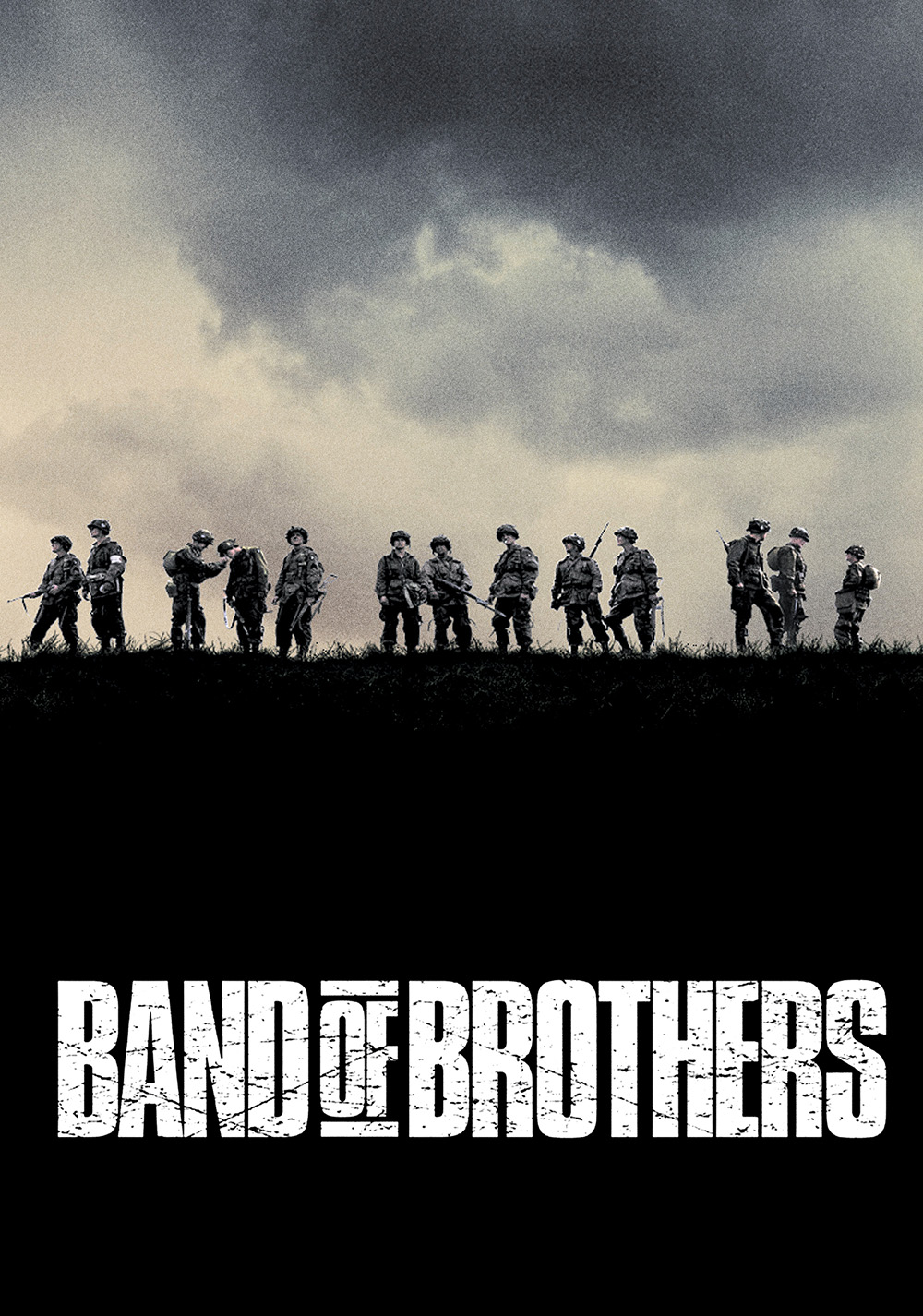
When we look back at the landscape of modern television, it is easy to take the concept of cinematic TV for granted. We live in an era where massive budgets, sweeping orchestral scores, and A-list Hollywood talent are regularly deployed on the small screen. But if you trace this golden lineage back to its true modern genesis, all roads inevitably lead to a singular, towering achievement: the 2001 HBO mini-series Band of Brothers. Produced by Tom Hanks and Steven Spielberg, this ten-part masterpiece did not just recount the harrowing journey of Easy Company, 506th Parachute Infantry Regiment, 101st Airborne Division during World War II; it fundamentally altered the DNA of television storytelling. Watching it today, a quarter-century after its initial broadcast, the series remains as potent, heartbreaking, and visually stunning as it was when it first shocked audiences. It exists as a perfect bridge between the classical Hollywood war epics of old and the uncompromising, gritty realism of twenty-first-century media. By committing to an unprecedented budget and an absolute refusal to sanitize the psychological horrors of combat, Band of Brothers set a high-water mark that few series have ever managed to touch, let alone surpass.

To understand the visual language and visceral power of Band of Brothers, one must first look at the cinematic earthquake that preceded it three years earlier: Steven Spielberg’s 1998 masterpiece Saving Private Ryan. That film rewrote the rules of how cinema captures warfare, abandoning the steady, heroic, brightly lit panoramas of mid-century studio pictures in favor of a terrifyingly immersive, chaotic style. Spielberg utilized desaturated colors, shutter-angle manipulation to create a jittery, hyper-real sense of motion, and handheld cameras that made the audience feel like they were ducking bullets in the surf of Omaha Beach. When Hanks and Spielberg pivoted to television to adapt Stephen E. Ambrose’s non-fiction book Band of Brothers, they brought this exact aesthetic blueprint with them. The impact of Saving Private Ryan on the mini-series cannot be overstated; it acts as the structural and aesthetic godfather of the entire project. Directors like Phil Alden Robinson, Richard Loncraine, and David Nutter utilized the same bleach-bypass film processing techniques to strip away vibrant primaries, leaving a color palette dominated by icy blues, muddy browns, and sickly olive drabs. This was not just a stylistic gimmick; it was a psychological tool that pulled the viewer out of the comfort of their living rooms and dropped them into the frozen, unforgiving forests of Bastogne or the smoke-choked ruins of Carentan. The camera became a participant in the war, getting splattered with mud, shaking violently during artillery barrages, and refusing to look away from the gruesome reality of what high-explosive shrapnel does to human flesh.

Yet, while it shared a visual vocabulary with Saving Private Ryan, Band of Brothers achieved something that a two-and-a-half-hour feature film simply never could, owing entirely to the expansive canvas of the mini-series format. A film must ultimately compress its narrative arc, often relying on archetypes and rapid pacing to reach a resolution. Over the course of ten hours, Band of Brothers allows its characters to breathe, change, harden, and break. Crucially, some of the show’s most powerful, lasting stories have absolutely nothing to do with active battles, but rather unfold in the quieter moments between the chaos. We do not just see these men in the heat of a firefight; we watch them suffer through the mundane, soul-crushing basic training regime of Camp Toccoa under the tyrannical eye of Captain Sobel, played with a brilliant, tragic insecurity by David Schwimmer. We sit with them in the agonizing, silent darkness of C-47 transport planes, listening to the vomit hitting the floorboards and watching the sheer, unadulterated dread on their faces before the jump over Normandy. We freeze with them in foxholes during the long, static winter in the forests of Bastogne, sharing the psychological numbness of isolation and the simple, desperate human desire for a dry pair of socks or a warm cup of coffee. This structural patience transforms the viewing experience from simple passive entertainment into an emotional marathon. We have known these men through their triumphs and their absolute lowest points, making their losses hit with the weight of personal bereavement.

While these quiet stretches build a deep, slow-burning empathy, the absolute biggest gut punch of the entire series arrives in Episode 9, titled Why We Fight. Throughout their march across Europe, the men of Easy Company—and by extension, the audience—have become somewhat cynical and battle-weary, numbly pushing forward simply to survive and get the job done. That numbness is completely shattered when a patrol stumbles across an sub-camp in the woods near Landsberg, which itself was part of the larger Dachau concentration camp complex. Up until this point, the war had been about geopolitical strategies, territory, and survival; suddenly, the men are brought face-to-face with the industrial scale of Nazi atrocities. The direction in this sequence is devastatingly restrained. There are no swelling orchestrations or heroic monologues, only the bewildered horror of soldiers looking at skeletal survivors wandering the camp in striped uniforms. Watching tough, battle-hardened paratroopers like Captain Nixon and Major Winters reduced to breathless, disbelieving silence as they uncover the truth of the Holocaust anchors the narrative in an entirely different tier of tragedy. It is an episode that completely recontextualizes the title of the series, showing that their ultimate purpose transcended military victory; they were liberating humanity from an unimaginable nightmare.

The casting of the series is another stroke of absolute genius that looks even more miraculous in hindsight. The producers deliberately avoided casting massive, distracting superstars for the main roles, opting instead for relatively unknown British and American theater and character actors. This decision was crucial for maintaining the show’s documentary-like authenticity; if Tom Cruise or Brad Pitt had been jumping out of those planes, the illusion would have been instantly shattered. Instead, we got Damian Lewis as Major Richard Winters, delivering a performance of quiet, stoic, and deeply principled leadership that serves as the moral anchor of the entire narrative. Alongside him was Ron Livingston as Captain Lewis Nixon, embodying the weary, cynical, and battle-fatigued intellect of a man seeking refuge from the horrors of war in a bottle of Vat 69. The ensemble is a treasure trove of talent, featuring early-career appearances from actors who would go on to become household names, including Tom Hardy, Michael Fassbender, James McAvoy, Simon Pegg, and Michael Cudlitz. Because the show focuses on an entire company, the perspective shifts naturally from episode to episode. One week we are viewing the war through the eyes of a terrified replacement medic in Bastogne, and the next we are embedded with the cynical, battle-hardened sergeant Carwood Lipton in The Breaking Point. This shifting focus ensures that the series never feels like a traditional Hollywood star vehicle, but rather a collective portrait of brotherhood where the company itself is the true protagonist.

The emotional resonance of Band of Brothers is amplified tenfold by the brilliant inclusion of interviews with the actual surviving veterans of Easy Company at the beginning of each episode. Kept anonymous until the very final moments of the series, these elderly men sit in simple chairs against dark backgrounds, their voices trembling and eyes misting over as they recall events that occurred more than half a century prior. There is a heartbreaking disconnect between the frail, weathered men on screen and the vibrant, muscular young actors portraying them in the dramatization. These interviews ground the cinematic spectacle in an undeniable, sobering reality. They serve as a constant reminder that the explosions, the blood, and the impossible acts of bravery we are witnessing were not the inventions of a Hollywood writers’ room, but the actual lived experiences of ordinary boys who were plucked from small-town America and dropped into the middle of the apocalypse. When the real-life winter veteran Dick Winters quotes his friend’s letter at the end of the series—saying, “Grandpa, were you a hero in the war? And Grandpa said no, but I served in a company of heroes”—it is impossible not to be moved to tears. It is a rare instance where a piece of media successfully honors historical figures without falling into the trap of cheap, unearned sentimentality or jingoistic propaganda.

Beyond its historical and emotional triumphs, the legacy of Band of Brothers is woven directly into the fabric of what we now refer to as prestige television. Before 2001, television was largely viewed as cinema’s lesser sibling—a medium defined by low budgets, procedural structures, and compromised production values meant to fit the square dimensions of old cathode-ray tube television sets. HBO had already begun to challenge this status quo with groundbreaking dramas like The Sopranos and Oz, but Band of Brothers was the project that proved television could match, and perhaps even exceed, the scale and artistic ambition of Hollywood blockbusters. With a staggering budget of over one hundred and twenty million dollars, it was the most expensive television miniseries ever produced at the time. The immense financial gamble paid off spectacularly, demonstrating to network executives and creators alike that audiences were hungry for complex, serialized, and visually uncompromising narratives that demanded to be treated as high art. The success of the show cleared the path for future cinematic television epics, directly inspiring sister projects like The Pacific and Masters of the Air, while setting the production standards that would later allow shows like Game of Thrones, Chernobyl, and Succession to flourish. It proved that the small screen was capable of housing massive, global historical narratives without losing the intimate character dynamics that make long-form storytelling so uniquely compelling.

Ultimately, Band of Brothers stands as a definitive milestone because it perfectly balanced the macro-scale horror of global warfare with the micro-scale beauty of human connection. It stripped away the romanticized myths of World War II to expose the sheer, terrifying randomness of survival, while simultaneously validating the profound love and loyalty that can only be forged in the crucible of shared suffering. It did not glamorize combat; instead, it illuminated the heavy, permanent psychological toll extracted from those who survived it. Through its hyper-realistic visual language inherited from Saving Private Ryan, its impeccable ensemble casting, and its revolutionary impact on the medium of television, the series achieved a timeless quality. It remains a definitive piece of cultural touchstone media that demands annual rewatches from millions of viewers around the globe. It is not just a historical chronicle, nor is it merely a well-executed piece of premium television; it is a monument to the human spirit, an artistic triumph that continues to remind us of the immense sacrifices made by an ordinary generation of heroes who stood together when the world was falling apart.

4 Shots From 4 Films: Special Bob Gale Edition


4 Shots From 4 Films is just what it says it is, 4 shots from 4 of our favorite films. As opposed to the reviews and recaps that we usually post, 4 Shots From 4 Films lets the visuals do the talking!

Today, the Shattered Lens wishes a happy birthday to screenwriter Bob Gale!  It’s time for….

4 Shots From 4 Films Written By Bob Gale

I Wanna Hold Your Hand (1978, dir by Robert Zemeckis, DP: Donald M. Morgan)

1941 (directed by Steven Spielberg, DP: William A. Fraker)

Used Cars (1980, dir by Robert Zemeckis, DP: Donald M. Morgan)

Back to the Future (1986, dir by Robert Zemeckis, DP: Dean Cundey)

Lisa Marie’s Way Too Early Oscar Predictions For March


Now that the awards for the best of 2025 have been handed out, it’s time to think about what might be nominated next year!

Below are my first set of Oscar predictions for 2026!  What am I basing these predictions on?  Nothing but instinct, wild guesses, and hopeful thinking.  Take them with a grain of salt.  If nothing else, we’ll look back on these a year from now and we’ll laugh.  Or, we’ll be amazed at my cognitive abilities.

Best Picture

Digger

Disclosure Day

Dune Part Three

I Play Rocky

The Invite

Mother Mary

The Odyssey

Queen At Sea

The Social Reckoning

Wild Horse Nine

Best Director

Lance Hammer for Queen At Sea

Martin McDonagh for Wild Horse Nine

Christopher Nolan for The Odyssey

Steven Spielberg for Disclosure Day

Denis Villeneuve for Dune Part Three

Best Actor

Nicolas Cage in Madden

Timothee Chalamet in Dune Part Three

Tom Cruise in Digger

Anthony Ippolito in I Play Rocky

John Malkovivh in Wild Hose Nine

Best Actress

Juliette Binoche in Queen At Sea

Emily Blunt in Disclosure Day

Isabelle Huppert in The Blood Countess

Mikey Madison in The Social Reckoning

Anya Taylor-Joy in Joni Mitchell

Best Supporting Actor

Tom Courtenay in Queen At Sea

Willem DaFoe in Werewulf

Stephan James in I Play Rocky

Edward Norton in The Invite

Jeremy Strong in The Social Reckoning

Best Supporting Actress

Anna Calder-Marshall in Queen At Sea

Michaela Coel in Mother Mary

Penelope Cruz in The Invite

AnnaSophia Robb in I Play Rocky

Meryl Streep in Joni Mitchell

4 Shots From 4 Films: Celebrating The Silhouette…Again!


4 Or More Shots From 4 Or More Films is just what it says it is, 4 shots from 4 of our favorite films. As opposed to the reviews and recaps that we usually post, 4 Shots From 4 Films lets the visuals do the talking!

As a photographer, I love a good silhouette shot.  Here are some more of my favorites.

4 Shots From 4 Films

Nosferatu (1922, Dir. by F.W. Murnau)

Gone With The Wind (1939, Dir. by Victor Fleming)

The Exorcist (1973, Dir by William Friedkin)

Saving Private Ryan (1998, Dir. by Steven Spielberg)

Here’s the Super Bowl Spot For Disclosure Day


Disclosure Day is Steven Spielberg’s latest film.  We really don’t know much about it, beyond the fact that it appears to be science fiction and it stars Emily Blunt.

The Super Bowl spot is certainly intriguing.  I’m looking forward to unraveling this film’s mysteries.

The Blues Brothers (1980, directed by John Landis)


The Blues Brothers!  They’re on a mission from God.

Jake (John Belushi) and Elwood Blues (Dan Aykroyd) are two Chicago orphans who love the blues and committing crime.  After Jake is paroled from Joliet Prison, he’s picked up by Elwood in an old police car.  Elwood traded the original Bluesmobile for a microphone.  Jake understands, even if he still doesn’t like being seen in a police car.  When they  visit the orphanage where they were raised, Sister Mary Stigmata (Kathleen Freeman) beats them with a ruler and tells them that the orphanage is going to close if she can’t pay a $5,000 tax bill.  Jake and Elwood set out to reform their band, raise $5,000, and save the orphanage.  Jake and Elwood may be two career criminals who never take off their dark glasses but they’re on a mission from God.

Along the way to putting the band together and raising $5,000, Jake and Elwood meet characters played by everyone from James Brown to Ray Charles to Aretha Franklin.  You never know when a big production number might break out.  Jake and Elwood also step on a few toes.  Soon, the Blues Brothers being chased by the police, the national guard, Jake’s parole officer (John Candy), Charles Napier’s country-western band, and a group of Illinois Nazis (led by Henry Gibson).  There’s also a mysterious woman (Carrie Fisher) who wants to kill them.  She has an impressive array of weapons but terrible aim.

The Blues Brothers was the first comedy to be based on a Saturday Night Live bit.  Unlike most other SNL movies, The Blue Brothers develops its plot far beyond what was originally seen on television.  Jake and Elwood get a full backstory and they also get personalities that go beyond the black suits and the dark eyewear. The Blues Brothers features Belushi at his most energetic but it’s also one of the few films to actually know what to do with Dan Aykroyd’s eccentric screen presence.  If Belushi’s Jake is all about earthly pleasures, Aykroyd’s Elwood almost seems like a visitor for another world.  Aykroyd’s performance of the Rawhide theme song is one of the film’s highlight.

The Blues Brothers has its share of funny lines and its famous for the amount of pointless destruction that it manages to fit into its storyline (with the “unnecessary violence” being authorized by the Chicago police to stop the Blues Brothers) but it’s also as surprisingly sincere tribute to the blues.  It’s a movie that can balance Ray Charles shooting at a shoplifter and a massively destructive car chase in a suburban mall with Cab Calloway playfully performing Minnie the Moocher and Aretha Franklin bringing down the house (or diner, as the case may be).  The movie can feature both a jump over an open drawbridge and Steven Spielberg as the clerk at the tax office.  It’s one of the strangest comedies ever made and it features all the excesses that would bring an end to 70s Hollywood but when Jake and Elwood say they’re on a mission from God, you believe them.


Icarus File #25: 1941 (dir by Steven Spielberg)


In the year 1979, a young Steven Spielberg attempted to conquer comedy in the same way that he previously conquered horror with Jaws and science fiction with Close Encounters of The Third Kind.  Working from a script written by Robert Zemeckis and Bob Gale, Spielberg made a film about the days immediately following Japan’s attack on Pearl Harbor.  The name of the film was 1941 and it remains Steven Spielberg’s only attempt to direct a full-out comedy.  There’s a reason for that.

The film follows a large group of characters over the course of one day and night in 1941.  It’s been six days since Pearl Harbor was attacked and the streets of Los Angeles are full of young men who are preparing to ship out and older man who are paranoid about when the next attack is going to come.  However, Major General Joseph Stilwell (Robert Stack) just wants to see Dumbo at the local theater.  Meanwhile, his womanizing aide (Tim Matheson, giving the same performance here that he did in National Lampoon’s Animal House) just wants to get Stillwell’s aviation-lusting secretary (Nancy Allen) into an airplane.

Elsewhere, Ward Douglas (Ned Beatty) is happy to allow Sgt. Tree (Dan Aykroyd) and his men (including John Candy) to set up on an anti-aircraft gun in his front yard.  Ward’s daughter, Betty (Dianne Kay), is only concerned about entering a dance contest with her friend, Maxine (Wendie Jo Sperber).  Cpl. Sitarski (Treat Williams) and dishwasher Wally Stephens (Bobby D iCicco) both hope to be Betty’s partner and their rivalry leads to a massive (and seemingly never-ending) brawl.

While Ward deals with the gun in his front yard, another concerned citizen — Claude Crumm (Murray Hamilton) — keeps watch from atop of Ferris wheel, along with amateur ventriloquist Herbie Kazlminsky (Eddie Deezen).

But that’s not all!  Susan Backilinie recreates her role from a previous Spielberg film, skinny dipping while the Jaws theme plays in the background and running straight into a submarine that is commanded by Commander Akiro Mitamura (Toshiro Mifune, trying to maintain his dignity).  Mifune decides to attack Hollywood but no one on the submarine is sure where that is.  Christopher Lee appears as an arrogant German who is along for the ride.  Slim Pickens shows up as a lumberjack who is temporarily captured by the Japanese.  John Belushi plays Wild Bill Kelso, who flies his airplane through Los Angeles.  Warren Oates yells and laughs.  Dick Miller, Elijah Cook Jr. and Lionel Stander show up in small roles.

“Since when is Steven funny?”  According to Peter Biskind’s Easy Riders, Raging Bulls, this was the reaction that most of Spielberg’s friends had when he announced that his next film would be a screwball comedy set during World War II.  Watching the film, one gets their point.  The majority of the film’s humor comes from people looking at the camera and screaming.  There’s a lot physical comedy, which would undoubtedly work in small amounts but which grows rather tiring when it’s dragged out to the extent that Spielberg’s drags it out.  (A brawl at a USO show seems like it should be funny but Spielberg allows it to go on for too long and the careful choreography takes away any element of spontaneity.)  The film attempts to duplicate the style of Animal House (and it’s probably not a coincidence that Matheson, Belushi, and director John Landis all have roles in the film) but Spielberg often seems as if he’s trying too hard.  There’s nothing subversive about the humor.  It’s more antic than funny.

A huge problem is that there really isn’t much of a story here.  Spielberg, who is normally one of Hollywood’s best storytellers, attempts to do a loose, Altman-style ensemble film and the result is that none of the characters feel alive and there’s never any sense of narrative momentum.  There are a few performers who manage to make an impression amongst all the explosions and the yelling.  John Belushi has the advantage of not having to share the majority of his scenes with anyone else.  Warren Oates’s manic energy is more than welcome.  Wendie Jo Sperber deserved more screentime.  Murray Hamilton and Eddie Deezen frequently made me laugh.  There’s a wonderful moment where Robert Stack’s intense general cries while watching Dumbo.  But, for the most part, the film never comes together.

That said, 1941 is definitely a Steven Spielberg film.  It received three Academy Award nominations, for Cinematography, Sound, and Visual Effects.  (All three of those categories, not surprisingly, are more associated with spectacle than with comedy.)  The film looks great!  Spielberg’s attention to detail is there in the production design and the costumes.  Watching 1941, you can see Spielberg’s talent while also seeing why he never directed another comedy.

Previous Icarus Files:

  1. Cloud Atlas
  2. Maximum Overdrive
  3. Glass
  4. Captive State
  5. Mother!
  6. The Man Who Killed Don Quixote
  7. Last Days
  8. Plan 9 From Outer Space
  9. The Last Movie
  10. 88
  11. The Bonfire of the Vanities
  12. Birdemic
  13. Birdemic 2: The Resurrection 
  14. Last Exit To Brooklyn
  15. Glen or Glenda
  16. The Assassination of Trotsky
  17. Che!
  18. Brewster McCloud
  19. American Traitor: The Trial of Axis Sally
  20. Tough Guys Don’t Dance
  21. Reach Me
  22. Revolution
  23. The Last Tycoon

6 Shots From 6 Films: Special Steven Spielberg Edition


4 Shots From 4 Films is just what it says it is, 4 shots from 4 of our favorite films. As opposed to the reviews and recaps that we usually post, 4 Shots From 4 Films is all about letting the visuals do the talking.

Today, we wish a happy birthday to director Steven Spielberg!  It’s time for….

6 Shots From 6 Films

Duel (1971, dir by Steven Speilberg, DP: Jack Marta)

Jaws (1975, dir. by Steven Spielberg, DP: Bill Butler)

Close Encounters of the Third Kind (1977, dir by Steven Spielberg, DP: Vilmos Zsigmond)

1941 (directed by Steven Spielberg, DP: William Fraker)

Schindler’s List (1993, dir by Steven Spielberg, DP: Janusz Kamiński)

Saving Private Ryan (1998, dir by Steven Spielberg, DP: Janusz Kamiński)


Spielberg delves into Sci-Fi again with the Disclosure Day Teaser


Spielberg. Williams. Koepp. Kaminski. What the heck is Disclosure Day?

The teaser trailer for Steven Spielberg’s Disclosure Day hit my phone via Letterbox’d. This is connected to those weird X-Files looking posters I’ve been seeing as of late. It looks like another film with aliens, similar to Close Encounters of the Third Kind with a dash of Zemekis’ Contact or sprinkle of Villeneuve’s Arrival. The film stars Josh O’Connor (Wake Up Dead Man: A Knives Out Mystery), Emily Blunt (Jungle Cruise), Colin Firth (Kingsman), Coleman Domingo (The Running Man), Wyatt Russell (Marvel’s Thunderbolts), and Eve Newson (Robin Hood).

Spielberg and Koepp have a good track record together with the Jurassic Park films, and it’a always good to see a pairing with John Williams. Still, this all looks really weird. Either way, we’ll find out when the film is released next June.

Enjoy!

Review: Saving Private Ryan (dir. by Steven Spielberg)


“Someday we might look back on this and decide that Saving Private Ryan was the one decent thing we were able to pull out of this whole godawful, shitty mess.” — Sergeant Horvath

Saving Private Ryan stands as a landmark achievement in war cinema, intricately weaving immersive battle scenes, rich character dynamics, and profound moral themes into a nearly three-hour exploration of World War II’s human cost. One of its most remarkable features is the opening Omaha Beach landing sequence, a meticulously crafted, over 24-minute depiction of warfare’s brutal reality. Spielberg deploys a cinema verité style with handheld cameras capturing disorientation and chaos through the soldiers’ eyes. The sound design envelops the viewer in a sensory onslaught—gunfire, shouting, explosions—creating a visceral experience that immerses audiences directly in the terror and confusion of D-Day.

The filming process drew heavily on historical accuracy, with the production shot on the coast of County Wexford, Ireland, employing amputee actors and practical effects over computer graphics to simulate violent injuries and battlefield horrors. Muted tones evoke wartime photographs, and rapid, shaky editing conveys the disorganized, frantic environment soldiers endured. Consulting WWII veterans and historians, Spielberg created a sequence that reshaped cinematic portrayals of war, influencing how future films would approach the genre’s raw immediacy and emotional weight.

The film’s narrative follows a squad led by Captain Miller on a mission to locate and bring home Private James Ryan, whose three brothers have been killed in combat. The mission is steeped in the real-life tragedy of the five Sullivan brothers who died together aboard the USS Juneau in the Pacific, prompting military policies to prevent similar familial devastation. This historical context frames the story’s ethical heart: risking several men’s lives to save one, raising enduring questions about the value of individual sacrifice within the broader war.

In Saving Private Ryan, sacrifice is portrayed ambiguously—not as the sacrifice of a single hero but as the collective cost borne by the men tasked with rescuing one individual under perilous conditions. As the squad journeys through the war-torn French countryside, the deaths, injuries, and tensions they face underscore war’s randomness and the difficulty of weighing one life against many. The narrative refuses to romanticize or simplify, instead confronting the audience with the tragic truth that countless soldiers lose their lives without recognition or purpose, while some survive against staggering odds.

Duty and camaraderie thread throughout the film, portrayed through the soldiers’ evolving relationships and personal struggles. Each grapples with loyalty not only to their mission but to their fellow men and their own moral codes.

Integral to the film’s power is Tom Hanks’s layered performance as Captain John Miller. Hanks breathes life and emotional depth into Miller, portraying him as a man shaped by civilian life—revealed poignantly when he discloses his pre-war profession as a schoolteacher—now transformed by the relentless demands of war. He embodies an officer who is both composed and vulnerable, carrying the heavy burden of leadership with quiet dignity. Hanks’s portrayal reveals the internal struggles beneath Miller’s stoic exterior: moments of doubt, moral conflict, and fatigue subtly expressed through a trembling hand or a weary gaze. This humanity makes Miller relatable, as a man trying to maintain order and purpose amid chaos.

Hanks skillfully balances Miller’s authoritative presence with warmth and empathy, particularly evident in his paternal interactions with younger soldiers, reinforcing Miller’s role as both a leader and protector. His nuanced acting delivers the complexity of a man constantly negotiating duty and compassion. In scenes of high tension or moral quandaries, Hanks conveys the weight of command while allowing glimpses into Miller’s psychological strain, deepening the film’s emotional resonance.

Following Hanks’s Miller, a standout amongst the supporting cast is Tom Sizemore’s portrayal of Technical Sergeant Mike Horvath, Miller’s steady second-in-command. Sizemore embodies the pragmatic, battle-hardened soldier whose loyalty and experience provide emotional grounding for the squad. Sizemore portrays Horvath’s weariness and quiet commitment, adding layers of realism that deepen the exploration of how war reshapes individuals. The chemistry and shared history between Miller and Horvath are palpable, illustrating the bonds that sustain soldiers through hardship and lending emotional weight to the narrative.

The film wrestles with intense moral ambiguity throughout. The mission’s premise—to risk many lives to save one—compels both characters and viewers to confront complex questions about justice, value, and the cost of war. Scenes presenting difficult choices, such as the decision to spare or execute prisoners, dramatize these ethical dilemmas and highlight the emotional burdens borne by soldiers.

Technically, the film excels, with Janusz Kaminski’s dynamic cinematography capturing both the chaos of battle and intimate moments with evocative clarity. The immersive sound design reinforces the brutal reality, stripping warfare of glamor and confronting audiences with its daunting human costs.

Despite the overwhelming destruction and loss, Saving Private Ryan offers moments of humanity and hope. The rescue mission serves as a fragile symbol of compassion in the midst of devastation, while the film’s closing reflections on memory and legacy emphasize the lasting significance of sacrifice and survival.

Saving Private Ryan stands as a monumental achievement in the war genre, combining visceral combat realism, compelling characters, and moral complexity. Through Hanks’s deeply human Captain Miller and the nuanced supporting performances, especially Sizemore’s grounded Horvath, the film explores themes of sacrifice, duty, and brotherhood with unflinching honesty. Its enduring legacy lies in its unvarnished yet empathetic portrayal of war’s cost and the profound sacrifices made by those who lived it.