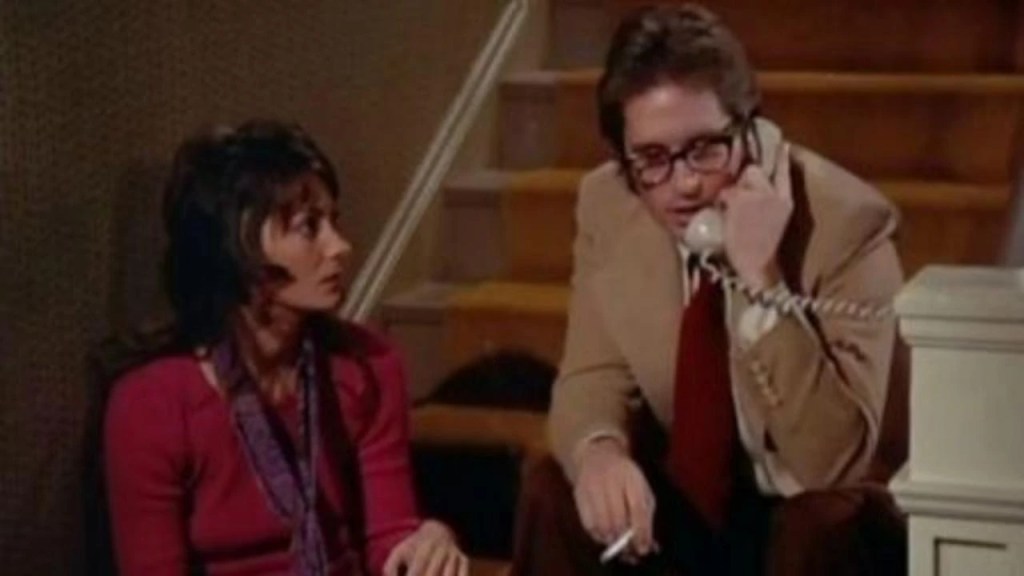
Brad reviews WHEN MICHAEL CALLS (1972), featuring Michael Douglas! 


Today, I was browsing the “scary movie” titles on Amazon Prime when I came across SHATTERED SILENCE, with Michael Douglas featured prominently on the cover. Being a big fan of Douglas, I decided to investigate a little further. I went to my Internet Movie Database app on my phone, input “Shattered Silence,” and it pulled up the 1972 TV movie WHEN MICHAEL CALLS. The premise actually sounded interesting and creepy, and the running time was less than 90 minutes, so I thought I’d check it out.

Based on a 1967 book of the same name from author John Farris, the simple story focuses on Helen Connelly (Elizabeth Ashley), a woman who begins receiving telephone calls from her nephew, Michael. There’s just one problem… Michael died fifteen years ago! Even worse, Michael seems to know that bad things will happen to the people that Helen loves. When her loved ones start dying in horrific accidents, Helen reaches out to her surviving nephew, and Michael’s brother, Craig (Michael Douglas). Craig’s a therapist who tries to help her understand what’s really going on. What starts out seeming like a cruel prank turns into something much worse!

During the opening credits of WHEN MICHAEL CALLS, I was surprised to see that its screenplay was by James Bridges. Bridges was born in Paris, Arkansas, and he’d go on to write and direct movies like THE PAPER CHASE (1973), THE CHINA SYNDROME (1979), which also starred Michael Douglas, and URBAN COWBOY (1980). One of the reasons I really love Bridges is the fact that he wrote and directed the 1977 film SEPTEMBER 30, 1955, which was filmed in the Arkansas towns of Conway and Toad Suck, the very community I was raised in. Here, he crafts a creepy little story that makes good use of something as ordinary as a telephone to create a sense of dread. It’s a simple concept, but it’s darn effective.

The cast of this TV movie is very good, especially Elizabeth Ashley, who does most of the heavy lifting. Ben Gazzara (ANATOMY OF A MURDER, ROAD HOUSE) is also good as her estranged husband, but looking back now, the main attraction is “guest star” Michael Douglas as her therapist nephew who helps her deal with these crazy phone calls. It was a lot of fun seeing him this early in his career, even before THE STREETS OF SAN FRANCISCO. Knowing the heights his stardom would eventually reach, the novelty of this appearance is all the more interesting.

At the end of the day, I enjoyed spending an hour and a half of my life with WHEN MICHAEL CALLS. It delivers a creepy little story, and I enjoyed seeing it through to its ending. I’m almost ashamed that I didn’t figure it out a little bit quicker, but I guess that’s all part of the fun. I won’t pretend it’s a masterpiece, but it is an effective television thriller, and I recommend it. 
Icarus File No. 33: A Chorus Line (dir by Richard Attenborough)


A Chorus Line always leaves me feeling angry.

Now, I should make clear that I’m talking about the 1985 film adaptation and not the show that ran for 6,137 performances on Broadway.  The original show was a tribute to the so-called Broadway gypsies, the dancers who went from show to show and performed anonymously behind the star.  It was a portrait of both the veteran performers and the young up-and-comers who still dreamed of someday moving out of the chorus and becoming stars on their own.  When it opened in 1975, it was considered to be groundbreaking in its frankness about things like sexuality and aging.  It featured heartbreaking monologues and, even more importantly, amazing songs.  The show was a true tribute to people who lived to be on stage.

The movie, on the other hand, is about a jerk of a director named Zack (Michael Douglas) and his ex-girlfriend, a rather self-absorbed dancer named Cassie (Alyson Reed).

My main issue with the film can be seen right at the start.  We watch as a large group of dancers are put through a strenuous audition process.  Everyone is working hard, trying to make an impression on Zack in the little time that they have.  Zack sits in the darkness of the theater, a malevolent presence with a sharp, cigarette-shaped voice.  Most of the dancers will only know him as the pitiless voice that dismisses them from the audition.  We watch as everyone pushes themselves.  The older dancers try to ignore the aches and pain that come with age.  The younger dancers are desperate to finally get their big break.  It’s an exciting sequence, one that shows just how much hard work goes into even getting through the auditions to be a finalist for a part in the chorus.

The only dancer who isn’t there is Cassie.  Cassie has just flown into New York.  She’s stuck in traffic.  She doesn’t arrive until towards the end of the initial eliminations.  She is greeted by the assistant choreographer, Larry (Terrence Mann, who gives one of the better performances in the film).  At first, Zack refuses to allow Cassie to audition.  Cassie says she needs the job.  Zack replies that she’s too good to just be a member of the Chorus Line.

Now, actually, Zack is right about one thing.  Cassie should not be allowed to audition.  But it’s not because she’s too good to be in the chorus.  She shouldn’t be allowed to audition because she didn’t show up on time!  She’s showed up late!  There are sixteen finalists and only 8 spots available.  The other finalists showed up on time and have spent the entire day dancing and proving themselves.  They’ve worked hard for their spot.  They fought for the opportunity.  Cassie just shows up late and basically acts as if she’s entitled to take away one of their spots.

We’re continually told that Cassie is special but we don’t really see any evidence of it.  A lot of that is because the film was rather stodgily directed by Richard Attenborough, who stages each scene in a way that makes everyone — including Cassie — seem rather bland.  One wishes the film could have been directed by a Bob Fosse or a Stanley Donen or a Vincente Minnelli or even a Rob Marshall.  All four of those director knew (or, in Marshall’s case, know) how to shoot a dance number so that the dancer’s personality and skill comes through.  Under Attenborough’s direction, everyone comes across as being vaguely generic.  Indeed, Attenborough focuses the film so much on Zack and Cassie’s relationship that the other performers get pushed to the side.  Some of the show’s best songs are either not featured or just occur in the background.  Attenborough’s film takes a show that was meant to be a celebration of an ensemble and instead turns it into a star vehicle.

Both the film and the show end with a rather heart-breaking scene in which 8 dancers are told to step forward before Zack thanks them for their time and sends them home.  In the show, it’s reflection of life on Broadway.  The director picks who he thinks is best for the show.  Sometimes, that means that a likable or talented actor is still not cast.  In the film, it feels cruel because we notice that Zack sent home 8 dancers who showed up on time and worked hard but still made room for Cassie, who didn’t.  (Notably, in the show, Cassie and Zach had the same relationship as in the film but Cassie also showed up on time for the audition.)  Now, I will say that Zach casting someone with whom he had a personal relationship over someone who he didn’t is probably realistic but it’s still annoying.

It’s debatable whether A Chorus Line could have ever been made into an effective film.  That said, picking Richard Attenborough to direct and an apparently disinterested Michael Douglas to star certainly didn’t help matters.

Previous Icarus Files:

  1. Cloud Atlas
  2. Maximum Overdrive
  3. Glass
  4. Captive State
  5. Mother!
  6. The Man Who Killed Don Quixote
  7. Last Days
  8. Plan 9 From Outer Space
  9. The Last Movie
  10. 88
  11. The Bonfire of the Vanities
  12. Birdemic
  13. Birdemic 2: The Resurrection 
  14. Last Exit To Brooklyn
  15. Glen or Glenda
  16. The Assassination of Trotsky
  17. Che!
  18. Brewster McCloud
  19. American Traitor: The Trial of Axis Sally
  20. Tough Guys Don’t Dance
  21. Reach Me
  22. Revolution
  23. The Last Tycoon
  24. Express to Terror 
  25. 1941
  26. The Teheran Incident
  27. Con Man
  28. Looker
  29. 1776
  30. Here
  31. The Adventures of Brisco County, Jr.
  32. The Cable Guy

Scenes That I Love: “Greed is Good” from Wall Street


Today, the Shattered Lens wishes a happy 82nd birthday to actor and producer Michael Douglas!

For today’s scene that I love, we have a scene from Oliver Stone’s 1987 film, Wall Street.  In this scene, Michael Douglas plays Gordon Gekko.  Gekko is supposed to be the film’s villain but he’s actually a lot more compelling and, at times, sympathetic than the film’s heroes.  He’s not a judgmental jerk like the union leader played by Martin Sheen.  Nor is he a snitch like his protegee, played by Charlie Sheen.  Instead, Gordon Gekko is honest about who he is.

This is the scene that won Michael Douglas an Oscar.  Watching him in this scene, it’s easy to see why Douglas’s performance supposedly inspired a lot of people to get a job working on Wall Street.  Douglas is so charismatic in this scene that he makes this movie into one of the best advertisements for capitalism ever filmed.

Brad’s “Scene of the Day” features Michael Douglas in BLACK RAIN (1989)!


BLACK RAIN opened on September 22nd, 1989, and I’ve been a big fan since the first time I saw it. Director Ridley Scott creates a visual masterpiece where ethically challenged supercop Nick Conklin (Michael Douglas) and his tragically fated, but fun, partner Charlie Vincent (Andy Garcia) head to Japan to deliver a yakuza murderer to the authorities. When the prisoner gives them the slip, they stay over in the Land of the Rising Son and engage in a clash of cultures with strait laced Japanese cop Masahiro (Japanese cinematic legend Ken Takakura) as they all try recapture their man. Needless to say, things don’t always go well.

I’ve chosen the opening sequence where Michael looks extremely cool riding his motorcycle while Greg Allman sings “I’ll Be Holding On” over some pretty impressive credits. Enjoy my friends.

Music Video of the Day: When The Going Gets Tough, The Tough Get Going by Billy Ocean (1985, dir by ????)


Sometimes, on twitter (or whatever it’s called nowadays), people will just become fixated with something.  Yesterday, it was this music video for a song called When The Going Gets Tough, The Tough Gets Going.  I lost track of how many times I saw this video shared on Saturday.

So, I figured, why not share it here as well?

This music video was made to promote the 1985 film, The Jewel of the Nile.  Along with Billy Ocean, the stars of the film — Kathleen Turner, Danny DeVito, and Michael Douglas — also appear in this video.  Was Danny really playing the saxophone?  No, he was not.  Apparently, in the UK, this video was briefly banned because Danny was not a member of the Musicians’ Union and his miming of the sax solo went against the rules.

The UK banning something because an American broke a rule?  Wow, that’s so unlike them!

Enjoy!

Scenes That I Love: “Greed is Good” from Wall Street


Today, the Shattered Lens wishes a happy 81st birthday to actor and producer Michael Douglas!

For today’s scene that I love, we have a scene from Oliver Stone’s 1987 film, Wall Street.  In this scene, Michael Douglas plays Gordon Gekko.  Gekko is supposed to be the film’s villain but he’s actually a lot more compelling and, at times, sympathetic than the film’s heroes.  He’s not a judgmental jerk like the union leader played by Martin Sheen.  Nor is he a snitch like his protegee, played by Charlie Sheen.  Instead, Gordon Gekko is honest about who he is.

This is the scene that won Michael Douglas an Oscar.  Watching him in this scene, it’s easy to see why Douglas’s performance supposedly inspired a lot of people to get a job working on Wall Street.  Douglas is so charismatic in this scene that he makes this movie, directed by a future supporter of Bernie Sanders, into one of the best advertisements for capitalism ever filmed.

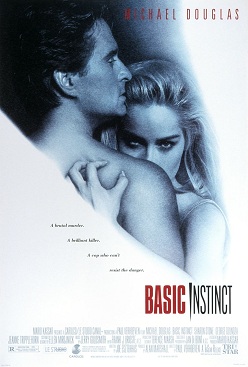
Basic Instinct (1992, directed by Paul Verhoeven)


Nick Curran (Michael Douglas) is a San Francisco police detective who, along with his jolly partner Gus (George Dzundza), finds himself investigating the ice pick-stabbing of a rock star.  The main suspect is glamorous writer Catherine Trammel (Sharon Stone), who is obviously guilty but manages to outsmart all of the men investigating her by not wearing panties during her interrogation.  Nick finds himself drawn to Catherine, despite his own relationship with with psychologist Elizabeth Garner (Jeanne Tripplehorn).  The more Nick digs into Catherine’s past, the more he becomes obsessed with her but also the more he suspects that she may be a serial killer.  This is mostly because Catherine obviously is a serial killer and anyone should have been able to figure that out.  Instead, Nick, an experienced homicide detective, just gets turned on.

It’s strange to remember how seriously people took Basic Instinct when it was released in 1992.  People debated whether it was a throwback to Hitchcock or just a dirty movie.  Feminists debated whether it was empowering or exploitive.  For several years afterwards, every show from The Simpsons to Seinfeld parodied the interrogation scene.  (In Seinfeld’s case, it helped that Wayne Knight appeared in the film as the district attorney who kept shifting in his seat to get a better view.)  Sharon Stone was described as being the new Grace Kelly and, for a period of years, was the subject of fawning profiles in which she was asked about the future of sex in movies.  For a while, she was inescapable.

Sharon Stone, to be fair, did make the role of Catherine her own.  It’s impossible to imagine some of the other actresses considered — Michelle Pfeiffer, Geena Davis, Mariel Hemingway, or Meg Ryan — in the role.  After a decade of not getting anywhere with her film career, Stone was hungry to be a star and was also willing to do things on camera that other name actresses would have refused.  Sharon Stone was not the next Grace Kelly and Catherine Trammel was ultimately more of a sexual fantasy than an actual character but Stone still deserves a lot of credit for her uninhibited performance in the role.  Though Stone later said that she didn’t realize what was actually being filmed during the interrogation scene, it’s her confidence and her unapologetic sensuality that makes the scene compelling.  Her performance has the energy that the sleepwalking Michael Douglas lacks.

Today, Basic Instinct is best-viewed as a satire.  Director Paul Verhoeven sends up both the cop film and the erotic thriller with a movie that turned everything to eleven.  The film’s sensibility is established by the fact that Michael Douglas’s “hero” is nicknamed Shooter because he killed two innocent people while high on cocaine.  The film’s main joke is an obvious one.  Everyone is too busy staring at Sharon Stone to notice that she’s about to stab them in the back with an icepick.  Joe Eszterhas’s script was vulgar to the point of parody and, fortunately, director Paul Verhoeven understood that even more than Eszterhas did.

Basic Instinct has been imitated countless times but it’s never been equaled.  To that, the credit is owed to Sharon Stone and Paul Verhoeven.


Brad’s “Scene of the Day” – The mudslide from ROMANCING THE STONE (1984)!


Happy 71st birthday to Kathleen Turner! The very first time I remember seeing her was with Michael Douglas in the jungle adventure film ROMANCING THE STONE! I just loved the movie and thought she was so beautiful. I also thought Michael Douglas was great as the rascally Jack Colton. A teenage me thought this mudslide scene was hilarious. I still do! Click on the link below and enjoy!  

Richard Chamberlain – Allen Quartermain, Toshiro Mifune & Charles Bronson!


When I was a kid, I loved the movie KING SOLOMON’S MINES (1985) with Richard Chamberlain and Sharon Stone, along with its follow up ALLAN QUARTERMAIN AND THE LOST CITY OF GOLD (1986). These movies don’t really hold up very well these days, but that does not change the fact that they still hold a special place in my heart. That was during my “Indiana Jones” phase and I wanted to watch any movie with adventurers in jungles. ROMANCING THE STONE (1984) is one of those types of movies that really does hold up; THE FURTHER ADVENTURES OF TENNESSEE BUCK (1988), not so much. While we were watching King Solomon’s Mines, I remember my parents telling us kids that Chamberlain was in a miniseries called THE THORNBIRDS, but I’ve never watched it. It intrigued me though. TV miniseries were a big thing in the 70’s and early 80’s and Chamberlain was a king of the TV miniseries age. I discovered that even further when I became obsessed with Toshiro Mifune. I discovered his great miniseries SHOGUN (1980) that also starred Chamberlain. 

As an obsessed Charles Bronson fan, I also discovered that they starred together in an episode of the TV series DR. KILDARE (pictured above). He also worked with Bronson in the film A THUNDER OF DRUMS (1961). Richard Chamberlain may not be one of my all time favorite actors, but he was a part of my life growing up and he worked with my favorite actor of all time a couple of different times. That feeling of nostalgia causes me to mourn his loss. It’s like a part of me is now gone. RIP, Richard Chamberlain. Thanks for sharing your talent with us. 

Scenes That I Love: “Greed is Good” from Wall Street


Today, the Shattered Lens wishes a happy 79th birthday to actor and producer Michael Douglas!

For today’s scene that I love, we have a scene from Oliver Stone’s 1987 film, Wall Street.  In this scene, Michael Douglas plays Gordon Gekko.  Gekko is supposed to be the film’s villain but he’s actually a lot more compelling and, at times, sympathetic than the film’s heroes.  He’s not a judgmental jerk like the union leader played by Martin Sheen.  Nor is he a snitch like his protegee, played by Charlie Sheen.  Instead, Gordon Gekko is honest about who he is.

This is the scene that won Michael Douglas an Oscar.  Watching him in this scene, it’s easy to see why Douglas’s performance supposedly inspired a lot of people to get a job working on Wall Street.  Douglas is so charismatic in this scene that he makes this movie, directed by a future supporter of Bernie Sanders, into one of the best advertisements for capitalism ever filmed.