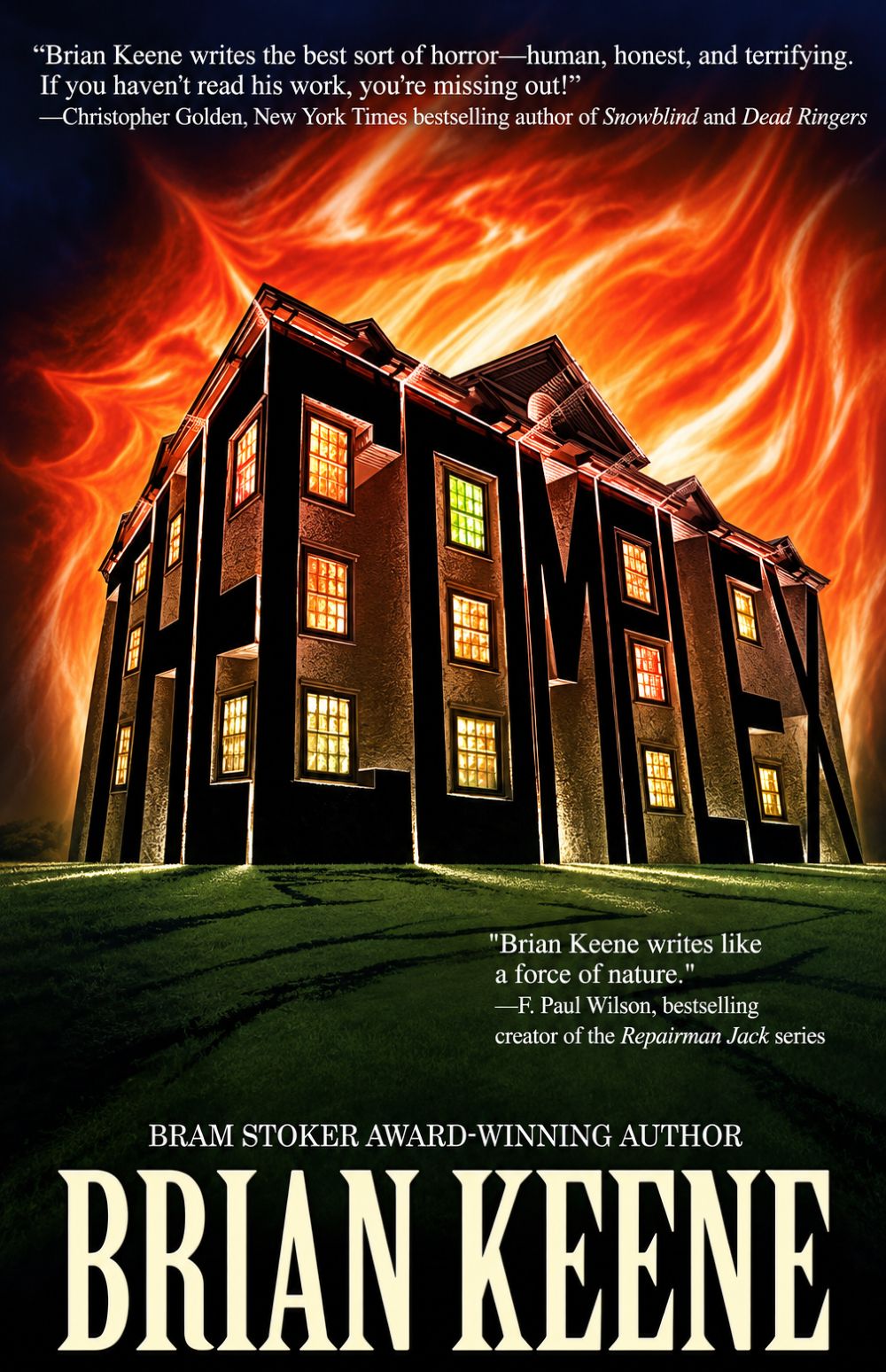
“The only thing they have in common is the unstoppable horde that wants to kill them.” — The Complex
Brian Keene’s The Complex takes a simple horror premise and gets a lot of bloody mileage out of it: a group of apartment residents suddenly find themselves under attack by naked, homicidal strangers, and surviving means trusting people they barely know. There’s no comfortable adjustment period, no time to assemble the perfect team, and certainly no guarantee that being decent will keep anyone alive. It’s a nasty, fast-moving siege novel whose biggest strength isn’t just its willingness to get vicious. It’s the way Keene turns an ordinary collection of neighbors into people worth worrying about before putting them through absolute hell.
The setting is Pine Village, an apartment complex in rural Pennsylvania. It’s the kind of place where people live close together without necessarily sharing much of their lives. Everyone has private problems, personal baggage, and assumptions about whoever lives nearby. Then a mob of crazed attackers arrives, and those everyday boundaries become meaningless. Suddenly, the person on the other side of the wall isn’t just background noise or an occasional annoyance. They might be your only chance of making it through the next few minutes. That shift gives the book a strong foundation beneath all the violence.
What makes the setup effective is how little preparation the characters receive. Keene introduces the residents as the situation starts unraveling, moving between apartments rather than spending ages establishing a normal world we already know is about to collapse. The present-tense narration adds to that feeling of being trapped inside an unfolding emergency. There’s a useful bluntness to the approach: people notice something wrong, try to understand it, and discover that understanding is a luxury they don’t have. The novel is at its strongest when it keeps that gap between recognizing danger and reacting to it painfully narrow.
The attackers are particularly unsettling because they occupy an uncomfortable space between recognizable human beings and something much harder to process. They have the relentless aggression associated with zombies, but describing them that way doesn’t quite capture their menace. Their nakedness removes the ordinary visual clues that help people categorize strangers, while their weapons and savage behavior turn the familiar human body into something threatening. Keene doesn’t need elaborate creature designs to make the situation grotesque. The horror comes from people behaving in ways that make ordinary social expectations completely useless. There’s nothing to negotiate with and very little time to hesitate.
Then there’s the Tick Tock Man, a hulking attacker whose mechanical head movements and incongruous Hello Kitty tattoo make him stand out from the surrounding chaos. He’s the sort of horror image that works because the details don’t comfortably belong together. The tattoo is almost absurd, but that absurdity makes the violence more disturbing rather than less. Amid a largely collective threat, he gives the terror a memorable individual presence. A murderous crowd can become anonymous after a while; one bizarre, recognizable figure gives both the characters and the reader something specific to dread.
Still, the residents are what keep The Complex from becoming an extended exercise in creative dismemberment. The ensemble includes a suicidal horror writer, a single mother, an aging veteran, an elderly woman, a transgender woman named Stephanie, and a serial killer known as the Exit. That’s a potentially overstuffed lineup, but the shared emergency gives these very different people a reason to occupy the same story. Their usefulness to one another doesn’t necessarily correspond to how respectable, stable, or approachable they might appear beforehand. Keene gets considerable tension out of that mismatch between someone’s social identity and what they can actually contribute under pressure.
The Exit deserves particular attention because he isn’t just another colorful addition to the cast. He’s a recurring figure in Keene’s fiction, appearing in the connected stories “I Am an Exit” and “This Is Not an Exit,” collected in Jack’s Magic Beans. His presence connects The Complex to Keene’s wider body of work, but you don’t need that background to appreciate what he brings to this nightmare. Having a serial killer among the survivors changes the usual siege dynamics: someone who would ordinarily be the threat becomes a potentially invaluable ally against something even worse. His familiarity with violence gives the residents an advantage while making their dependence on him deeply uncomfortable. They aren’t simply cooperating with neighbors they’ve overlooked; they’re benefiting from the abilities of someone they would otherwise have every reason to fear. It adds a nasty moral wrinkle to their survival without turning him into a conventional hero.
Stephanie also gives the novel room to explore the difference between how someone understands herself and how other people see her. In a story built around strangers becoming unwilling allies, that distinction matters. Survival requires the residents to recognize one another as people rather than settle for whatever category seems easiest. The book’s human element isn’t separate from its horror machinery; it’s part of what makes that machinery work. Violence forces everyone into proximity, but cooperation requires something more. That’s a more interesting emotional basis for a siege story than simply dividing the cast into obvious heroes and disposable victims.
Keene’s handling of action is another major selling point. The novel has a cinematic quality, but not merely because it’s easy to imagine the blood on a screen. Its central situation produces immediate, understandable objectives: get away from danger, find shelter, stay together, and figure out whether escape is possible. The apartment setting keeps those goals close and urgent. There isn’t much room for the characters—or the narrative—to wander off. For readers who enjoy horror that keeps applying pressure rather than pausing for extensive explanation, that concentration is a considerable advantage.
The downside is that the same stripped-down approach can leave parts of the experience feeling underdeveloped. The dialogue sometimes has the efficiency of movie dialogue, delivering what a scene needs without always sounding entirely natural. Likewise, an ensemble this varied invites curiosity that a relentless survival plot can’t always satisfy. The character concepts are compelling, but the book’s commitment to forward motion limits how long it can sit with them. Whether that feels like a flaw depends on what you want from it: a sustained nightmare benefits from momentum, while a richer character study would need more breathing room.
The ending is likely to be the biggest dividing line. Keene doesn’t provide a tidy explanation for the outbreak, and the conclusion leaves substantial questions unanswered. Its abruptness recalls the ending of his zombie novel The Rising, which similarly split readers between those who appreciated being left hanging and those who felt the story stopped just when it needed to deliver a payoff. The comparison isn’t exact—The Rising received a direct continuation in City of the Dead—but the potential frustration is familiar: after becoming invested in the characters’ struggle, some readers will want more closure than Keene gives them here. There’s still a strong argument for leaving things uncertain. People caught in a catastrophe wouldn’t automatically discover its cause, and withholding answers preserves the sense that the world has become incomprehensible. But uncertainty and satisfaction aren’t interchangeable. The book works better as an immediate survival experience than as a mystery promising a fully worked-out solution.
For all its bloodshed and relentless action, The Complex works best when it makes you care about the people caught in the middle. Its viciousness matters because Keene gives the endangered residents enough individuality to make their situation more than a body-count exercise. The gore is plentiful, the central threat is unnerving, and the unlikely alliances provide an emotional thread through the carnage. Some dialogue could be smoother, and the unresolved ending won’t satisfy everyone, but those limitations don’t erase the effectiveness of the ride. This is lean, mean survival horror with a human center: an ugly night shared by people who never expected to need one another quite so badly.

