September 19th has always been an important day in my life, primarily because it was the day I was born. Of secondary importance, but still cool, is the fact that it was also the day in 1997 that THE FULL MONTY received a nationwide release in the United States of America. I caught the film at the theater during its initial run, and it turned out to be a truly heartwarming tale of a group of lovable, unemployed losers who decided to put on a strip show to raise some cash. Their special hook is that they would do something even the Chippendales wouldn’t do… show the full Monty! On this special day, I thought I’d share this fun little scene where Donna Summer’s “Hot Stuff” comes over the loudspeakers while the guys are in the unemployment line. Enjoy, my friends!
Tag Archives: Tom Wilkinson
Film Review: The Patriot (dir by Roland Emmerich)
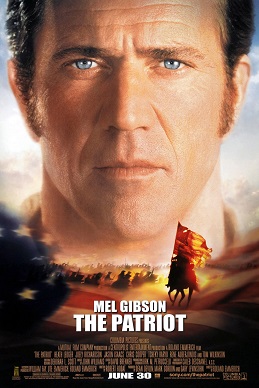
First released in the year 2000, The Patriot stars Mel Gibson (back before the arrests and scandals) as Benjamin Martin.
Benjamin Martin is a planter living in colonial-era South Carolina. When he was younger, he fought in the French/Indian War and was infamous for his ferocity as a combatant. However, in the year 1776, he is devoted to working the land and peacefully caring for his children. When, as a member of the South Carolina General Assembly, he is called upon to cast a vote for or against independence, he abstains. He’s no fan of the British but he’s also seen the harsh reality of war and doesn’t want his sons to have any part of it. However, the Assembly still votes for Independence and Martin’s oldest son, Gabriel (Heath Ledger), is among the first to enlist in the army.
Four years later, the British come to the Martin farm and demand that Benjamin had over a wounded Gabriel to them. When Benjamin resists, the arrogant Col. Tavington (Jason Isaacs) kills one of Benjamin’s other sons. After Tavington has Gabriel arrested, Benjamin and two of his remaining sons track down the British convoy transporting him. While his two youngest sons look on in horror, Benjamin savagely shoots and hacks to death all of the British soldiers and rescues Gabriel.
The Patriot may be a film about the American Revolution but it’s also definitely a Mel Gibson film. That means that Benjamin is man driven as much be revenge as by a desire to win his country’s independence. The British killed his son and burned down his house. Benjamin responds by grabbing his musket and packing his axe and soon, it’s more common than not to see Benjamin covered in blood. Benjamin attacks like a feral beast who is determined to dominate anyone and anything that would invade his territory. Two of his sons go from being honored to be asked to come along to being terrified at the sight of their father murdering soldier after soldier. It’s probably the most emotionally honest moment you’ll ever find in a Roland Emmerich film. Of course, whether Emmerich meant for it to be so is open to debate.
And indeed, it should be noted that The Patriot is very much a Roland Emmerich film. The running time is an epic 165 minutes. The battle scenes are long and loud and carefully choreographed. Gibson was still rugged and handsome when he played Benjamin Martin. (Both before his downfall and after, Gibson has always been best cast as people who just want to be left alone and who finally snap once it becomes obvious that’s not going to happen.) Heath Ledger almost appears beatific in his scenes. The film looks great without ever quite looking authentic. It’s like a fever dream that is less about how the American Revolution was actually fought and more about how we imagine it was fought.
And you know what?
The film works for me. This is one of Emmerich’s best films, which admittedly is not a high bar to clear. Yes, it’s a bit simplistic. Yes, it’s not historically accurate. Yes, all of the British are portrayed as being one-dimensional villains. Who cares? Whether he realizes it or not, Roland Emmerich has always been a B-movie maker at heart and The Patriot is effective in much the same way that many crude but shameless B-movies are. The mix of Mel Gibson’s madness, Heath Ledger’s beatific earnestness, and Jason Isaac’s arrogance transforms The Patriot into a triumph of the pulp imagination. Much like America itself, The Patriot is big and loud and it makes absolutely no apologies.
I Watched Molokai: The Story of Father Damien (1999, Dir. by Paul Cox)
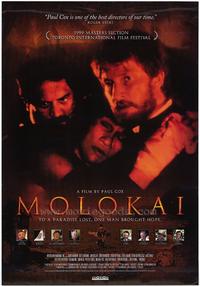
In the late 19th Century, a leper colony was established on the Hawaiian island of Molokai. Officially, the Kalaupapa Leprosy Settlement was said to be for the care of people with leprosy, which was then raging across Asia. Unofficially, it was a prison where lepers were isolated from the rest of society and left to die. Any leper who tried to leave the colony would be shot on sight. Father Damien, a Belgian priest, was one of the few people willing to walk amongst the lepers. When he was first sent to the colony, he was ordered to only administer last rites to the dying and to not allow himself to be touched. Instead, Damien stayed and ministered to the lepers, knowing that he would probably never be allowed to leave. For 16 years, Damien ministered to the colony. Even after he himself grew sick, he continued his ministry and continued to be an advocate for his fellow lepers until he died.
Molokai: The Story of Father Damien is a wonderful film about the life and ministry of Father Damien. The movie features a lot of familiar actors in small roles, like Sam Neill, Kris Kristofferson, Peter O’Toole, Tom Wilkinson, and Alice Krige. But the star of the film is David Wenham, who portrays the kindness and dedication of Father Damien without ever making him seem idealized or boring. Father Damien is guided by both his faith and his belief that no one should be abandoned. It’s not always easy to watch. The horrors of leprosy are unflinchingly portrayed. But, by the end of the movie, it doesn’t matter if you’re Catholic or not. You’re just thankful for men like Father Damien.
Saint Damien of Molokai was canonized by Pope Benedict XVI in 2009.
Lisa Marie Reviews An Oscar Nominee: In The Name Of The Father (dir by Jim Sheridan)
One thing that I’ve come to realize is that Irish-Americans (like myself) have been guilty of idealizing the Irish Republican Army in the past.
We tend to view the IRA as being freedom fighters, battling against the occupation and standing up against religious bigotry. The truth of the matter is that the IRA was a violent organization whose actions often made things even worse for the Catholics in Northern Ireland. While the IRA’s American supporters always tended to present the IRA as plotting actions against the British army, the truth of the matter is that many of the IRA’s victims were Irish citizens who were judged to either be collaborators or to not be properly enthused about the IRA in general. The popular excuse for the IRA’s terrorism is to say that the IRA usually called and gave advanced warning before a bomb went off but really, that’s kind of a weak excuse when you think about it. Really, the only thing that the IRA had going for it was that the British were often just as bad and even more heavy-handed when it came to dealing with the Irish.
In 1993’s In The Name of the Father, Daniel Day-Lewis plays Gerry Conlon, who is sent to London by his father, Giuseppe (Pete Postlethwaite), specifically to keep him from falling victim to the IRA. Of course, once Gerry arrives in London, he supports himself through burglaries and spends most of his time in a state of stoned bliss with his friends. It’s while Gerry is in London that an IRA bomb blows up a pub in Guildford. When Gerry later returns to Belfast, he is promptly arrested and accused of being one of the four people responsible for the bombing.
Gerry protests that he’s innocent and we know that he’s innocent. We know that, when the bomb was placed, Gerry was busy getting high with Paul Hill (John Lynch). Paul has also been arrested and the British police are determined to get a confessions out of both him and Gerry. The interrogation stretches for hours. Though exhausted, Gerry refuses to confess. Suddenly, Inspector Robert Dixon (Corin Redgrave) enters the room. He walks up to Gerry and whispers in his ear that if Gerry doesn’t confess, “I will kill your Da.”
It’s a shocking moment because the threat is delivered without a moment of hesitation on the part of Dixon. Dixon’s voice is so cold and so direct that, when I watched this film, I actually gasped at the line. An exhausted and terrified Gerry confesses. Soon, Gerry is thrown in prison. He’s joined by his sickly father, who has been accused of being a co-conspirator. At first, Gerry resigns himself to never being free again. He meets Joe (Don Baker), who says that he’s the one who set the bomb and that he confessed after Gerry, Giuseppe, Paul Hill, and the other members of the so-called Guildford Four had been given their life sentences. With Giuseppe’s health faltering, Gerry finally steps up and, with the help of an attorney (Emma Thompson), fights for his freedom.
In The Name of the Father is a powerful film, one that was based on a true story. Gerry and his father come to represent every victim of a biased justice system and an authoritarian-minded police force. Gerry starts the movie trapped between the two sides of the Troubles. The IRA doesn’t trust him because he’s not a bomb-thrower. The British distrust him because he’s Irish. Despite his innocence being obvious, Gerry finds himself sent to prison because letting him go would be viewed as a sign of weakness. Daniel Day-Lewis gives a passionate and charismatic performance as the impulsive and somewhat immature Gerry but the film’s heart really belongs to the late Pete Postlethwaite, playing a father who refuses to give up on either his freedom or his son.
In The Name of the Father received seven Oscar nominations, including Best Picture, Director, Actor, Supporting Actor, and Supporting Actress (for Emma Thompson). That was also the year of Schindler’s List, which took the Oscars for both Picture and Director. Daniel Day-Lewis lost to Philadelphia’s Tom Hanks while Postlethwaite lost to Tommy Lee Jones for The Fugitive and Thompson lost to Anna Paquin for The Piano. 1993 was a good year for movies and the Oscars, though I would have voted for Day-Lewis over Hanks.
RUSH HOUR – 1998, a special year for this fan of Hong Kong action cinema!
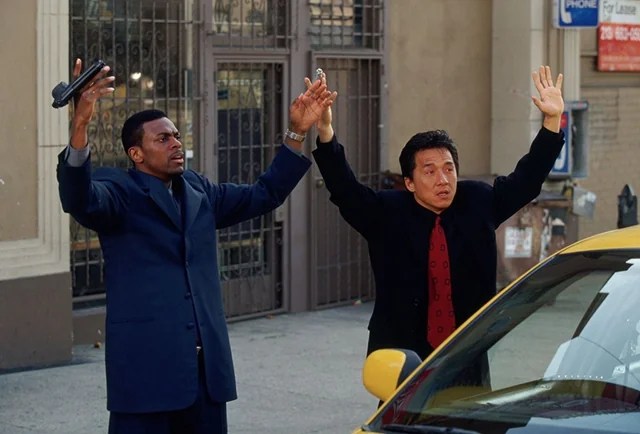
1998 was certainly a special year for me as a fan of Hong Kong cinema but first let me provide a little context… After 150 years of British rule, Hong Kong was being handed over to communist China on July 1, 1997. This left a lot of uncertainty in Hong Kong’s local film industry. Because of that uncertainty, many of Hong Kong’s most popular filmmakers decided it was time to take their talents abroad. Director John Woo had already left for America in the early 90’s and had made successful films like HARD TARGET, BROKEN ARROW and FACE/OFF. This gets us to 1998, the year that many of Hong Kong’s biggest action stars would release their first American films. Chow Yun-fat would reprise his popular, honorable hitman role in his first American film, THE REPLACEMENT KILLERS, which was produced by John Woo and directed by Antoine Fuqua. Jet Li would make a strong impact as the badass villain in the 4th installment of the LETHAL WEAPON franchise. And then there’s Jackie Chan, probably the biggest of all the Hong Kong movie stars. Jackie had been banging around Hollywood as early as 1980 without a lot of fanfare in the west. But in 1996 Chan had a solid American box office hit when his Hong Kong production RUMBLE IN THE BRONX was dubbed and released in America. Armed with that success and a sizable budget provided by an American studio, Chan would get his own big release in 1998, the action-comedy RUSH HOUR!
In RUSH HOUR, Jackie Chan plays inspector Lee, a Hong Kong police detective who’s also a friend to Chinese Consul Han (Tzi Ma), currently serving in Los Angeles. When Consul Han’s daughter Soo Yung is kidnapped, he asks Lee to come to America to assist him and the FBI in rescuing her. The FBI doesn’t really want Lee’s help so they ask the Los Angeles police department to assign someone, anyone, to stay with Lee and keep an eye on him so he doesn’t get in the way of their investigation. Enter fast-talking, LAPD Detective James Carter. After some initial clashes and disagreements, the mismatched duo eventually begins working together to find the criminal mastermind behind the kidnapping, Juntao.
I watched RUSH HOUR at the movie theater on my birthday in 1998. I loved every second of it. A few weeks later I was on a business trip in Chicago, I told my boss how good the film was, and we went to see it as well. I enjoyed it just as much the 2nd time. I’m a big fan of “buddy cop” films like LETHAL WEAPON and BAD BOYS, and RUSH HOUR is an excellent addition to that sub-genre of action films. Jackie Chan and Chris Tucker have an excellent chemistry together. Their comedic interplay is hilarious and entertaining. It’s one of the main reasons I enjoy the movie so much. Jackie Chan was 44 years old when RUSH HOUR was released, but he was still extremely athletic so his brand of martial arts action and comedy still worked. The movie would go on to gross just short of $250 million at the worldwide box office and establish Jackie Chan as a bonafide star in the American film market. 2001’s RUSH HOUR 2 would be an even bigger hit, making almost $350 million worldwide. No one works harder or gives more of himself to his film productions than Jackie Chan, and it was nice seeing him achieve the truly worldwide success that he had earned!
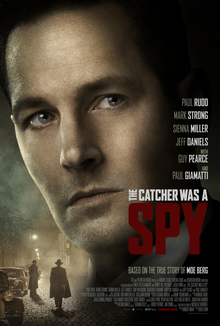
Film Review: The Catcher Was A Spy (dir by Ben Lewin)
I was so impressed with Paul Rudd’s performance in Avengers: Endgame that, last night, I decided to watch another Paul Rudd film, 2018’s The Catcher Was A Spy.
Based on a true story, The Catcher Was A Spy tells the tale of Moe Berg (Paul Rudd). When we first meet Moe, it’s towards the end of World War II and Moe has been sent behind enemy lines to investigate just how close the Nazis are to building an atomic bomb. Intelligence suggests that physicist Werner Heisenberg (Mark Strong) is leading the Nazi effort and, if the intelligence turns out to be true, Moe has been ordered to assassinate Heisenberg. As Moe considers whether or not he’s actually capable of killing a man, we get flashbacks to how Moe eventually ended up working as a spy.
What we learn is that, in the 1930s, Moe Berg was a major league baseball player. He was a catcher and, though he was never a great player, he was famous for being far more educated than the average professional athlete. At a time when open anti-Semitism was socially acceptable among America’s upper classes, Moe Berg managed to get an Ivy League education. Not only does he keep up with current events but he can also speak several languages. The other players aren’t quite sure what to make of Moe, nor does Moe ever seem to make much of an effort to open up to anyone, including his girlfriend, Estella (Sienna Miller, playing yet another girlfriend in yet another biopic).
Because he can speak Japanese, Moe is selected to be a part of a delegation of players who will be sent to Japan. While the rest of the players hang out around the hotel, Moe hangs out with an intellectual named Kawabata (Hiroyuki Sanada), discusses inevitably of war, and — for reasons that the film deliberately leaves unclear — decides to shoot a film of Tokyo Harbor.
Five years later, with the United States now at war with the Axis powers, it’s that film that leads to Moe getting a meeting with the head of the Office of Strategic Services, Bill Donovan (Jeff Daniels). No longer a baseball player and apparently bored with coaching, Moe wants to become a spy. Donovan notes that Moe has never married and asks him flat out if he’s gay. Moe smiles slightly and says, “I’m good at keeping secrets.”
And indeed, he is! Unfortunately, Moe is so good at keeping secrets that we never quite get into his head. It’s hard not to compare this film to the superficially similar The Imitation Game. But whereas that film made you feel as if you were seeing the world through Alan Turing’s eyes, The Catcher Was A Spy always seems to be standing outside of Moe Berg. In the film’s final title cards, it refers to Moe as being an “enigma” and that’s pretty much the way he is throughout the entire film. We like him because he’s played by Paul Rudd but we never really feel like we know him. The closest the film comes to suggesting what’s going on inside the head of its main character is when Moe — who has described himself as non-religious — attends a Kol Nidrel service at a Zurich synagogue and, for a few minutes, Moe lets his guard down. But, for the majority of the film, Moe remains unknowable.
With the exception of one battle scene, it’s also a rather low-key spy film, one that’s more in the style of Tinker, Tailor, Soldier, Spy than SPECTRE. Again, that may be true to the actual story but, considering that it’s a film about a possibly gay Jew working to take down a homophobic, anti-Semitic war machine, it’s still hard not to regret the film’s lack of big “stand up and cheer” moments. Clocking in at a rather brisk 97 minutes, it’s hard not to feel that there’s some big pieces missing from the film’s story.
Here’s the good news: Paul Rudd proves himself to be a thoroughly charismatic leading man in this film, showing that he can hold the audience’s attention even without special effects or a punch line. Rudd does an excellent job playing a character who, to be honest, has very little in common with what we may think of as being a typical Paul Rudd role. Rudd is always watchable, even while Moe Berg remains an enigma. Hopefully, Rudd will get more opportunities in the future to show us what he’s truly capable of doing as an actor.
Playing Catch-Up: The Accountant, Carnage Park, The Choice, The Legend of Tarzan
Continuing my look back at the films of 2016, here are four mini-reviews of some films that really didn’t make enough of an impression to demand a full review.
The Accountant (dir by Gavin O’Connor)
2016 was a mixed year for Ben Affleck. Batman v. Superman may have been a box office success but it was also such a critical disaster that it may have done more harm to Affleck’s legacy than good. If nothing else, Affleck will spend the rest of his life being subjected to jokes about Martha. While Ben’s younger brother has become an Oscar front runner as a result of his performance in Manchester By The Sea, Ben’s latest Oscar effort, Live By Night, has been released to critical scorn and audience indifference.
At the same time, Ben Affleck also gave perhaps his best performance ever in The Accountant. Affleck plays an autistic accountant who exclusively works for criminals and who has been raised to be an expert in all forms of self-defense. The film’s plot is overly complicated and director Gavin O’Connor struggles to maintain a consistent tone but Affleck gives a really great performance and Anna Kendrick reminds audiences that she’s capable of more than just starring in the Pitch Perfect franchise.
Carnage Park (dir by Mickey Keating)
I really wanted to like Carnage Park, because it was specifically advertised as being an homage to the grindhouse films of the 1970s and y’all know how much I love those! Ashley Bell plays a woman who gets kidnapped twice, once by two bank robbers and then by a psycho named Wyatt (Pat Healy). Healy chases Bell through the desert, hunting her Most Dangerous Game-style. There are some intense scenes and both Bell and Healy are well-cast but, ultimately, it’s just kind of blah.
The Choice (dir by Ross Katz)
The Choice was last year’s Nicholas Sparks adaptation. It came out, as all Nichols Sparks adaptations do, just in time for Valentine’s Day and it got reviews that were so negative that a lot of people will never admit that they actually saw it. Benjamin Walker and Teresa Palmer play two people who meet, fall in love, and marry in North Carolina. But then Palmer is in a car accident, ends up in a coma, and Walker has to decide whether or not to turn off the life support.
As I said, The Choice got terrible reviews and it’s certainly not subtle movie but it’s actually better than a lot of films adapted from the work of Nicholas Sparks. Walker and Palmer are a likable couple and, at the very least, The Choice deserves some credit for having the courage not to embrace the currently trendy cause of euthanasia. That alone makes The Choice better than Me Before You.
The Legend of Tarzan (dir by David Yates)
Alexander Skarsgard looks good without his shirt on and Samuel L. Jackson is always a fun to watch and that’s really all that matters as far as The Legend of Tarzan is concerned. It’s an enjoyable enough adventure film but you won’t remember much about it afterward. Christoph Waltz is a good actor but he’s played so many villains that it’s hard to get excited over it anymore.
Lisa Reviews An Oscar Nominee: Sense and Sensibility (dir by Ang Lee)
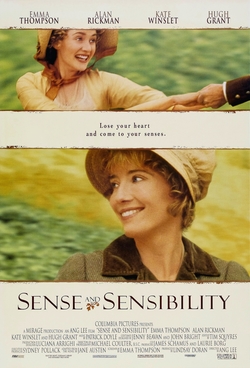
I just finished watching the 1995 best picture nominee Sense and Sensibility on TCM and, despite the fact that I’ve watched it several times in the past, I’m glad that I took time to rewatch it. Sense and Sensibility is one of those very special films that you should rewatch every few months just to be reminded of how good it is. There’s no CGI in Sense and Sensibility. Instead, there’s just some very good writing, some excellent performances, and some lushly wonderful images of the English countryside, courtesy of director Ang Lee. It’s a deliberately paced film, one that proves the virtue of a subtle touch.
The film tells the story of the Dashwoods. As Mr. Dashwood (Tom Wilkinson) dies, he tells his son by his first wife, John (James Fleet), to take care of his second wife (Gemma Jones) and their three daughters, Elinor (Emma Thompson), Marianne (Kate Winslet), and Margaret (Emilie Francois). Naturally enough, John does the exact opposite and soon the Dashwood sisters are forced to leave their large estate and fend for themselves.
The film centers on the practical Elinor and the passionate Marianne. Elinor meets and falls in love with Edward (a surprisingly restrained Hugh Grant), an aspiring clergyman who is also John’s brother-in-law. Edward comes from a wealthy family but will be disinherited if he marries someone who has neither money nor social prominence. Marianne, meanwhile, has fallen in love with John Willoughby (Greg Wise), who is handsome, dashing, rich, and a bit of a cad. (Cad is such a cool word. People should start using it more.) Marianne is so in love with the unworthy Willoughby that she misses the fact that the kindly Col. Brandon (Alan Rickman) has also fallen in love with her.
Sense and Sensibility is based on a Jane Austen novel and, in its very British way, it’s a wonderfully romantic film. Tonight, when viewed in the shadow of the recent passing of Alan Rickman, the scenes featuring Col. Brandon were even more poignant than usual. His love for Marianne is perhaps the most pure and selfless love to be found in the entire film. There’s a scene where Col. Brandon is speaking to Elinor and Marianne, inviting them to his estate. Marianne ignores him until Brandon mentions that Willoughby is also inspected. Suddenly, Marianne looks up and smiles and Alan Rickman allows just a hint of pain to enter his voice. It’s a masterful performance.
But really, the reason why I love this film is because it’s about sisters. I am the youngest of four sisters and, whenever I see this film, it’s hard for me not to see the Bowman sisters in the Dashwood sisters. There is so much about Marianne that I relate to, from her passionate pursuit of “true love” to her artistic sensibility to her somewhat dangerous habit of wandering around in the middle of thunderstorm. You never doubt for a second that Emma Thompson and Kate Winslet could be related and this film always makes me appreciate my own sisters.
Sense and Sensibility was nominated for Best Picture of 1995 but it lost to a film that is its total opposite, Mel Gibson’s Braveheart.
Playing Catch-Up: Jenny’s Wedding (dir by Mary Agnes Donoghue)
There’s an early scene in Jenny’s Wedding in which Jenny (Katherine Heigl) is talking to her roommate, Kitty (Alexis Biedel) about how difficult it is to spend time with her family. They all want to know when Jenny is going to get married. After all, her younger sister, Anne (Grace Gummer), is married. Jenny tells Kitty that she does want to get married and start a family and she wants to do it soon.
Kitty replies with something like: “I guess you’re going to have to tell them about us.”
And WOW! THAT WOULD BE SUCH A MIND-BLOWING MOMENT … if not for the fact that it’s 2015. Jenny’s Wedding seems to take place in an alternative universe where Glee was never a hit TV show, thousands of people never changed their Facebook avatar to a rainbow flag, Milk was never a box office hit, nobody’s ever watched a program on Bravo or seen that Ikea commercial, and the majority of Americans continue to believe that gays are some exotic group of people who exclusively live in New York, San Francisco, and Oak Lawn. Maybe in 2002, Jenny’s Wedding‘s approach to LGBT issues would have felt brave and groundbreaking but in 2015, it just feels heavy-handed and trite.
“Nothing will ever be the same again!” Jenny’s mom (Linda Emond) wails when Jenny comes out of the closet.
“I mean, we’re ordinary people…” Jenny’s dad (Tom Wilkinson) laments when Jenny tells him that she’s a lesbian and she’s going to marry Kitty.
“They must’ve done something wrong,” one of the neighbors is overhead gossiping after it becomes common knowledge that Jenny is getting married to a *GASP* woman.
Especially when compared to the many truly groundbreaking, touching, and thought-provoking LGBT-films that have been released over the past few years, Jenny’s Wedding is heavy-handed and utterly lacking in either nuance or insight. Watching it, I wondered who could be responsible for making such an old-fashioned film that seemed to be so totally out-of-touch with the modern world. Then I checked with Wikipedia and discovered that the film’s director is 72 years old and straight and that explained a lot.
I think the idea was for the viewers to be stunned that Katherine Heigl was playing a lesbian and I guess the viewers are all supposed to think, “If Katherine Heigl can be a lesbian, then anyone can be a lesbian!” And I guess that could have happened in 2002, though it still seems to be based on a massive misreading of the popularity of a performer who has, several times, literally been described as being “box office poison.” But this is 2015 and anyone who still believes that a character played by Katherine Heigl could never be a lesbian probably is not going to be watching a movie about a lesbian wedding.
As well, it doesn’t help that Katherine Heigl gives a performance that is brittle even by the standards of Katherine Heigl. Watching Jenny’s Wedding, I couldn’t help but feel that Kitty could do so much better.
Shattered Politics #87: The Ghost Writer (dir by Roman Polanski)
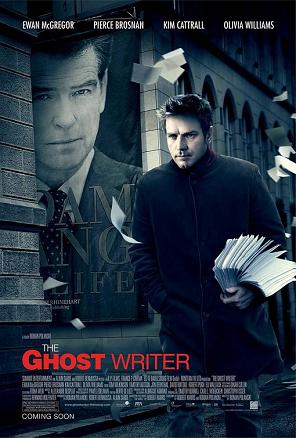 In the 2010 film The Ghost Writer, Ewan McGregor plays a character known as the Ghost. We never actually learn the name of his character and that’s perhaps appropriate. The Ghost has made his living by being anonymous. He’s a ghost writer. He’s the guy who is hired to help inarticulate and occasionally illiterate celebrities write best-selling biographies.
The Ghost has been given a new assignment. He is to ghost write the memoirs of former British Prime Minister Adam Lang (Pierce Brosnan). Despite the fact that Adam is one of the most famous men in the world, the Ghost is not initially enthusiastic about working with him.
First off, there’s the fact that Adam and his wife, Ruth (Olivia Williams), are currently hiding out in America because America is one of the few countries that will not extradite him to be prosecuted for war crimes at the International Criminal Court. It seems that Adam (much like Tony Blair) is a controversial figure because of some of the actions he may have authorized as a part of the war on terror. Not only does the Ghost have political objections to working with Adam but he has to leave his London home and go to Massachusetts in order to do so.
Secondly, there’s the fact that, once the Ghost arrives in America, he discovers that — for such a controversial figure — Adam is actually rather boring and seems to have very little knowledge about anything that he did while he was prime minister. Instead, he seems to be more interested in spending time with his mistress (Kim Cattrall, giving the film’s one bad performance). Ruth seems to be the political (and smart) one in the marriage.
And finally, there’s the fact that the Ghost is actually the second writer to have worked with Adam. The previous writer mysteriously drowned. While that death was ruled to be an accident, the Ghost comes to suspect that it was murder and that the motive is hidden in the first writer’s manuscript…
The Ghost Writer is a favorite of mine, a smart and witty political thriller that features great performances from Ewan McGregor, Olivia Williams, and Pierce Brosnan. Brosnan especially seems to be having a lot of fun sending up his dashing, James Bond image. Roman Polanski directs at a fast pace and maintains a perfect atmosphere of growing paranoia throughout the entire film. In the end, The Ghost Writer proudly continues the tradition of such superior paranoia films as The Conversation, Three Days of the Condor, and the Parallax View.
Incidentally, I have a theory that Adam Lang was also the unseen Prime Minister who was featured in Into the Loop. Watching The Ghost Writer, it’s hard not to feel that Adam really feel apart without Malcolm around to help him out.

