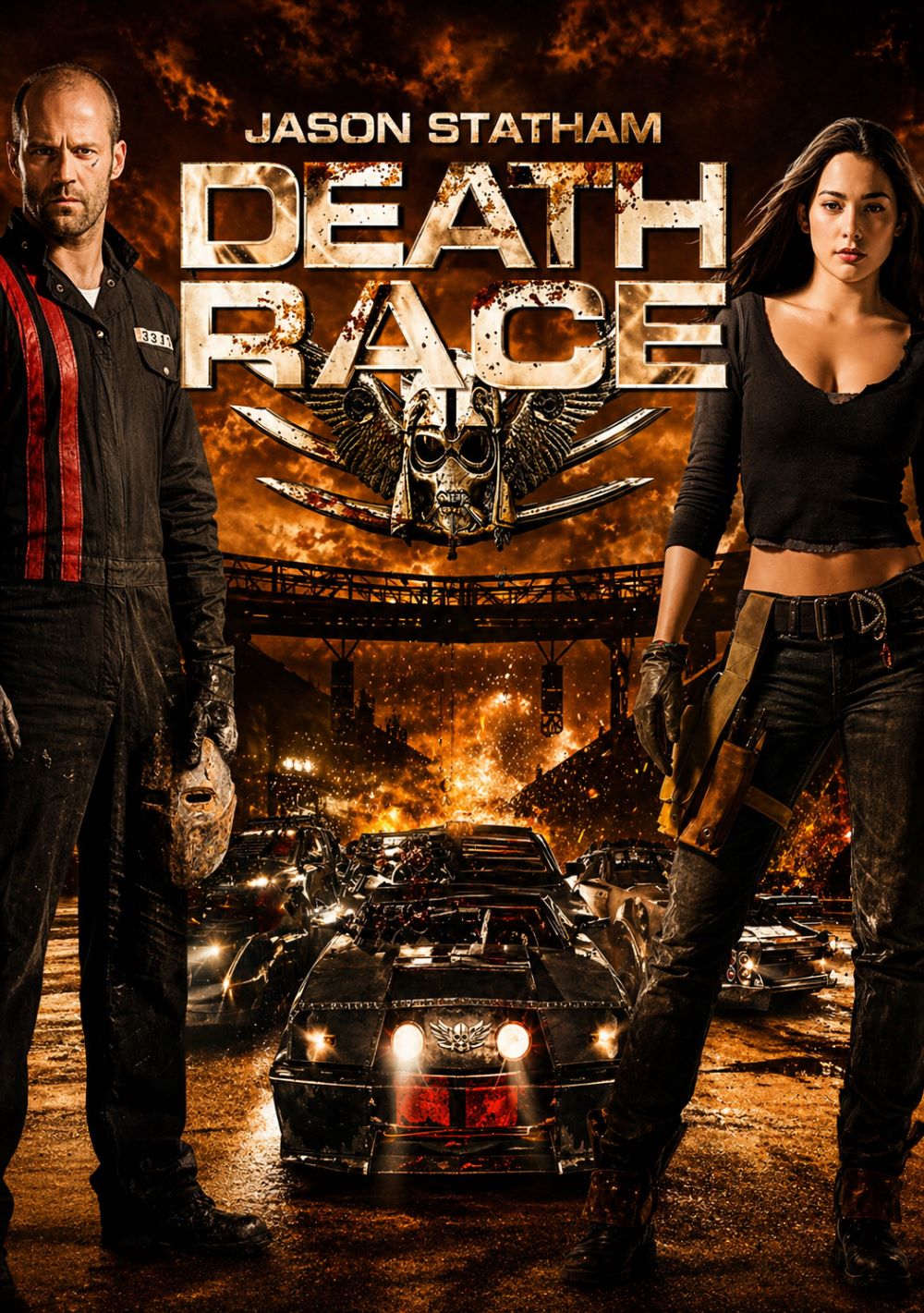
Guilty Pleasure No. 114: Death Race (dir. by Paul W.S. Anderson)


Death Race (2008) is the kind of movie that feels like it was engineered in a lab specifically to test how much nonsense an audience will tolerate as long as things explode every ten minutes. Directed by Paul W.S. Anderson, a filmmaker whose entire career seems built on the philosophy of “style over literally anything else,” the film doesn’t so much tell a story as it barrels through one at full speed, flipping off logic, subtlety, and occasionally even coherence along the way. And yet—this is the annoying part—it works. Not in a “this is a good film” sense, but in that grimy, late-night cable, “I probably shouldn’t be enjoying this as much as I am” way.

The premise is pure pulp: in a dystopian future where the economy has collapsed (because of course it has), prisons have turned into profit-generating entertainment hubs. The main attraction is the Death Race, a gladiatorial car battle where inmates drive weaponized vehicles and murder each other for the amusement of a bloodthirsty audience. Jason Statham plays Jensen Ames, a wrongfully convicted ex-racer forced to step into the role of a masked legend named Frankenstein. It’s as blunt and ridiculous as it sounds, and the movie never once tries to elevate it beyond that. There’s no pretense of social commentary that isn’t immediately undercut by another machine gun turret popping out of a car hood.

Anderson directs the whole thing like he’s permanently hopped up on energy drinks and early 2000s music video aesthetics. The camera is constantly moving, cutting, shaking, and occasionally losing track of what’s happening entirely. Action scenes are edited within an inch of their life, creating a sense of chaotic momentum that’s exciting in the moment but completely disposable five seconds later. It’s visual junk food—greasy, loud, and weirdly satisfying even when you know it’s terrible for you.

A huge part of why Death Race remains watchable—arguably the biggest reason—is the decision to cast Jason Statham in the lead. This is exactly the kind of role his entire screen persona was built for, and the film leans on that heavily. Statham doesn’t bring depth or complexity, but he brings something more valuable here: credibility. You believe he can survive this world. You believe he can drive, fight, and endure the endless barrage of chaos being thrown at him. In a movie this dumb, that kind of grounding goes a long way. Swap him out for a less naturally commanding actor, and the whole thing probably collapses under its own stupidity.

That’s not to say he’s delivering some kind of nuanced performance. He isn’t. He operates in that familiar Statham mode—minimal dialogue, maximum scowl, and a constant sense that he’s two seconds away from breaking someone’s arm. But that simplicity works in the film’s favor. He becomes the one stable element in an otherwise unhinged movie, a human anchor that keeps the madness from drifting into outright parody. The choice to center the film around him is one of the few decisions here that feels genuinely smart, even if everything surrounding it is chaos.

Then you’ve got Joan Allen, who plays the prison warden with a level of icy commitment that almost tricks you into thinking the movie has something deeper going on. She treats the Death Race like high art, which is both hilarious and oddly effective. There’s a strange tension between her seriousness and the film’s inherent stupidity that gives Death Race a bit more texture than it probably deserves. She’s acting in a better movie that doesn’t exist, and somehow that makes this one more watchable.

But let’s not kid ourselves—this is not a good film. The characters are paper-thin, the dialogue is aggressively functional, and the plot moves forward with the grace of a sledgehammer. Emotional beats land with a dull thud, and any attempt at stakes is drowned out by the next explosion or metal-on-metal collision. It’s the kind of movie where you can predict every major turn five minutes in advance and still not care because you’re too busy watching a car fire a missile at another car.

What makes Death Race oddly compelling, though, is how completely it commits to its own stupidity. There’s no wink to the audience, no self-aware humor trying to soften the edges. It plays everything straight, which paradoxically makes it feel more honest than a lot of “so bad it’s good” movies. It’s not trying to be clever or subversive—it just wants to show you armored cars smashing into each other while people scream and things explode. And on that level, it absolutely delivers.

There’s also something weirdly nostalgic about it. It feels like a relic of a very specific era of action filmmaking, where grit meant desaturated colors, shaky cameras, and protagonists who communicated exclusively through clenched jaws and short sentences. It’s pre-Mad Max: Fury Road, pre-the current wave of more thoughtfully constructed action cinema. Death Race exists in that awkward middle ground where filmmakers had access to bigger budgets and better effects but hadn’t quite figured out how to use them with any real finesse.

And yet, despite all its flaws—or maybe because of them—it’s entertaining. Not in a “this is a masterpiece” way, but in that guilty pleasure sense where you’re fully aware of how dumb it is and still having a good time. It’s a film that succeeds almost accidentally, powered by sheer momentum and a refusal to slow down long enough for you to think too hard about what you’re watching.

In the end, Death Race is a mess. A loud, clunky, overedited mess with delusions of intensity and a complete disregard for nuance. But it’s also a perfect example of a movie that’s entertaining despite itself. It shouldn’t work, and on paper, it really doesn’t. But between the explosions, the ridiculous premise, and—crucially—Statham’s perfectly calibrated presence, it finds a groove and sticks to it. You don’t respect it, you don’t admire it—but you kind of enjoy the hell out of it anyway.

Previous Guilty Pleasures

  1. Half-Baked
  2. Save The Last Dance
  3. Every Rose Has Its Thorns
  4. The Jeremy Kyle Show
  5. Invasion USA
  6. The Golden Child
  7. Final Destination 2
  8. Paparazzi
  9. The Principal
  10. The Substitute
  11. Terror In The Family
  12. Pandorum
  13. Lambada
  14. Fear
  15. Cocktail
  16. Keep Off The Grass
  17. Girls, Girls, Girls
  18. Class
  19. Tart
  20. King Kong vs. Godzilla
  21. Hawk the Slayer
  22. Battle Beyond the Stars
  23. Meridian
  24. Walk of Shame
  25. From Justin To Kelly
  26. Project Greenlight
  27. Sex Decoy: Love Stings
  28. Swimfan
  29. On the Line
  30. Wolfen
  31. Hail Caesar!
  32. It’s So Cold In The D
  33. In the Mix
  34. Healed By Grace
  35. Valley of the Dolls
  36. The Legend of Billie Jean
  37. Death Wish
  38. Shipping Wars
  39. Ghost Whisperer
  40. Parking Wars
  41. The Dead Are After Me
  42. Harper’s Island
  43. The Resurrection of Gavin Stone
  44. Paranormal State
  45. Utopia
  46. Bar Rescue
  47. The Powers of Matthew Star
  48. Spiker
  49. Heavenly Bodies
  50. Maid in Manhattan
  51. Rage and Honor
  52. Saved By The Bell 3. 21 “No Hope With Dope”
  53. Happy Gilmore
  54. Solarbabies
  55. The Dawn of Correction
  56. Once You Understand
  57. The Voyeurs 
  58. Robot Jox
  59. Teen Wolf
  60. The Running Man
  61. Double Dragon
  62. Backtrack
  63. Julie and Jack
  64. Karate Warrior
  65. Invaders From Mars
  66. Cloverfield
  67. Aerobicide 
  68. Blood Harvest
  69. Shocking Dark
  70. Face The Truth
  71. Submerged
  72. The Canyons
  73. Days of Thunder
  74. Van Helsing
  75. The Night Comes for Us
  76. Code of Silence
  77. Captain Ron
  78. Armageddon
  79. Kate’s Secret
  80. Point Break
  81. The Replacements
  82. The Shadow
  83. Meteor
  84. Last Action Hero
  85. Attack of the Killer Tomatoes
  86. The Horror at 37,000 Feet
  87. The ‘Burbs
  88. Lifeforce
  89. Highschool of the Dead
  90. Ice Station Zebra
  91. No One Lives
  92. Brewster’s Millions
  93. Porky’s
  94. Revenge of the Nerds
  95. The Delta Force
  96. The Hidden
  97. Roller Boogie
  98. Raw Deal
  99. Death Merchant Series
  100. Ski Patrol
  101. The Executioner Series
  102. The Destroyer Series
  103. Private Teacher
  104. The Parker Series
  105. Ramba
  106. The Troubles of Janice
  107. Ironwood
  108. Interspecies Reviewers
  109. SST — Death Flight
  110. Undercover Brother
  111. Out for Justice
  112. Food Wars!
  113. Cherry

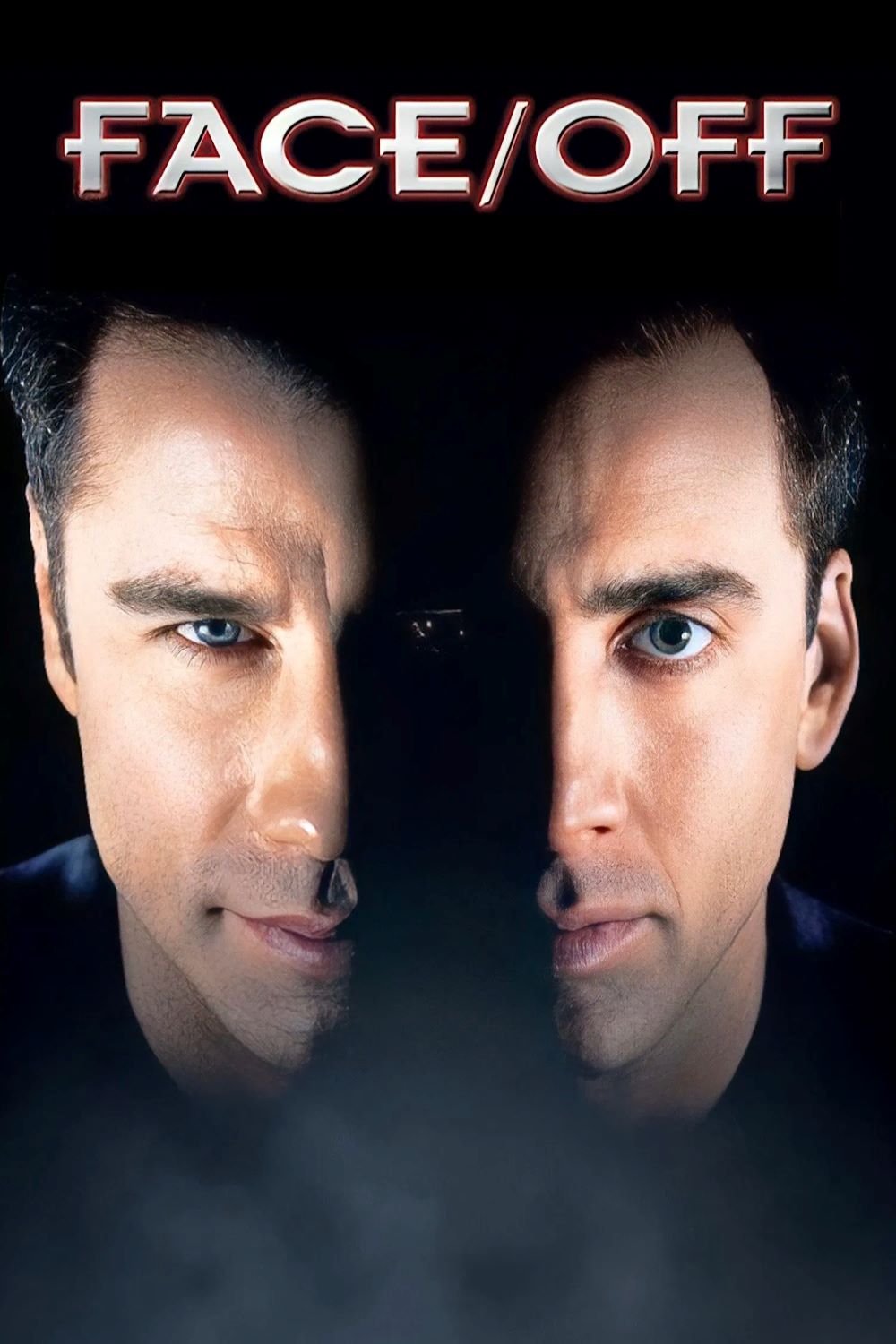
Review: Face/Off (dir. by John Woo)


“It’s like looking in a mirror. Only… Not.”​ — Castor Troy with Sean Archer’s face

Face/Off is one of those late‑90s action movies that feels like it escaped from an alternate universe where “too much” is a compliment, not a warning label. It is bigger than it needs to be, sillier than the premise probably deserves, and yet somehow more emotionally earnest than most modern blockbusters. The result is a film that swings hard between breathtakingly good and gloriously ridiculous, and that tension is exactly what makes it worth revisiting.​

At its core, Face/Off is a story about two men who literally become each other, but it works because it never treats that concept as a small thing. John Travolta’s Sean Archer is an FBI agent consumed by grief after the death of his young son, while Nicolas Cage’s Castor Troy is a theatrical terrorist who seems to enjoy being evil as a kind of performance art. The sci‑fi hook—cutting off their faces and swapping them—does not remotely pass a reality test, but the movie leans into the idea with such conviction that you either roll with it or get left behind in the opening act.​

The big selling point is the acting showcase baked into that swap. Watching Travolta play a supposedly buttoned‑up lawman unraveling inside the body of a flamboyant villain, while Cage dials his madness into something deceptively controlled, gives the film a strange, theatrical energy. There is a real pleasure in tracking how each actor steals little gestures and rhythms from the other, so scenes become layered: what you’re seeing on the surface and who you know is “underneath” the borrowed face are constantly at odds.​

That identity confusion isn’t just a gimmick; it gives the film some surprising emotional weight. Archer’s grief isn’t window dressing—his obsession with bringing down Troy comes from the trauma of losing his son, and the face swap forces him to confront who he’s become in that tunnel‑vision pursuit. Meanwhile, Troy, once inside Archer’s life, plays “family man” in a way that’s both gross and unnervingly intimate, manipulating Archer’s wife Eve and daughter Jamie with a mix of faux tenderness and predatory charm.​

Joan Allen, as Eve, quietly grounds all this insanity. Her character spends a good chunk of the film being gaslit on a level that would break most people, yet Allen plays her with a subdued intelligence that makes the eventual moment of realization feel earned instead of convenient. Dominique Swain’s Jamie gets more of a stock “rebellious teen” setup, but the way Troy‑as‑Archer slithers into her life gives some scenes a genuinely uncomfortable edge, underlining how invasive the villain’s masquerade really is.​

Of course, this is a John Woo movie, so the drama is constantly fighting for space with balletic gunfights and slow‑motion chaos. The action is elaborate and stylized, full of dual pistols, flying bodies, and highly choreographed carnage that feels closer to a violent dance than a grounded firefight. Whether it is the prison escape with its magnetic boots or the church shootout framed with doves and religious imagery, Woo stages set pieces as big operatic crescendos, not just plot checkpoints.​

That operatic tone is both a strength and a weakness. On the one hand, the heightened style matches the bonkers premise, letting the movie exist in a kind of hyper‑reality where emotions and bullets fly with the same intensity. On the other hand, the sheer excess sometimes undercuts the more serious beats, as if the film can’t decide whether it wants to be a heartfelt story about grief and identity or the wildest action comic you have ever flipped through.​

The script occasionally gestures at deeper themes but rarely lingers on them. Archer’s time in a secret off‑the‑books prison hints at broader commentary about state power and dehumanization, yet the movie mostly uses the setting as a backdrop for an escape sequence rather than exploring what it means. Similarly, Troy’s infiltration of Archer’s family brushes against ideas about how easily trust and intimacy can be weaponized, but the story is more interested in cranking up tension than really unpacking that psychological damage.​

Where the writing truly shines is in the mechanics of the cat‑and‑mouse relationship. The film keeps finding new ways to twist the knife, whether it’s Archer stuck in Troy’s body trying to convince former enemies he’s changed sides, or Troy using Archer’s authority to erase evidence and tighten the trap. Some of the most satisfying scenes are the quieter confrontations where both men have to stay in character in front of others while aiming verbal daggers at each other, maintaining the illusion even as their hatred escalates.​

Still, Face/Off is not exactly a model of restraint or logic, and that’s where some fair criticism comes in. The science of the face swap is nonsense even by sci‑fi standards, and the movie’s attempts to hand‑wave voice, body shape, and mannerisms require a level of suspension of disbelief that will be deal‑breaking for some viewers. On top of that, the third act piles on so many stunts and reversals that fatigue can set in; not every action beat feels necessary when the emotional arc has already hit its key notes.​

There is also the question of tone in how the film treats violence and trauma. The opening murder of Archer’s son is genuinely brutal, and the later manipulation of his family taps into real discomfort, yet the movie often snaps back into cool‑shot mode a moment later, as if unsure how long it wants to sit with pain. That tonal whiplash can make it hard to fully buy into the emotional stakes, because the film keeps reminding you it is here, first and foremost, to put on a show.​

Despite those flaws, Face/Off has aged in a strangely resilient way. In an era where many big action movies flatten actors into interchangeable cogs in a CG machine, there’s something refreshing about how much personality this film allows its leads to display, even when they’re chewing the scenery. The movie’s excess becomes part of its charm: it feels handcrafted in its madness, a spectacle built around big performances rather than just big effects.​

Face/Off is neither a straightforward masterpiece nor a disposable guilty pleasure; it lives in a messy, entertaining space between those extremes. The film delivers memorable performances, inventive set pieces, and a surprisingly sincere emotional throughline, but it also leans on ludicrous science, tonal inconsistency, and overindulgent action. If you can accept its central absurdity and meet it on its own heightened wavelength, it remains a wild, engaging ride that showcases what happens when star power, genre bravado, and unfiltered style crash into each other at full speed.​

Join #MondayMuggers For MANHUNTER!


Hi, everyone!  Brad and his wife Sierra are on vacation so guess is who is guest hosting the #MondayMuggers live tweet tonight?  That’s right …. me!

Tonight’s movie will be MANHUNTER (1986), the classic Michael Mann-directed thriller that introduced the world to the characters of Will Graham, Jack Crawford, Francis Dollarhyde, and Hannibal Lecter!  (Though it’s spelled Lektor in this film.)  Check out the trailer!

You can find the movie on Prime and then you can join us on twitter at 9 pm central time!  (That’s 10 pm for you folks on the East Coast.)  See you then!

Happy 71st Birthday, John Travolta!!


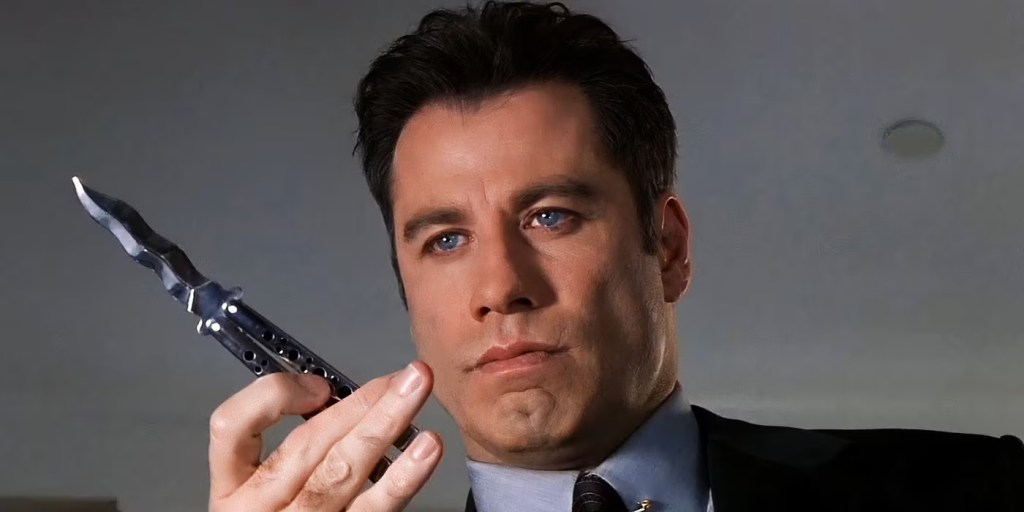
I couldn’t let today go by without recognizing John Travolta. I’ve enjoyed so many of his films over the years, especially movies like GREASE, BLOW OUT, PULP FICTION, and GET SHORTY. But the movie I probably love the most is FACE/OFF. I remember watching it at the movie theater back in 1997 and thinking it was the best movie ever. It came out at a perfect time when I was obsessed with John Woo, and I was still enjoying Travolta’s mid-90’s comeback. I still watch FACE/OFF at least once every year.

Enjoy this excellent scene from John Woo’s FACE/OFF!

Scenes That I Love: The Tiger Scene From Manhunter


Since today is Michael Mann’s birthday, today’s scene that I love comes from his 1986 film, Manhunter.

In this scene, a blind woman (played by Joan Allen) pets a sedated tiger while her new boyfriend (Tom Noonan) watches.  This would actually be a pretty romantic scene if not for the fact that her boyfriend is also a homicidal maniac.  This is a scene that, when you watch the film, seems to come out of nowhere but, when you look back, you realize it was one of the key moments in the narrative.  While the killer watches the woman who represents a possible redemption embrace another predator, the profiler played by William Petersen continues his way into the killer’s tortured psyche.

This scene is Michael Mann at his best.

Film Review: Tucker: The Man and His Dream (by Francis Ford Coppola)


First released in 1988, Tucker: The Man and His Dream is a biopic about Preston Tucker.

Tucker was an engineer in Detroit who went from designing vehicles for the Army during World War II to trying to launch his own car company.  His ideas for an automobile don’t sound particularly radical today.  He wanted every car to have seat belts.  He wanted a windshield that popped out as a safety precaution.  He want brake pads and he also wanted a car that looked sleek and aerodynamic, as opposed to the old boxy cars that were being pushed out be Detroit.  He wanted a car that got good mileage and he wanted one that could be taken just about anywhere.  Unfortunately, Tucker’s dreams were cut short when he was indicted for stock fraud, a prosecution that most people agree was a frame-up on behalf of the Big Three auto makers.  Tucker was eventually acquitted but his car company went out of business.  Of the 50 cars that Tucker did produce, 48 of them were still on the road and being driven forty years later.

The film stars Jeff Bridges as Preston Tucker, Joan Allen as his wife, Christian Slater and Corin Nemec as two of his sons, Lloyd Bridges as the senator who tried to take Tucker down, Martin Landau as Tucker’s business partner, and Dean Stockwell as Howard Hughes, who shows up for a few minutes to encourage Tucker to follow his dreams regardless of how much the government tries to stop him.  One gets the feeling that the film was a personal one for director Francis Ford Coppola, a filmmaker who has pretty much spent his entire career fighting with studios while trying to bring his vision to the screen.  Tucker fought for seat belts.  Coppola fought for a mix of color and black-and-white in Rumble Fish.  Tucker stood up for his business partner.  Francis Ford Coppola stood up for Al Pacino when no one else could envision him as Michael Corleone.  As is the case with many of Coppola’s films, Tucker: The Man And His Dream is a film that Coppola spent years trying to get made.  It was the film that Coppola originally intended to be the follow-up to The Godfather, with Marlon Brando projected for the lead role of Tucker.  After watching the Tucker, it’s hard not to feel that it worked out for the best that Coppola was not able to make the film in 1973.  It’s impossible to imagine anyone other than Jeff Bridges in the role of Preston Tucker.

“Chase that tiger….chase that tiger….chase that tiger….” It’s a song that Tucker sings constantly throughout the film as the camera spins around him and how you react to Tucker: The Man And His Dream will largely depend on how tolerant you are of Coppola’s stylistic flourishes.  Coppola directs the film as a combination of Disney fairy tale and film noir.  The opening of the film, with Tucker running around in almost a manic state and excitedly telling everyone about his plans, is presented with vibrant colors and frequent smiles and an almost overwhelming air of cheerful optimism.  As the film progresses and Tucker finds himself being targeted by both the government and the other auto companies, the film gets darker and the viewer starts to notice more and more shadows in the background.  The moments of humor become less and less and there’s a heart-breaking moment where Martin Landau, in one of his best performances, reveals just how far the government will go to take down Tucker’s company.  But, in the end, Tucker refuses to surrender and Jeff Bridges’s charming smile continues to fill the viewer with hope.  The film becomes about more than just cars.  It’s a film that celebrates all of the innovators who are willing to defy the establishment.

There’s a tendency to dismiss the majority of Coppola’s post-Apocalypse Now films.  However, Tucker: The Man And His Dream is a later Coppola film that deserves to be remembered.

Back to School Part II #34: The Ice Storm (dir by Ang Lee)


the-ice-storm

The 1997 film The Ice Storm is kind of a schizophrenic film, which makes sense since it’s set in 1973 and, just from what I’ve seen in the movies, it appears that the early 70s were kind of a schizophrenic time.

It’s a film that deals with two sets of people who all live in an upper class Connecticut community.  One part of the film deals with parents who are freaking out about suddenly being adults.  The other part of the film deals with the children, most of whom seem destined to make the same mistakes as their parents.  It’s a film that is occasionally bracingly realistic and relatable, one that reminds us that being directionless in the 70s isn’t necessarily that different from being directionless in 2016.  At other times, the film feels a bit too studied for its own good.  This is one of those films that features a Tobey Maguire voice-over and, as good an actor as Maguire has always been, he’s always at his worse when reciting a pseudo-profound voice over.  And then there are other times when the film feels a bit too cartoonish for its own good.  Elijah Wood’s a stoner.  Sigourney Weaver walks around with a bullwhip.  David Krumholtz shows up as a character named Francis Davenport.

Fortunately, the film is directed by Ang Lee and Ang Lee is probably one of the few filmmakers who can overcome tonal inconsistency.  Lee is so good with actors and is such a good storyteller that even his lesser films are usually worth watching.  The Ice Storm would just be another silly sin-in-the-suburbs film if it had been made by any director other than Ang Lee.

The main adult in the film is Ben Hood (Kevin Kline).  Ben is married to Elena (Joan Allen) but he’s having an affair with his neighbor, Janey (Sigourney Weaver).  Elena may be upset when she finds out about the affair but she’s still willing to accompany her husband to a key party.  A key party was a 70s ritual in which husbands would throw their car keys into a big punch bowl and then the wives would randomly pick a key and have sex with the owner.  Basically, anytime a TV show or a movie takes place in the suburbs during the 70s, there has to be at least one key party.

And The Ice Storm‘s key party is kind of fun to watch.  Kevin Kline and Joan Allen both give really good performances and Ben is such a loser that it’s fun to watch him freak out when Janey gets a key other than this own.  Elena, meanwhile, ends up going off with Janey’s husband (Jamey Sheridan, pretty much looking the same in this 1997 film as he did in Spotlight and Sully) and they share a really good scene together, one that reveals that none of the film’s adults are really as mature or liberated as they claim to be.

While the adults attempt to play, their children attempt to find some sort of meaning to their empty existence.  Ben and Elena’s daughter, Wendy (Christina Ricci), wears a Richard Nixon mask and enjoys sexually teasing her classmates, especially Janey’s youngest son, Sandy (Adam Hann-Byrd).  Ben and Elena’s oldest son, Paul (Tobey Maguire) is in New York, hoping to lose his virginity to Libbits (Katie Holmes) despite the fact that Libbets is far more interested in his boarding school roommate, Francis Davenport (David Krumholtz).  Paul also compares his family to the Fantastic Four so, assuming Paul survived both the 70s and 80s, he’s probably still living in Connecticut and telling everyone who disappointed he was with last year’s film.

And, of course, there’s Mickey (Elijah Wood).  Mickey is Janey’s oldest son and he’s permanently spaced out.  When the ice storm of the title occurs, Mickey is the one who decides to wander around outside and appreciate the beauty of nature’s remorseless wrath.

Needless to say, the ice storm is also a really obvious metaphor for the way all of these very unhappy (but very prosperous) characters tend to view and treat each other.  Despite all the attempts to pretend otherwise, everyone has a frozen soul.  Nobody’s capable of maintaining any sort of real emotional connection.  Of course, someone dies and everyone’s forced to take a look at the sad reality of their lives and the film ends with a sudden and spontaneous display of actual human emotion.  It’s one of those ideas that probably works better as a literary conceit than a cinematic one.

That said, The Ice Storm is flawed but very watchable.  I enjoyed it, even if it did occasionally seem to be trying way too hard.  It’s well-acted and, if nothing else, I enjoyed getting to see all of the amazingly tacky clothes and the interiors of all those big houses.  These people love their wide lapels and their shag carpeting.  The Ice Storm is not Ang Lee’s best but it’s still good enough.

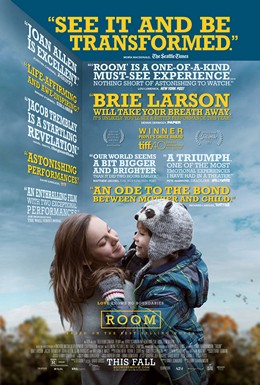
Playing Catch-Up: Room (dir by Lenny Abrahamson)


Room_Poster

Have you seen Room yet?

I ask because I’m debating how much information I should share in this review.  Room came out a few months ago and I’ve been late in reviewing it because watching the film was such an emotionally overwhelmingly experience that I wasn’t sure where to begin.  Now, all of this time has passed and I’m in a hurry to review this film because it’s obviously going to be nominated for some Oscars on Thursday morning and I’m wondering how much I can reveal without spoiling the movie.

It’s always tempting to say “Spoilers be damned!” but I’m not going to do that this time.  Room is a great film and it’s one that deserves to be discovered with a fresh mind.  I imagine that many people who missed the film the first time will see it once Brie Larson has been nominated for Best Actress.  Out of respect for those people, I am going to hold off from going into too much detail about the film’s plot.

Of course, this means that, if you haven’t seen the film, you’re going to have to have a little bit of faith in me.  You’re going to have to trust me.  When I tell you that this is an amazing film that will take you by surprise, you’re just going to believe me.  Because if I ruin those surprises … well, then they won’t be surprises anymore, will they?

When I first heard all the Oscar talk swirling around Room, my initial instinct was to make a joke about Tommy Wiseau finally getting the credit he deserves.  But then I saw Room and, within a few minutes of the film, I was in tears.  It’s hard for me to think of any other film this year that made me cry as much as Room.

Room is narrated by Jack (Jacob Tremblay), a 5 year-old boy whose hair is so long that he is frequently mistaken for being a girl.  Jack lives in a filthy room with Ma (Brie Larson).  The tiny room has only a toilet, a sink, a bed, a small kitchen area, and a cheap television.  There’s also the small closet where Jack sleeps and a skylight in the ceiling.  As quickly becomes apparent from his narration, Jack has never been outside of the room.  All he knows about the outside world comes from TV and the stories told to him by Ma.

Occasionally, a nervous man named Old Nick (Sean Bridgers) enters the room.  Whenever Old Nick shows up, Ma orders Jack to hide in the closet.  However, even in the closet, Jack listens to Ma and Nick talking in the room.  Ma talks about how Nick kidnapped her when she was 17.  Nick talks about how he has recently lost his job and may not be able to continue to take care of his two prisoners.  Fearful for her life, Ma humors the self-pitying Nick.  Nick, meanwhile, plays the victim and complains about how difficult it is to keep her and Jack prisoner.  It quickly becomes apparent that Jack is Nick’s child.

Now that Jack is five, Ma knows that he’s old enough that she can tell him about her plan to escape from Nick.  However, escaping means exposing Jack to a world that he’s never experienced and that Ma fears she no longer remembers.

Meanwhile, Ma’s parents wonder what has happened to their missing daughter.  (It’s from her parents that we learn that, much like a character played by fellow Oscar contender Jennifer Lawrence, Ma’s name is Joy.)  Ma’s mother, Nancy (Joan Allen), is now divorced from Joy’s emotionally repressed father (William H. Macy).  Nancy is now married to the kind and appealingly disheveled Leo (Tom McCamus).  However, still hoping that her daughter will someday return, Nancy hasn’t even touched Joy’s old bedroom.

Finally, the opportunity comes for Ma and Jack to escape and…

…and that’s all I can tell you without spoiling the film.  Room is an emotionally exhausting film, one that will make you cry but which will also leave feeling strangely hopeful for the future.  Brie Larson gives a courageously vulnerable and emotionally raw performance as Joy while Jacob Tremblay is perfectly cast as Jack.  Since Larson and Tremblay are both getting a lot of attention as possible Oscar nominees, I want to take a few minute to single out one member of the cast who, so far, has been overshadowed.  Tom McCamus doesn’t have a lot of screen time but he makes the most of every second he gets, turning Leo into the ideal father figure.

Room made me cry and cry and I can’t wait to see it again.

Lisa’s Oscar Predictions for November!


oscar trailer kitties

Have you heard the news?  Apparently, Steve Jobs is shaping up to the be one of the biggest box office bombs of all time!  Over this past weekend, it went from playing in 2,000 theaters to playing in 424.

Myself, I have to wonder why anyone thought Steve Jobs was going to be a huge financial success in the first place.  Isn’t this the third Steve Jobs biopic to be released in as many years?  None of them have made in money.  It may be time for people of a certain age and certain economic class to admit that not everyone is as fascinated by Steve Jobs as they are.  I haven’t seen Steve Jobs yet so I better get out to a theater this week or else I’ll have to see it in a dollar theater and I always seem to have a bad experience at those places.  In the mean time, be sure to check out Leonard’s review!

Anyway, with Steve Jobs crashing and burning, I’m dropping it from my list of Oscar predictions.  Sorry, Steve Jobs.  Sorry, Danny Boyle and Kate Winslet.  Don’t worry, Michael Fassbender — you’re still on my list.

Anyway, here are my Oscar predictions for November.  Be sure to also check out my predictions for January, February, March, April, May, June, July, August, September, and October!

The_Martian_film_poster

Best Picture

Bridge of Spies

Brooklyn

Carol

The Danish Girl

Joy

Love & Mercy

The Martian

The Revenant 

Room

Spotlight

Best Director

Lenny Abrahamson for Room

Todd Haynes for Carol

Alejandro G. Inarritu for The Revenant

Thomas McCarthy for Spotlight

Ridley Scott for The Martian

Best Actor

Matt Damon in The Martin

Johnny Depp in Black Mass

Leonardo DiCaprio in The Revenant

Michael Fassbender in Steve Jobs

Eddie Redmayne in The Danish Girl

Best Actress

Cate Blanchett in Carol

Brie Larson in Room

Jennifer Lawrence in Joy

Carey Mulligan in Suffragette

Saiorse Ronan in Brooklyn

Best Supporting Actor

Paul Dano in Love & Mercy

Robert De Niro in Joy

Benicio Del Toro in Sicario

Idris Elba in Beasts of No Nation

Mark Rylance in Bridge of Spies

Best Supporting Actress

Joan Allen in Room

Elizabeth Banks in Love & Mercy

Jane Fonda in Youth

Rooney Mara in Carol

Alicia Vikander in The Danish Girl

mara_blanchett_carol