There are only five hours left in Twin Peaks: The Return and yet, there are still many mysteries to be resolved. Considering that this is a David Lynch production, it’s entirely possible and probably rather probable that a good deal of those mysteries will never be resolved.
That said, all of the disparate elements of Twin Peaks: The Return have slowly been coming together, providing evidence — if any was needed — that Lynch knows exactly what he’s doing. In some ways, tonight’s episode was Twin Peaks at its most straightforward. And yet, nothing can ever be totally straight forward when it comes to Twin Peaks.
We wouldn’t want it any other way.

Tonight’s episode begins with joyful music playing in Las Vegas. As Anthony Sinclair (Tom Sizemore) watches from his office, the Mitchum Brothers (James Belushi and Robert Knepper) dance down the hallways. The three ladies in pink are with them. And so is … Dougie Jones (Kyle MacLachlan), the man who Anthony was supposed to trick the Mitchums into killing!
The Mitchums have come to see Bushnell Mullins (Don Murray) and they’ve brought him gifts, all to thank him for introducing them to Dougie and for helping them to make money off of that insurance claim. “A wrong has been made right and the sun is shining bright!” Bradley Mitchum declares.
Meanwhile, in his office, Anthony calls Duncan Todd (Patrick Fischler) and tells him that Dougie is still alive. Todd replies that it’s now Anthony’s responsibility to kill Dougie and he only had one day to do it, not the two days that he promised earlier.
The generosity of the Mitchums continues as both a new car and a jungle gym are delivered to Dougie’s house. It’s quite a jungle gym as well. It’s big, it’s lit up with neon, and everything about it just screams Vegas. Sonny Jim (Pierce Gagnon) is quite happy. So is Janey-E (Naomi Watts), which is good. They deserve some happiness.
The next morning, in Montana, the evil Doppelganger Cooper arrives at a compound called The Farm. Ray (George Griffith) has been hiding out at the Farm with Renzo (Derek Mears) and his men. When they see the Doppelganger pull up, Ray comments that he killed the Doppelganger. “You didn’t kill him too good, Ray,” Renzo replies.
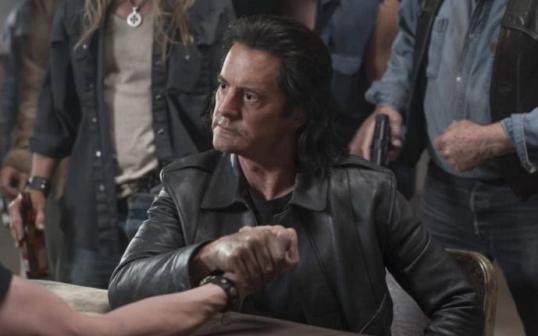
Anyway, Ray volunteers to kill the Doppelganger a second time but it turns out that Renzo is something of an arm wrestling fanatic. Renzo explains that if the Doppelganger can beat him, he’ll get control of the Farm and Renzo’s entire crew. The only catch is that Renzo has never been defeated. The Doppelganger says he doesn’t want the farm, he just wants Ray.
The arm wrestling goes about how you would imagine it would go — Renzo ends up getting his arm broken and then his face literally smashed in by one punch from the Doppelganger. As for Ray, he confesses that it was Phillip Jeffries who hired him to kill the Doppelganger. Ray explains that he never met Jeffries, he just talked to him on the phone. Jeffries told Ray that the Doppelganger had something inside of him that “they” wanted. (Killer BOB, perhaps? BOB was seen directly inside of the Doppelganger during Part 8.) Ray holds up a ring that he was supposed to put on the Doppelganger’s finger. Ray says that he got it from a prison guard right before they escaped. The Doppelganger makes Ray put on the ring. Ray then gives the Doppelganger a piece of paper with the coordinates that he says he got from Bill Hastings and his secretary (that would be Ruth Davenport). The Doppelganger asks Ray where Phillip Jeffries is. Ray says Philip is at a place called “The Dutchman’s.” The Doppelganger proceeds to shoot Ray in the face.
And guess whose watching all of this unfold? Richard Horne (Eamon Farren)! Apparently, ever since fleeing Twin Peaks, Richard has been hiding out in Montana. So, does that mean that the Farm and the late Renzo had a connection to Red? If so, how is Red going to react to the Doppelganger killing Renzo and becoming The Farm’s new boss? And does Richard looked so shocked because he never thought anyone would ever beat Renzo at arm wrestling (not to mention kill him) or is it because he realizes that the Doppelganger is probably his father?
Ray’s body appears inside the Black Lodge. MIKE (Al Strobel) takes the ring and puts it on a marble table.
Back at the Las Vegas Metropolitan Police HQ, something weird’s going on in the background. We can hear a woman yelling as she apparently defecates on the floor. She’s tased and screams, “I want to report a cop!” Sitting in their office, the Fuscos aren’t too concerned. It doesn’t even bother them when they receive a report that Dougie has the same fingerprints as both an escapee from a South Dakota prison and a missing FBI agent. They laugh and throw the report away.
They barely notice as Anthony Sinclair wanders through the station, looking for Detective Clark (John Savage). Clark is outside smoking a cigarette and he doesn’t appear to be very enthusiastic about the prospect of talking to Anthony. Anthony asks Clark for the name of a good poison, one that would be undetectable. Apparently, Clark also works for Duncan Todd. Clark agrees to help Anthony get the poison.
In South Dakota, Chantal (Jennifer Jason Leigh) and Hutch (Tim Roth) drive down the interstate and, as they enter Utah, discuss what it must be like to be a Mormon.

The next morning, after Janey-E drops him off at work, Dougie runs into Anthony. A nervous Anthony offers to buy Dougie a cup of coffee at the pastry shop. Since Dougie is obsessed with coffee, he agrees. When Dougie gets distracted by a cheery pie in a display case and stands up to go stare at it, Anthony puts the poison in Dougie’s coffee.
When Dougie returns to the table, he is distracted by the dandruff on the back of Anthony’s suit. Dougie places his hands on Anthony shoulders. Mistaking this for a sign of friendship, Anthony breaks down into tears and shouts that he never meant to hurt anyone. He pours out Dougie’s poisoned coffee. Dougie responds by drinking Anthony’s coffee instead.
In Twin Peaks, at the Double R, Shelley (Madchen Amick) gets a call from Becky (Amanda Seyfried). Becky’s in tears. Steven, the man she tried to shoot, hasn’t come home in two days.
Back in Vegas, Anthony sits in Bushnell’s office and says that he’s come to confess. Standing to the side, Dougie blankly repeats, “Confess.” Anthony confesses to Bushnell that he’s been working for Duncan Todd and that he’s been lying to Bushnell for years. Bushnell says that Dougie revealed all of this to him yesterday. Bushnell asks if Anthony is prepared to testify against Duncan Todd. Anthony says that he is.
Bushnell asks if Anthony is willing to testify “against the two cops that Dougie found.”
“He know about them too!?” Anthony says.
“Them too,” Dougie blankly repeats.
Anthony says he only wants to fix the mess that he made. He says that Dougie saved his like. “Thanks, Dougie!”
“Thank Dougie,” Dougie says.
In tears, Anthony does just that.
At the Double R, Norma (Peggy Lipton) has a meeting with the somewhat oily Walter Lawford (Grant Goodeve). Apparently, Norma’s Double R is a franchise now. Walter says that there are several profitable locations in Washington State but Norma is concerned that those locations are using inferior ingredients. Walter argues that it makes good business sense to cut costs. This entire scene, of course, feels like Lynch’s commentary on the studio executives who constantly tried to interfere with Twin Peaks the first time around.
Norma and Walter are apparently a couple, as well. As they talk, they are watched by both Deputy Bobby Briggs (Dana Ashbrook) and Big Ed Hurley (Everett McGill), Norma’s former (?) lover and the husband of Nadine (Wendy Robie).
Speaking of Nadine, she is leaving her silent drape store when who should show up but Dr. Jacoby (Russ Tamblyn)! As we’ve already seen, Nadine is a huge fan of Jacoby’s podcast. She even has her own golden shovel hanging in the window of her store. Dr. Jacoby says that the last time he saw Nadine, she was on her hands and knees, looking for a potato.
At the Palmer House, Sarah (Grace Zabrikie) is drunk and watching a boxing match. Or, actually, I should say that she’s watching 30 second of a boxing match on a continious loop. The announcer says, several times: “Oh the right hand catches the big guy by the ear! And he finally goes down, hanging on the ropes. Oh, the gentleman asks if he’s okay. Look like, uh, round number one and two on the way. Now, it’s a boxing match again.”

Elsewhere, Audrey (Sherilyn Fenn) yells at Charlie (Clark Middleton). An emotional Audrey says that she feels like she’s somewhere else, like she’s not sure who she is. Charlie says, “This is Existentialism 101.” Audrey’s not amused and demands to know what she’s supposed to do if she can’t trust anyone and she’s not sure who she is. Charlie replies that she’s supposed to go to the Roadhouse and look for Billy. Audrey demands to know where the Roadhouse is.
“Are you going to stop playing games?” Charlie asks, “or am I going to have to end your story, too?”
Audrey starts to cry.
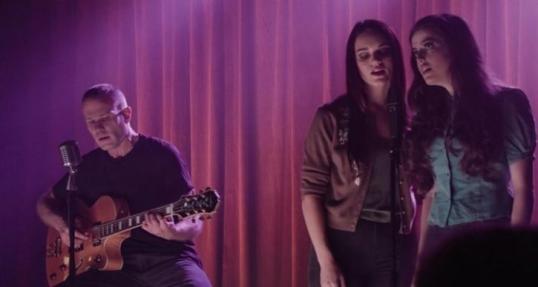
At the Roadhouse, none other than James Hurley (James Marshall) performs the song You and I. Accompanying him are two backup singers who look like they could be Donna and Maddy. Considering that the scene during the second season, in which James, Donna, and Maddy performed You And I, is regularly ridiculed by even the show’s biggest fans, you have to wonder if David Lynch is doing some deliberate trolling here. Well, it does’t matter. It’s a lovely song, one that perfectly captures the aching feeling of loss that runs through every minute of Twin Peaks: The Return.
At the gas station, Big Ed Hurley sits alone, staring at his gas pumps.
And that’s how Part 13 ends.

Twin Peaks on TSL:
- Twin Peaks: In the Beginning by Jedadiah Leland
- TV Review: Twin Peaks 1.1 — The Pilot (dir by David Lynch) by Lisa Marie Bowman
- TV Review: Twin Peaks 1.2 — Traces To Nowhere (directed by Duwayne Dunham) by Jedadiah Leland
- TV Review: Twin Peaks 1.3 — Zen, or the Skill To Catch A Killer (dir by David Lynch) by Lisa Marie Bowman
- TV Review: Twin Peaks 1.4 “Rest in Pain” (dir by Tina Rathbone) by Leonard Wilson
- TV Review: Twin Peaks 1.5 “The One-Armed Man” (directed by Tim Hunter) by Jedadiah Leland
- TV Review: Twin Peaks 1.6 “Cooper’s Dreams” (directed by Lesli Linka Glatter) by Lisa Marie Bowman
- TV Review: Twin Peaks 1.7 “Realization Time” (directed by Caleb Deschanel) by Lisa Marie Bowman
- TV Review: Twin Peaks 1.8 “The Last Evening” (directed by Mark Frost) by Leonard Wilson
- TV Review: Twin Peaks 2.1 “May the Giant Be With You” (dir by David Lynch) by Leonard Wilson
- TV Review: Twin Peaks 2.2 “Coma” (directed by David Lynch) by Jedadiah Leland
- TV Review: Twin Peaks 2.3 “The Man Behind The Glass” (directed by Lesli Linka Glatter) by Jedadiah Leland
- TV Review: Twin Peaks 2.4 “Laura’s Secret Diary” (dir by Todd Holland) by Lisa Marie Bowman
- TV Review: Twin Peaks 2.5 “The Orchid’s Curse” (dir by Graeme Clifford) by Lisa Marie Bowman
- TV Review: Twin Peaks 2.6 “Demons” (dir by Lesli Linka Glatter) by Leonard Wilson
- TV Review: Twin Peaks 2.7 “Lonely Souls” (directed by David Lynch) by Jedadiah Leland
- TV Review: Twin Peaks 2.8 “Drive With A Dead Girl” (dir by Caleb Deschanel) by Lisa Marie Bowman
- TV Review: Twin Peaks 2.9 “Arbitrary Law” (dir by Tim Hunter) by Lisa Marie Bowman
- TV Review: Twin Peaks 2.10 “Dispute Between Brothers” (directed by Tina Rathbone) by Jedadiah Leland
- TV Review: Twin Peaks 2.11 “Masked Ball” (directed by Duwayne Dunham) by Leonard Wilson
- TV Review: Twin Peaks 2.12 “The Black Widow” (directed by Caleb Deschanel) by Leonard Wilson
- TV Review: Twin Peaks 2.13 “Checkmate” (directed by Todd Holland) by Jedadiah Leland
- TV Review: Twin Peaks 2.14 “Double Play” (directed by Uli Edel) by Jedadiah Leland
- TV Review: Twin Peaks 2.15 “Slaves and Masters” (directed by Diane Keaton) by Lisa Marie Bowman
- TV Review: Twin Peaks 2.16 “The Condemned Woman” (directed by Lesli Linka Glatter) by Leonard Wilson
- TV Review: Twin Peaks 2.17 “Wounds and Scars” (directed by James Foley) by Lisa Marie Bowman
- TV Review: Twin Peaks 2.18 “On The Wings of Love” (directed by Duwayne Dunham) by Jedadiah Leland
- TV Review: Twin Peaks 2.19 “Variations on Relations” (directed by Jonathan Sanger) by Lisa Marie Bowman
- TV Review: Twin Peaks 2.20 “The Path to the Black Lodge” (directed by Stephen Gyllenhaal) by Lisa Marie Bowman
- TV Review: Twin Peaks 2.21 “Miss Twin Peaks” (directed by Tim Hunter) by Leonard Wilson
- TV Review: Twin Peaks 22.2 “Beyond Life and Death” (directed by David Lynch) by Lisa Marie Bowman
- Film Review: Twin Peaks: Fire Walk With Me (dir by David Lynch) by Lisa Marie Bowman
- Here’s The Latest Teaser for Showtime’s Twin Peaks by Lisa Marie Bowman
- Here’s The Newest Teaser for Showtime’s Twin Peaks by Lisa Marie Bowman
- 12 Initial Thoughts About Twin Peaks: The Return Parts One and Two by Lisa Marie Bowman
- This Week’s Peaks: Parts One and Two by Ryan C. (trashfilm guru)
- TV Review: Twin Peaks: The Return Parts One and Two (dir by David Lynch) by Lisa Marie Bowman
- 4 Shots From 4 Films: Special Twin Peaks Edition by Lisa Marie Bowman
- This Week’s Peaks: Parts Three and Four by Ryan C. (trashfilm guru)
- 14 Initial Thoughts About Twin Peaks: The Return Part Three by Lisa Marie Bowman (dir by David Lynch)
- 10 Initial Thoughts About Twin Peaks: The Return Part Four by Lisa Marie Bowman (dir by David Lynch)
- TV Review: Twin Peaks: The Return Parts Three and Four (dir by David Lynch) by Lisa Marie Bowman
- 18 Initial Thoughts About Twin Peaks: The Return Part 5 (dir by David Lynch) by Lisa Marie Bowman
- This Week’s Peaks: Part Five by Ryan C. (trashfilm guru)
- TV Review: Twin Peaks: The Return: Part 5 (dir by David Lynch) by Lisa Marie Bowman
- 14 Initial Thoughts On Twin Peaks Part 6 (dir by David Lynch) by Lisa Marie Bowman
- This Week’s Peaks: Part Six by Ryan C. (trashfilm guru)
- TV Review: Twin Peaks: The Return Part 6 (dir by David Lynch) by Lisa Marie Bowman
- 12 Initial Thoughts on Twin Peaks: The Return Part 7 (dir by David Lynch) by Lisa Marie Bowman
- This Week’s Peaks: Part Seven by Ryan C. (trashfilm guru)
- TV Review: Twin Peaks: The Return Part 7 (dir by David Lynch) by Lisa Marie Bowman
- Ten Initial Thoughts on Twin Peaks: The Return Part 8 (dir by David Lynch) by Lisa Marie Bowman
- This Week’s Peaks: Part Eight by Ryan C (trashfilm guru)
- TV Review: Twin Peaks: The Return Part 8 (dir by David Lynch) by Lisa Marie Bowman
- 16 Initial Thoughts on Twin Peaks: The Return Part 9 (dir by David Lynch) by Lisa Marie Bowman
- This Week’s Peaks: Part Nine by Ryan C (trashfilm guru)
- TV Review: Twin Peaks: The Return Part 9 (dir by David Lynch) by Lisa Marie Bowman
- 20 Initial Thoughts On Twin Peaks: The Return Part 10 (dir by David Lynch) by Lisa Marie Bowman
- This Week’s Peaks: Part 10 by Ryan C (trashfilm guru)
- TV Review: Twin Peaks: The Return Part 10 (dir by David Lynch) by Lisa Marie Bowman
- 16 Initial Thoughts About Twin Peaks: The Return Part 11 (dir by David Lynch) by Lisa Marie Bowman
- This Week’s Peaks: Part 11 by Ryan C (trashfilm guru)
- TV Review: Twin Peaks: The Return Part 11 (dir by David Lynch) by Lisa Marie Bowman
- 20 Initial Thoughts on Twin Peaks: The Return Part 12 (dir by David Lynch) by Lisa Marie Bowman
- This Weeks Peaks: Part 12 by Ryan C (trashfilm guru)
- TV Review: Twin Peaks: The Return Part 12 (dir by David Lynch) by Lisa Marie Bowman
- 22 Initial Thoughts on Twin Peaks: The Return Part 13 (dir by David Lynch) by Lisa Marie Bowman
- This Week’s Peaks: Part 13 by Ryan C (trashfilm guru)





 Through the Shattered Lens