Hello, fellow readers! I’m doing today’s book review while Lisa gets some well-earned rest.
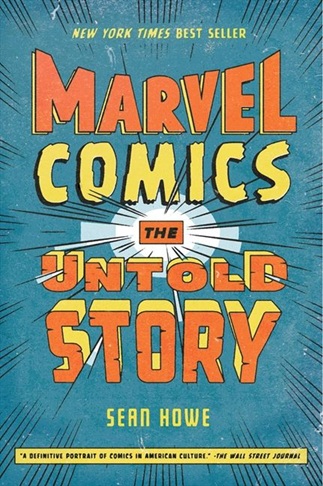
Today, it seems like everyone is an expert on the history of Marvel Comics, but if you actually talk to them, you discover that the majority seems to think that history started when the first Iron Man movie came out in 2008. They should definitely read Sean Howe’s Marvel Comics: The Untold Story, which begins when Marvel was known as Timely Comics and ends right when the MCU is on the verge of taking over pop culture.
The history of a comic book company might not sound that interesting, but Marvel Comics: The Untold Story is surprisingly compelling. We follow the company from the Timely years through the modern era. We see how Marvel changed comics forever in the 1960s. We see how they continued to challenge conventions in the 1970s while also becoming the type of big business that sold a lot of comics and left behind a lot of angry readers and creators. We feel as if we’re watching as Stan Lee becomes a minor celebrity and struggles to get a foothold in Hollywood. Howe spends as much time discussing the bad times as the good ones. In the 1980s, Jim Shooter burns a lot of money with the New Universe. In the 1990s, Marvel goes from being the upstart company that took risks to being a symbol of the moribund establishment. With the success of the MCU, it’s easy to forget how bad things got at Marvel before the movies gave the company a new life.
The book doesn’t shy away from the controversies, in particular the question of whether Stan Lee took credit for the work of others. Lee comes across as an exuberant force who was tireless in his efforts to promote Marvel but who also could be prickly and egotistical. Artists and writers like Jack Kirby and Steve Ditko are profiled as the talented men who never got the credit they deserved for Marvel’s success. Chris Claremont is described as someone whose ideal X-Men story would be the characters just hanging out in New York and talking. John Byrne is described as using unsold New Universe comics to start a bonfire. Todd McFarlane fires Rob Liefeld by telling him, “We don’t like you no more.” The book is full of memorable moments.
Howe’s book is at its most interesting when it discusses Marvel in the 1970s. That was when a new crew of artists and writers, many of whom were young hippies who had recently graduated from art school, joined the company and discovered that Marvel was a business first. The comics may have dealt with current events, but they were still largely being drawn and written by veterans from the 1940s and 1950s. (In the 1970s, Stan Lee tried to attract female readers with Ms. Marvel but the first issue, written and drawn by men whose career stretched back the Golden Age of Comics, is described as being a series of crotch shots.) The book examines the conflict of artists trying to create in a corporate environment where the one rule is that nothing can ever change.
It’s a must-have for anyone who claims to be a fan of Marvel.
“We are not enemies. We are the agents of change. To that end we are bound together.” — Hecate
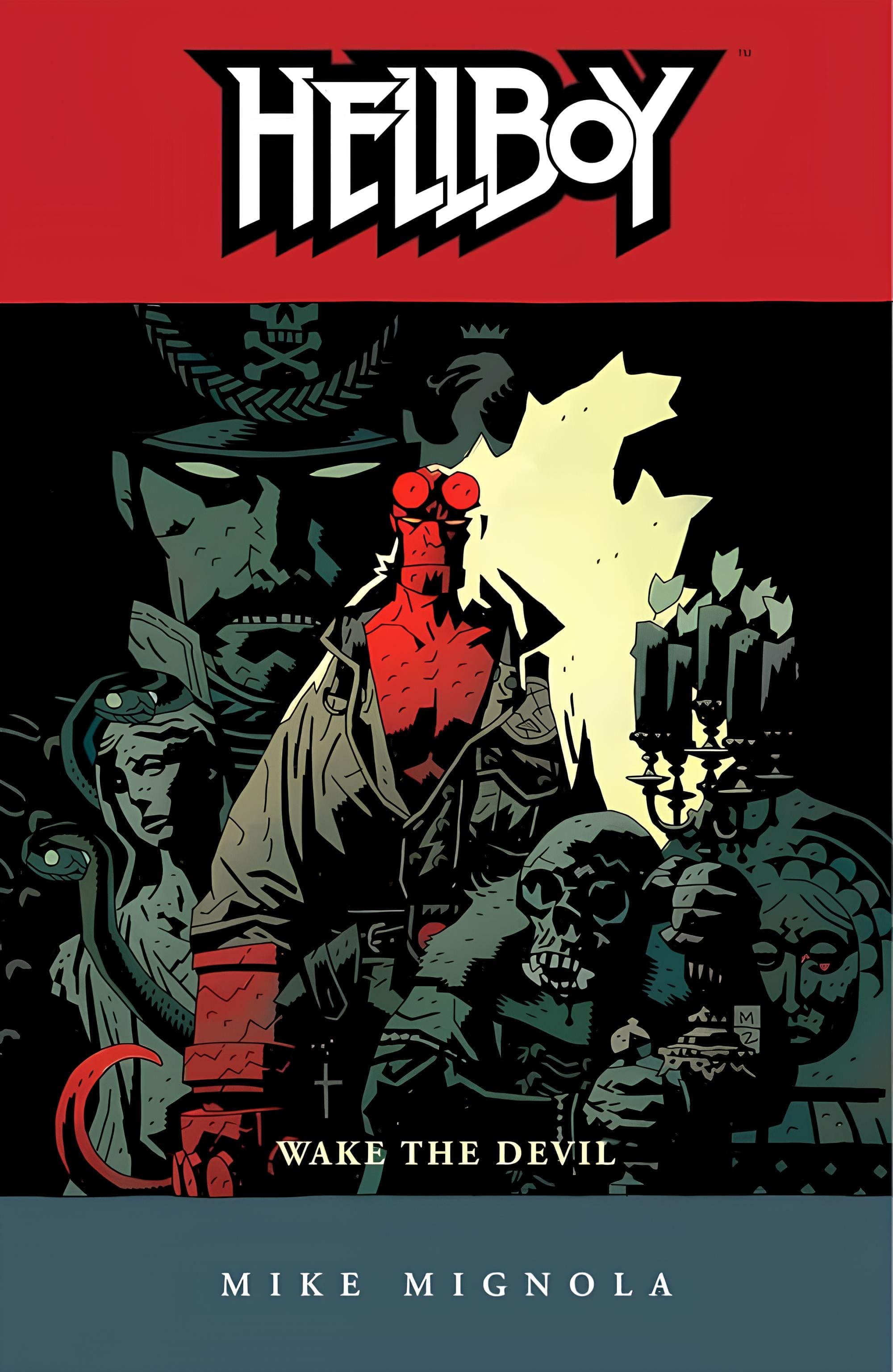
By the time Hellboy: Wake the Devil begins, Mike Mignola has already made clear that Hellboy’s world is not one where the dead stay buried or where ancient evils remain confined to history. Building on the groundwork established in Hellboy: Seed of Destruction, this graphic novel moves deeper into the peculiar mixture of pulp adventure, Gothic horror, occult conspiracy, folklore, and apocalyptic myth that makes Hellboy so distinctive. It is a darker, stranger, and more confident continuation, one that expands Hellboy’s world through vampires, witches, ancient ruins, Russian legends, Nazi occultists, and the ever-present suggestion that the past is not buried so much as waiting to rise again.
Where Hellboy: Seed of Destruction had to introduce readers to Hellboy, the B.P.R.D., Rasputin, and the ominous question of the hero’s intended destiny, Hellboy: Wake the Devil benefits from being able to assume some familiarity with the larger premise. It does not waste time reintroducing every concept or explaining Hellboy’s origin in exhaustive detail. Instead, Mignola plunges directly into another supernatural crisis, trusting the reader to follow the fragments of history, prophecy, and folklore that emerge along the way. That confidence gives the book a more distinctive identity than the first graphic novel, which was highly entertaining but still carried some of the structure of a traditional early-1990s superhero adventure.
This difference also reflects Mignola’s greater control over the material. While Hellboy: Seed of Destruction was co-plotted and scripted by John Byrne, Wake the Devil feels more purely shaped by Mignola’s own creative instincts. The writing is leaner, stranger, and more willing to leave mysteries partially unresolved. The plot remains accessible, but it is not interested in handing readers a complete guidebook to its mythology. Rather than explaining every occult reference, historical figure, or supernatural artifact, Mignola presents them as pieces of a much larger hidden world. That approach gives the story a dreamlike quality, as if Hellboy has stumbled into a folktale that has been unfolding for centuries without him.
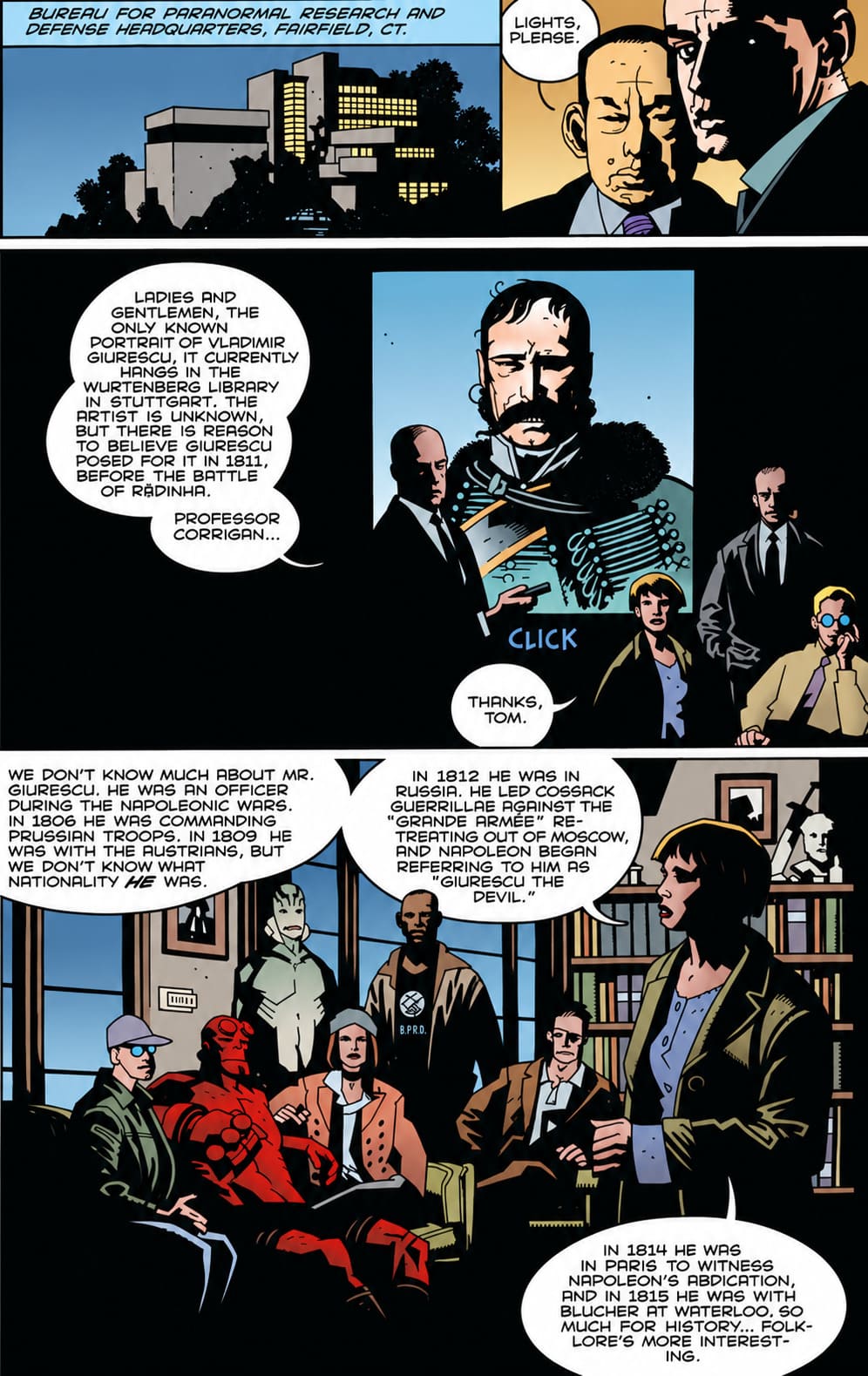
The story begins with a stolen corpse, an opening that immediately establishes the book’s grim tone. This theft is connected to Vladimir Giurescu, an ancient vampire whose resurrection becomes the central threat of the graphic novel. Giurescu is not presented as a familiar, romantic version of Dracula, nor is he simply another monster for Hellboy to punch through a wall. He is an old-world figure tied to European violence, occult ritual, aristocratic power, witchcraft, and death. Mignola makes him feel ancient in the best sense: not merely old, but connected to a past so deep and cruel that modern people cannot fully comprehend it.
Giurescu’s presence is one of the book’s greatest strengths because he embodies the kind of villain Mignola handles especially well. He is frightening not because he constantly performs elaborate acts of violence, although the story has no shortage of monstrous imagery, but because he carries the weight of history with him. His return does not feel like the arrival of a single antagonist. It feels like a buried nightmare opening its eyes. Mignola’s supernatural villains often possess this quality. They are dangerous as individuals, but they are even more dangerous as evidence that Hellboy’s world is built over ancient horrors that have never truly disappeared.
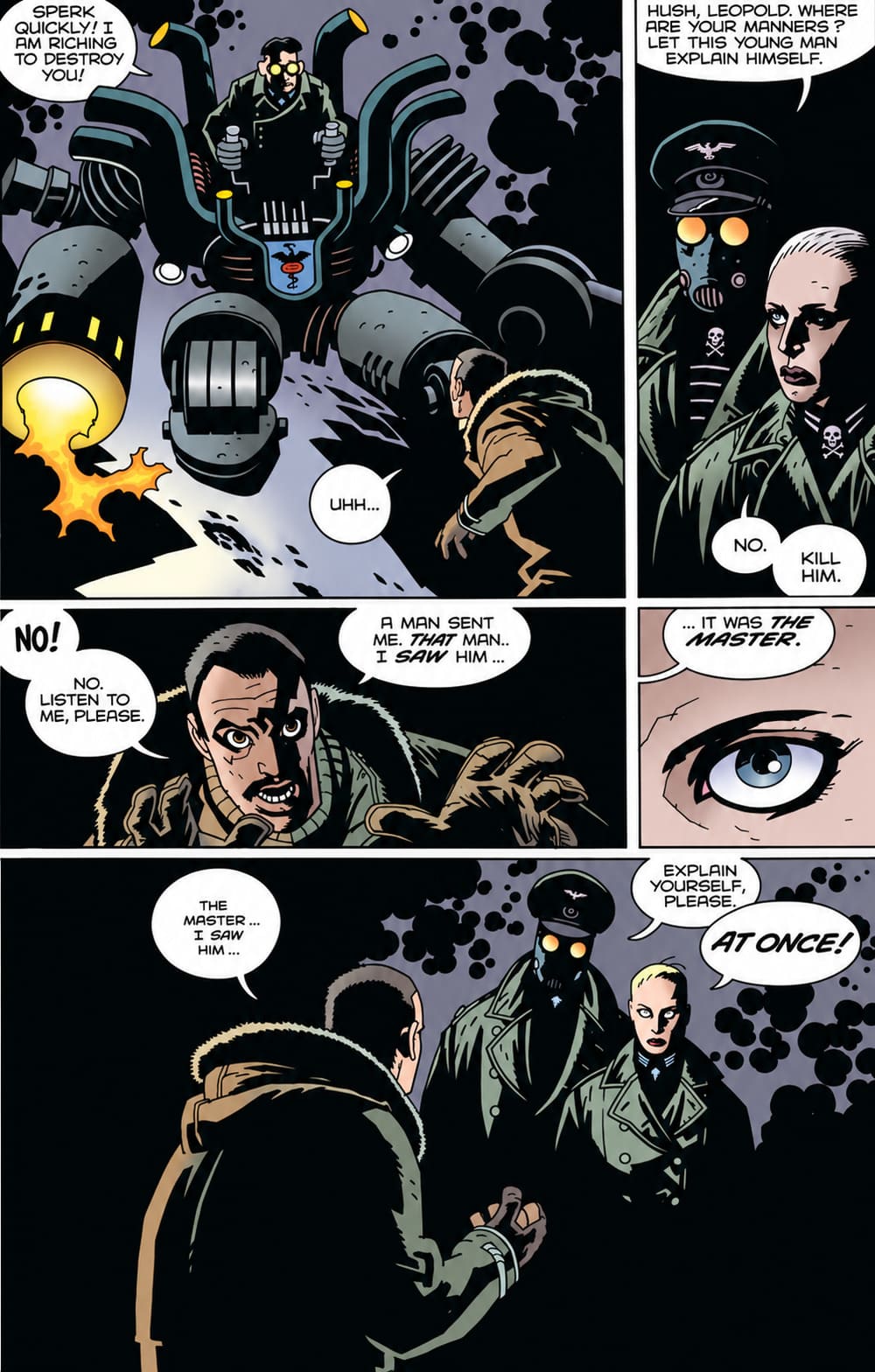
The plot also brings back Ilsa Haupstein, one of the Nazi occultists introduced in Hellboy: Seed of Destruction. Her involvement gives Wake the Devil a direct link to the previous story without making the book feel like a repetitive sequel. The Nazi occult material remains important, but Mignola wisely expands the scope beyond it. The conspirators and occultists are no longer the entire center of the story. They become one part of a wider mythology involving vampires, witches, old relics, secret histories, and supernatural forces that existed long before the twentieth century. The result is a story that feels more expansive without becoming bloated.
The title carries an interesting irony, since Hellboy himself is constantly associated with the devil because of his red skin, horns, tail, and demonic appearance. People who encounter him often assume that he must be monstrous, dangerous, or connected to evil. Yet Wake the Devil again makes clear that Hellboy’s appearance has little to do with his moral character. He may look like a demon, but he is still the person trying to stop the resurrection of an ancient vampire and the spread of occult evil. The real devils in the story are the people and creatures who seek power through murder, ritual, resurrection, and the exploitation of forbidden knowledge.
Hellboy’s moral simplicity is one of the series’ most enduring strengths. He is not simple in the sense of being a shallow character, but he is direct about what matters. He does not spend pages agonizing over whether monsters should be stopped. If something evil is threatening innocent people, he goes after it. He complains, gets irritated, takes a beating, delivers a dry joke, and keeps moving. That makes him an ideal protagonist for Mignola’s world. The setting is filled with cryptic prophecies, ancient names, hidden archives, and supernatural mysteries, but Hellboy gives the reader someone grounded to follow through it all.
His humor remains especially important. Wake the Devil is a dark book, full of graves, corpses, ruined buildings, occult rites, and creatures whose existence seems to violate the natural order. Without Hellboy’s blunt attitude, the material could become overly solemn. He does not make light of the danger, but his presence keeps the graphic novel from collapsing under the weight of its own mythology. Hellboy has the energy of a hardboiled detective dropped into a nightmare, even though his methods usually involve a massive stone fist rather than a revolver and a fedora.
The B.P.R.D. supporting cast also becomes more meaningful in this story. Abe Sapien and Liz Sherman are not merely background teammates, even if Hellboy remains the main focus. Abe’s intelligence and aquatic strangeness make him a natural fit for a universe filled with lost civilizations, secret knowledge, and evolutionary mysteries. Liz, meanwhile, carries a more tragic and dangerous presence because of her pyrokinetic powers. She is not simply a character who can shoot fire at monsters. Her abilities are tied to fear, isolation, and trauma, which gives her a vulnerability that contrasts sharply with Hellboy’s more durable and outwardly confident persona.
The relationship between these characters reinforces the unusual nature of the B.P.R.D. It is not a brightly polished superhero team assembled to save the world in matching costumes. It is an organization of people who have been pushed outside ordinary society, whether by their appearance, their powers, or the bizarre things they have experienced. Hellboy, Abe, and Liz are united less by traditional comic-book camaraderie than by shared alienation. They understand dangers that ordinary people would struggle to believe, and that creates a quieter emotional bond beneath the monster fights and supernatural investigations.
Visually, Hellboy: Wake the Devil is a major achievement. Mignola’s artwork is not built around realism or dense anatomical detail. Instead, it relies on dramatic shapes, bold shadows, exaggerated silhouettes, and a masterful sense of composition. His pages can make a single doorway, tomb, hallway, or distant figure feel ominous. A black shape against a pale background becomes threatening because Mignola knows precisely how much information to withhold. His art frequently suggests that the real terror is not necessarily what readers can see, but what might be waiting inside the darkness beyond the panel.
The book’s use of architecture is especially striking. Castles, crypts, underground chambers, cemeteries, churches, and ruined interiors are not just places where the action happens. They feel like extensions of the story’s ancient dread. Heavy stone walls, towering doorframes, deep corridors, and massive areas of black create the impression that Hellboy is moving through a physical landscape built by history itself. The settings seem to contain memories. Every abandoned room and buried chamber implies that something dreadful once happened there, and perhaps never truly stopped happening.
Matt Hollingsworth’s color work adds enormously to this atmosphere. The palette is often muted and moody, dominated by dark blues, sickly greens, faded browns, purples, and deep black shadows. This restraint makes the bursts of red more powerful, whether the red comes from Hellboy himself, blood, fire, or supernatural violence. The colors give the pages an aged, almost storybook texture. It can feel as though the reader is looking at a collection of old illustrations from some forbidden European folktale rather than a conventional comic book.
Mignola’s pacing is equally important. Wake the Devil knows when to pause and let the mood settle. There are moments where a character simply stands before an open grave, explores a silent corridor, or confronts an object that hints at a terrible history. Those quieter scenes make the action scenes more forceful. Hellboy does not fight with the slick agility of a typical superhero. He crashes through doors, falls through floors, gets thrown into walls, and responds to impossible threats with the stubborn endurance of someone who has spent his whole life being sent into terrible places.
That physicality helps make Hellboy feel vulnerable even when he is clearly superhuman. He is powerful, but he is not untouchable. He gets hurt, overwhelmed, deceived, and placed in situations where brute strength alone is not enough. The Right Hand of Doom is visually iconic, but it is not a solution to every problem. Hellboy survives because he is resilient, practical, and unwilling to give up when the supernatural situation becomes more complicated than expected.
The story’s deeper theme is the danger of seeking power through forbidden knowledge. Nearly every major threat in Wake the Devil grows out of someone trying to revive, exploit, or control something that should have remained lost. Characters pursue immortality, occult strength, revenge, or access to secret history, only to discover that ancient evil does not become manageable merely because someone has learned its name. Mignola draws heavily from Gothic vampire fiction, but the story also has the broader cosmic unease that defined Seed of Destruction. The horrors here are not merely monsters with weaknesses. They are fragments of a much bigger darkness.
At times, the book can seem deliberately cryptic, particularly for readers unfamiliar with the expanding mythology of Hellboy. Mignola introduces artifacts, historical references, mystical forces, and supernatural figures without always providing a detailed explanation. Yet that ambiguity is largely part of the appeal. The comic does not make its world feel small enough to be completely explained in a few captions. Instead, it invites readers to feel the weight of a hidden history that Hellboy can only partially understand.
Ultimately, Hellboy: Wake the Devil is an essential chapter in Mike Mignola’s larger saga. It confirms that Hellboy is not merely a clever premise about a demon who fights monsters for a government agency. It is a singular world of pulp adventure, folklore, Gothic horror, vampire mythology, wartime conspiracy, and dark fantasy, all filtered through Mignola’s unmistakable visual imagination. The graphic novel deepens the mythology while preserving the straightforward pleasure of watching Hellboy enter a supernatural disaster, trade a sarcastic remark with a monster, and refuse to let ancient evil dictate his fate.
If Hellboy: Seed of Destruction introduced a hero resisting the destiny imposed upon him, Hellboy: Wake the Devilreveals the scale of the haunted world surrounding that struggle. It is eerie, violent, funny, mysterious, and visually beautiful. Most importantly, it shows that Hellboy’s greatest strength is not the Right Hand of Doom or his ability to survive battles with creatures from nightmare. His true strength is his refusal to let monsters, prophecies, occult conspiracies, or his own infernal appearance determine who he is.
At the time, Toho was no longer making Godzilla films but they remained popular on American television. Marvel’s Stan Lee, no longer constrained by the comics code’s restriction on monster and horror comics, approached Toho about licensing the character. Lee bought the rights for Godzilla but not for any of the other monsters from the Godzilla films. Mothra, Rodan, and all the others were just out luck. Toho took the money and didn’t pay much attention to anything else that Lee and Marvel did with the character.
Unlike Marvel’s famous adaptation of Star Wars, Godzilla was dropped straight into the Marvel universe. When he attacked San Francisco, the Champions saved what they could of their city. When he roamed through New York, the Avengers and the Fantastic Four teamed up to fight him. Godzilla’s most frequent nemesis was SHIELD. Dum Dum Dugan found himself in charge of the anti-Godzilla effort.
It all started with the first issue of Godzilla, King of the Monsters. Written by Doug Moensch and featuring the art of Herb Trimpe, the first issue was published in August of 1977 and featured Godzilla being awakened by nuclear tests in Alaska. Soon, he was heading towards Washington State. SHIELD saved Seattle. I wonder if Nick Fury ever regretted that.
Godzilla was officially a part of the Marvel universe for two years. After the series was canceled after twenty-four issues, Marvel lost the rights to the character. However, Red Ronin, who was originally introduced as an opponent of Godzilla, continues to appear in other Marvel titles. Godzilla is still there, even if no one is allowed to talk about him anymore.
“You don’t need a face to know who you are.” — Agent Graves
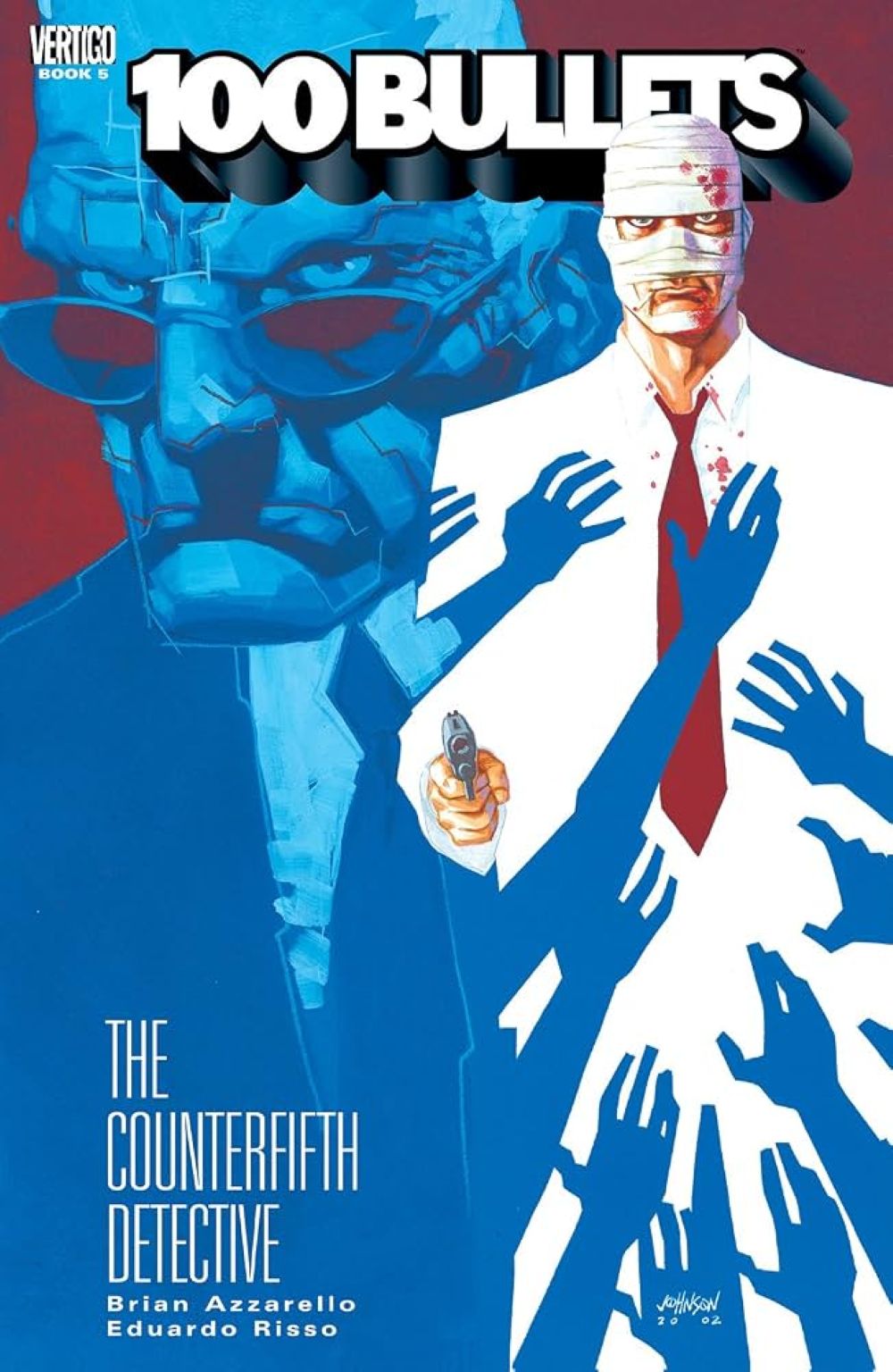
With The Counterfifth Detective, Brian Azzarello and Eduardo Risso pull 100 Bullets back toward the kind of hard-boiled detective story its title and visual style have been flirting with since the beginning. The series has spent four volumes building from Agent Graves’s deceptively simple revenge offer into a much wider conspiracy involving the Trust, the Minutemen, and a long list of people carrying old grudges, hidden loyalties, and enough baggage to sink a city block. This fifth collection does not exactly slow that larger story down, but it does give it a tighter, more focused mystery to work through.
The central character is Milo Garret, a Los Angeles private investigator who wakes up in a hospital after what appears to have been a very bad car accident. His face is wrapped in bandages, his memories are incomplete, and his life has somehow become even more miserable than the average 100 Bullets protagonist’s. Naturally, Agent Graves shows up at exactly the moment when Milo is vulnerable, angry, and looking for somebody to blame. Graves gives him the familiar attaché case containing a gun, proof, and one hundred untraceable bullets, then suggests that Milo’s accident may not have been accidental at all.
That setup brings the series back to its original premise, but there is an important difference this time. Milo is not merely an ordinary person presented with a chance to kill the person who ruined his life. He is a detective, or at least he very badly wants to be the kind of detective he has seen in old movies and read about in pulp novels. He drinks too much, gets knocked around constantly, talks like somebody trying to turn every conversation into a Bogart monologue, and keeps walking into dangerous situations because it is what he thinks a real private eye is supposed to do. It would be easy for that to become irritating, but Azzarello makes Milo’s self-conscious noir act part of what makes him interesting.
Milo is clearly performing an identity, even before the story begins questioning whether he really understands his own past. He treats the hard-drinking, wisecracking private detective routine like armor. With his face literally hidden beneath layers of bandages, he has even more reason to cling to the image of who he believes he is. That gives The Counterfifth Detective a stranger and more personal angle than the earlier revenge stories. Milo is not just trying to find out who hurt him. He is trying to find out what he has forgotten, why so many people seem to know more about him than he does, and whether the version of himself he believes in has ever been real.
The title itself is one of those Azzarello word games that sounds like nonsense until the book starts circling around identity, forgery, and false versions of the truth. Milo gets drawn into the search for a stolen painting, but the painting is not simply a MacGuffin to move the plot along. It becomes tied to memory, deception, and the larger secrets that have been buried around the Trust and the Minutemen. Like much of 100 Bullets, the plot does not always hand the reader clean explanations right away. People speak in half-truths, conversations seem to skip over the most important details, and every time Milo gets what looks like an answer, it creates two more questions.
That can make the volume feel deliberately tangled. Azzarello is not writing a traditional detective mystery where every clue fits neatly into place by the final chapter. This is a conspiracy story told from the point of view of a man who has been dropped into the middle of it with a damaged memory and a gun in his hand. Milo is confused because he should be confused. The reader is meant to feel that same instability as the people around him lie, betray each other, disappear, get beaten up, or turn up dead before they can explain what they know.
At the same time, this is one of the more accessible volumes since the early days of the series because Milo gives the story a strong point of view. A Foregone Tomorrow was important for expanding the scope of the Trust and making the Minutemen feel like a real part of the series rather than vague backstory, but it was also intentionally scattered. The Counterfifth Detective still feeds the larger mythology, yet it is built around one man trying to survive one increasingly ugly case. The result feels more focused, even when the actual plot becomes more complicated.
Agent Graves is especially effective here because his role has changed so much from the early volumes. He still presents himself as a man offering someone the tools to take revenge, but it is impossible to see him as a neutral facilitator anymore. Graves knows far more about Milo than Milo does. He is not just giving the detective a choice; he is guiding him toward a confrontation that has clear value in Graves’s wider war against the Trust. The attaché case remains a powerful symbol because it looks like freedom. It promises immunity, a weapon, and a chance to settle the score. But in this series, the case is never really freedom. It is an invitation into Graves’s game.
The presence of Lono also helps give the story some extra menace. Lono is one of the series’ most unnerving characters because he is not merely violent; he seems to enjoy making everybody else feel smaller, dirtier, and more helpless. Whenever he appears, the atmosphere immediately gets worse. He brings a kind of ugly unpredictability that contrasts nicely with Graves’s calm manipulation. Graves always seems like he has calculated the next ten moves. Lono feels like he might wreck the board just to hear the pieces crack.
Risso’s artwork continues to carry an enormous amount of the book’s personality. The bandaged Milo is a great visual creation because he looks both mysterious and ridiculous, like a cheap horror-movie monster trying to pass himself off as a tough guy. Risso finds the humor in that image without undercutting the danger around it. He is also excellent at making Los Angeles feel appropriately worn down and hostile. The city is not glamorous here. It is a place of cheap offices, dim bars, empty roads, battered cars, suspicious hotel rooms, and people who look like they have been awake for three days making terrible decisions.
His use of shadow remains one of the series’ biggest strengths. A room can be almost empty and still feel tense because of the angle of a lamp, the silhouette of somebody standing in a doorway, or the way a character’s face is half-covered by darkness. That visual approach suits a story about missing memories and hidden identities perfectly. Risso rarely needs to make a big flashy gesture to sell danger. Sometimes all it takes is someone sitting too calmly in the wrong place.
Azzarello’s dialogue is still sharp, vulgar, and often very funny in a nasty way. Not every line lands, and the characters can sometimes sound like they are competing to be the most quotable person in the room, but that heightened style has become part of the book’s identity. These are people who use tough talk as a weapon. They insult, threaten, flirt, and lie in the same breath because direct honesty would make them too vulnerable.
100 Bullets Vol. 5: The Counterfifth Detective is a strong installment because it combines the series’ expanding conspiracy with a satisfying noir setup. Milo Garret is not as immediately sympathetic as Dizzy Cordova or as tragically lost as Loop Hughes, but he is a memorable lead precisely because he is such an imperfect version of a classic private eye. He wants answers, revenge, and a sense of control, but the deeper he goes, the clearer it becomes that he may be chasing a life that was invented for him by somebody else.
This is not the cleanest or easiest 100 Bullets volume, and readers looking for every mystery to be fully explained may come away frustrated. But it is stylish, mean, funny, and packed with the kind of uneasy connections that make the larger series addictive. Azzarello keeps tightening the web around Agent Graves, the Trust, and the surviving Minutemen, while Risso makes every page look like it was pulled from the darkest corner of a crime film. By the end, Milo may have found some answers, but like everybody who accepts Graves’s offer, he has paid far more for them than he ever expected.
“Imagine the good this boy could do. I know what he is, what he might grow into, maybe even what he’s meant to be. But I also see what he can be. He just needs a little guidance and someone to set a proper example.” — Trevor Bruttenholm
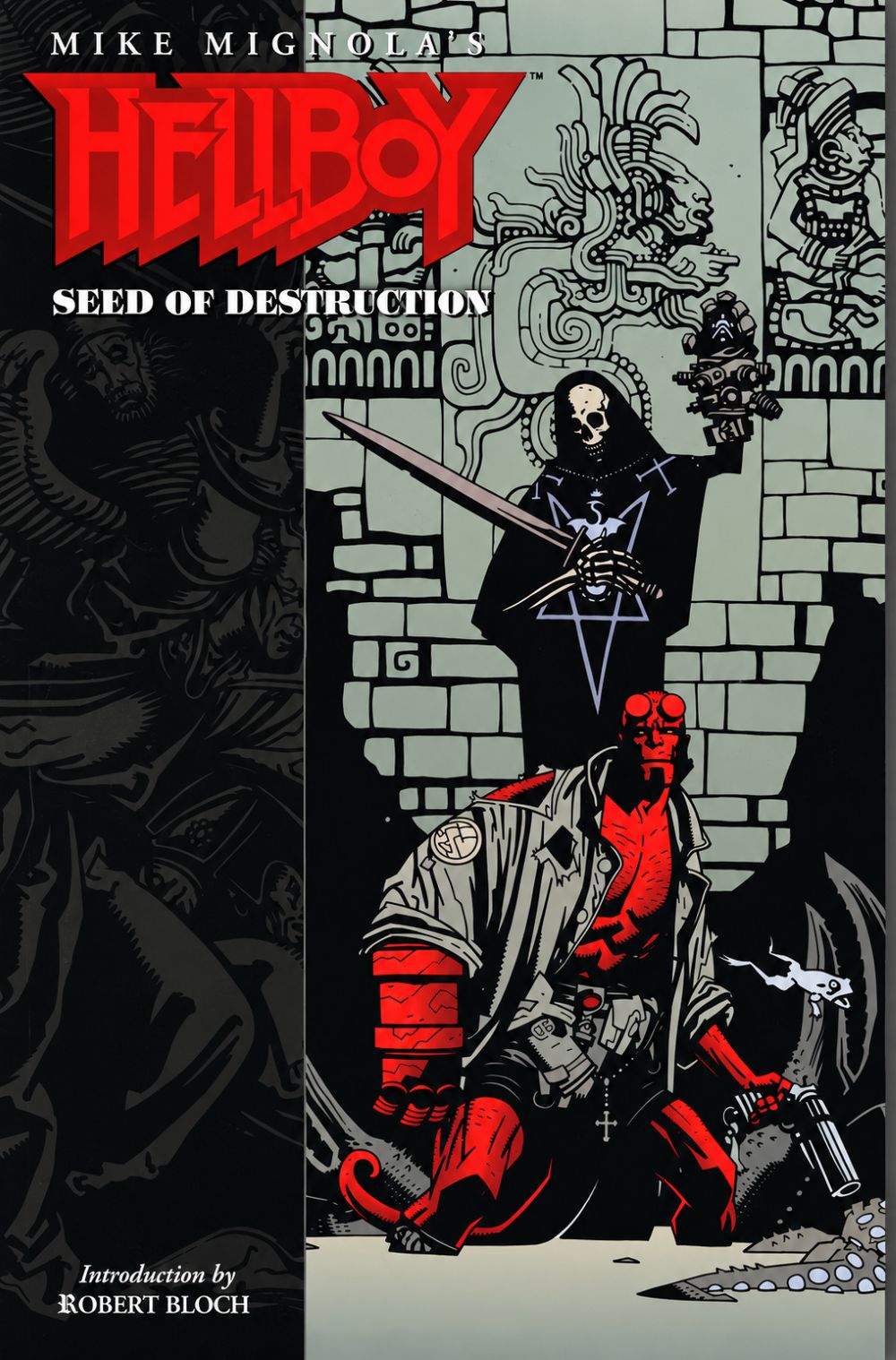
Mike Mignola’s Hellboy: Seed of Destruction is more than the opening chapter of a popular comic-book universe. It is a foundational work of supernatural adventure, combining pulpy monster fiction, wartime conspiracy, Gothic imagery, Lovecraftian apocalypse, and a surprisingly human story about identity and free will. First published as a four-issue miniseries in 1994 and co-plotted with John Byrne, the graphic novel introduces Hellboy with striking confidence. The mythology already feels vast, the visual identity is fully recognizable, and the title character arrives as one of the most distinctive heroes in modern comics: a cigar-smoking red demon with a stone right hand, a sarcastic sense of humor, and a stubborn refusal to become the monster everyone expects him to be.
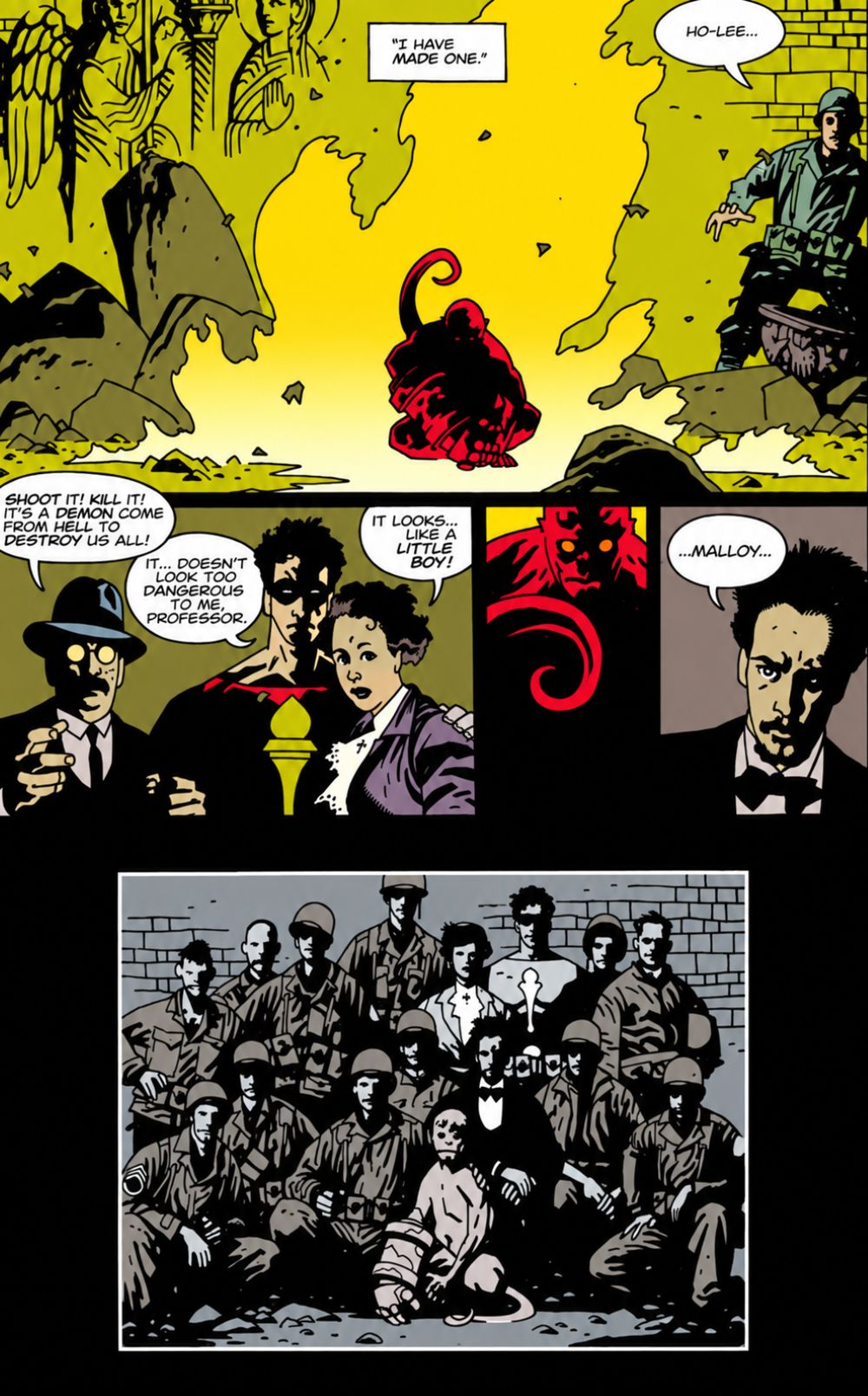
The premise is immediately compelling. In the final days of World War II, Nazi occultists conduct an elaborate ritual intended to summon a weapon powerful enough to alter the war’s outcome. The ceremony is overseen by Grigori Rasputin, who is reimagined here not simply as the notorious Russian mystic but as a servant of ancient, world-ending forces. Allied soldiers disrupt the ritual, but instead of the apocalypse the Nazis hoped to unleash, they discover a small red-skinned demon child transported to Earth. That child becomes Hellboy. He is taken in by Professor Trevor Bruttenholm, founder of the Bureau for Paranormal Research and Defense, and raised not as a weapon or scientific specimen, but as a son.
That decision gives Hellboy: Seed of Destruction its emotional center. Hellboy looks like the obvious villain of his own story. He has red skin, filed-down horns, a tail, cloven feet, and the massive stone right hand known as the Right Hand of Doom. He appears as though he should stand alongside Dracula, Frankenstein’s monster, or Satan himself. Yet Mignola’s central idea is that origin does not have to determine destiny. Hellboy may have entered the world through an act of evil, and powerful supernatural forces may expect him to fulfill an apocalyptic role, but he chooses another path. As an adult, he works for the B.P.R.D., investigating paranormal threats and protecting humanity from the very kinds of monsters he might be expected to join.
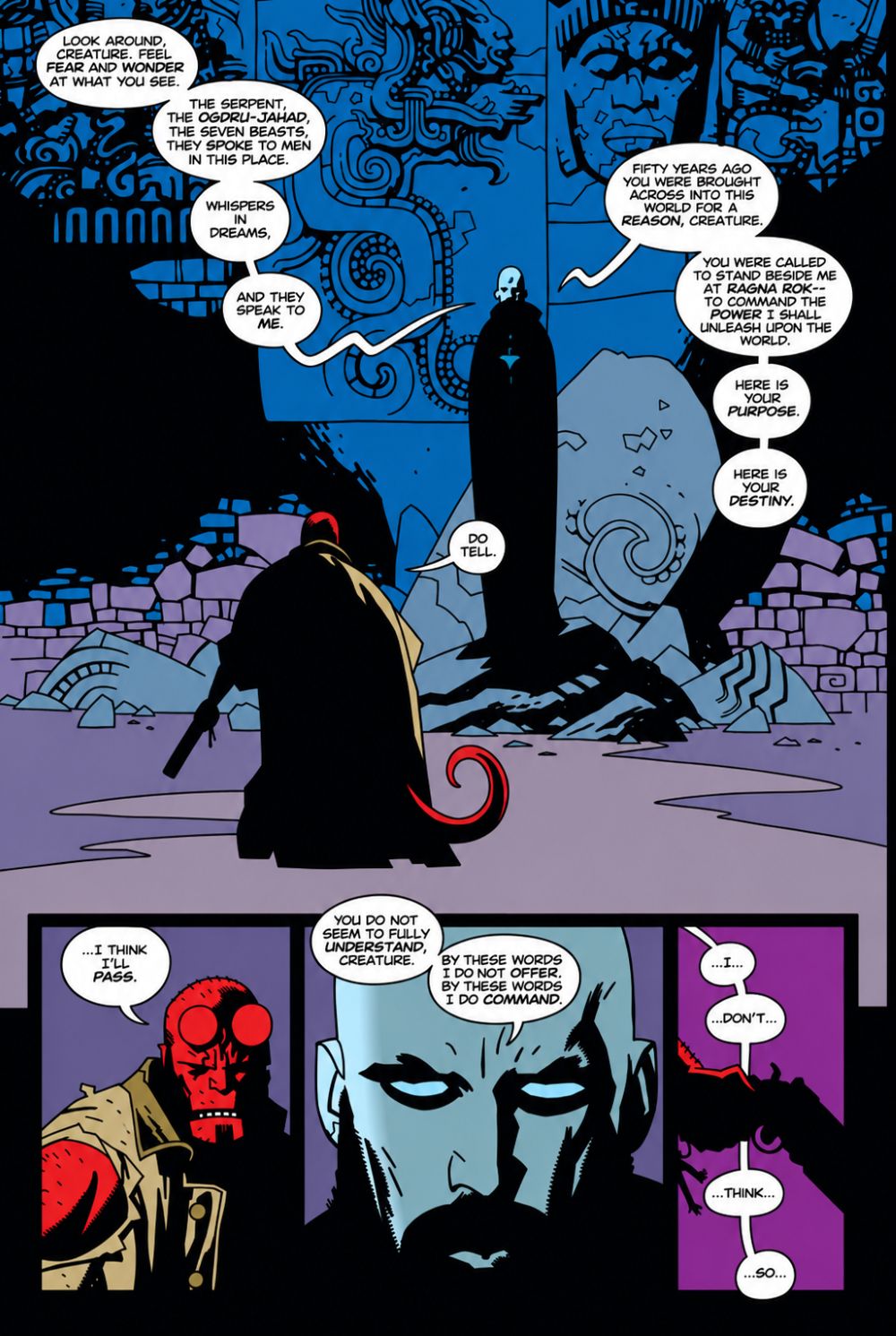
The main story takes place decades after Hellboy’s arrival and begins when a death close to him forces the past back into the present. The loss gives the investigation a personal urgency and propels Hellboy toward the hidden truth behind his own origins. As he follows the trail, he becomes entangled in a conspiracy involving Rasputin’s return, surviving Nazi occultists, forgotten rituals, buried secrets, and the terrifying possibility that Hellboy himself may have a role in an event far greater than any single monster attack. The plot steadily expands from a personal mystery into a threat with apocalyptic implications, but it never completely loses sight of Hellboy as a character caught between the person he has chosen to be and the fate others want to impose upon him.
Hellboy is joined by fellow B.P.R.D. agents Abe Sapien and Liz Sherman. Abe, an amphibious investigator with a calm, analytical nature, provides an effective contrast to Hellboy’s bluntness and impatience. Liz, a pyrokinetic woman whose connection to fire comes with emotional burdens of its own, brings a more vulnerable and tragic element to the team. In this first volume, they are not yet as richly developed as they would become in later stories, but their presence establishes the B.P.R.D. as something more interesting than an ordinary superhero team. These are not polished celebrity heroes in colorful costumes. They are unusual, damaged, and often isolated people employed to confront dangers that the public cannot know exist.
Mignola’s art is the graphic novel’s defining achievement. Even among the strongest comics of the 1990s, Hellboy: Seed of Destruction feels visually singular. At a time when much of mainstream superhero art emphasized intricate rendering, oversized muscles, and hyperactive action, Mignola worked through silhouette, shadow, stark design, and carefully controlled negative space. His figures are often blocky and stylized, but they are never lifeless. A few lines can convey fear, exhaustion, anger, or resignation. A large black shape can become a doorway, a corridor, an abyss, or a threat the reader cannot fully see.
Mignola does not use darkness merely to make the comic look moody. His shadows are active storytelling tools. Characters disappear into them, monsters emerge from them, and entire environments seem to exist only partially in the light. A seemingly empty room can become frightening because its far wall is swallowed by blackness. A frozen landscape can feel ominous because it leaves its characters exposed beneath an enormous blank sky. His layouts often evoke old pulp-horror illustrations, German Expressionist cinema, Gothic architecture, folklore engravings, and vintage monster movies. Rather than presenting a sleek modern superhero world, Mignola creates a universe that feels ancient, secretive, and half-buried under centuries of superstition.
The color work deepens that atmosphere. The pages use earthy browns, faded blues, icy whites, sickly greens, and vivid flashes of red to create a world that feels both dreamlike and decayed. Hellboy’s red skin makes him instantly recognizable within Mignola’s compositions, especially when he stands against a field of black shadow. He often resembles a burning ember in a world of darkness: visually connected to the supernatural realm around him, yet refusing to be extinguished by it. That visual contrast captures the character’s place in the story. Hellboy belongs to the darkness in a literal sense, but he continually chooses to stand against it.
The writing is more exposition-heavy than some later Hellboy stories, but it serves an understandable purpose. Hellboy: Seed of Destruction has to introduce Hellboy, the B.P.R.D., Rasputin, the Nazi occultist threat, the supernatural cosmology, and the significance of the Right Hand of Doom in a relatively short space. John Byrne’s scripting helps organize the material and gives the narrative forward momentum. Certain explanations have the recognizable rhythm of early-1990s genre comics, but the story’s atmosphere remains strong enough that the mythology rarely feels like a dry information dump. Mignola and Byrne create the impression that readers are seeing only a small piece of an immense occult history, one filled with ancient gods, forgotten disasters, and forces that have been waiting in darkness for centuries.
The pacing is deliberate rather than relentlessly action-driven. Mignola allows scenes to breathe, lingering over ruined architecture, old artifacts, empty corridors, haunted chambers, and moments of tense silence. The dread accumulates gradually. When action erupts, it tends to be sudden, heavy, and physical. Hellboy is not an acrobatic hero who glides through combat with effortless grace. He breaks through doors, trades blows with monsters, absorbs punishment, and keeps moving forward. His heroism has a blue-collar quality. He treats fighting the impossible as difficult, unpleasant work that nevertheless needs to be done.
That quality makes him especially effective within the story’s Lovecraftian framework. Traditional cosmic horror often centers on human helplessness in the face of forces too vast, ancient, and indifferent to comprehend. Hellboy: Seed of Destruction preserves that feeling, particularly in its suggestions of ancient beings and apocalyptic forces beyond normal understanding. However, it gives readers a protagonist willing to confront that terror rather than collapse before it. Hellboy cannot necessarily understand every supernatural threat, and he cannot erase the ominous circumstances of his birth, but he can refuse to cooperate with the fate laid out for him. His defiance is not naïve optimism. It is a hard-earned, practical moral stance: he will not let anyone turn him into a weapon, and he will not stand aside while innocent people are endangered.
The relationship between Hellboy and Bruttenholm gives that moral stance its weight. Bruttenholm represents the compassion that allowed Hellboy to become something other than an instrument of destruction. He does not deny Hellboy’s demonic origins, but he refuses to treat those origins as a permanent verdict. Their bond lends real emotion to the graphic novel without overwhelming it with melodrama. Mignola’s best moments of feeling are often restrained, expressed through silence, body language, or a brief line rather than a lengthy speech. This restraint suits Hellboy himself. He is not a character who easily verbalizes grief, fear, or tenderness, but those feelings are present beneath his rough exterior.
The graphic novel also has an important place in Hellboy’s larger cultural legacy because it served as the basis for Guillermo del Toro’s live-action film Hellboy. The adaptation draws from the comic’s wartime origin, B.P.R.D. framework, Rasputin-centered occult threat, and larger supernatural mythology, helping bring Mignola’s character and visual world to a wider audience. Even so, Hellboy: Seed of Destruction stands firmly on its own as the original expression of that world: darker, quieter, and more reliant on the power of shadow, silence, and graphic design than any adaptation could fully reproduce.
Hellboy: Seed of Destruction is not entirely flawless. The exposition can occasionally be dense, and Abe and Liz are not yet given the emotional complexity they receive in later Hellboy stories. The book also has the understandable burden of establishing a great deal of lore in a short opening arc. Yet those limitations are minor beside its achievements. Mignola creates a complete aesthetic universe from the beginning, one populated by ancient horrors, occult conspiracies, cryptic prophecies, and damaged people trying to do the right thing in a world that often seems hostile to human life.
Ultimately, Hellboy: Seed of Destruction remains a landmark graphic novel because it places mood, design, and character above conventional superhero spectacle. It is not simply about a demon punching monsters, even though it delivers that pleasure exceptionally well. It is about a creature born under the shadow of evil who insists on defining himself through his choices. Hellboy’s greatest strength is not his stone fist, supernatural durability, or ability to survive encounters with horrors beyond human comprehension. It is his refusal to become what he was made to be.
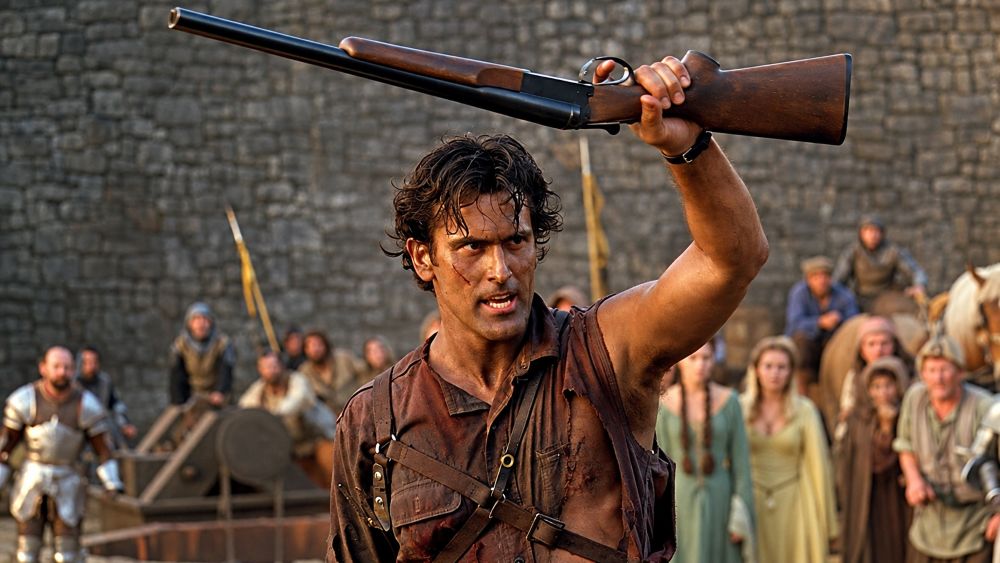
“Good. Bad. I’m the guy with the gun.” — Ash Williams
Ash Williams endures because he is not a conventional chosen-one hero. Across the Evil Dead franchise, he begins as an ordinary young man on a disastrous cabin getaway—vain, impatient, frightened, and spectacularly unprepared for supernatural horror. Yet the series turns those limitations into its central appeal. Ash is never compelling because he is innately noble or especially capable; he is compelling because demonic catastrophe repeatedly forces him to become capable. Every victory feels improvised, painful, and slightly ridiculous, earned through panic, rage, bad luck, and a stubborn refusal to die.
In The Evil Dead, Ash is primarily a survivor, defined by shock and escalating isolation as the people around him are possessed or killed. Bruce Campbell’s performance gives the character a physical vulnerability that later entries deliberately reshape: this Ash screams, hesitates, grieves, and looks genuinely overwhelmed by what he is witnessing. The cruel ingenuity of the Deadites makes survival an ordeal rather than a triumph. By the end, Ash has not cleanly conquered evil so much as endured an experience that has stripped away his normal life. That origin matters because the swagger of the later character retains a trace of trauma underneath it.
Evil Dead II transforms that shaken survivor into the archetypal Ash: a battered, increasingly unhinged fighter whose body becomes the franchise’s most elastic special effect and comic battlefield. His severed hand attacking him, the chainsaw prosthetic, and his mounting psychological collapse turn horror into a kind of brutal slapstick. But the comedy does not make the danger meaningless. Instead, it reveals Ash’s defining heroic quality: adaptability. Faced with a nightmare that cannot be reasoned with, he finds increasingly absurd practical solutions. He can be cowardly, selfish, and short-tempered, but when the moment demands it, he picks up the chainsaw and does what no one else can.
By Army of Darkness, Ash has become a deliberate parody of the macho action hero: a loud, arrogant time-displaced retail employee who talks like a conquering legend before fully earning the title. Lines such as “Groovy” and “This is my boomstick” work because Campbell delivers them with absolute, unearned confidence. Ash’s bravado is funny precisely because it is often defensive; he projects invincibility while repeatedly bungling spells, alienating allies, and creating new disasters. Even so, his eventual willingness to fight for people in a world that is not his own gives the character emotional weight. He may complain the entire time, but he does not ultimately abandon the fight.
That balance remains the foundation of Ash vs Evil Dead, which reunites the character with the consequences of his past rather than pretending he ever truly escaped them. Older Ash is still crude, impulsive, and prone to making catastrophically bad choices, but the series allows him to become a mentor and a protector without sanding down his worst qualities. The broader franchise, including comic-book continuations such as Army of Darkness and crossover material like Freddy vs. Jason vs. Ash, keeps returning to the same essential comic-book principle: Ash is an underqualified man facing impossibly large evil with whatever weapon is within reach. He is compelling because he never becomes a polished hero. He remains a damaged, vulgar, frightened human being who keeps stepping forward anyway—and in a horror universe built to reduce people to victims, that messy persistence is genuinely heroic.
“On your feet, soldier. You’ve just been drafted. This is a war.” — Agent Graves
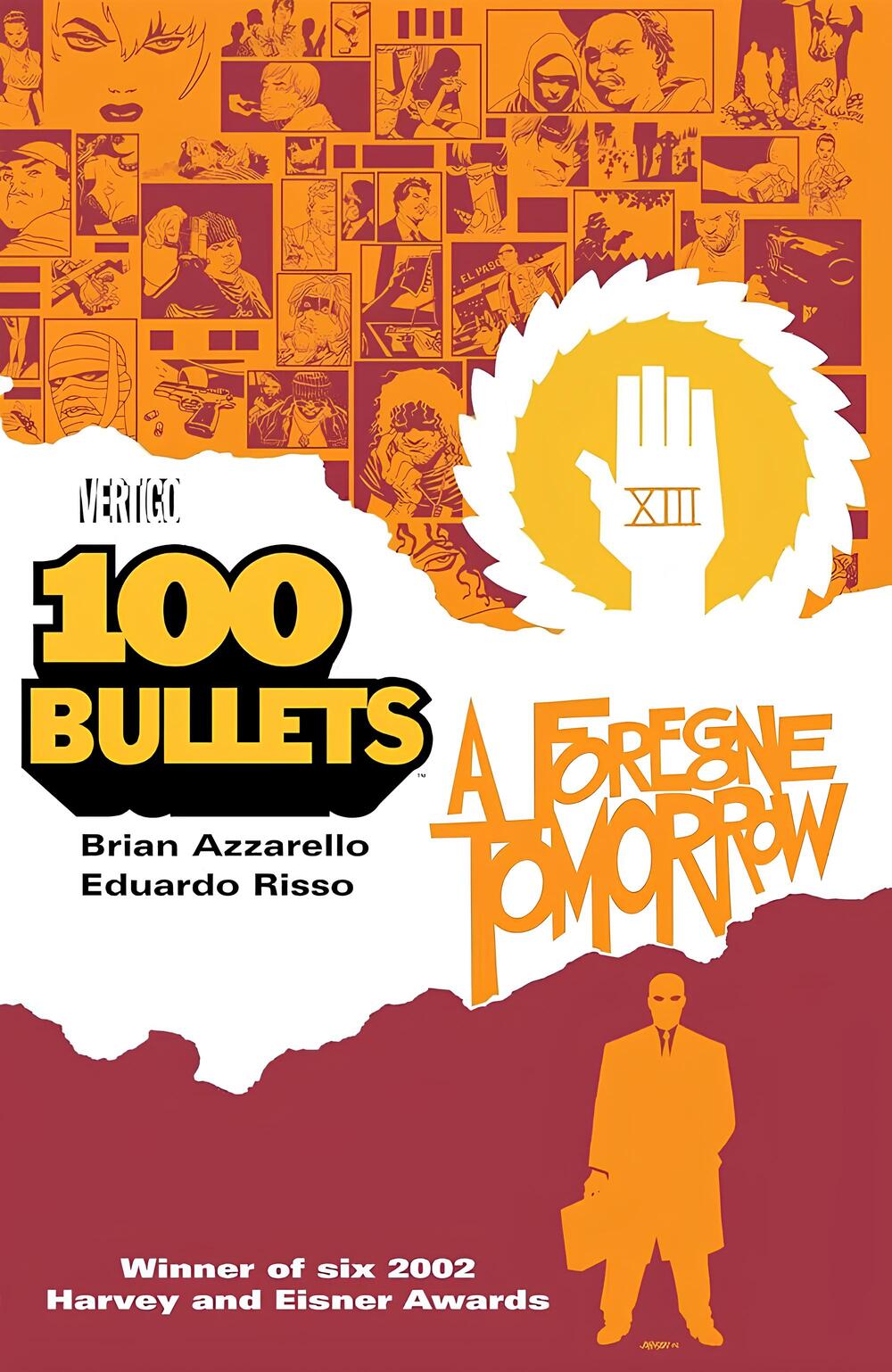
With A Foregone Tomorrow, Brian Azzarello and Eduardo Risso make it clear that 100 Bullets is done merely teasing the larger story behind Agent Graves, the Trust, and the Minutemen. The earlier volumes built their appeal around a very simple but powerful idea: Graves finds someone whose life has been ruined, hands them a briefcase containing a gun, proof, and one hundred untraceable bullets, then leaves them to decide what revenge is worth. That premise is still present here, but it no longer feels like the whole series. This fourth collection, which gathers issues #20-30, is where the long-running conspiracy really begins stepping out from the shadows. The Trust finally feels like a real organization rather than a few names being dropped in dark rooms, the Minutemen begin to take clearer shape, and Agent Graves starts to look less like a cryptic avenger and more like a man moving pieces around a board that only he fully understands.
The collection opens with “The Mimic,” and it is a good representation of what this volume does best. Azzarello ties together two conversations that seem unrelated at first: one involving Mr. Shepherd and Benito Medici, and another taking place at street level among people trying to survive in a world where even the smallest patch of territory has consequences. The contrast is important. On one side are the rich, insulated people who control entire criminal and financial networks without ever getting their own hands dirty. On the other are the desperate hustlers, dealers, addicts, and low-level criminals who are usually the first ones to bleed when those powerful people make a move. 100 Bullets has always had a strong sense of class anger under all the pulp dialogue and gunplay, but this volume puts that feeling more directly into the story.
Benito Medici is one of the most interesting additions here because he does not initially come across as the kind of polished, ruthless heir one would expect from the Trust. He seems immature, reckless, and more interested in enjoying the benefits of his family name than understanding what it costs other people. But Azzarello does not make him a joke. Benito is a spoiled rich kid, sure, but he is also a young man slowly realizing that he has been born into something dangerous and ancient. The Medici name gives him protection, money, and influence, but it also makes him a target. That uneasy realization gives his scenes some real tension. He is not just learning how much power his father Augustus has; he is learning that power in this world is never free.
The Trust itself is probably the biggest reason A Foregone Tomorrow feels like such a major turning point. Earlier books gave readers names like Augustus Medici and Megan Dietrich, along with hints about a hidden system that existed beyond regular crime families and street gangs. Here, the curtain gets pulled back much further. The Trust is revealed as a collection of powerful old families whose influence stretches across the country, while the Minutemen were created as their enforcers and internal police. The scope is suddenly much bigger than one person deciding whether to pull the trigger on somebody who wronged them. Agent Graves is not simply handing out opportunities for revenge. He is using those opportunities to destabilize a system that has spent generations protecting itself.
That expansion does make the book denser than the first three collections. Readers who liked the clean, self-contained revenge stories from First Shot, Last Call may need a little patience here. Azzarello is deliberately withholding information, and a lot of dialogue involves people speaking around the truth rather than plainly stating it. Characters mention events, names, and old betrayals that do not fully make sense until later. But that is also part of the fun. 100 Bullets is becoming a crime epic where every casual insult, odd coincidence, and brief appearance may eventually matter. The book trusts readers to keep up, and even when the plot gets murky, it rarely stops being compelling.
The Jack Daw material is probably the weakest portion of the collection, though it still has its uses. Jack is a huge, self-destructive junkie who already has one of Graves’s cases when the reader meets him. That is an interesting reversal of the usual formula because we do not see the initial pitch or the moment of temptation. We are instead dropped into the aftermath of a man who has already been given a chance to change his life and has clearly made a mess of it. Jack is not especially sympathetic, and the story never quite reaches the emotional impact of Dizzy Cordova’s or Loop Hughes’s earlier arcs. Still, he feels like another example of the kind of damaged person Graves is collecting. He is not a hero waiting to be awakened. He is a wrecking ball waiting for someone to point him in a direction.
The more memorable material comes from the way Azzarello keeps connecting old threads to new ones. Mr. Branch, who has spent much of the series trying to understand the conspiracy around Graves, becomes increasingly important as someone who sees patterns other characters are too close to notice. The story also takes a detour into the past with a strange, darkly funny episode involving baseball, Hollywood, and the Kennedy assassination. It is the kind of side story that might feel random in another series, but it works here because it reinforces the sense that Agent Graves has been active for a very long time. His briefcases are not a recent hobby. They are part of a much older game.
There is also an unexpectedly funny stretch involving a trip to Mexico, though the humor never makes the story feel safe. Azzarello has a talent for writing characters who can trade ridiculous insults and crude jokes one minute, then become frighteningly violent the next. That tonal balance is one of the things that keeps 100 Bullets from becoming unbearably grim. These people are living ugly lives in ugly places, but they still have personality. They still argue, posture, flirt, lie, and make each other laugh. The humor is usually mean, but it feels authentic to the world rather than forced comic relief.
Eduardo Risso remains the series’ secret weapon, even though by this point it is hard to call him a secret. His art gives every character an immediately recognizable silhouette and attitude. There are a lot of people in this volume, including gangsters, Trust members, old associates, street criminals, and potential Minutemen, yet Risso makes it easy to tell them apart. Benito looks like a privileged kid trying to wear confidence like a costume. Shepherd always carries himself with quiet control. Graves is still composed and unreadable, like somebody who has already calculated every possible outcome before entering the room.
Risso’s layouts are especially strong in the opening material, where different conversations and locations are visually paired to show how the powerful and powerless reflect each other. He can make a simple exchange in a park, a bar, or a hotel suite feel loaded with menace. His use of shadows, extreme angles, and stylized expressions gives the book its distinctive noir personality, but he never lets the style overwhelm the storytelling. You always know where to look and what emotional beat matters most. The guest pinup pages included around the original twenty-fifth issue are a neat bonus, though they do not have the same storytelling impact as Risso’s regular pages.
A Foregone Tomorrow is not as emotionally focused as Hang Up on the Hang Low, and it can feel more like a bridge volume than a completely self-contained story. But it is a very important bridge. This is where the series proves that its revenge setup was never just a clever anthology gimmick. The briefcases, bullets, and personal vendettas are all part of a larger conflict between men and women who believe they own the world and the people willing to burn that world down. By the end, Agent Graves is still mysterious, the Trust is still dangerous, and the Minutemen are only beginning to emerge from the past. But the road ahead is much clearer, and much more threatening.
100 Bullets Vol. 4: A Foregone Tomorrow is a strong, complicated, and occasionally messy installment that rewards readers who have been paying attention. Azzarello continues building the series into a sprawling noir conspiracy filled with damaged people, crooked power structures, and revenge that never comes without a price. Risso keeps the whole thing looking stylish, dangerous, and alive. It may not be the easiest volume to jump into, but for anyone following the series from the beginning, this is the point where the larger machine finally starts roaring to life.
“You people don’t know what the truth is! It’s there, just under their bullshit, but you never look! That’s what I hate most about this fucking city—lies are news and the truth is obsolete!” — Spider Jerusalem
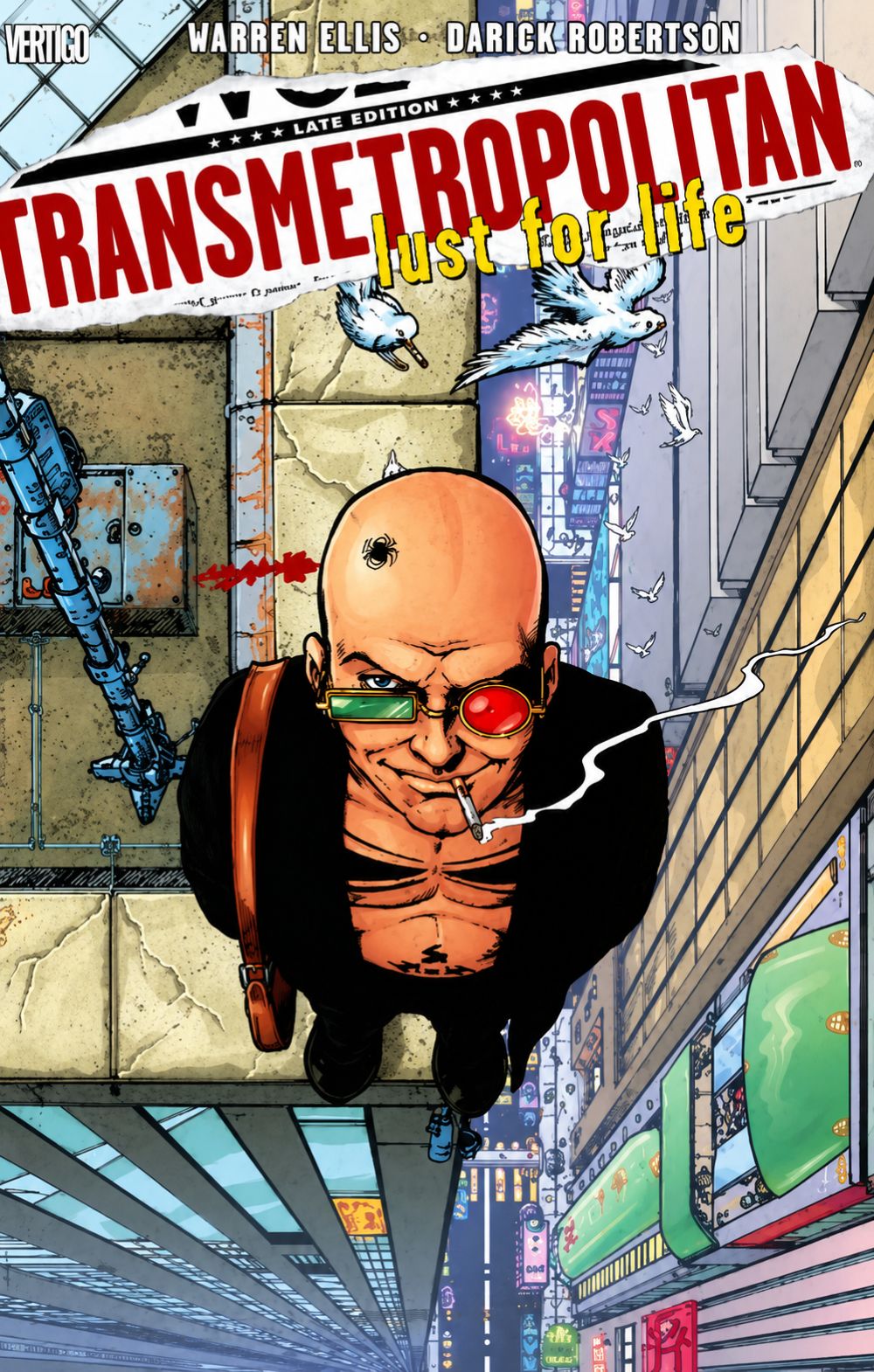
When you crack open the second volume of Warren Ellis and Darick Robertson’s Transmetropolitan, collected as Lust for Life, you’re not just getting another fix of cyberpunk chaos. You’re getting a book that solidifies exactly why this series is so brutally timeless. The first volume, Back on the Street, introduced us to the magnificent, drug-fueled trainwreck that is Spider Jerusalem and the grotesque, sprawling City he calls home. The second volume, however, is where the series finds its real footing. It’s not just about the loud, visceral shock value—though there’s plenty of that—but about deepening the world and its characters in a way that hits uncomfortably close to home.
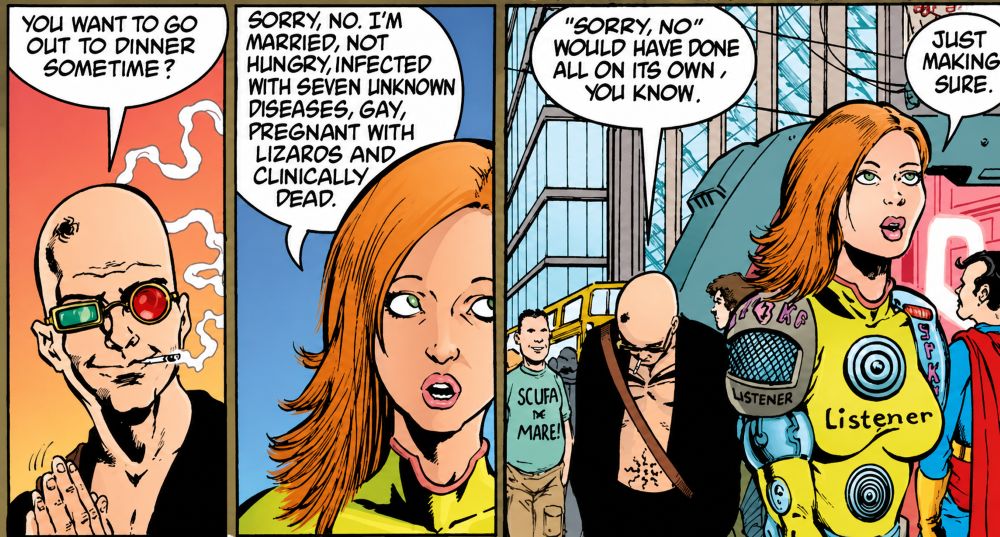
Spider Jerusalem is, and always will be, the heart of this series. He’s a chain-smoking, drug-abusing, perpetually enraged journalist in the mold of Hunter S. Thompson, armed with a bowel disruptor and a vicious tongue. He’s a complete and utter bastard to almost everyone he meets, prone to violent outbursts and scatological tirades. And yet, he’s our hero because he’s one of the few people in this future who actually gives a damn. His entire reason for being is his unwavering, almost religious, dedication to “The Truth.” He despises the apathy of the masses as much as the corruption of the powerful, and he’s willing to burn his life down to expose both. This volume showcases that beautifully, adding a layer of vulnerability that prevents him from becoming a one-note caricature. He’s a misanthrope who somehow still cares, and that tension is what makes him so compelling.
Lust for Life collects issues thirteen through twenty-four, and it’s structured more as a series of vignettes than a single, driving narrative. This is actually its greatest strength, as it allows Ellis and Robertson to expand the world and build the supporting cast in ways a more focused plot wouldn’t allow. A major chunk of the book is dedicated to the insane adventure of the frozen head of Spider’s ex-wife being stolen. It’s a gloriously bizarre plot, full of the kind of absurd, high-stakes chaos that Transmetropolitan does so well.
But the real emotional heft of Lust for Life comes from the quieter, more tragic stories woven between the gunfights and drug-induced rants. One of the most powerful sequences focuses on Channon, Spider’s long-suffering assistant. She’s a pillar of strength, constantly cleaning up Spider’s messes, but this volume shows her vulnerability. Her boyfriend decides to undergo a process to become a “gaseous vapor,” leaving his body behind for a formless existence. It’s a concept that sounds completely outlandish, but the execution is devastating. Ellis writes it not as a sci-fi gimmick but as a heartbreaking exploration of letting go, of watching someone you love choose a path you can’t follow. Channon’s pain and helplessness are palpable, grounding the over-the-top world in real human emotion.
Then there’s the story of Mary, a woman from our recent past who was cryogenically frozen and wakes up in the City. She’s presented as a historical relic, a simple photographer from the twentieth century who is completely out of her depth in this frantic, hyper-consumerist future. This is where the book delivers its most potent gut-punch. Mary is us. She’s the reader, trying to make sense of this alien world, and she fails. The City is a claustrophobic nightmare even for the people who were born into it, but for Mary, it’s a terrifying prison of isolation and confusion. Her story is a bleak reminder that this “progress” we’re supposedly heading toward often comes at the cost of our humanity. It’s a deeply existential and sad tale that serves as a harsh critique of the very future we might be trying to build.
Now, while Transmetropolitan is set in a hyper-exaggerated, grotesque future, the reason it remains so relevant is that the satire has proven to be uncomfortably prophetic. The City is a sprawling, neon-drenched hellscape where the line between news and entertainment has completely dissolved, where handheld devices connect everyone to a digital stream of information, and where journalism has devolved into a race for ratings and eyeballs. It’s a world where media personalities are more influential than politicians, and political leaders are cynical, manipulative populists who are experts at gaming the system. Sound familiar?
The landscape of modern journalism feels like a grim step toward this world. The “Death of Truth” that Spider rails against is a concept that has become a cornerstone of our current political and media discourse. The Beast and The Smiler, the corrupt politicians in the series, aren’t just cartoon villains; they’re mirrors reflecting a world of political spin, gerrymandering, and where the “villains” are often the ones controlling the narrative. Spider’s constant, violent struggle to get the real story feels less like a sci-fi fantasy and more like a desperate wish-fulfillment for anyone frustrated with the spin and half-truths of modern politics.
When Spider writes his column, “I Hate It Here,” he’s speaking for a populace that feels powerless and manipulated, a populace nicknamed “The New Scum” by the establishment. This social commentary hits hard because you can see its echoes everywhere today. The series suggests that technology has advanced, but human nature—our greed, our apathy, our susceptibility to manipulation—has not. It’s a bitter pill to swallow, but it’s what gives the book its power.
Transmetropolitan Vol. 2: Lust for Life might be a little light on overarching plot for some readers’ tastes. It’s not a major political arc; it’s more of a character study of the city and its inhabitants. But that’s precisely why it’s so effective. It proves that the series isn’t just a one-trick pony of cyberpunk fury. It has a heart, a soul, and a searing intelligence that cuts to the bone of our own societal failings. It’s a book that will make you laugh at its absurdity one minute and then leave you staring at the wall in quiet contemplation the next. It reinforces that even a nihilistic, drug-addled, foul-mouthed bastard like Spider Jerusalem is exactly the kind of hero we need to remind us of what we’re losing.
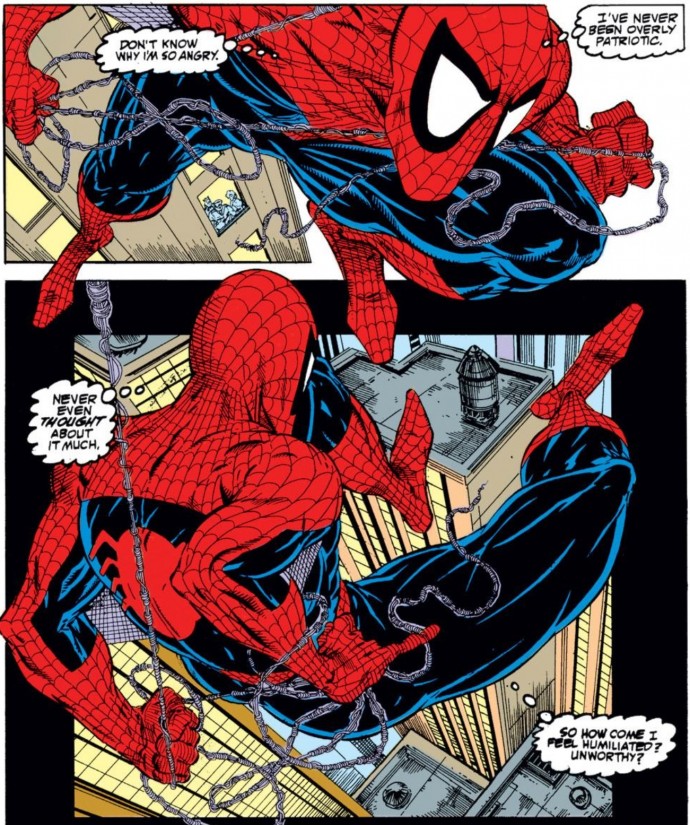
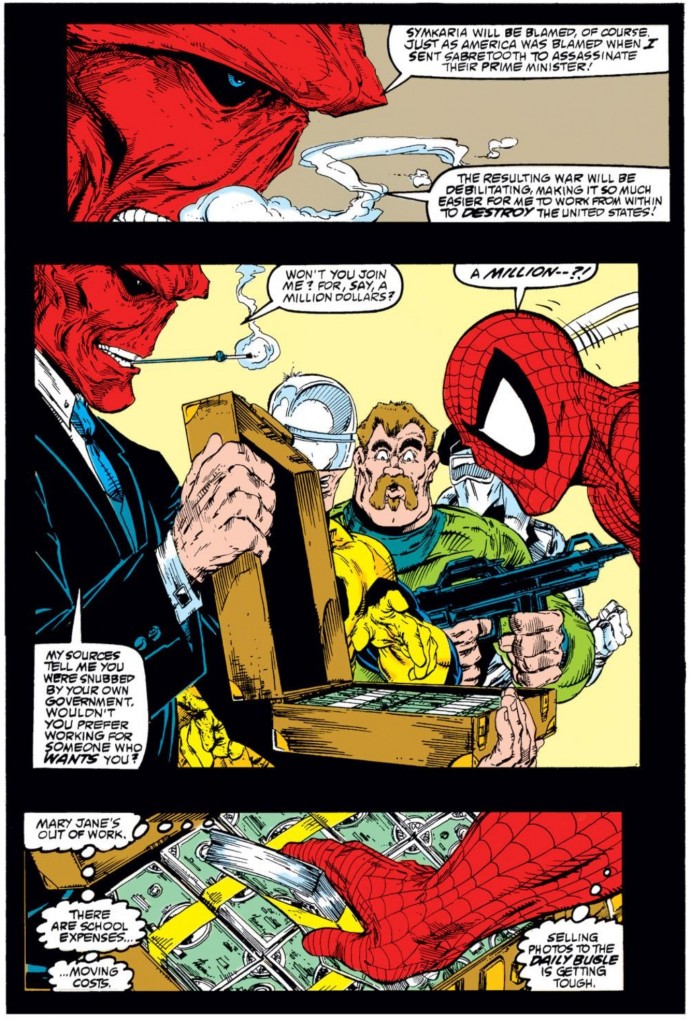
In 1989, the Red Skull offered Spider-Man a million dollars to sell out his country.
It happened in The Amazing Spider-Man #325. The Red Skull was trying to engineer a war between America and the (fictional) country of Symaria by framing each country for murdering the other’s ambassador. The Red Skull felt the war would leave America weakened and distracted and therefore vulnerable to his attempts to conquer and destroy it. He offered Spider-Man a million dollars to turn traitor and help him.
Spider-Man had reason to be tempted. Unlike most of the Marvel heroes, Spider-Man was never rich. He was usually on the verge of getting kicked out of his home for not being able to pay the rent. J. Jonah Jameson didn’t pay a lot for his pictures. His marriage to Mary Jane was usually strained, due to his finances and also lazy writing on the part of Spider-Man’s creative team. As well, in this issue, the U.S. government refused to issue Spider-Man a security clearance because he wouldn’t reveal his secret identity. Realistically, most people would probably ask for a lot more than a million before risking execution as a traitor but, to comic book readers in 2000, a million still seemed like a big deal.
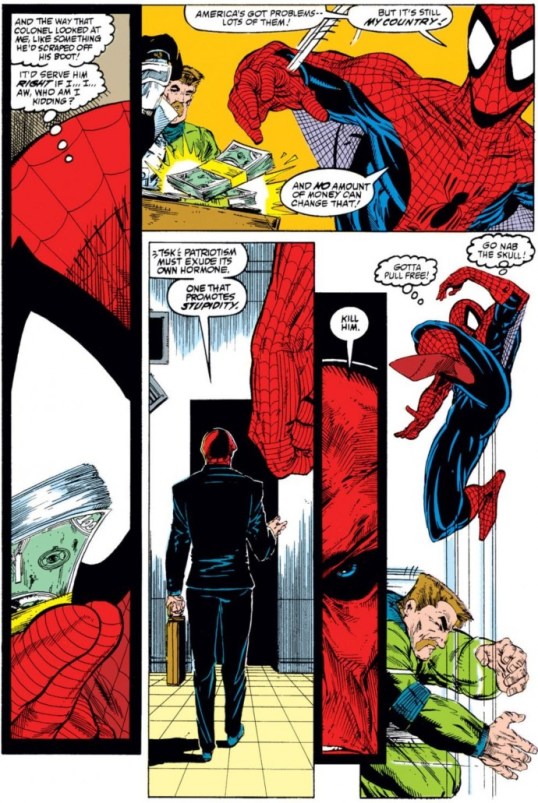
Did Spider-Man sell out his country?
What do you think?
The Amazing Spider-Man #325 is controversial because, amongst other things, it neve made sense that the Red Skull would think he could bribe Spider-Man in the first place. For today, though, the important thing is that Spider-Man, one of Marvel’s most easily disillusioned heroes, confirmed what we already suspected.
 Hello, fellow readers! I’m doing today’s book review while Lisa gets some well-earned rest.