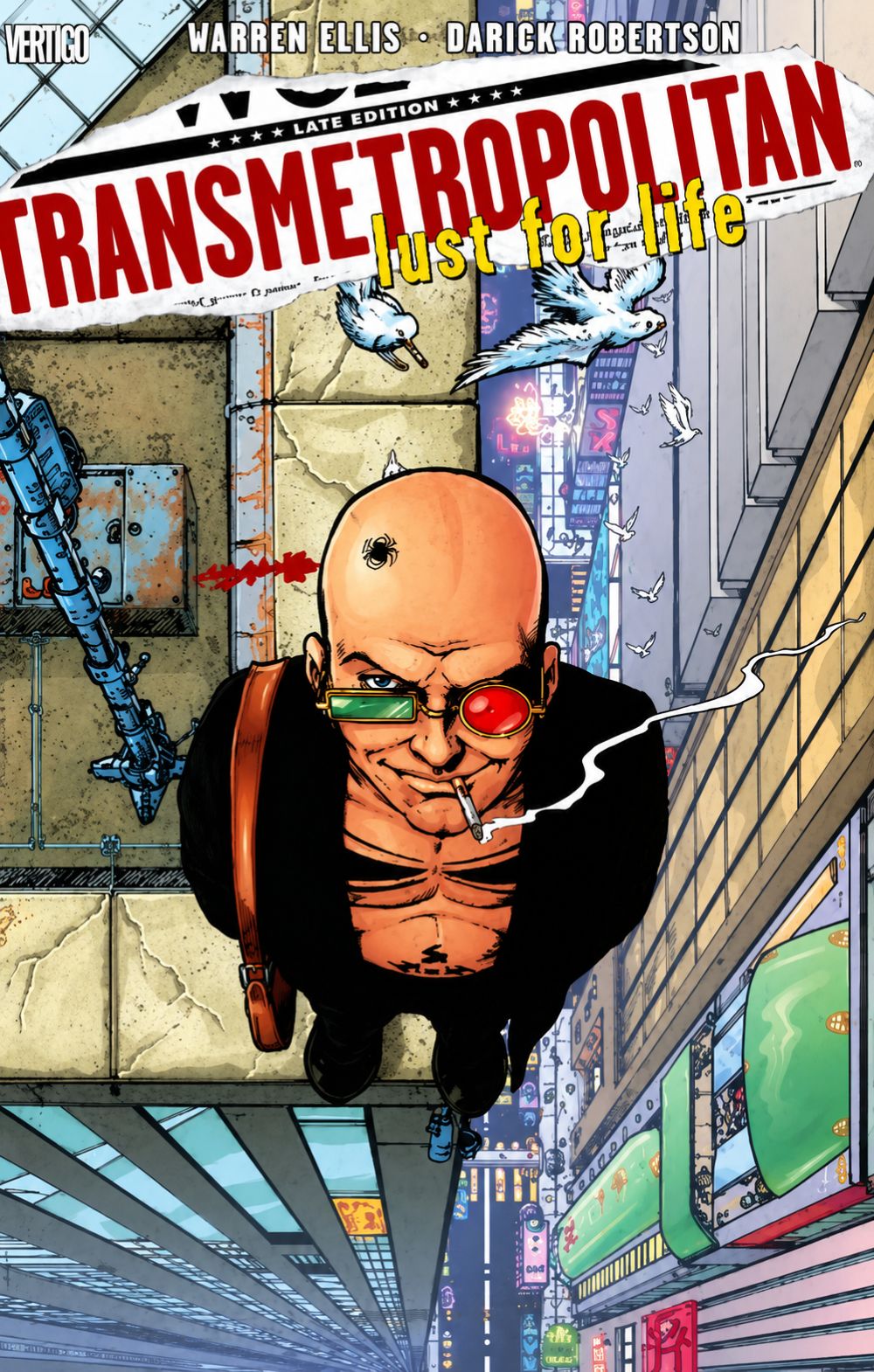
“You people don’t know what the truth is! It’s there, just under their bullshit, but you never look! That’s what I hate most about this fucking city—lies are news and the truth is obsolete!” — Spider Jerusalem
When you crack open the second volume of Warren Ellis and Darick Robertson’s Transmetropolitan, collected as Lust for Life, you’re not just getting another fix of cyberpunk chaos. You’re getting a book that solidifies exactly why this series is so brutally timeless. The first volume, Back on the Street, introduced us to the magnificent, drug-fueled trainwreck that is Spider Jerusalem and the grotesque, sprawling City he calls home. The second volume, however, is where the series finds its real footing. It’s not just about the loud, visceral shock value—though there’s plenty of that—but about deepening the world and its characters in a way that hits uncomfortably close to home.
Spider Jerusalem is, and always will be, the heart of this series. He’s a chain-smoking, drug-abusing, perpetually enraged journalist in the mold of Hunter S. Thompson, armed with a bowel disruptor and a vicious tongue. He’s a complete and utter bastard to almost everyone he meets, prone to violent outbursts and scatological tirades. And yet, he’s our hero because he’s one of the few people in this future who actually gives a damn. His entire reason for being is his unwavering, almost religious, dedication to “The Truth.” He despises the apathy of the masses as much as the corruption of the powerful, and he’s willing to burn his life down to expose both. This volume showcases that beautifully, adding a layer of vulnerability that prevents him from becoming a one-note caricature. He’s a misanthrope who somehow still cares, and that tension is what makes him so compelling.
Lust for Life collects issues thirteen through twenty-four, and it’s structured more as a series of vignettes than a single, driving narrative. This is actually its greatest strength, as it allows Ellis and Robertson to expand the world and build the supporting cast in ways a more focused plot wouldn’t allow. A major chunk of the book is dedicated to the insane adventure of the frozen head of Spider’s ex-wife being stolen. It’s a gloriously bizarre plot, full of the kind of absurd, high-stakes chaos that Transmetropolitan does so well.
But the real emotional heft of Lust for Life comes from the quieter, more tragic stories woven between the gunfights and drug-induced rants. One of the most powerful sequences focuses on Channon, Spider’s long-suffering assistant. She’s a pillar of strength, constantly cleaning up Spider’s messes, but this volume shows her vulnerability. Her boyfriend decides to undergo a process to become a “gaseous vapor,” leaving his body behind for a formless existence. It’s a concept that sounds completely outlandish, but the execution is devastating. Ellis writes it not as a sci-fi gimmick but as a heartbreaking exploration of letting go, of watching someone you love choose a path you can’t follow. Channon’s pain and helplessness are palpable, grounding the over-the-top world in real human emotion.
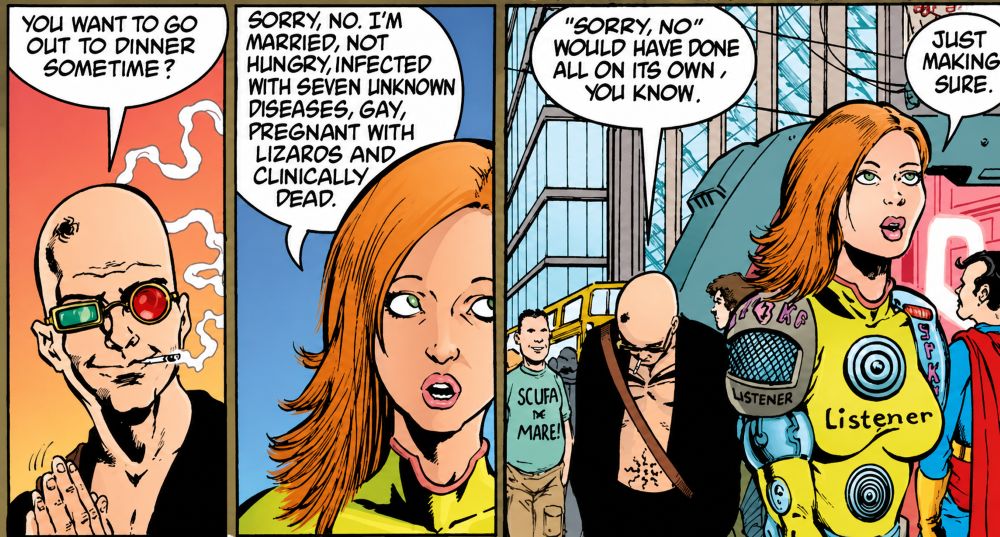
Then there’s the story of Mary, a woman from our recent past who was cryogenically frozen and wakes up in the City. She’s presented as a historical relic, a simple photographer from the twentieth century who is completely out of her depth in this frantic, hyper-consumerist future. This is where the book delivers its most potent gut-punch. Mary is us. She’s the reader, trying to make sense of this alien world, and she fails. The City is a claustrophobic nightmare even for the people who were born into it, but for Mary, it’s a terrifying prison of isolation and confusion. Her story is a bleak reminder that this “progress” we’re supposedly heading toward often comes at the cost of our humanity. It’s a deeply existential and sad tale that serves as a harsh critique of the very future we might be trying to build.
Now, while Transmetropolitan is set in a hyper-exaggerated, grotesque future, the reason it remains so relevant is that the satire has proven to be uncomfortably prophetic. The City is a sprawling, neon-drenched hellscape where the line between news and entertainment has completely dissolved, where handheld devices connect everyone to a digital stream of information, and where journalism has devolved into a race for ratings and eyeballs. It’s a world where media personalities are more influential than politicians, and political leaders are cynical, manipulative populists who are experts at gaming the system. Sound familiar?
The landscape of modern journalism feels like a grim step toward this world. The “Death of Truth” that Spider rails against is a concept that has become a cornerstone of our current political and media discourse. The Beast and The Smiler, the corrupt politicians in the series, aren’t just cartoon villains; they’re mirrors reflecting a world of political spin, gerrymandering, and where the “villains” are often the ones controlling the narrative. Spider’s constant, violent struggle to get the real story feels less like a sci-fi fantasy and more like a desperate wish-fulfillment for anyone frustrated with the spin and half-truths of modern politics.
When Spider writes his column, “I Hate It Here,” he’s speaking for a populace that feels powerless and manipulated, a populace nicknamed “The New Scum” by the establishment. This social commentary hits hard because you can see its echoes everywhere today. The series suggests that technology has advanced, but human nature—our greed, our apathy, our susceptibility to manipulation—has not. It’s a bitter pill to swallow, but it’s what gives the book its power.
Transmetropolitan Vol. 2: Lust for Life might be a little light on overarching plot for some readers’ tastes. It’s not a major political arc; it’s more of a character study of the city and its inhabitants. But that’s precisely why it’s so effective. It proves that the series isn’t just a one-trick pony of cyberpunk fury. It has a heart, a soul, and a searing intelligence that cuts to the bone of our own societal failings. It’s a book that will make you laugh at its absurdity one minute and then leave you staring at the wall in quiet contemplation the next. It reinforces that even a nihilistic, drug-addled, foul-mouthed bastard like Spider Jerusalem is exactly the kind of hero we need to remind us of what we’re losing.
Transmetropolitan Volume Reviews
 Through the Shattered Lens
Pingback: Review: Transmetropolitan Vol. 3 – Year of the Bastard | Through the Shattered Lens