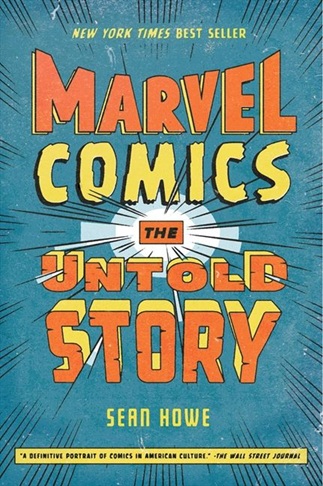
 Hello, fellow readers! I’m doing today’s book review while Lisa gets some well-earned rest.
Today, it seems like everyone is an expert on the history of Marvel Comics, but if you actually talk to them, you discover that the majority seems to think that history started when the first Iron Man movie came out in 2008. They should definitely read Sean Howe’s Marvel Comics: The Untold Story, which begins when Marvel was known as Timely Comics and ends right when the MCU is on the verge of taking over pop culture.
The history of a comic book company might not sound that interesting, but Marvel Comics: The Untold Story is surprisingly compelling. We follow the company from the Timely years through the modern era. We see how Marvel changed comics forever in the 1960s. We see how they continued to challenge conventions in the 1970s while also becoming the type of big business that sold a lot of comics and left behind a lot of angry readers and creators. We feel as if we’re watching as Stan Lee becomes a minor celebrity and struggles to get a foothold in Hollywood. Howe spends as much time discussing the bad times as the good ones. In the 1980s, Jim Shooter burns a lot of money with the New Universe. In the 1990s, Marvel goes from being the upstart company that took risks to being a symbol of the moribund establishment. With the success of the MCU, it’s easy to forget how bad things got at Marvel before the movies gave the company a new life.
The book doesn’t shy away from the controversies, in particular the question of whether Stan Lee took credit for the work of others. Lee comes across as an exuberant force who was tireless in his efforts to promote Marvel but who also could be prickly and egotistical. Artists and writers like Jack Kirby and Steve Ditko are profiled as the talented men who never got the credit they deserved for Marvel’s success. Chris Claremont is described as someone whose ideal X-Men story would be the characters just hanging out in New York and talking. John Byrne is described as using unsold New Universe comics to start a bonfire. Todd McFarlane fires Rob Liefeld by telling him, “We don’t like you no more.” The book is full of memorable moments.
Howe’s book is at its most interesting when it discusses Marvel in the 1970s. That was when a new crew of artists and writers, many of whom were young hippies who had recently graduated from art school, joined the company and discovered that Marvel was a business first. The comics may have dealt with current events, but they were still largely being drawn and written by veterans from the 1940s and 1950s. (In the 1970s, Stan Lee tried to attract female readers with Ms. Marvel but the first issue, written and drawn by men whose career stretched back the Golden Age of Comics, is described as being a series of crotch shots.) The book examines the conflict of artists trying to create in a corporate environment where the one rule is that nothing can ever change.
It’s a must-have for anyone who claims to be a fan of Marvel.

