“You’re waiting for something else to happen, aren’t you?” — John Holman
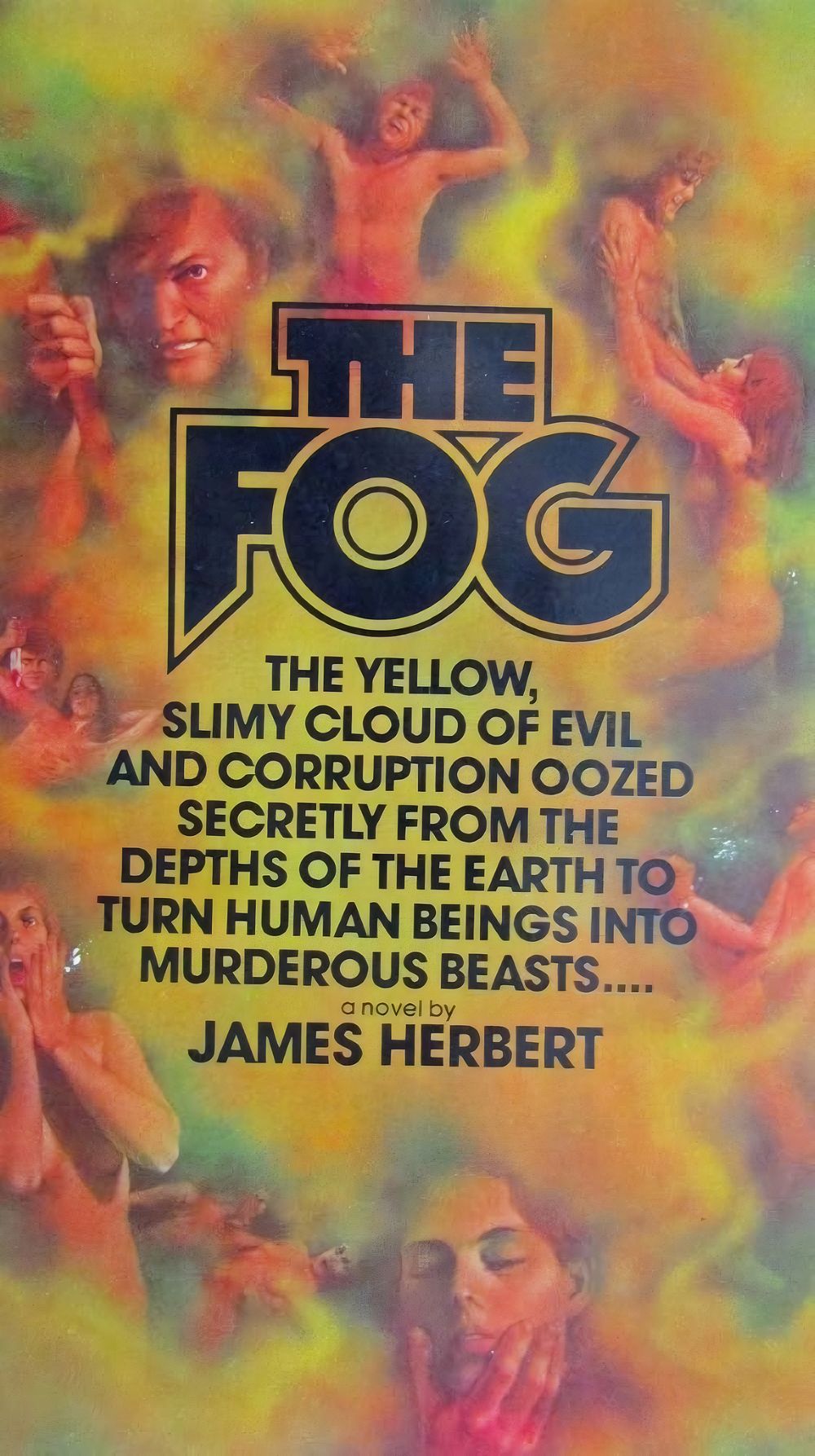
James Herbert’s The Fog treats civilization like something that can come apart in a single bad afternoon. That’s what gives this 1975 horror novel its kick: the sense that ordinary life, with all its routines and reassurances, is much less sturdy than people would like to believe. Release something poisonous into the air, strip away the usual restraints, and suddenly familiar places become killing grounds. Herbert isn’t subtle about any of this, but subtlety isn’t really the attraction. The book works by taking a straightforward nightmare and following it into increasingly ugly territory, until a local catastrophe starts looking like the beginning of a much larger collapse.
The story opens with an earthquake tearing through an English village and releasing a strange fog from underground. John Holman, an investigator for the Department of the Environment, survives exposure and eventually recovers, making him unusually valuable once the authorities begin investigating. The fog drives people toward madness and extreme violence, and it doesn’t remain conveniently confined to the place where it first appeared. As it moves across the countryside, Holman becomes involved in the effort to understand and stop it. Herbert gets the essentials moving quickly, establishing both the immediate danger and the uncomfortable possibility that nobody is equipped to handle it.
What makes the premise effective is how easily it turns the everyday world against itself. The threat isn’t simply a mysterious cloud you need to avoid. It’s the person who has already walked through it, carrying violence into a setting that seemed perfectly ordinary moments earlier. The distinction between danger and safety becomes harder to maintain when people themselves are the instruments of destruction. Herbert repeatedly returns to that instability. Homes, workplaces, and public spaces offer little protection once the behavior everyone takes for granted disappears. The familiar surroundings don’t soften the horror; they make its arrival feel more invasive.
The episodic structure is particularly good at showing that breakdown. Herbert regularly leaves the main investigation to introduce people whose lives are about to collide with the spreading disaster. Some receive only a brief sketch before things go wrong, but that quickness can be an advantage. You recognize enough of their circumstances to understand what’s being destroyed without needing a lengthy backstory. Before long, every new introduction carries an unpleasant little question: what’s going to happen to this person? Herbert turns that expectation into a reliable source of tension, even if the pattern eventually becomes easy to recognize.
Naturally, the answer is often something horrible. The notorious school sequence demonstrates how readily Herbert turns an institution associated with order into a scene of grotesque disorder. The shock comes from the violence, but also from seeing familiar roles and expectations completely overturned. Still, this approach has its limits. There are passages where sexual violence and extreme cruelty feel less like necessary developments than attempts to raise the stakes through sheer offensiveness. Herbert can make the collapse of restraint terrifying, but sometimes he seems a little too eager to show just how far he’s willing to go.
The expanding scope helps distinguish The Fog from later novels working with similar ideas, particularly Jack Ketchum’s Ladies’ Night and Richard Laymon’s One Rainy Night. Ketchum uses a chemical spill in New York to unleash murderous violence, while Laymon subjects a town to strange black rain that turns people into killers. Both keep their principal action relatively localized, emphasizing survival within a particular area. Herbert lets his threat travel. Instead of remaining one community’s nightmare, the disaster spreads into something increasingly apocalyptic. Getting out of one place isn’t much comfort when the next place could soon become just as dangerous.
That difference matters because it removes the reassuring possibility of a safe world somewhere outside the story’s boundaries. Those boundaries keep expanding. Individual atrocities become signs of a broader emergency, and the authorities’ struggle to respond suggests how quickly events could overtake them. Herbert also varies how he presents the destruction. Reports, discoveries, and glimpses of aftermath imply horrors beyond the scenes he directly dramatizes. That’s important in a novel this graphic. Relentless explicit violence could become numbing, but uncertainty allows the reader’s imagination to do some of the work and makes the larger catastrophe feel harder to measure.
Holman gives all this destruction a necessary center, although he’s more convincing as someone enduring an awful assignment than as a particularly layered character. His recovery makes him useful without making him invulnerable, which preserves some tension around his involvement. The more personal material is less successful. His relationship with Casey gives him something to care about beyond the immediate emergency, but it rarely feels as vivid as the surrounding horror. Herbert can make a stranger’s brief encounter with the fog memorable, yet the central relationship sometimes feels like an obligation the story pauses to acknowledge before returning to its stronger material.
The prose is similarly uneven. Herbert’s direct style works well when something terrible is happening, keeping the action clear and the pace brisk. He doesn’t spend pages decorating a scene when a sharp reversal will do the job. The weaknesses become more noticeable during conversations, explanations, and quieter emotional moments. Some dialogue sounds like characters exchanging the information required to get everyone into position. Scientific discussion and official briefings are useful to the plot, but they can flatten the atmosphere. You feel the difference between being caught inside a nightmare and sitting through a meeting about how the nightmare operates.
Those passages gradually pull The Fog toward the disaster thriller. Government secrecy, institutional responsibility, and attempts at containment give the narrative a practical direction, but they also reduce some of the threat’s mystery. Early on, the horror feels unpredictable and almost impossible to grasp. Later, it becomes something people can investigate, discuss, and potentially overcome. That shift isn’t inherently a problem, though Herbert handles the immediate terror more confidently than the explanations. The book is strongest when control is slipping away, not when people are describing how they might get it back.
Ultimately, The Fog is a rough-edged but effective horror novel whose momentum and vicious imagination outweigh its thinner characterization and awkward stretches. Not every atrocity earns its place, and the emotional material doesn’t always match the intensity of the disaster. But Herbert understands how to make ordinary life feel suddenly precarious. The widening threat gives his nastiest scenes consequences beyond their immediate shock value, suggesting that the damage might not stop with the people currently suffering. Civilization doesn’t collapse here because some grand force defeats it in battle. It starts coming apart because the people holding it together can no longer be trusted to do so.

