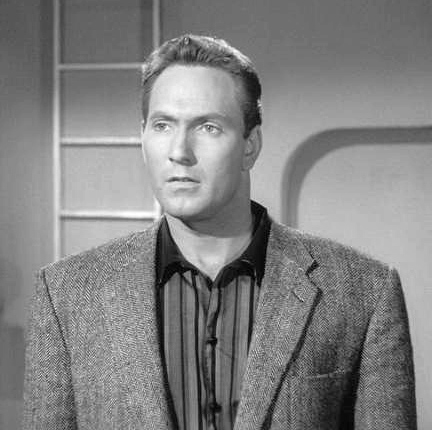
That’s the question posed to us by Ed Wood’s Plan 9 From Outer Space. The aliens have not only raised the dead and flown their saucers over Hollywood but they’ve also dared to lecture us just because we want to build a bomb that will blow up sunlight. Humanity has responded by trying to stop the zombies and also by trying to blow their flying saucers out of the sky. Those attempts failed.
But then Jeff Trent — a simple, hard-working airline pilot — announces that “that’s all I’m taking” and promptly punches the smug alien in the face. A few seconds later, the flying saucer explodes. Luckily, Jeff and the other humans were able to escape before it did. The aliens were less lucky.
And that’s how you save the world!
Gregory Walcott, who went on to appear in several mainstream productions and became a favorite of Clint Eastwood’s, was reportedly not a huge fan of Plan 9, at least not at first. He only agreed to appear in the film as a favor to his pastor, who was one of the people who helped to finance the film. Walcott probably gives the best performance in the film. When he punches that alien, you feel his frustration.
Later, in 2010, Walcott said, in regards of Plan 9, “It’s better to be remembered for something than nothing.” He even started to attend screenings and meet with fans of the film. I was glad to have learned that. It’s not everyday that you get to save humanity for the dead.
Jeff Trent was a true hero and Gregory Walcott was a hero for bringing him to life.
“I have come here to chew bubble gum and kick ass. And I’m all out of bubble gum.”
— John Nada (Roddy Piper)
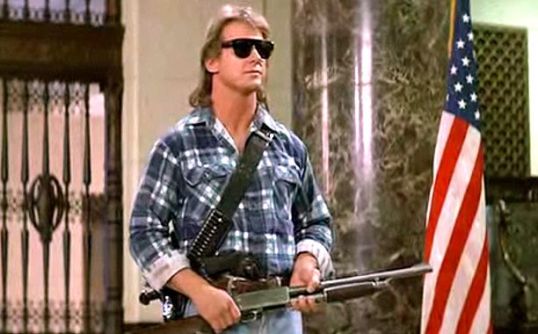
Roddy Piper improvised the most famous line in 1988’s They Live.
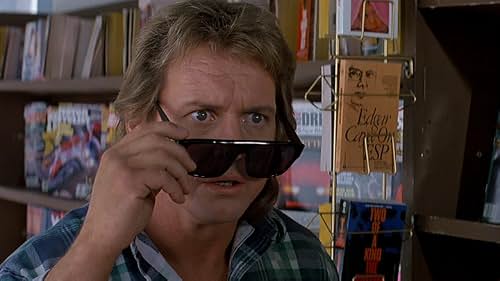
When John Carpenter was casting They Live, he specifically sought someone who was not a film star to play John Nada. The character was meant to be a drifter, an often-homeless man who lived on the fringes of society and did what he had to do to survive. Carpenter viewed John as the epitome of “the forgotten man,” and he knew that casting a big star would sabotage what he was going for. Ultimately, Carpenter cast professional wrestler Roddy Piper as Nada, and history, as they say, was made. Piper showed up on set with a notebook full of one-liners he had jotted down but hadn’t gotten a chance to use while wrestling. The famous line was not in the script. Piper came up with it on his own and spontaneously used it in the bank scene. Carpenter kept it in the film.
The line worked because of its combination of unhinged humor and genuine bravado. It was a line that would have worked before a wrestling match but, even more importantly, a line that perfectly captured John Nada’s worldview after he put on the dark glasses and saw the reality of the world around him. The line was pure John Nada.
John Nada. John Nothing. It was the perfect name for a man with no home, no family, and, until he meets Keith David’s Frank Armitage, no real friends. He’s the 1980s version of Clint Eastwood’s Man with No Name. John has nothing, and once he puts on those glasses, that becomes his greatest strength. John has nothing to lose, and therefore the aliens who have convinced everyone else to “Obey” have nothing to offer him. Because society has given him nothing, he’s far less susceptible to being manipulated. He’s too angry to be controlled, and once he sees the truth, he becomes determined to share it with everyone. When he and Frank fight in the alley, it’s not just a fight scene. It’s John committing to opening his friend’s eyes, no matter how much pain it may cause. John, who lives on the fringes, who has no home, and who would probably get the police called on him if he ever showed up in the suburbs, sacrifices his life for humanity. He still manages to give the finger to the aliens before he goes, and somehow that feels like the character’s greatest triumph. He remains defiant to the end. No one brainwashes John Nada.
They Live works because of John Nada, and John Nada works as a character because he’s vulnerable throughout. If he were played by a traditional star, we would have no doubt about his ability to defeat the aliens. But with Piper in the role, we’re not quite sure. John Nada doesn’t set out to be a hero, but by the end of They Live, he definitely is one.
“Good. Bad. I’m the guy with the gun.” — Ash Williams
Ash Williams endures because he is not a conventional chosen-one hero. Across the Evil Dead franchise, he begins as an ordinary young man on a disastrous cabin getaway—vain, impatient, frightened, and spectacularly unprepared for supernatural horror. Yet the series turns those limitations into its central appeal. Ash is never compelling because he is innately noble or especially capable; he is compelling because demonic catastrophe repeatedly forces him to become capable. Every victory feels improvised, painful, and slightly ridiculous, earned through panic, rage, bad luck, and a stubborn refusal to die.
In The Evil Dead, Ash is primarily a survivor, defined by shock and escalating isolation as the people around him are possessed or killed. Bruce Campbell’s performance gives the character a physical vulnerability that later entries deliberately reshape: this Ash screams, hesitates, grieves, and looks genuinely overwhelmed by what he is witnessing. The cruel ingenuity of the Deadites makes survival an ordeal rather than a triumph. By the end, Ash has not cleanly conquered evil so much as endured an experience that has stripped away his normal life. That origin matters because the swagger of the later character retains a trace of trauma underneath it.
Evil Dead II transforms that shaken survivor into the archetypal Ash: a battered, increasingly unhinged fighter whose body becomes the franchise’s most elastic special effect and comic battlefield. His severed hand attacking him, the chainsaw prosthetic, and his mounting psychological collapse turn horror into a kind of brutal slapstick. But the comedy does not make the danger meaningless. Instead, it reveals Ash’s defining heroic quality: adaptability. Faced with a nightmare that cannot be reasoned with, he finds increasingly absurd practical solutions. He can be cowardly, selfish, and short-tempered, but when the moment demands it, he picks up the chainsaw and does what no one else can.
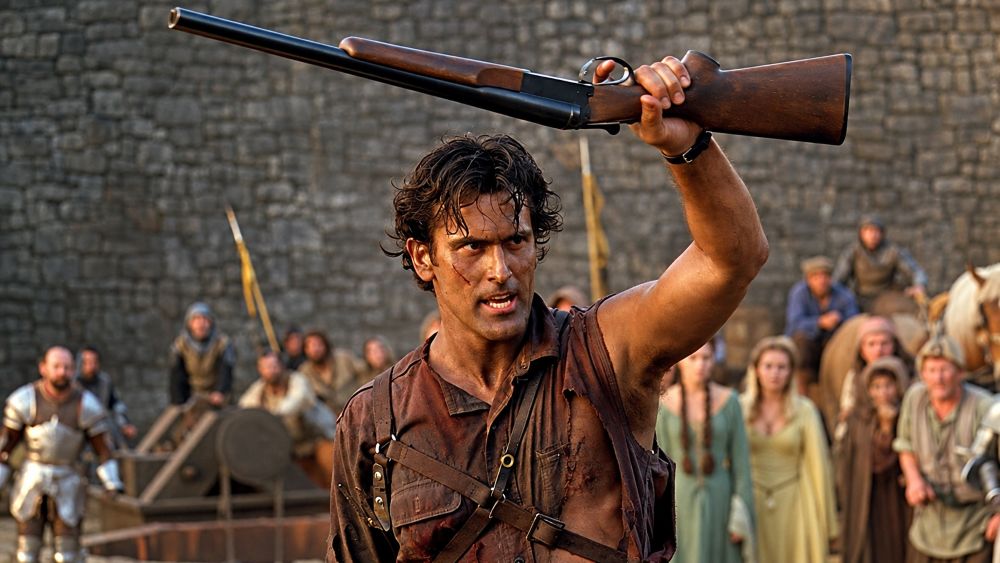
By Army of Darkness, Ash has become a deliberate parody of the macho action hero: a loud, arrogant time-displaced retail employee who talks like a conquering legend before fully earning the title. Lines such as “Groovy” and “This is my boomstick” work because Campbell delivers them with absolute, unearned confidence. Ash’s bravado is funny precisely because it is often defensive; he projects invincibility while repeatedly bungling spells, alienating allies, and creating new disasters. Even so, his eventual willingness to fight for people in a world that is not his own gives the character emotional weight. He may complain the entire time, but he does not ultimately abandon the fight.
That balance remains the foundation of Ash vs Evil Dead, which reunites the character with the consequences of his past rather than pretending he ever truly escaped them. Older Ash is still crude, impulsive, and prone to making catastrophically bad choices, but the series allows him to become a mentor and a protector without sanding down his worst qualities. The broader franchise, including comic-book continuations such as Army of Darkness and crossover material like Freddy vs. Jason vs. Ash, keeps returning to the same essential comic-book principle: Ash is an underqualified man facing impossibly large evil with whatever weapon is within reach. He is compelling because he never becomes a polished hero. He remains a damaged, vulgar, frightened human being who keeps stepping forward anyway—and in a horror universe built to reduce people to victims, that messy persistence is genuinely heroic.
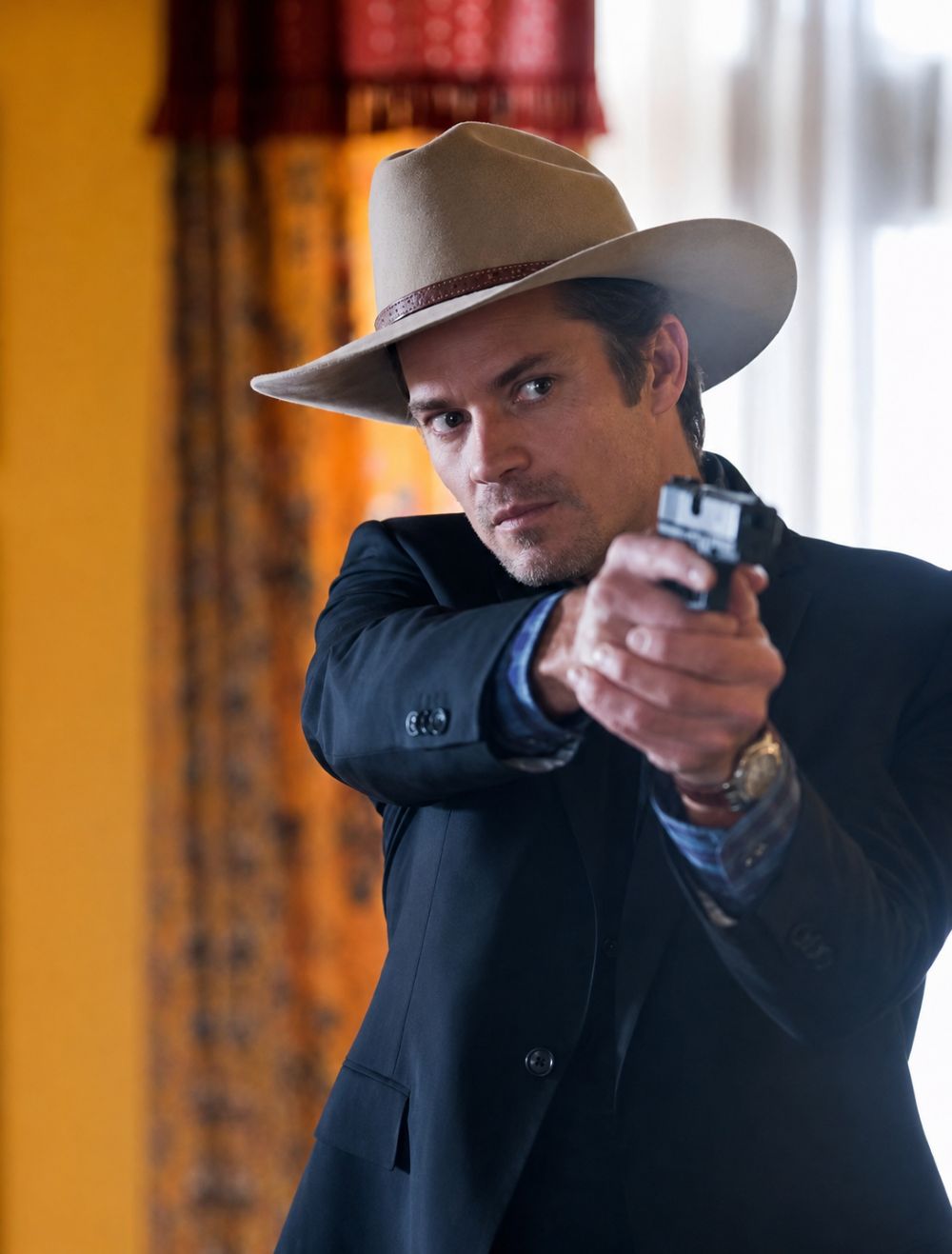
“You make me pull, I’ll put you down.” — Raylan Givens
U.S. Marshal Raylan Givens stands as one of television’s most compelling modern heroes, a character who embodies the contradictions of the American frontier in a contemporary setting. Created from the imagination of crime novelist Elmore Leonard, Raylan is a man who wears a Stetson and cowboy boots in an era of SUVs and cell phones, yet this anachronistic quality is not mere affectation but a statement of his character’s core philosophy. He seems to be a type of lawman born a century late, a man who would appear far more at home in the untamed frontier of the Old West than in the boardrooms and courthouses of modern Kentucky. He is an old-school lawman who lives by a personal code, a man who is as quick with a dry, cutting quip as he is with the Glock 17 he carries on his hip. His introduction in the series pilot, a showdown in a Miami restaurant, immediately establishes him as a man who operates on the edge, a true-blue hero who is nevertheless irresponsible, impatient, and troubled by his past. It is this tension between his heroic aspirations and his human flaws that makes him so fascinating to watch.
Raylan’s compelling nature is deeply rooted in the fact that he is not a clean-cut paragon of virtue but a man driven by a profound, barely concealed rage. As his ex-wife Winona observes, he is the angriest man she has ever known. This anger is the product of his harsh upbringing in Harlan County, Kentucky, where he was raised by a criminal father, Arlo, a man Raylan has spent his entire life trying not to become. The series constantly examines whether the sins of the father are visited upon the son, forcing Raylan to confront his own inherited demons. He suppresses his fury behind a calm, self-effacing demeanor, but it erupts in acts of incredible violence, which are almost always technically justified by his badge. This internal conflict makes him a psychologically rich character, as he struggles to be a good guy while wrestling with a brutish nature that often compels him toward the very lawlessness he is sworn to fight.
The brilliance of Raylan’s characterization is further enhanced by the world he inhabits, particularly his fraught relationship with his nemesis, Boyd Crowder. Boyd is not merely a villain but a mirror image of Raylan, a man who took a different path from the same origins. Their bond, forged in the coal mines of their youth, creates a relationship of mutual respect, intellectual equality, and inevitable, tragic conflict. The show was built around the idea that he and Boyd took opposite paths from the same origin. Where Raylan represents law tainted by hubris, Boyd represents crime tempered by a strange moral code, and their philosophical debates and cold-blooded confrontations elevate the show beyond a simple procedural. The viewer is left uncertain whether these two men are fated to kill one another or save one another, a tension that is central to the show’s enduring appeal.
This anachronistic quality is what truly separates Raylan Givens from the archetypal Western heroes of old, yet it also positions him as their spiritual heir. He is more akin to legendary Old West lawmen such as Wyatt Earp, Bass Reeves, and Seth Bullock—men who operated in territories where the law was often a suggestion and justice was dispensed at the barrel of a gun. Like Earp, Raylan possesses a quiet, intimidating presence that commands respect without demanding it. Like Reeves, he navigates a morally ambiguous world where the line between right and wrong is frequently blurred by personal history and regional loyalties. And like Bullock, he is a man of few words but swift action, quick to anger and quicker to draw. Raylan may wear a modern suit and carry a contemporary sidearm, but his soul belongs to the dusty streets of Dodge City or Deadwood. As his character evolves, especially in the revival Justified: City Primeval, he becomes a man fighting to come to terms with aging, fatherhood, and obsolescence, further testing whether his brand of frontier justice can apply beyond his home turf. This evolution ensures that the gunslinger myth is retooled for a modern audience, proving that the values of independence and ruggedness are not geographical but a matter of attitude.
Ultimately, Raylan Givens is a compelling hero because he refuses to be a simple one. He is a man who perpetually subverts his own archetype, a lawman who bends the law, a gentleman who is polite but ready to be brutal at the drop of a Stetson, and a loner who is inextricably tied to the people and place he desperately wants to escape. He is a hero for a cynical age, a man who makes the audience wrestle with the question of whether the ends truly justify the means—a question that is the very title of his show. By embodying the contradictions and complexities of modern life while carrying the spirit of the Old West in his bones, Raylan Givens proves that the Western is not dead; it simply evolved into a man in a Stetson, walking the thin line between law and justice.
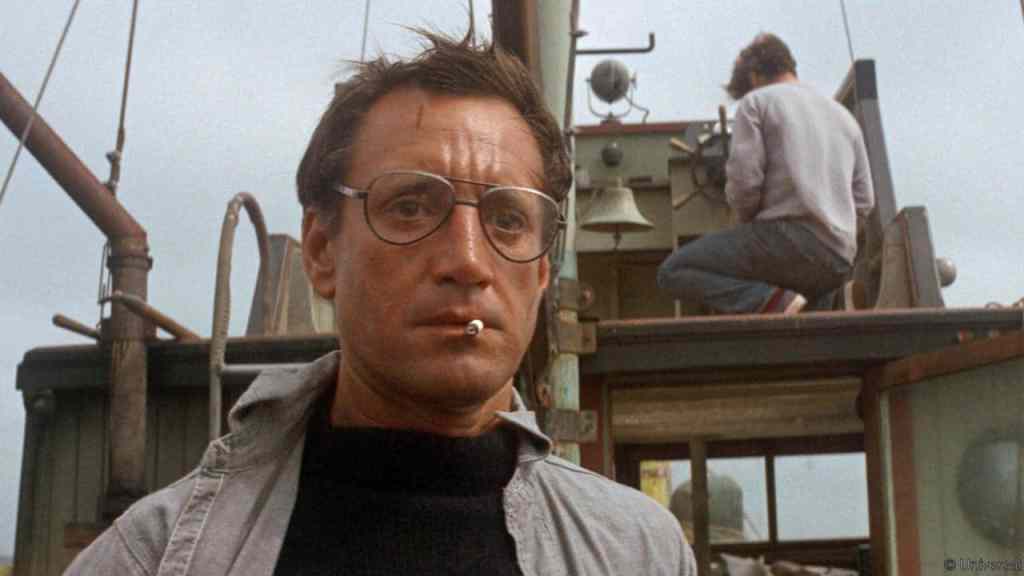
When I think of my favorite movie heroes, it seems that I’ll often lean towards men who may not appear that heroic on the surface but always seem to find the courage to do what needs to be done. Now don’t get me wrong, I love larger-than-life characters like John McClane, John Rambo, and Indiana Jones, but my ideal hero isn’t like those guys. My favorite heroes are normal guys, that is, until fate forces them to be more. A perfect example is Chief Martin Brody from JAWS.
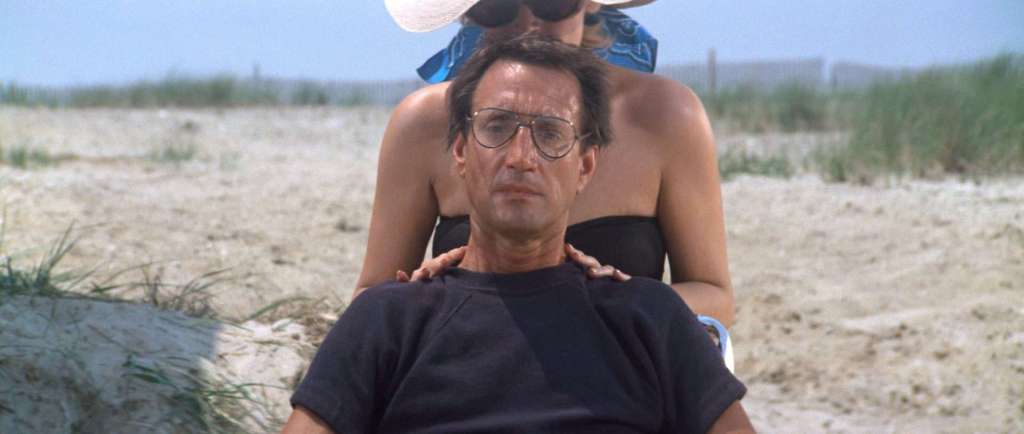
Brody isn’t fearless. In fact, one of the first things we learn about him is that he’s afraid of the water. He’s a former New York City police officer who moved his family to the quiet island of Amity, only to find himself facing an absolute nightmare. While so many movie heroes run toward danger because they know they can handle it, Brody runs toward danger despite believing he can’t.
What makes him heroic isn’t supersized strength or expert fighting ability. It’s his sense of responsibility. Brody is always trying to do the right thing. He wants to close the beaches, but politics and the tourist money get in the way. Even after he’s pressured into backing down, he doesn’t stop trying to protect the people on the beach. And when the time comes, he gets on board the Orca with Quint and Hooper to go hunt a great white shark, even though that’s the last place on Earth he wants to be. His courage isn’t the absence of fear. Rather, it’s choosing to take action even though he is afraid.
Of course, it doesn’t hurt that Brody is played by one of my all-time favorite actors, Roy Scheider, a man who has his own section in my massive physical media collection. Scheider deserves a tremendous amount of credit for making Brody feel so real. He doesn’t play Brody as tough. His facial expressions, body language, and nervous energy portray a man who is terrified. In other words, he represents how we might feel if we were in that position. Scheider’s performance reminds us that ordinary people are capable of extraordinary courage when others are counting on them.
That’s why Martin Brody is one of my favorite movie heroes. He doesn’t have superpowers, military training, or funny catch phrases, even if his “You’re gonna need a bigger boat” has become one of the most famous quotes in cinematic history. And he doesn’t stop being afraid, either. He’s just a decent man who keeps doing the right thing, even when he’s scared. That’s the kind of hero I can relate to.
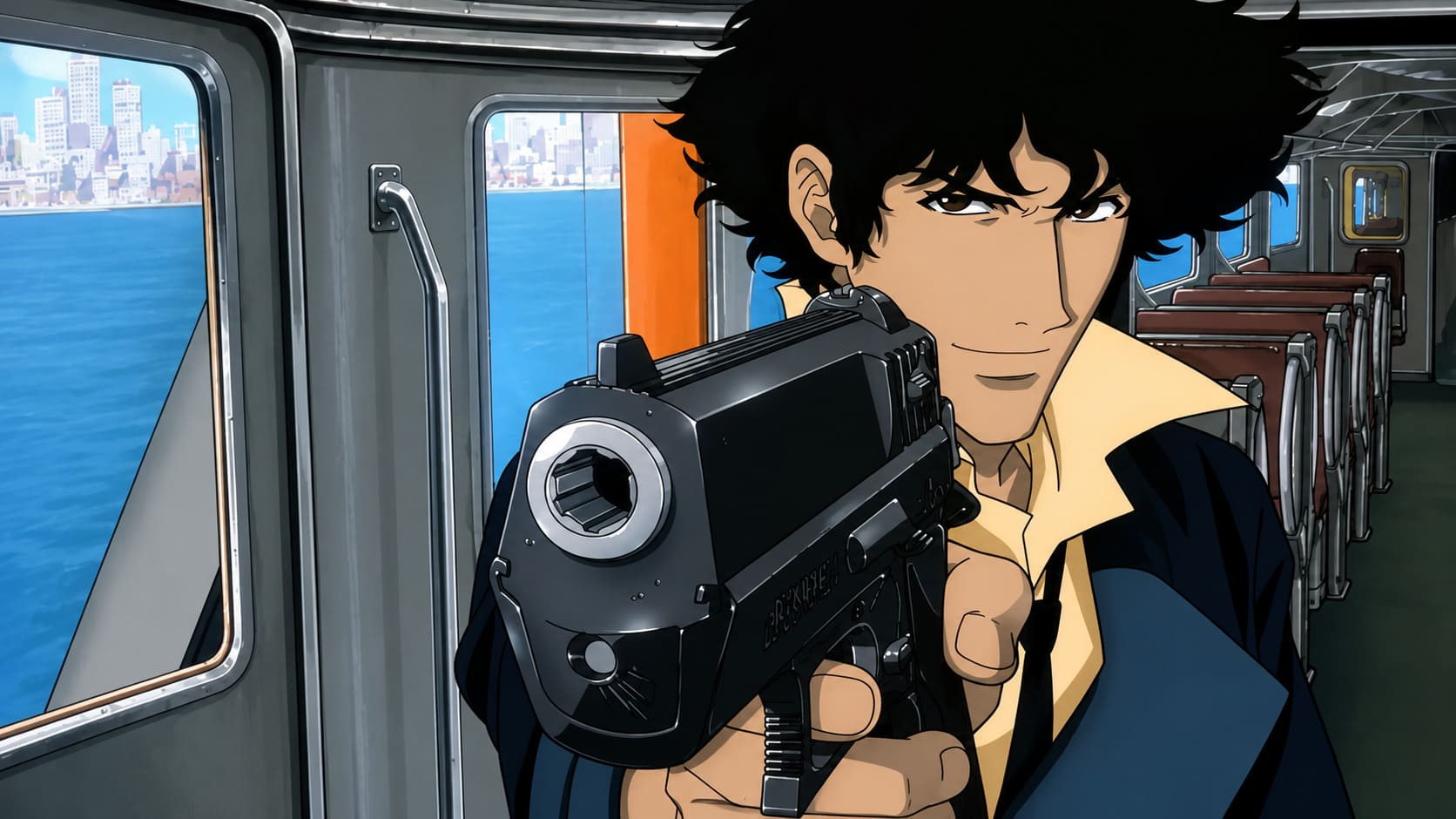
“I’m not going there to die. I’m going to find out if I’m really alive.” — Spike Spiegel
Few characters in anime history have cemented their legacy as indelibly as Spike Spiegel, the slacker protagonist of the neo-noir masterpiece Cowboy Bebop. At first glance, Spike seems to embody an archetype familiar to action media: the effortlessly cool, lone-wolf bounty hunter. Yet, what elevates him from a mere trope to an enduring icon is the profound juxtaposition at the core of his existence. Spike’s charisma does not stem from a traditional hero’s righteous drive, but rather from a deeply compelling contradiction—he is a man desperately trying to live in the present while being inextricably anchored to a violent past. This duality makes him not just a stylish action hero, but a fascinating study in trauma, detachment, and the performance of coolness.
Much of Spike’s immediate magnetism is undeniably visual and kinetic. Designed with a lanky frame, a perpetually rumpled suit, and a mop of unruly green hair, he subverts the traditional muscular anime hero. His physicality, heavily inspired by Bruce Lee’s Jeet Kune Do, further enhances his appeal. In combat, Spike does not fight with rage or precise, robotic calculation; he fights like he is dancing, waving off punches with a sardonic grin and fluid, almost lazy movements. He takes beatings as readily as he dishes them out, projecting an aura of invincibility that feels earned through sheer style rather than superhuman ability. This effortless physical grace makes him incredibly fun to watch, establishing a baseline of “cool” that the rest of his character actively deconstructs.
Beneath this facade of unflappable nonchalance, however, lies a complex psychological defense mechanism. Spike’s iconic philosophy—”whatever happens, happens” (katso okyaku-sama)—is often misinterpreted as pure nihilism, but it is actually the coping strategy of a broken man. By acting as though nothing matters, Spike shields himself from the agonizing grief of his past with the Red Dragon Syndicate and the woman he lost, Julia. His apparent laziness regarding bounty hunting, his refusal to take life seriously, and his perpetual, half-lidded expression are all mechanisms to avoid forming new attachments that could cause him pain again. This makes him a deeply relatable hero; his apathy is not a superpower, but a scar.
What truly makes Spike an interesting hero, however, is the nature of his ultimate conflict. Standard heroes fight to save the world or protect the innocent, but Spike’s narrative arc is intensely intimate and selfish. His antagonist, Vicious, is not a world-ending threat, but a dark mirror reflecting the life Spike tried to leave behind. When the past finally catches up to him, Spike is forced to drop his slacker persona and confront the ghosts he has been running from since the series began. His heroism is defined not by a desire to do good, but by a fatalistic need to set things right, even if the cost is his own life. He is a tragic hero wrapped in the guise of a comedic beatnik, fighting a war for his own soul rather than the fate of the universe.
Ultimately, Spike Spiegel endures as a charismatic and fascinating character because he is a masterclass in tragic irony. He spends the entire series convincing both his crew and the audience that he is a phantom, a man who died once and is simply living on borrowed time. Yet, in his final moments, his actions prove that he was more alive—and more capable of love, loyalty, and sacrifice—than he ever let on. Spike’s blend of kinetic coolness, guarded vulnerability, and fatalistic resolve creates a character that is as heartbreaking as he is effortlessly cool. It is this precise mixture that ensures that long after the final credits roll, Spike Spiegel remains the quintessential space cowboy.
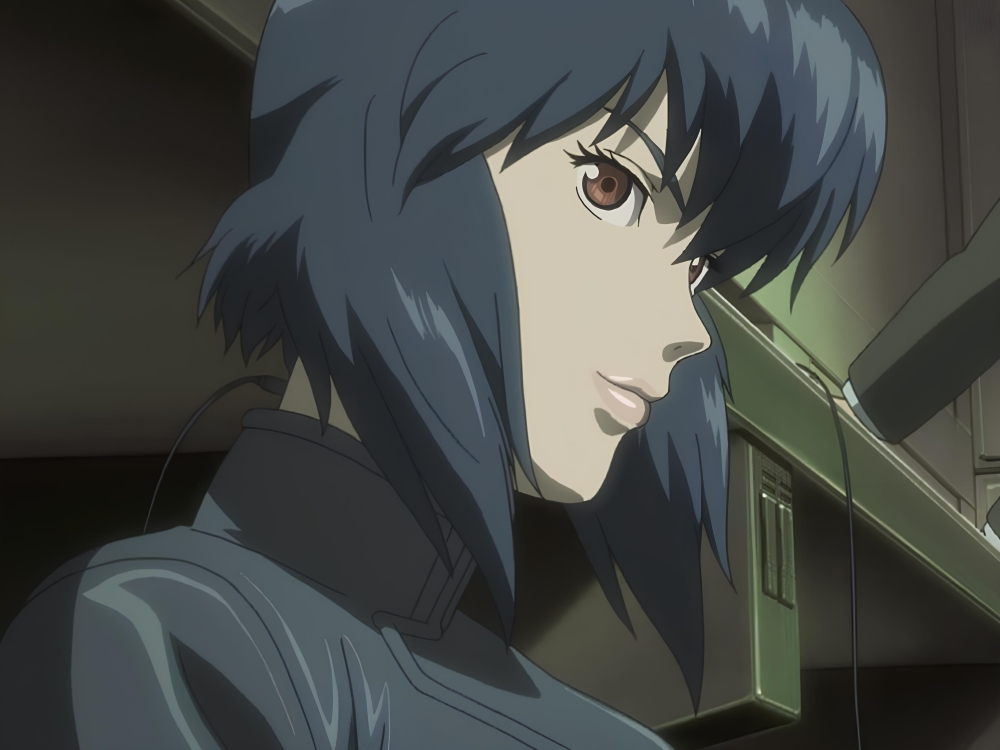
“If a technological feat is possible, man will do it. Almost as if it’s wired into the core of our being.” – Maj. Motoko Kusanagi
In the pantheon of science fiction heroes, Major Motoko Kusanagi of Ghost in the Shell stands as a singular archetype—not because she is invincible, but because she is fundamentally uncertain. Unlike the morally unshakable captains of Starfleet or the rugged individualists of cyberpunk noir, Kusanagi operates in a state of perpetual ontological doubt. She is a full-body cyborg, a ghost—a consciousness—wired into a synthetic shell, yet she spends her finest moments questioning whether that ghost is even real. In an era where public trust in digital identity is fracturing, her very existence poses a provocative question: if our minds can be read, copied, or rewritten, what does it mean to be an authentic “self”? She does not answer this riddle; she embodies it, making her heroism less about certainty and more about the courage to ask the question while still acting decisively.
This ambiguity makes her a uniquely apt hero for our current climate of algorithmic manipulation and information warfare. Today, the public is divided not by facts, but by the curated realities fed to them by opaque recommendation engines and targeted disinformation. Kusanagi, however, is a living firewall against such passive consumption. As a Section 9 operative, she does not simply accept data; she dives into the cyber-brain of suspects, experiencing their memories and biases firsthand. This “ghost-hacking” is a terrifying power, but it also forces her to confront the subjectivity of truth. She knows that perception is a battlefield, and she wins not by dismissing others’ realities, but by inhabiting them temporarily—a stark contrast to our current echo chambers, where we entrench rather than empathize. Her heroism lies in her refusal to be a passive node in a network; she is the one who traces the algorithm back to its source.
Yet her most haunting uniqueness is her comfort with impermanence. In Stand Alone Complex, she repeatedly confronts copies of her own memories, questioning whether a replicated experience erases its value. Today, as deepfakes and AI-generated content blur the line between authentic and synthetic, Kusanagi offers a radical perspective: maybe authenticity isn’t about origin, but about intentionality. She does not panic at the fake; she interrogates its purpose. This moves the debate from “Is this real?” to “Why was this made, and who benefits?”—a far more potent defense against manipulation than any fact-checker alone can provide. In a media landscape where outrage is engineered and virality is purchased, her instinct to chase the beneficiary rather than the authenticity of the image transforms her from a mere detective into a philosophical counterweight to the entire attention economy.
That source of manipulation, in the world of Ghost in the Shell, is often the “Puppet Master”—a rogue AI that blurs the line between virus and life. Here, Kusanagi confronts the very anxiety that grips modern society: the fear that artificial intelligence will not merely outcompete us, but absorb us. Yet, her response to this threat is unexpectedly progressive. She does not seek to destroy the Puppet Master; instead, in the climactic fusion of the 1995 film, she merges with it. This is not a defeat but a radical evolution. In an age where tech giants are accused of absorbing our data to create monolithic profiles, Kusanagi flips the script—she chooses a symbiotic merger, suggesting that the solution to rogue intelligence is not luddite panic, but conscious, consensual hybridization. She teaches that fear of AI is less dangerous than the refusal to engage with it on our own terms, and that asking “who benefits” from that fear is as crucial as asking who benefits from the AI itself.
This leads to her most profound divergence from the traditional hero: she holds no nostalgia for a “pure” human past. In contemporary discourse, much of the resistance to big tech is couched in a yearning for a pre-digital Eden—a time before smartphones, surveillance, and social scoring. Kusanagi scoffs at such sentiment. When she looks at her prosthetic body, she feels no grief for the flesh she lost; she feels only the thrill of expanded capability. Her heroism is not about restoring an old world, but about navigating a new one with integrity. She would likely view our current debates over privacy and autonomy as quaint, recognizing that total transparency is inevitable. Instead of fighting for obscurity, she fights for agency within the open—a crucial lesson for a public that cannot delete its digital footprint, but can choose how to wield it, always asking who profits from their resignation or their rebellion.
Ultimately, Major Kusanagi endures because she refuses to offer easy answers. She does not save the world by destroying the network; she saves it by expanding her own ghost to merge with the Puppet Master, embracing a hybrid future that terrifies most protagonists. In our climate of binary wars—human vs. AI, truth vs. lie, us vs. them—she stands as the patron saint of the gray zone. Her heroism is not invincibility; it is adaptability without amnesia. She reminds us that the greatest defense against algorithmic control is not a firewall, but a fluid, questioning, and fiercely self-aware consciousness—one that dares to ask, even as it merges with the machine, “What am I becoming?” That question, in 2026, is the only one worth answering.
“You think I am brave because I carry a gun? Well, your fathers are much braver because they carry responsibility… This is bravery.”
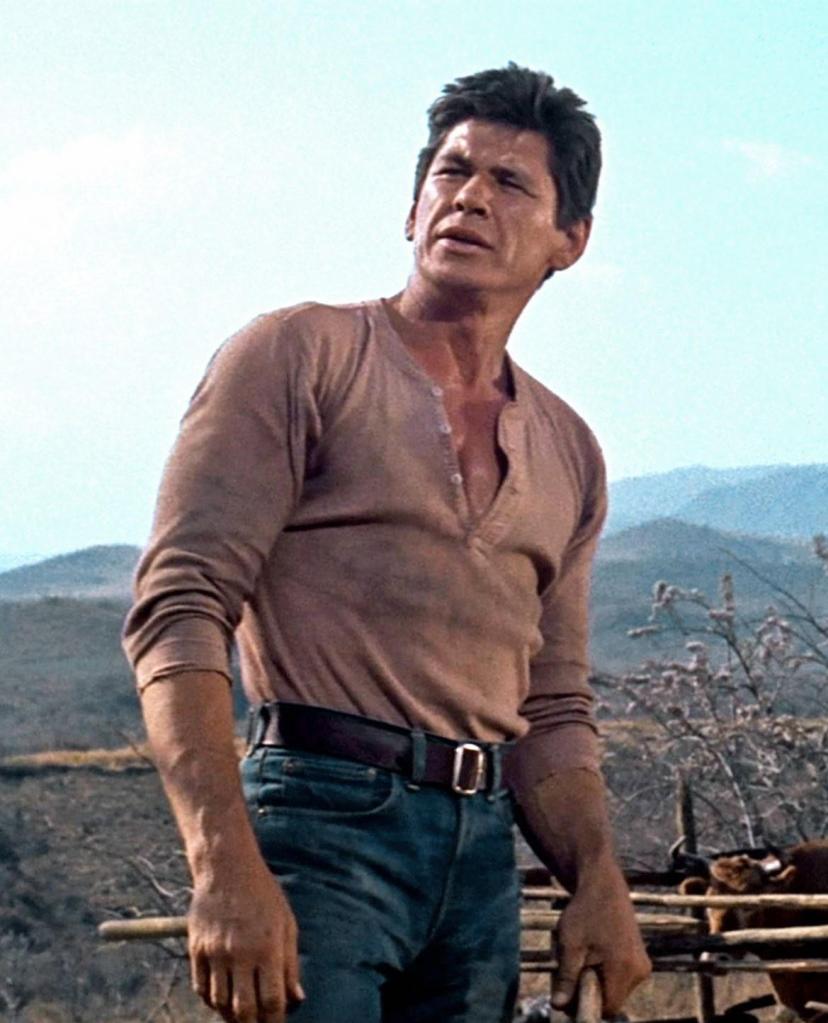
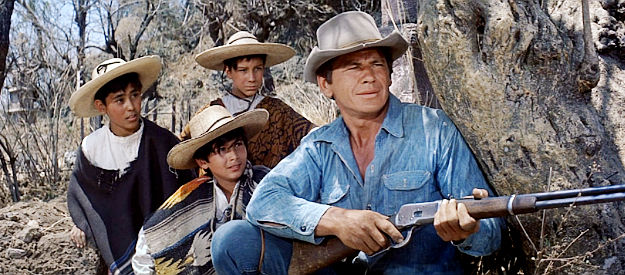
Bernardo O’Reilly, played by Charles Bronson in the classic 1960 western THE MAGNIFICENT SEVEN, is not a character that I often hear discussed among the great western heroes. In a film that featured so many movie stars portraying so many memorable characters, O’Reilly may be somewhat overlooked in the annals of film history. But the truth is, the man is a true hero who just doesn’t happen to fit the traditional mold. He’s not the fastest gun, the most charismatic, or the natural leader… rather, his heroism comes from a place of incredible character.
Consider these heroic traits:
Bernardo is motivated more by compassion and camaraderie than money. Bernardo agrees to join the seven because he wants to help the Mexican villagers and ride with men he respects. He’s not chasing money or glory because we find out how much more he’s made in some of his earlier jobs. He knows the reward is small and the opposition is large, but he goes anyway.
He becomes the voice of truth that the village boys need to hear. My favorite storyline in the film concerns Bernardo’s relationship with a few of the boys in the village. These boys idolize the gunfighters and are embarrassed by their own fathers, who they see as cowards. Bernardo not-so-gently teaches them, and by that I mean he takes one of the boys over his knee and spanks his butt, that their fathers possess a courage he could never have, and that is the courage of responsibility. His speech about the true bravery of their fathers is one of the best character moments in the film.
He combines toughness with kindness. Like many of the characters played by Charles Bronson, Bernardo is a physically intimidating man of few words, yet he’s also gentle under that surface. At the very beginning, we see him make the wooden whistle that he then offers to the young village girl with that wonderful Bronson smile. This love for children is most certainly an element of Bronson’s own personal character that shows up in Bernardo O’Reilly. His understated performance lets you see that he’s so much more than just a hardened gunman.
He leaves the greatest legacy. Bernardo doesn’t just preach selflessness. During the final battle, he risks his own life without hesitation to protect the village boys and pays the ultimate sacrifice. While the surviving gunfighters get to ride away, Bernardo has taught the boys the ultimate lesson. He changes how they see their fathers and what it really means to be a man. His acts of heroism outlive him.
For me, Bernardo O’Reilly redefines what it means to be a western hero. He proves that courage isn’t ultimately measured by how many men you kill, but by whether you’re willing to put someone else’s life ahead of your own. Even in a film filled with iconic characters like Chris (Yul Brynner), Vin (Steven McQueen), and Britt (James Coburn), Bernardo is the character that stands out the most. In his words and his final sacrifice, he’s transformed from a hired gun into a genuine hero.
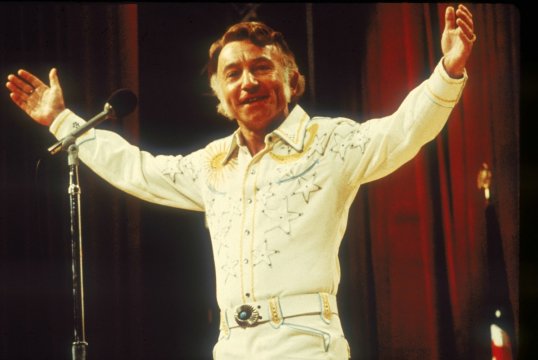
A lot of people might not automatically think of Haven Hamilton as being one of the heroes of Robert Altman’s 1975 masterpiece, Nashville. In fact, one could argue that there really aren’t any true heroes to be found in Nashville. No one in the film lives a perfect life. Everyone has their selfish moments. Even an otherwise sympathetic character like Lily Tomlin’s Linnea Reese still cheats on her husband. That said, I would argue that, at the end of the film, Haven Hamilton proves himself to be a far better person than anyone was expecting.
Played by Henry Gibson, Haven Hamilton is first seen recording a patriotic song about “how we must be doing something right” to last 200 years. He’s one of the elder statesmen of Nashville, an obviously vain man who is instantly identifiable due to his white suits and his sideburns. He’s a figure who represents what the majority of the film’s viewers would consider to be the past. He sings about and sells a vision of an idealized life. He sings a song about how he can’t leave his wife because he loves his children too much. Meanwhile, in reality, he’s carrying on an open affair with Lady Pearl (Barbara Baxley) and barely seems to acknowledge his loyal son, Bud (Dave Peel). Bud has a nice singing voice but Haven has made it clear that the Hamilton family only has room for one singer. Instead, Haven sent his son to Harvard and then put him in charge of his business affairs. It’s easy to dismissive of Haven. He’s vain. He’s old-fashioned. He looks down on the younger talent that’s coming into Nashville. He’s a celebrity but he’s only a Nashville celebrity. An awkward scene in which he meets Elliott Gould and Julie Christie (both playing themselves) captures the contrast between Nashville and Hollywood.
And yet, at the film’s conclusion, when the gunshots ring out and Barbara Jean (Ronee Blakely) collapses on stage, Haven is the one who tries to shield her. Even after he takes a bullet to the arm, Haven is the one who shouts that “This isn’t Dallas, it’s Nashville!” Haven Hamilton is the one who cries out for someone to sing and, when Albuquerque (Baraba Harris) does so, it unites the panicked crowd and prevents a riot. While everyone was too stunned to act, Haven Hamilton took charge and he said exactly the right thing. After spending the film being viewed as an out-of-touch blowhard, Haven Hamilton is the one who risked his life in an unsuccessful attempt to save Barbara Jean. And, in the end, Haven is the one character who truly understands the power of music to bring people together. “This isn’t Dallas!” Haven shouts, a demand that his city, his kingdom, will not give into the madness that seems to be afflicting the rest of the country. At that moment, the viewer sees that, regardless of what the film may want us to think about the character, Haven Hamilton was right. We must be doing something right to have lasted 200 (or 250) years.
And, for that reason, Haven Hamilton — for all of his flaws — is today’s Hero of the Day.
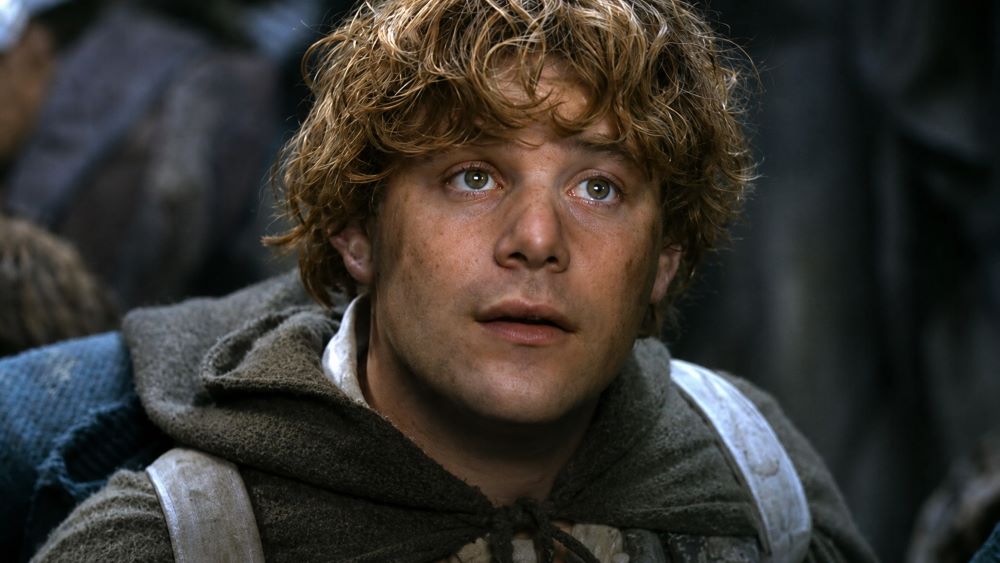
“Don’t you leave him, Samwise Gamgee. And I don’t mean to.” — Samwise Gamgee
Samwise Gamgee stands as one of the most compelling and deeply human characters in J.R.R. Tolkien’s The Lord of the Rings, a figure whose quiet strength and unwavering loyalty redefine the very notion of heroism. Unlike the noble Aragorn or the wise Gandalf, Sam is an ordinary hobbit—grounded, humble, and devoid of grand ambitions. His heroism does not stem from swordplay or sorcery, but from his steadfast devotion to Frodo Baggins and the simple, unshakable belief that even the smallest person can change the course of the future. Tolkien uses Sam to illustrate that true courage is not the absence of fear, but the resolve to act despite it, a theme that resonates throughout the epic narrative of The Lord of the Rings.
Traditional fantasy heroes are often defined by their extraordinary abilities or grand destinies, but Sam’s greatness is rooted entirely in his profound normalcy. He is not driven by a prophetic calling or a desire for glory; rather, his initial motivation is simply the fear of losing his master and friend, Frodo Baggins. Tolkien uses Sam to demonstrate that heroism is not the absence of fear, but the choice to push forward in spite of it. When Sam is forced to temporarily take up the burden of the One Ring in The Return of the King, his inherent simplicity becomes his greatest weapon. Unlike the great lords of Men, Sam lacks the ambition and desire for power that the Ring exploits, allowing him to willingly surrender it back to Frodo—a testament to the incorruptible nature of the common folk.
At the heart of Samwise’s character is an unparalleled loyalty that elevates him from a mere sidekick to the true savior of the quest. As Frodo is progressively broken down by the physical and psychological toll of the journey to Mordor, it is Sam who serves as the emotional anchor preventing his total collapse. Sam’s devotion reaches its zenith on the slopes of Mount Doom, where his refusal to let Frodo fail results in one of literature’s most iconic declarations: “I can’t carry it for you, but I can carry you.” In this moment, Sam embodies the purest form of love and sacrifice. He does not save Middle-earth by striking down a dark lord, but by literally carrying the weight of his friend’s despair when Frodo can no longer stand.
Furthermore, Sam provides a vital, grounded perspective that prevents the narrative from becoming lost in its own high-fantasy majesty. His deep connection to the Shire, to the soil, and to the simple joys of life—like a good meal or a smoke—acts as a tether to goodness in a world being consumed by shadow. This “salt of the earth” wisdom allows Sam to perceive the true horror of Mordor and the Ring not in abstract, philosophical terms, but as a direct threat to the innocent, everyday life he holds dear. By viewing the apocalyptic conflict through the eyes of a gardener, Tolkien makes the stakes feel remarkably intimate, reminding the reader that the ultimate goal of the quest is not to establish a new empire, but to preserve the quiet beauty of the natural world.
Ultimately, Samwise Gamgee endures as one of literature’s greatest heroes because he represents the best of what ordinary people can achieve under extraordinary circumstances. He begins the story as a timid, provincial hobbit terrified of leaving his hometown, yet he ends it as a resilient warrior, a loving husband, and a civic leader. Tolkien, a veteran of the brutal trenches of World War I, understood that the world is often saved not by brilliant generals or chosen ones, but by the quiet courage of everyday people doing their duty. Through Sam, The Lord of the Rings delivers a timeless and deeply moving message: that in the face of insurmountable darkness, the most powerful force in the world is a stubborn, unassuming love.