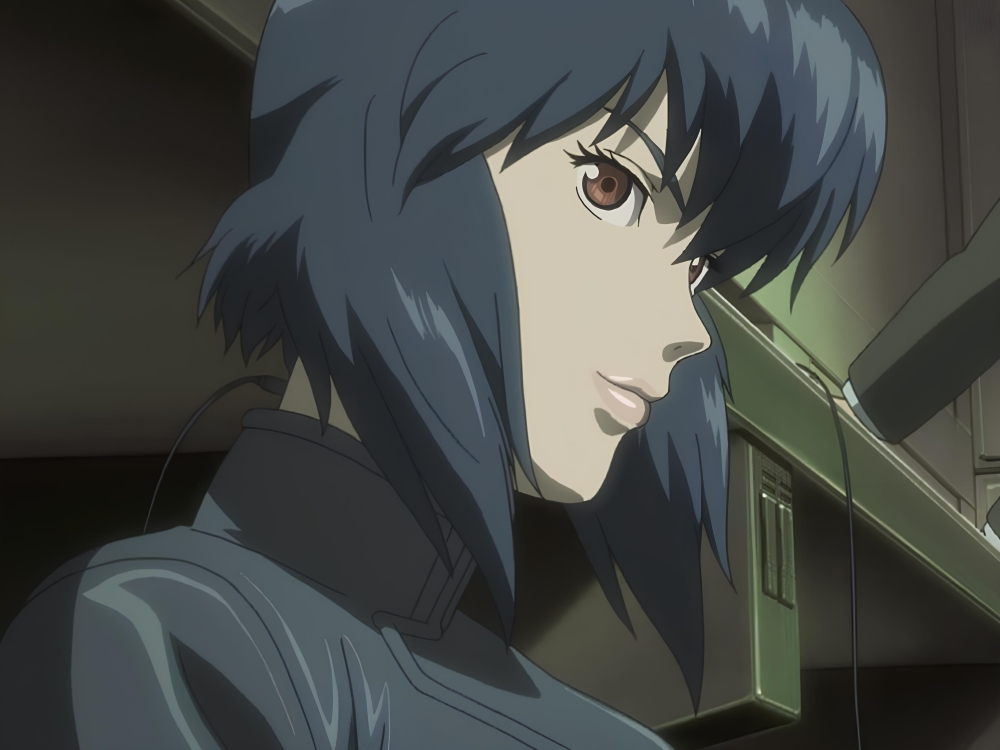
“If a technological feat is possible, man will do it. Almost as if it’s wired into the core of our being.” – Maj. Motoko Kusanagi
In the pantheon of science fiction heroes, Major Motoko Kusanagi of Ghost in the Shell stands as a singular archetype—not because she is invincible, but because she is fundamentally uncertain. Unlike the morally unshakable captains of Starfleet or the rugged individualists of cyberpunk noir, Kusanagi operates in a state of perpetual ontological doubt. She is a full-body cyborg, a ghost—a consciousness—wired into a synthetic shell, yet she spends her finest moments questioning whether that ghost is even real. In an era where public trust in digital identity is fracturing, her very existence poses a provocative question: if our minds can be read, copied, or rewritten, what does it mean to be an authentic “self”? She does not answer this riddle; she embodies it, making her heroism less about certainty and more about the courage to ask the question while still acting decisively.
This ambiguity makes her a uniquely apt hero for our current climate of algorithmic manipulation and information warfare. Today, the public is divided not by facts, but by the curated realities fed to them by opaque recommendation engines and targeted disinformation. Kusanagi, however, is a living firewall against such passive consumption. As a Section 9 operative, she does not simply accept data; she dives into the cyber-brain of suspects, experiencing their memories and biases firsthand. This “ghost-hacking” is a terrifying power, but it also forces her to confront the subjectivity of truth. She knows that perception is a battlefield, and she wins not by dismissing others’ realities, but by inhabiting them temporarily—a stark contrast to our current echo chambers, where we entrench rather than empathize. Her heroism lies in her refusal to be a passive node in a network; she is the one who traces the algorithm back to its source.
Yet her most haunting uniqueness is her comfort with impermanence. In Stand Alone Complex, she repeatedly confronts copies of her own memories, questioning whether a replicated experience erases its value. Today, as deepfakes and AI-generated content blur the line between authentic and synthetic, Kusanagi offers a radical perspective: maybe authenticity isn’t about origin, but about intentionality. She does not panic at the fake; she interrogates its purpose. This moves the debate from “Is this real?” to “Why was this made, and who benefits?”—a far more potent defense against manipulation than any fact-checker alone can provide. In a media landscape where outrage is engineered and virality is purchased, her instinct to chase the beneficiary rather than the authenticity of the image transforms her from a mere detective into a philosophical counterweight to the entire attention economy.
That source of manipulation, in the world of Ghost in the Shell, is often the “Puppet Master”—a rogue AI that blurs the line between virus and life. Here, Kusanagi confronts the very anxiety that grips modern society: the fear that artificial intelligence will not merely outcompete us, but absorb us. Yet, her response to this threat is unexpectedly progressive. She does not seek to destroy the Puppet Master; instead, in the climactic fusion of the 1995 film, she merges with it. This is not a defeat but a radical evolution. In an age where tech giants are accused of absorbing our data to create monolithic profiles, Kusanagi flips the script—she chooses a symbiotic merger, suggesting that the solution to rogue intelligence is not luddite panic, but conscious, consensual hybridization. She teaches that fear of AI is less dangerous than the refusal to engage with it on our own terms, and that asking “who benefits” from that fear is as crucial as asking who benefits from the AI itself.
This leads to her most profound divergence from the traditional hero: she holds no nostalgia for a “pure” human past. In contemporary discourse, much of the resistance to big tech is couched in a yearning for a pre-digital Eden—a time before smartphones, surveillance, and social scoring. Kusanagi scoffs at such sentiment. When she looks at her prosthetic body, she feels no grief for the flesh she lost; she feels only the thrill of expanded capability. Her heroism is not about restoring an old world, but about navigating a new one with integrity. She would likely view our current debates over privacy and autonomy as quaint, recognizing that total transparency is inevitable. Instead of fighting for obscurity, she fights for agency within the open—a crucial lesson for a public that cannot delete its digital footprint, but can choose how to wield it, always asking who profits from their resignation or their rebellion.
Ultimately, Major Kusanagi endures because she refuses to offer easy answers. She does not save the world by destroying the network; she saves it by expanding her own ghost to merge with the Puppet Master, embracing a hybrid future that terrifies most protagonists. In our climate of binary wars—human vs. AI, truth vs. lie, us vs. them—she stands as the patron saint of the gray zone. Her heroism is not invincibility; it is adaptability without amnesia. She reminds us that the greatest defense against algorithmic control is not a firewall, but a fluid, questioning, and fiercely self-aware consciousness—one that dares to ask, even as it merges with the machine, “What am I becoming?” That question, in 2026, is the only one worth answering.
Hero of the Day
- Inspector “Tequila” Yuen Ho-yan (Hard Boiled)
- Josey Wales (the Outlaw Josey Wales)
- Vince Majestyk (Mr. Majestyk)
- Monkey D. Luffy (One Piece)
- Leo Kessler (Ten to Midnight)
- Senku Ishigami (Dr. Stone)
- Marcus Fenix (Gears of War)
- Samwise Gamgee (Lord of the Rings)
- Haven Hamilton (Nashville)
- Bernardo O’Reilly (The Magnificent Seven)


Pingback: Hero of the Day: Spike Spiegel (Cowboy Bebop) | Through the Shattered Lens
Pingback: Brad’s “Hero of the Day” – Chief Martin Brody (JAWS) | Through the Shattered Lens
Pingback: Hero of the Day: Raylan Givens (Justified) | Through the Shattered Lens
Pingback: Hero of the Day: Ash Williams (Evil Dead Series) – Through the Shattered Lens
Pingback: Hero Of The Day: John Nada (They Live) – Through the Shattered Lens
Pingback: Hero of the Day: Jeff Trent (Plan 9 From Outer Space) – Through the Shattered Lens