Hellboy: Seed of Destruction (by Mike Mignola) Review


“Imagine the good this boy could do. I know what he is, what he might grow into, maybe even what he’s meant to be. But I also see what he can be. He just needs a little guidance and someone to set a proper example.” — Trevor Bruttenholm

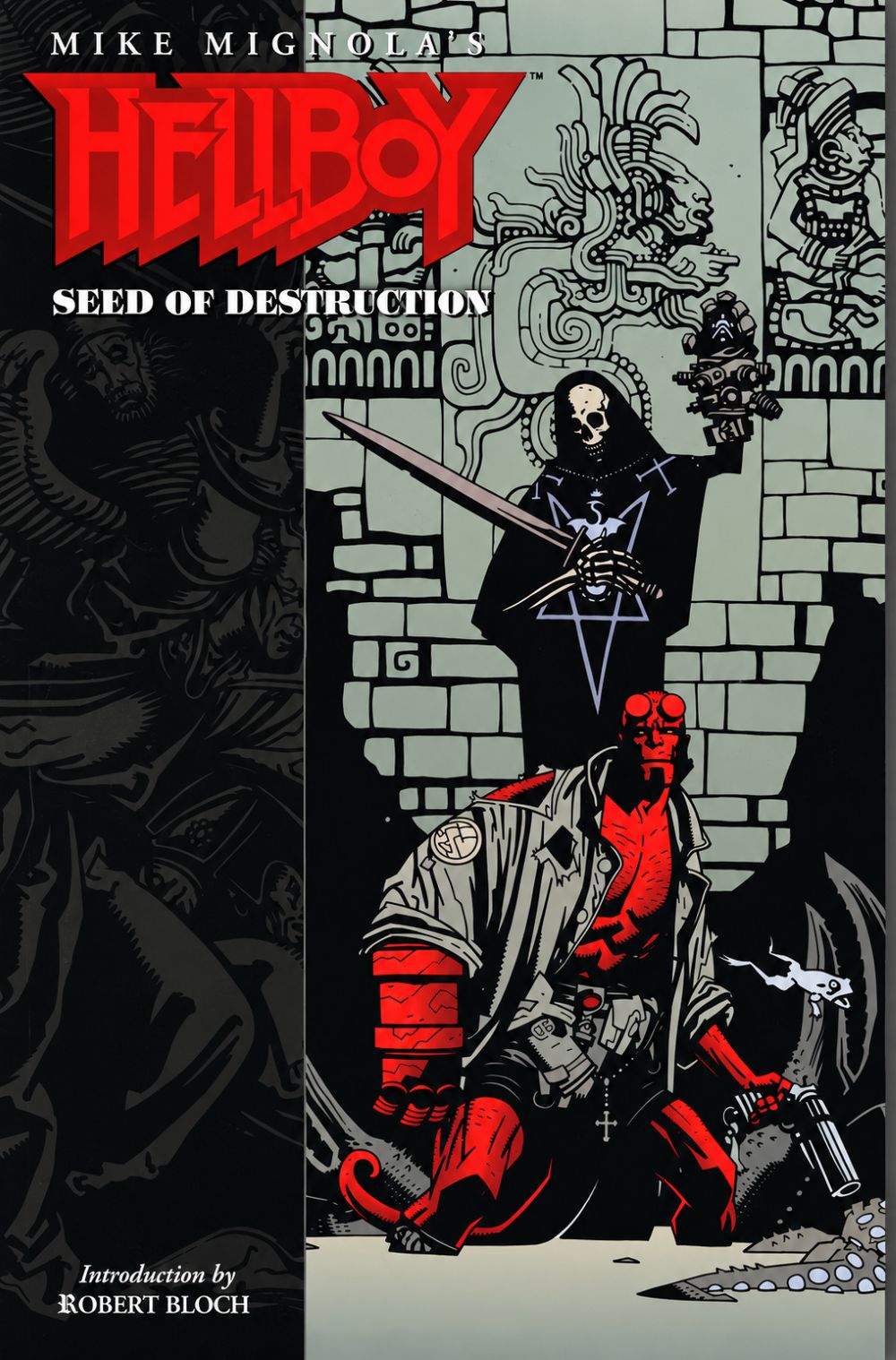
Mike Mignola’s Hellboy: Seed of Destruction is more than the opening chapter of a popular comic-book universe. It is a foundational work of supernatural adventure, combining pulpy monster fiction, wartime conspiracy, Gothic imagery, Lovecraftian apocalypse, and a surprisingly human story about identity and free will. First published as a four-issue miniseries in 1994 and co-plotted with John Byrne, the graphic novel introduces Hellboy with striking confidence. The mythology already feels vast, the visual identity is fully recognizable, and the title character arrives as one of the most distinctive heroes in modern comics: a cigar-smoking red demon with a stone right hand, a sarcastic sense of humor, and a stubborn refusal to become the monster everyone expects him to be.

The premise is immediately compelling. In the final days of World War II, Nazi occultists conduct an elaborate ritual intended to summon a weapon powerful enough to alter the war’s outcome. The ceremony is overseen by Grigori Rasputin, who is reimagined here not simply as the notorious Russian mystic but as a servant of ancient, world-ending forces. Allied soldiers disrupt the ritual, but instead of the apocalypse the Nazis hoped to unleash, they discover a small red-skinned demon child transported to Earth. That child becomes Hellboy. He is taken in by Professor Trevor Bruttenholm, founder of the Bureau for Paranormal Research and Defense, and raised not as a weapon or scientific specimen, but as a son.

That decision gives Hellboy: Seed of Destruction its emotional center. Hellboy looks like the obvious villain of his own story. He has red skin, filed-down horns, a tail, cloven feet, and the massive stone right hand known as the Right Hand of Doom. He appears as though he should stand alongside Dracula, Frankenstein’s monster, or Satan himself. Yet Mignola’s central idea is that origin does not have to determine destiny. Hellboy may have entered the world through an act of evil, and powerful supernatural forces may expect him to fulfill an apocalyptic role, but he chooses another path. As an adult, he works for the B.P.R.D., investigating paranormal threats and protecting humanity from the very kinds of monsters he might be expected to join.

The main story takes place decades after Hellboy’s arrival and begins when a death close to him forces the past back into the present. The loss gives the investigation a personal urgency and propels Hellboy toward the hidden truth behind his own origins. As he follows the trail, he becomes entangled in a conspiracy involving Rasputin’s return, surviving Nazi occultists, forgotten rituals, buried secrets, and the terrifying possibility that Hellboy himself may have a role in an event far greater than any single monster attack. The plot steadily expands from a personal mystery into a threat with apocalyptic implications, but it never completely loses sight of Hellboy as a character caught between the person he has chosen to be and the fate others want to impose upon him.

Hellboy is joined by fellow B.P.R.D. agents Abe Sapien and Liz Sherman. Abe, an amphibious investigator with a calm, analytical nature, provides an effective contrast to Hellboy’s bluntness and impatience. Liz, a pyrokinetic woman whose connection to fire comes with emotional burdens of its own, brings a more vulnerable and tragic element to the team. In this first volume, they are not yet as richly developed as they would become in later stories, but their presence establishes the B.P.R.D. as something more interesting than an ordinary superhero team. These are not polished celebrity heroes in colorful costumes. They are unusual, damaged, and often isolated people employed to confront dangers that the public cannot know exist.
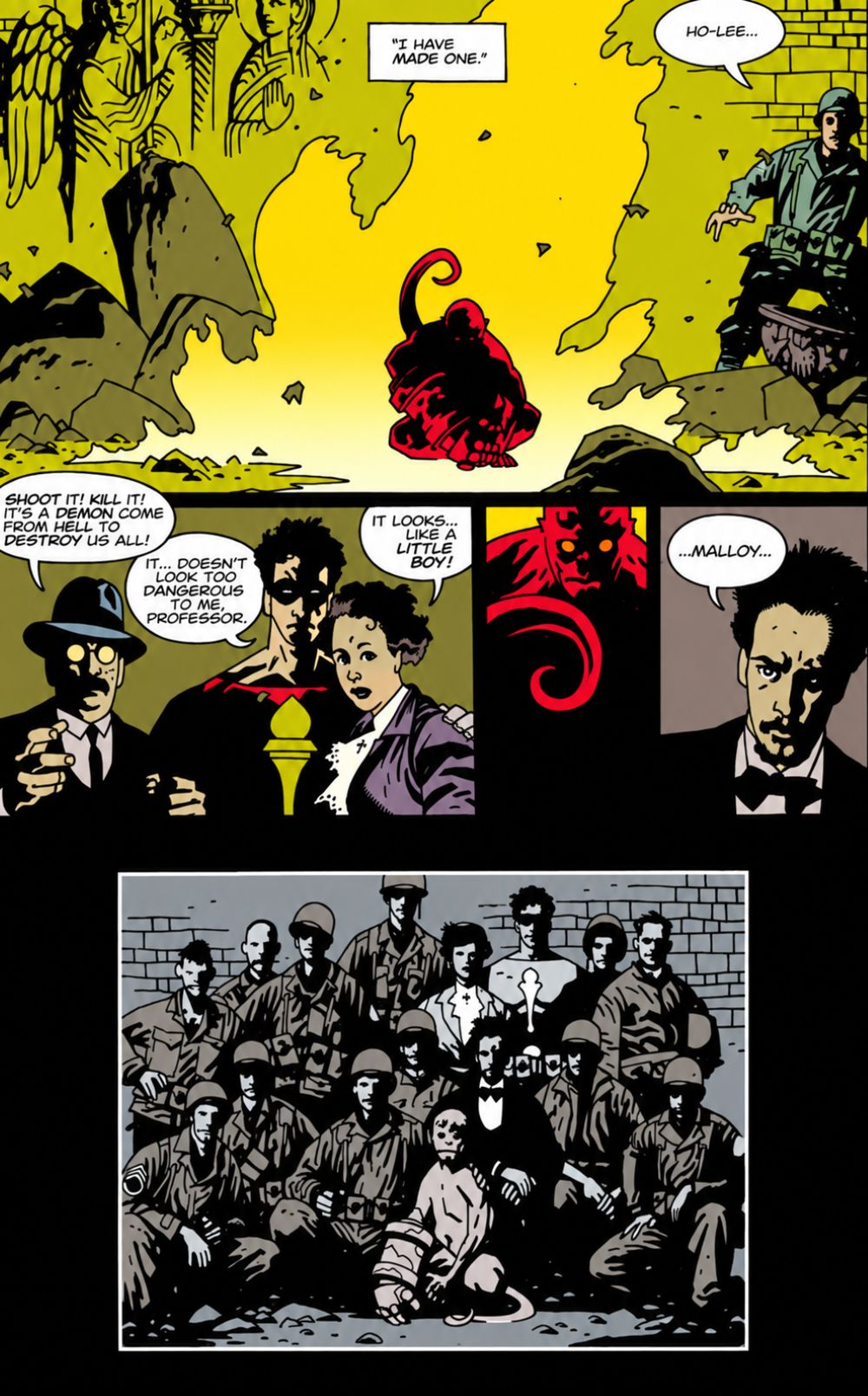
Mignola’s art is the graphic novel’s defining achievement. Even among the strongest comics of the 1990s, Hellboy: Seed of Destruction feels visually singular. At a time when much of mainstream superhero art emphasized intricate rendering, oversized muscles, and hyperactive action, Mignola worked through silhouette, shadow, stark design, and carefully controlled negative space. His figures are often blocky and stylized, but they are never lifeless. A few lines can convey fear, exhaustion, anger, or resignation. A large black shape can become a doorway, a corridor, an abyss, or a threat the reader cannot fully see.

Mignola does not use darkness merely to make the comic look moody. His shadows are active storytelling tools. Characters disappear into them, monsters emerge from them, and entire environments seem to exist only partially in the light. A seemingly empty room can become frightening because its far wall is swallowed by blackness. A frozen landscape can feel ominous because it leaves its characters exposed beneath an enormous blank sky. His layouts often evoke old pulp-horror illustrations, German Expressionist cinema, Gothic architecture, folklore engravings, and vintage monster movies. Rather than presenting a sleek modern superhero world, Mignola creates a universe that feels ancient, secretive, and half-buried under centuries of superstition.

The color work deepens that atmosphere. The pages use earthy browns, faded blues, icy whites, sickly greens, and vivid flashes of red to create a world that feels both dreamlike and decayed. Hellboy’s red skin makes him instantly recognizable within Mignola’s compositions, especially when he stands against a field of black shadow. He often resembles a burning ember in a world of darkness: visually connected to the supernatural realm around him, yet refusing to be extinguished by it. That visual contrast captures the character’s place in the story. Hellboy belongs to the darkness in a literal sense, but he continually chooses to stand against it.

The writing is more exposition-heavy than some later Hellboy stories, but it serves an understandable purpose. Hellboy: Seed of Destruction has to introduce Hellboy, the B.P.R.D., Rasputin, the Nazi occultist threat, the supernatural cosmology, and the significance of the Right Hand of Doom in a relatively short space. John Byrne’s scripting helps organize the material and gives the narrative forward momentum. Certain explanations have the recognizable rhythm of early-1990s genre comics, but the story’s atmosphere remains strong enough that the mythology rarely feels like a dry information dump. Mignola and Byrne create the impression that readers are seeing only a small piece of an immense occult history, one filled with ancient gods, forgotten disasters, and forces that have been waiting in darkness for centuries.
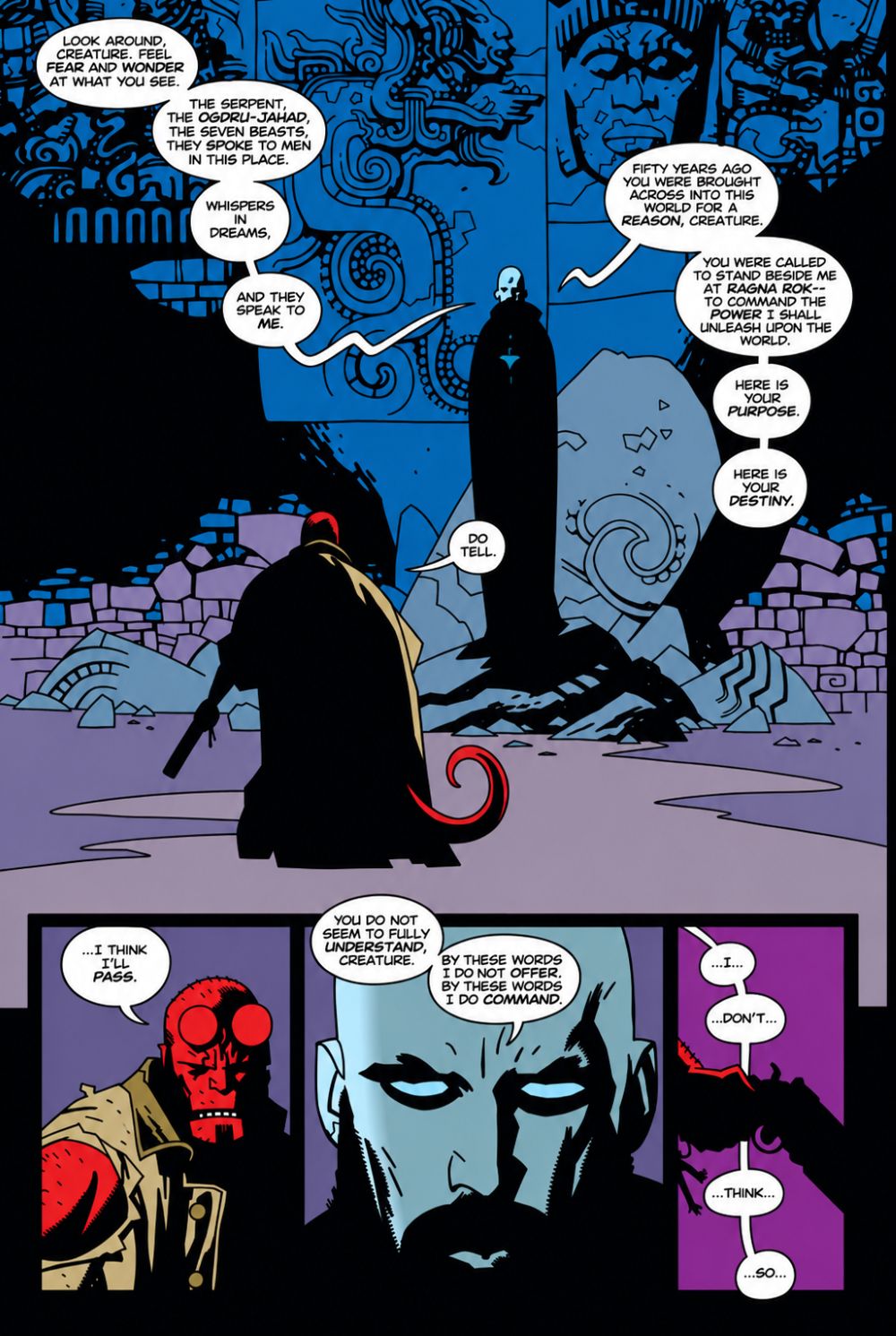
The pacing is deliberate rather than relentlessly action-driven. Mignola allows scenes to breathe, lingering over ruined architecture, old artifacts, empty corridors, haunted chambers, and moments of tense silence. The dread accumulates gradually. When action erupts, it tends to be sudden, heavy, and physical. Hellboy is not an acrobatic hero who glides through combat with effortless grace. He breaks through doors, trades blows with monsters, absorbs punishment, and keeps moving forward. His heroism has a blue-collar quality. He treats fighting the impossible as difficult, unpleasant work that nevertheless needs to be done.

That quality makes him especially effective within the story’s Lovecraftian framework. Traditional cosmic horror often centers on human helplessness in the face of forces too vast, ancient, and indifferent to comprehend. Hellboy: Seed of Destruction preserves that feeling, particularly in its suggestions of ancient beings and apocalyptic forces beyond normal understanding. However, it gives readers a protagonist willing to confront that terror rather than collapse before it. Hellboy cannot necessarily understand every supernatural threat, and he cannot erase the ominous circumstances of his birth, but he can refuse to cooperate with the fate laid out for him. His defiance is not naïve optimism. It is a hard-earned, practical moral stance: he will not let anyone turn him into a weapon, and he will not stand aside while innocent people are endangered.

The relationship between Hellboy and Bruttenholm gives that moral stance its weight. Bruttenholm represents the compassion that allowed Hellboy to become something other than an instrument of destruction. He does not deny Hellboy’s demonic origins, but he refuses to treat those origins as a permanent verdict. Their bond lends real emotion to the graphic novel without overwhelming it with melodrama. Mignola’s best moments of feeling are often restrained, expressed through silence, body language, or a brief line rather than a lengthy speech. This restraint suits Hellboy himself. He is not a character who easily verbalizes grief, fear, or tenderness, but those feelings are present beneath his rough exterior.

The graphic novel also has an important place in Hellboy’s larger cultural legacy because it served as the basis for Guillermo del Toro’s live-action film Hellboy. The adaptation draws from the comic’s wartime origin, B.P.R.D. framework, Rasputin-centered occult threat, and larger supernatural mythology, helping bring Mignola’s character and visual world to a wider audience. Even so, Hellboy: Seed of Destruction stands firmly on its own as the original expression of that world: darker, quieter, and more reliant on the power of shadow, silence, and graphic design than any adaptation could fully reproduce.

Hellboy: Seed of Destruction is not entirely flawless. The exposition can occasionally be dense, and Abe and Liz are not yet given the emotional complexity they receive in later Hellboy stories. The book also has the understandable burden of establishing a great deal of lore in a short opening arc. Yet those limitations are minor beside its achievements. Mignola creates a complete aesthetic universe from the beginning, one populated by ancient horrors, occult conspiracies, cryptic prophecies, and damaged people trying to do the right thing in a world that often seems hostile to human life.

Ultimately, Hellboy: Seed of Destruction remains a landmark graphic novel because it places mood, design, and character above conventional superhero spectacle. It is not simply about a demon punching monsters, even though it delivers that pleasure exceptionally well. It is about a creature born under the shadow of evil who insists on defining himself through his choices. Hellboy’s greatest strength is not his stone fist, supernatural durability, or ability to survive encounters with horrors beyond human comprehension. It is his refusal to become what he was made to be.

Pulp Fiction #2: The Man of Steel Turns 80!


gary loggins's avatarcracked rear viewer

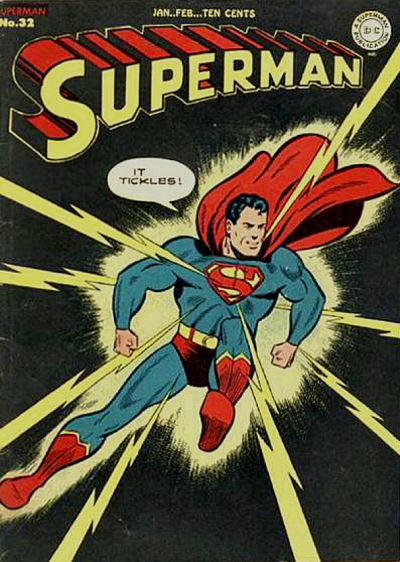
On April 18, 1938, National Publications presented Action Comics #1, showcasing typical comic book fare of the era like master magician Zatara, sports hero Pep Morgan, and adventurer Tex Thompson. And then there was the red-and-blue suited guy on the cover…

Yes, it’s Superman, strange visitor from another planet with powers and abilities far beyond those of mortal men… who can change the course of mighty rivers… bend steel in his bare hands… and so on and so forth! Eighty years ago tomorrow, Superman made his debut and changed the course of mighty comic book publishers forever. An immediate hit with youthful readers, Superman headlined his own comic a year later, spawned a slew of superhero imitators, became a super-merchandising machine, and conquered all media like no other before him!

Wayne Boring’s Superman

And to think he came from humble beginnings. No, not the planet Krypton, but from the fertile…

View original post 1,246 more words

Confessions of a TV Addict #2: A Fan’s Appreciation of Adam West


gary loggins's avatarcracked rear viewer

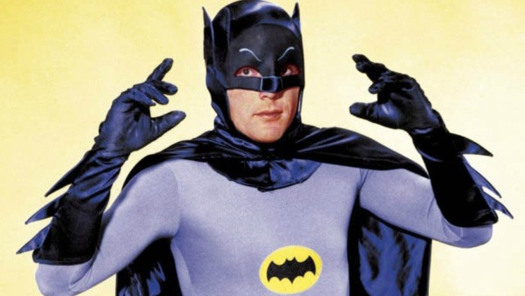
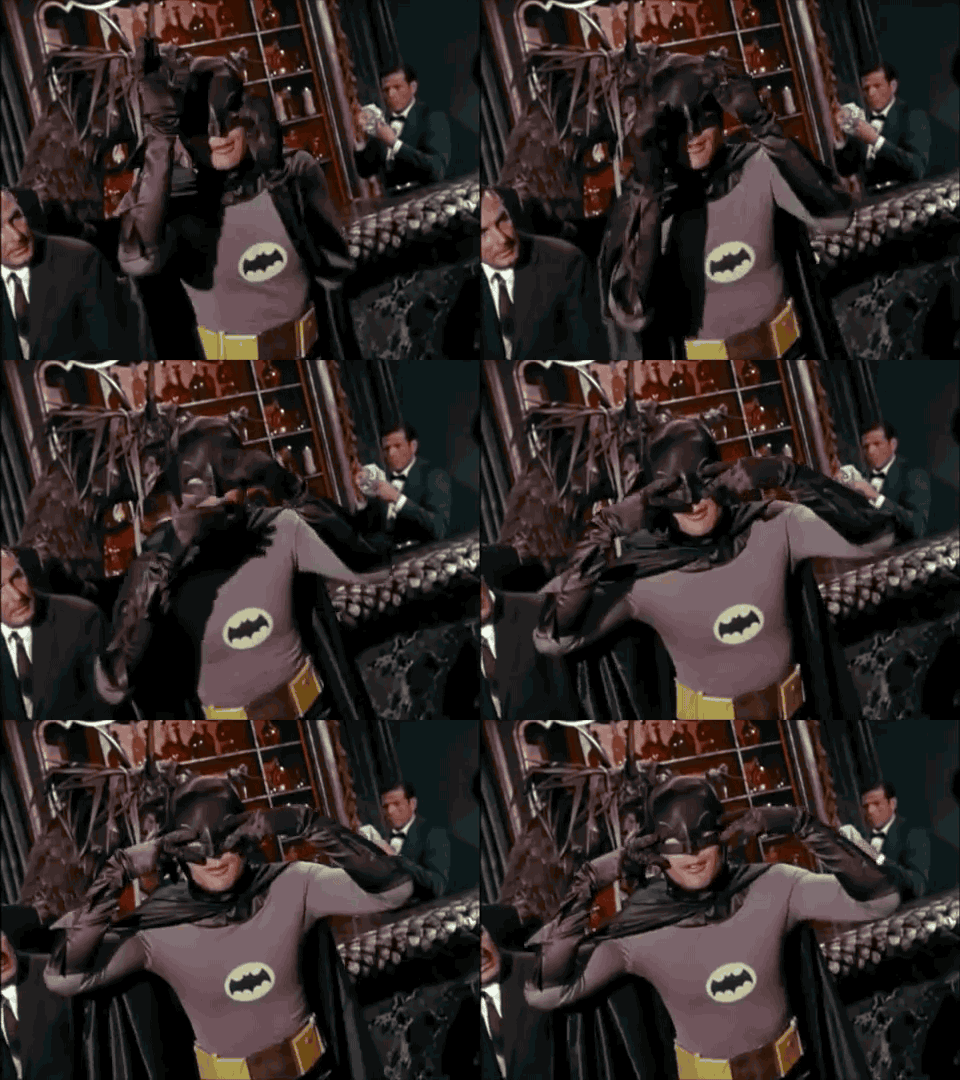
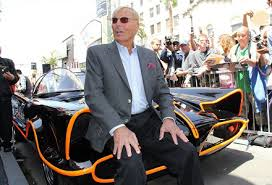
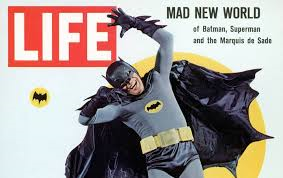
Adam West, who died June 9th at age 88, will never be ranked among the world’s greatest thespians. He was no Brando or Olivier, no DeNiro or Pacino. His early career wasn’t very distinguished: one of Robert Taylor’s young charges in the final season of THE DETECTIVES, Paul Mantee’s doomed fellow astronaut in 1964’s ROBINSON CRUSOE ON MARS, the bumbling romantic lead in The Three Stooges’ THE OUTLAWS IS COMING (1965). Were it not for one role, no one would be mourning his loss today. But that one role, as millionaire Bruce Wayne aka BATMAN, captured the imagination of an entire nation, and remains the hero of an entire generation.

It’s hard to describe to anyone who wasn’t a kid in 1966 just what BATMAN meant to us. The series was a comic book come to life, before comics became “dark and brooding” little psychodramas for fanboys. Comic Books were OUR medium…

View original post 473 more words

Sock! Pow! Zok!: STARRING ADAM WEST (documentary, 2014)


adam3Holy high camp! STARRING ADAM WEST is a fun documentary about the quest to get a star on the Hollywood Walk of Fame for 60s TV star Adam BATMAN West. The film also serves as a biography of the cult actor, from his humble beginnings as a child in Walla Walla, Washington to his rise as TV’s biggest star of the mid-60s, and his fall after being typecast as the Caped Crusader reduced to performing in crappy car shows and carnivals. West later resurrected his career as an ironic icon in the 90s and still does voice work today, notably on the animated FAMILY GUY. Through all the ups and downs, the star has retained both his sense of humor and love of family. An entertaining look at a down to earth guy in the what-have-you-done-for-me-lately world of show biz, STARRING ADAM WEST is playing all this month on Showtime.

adam2

T.V. Review: Marvel’s Agents of S.H.I.E.L.D. – Season 1, Episode 4 (“Eye-Spy”)


AgentsofSHIELD

I’ve been a fan of Joss Whedon shows since he first burst onto the scene with Buffy, The Vampire Slayer over on what used to be the WB Network. I’ve followed his work from one show to the next and if there’s one thing all his shows seems to have in common it’s that they take time to find their stride. In the past, shows were given time to get their bearings. See what  works and what doesn’t in a narrative sense. These first few episodes also give the writers a chance to flesh out characters for the long run. Yet, in this day and age of instant gratification Whedon and company may not have the luxury to take their time to get their footing, so to speak.

Marvel’s Agents of S.H.I.E.L.D. has been good to so-so the first three episodes. While all the episodes have been fun there’s also a feeling that ABC and Disney were really going on the cheap side of production with these episodes. It’s almost as if the powers-that-be producing the show were hedging their bets as to whether the show will be a sure-fire hit or a dud soon to be cancelled. This is Whedon we’re talking about whose last two series haven’t really panned out despite a rabid fanbase.

I think with tonight’s episode, “Eye-Spy”, the series may finally be finding its rhythm. It’s still not a perfect show. The fun factor is still present as is the witty banter that comes with a Whedon show, but where the first three episode looked somewhat cheap this fourth entry had a much more polished look to it. Maybe Disney and ABC finally loosened the purse strings. Even the look of the episode had a subtle change to it. Gone was the overlit scenes that added to the cheapness of the production. We actually were given scenes with shadows and darkness. There wasn’t an overlit sequence to be seen.

Let’s return to the episode at hand.

Tonight’s episode sees Agent Coulson taking the team to Stockholm, Sweden to investigate an apparent diamond heist. The heist itself was a nice cold opening. With over a dozen men dressed in matching black suits and all wearing those creepy red “Stranger” masks. First reaction to this was that they must be part of some sort of secret organization that was probably actively going against S.H.I.E.L.D. Yet, the writers do a 180 and we find out they’re just an elaborate, albeit unsuccessful, attempt to keep a briefcase carrying 30million dollars in diamonds from being stolen. We’re soon introduced to the target of Coulson and his team. One Akela Amador, a rogue S.H.I.E.L.D. agent and one-time Coulson protege, who may appear to be more than meets the eye.

This whole episode has been about getting a bit more character development for Agent Coulson and his latest protege, Rising Tide hacktivist Skye. The chemistry between the Coulson and Skye looks to be more well-developed than the love interest angle the writers have been trying to create between Skye and field agent Ward. While the latter looks like it’s still a hit-or-miss proposition the former looks to be developing quite nicely. If there’s one thing Whedon and his writers have been very adept at creating in their past shows it’s setting up the mentor/protege relationship. The best example would be Buffy and her Giles who also didn’t start off on the right footing in the early episodes of Buffy’s first season, but as time passed that relationship grew and there’s signs of something similar happening between Coulson and Skye.

The writing for tonight’s episode was crisper than the previous episode. We got less forced humorous moments. The dialogue actually flowed much more smoothly and allowed for the funny bits to come across naturally. Once again it’s Clark Gregg as Agent Coulson that provides the rock upon which the rest of the cast steady themselves. There’s an almost old-fashion earnestness to Gregg’s portrayal of Coulson which have endeared the character to legions of fans.

So, it’s only natural that the episode provide some more hints and bits of dialogue that Coulson may not be who he appears to be as well. Theories continue to abound that Coulson may be a Life-Model Decoy or being set-up to be future Avenger recruit Vision. There’s also some talk that he was revived by sorcery which means it’s a step to introducing magic and Dr. Strange to the MCU (Marvel Cinematic Universe). In the end, the mystery of how Coulson survived the mortal wound he received from Loki might just be the main mystery of the show’s first season.

“Eye-Spy” was was written by Whedon-veteran Jeffrey Bell and directed by Star Trek alumni Roxann Dawson (better known as B’Elanna Torres from Star Trek: Voyager). The two worked well together and I’ll be interested to seeing the two become more involved in moving the show through it’s first season. So far, they seem to have found the necessary balance of spy intrigue, superhero action and witty byplay that the first three seemed to lack.

time will tell if the show will be a huge success or just good enough to survive it’s first season. But seeing how much Marvel and Disney have invested in adding this show as an integral cog in their Marvel Cinematic Universe I see Whedon and his writers getting a bit more leeway than they’ve had in the past (looking at you Fox Network executives).

Scenes I Love: “The Orange Man” from Unbreakable.


There’s a part of me that really wants to see M. Night Shyamalan come back into his own again. I think somewhere between The Village and Lady in the Water, he started this strange descent. But back in 2000, he had “Unbreakable” which wasn’t bad at all. The story of a man who discovers he has abilities far beyond normal people, Unbreakable could be considered one of the first ‘every person superhero’ films. As with some origin stories, Unbreakable’s David Dunn has to come to terms with what he can do. Once he’s put on the path by a Comic Book aficionado (played by Samuel L. Jackson), he heads off to do some good.

The above is David Dunn taking down a home invader with a simple choke hold. Enjoy.

The first time I saw this scene was on DVD, with my little brother. This part in particular left us with smiles. It’s not so much what takes place, but the music behind it. James Newton Howard’s score takes what would normally be a quick action theme (for a story like this) and uses a dramatic piece to cover the scene. I thought it worked really well here. It also reminds me that as he wasn’t working on The Dark Knight Rises score with Hans Zimmer, you might not find a lot of those softer themes. Then again, with Gotham in turmoil, maybe that’s not the kind of music it needs right now.

Trailer: The Dark Knight Rises (Official Teaser)


The first official teaser trailer for the third and final installment of Christopher Nolan’s Dark Knight Saga has finally arrived in it’s official form. The teaser had leaked in bootleg form last week. People who went to watch Harry Potter and The Deathly Hallows, Part 2 were able to see the teaser in all it’s glory on the big-screen and from my own experience it was one of the major highlight’s even before the main attraction began.

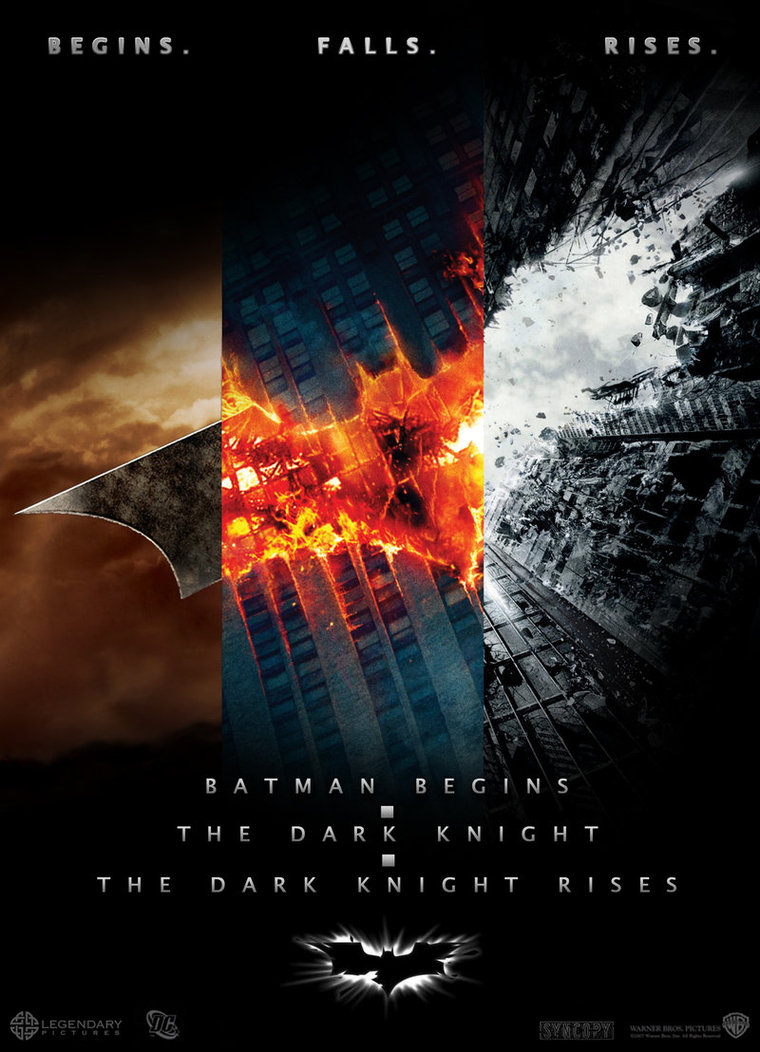
The teaser trailer plays exactly as it sounds. It teases just enough to begin the buzz and hype which should run a full year before the film’s release. We see glimpses of Tom Hardy in the role of Bane. Most of the teaser has Police Commissioner Jim Gordon in a hospital bed looking like he may have just gone a round or two with Bane. It also brings back the lesson first given to Bruce Wayne by Ra’s al Ghul from the first film about how a man could become a legend. There’s even some Inception-like imagery of crumbling high-rises that could only mean Gotham City itself now under siege.

It’s going to be a long wait til The Dark Knight Rises premieres in the theaters on July 20, 2012.

Trailer: Captain America: The First Avenger (Theatrical)


The summer of 2011 has been called the Summer of Superhero Films. In early May we had Marvel Studios’ Thor film premiere to good reviews and it has had a certain level of success (though not the level of The Dark Knight success rabid fanboys and jaded film bloggers think every comic book-based film should be doing). Then next up was the fourth X-Men film from Twentieth Century Fox by Matthew Vaughn that seem to reboot the franchise from it’s downward spiral begun by the third film and the Wolverine origins film. This film garnered even higher praise than Thor and many saw it as equaling or surpassing the X2. While it’s box-office success has been good it didn’t make the sort of money previous films in the franchise have made in years past. Then we come to the recently released Green Lantern from Warner Brothers and DC Entertainment.

This film was to be the next crown jewel to join DC’s successful Batman film franchise and iconic Superman series which seems to be the only DC properties to have had a successful live-action adaptation. While the film did very good in it’s first weekend the reviews of the film range from “ok and fun” at best to “downright awful” at its worst. All three films have huge budgets and, most likely, all three will be a profit for their studios, but not runaway hits.

Maybe the public has begun to tire of superhero films as a cause for the less than cosmic box-office returns. One other reason could be that too many people have been blinded by the massive box-office success of Christopher Nolan’s The Dark Knight that every superhero film must now be compared to that one fair or not. This makes the job much harder for Marvel Studios’ second film of the summer, Captain America: The First Avenger, as that film looks to cement the foundation for next summer’s major blockbuster ensemble superhero film, The Avengers.

I don’t see Captain America doing TDK level money, but early screenings of the film has earned it some major positive buzz that had been missing from Thor. That early positive buzz and this latest trailer which really showcases the action of this period piece of a superhero film should help push Captain America to be a success no matter if it makes 200million dollars domestic or more.

One thing I’m sure of is that this latest trailer should be more people excited for Captain America: The First Avenger when it comes out on July 22, 2011.

Review: X-Men: First Class (dir. by Matthew Vaughn)


The name Matthew Vaughn should be familiar with comic book fans everywhere. In 2005, Vaughn was introduced as the director to replace Bryan SInger for the third film in the X-Men franchise. The news was met with some cautious optimism. This was a filmmaker who had quite the loyal and growing following for his work on Stardust and Layer Cake. Months after he was picked my 20th Century Fox news came down that he was backing out of the project due to personal reasons and the film scrambled for a replacement which ended up being Brett Ratner. History was made that day as the beginning of the franchise’s decline began and steep plummet which recently reached it’s nadir with 2009’s Wolverine: Origins.

It’s has now been five years since X-Men: The Last Stand made it to the big-screen and now we have a new film in the franchise. X-Men: First Class has a familiar name behind the director’s seat and it looks like Matthew Vaughn stayed this time around (after directing a smaller superhero film in Kick-Ass for 2010) to craft what could become the best film in the X-Men/Wolverine film franchise. This film is a prequel/reboot of sorts (more on that later) and brings a fresh set of eyes and take on the origin story of this franchise.

X-Men: Last Stand actually begins the film exactly how the first X-Men film began with the 1944 World War II concentration camp setting where a young Erik Lensherr (later to become Magneto) finally manifests his power over magnetic fields as he watches his parents torn from his side. The first film ended that sequence once Erik was knocked out, but this time around it continues with a mysterious man named Schmidt (aka Sebastian Shaw and played with James Bond villainous-flair by Kevin Bacon) taking great interest in Erik and his ability which Erik could only use during bouts of pain and anger. The film continues this slight change in the series’ origins by switching over to Westchester County and into the expansive home of a young Charles Xavier who finds a certain young, blue-skinned shapeshifter named Raven who he invites to stay and become his friend once he realized he wasn’t the only one who was different and with abilities.

These two sequences continue to move the film forward as the we see these two “leaders in the making” adults and trying to find their place in the world of the free-swinging lifestyle and the Cold War culture of the 1960’s. Charles Xavier (played like a well-meaning cad and good-natured naivete about the world by James McAvoy) is a student working on his doctorate in Oxford on genetic theories while his “sister” Raven (Jennifer Lawrence) accompanies him. This is a Xavier who still hasn’t found the patient benevelonce of Patrick Stewart’s Professor X and uses his considerable telepathic abilities to help him pick up on beautiful coeds instead. It’s during such a scene where we see Raven show just a hint of jealousy as Xavier tries his lines and moves on a beautiful British lass. It would seem Raven’s feelings for her ‘brother” may go beyond sibling affection though Xavier doesn’t see her as anything other than a sister for him to protect.

Erik Lensherr’s time as an adult was shown as having become a life of obsession over his treatment at the hands of the Nazi’s and those of Schmidt’s as he travels the world in search of escaped Nazi war criminals. Erik takes him throughout South America as he finds the trail of Nazis hiding out in that region since the end of the war. We see this adult Erik hardened by his anger and single-minded need for revenge on Schmidt and those he worked for. He’s not above using his abilities to kill in order to get the information he requires and there’s a hint of satisfaction when he does kill those he sees as responsible for his tragic upbringing with his magnetic abilities. These two adult sequences continues the film’s theme of the ideological difference between Xavier and Erik being formed through nature and nurture as their lives moved down diverging paths from an early beginning until it convergence for a small, brief period around the time of the Cuban Missile Crisis.

The film’s second act begins with Moira McTaggart (Rose Byrne), now a covert CIA Agent, investigating a certain Col. Hendry who she suspects as having betrayed the nation to the Soviets, but instead finds out that the true nature of Hendry’s associations were much more insidious and dangerous. The iconic Hellfire Club of the comics finally make their appearance with Schmidt who actually happens to be Sebastian Shaw (whose powers grant him the ability to absorb all kinetic energy which he uses to keep himself young and can release with explosive results), Emma Frost (January Jones) who’s a telepath with the ability to turn body in a sort of diamond-form, Riptide who can create tornado-like abilities and finally the demonic-looking Azazel whose ability to teleport might give people not well-versed in the “X-Men Universe” a clue as to one-half of parents who may be responsible for Nightcrawler in the second film.

X-Men: First Class spends much of this second act like it was Ocean’s 11 as Xavier and Erik get recruited by the CIA to find other mutants and create their own mutant team to counter Sebastian Shaw’s Hellfire Club and his goal of initiating World War III between the US and the USSR and thus destroy all of humanity and leave the planet for the mutants to rule over. Yeah, it is this part of the film’s plot which may strain the suspension of disbelief for some audiences who never grew up reading the comics, but it shouldn’t. Ian Fleming’s James Bond series used scenarios just as ludicrous with villains just as Machiavellian in the form of SPECTRE so X-Men: First Class and it’s world domination plans shouldn’t be too farfetched to fans of that British superspy and his adventures.

This middle section of the film is where X-Men: First Class actually begins to lag after a strong first act. I don’t know if the sequences of the new recruits training, bonding and learning how to use their powers could’ve been written to move much faster without losing some of the character building scenes. From how this second act played it seemed to look like scenes were actually cut out to try and keep the film from being too long (it’s final cut being just a tad over two hours already upon release), but I wouldn’t be surprised if the DVD/Blu-Ray release actually has a director’s or uncut version that actually expands this middle section to really give life to it instead of having it play out like a perfunctory training montage with a dash of character beats.

The film hits it’s action-film stride with the third and final act as Xavier and Erik’s team of young mutants must now use their abilities to stop Shaw and his Hellfire Club and at the same time prevent World War III from beginning and not freaking out the humans who are still unaware of their existence as a whole. It’s this third section which we see too much of it in the trailers and tv spots that one might say we’ve seen it all before we even see the film as a whole, but it still kept back a lot from those ads to make the whole final twenty minutes of the film thrilling and action-packed.

All of this could just mean that X-Men: First Class was just your run-of-the-mill superhero action film that we get on a yearly basis come summertime, but it’s a testament to Matthew Vaughn’s direction and the strength of the script by Vaughn, longtime collaborator Jane Goldman and Thor scribes Ashley Edward Miller and Zack Stentz that the film goes beyond being just an action film with all it’s sturm und drang coupled with fancy special effects. The previous films in the series always explored important cultural and moral themes that’s always been the bread-and-butter of the X-Men stories in the comic books. We just don’t see the film explore the ideological difference between Xavier’s peaceful co-existence between humans and mutants alike, but also we get more detail on why Magneto finally comes to the conclusion that war between humans and mutants was an inevitability and why his stance doesn’t fall under the aegis of being evil, but something that anyone could understand and even support whether one was human or mutant.

The story also doesn’t just pay lip-service to the idea of how mutants view themselves and how even within the mutant community there’s a visible rift between those whose abilities are invisible to the general population and those whose abilities and genetic mutation physically manifest themselves in such ways that to many might not look to appealing. This idea really gets a major exploration in the subplot involving Raven (soon to be Mystique), Hank McCoy and, to a certain degree, Xavier and Erik. We see how those like Xavier whose abilities don’t show in a physical manner have a sort of “don’t ask, don’t show” about those like Raven when it comes to their power when in public.

Raven (played beautifully by Jennifer Lawrence) is caught between Xavier who wants her to remain incognito so as not to shock the world too soon in realizing that mutants exists and that of Erik who sees Raven’s original blue-skinned form as beauty and perfection and how she should never hide who she truly is. This tug and pull between her two mentors makes for a convincing subplot in how Raven comes to the conclusion which would take her to the side of Magneto in later films, but also highlight how the two sides in later films have so much intertwining bonds of friendship and relationship that seeing them against each other becomes a tragedy on its own. Civil wars are not just a thing of humans but those who sees themselves apart from them.

The great performances by most of the leads add to the film’s strength. McAvoy and Fassbender, at first, look to be unconvincing in terms of their appearance as the younger versions of Patrick Stewart and Ian McKellen, respectively. This becomes a non-issue once they’ve established themselves through their performances which gives new layers to the personalities of Professor X and Magneto. Many people always saw these two as the comic book version of Martin Luther King, Jr and Malcolm X, but that’s an oversimplification. The film and the performances by McAvoy and Fassbender digs deeper into both their characters’ motivations and ideologies and how their past experiences and upbringing couple with their time together as brothers-in-arms and friends show more about these two than just being mutant-proxies of MLK and Malcolm X. The other young mutants do an adequate enough job that they don’t seem lost in the film. Nicholas Hoult as the young Hank McCoy and how he plays off Lawrence’s Raven during their little subplot in the film is one stand-out that I hope gets explore even more in any follow-up sequel.

There’s a nice burgeoning young love chemistry between him and Lawrence as Beast and Raven that doesn’t seem too tacked on to create a the prerequisite love couple in any film. Their common trait of having physical mutations and how they seem to both feel apart even from their fellow mutants develop their characters in ways the previous films in the series never did. They never want to rid themselves of their mutant powers. They just want to look normal and still keep their abilities. It’s a having your cake and eat it too mentality that has some surprising results for both Raven and Hank.

X-Men: First Class has had some fans of the series put in a very difficult situation. The film definitely is a prequel to the previous films, but it also does a major time in rewriting continuity in the series. I was one of those fans and thought it would ruin the film in the context of the franchise. I’m surprised that in the end I didn’t really care and actually hope that this film actually is a reboot of the franchise. I see this film and forget the previous three as being part of it. This film was just too good and fun in it the end for continuity issues to become the major flaw that sinks it. I liken this film as similar to Christopher Nolan rebooting the Batman film franchise. That film honored the contributions to the character, but went on it’s own way to tell that character’s tale. I see Vaughn doing the same with this film. He has done something which many thought was a near-impossible task and that’s make the X-Men franchise relevant once more in a pop-culture landscape that seems to have left the franchise behind after the disastrous Wolverine: Origins of 2009.

This film delivered on the ideas that made the comic books so beloved by millions of fans for almost a half-century. It made great use of the 1960’s time and setting to tell a story of these characters beginnings as heroes and villains (though the latter shouldn’t be seen as them being truly just evil bad guys). Even the inclusion of real-world historical event like the Cuban Missile Crisis was a nice touch which gave the film a foundation in realism. Again, this film played off like a superhero, Marvel version of an Iam Fleming James Bond story. For those who are huge fans of the previous films there’s even two brief cameos of those films two favorite characters that appear in this film. They don’t come off as cheesy and unnecessary and actually come off as great additions. I won’t mention who these cameos were but the audience’s reaction to them was very vocal and very positive. I say the same should be said for X-Men: First Class as a film that resuscitates the franchise.

Review: Thor (dir. by Kenneth Branagh)


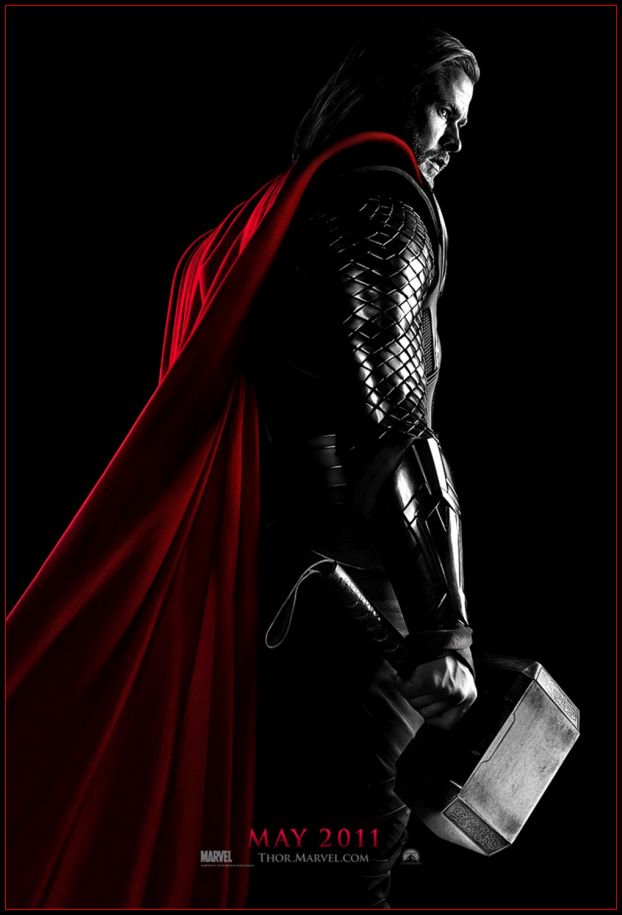
Marvel Comics has had a much better success in bringing their 2nd-tier characters over onto the big-screen than DC Comics and they’ve made the risky decision to tie-in every film they make into one shared universe. Comic book fans have begun to call this the Marvel Film Universe since it contains the same characters and backgrounds as those of their comic book counterparts but also with enough changes to make them stand-out on their own. They’ve already begun this with the first two Iron Man films and a recent reboot of the Incredible Hulk. With the X-Men, Spider-Man, Daredevil and Fantastic Four film rights still under the control of other film studios it left Marvel (now Disney) to use other characters in their control to fill out the rest of this shared universe. The next one to get their turn on the bigscreen is the live-action adaptation of Marvel’s Asgardian God of Thunder. The studios picked British filmmaker Kenneth Branagh to handle this adaptation and his background in bringing Shakespeare to the big-screen has made Thor a flwed but very entertaining superhero film.

To start off, it has to be said that Thor was always going to be the most difficult of all the characters that will make up The Avengers film to bring to the bigscreen. While all these Marvel films do have their fantastic elements due to each character’s superhero nature it was even more fantastic with the character of Thor. This character is in effect a being who has been worshipped by humans in the past as one of their deities. God-like characters have always been tough to make human and relatable in stories and film. It’s a testament to Branagh’s handle of the Asgard characters such as Thor, Odin and Loki that we don’t end up with just all-powerful beings, but individuals whose impulses and motivations definitely are human. It’s this dynamic between Thor, his father Odin and his brother Loki which drives the Shakespearean angle of the film’s storyline. It’s where Branagh’s history of making Shakespeare accessible to the general film audience that makes their story easy to follow and understand.

The film actually begins with the human characters of Dr. Jane Foster (played by Natalie Portman) and her colleagues (Stellan Skarsgard and Kat Dennings)  driving around in the New Mexico desert at night looking for atmospheric disturbances which should validate Foster’s theories on the Einstein-Rosen Bridge aka wormholes. What they end up running to instead is Thor himself arriving on Earth (Midgard in Asgardian terms) to begin his banishment from his homeworld. Yes, I say homeworld as the film has turned one of the more difficult aspects of Thor’s background into something that makes sense for the audience not steeped and learned from decades of Thor comic books. Thor’s home of Asgard is just one of nine worlds around the galaxy of which Earth is one.

It’s right after this scene that we go back to what started Thor’s banishment. The film does a great job explaining the role the Asgard’s played in Earth’s past history and the consequences of their war against the Frost Giants of the world of Jotunheim (one of the nine worlds). It’s through the narration by Odin himself (Anthony Hopkins) that we learn of the origins of the Gods and myths of Norse culture. This intro scene also shows Odin showing his two young sons in Thor and Loki the relic he had taken to end the wars between Asgard and the Jotunheim. For an origin sequence it was able to set up the rules of this fantastical world of Asgard and it’s Nine Realms. It’s the sequence right after which would lead to Thor’s banishment from Asgard and the stripping of his all-powerful hammer, Mjolnir, and his powers.

For some, and I would have to agree, this sequence which takes Thor, his brother Loki, childhood friends Sif and Warriors Three to the icy world of Jotunheim made up the best action setpiece for the film. The battle which begins between Thor’s forces and those of King Lauhey (Colm Feore under some very elaborate make-up effects) of the Frost Giants. This scene shares some similar qualities with an earlier action setpiece in the first Iron Man film in that it surpasses all other setpieces which would occur later in their respective films. This is not to say that the other action scenes were boring or just simple fare. They were exhilirating and full of energy, but that very first one in the beginning just had even more energy and action that it might’ve been better saved for the climax of the film.

Once the banishment occurs we finally catch up to the film’s first scene and the film begins to go back and forth between Asgard and Earth. With the former we see the machiavellian side of Loki finally assert itself. While Loki’s character is never truly shown to be evil his mischievious streak does show to have a cruel side to it. The bombshell of a news from Odin about his true origins was a nice touch, but it doesn’t lead to the sort of evil character turn we’re used to. In fact, I would say that Loki’s character (played with Iago-like relish by Tom Hiddleston) ends up becoming like the son who does the wrong things for the right reasons. He’s a nice contrast to the more open-faced Thor who does what he says instead of dancing around the subject even to the detriment of his standing with his father.

The scenes on Earth itself is where the comedic aspect of the film comes in. Most of the comedy comes at the expense of Thor’s “fish out of water” reaction to the new world around him. It’s helped much by some great comedic timing by Jane’s assistant Darcy (Kat Dennings who steals the film from Portman whenever they’re on together). It is also the time on Earth where some of the flaws in the film really become apparent. First and foremost would be Portman’s Jane Foster character who seem to be so uneven. She goes from brilliant astrophysicist one moment then giggling schoolgirl the next whenever she’s in close proximity to Thor. While Portman and Hemsworth do make quite the radioactively beautiful couple there’s a sense of untapped chemistry between the two that might have been left on the editing floor. It’s a shame really since so much could’ve been done with the Foster character to really give reasons to why Thor ends up valuing the lives of said mortals to earn his God of Thunder status once again.

Thor really does entertain despite some character and storytelling (really most of it on the Earth side of things) flaws which could’ve sunk the film right from the start. I believe that it’s director Branagh’s handling of the Shakespearean tragedy on the Asgard side of the film that holds the film together. This is one reason and the other being a star-turning turn by Chris Hemsworth as Thor himself. His performance goes from cocky, brash young man on the cusp of leadership to lost, confused and rudderless once banished then back again to a maturing prodigal son who finally learns the lessons his father has been trying to teach him. It would interesting to see Hemsworth’s Thor truly interact with Downey’s Tony Stark and Chris Evans’ Steve Rogers when The Avengers comes out in 2012.

The riskiest part of Marvel’s attempt to create their Marvel Cinematic Universe succeeds where most seem to think it will fail. It’s not as strong an origin film as Favreau’s first Iron Man, but it does add a sense of wonder that film could never grasp through two films. Even the controversial casting choices to put non-white actors to play Asgard roles (Tadanobu Asano as Hogun and Idris Elba as Heimdall) comes off well that the audience shouldn’t even wonder why a black and Asian person were playing characters written originally as white.

From the look of things there’s no official word whether there will be a second Thor film, but I wouldn’t be surprised if there was no matter how the film does boxoffice-wise. There’s just too much great stories to tell about Thor, Asgard and the rest of the Asgard Nine Realms now that the foundation has been laid down with this first film. I do hope that Branagh returns for those sequels if they do happen. One thing which Branagh has proven was his handling of action sequences. They weren’t amazing, but they were handled with enough skill that I believe a second time around we’d get even better action from a director known more for serious dramatic films.

A final thing to mention would be the Easter Egg final scene which occurs once the end credits finish their run at the end of the film. For those who stayed to see this scene it should be a nice treat for Marvel and comic book fans. It shows a certain artifact that should tie Thor to the upcoming Captain America film later this summer. All I can say for those who didn’t stay to see it and knows their Marvel trivia are two words: Cosmic and cube.

PS: An Avenger member makes a cameo appearance halfway in the film that doesn’t look tacked on despite what some of the more “glass half-empty” film bloggers on the net would make you think…Also, it’s safe to forgo seeing Thor in 3D. It’s not a bad post-conversion but it doesn’t really add to the film. See it in 2D to save yourself a few bucks on the ticket price.